REVIEW 3 major objections 4 minor 23 references
Toric sheaves and polyhedra
T0 review · 3 major / 4 minor · reviewed 2026-08-11 · deepseek-v4-flash
Pith's one-line read This paper proves that the torus-invariant cohomology of a toric sheaf equals the cohomology of a constructible sheaf built from the polytopes of its Weil decoration.
desk verdict A substantial generalization of the rank-one Klyachko dictionary to arbitrary rank toric sheaves; the main theorem is plausible and useful, but two geometric contractibility lemmas in the proof are only sketched and need completion. read the letter →
The pith
A machine-rendered reading of the paper's core claim, the machinery that carries it, and where it could break.
The reading
What carries the argument
The central objects are Weil decorations: maps $D$ from nonzero vectors of the torus-invariant vector space $E$ to toric divisors (or polytopes), satisfying the subadditivity condition $D(e+e') \ge D(e) \wedge D(e')$. They completely encode a toric sheaf, and after an ample twist they define the constructible sheaf $F(E)$ on $\Delta$. The proof that $F(E)$ computes cohomology runs through the inverse system of local sheaves $F_\sigma$ on the fan and hinges on exactness of the augmented stalk complex $K(F)^\bullet$; the critical geometric input is Lemma 7.10, which asserts that the dual boundary subcomplex $\Delta'$ contracts to the point $u$ for every stratum and boundary position.
What would settle it
Find a smooth projective toric variety, an amply decorated toric sheaf, and a boundary point $u \in \partial \Delta$ for which the subcomplex $\Delta'$ of facets with $\min\langle D^+(S), \rho\rangle \ge_\rho \langle u, \rho\rangle$ has nonvanishing reduced homology, contradicting the contraction asserted in Lemma 7.10; then the complex $K(F)^\bullet$ becomes non-exact and Theorem 6.1 must fail.
Extended reading notes
Core claim
Theorem 6.1 states that if $X$ is a smooth projective toric variety and $E^+ = E(\Delta)$ is amply decorated for $\Delta \in \mathrm{Pol}^+(\Sigma)$, then $H^\ell(X,E)_0 \cong H^\ell(\Delta, F(E))$, where $F(E)(U) = \{e \in E \mid U \subseteq D^+(e)\}$ is a constructible sheaf on the polytope $\Delta$. Together with Theorem 8.3, this says the $T$-invariant cohomology of every toric sheaf is the abutment of a spectral sequence whose $E_1$ terms are sums of reduced cohomology groups $\tilde H^{q-1}(P(T))$ of polyhedral subsets $P(T) = \Delta \setminus \mathrm{int}_\Delta D^+(T)$.
Load-bearing premise
The theorem stands or falls on the geometric contraction claim in Lemma 7.10: for every stratum and every boundary position of $u$, the dual boundary subcomplex $\Delta'$ must be contractible to $u$; together with the deferred acyclicity of local sheaves for line bundles in Lemma 6.11, this exactness drives the entire bridge.
Editorial extensions
If this is right
- Amply decorated toric sheaves are acyclic: $H^\ell(X,E) = 0$ for all $\ell \ge 1$ (Corollary 6.3).
- The $T$-invariant cohomology of any toric sheaf is computable from the reduced cohomology of polyhedral subsets via the spectral sequence of Theorem 8.3.
- The torus-invariant universal extension of two nef line bundles admits an explicit polyhedral inclusion/exclusion description (Theorem 5.2).
- The Euler characteristic of a toric sheaf in degree zero is governed by the Möbius function of its stratum poset (Corollary 8.8).
- Shifting $\Delta$ by $m \in M$ recovers the $m$-graded piece $H^\ell(X,E)_m$ (Remark 6.2).
Reading between the lines
- The constructible-sheaf bridge suggests a practical algorithm: from a Weil decoration one can compute $H^\ell(X,E)_0$ directly by polyhedral topology, bypassing resolutions by line bundles.
- If the local acyclicity assumptions survive without smoothness, the same polyhedral formula might extend to singular or non-complete toric varieties.
- The spectral sequence could be compared with the coherent-constructible correspondence to translate Morse-theoretic or tropical data on $\Delta$ into sheaf cohomology.
- Because the complex length is governed by the height of the stratification, the method is especially short for rank-two sheaves, as the paper demonstrates.
Editorial analysis
A structured set of objections, weighed in public.
Referee Report
Summary. The paper develops a polyhedral framework for toric sheaves (equivariant reflexive sheaves) on smooth projective toric varieties. Every toric sheaf is encoded by a Weil decoration, a map from the nonzero vectors of the associated torus-invariant vector space to toric divisors, equivalently to virtual polytopes. The authors use this to construct the torus-invariant universal extension of two nef line bundles via inclusion/exclusion of polyhedra, and then to attach to each toric sheaf E a constructible sheaf F(E) on an ample polytope Δ. The central result, Theorem 6.1, asserts that H^ℓ(X,E)_0 is isomorphic to H^ℓ(Δ,F(E)); a spectral sequence in Theorem 8.3 computes these groups from reduced singular cohomology of polyhedral subsets of Δ. The paper closes with worked examples, including line bundles and the twisted tangent sheaves of the projective plane.
Significance. If the main theorem is correct, it gives a genuinely polyhedral-topological description of the T-invariant cohomology of every toric sheaf after a twist, which is a substantial generalization of the known line-bundle formula of [ABKW20] and [AP20]. The construction of the universal extension by Weil decorations and inclusion/exclusion sequences is elegant and appears to explain and extend [AFH23], including cases where the virtual intersection is not an honest lattice polytope. The spectral sequence of Theorem 8.3, with E1-terms involving only reduced cohomology of polyhedral subsets, is concrete and well suited to examples such as the tangent sheaf of P2. The paper is ambitious, mostly well organized, and the large supply of worked examples is a real strength. The main reservation is that two load-bearing geometric inputs in the proof of Theorem 6.1 are only sketched or deferred.
major comments (3)
- [§7.2.2, Lemma 7.10] Lemma 7.10 is the key exactness input: the subfan Čech complex C(Σ_S)• is exact because the dual boundary subcomplex Δ′ 'can be contracted to u'. The proof of this contractibility is not a complete argument: for u in the relative interior of Δ the picture in Figure 15 is plausible, but for u∈∂Δ the relations (54) and (55) reverse strictness, so Δ′ may include facets with min⟨D+(S),ρ⟩ = ⟨u,ρ⟩ that the standard case would exclude. Remark 7.8 explicitly flags that in this boundary regime a>ρ b need not imply a≥ρ b. No proof is given that the resulting larger subcomplex is still contractible. This matters because Lemma 7.10 is used to show exactness of the augmented stalk complex K(F)• in (52), which is exactly what Proposition 7.5 and hence Theorem 6.1 require. The authors should supply a rigorous proof of the contractibility of Δ′ for every stratum S and every u∈Δ, with the boundary cases handled explicitly rather than by appeal to a figure.
- [§6.3, Lemma 6.11 and Proposition 6.7] Lemma 6.11 asserts that for a line bundle with ample twist and Δ nef, the local sheaves Fσ have vanishing higher cohomology; the proof is only sketched and refers to [AP20, Claim 3.3.2] for the key claim that the set S(σ) is empty or retractible to rσ. This lemma is load-bearing: Proposition 6.7, which follows from it, is used in Lemma 7.3 to conclude that RΓΔ(F•) = ΓΔ(F•), and that equality is needed in equation (49) to pass from the Klyachko–Čech complex to H(Δ, R lim← F•). The manuscript should either give a complete proof of Lemma 6.11 or state precisely which assertion is imported from [AP20] and verify that the cited claim covers all cones σ∈Σ, not only maximal cones. As written, this is a second gap in the proof of the central theorem.
- [§8.2, Theorem 8.3, Eq. (67)] The spectral sequence in Eq. (67) is stated with sums over S<T and chains chℓ(S,T) for S<T. For ℓ=0, ch0(S,T) is empty unless S=T, so the displayed E1-term makes E^{0,q}_1 = 0. This contradicts Theorem 8.2, where G^0 = ⊕_S G_S, and also contradicts the surrounding discussion and Figure 16, which visibly uses E^{0,q}_1 from the generic and minimal strata. The sums should be over S≤T, with the ℓ=0 case giving S=T. This is a straightforward indexing correction but it affects the statement of a main theorem and therefore should be fixed in the text.
minor comments (4)
- [§7.2.2, Remark 7.8] Remark 7.8 acknowledges the nonstandard behavior of the relations >ρ and ≥ρ on ∂Δ but gives no concrete example where a>ρ b occurs without a≥ρ b. Since this is exactly the regime that makes Lemma 7.10 delicate, a short explicit example would substantially help the reader.
- [§8.5, final paragraph] The last sentence of Section 8.5 ends with 'In particular, it follows that' followed immediately by Section 9; the intended display or conclusion appears to be missing. Please complete the sentence and give the promised Euler-characteristic conclusion.
- [§6.2.1, Eq. (30)] The derivation of H^ℓ(Δ,F) = H̃^{ℓ−1}(Z) uses the reduced cohomology convention in which H̃^{-1}(∅) = k; this is stated in the introduction but it would be helpful to repeat the convention at first use in the Gysin sequence.
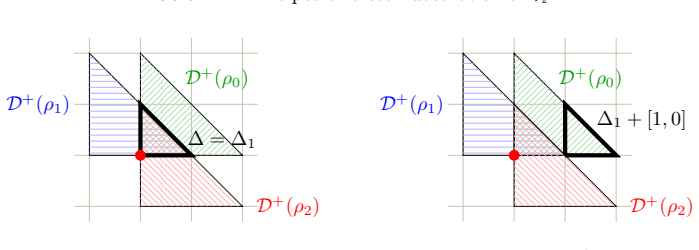
- [§6.2.3, Eq. (33)] The Weil decoration of the tangent sheaf is written as D(ρ_i) = Δ_1, Δ_1−[1,0], Δ_1−[0,1]; the reader has to infer that the rays ρ_i are ordered consistently with the labels in Figure 9. A one-sentence explanation of the labeling would remove ambiguity.
Circularity Check
No significant circularity: the central isomorphism is proved via original polyhedral/constructible arguments, with prior author results serving as independent inputs rather than as the target claim.
full rationale
The paper's central isomorphism (Theorem 6.1) is proved in Section 7 by an original chain: the Klyachko–Čech complex (47) computes H•(X,E)_0 (an external theorem of Klyachko), the identification (34) rewrites the degree-zero pieces as Γ(Δ,Fσ), equation (49) converts the computation into H(Δ, R lim F•), and Proposition 7.5 is then proved by showing exactness of the augmented stalk complex K(F)• via the strata double complex and the contraction argument in Lemma 7.10. None of these steps defines the target cohomology in terms of itself; F(E) is built directly from the Weil decoration D+, which is independent of the cohomology. The paper does cite the authors' own previous work at several load-bearing points: Eq. (1)/(26) from [ABKW20]/[AP20] for line-bundle cohomology and Ext groups, Lemma 6.11 relying on [AP20, Claim 3.3.2] for local acyclicity of line bundles, and Theorem 5.2 relying on [AFH23, Theorem 19 and Section 4.2.2] for the nested case and pushout characterization. These are independent published results with stated assumptions that do not include the present theorem; the current paper's central claim is not merely a restatement of them, and the general toric-sheaf case is new. The geometric contraction claim in Lemma 7.10 is asserted from Figure 15 with the boundary cases regulated by the ad hoc relations (54)–(55) and flagged in Remark 7.8; a failure there would make the proof incorrect, but that is a correctness risk rather than circularity. The indexing issue in Theorem 8.3 (S<T instead of S≤T) is likewise an apparent error, not a circular reduction. No fitted parameter is renamed as a prediction, and no uniqueness theorem from the authors is invoked to force a choice.
Assumptions & free parameters
assumptions (7)
- standard math The Klyachko-Čech complex K(E)^•_m computes the m-graded sheaf cohomology H^•(X,E)_m.
- domain assumption Rank-one cohomology formula H^ℓ(X,O_X(D))_0 ≅ H̃^{ℓ-1}(∇- ∖ ∇+) for D = ∇+ - ∇-.
- domain assumption For the nested case ∇+ ⊆ ∇-, the sheaf E(∇-,∇+) built from inclusion/exclusion polytopes is the universal extension ([AFH23, Theorem 19]), and the torus-invariant universal extension is a pushout ([AFH23, Section 4.2.2]).
- domain assumption For a line bundle with E+ ample and Δ = ∇- nef, the set S(σ) = ∇- ∖ (∇+ + σ∨) is empty or retractible to r_σ, making F_σ acyclic.
- ad hoc to paper The subcomplex Δ' of ∂Δ determined by the rays with D+(S) not containing u contracts to u, so the fan subcomplex C(Σ_S)^• is exact.
- standard math The Klyachko-Čech complex (48) represents the derived inverse limit R lim← Γ_Δ(F_•) in Db(Veck), per [BL03, Section 3.5].
- domain assumption Working hypotheses: k algebraically closed of characteristic 0, X smooth projective with convex full-dimensional fan support (assumption (5)).
invented entities (3)
-
Weil decoration D_E: E ∖ {0} → Div_T(X)
independent evidence
-
Constructible sheaf F(E) on the polytope Δ, with F(E)(U) = {e ∈ E | U ⊆ D+(e)}
independent evidence
-
Virtual polytope intersection ∇- ∧ ∇+ = P(D- ∧ D+) in Pol(Σ)
independent evidence
Cite this review
Pith. "Pith review of Toric sheaves and polyhedra." pith.science (2026). https://pith.science/paper/F2UCILNL
@misc{pith2026241203476,
  author       = {Pith},
  title        = {Pith review of: Toric sheaves and polyhedra},
  year         = {2026},
  howpublished = {\url{https://pith.science/paper/F2UCILNL}},
  note         = {Machine review of arXiv:2412.03476}
}
read the original abstract
Over a smooth projective toric variety we study toric sheaves, that is, reflexive sheaves equivariant with respect to the acting torus, from a polyhedral point of view. One application is the explicit construction of the torus invariant universal extension of two nef line bundles via polyhedral inclusion/exclusion sequences. Second, we link the cohomology of toric sheaves to the cohomology of certain constructible sheaves explicitly built out of the associated polyhedra. For the latter we define a concrete double complex and a spectral sequence which computes the cohomology of toric sheaves from the reduced cohomology of polyhedral subsets living in the realification of the character lattice of the toric variety.
Figures


Figures from the paper (16 more)




Reference graph
Works this paper leans on
-
[1]
Immaculate line bundles on toric varieties
Klaus Altmann , Jaros aw Buczy\'nski , Lars Kastner , and Anna-Lena Winz . Immaculate line bundles on toric varieties. Pure and Applied Mathematics Quarterly , 16(4):1147--1217, 2020
work page 2020
-
[2]
Extensions of toric line bundles
Klaus Altmann, Amelie Flatt, and Lutz Hille. Extensions of toric line bundles. Math. Z. , 304(1):26, 2023
work page 2023
-
[3]
Displaying the cohomology of toric line bundles
Klaus Altmann and David Ploog . Displaying the cohomology of toric line bundles. Izv. Math. , 84(4):683--693, 2020
2020
-
[4]
Intersection cohomology on nonrational polytopes
Paul Bressler and Valery Lunts. Intersection cohomology on nonrational polytopes. Compos. Math. , 135(3):245--278, 2003
work page 2003
-
[5]
Piecewise polynomial functions, convex polytopes and enumerative geometry
Michel Brion. Piecewise polynomial functions, convex polytopes and enumerative geometry. In Parameter spaces: enumerative geometry, algebra and combinatorics. Proceedings of the Banach Center conference, Warsaw, Poland, February 1994 , pages 25--44. Warszawa: Inst. of Math., Polish Acad. of Sciences, 1996
work page 1994
-
[6]
The structure of the polytope algebra
Michel Brion. The structure of the polytope algebra. T \^o hoku Math. J. (2) , 49(1):1--32, 1997
work page 1997
-
[7]
Toric vector bundles and parliaments of polytopes
Sandra Di Rocco , Kelly Jabbusch , and Gregory Smith . Toric vector bundles and parliaments of polytopes . Trans. Am. Math. Soc. , 370(11):7715--7741, 2018
work page 2018
-
[8]
The coherent-constructible correspondence for toric Deligne - Mumford stacks
Bohan Fang, Chiu-Chu Melissa Liu, David Treumann, and Eric Zaslow. The coherent-constructible correspondence for toric Deligne - Mumford stacks. Int. Math. Res. Not. , 2014(4):914--954, 2014
work page 2014
Show all 23 references
-
[9]
Introduction to toric varieties
William Fulton . Introduction to toric varieties. The 1989 William H. Roever lectures in geometry. Princeton, NJ: Princeton University Press, 1993
1989
-
[10]
Anderson's conjecture and projective modules over monoid algebras
Joseph Gubeladze. Anderson's conjecture and projective modules over monoid algebras. Soobshch. Akad. Nauk Gruz. SSR , 125:289--291, 1986
1986
-
[11]
Algebraic geometry
Robin Hartshorne. Algebraic geometry . Springer-Verlag, New York, 1977. Graduate Texts in Mathematics, No. 52
1977
-
[12]
Stable reflexive sheaves
Robin Hartshorne. Stable reflexive sheaves. Math. Ann. , 254:121--176, 1980
1980
-
[13]
Cohomology of sheaves , volume 55 of Lect
Birger Iversen. Cohomology of sheaves , volume 55 of Lect. Notes Ser., Aarhus Univ. Aarhus: University of Aarhus, Department of Mathematics, 1984
1984
-
[14]
Torus-equivariant vector bundles on projective spaces
Tamafumi Kaneyama. Torus-equivariant vector bundles on projective spaces. Nagoya Math. J. , 111:25--40, 1988
1988
-
[15]
Equivariant bundles on toral varieties
Alexander Klyachko. Equivariant bundles on toral varieties. Math. USSR, Izv. , 35(2):337--375, 1990
1990
-
[16]
Toric vector bundles, valuations and tropical geometry
Kiumars Kaveh and Christopher Manon. Toric vector bundles, valuations and tropical geometry. Preprint, arXiv :2304.11211 [math.AG], 2023
2023 arXiv
-
[17]
Tropical vector bundles and matroids
Kiumars Kaveh and Christopher Manon. Tropical vector bundles and matroids. Preprint, arXiv :2405.03576 [math.AG], 2024
2024 arXiv
-
[18]
On derived equivalences of categories of sheaves over finite posets
Sefi Ladkani. On derived equivalences of categories of sheaves over finite posets. J. Pure Appl. Algebra , 212(2):435--451, 2008
2008
-
[19]
Geometric invariant theory
David Mumford, John Fogarty, and Frances Kirwan. Geometric invariant theory. , volume 34 of Ergeb. Math. Grenzgeb. Berlin: Springer-Verlag, 3rd enl. ed. edition, 1994
1994
-
[20]
Hyperplane Arrangements in the Grassmannian
Elia Mazzucchelli, Dmitrii Pavlov, and Kexin Wang. Hyperplane Arrangements in the Grassmannian . Preprint, arXiv :2409.04288 [math. AG ], 2024
2024 arXiv
-
[21]
Vector bundles on complex projective spaces , volume 3 of Prog
Christian Okonek, Michael Schneider, and Heinz Spindler. Vector bundles on complex projective spaces , volume 3 of Prog. Math. Birkh \"a user, Cham, 1980
1980
-
[22]
Enumerative combinatorics
Richard Stanley. Enumerative combinatorics. Vol . 1. , volume 49 of Camb. Stud. Adv. Math. Cambridge: Cambridge University Press, 2nd ed. edition, 2012
2012
-
[23]
Morse theory and toric vector bundles
David Treumann. Morse theory and toric vector bundles. Trans. Am. Math. Soc. , 369(1):1--29, 2017
2017
Reviewed August 11, 2026 · model on record in the stance chip above.
Discussion (0). Continue with ORCID to comment.