pith. machine review for the scientific record. sign in

math.AG

Algebraic Geometry

Algebraic varieties, stacks, sheaves, schemes, moduli spaces, complex geometry, quantum cohomology

0
math.AG 2026-05-13 Recognition

Degree-6 polynomial maps R2 to R2 with non-zero Jacobian are injective

The real Jacobian conjecture for maps with one component having degree 6

This settles injectivity at degree 6 and, with prior work, confirms the real Jacobian conjecture for maps having one coordinate of degree at

Figure from the paper full image
abstract click to expand
We show that if $F=(p,q):\mathbb R^2\to \mathbb R^2$ is a polynomial map such that the degree of $p$ is $6$ and whose Jacobian determinant is nowhere zero, then $F$ is injective. This together with previous works in the literature, guarantees the validity of the real Jacobian conjecture in the plane provided that one of the coordinate functions of the map has degree smaller than $7$.
0
0
math.AG 2026-05-13 1 theorem

Reeb spaces stay 1D graphs even without CW structure

Representations of Reeb spaces via simplified graphs and examples

Nice Hausdorff spaces with continuous functions yield one-dimensional Reeb spaces that admit simplified graph representations and explicit例子

abstract click to expand
Reeb spaces of continuous real-valued functions on topological spaces are fundamental and strong tools in investigating the spaces. The Reeb space is the natural quotient space of the space of the domain represented by connected components of its level sets. They have appeared in theory of Morse functions in the last century and as important topological objects, they are shown to be graphs for tame functions on (compact) manifolds such as Morse(-Bott) functions and naturally generalized ones. Related general theory develops actively, recently, mainly by Gelbukh and Saeki. For nice Haudorff spaces and continuous functions there, they are "$1$-dimensional". We concentrate on Reeb spaces which are not CW complexes and study their representations by graphs and nice examples. Reconstructing nice smooth functions with given Reeb graphs is of related studies and pioneered by Sharko and followed by Masumoto, Michalak, Saeki, and so on. The author has also contributed to it.
0
0
math.AG 2026-05-13 2 theorems

Double Veronese cones reach at most 21 nodes

Double Veronese cones with singularities

Q-factorial terminal Gorenstein examples achieve the bound and obey explicit rationality criteria.

Figure from the paper full image
abstract click to expand
We study double Veronese cones -- three-dimensional del Pezzo varieties of degree one -- with terminal Gorenstein singularities. We prove sharp bounds for the number of nodes, determine the structure of the automorphism group, and establish criteria for rationality and unirationality. In particular, we exhibit a $\mathbb{Q}$-factorial nodal double Veronese cone with $21$ nodes.
0
0
math.AG 2026-05-13 2 theorems

Cubic surfaces yield positive geometries in dimensions 2

Positive Geometries from Cubic Surfaces

The surface minus its 27 lines, its complement in 3-space, and the moduli space each carry a positive arrangement and canonical form.

Figure from the paper full image
abstract click to expand
We present a study of cubic surfaces from the novel perspective of positive geometry. Our positive geometries have dimension two (the surface minus its 27 lines), dimension three (its complement in 3-space), and dimension four (the moduli space). In each case we explore the positive arrangement, its combinatorial rank, and the canonical forms.
0
0
math.AG 2026-05-13 Recognition

Gieseker K-theory matches Jucys-Murphy center of cyclotomic Hecke algebra

K-theory of Gieseker variety and type A cyclotomic Hecke algebra

The identification supplies an algebraic description of geometric invariants and new information on centers of Hecke algebras in generic and

abstract click to expand
We give an algebraic description of the equivariant $K$-theory of Gieseker varieties. Our main result identifies the equivariant $K$-theory of the Gieseker space with the Jucys--Murphy center of the cyclotomic Hecke algebra, over the equivariant $K$-theory of a point. The construction is inspired by the proof of the Hikita--Nakajima conjecture for Gieseker spaces given by the first and third authors. We discuss consequences for the center of cyclotomic Hecke algebras. Under the specialization $q=1$, we recover the corresponding description in terms of the group algebra, while at roots of unity, assuming an identification between the equivariant $K$-theory of the Lagrangian subvariety and the cocenter, our result identifies the $K$-theory of affine type A quiver varieties with the centers of the corresponding blocks of specialized cyclotomic Hecke algebras. This last result strengthens the correspondences obtained by the second author in earlier work.
0
0
math.AG 2026-05-13 2 theorems

Induced irreps match images of exceptional curves under group quotient

Geometric Construction of the McKay-Slodowy Correspondence

The bijection extends the classical McKay correspondence to pairs G containing normal H inside SL(2,C) by pushing forward components of the

abstract click to expand
This paper presents a geometric construction of the McKay-Slodowy correspondence, which extends the classical McKay correspondence. The classical McKay correspondence says: for a finite subgroup G of SL_2(C), there is a bijection between the set of nontrivial irreducible representations of G and the irreducible components of the exceptional locus of the minimal resolution of the quotient variety C^2/G. We generalizes it to a pair of groups: when G is a finite subgroup of SL_2(C) with a normal subgroup H, the set of induced nontrivial irreducible representations from H to G corresponds one-to-one to the set of pushing-forward of components of the exceptional locus of the minimal resolution of C^2/H under the quotient by G/H-action. Our proof is not given by case-by-case verification.
0
0
math.AG 2026-05-12 2 theorems

Low-dim symmetric polynomials yield codes in even char

Evaluation codes from linear systems of conics

Generalized Datta-Johnsen evaluation codes on distinct-coordinate points are shown to remain well-behaved when the field has characteristic

abstract click to expand
The Datta-Johnsen code is an evaluation code where the linear combinations of elementary symmetric polynomials are evaluated on the set of all points with pairwise distinct coordinates in an affine space of dimension $\ge 2$ over a finite field $\mathbb{F}_q$. A generalization is obtained by taking a low dimensional linear system of symmetric polynomials. The odd characteristic case was the subject of a recent paper. Here, the even characteristic case is investigated.
0
0
math.AG 2026-05-12 Recognition

Log Hochschild homology is functorial for log smooth pairs

Functoriality of logarithmic Hochschild homology of log smooth pairs

Strong kernels on blow-ups restore adjunctions and yield a bicategory where the homology is invariant.

Figure from the paper full image
abstract click to expand
The construction of a satisfactory dg category of logarithmic coherent sheaves remains a central open problem in logarithmic geometry. In this paper, we propose an alternative correspondence-theoretic approach based on logarithmic Fourier--Mukai transforms. For smooth proper log pairs, we introduce strong log Fourier--Mukai kernels supported on canonical blow-up compactifications and prove that logarithmic Hochschild homology is functorial with respect to the induced transforms. Unlike the classical setting, logarithmic correspondences do not naturally live on ordinary products, and the standard adjunction formalism fails because of blow-up discrepancies. We overcome these difficulties by constructing explicit unit- and counit-type morphisms that provide the necessary adjunction data without requiring an ambient dg category of logarithmic sheaves. As applications, we construct a dg bicategory of logarithmic correspondences in which logarithmic Hochschild homology and cohomology become categorical invariants. We also define logarithmic Chern characters and a logarithmic Euler pairing compatible with the logarithmic Fourier--Mukai formalism.
0
0
math.AG 2026-05-12 3 theorems

Theta function on singular Jacobians supplies universal sections for all degree-d bundles

Theta functions for singular curves

Translates restricted to the Abel image of the normalization generate every line bundle section on the singular curve.

abstract click to expand
Let $X$ be an irreducible singular Riemann surface, with desingularisation $\widetilde X$. The generalised Jacobian $J(X)$ of $X$ fibers over the Jacobian $J(\widetilde{X})$ of $\widetilde X$, and there is an Abel map $A$ of $\widetilde X$ to $J(X)$, lifting the Abel map to $J(\widetilde X)$. We build a theta function on a compactification of the generalised Jacobian $J(X)$ (giving a section of a suitable positive line bundle). The translation action on $J(X)$ then yields all line bundles of that degree, and the translates of the theta function, restricted to $A(\widetilde X)$, give a ``universal section'' of the line bundles of that degree over $X$. This extends to the singular case a classical result of Riemann.
0
0
math.AG 2026-05-12 2 theorems

Determinantal schemes classify 3D tensor degeneracy and rank

Some remarks on degeneracy of tridimensional tensors

A classical geometric approach identifies whether tridimensional tensors are degenerate or concise and reveals their essential formats.

abstract click to expand
We study tridimensional tensors on the complex field from the point of view of hypermatrices, taking into consideration the problem of determining whether they are degenerate or not, concise or not, what is their essential format if they are non-coincise, and, in some cases, their tensor rank. We use a geometrical approach to these problems which, in part, goes back to Schl\"{a}fli and consists in studying certain determinantal schemes associated to the hypermatrix.
0
0
math.AG 2026-05-12 2 theorems

Polarity extends canonical forms to curved polypols as holonomic periods

Canonical forms and moment-generating functions of plane polypols

The dual mechanism from polygons persists but yields branched periods whose singularities are fixed by vertices and dual curves.

abstract click to expand
We study two closely related objects associated with plane domains bounded by rational algebraic arcs: canonical forms in the sense of positive geometry and normalized moment-generating functions, or Fantappie transforms. For polygons these objects are related by polarity: the normalized Fantappie transform of a polygon is the canonical form of the polar polygon. For genuinely curved polypols the same dual-geometric mechanism survives, but the transform is no longer a rational logarithmic canonical form; rather, it is a holonomic, generally branched period whose singularities are controlled by vertex hyperplanes and by the projective dual curves of the nonlinear boundary components. We give explicit examples, including sectors and half-disks, and explain how harmonic moment generating functions arise as one-dimensional restrictions of the same Fantappi`e transform.
0
0
math.AG 2026-05-12 Recognition

Central extensions of tangent sheaf on formal 2-disk classified

Two-dimensional Virasoro algebras

The classification produces a local universal Grothendieck-Riemann-Roch theorem for families of complex surfaces.

Figure from the paper full image
abstract click to expand
We classify central extensions of the dg Lie algebra of derived global sections of the tangent sheaf on the punctured, formal 2-disk. We then prove a local and universal form of the Grothendieck--Rieman--Roch theorem for families of two-dimensional complex varieties.
0
0
math.AG 2026-05-12 2 theorems

Condensed fundamental group of Spec(Z) is non-trivial

On Galois categories and condensed contractible schemes

Formula for Dedekind domains shows the spectrum of the integers fails to be condensed contractible.

abstract click to expand
We extend the study of the condensed Galois category of a scheme introduced by Barwick, Glasman and Haine in their work on Exodromy. We elaborate its connection to Lurie's work on Ultracategories and provide a description in terms of w-contractible rings. We give a classification of schemes whose Galois category has an initial, respectively, a terminal object. This implies the condensed homotopy type of the scheme, which was studied in more detail in [arXiv:2510.07443v1], to be trivial. Furthermore, we compute a formula for the (underlying group of the) condensed fundamental group of a general Dedekind domain and show that it is non-trivial for the spectrum of the integers Spec(Z).This means that Spec(Z) is not condensed contractible.
0
0
math.AG 2026-05-12 1 theorem

Blow-ups of P(1,1,m) yield surfaces with polarized cylinders

Polarized cylinders on blow-ups of weighted projective planes

The resulting rational surfaces, realized as hypersurfaces, support explicit analysis of the cylinders through their weighted equations and

Figure from the paper full image
abstract click to expand
We study polarized cylinders in certain rational surfaces arising from blow-ups of weighted projective planes. In particular, we consider the surfaces obtained by blowing up $m+4$ points in general position on the weighted projective plane $\mathbb{P}(1,1,m)$. These surfaces appear naturally as weighted hypersurfaces or quasi-smooth complete intersections.
0
0
math.AG 2026-05-12 2 theorems

Normalization of moduli space for klt minimal models is quasi-projective

Quasi-Projective Moduli for Polarized klt Good Minimal Models

Weak positivity of direct images over reduced quasi-projective bases lets Viehweg's criterion establish the property for arbitrary Kodaira

abstract click to expand
We prove the weak positivity of direct images for locally stable families of klt good minimal models over reduced quasi-projective bases using Gabber's Extension Theorem. As an application, we apply Viehweg's ampleness criterion to show that the normalization of the moduli space of polarized klt good minimal models of arbitrary Kodaira dimension, constructed in [Jia23], is quasi-projective.
0
0
math.AG 2026-05-12 2 theorems

Homological sieve tackles Manin's conjecture

Homological sieve and Manin's conjecture

Survey explains how homological tools isolate geometric contributions to predict counts of rational points.

abstract click to expand
This is a report of the author's talk at RIMS workshop Algebraic Number Theory and Related Topics 2025 which was held at RIMS Kyoto University during December 15th-19th 2025. In this survey paper, we explain the homological sieve method, which is proposed by Das, Lehmann, Tosteson, and the author, and its applications to Manin's conjecture.
0
0
math.AG 2026-05-12 3 theorems

Geometric Shafarevich conjecture holds for stable minimal model stacks

Geometric Shafarevich boundedness conjecture for families of polarized varieties

Finiteness of families is established when bad reduction is confined to a finite set of points on the base.

abstract click to expand
We establish the geometric Shafarevich boundedness conjecture for the moduli stack of stable minimal models, including in particular the moduli stack of KSB pairs.
0
0
math.AG 2026-05-11 1 theorem

Recursive algorithm computes centralizers of orthogonal groups

Centralizers of the complex orthogonal and symplectic group

It also yields the isotropy groups for similarity actions on skew-symmetric and Hamiltonian matrices by reducing them to rectangular block-T

abstract click to expand
We find a recursive algorithm for computing the precise centralizers of the complex orthogonal and symplectic groups, and hence the isotropy groups, with respect to the similarity transformation on the spaces of skew-symmetric and Hamiltonian matrices, respectively. These groups are conjugate to groups of certain nonsingular block matrices whose blocks are rectangular block Toeplitz.
0
0
math.AG 2026-05-11 Recognition

Matroid alone determines motivic Chern class of hyperplane complements

Grothendieck Weights on Permutohedral Varieties and Matroids

K-theoretic weights on permutohedral fans prove invariance under realization and extend the class to all loopless matroids

Figure from the paper full image
abstract click to expand
Grothendieck weights, introduced by Shah, are $K$-theoretic analogues of Minkowski weights on smooth toric varieties. We study Grothendieck weights on the permutohedral fan and prove two main results: a $K$-balancing condition that characterizes Grothendieck weights by a finite system of linear equations, and an explicit product rule for the ring structure. We apply this framework to matroids, giving a combinatorial characterization of Grothendieck weights on matroidal fans. As the main application, we compute the motivic Chern class of the hyperplane arrangement complement in its wonderful compactification and show that the result depends only on the matroid, not on the realization. This allows us to extend the definition of the motivic Chern class to all loopless matroids.
0
0
math.AG 2026-05-11 2 theorems

Algebraic rectifiability tied to quadratic differentials

Plane rectifiable curves: old and new

Classical plane-curve property gains new tests and extends to higher-order differentials while staying algebraic.

abstract click to expand
In this note we recall the classical notion of an algebraically rectifiable plane curve going back to J. A. Serret, E. Laguerre and G. Humbert. We provide new criteria of algebraic rectifiability, relate this notion to quadratic differentials, and generalize it to differentials of higher order.
0
0
math.AG 2026-05-11 2 theorems

Explicit 16-dimensional component of Hassett-maximal cubic fourfolds

The equations of general Hassett maximal cubic fourfolds

Lattice analysis proves the primitive image spans the full Hassett subset for this irreducible family.

abstract click to expand
In this note, we discuss Hassett maximal cubic fourfolds and construct an explicit irreducible component of maximal dimension sixteen of the locus $\mathcal{Z}$ of Hassett maximal cubic fourfolds. We utilize algebraic and arithmetic methods to analyze the associated lattice of these fourfolds. % By studying general integral quadratic forms and proving the ADC property for a specific ternary form, we demonstrate that the primitive image of our lattice spans the entire Hassett subset, confirming the Hassett maximality of the cubic fourfolds we describe.
0
0
math.AG 2026-05-11 3 theorems

Refined lattice counts compute Euler characteristics of Klein moduli spaces

Refined lattice point counting on the moduli space of Klein surfaces

Metric Möbius graphs equipped with a non-orientability weight yield a refined recursion and explicit values for the invariant.

abstract click to expand
We introduce the moduli space of metric M\"obius graphs, which extend ribbon graphs to the non-orientable world. This space contains both the moduli space of Riemann surfaces and the moduli space of non-orientable Klein surfaces. Each metric M\"obius graph is equipped with a measure of non-orientability. We count lattice points in this moduli space, weighted by the measure of non-orientability, and prove a refined version of Norbury's recursion for this count. Taking the limit as the mesh becomes finer, we deduce a recursion for the Euclidean volumes, yielding a refined version of the Witten--Kontsevich recursion. As an application, we give a geometric definition of the refined Euler characteristic of the moduli space and compute it explicitly, thereby answering a question of Goulden, Harer, and Jackson.
0
0
math.AG 2026-05-11 2 theorems

Tangent degree never equals one when N equals 2n

On the tangent degree and the degree of the tangent variety of a projective variety

For X^n in P^{2n} the count of tangent spaces through general tangent points avoids 1, with linear degree lower bound when Tan(X) differs.

abstract click to expand
The tangent degree $\tau(X)$ of a projective variety $X^n\subset\mathbb P^N$ is the number of tangent spaces to $X$ at smooth points passing through a general point of the tangent variety $Tan(X)\subseteq\mathbb P^N$, if positive and finite; it is equal to zero if $\dim(Tan(X))<2n$. In this paper we focus on general properties of $\tau(X)$ and of $deg(Tan(X))$. For example $\tau(X)\neq 1$ if $N=2n$ and, as soon as $Tan(X)$ does not coincide with the secant variety, we prove a linear lower bound for the degree of $Tan(X)$ in terms of its codimension in the spirit of the paper Ciliberto.Russo.2006. Then we consider the cases in which the previous two invariants attain the lower bounds found here, either in small dimension/codimension and/or under the smoothness assumption. Finally for $N\geq 2n+1$ we consider varieties $X^n\subset\mathbb P^N$ having $\tau(X)>1$ and provide their classification in small dimension.
0
0
math.AG 2026-05-11 2 theorems

Minimal GSV-index on hypersurface germs equals 1 plus or minus Tjurina number

Generic vector fields on isolated complex hypersurface germs

Equality holds exactly when the vector field extends to a nondegenerate zero in ambient space, and such fields form an open dense set

abstract click to expand
We study holomorphic vector fields on isolated hypersurface singularities and derive global obstructions to the existence of holomorphic vector fields on compact singular varieties. For a hypersurface germ $(V,0)$ with an isolated singularity, we characterize the generic elements in the space of holomorphic vector fields with isolated singularity in terms of the GSV-index. Letting $\tau(V,0)$ denote the Tjurina-Greuel number, we prove that the minimal possible index is bounded below by $1+(-1)^{\dim(V)}\tau(V,0)$. We further prove that equality holds if and only if the vector field admits an extension to $\mathbb{C}^{n+1}$ with a nondegenerate singularity at $0$, and that such extensions, when they exist, form an open dense subset of the set of vector fields with an isolated singularity at $0$. This yields a description of the generic vector fields on weighted homogeneous hypersurface germs. As a consequence, we obtain a characterization of weighted homogeneous hypersurface germs. Also, as applications to singular hypersurfaces in complex manifolds, we derive constraints on compact singular varieties admitting holomorphic vector fields. In particular, we show that an irreducible compact singular complex curve carrying a nontrivial holomorphic vector field with zeros is rational and has at most two singular points. We further prove that, for singular surfaces in K{\"a}hler 3-folds satisfying suitable positivity assumptions on the adjoint line bundle, the geometric genus is greater of equal than the irregularity.
0
0
math.AG 2026-05-11 Recognition

Generalized Jacobian points recover curve data up to twist

A curve and its abstract generalized Jacobian

The abstract group and its embedded curve subset determine the original curve, point and divisor, proving a conjecture of Booher and Voloch.

abstract click to expand
To a smooth proper curve $C$ over a field $k$ equipped with a $k$-point $c$ and an effective divisor $\mathfrak m$ coprime to $c$, one may associate the abstract group $J_{\mathfrak m}(\bar k)$ of $\overline k$-points of the generalized Jacobian, as well as a subset \[ \tag{*} \big(C\setminus \operatorname{Supp}(\mathfrak m)\big)(\bar k) \subset J_{\mathfrak m}(\bar k). \] We show that the data $(C,c,\mathfrak m)$ can be retrieved from (*) up to a twist by an automorphism of $\overline k$, proving a conjecture of Booher and Voloch. By a result of Booher and Voloch this shows that when $k$ is a finite field, the same data may also be retrieved from $L$-functions of characters of certain Galois extensions of the function field of $C$. The proof is a generalization of Zilber's well known work "A curve and its abstract Jacobian".
0
0
math.AG 2026-05-11 2 theorems

Tropical floor-diagram counts stay the same after merging point conditions

Merge-position invariance in quadratically enriched tropical floor diagrams

Wall-crossing reduces any difference to a Pfister form that vanishes when 2 is a square in the field

Figure from the paper full image
abstract click to expand
Jaramillo Puentes et al. give a Grothendieck-Witt valued floor-diagram formula for rational curves in smooth toric del Pezzo surfaces with simple and quadratic double point conditions. We study its dependence on the choice of merge positions, namely on which adjacent pairs of point conditions are merged. Although independence of these choices follows abstractly from the tropical correspondence and algebraic invariance, it is not manifest in the floor-diagram expression. We prove a wall-crossing factorisation for the floor formula: for any two merge configurations, the difference is of the form $\Delta N = C \prod_{j=1} ^s (\langle d_j\rangle-\langle 1\rangle)$. The coefficient $C$ admits a fixed universal lift. Using real broccoli invariance, the possible obstruction is reduced to a multiple of the virtual Pfister element $\langle\langle 2,d_1, \ldots,d_s\rangle\rangle$. This gives a complete tropical proof of merge- position invariance over every admissible field in which $2$ is a square. Over a general admissible field, the same tropical analysis reduces the problem to one explicit mod-$2$ congruence for the residual coefficient; this congruence is verified by a single Laurent-series specialisation, using the tropical correspondence of Jaramillo Puentes et al. and the algebraic invariance theorem of Kass-Levine-Solomon-Wickelgren.
0
0
math.AG 2026-05-11 2 theorems

Refined obstructions control Hasse principle for 0-cycles on Kummer varieties

Refined obstructions to local-global principles for 0-cycles

Assuming finiteness of Tate-Shafarevich groups, new obstructions determine local-global principles for 0-cycles on generalised Kummer and bi

abstract click to expand
We introduce new `refined' obstructions to local-global principles for 0-cycles on algebraic varieties over number fields. Assuming finiteness of relevant Tate--Shafarevich groups, we show that the Hasse principle and weak approximation for 0-cycles on generalised Kummer varieties and bielliptic surfaces are controlled by obstructions of this new type. As an additional application of our refined obstructions, we answer a question of Zhang about the relationship between the Brauer--Manin and connected descent obstructions for 0-cycles. We also show that a Corwin--Schlank style refined obstruction set coincides with the set of global 0-cycles, conditionally on the Section Conjecture.
0
0
math.AG 2026-05-11 Recognition

Some cases of Iitaka C_{n,3} hold for fiber spaces over threefolds

Kodaira dimension of algebraic fiber spaces over threefolds : Part 1

Includes results when the base is a Calabi-Yau threefold under the paper's technical conditions on the fibration.

abstract click to expand
We study the behavior of the Kodaira dimension of algebraic fiber spaces over threefolds. We prove some cases of the Iitaka Conjecture $C_{n,3}$, including certain situations where the base variety is a Calabi--Yau threefold.
0
0
math.AG 2026-05-11 Recognition

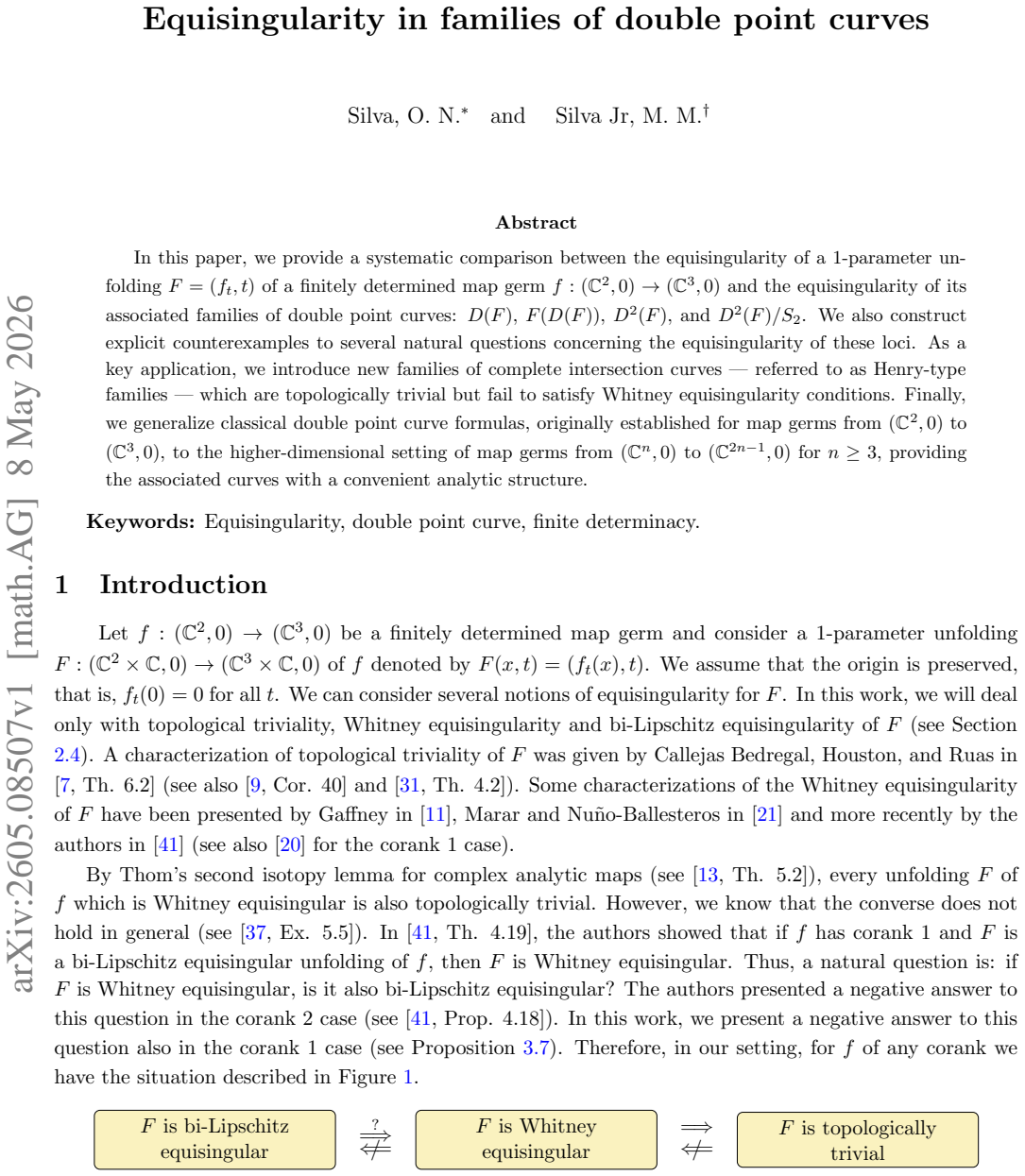
Map unfolding equisingularity independent of double point curve equisingularity

Equisingularity in families of double point curves

Counterexamples and new Henry-type curve families show that topological triviality does not ensure Whitney equisingularity for these loci.

Figure from the paper full image
abstract click to expand
In this paper, we provide a systematic comparison between the equisingularity of a 1-parameter unfolding F = (f_t, t) of a finitely determined map germ f: (\mathbb{C}^2, 0) \to (\mathbb{C}^3, 0) and the equisingularity of its associated families of double point curves: D(F), F(D(F)), D^2(F), and D^2(F)/S_2. We also construct explicit counterexamples to several natural questions concerning the equisingularity of these loci. As a key application, we introduce new families of complete intersection curves - referred to as Henry-type families - which are topologically trivial but fail to satisfy Whitney equisingularity conditions. Finally, we generalize classical double point curve formulas, originally established for map germs from (\mathbb{C}^2, 0) to (\mathbb{C}^3, 0), to the higher-dimensional setting of map germs from (\mathbb{C}^n, 0) to (\mathbb{C}^{2n-1}, 0) for n \geq 3, providing the associated curves with a convenient analytic structure.
0
0
math.AG 2026-05-11 2 theorems

Gm-quotient turns derived symplectic spaces into contact spaces

Equivariant Quotients of Derived Symplectic Spaces and Legendrian Intersection Theorem

The classical transversality lemma extends by replacing Liouville fields with Gm fundamental vector fields, producing contact structures on

abstract click to expand
The classical transversality lemma of contact geometry constructs a contact structure on a hypersurface transverse to a Liouville vector field using point-set topology and local flows. This paper translates the classical transversality lemma into the context of derived algebraic geometry and provides the derived Legendrian intersection theorem, along with various applications to moduli theory. In brief, we first prove that taking the quotient of a derived symplectic space descends the symplectic data to a contact structure, avoiding a transverse hypersurface, where the fundamental vector field of a weight 1 $\mathbb{G}_m$-action, in the derived setting, replaces the classical Liouville vector field. Secondly, the derived Legendrian intersection theorem is proven using base change, an $\infty$-categorical descent cube, and $\mathbb{G}_m$-equivariant lifts along the symplectification projection. As applications of the main results, we first examine the derived geometry of the discriminant loci of 1-jet bundles and show that these loci carry a $(-1)$-shifted contact structure. In addition, we show that our results apply to certain moduli problems, including projective Higgs bundles, $\ell$-adic local systems, and Lie 2-groups, and we provide further examples of contact derived moduli stacks.
0
0
math.AG 2026-05-11 Recognition

Kummer-type manifolds with finite symplectic maps are twisted modular

Finite order symplectic birational self-maps on Kummer-type manifolds

Except for certain Picard rank 3 cases, the map implies the manifold is birational to an Albanese fiber from twisted sheaves on an abelian

abstract click to expand
A projective hyperk\"ahler manifold of Kummer-type is said to be twisted modular if it is birational to the Albanese fiber of a moduli space of twisted sheaves on an abelian surface. We prove that, with the exception of certain cases of Picard rank 3, any projective Kummer-type manifold admitting a finite-order symplectic birational self-map that acts nontrivially on its second cohomology group is twisted modular. We provide a complete characterization of these exceptions in terms of their N\'eron-Severi lattices. We then investigate symplectic birational self-maps of modular Kummer-type manifolds, determining exactly which Mukai vectors allow the birational transformation induced by crossing the vertical wall, which acts on cohomology as a reflection, to correspond to a finite-order symplectic birational self-map. Additionally, we prove in an appendix several results concerning moduli spaces of twisted sheaves on abelian surfaces which were not readily available in the literature.
0
0
math.AG 2026-05-11 Recognition

Affine schemes are limits of their band schemes

On Bands and Limit Theorems in Tropical Geometry

This scheme-theoretic limit enhances Payne's tropical theorem and recovers tropicalizations from points over the tropical band.

abstract click to expand
We review the basic theory of bands and band schemes introduced by Baker-Jin-Lorscheid, which is an algebraic framework for tropicalization, analytification, and $\mathbb{F}_1$-geometry. For an affine scheme $X$ over a non-Archimedean valued field $k$, one can associate to every affine embedding $\iota$ of $X$ a naturally defined affine band scheme $Y_\iota$ whose rational points over the tropical band $\mathbb{T}$ recover the tropicalization $Trop(X,\iota)$. We prove that $X$ is the limit of the $Y_\iota$ in the category of band schemes, thereby obtaining a scheme-theoretic enhancement of Payne's limit theorem. By taking $\mathbb{T}$-rational points, this recovers Payne's theorem for affine tropicalizations from the perspective of band scheme theory and the same method provides an analogous result in the real tropical setting.
0
0
math.AG 2026-05-11 2 theorems

Singly graded syzygy gives implicit equation of tensor product surface

Tensor product surfaces and graded syzygies

The method works when the bigraded ideal I_U has this property, extending prior techniques to produce the surface equation in P^3.

abstract click to expand
Let $U\subseteq H^0(\mathcal{O}_{\mathbb{P}^1\times \mathbb{P}^1}(a,b))$ be a four-dimensional vector space and consider the rational map $\phi_U:\,\mathbb{P}^1\times \mathbb{P}^1 \dashrightarrow \mathbb{P}^3$ defined by its basis of bihomogeneous polynomials. The tensor product surface $X_U\subseteq \mathbb{P}^3$ is the closed image of $\phi_U$, and a fundamental problem in this setting is to determine its implicit equation. As these surfaces are ubiquitous within the field of geometric modeling and design, knowledge of their implicit equations is particularly advantageous, allowing for more effective and efficient computations. In this article, we expand upon work of Duarte-Schenck and work of the present author to solve this implicitization problem when the bigraded ideal $I_U$ admits a singly graded syzygy.
0
0
math.AG 2026-05-11 1 theorem

Transformation rule for adjoint test modules along CM maps

Adjoint test modules along Cohen--Macaulay morphisms

It makes Enescu's theorem on F-rationality ascent effective for such varieties.

abstract click to expand
We provide a transformation rule for adjoint test modules along Cohen--Macaulay maps between Cohen--Macaulay varieties that have $F$-rational geometric fibers. This is, in part, an effective version of Enescu's theorem on the ascent of $F$-rationality under local maps with $F$-rational geometric fibers.
0
0
math.AG 2026-05-11 2 theorems

Finite list of degree-four pre-foliations on P² classified for flat 4-webs

Homogeneous pre-foliations of co-degree one and degree four on the projective plane

Classification by ramification data of the Gauss map completes the picture for underlying foliations of tangent degrees 3 and 4.

abstract click to expand
We classify, up to projective automorphism, all homogeneous pre-foliations of co-degree one and degree four on the complex projective plane $\Ptwo$ whose Legendre transform defines a flat $4$-web. The classification is organized according to the type of the underlying homogeneous foliation $\Hcal$ of degree~$3$, distinguishing the cases $\deg(\Tcal_{\Hcal})=2$, $3$, and~$4$. The case $\deg(\Tcal_{\Hcal})=2$ was treated by Bedrouni, while the cases $\deg(\Tcal_{\Hcal})=3$ and $\deg(\Tcal_{\Hcal})=4$ are completed here. The proof combines Bedrouni's curvature-holomorphy criteria with explicit normal forms and symbolic computation; the result yields a finite list of explicit one-forms, parametrised by the ramification data of the Gauss map of~$\Hcal$.
0
0
math.AG 2026-05-11 2 theorems

Tropical intersections give exact root counts for vertical polynomial systems

Root bounds of vertical systems using tropical geometry

Generic complex zeros of an augmented vertical system equal the intersection number of a tropical linear space and a classical linear space.

Figure from the paper full image
abstract click to expand
Sparse polynomial systems with vertical coefficient dependencies arise naturally when describing the critical points of optimization problems and, when augmented with linear forms, the steady states of chemical reaction networks. Moreover, any polynomial system is the specialization of such a parametrized system. We prove that the generic number of complex zeros of an augmented vertically parametrized system is the tropical intersection number of a tropical linear space and a classical linear space. In the special case when the matroid of the tropical linear space is cotransversal, we express this number as a mixed volume. We also obtain bounds on the maximal number of positive zeros, which is often the significant number in applications. We derive lower bounds from the number of intersections between positive tropicalizations, and when the positive zeros have toric structure, we provide upper bounds that are simpler and in some cases smaller than the generic root count. The resulting algorithms are implemented in Julia.
0
0
math.AG 2026-05-11 2 theorems

Fiberwise check determines A1-contractibility for smooth morphisms

Relative mathbb{A}¹-Contractibility of Smooth Schemes

Over bases of finite Krull dimension, the property in the A1-homotopy category holds exactly when it holds on all geometric fibers.

abstract click to expand
We study smooth morphisms $f \colon X \to S$ that are $\mathbb{A}^1$-contractible in the unstable $\mathbb{A}^1$-homotopy category $\mathcal{H}(S)$. For base schemes $S$ of finite Krull dimension, we show that $\mathbb{A}^1$-contractibility is a fiberwise property: such a morphism is $\mathbb{A}^1$-contractible if and only if all its geometric fibers are $\mathbb{A}^1$-contractible. We apply this criterion to $\mathbb{A}^n$-fiber spaces, obtaining a geometric description of their $\mathbb{A}^1$-contractibility in terms of local factorizations as towers of torsors under vector bundles, building on results of Asanuma. In low relative dimensions, we establish rigidity results. In relative dimension $1$, $\mathbb{A}^1$-contractible morphisms over normal bases are precisely Zariski locally trivial $\mathbb{A}^1$-bundles. In relative dimension $2$, we show that over bases with characteristic zero residue fields, $\mathbb{A}^1$-contractible morphisms are $\mathbb{A}^2$-fiber spaces, and we obtain Zariski local triviality under additional hypotheses on the base. We also exhibit counterexamples in positive and mixed characteristic and formulate open problems concerning the existence of exotic $\mathbb{A}^1$-contractible surfaces.
0
0
math.AG 2026-05-11 Recognition

Exponents classify affine surfaces up to isomorphism

The Isomorphism Classes of the Surfaces x₁^{a₁} + x₂^{a₂} + x₃^{a₃} + 1 = 0

The surfaces x^a + y^b + z^c + 1 = 0 are isomorphic over C exactly when their exponent triples match after reordering.

abstract click to expand
Let $f = x_1^{a_1} + x_2^{a_2} + x_3^{a_3} + 1 \in \mathbb{C}[x_1,x_2,x_3]$ and let $g = y_1^{b_1} + y_2^{b_2} + y_3^{b_3} + 1 \in \mathbb{C}[y_1,y_2,y_3]$ where $a_1,a_2,a_3,b_1,b_2,b_3 \geq 2$. We prove that the surfaces $V(f) \subset \mathbb{A}^3$ and $V(g) \subset \mathbb{A}^3$ are isomorphic if and only if $(a_1,a_2,a_3) = (b_1,b_2,b_3)$ up to a permutation of the entries.
0
0
math.AG 2026-05-11 2 theorems

Sections on elliptic surfaces classify even-multiplicity conics to nodal-cuspidal quartics

Geometry of weak contact conics to irreducible quartics with 2 nodes and 1 cusp via rational elliptic surfaces and Zariski pairs

For every irreducible quartic with two nodes and one cusp, the conics meeting the even-multiplicity and smooth-point conditions arise from a

abstract click to expand
Let $\mathcal{Q}$ be an irreducible quartic with two nodes and one cusp as its singularities and let $\mathcal{C}$ be a conic such that the intersection multiplicity at each point of $\mathcal{C} \cap \mathcal{Q}$ is even and $\mathcal{C} \cap \mathcal{Q}$ contain at least one smooth point $z_o$ of $\mathcal{Q}$. In this paper, for every $\mathcal{Q}$ we find all possible conics $\mathcal{C}$ as above via studying geometry of $\mathcal{C}$ and $\mathcal{Q}$ through that of integral sections of a rational elliptic surface which canonically arises from $\mathcal{Q}$ and $z_o \in \mathcal{C} \cap \mathcal{Q}$. As an application, we construct Zariski pairs of degree 7 and degree 8, whose irreducible components consist of $\mathcal{Q}$, $\mathcal{C}$ and line passing through two of the singular points of $\mathcal{Q}$ .
0
0
math.AG 2026-05-11 2 theorems

Traintrack integral modularity proven by Picard-Fuchs factorization

Modularity of Feynman Integrals and Factorization of Appell F2 Systems

The associated differential system factors into Gauss hypergeometrics under a gauge transformation, confirming the modular properties of the

abstract click to expand
Certain Feynman integrals can be expressed as periods of differential forms on Calabi--Yau manifolds. We provide a mathematical proof of a result of Duhr and Maggio on the modularity of the two-dimensional conformal traintrack integral. Our approach is based on a factorization of the associated Picard-Fuchs system into a tensor product of Gauss hypergeometric systems via a gauge transformation due to Clingher, Doran and Malmendier.
0
0
math.AG 2026-05-11 2 theorems

Batchelor spaces split globally in C∞-superschemes

The Structure of C^infty-Superschemes

The split induces a natural Z≥0-grading equivalent to an Euler vector field, giving splittings a differential-geometric form.

abstract click to expand
This paper establishes a structural generalization of Batchelor's theorem within the framework of $C^\infty$-superschemes. Our main result proves that any Batchelor space satisfies a global splitness condition, establishing an isomorphism between the structure sheaf and its associated graded sheaf. Although this isomorphism is non-canonical, the existence of a splitting endows the structure sheaf with a natural $\mathbb{Z}_{\geq 0}$-grading. This grading is shown to be equivalent to the data of an even superderivation, which we term an Euler vector field. Consequently, global splittings of $C^\infty$-superspaces can be characterized in terms of Euler vector fields, providing a differential-geometric formulation of the splitting.
0
0
math.AG 2026-05-08 Recognition

Abelian varieties' dRB groups contain the multiplicative group

Weight of the De Rham-Betti Structures of Abelian Varieties

This forces all odd-degree de Rham-Betti cohomology classes to vanish over the algebraic closure of the rationals.

abstract click to expand
In this note, we prove that for any abelian variety defined over $\overline{\mathbb{Q}}$, its de Rham-Betti (dRB) group necessarily contains $\mathbb{G}_{m}$ as the group of homotheties. Consequently, this rules out the existence of non-zero dRB classes in odd-degree cohomology groups of abelian varieties over $\overline{\mathbb{Q}}$. This generalises results of the first part of arXiv:2511.01072.
0
0
math.AG 2026-05-08 Recognition

Local Bourbaki degrees sum to the global degree for plane curves

The Local Bourbaki Degree of a Plane Projective Curve

The equality lets researchers compute the invariant pointwise and test freeness with fewer global calculations.

abstract click to expand
The Bourbaki degree of a plane projective curve $F$, denoted by $\mathrm{Bour}(F)$, was introduced in \cite{Marcos} by Jardim, Nejad and Simis. It is defined as the degree of $R/I_\epsilon$, where $R = k[x,y,z]$ is the graded polynomial ring, with $k$ algebraically closed, and $I_\epsilon \subseteq R$ is the Bourbaki ideal associated with a minimal generator $\epsilon$ of the module of first syzygies of the Jacobian ideal $J_F$. In this work, we propose the definition of the local Bourbaki degree at a point $P \in \mathbb{P}^2$, denoted by $\mathrm{Bour}_P(F)$, and prove that $\mathrm{Bour}(F) = \sum_{P \in \mathbb{P}^2}\mathrm{Bour}_P(F).$ Furthermore, we present results that follow from this local definition, which are instrumental in determining the Bourbaki degree and in establishing whether a curve is (nearly) free. In addition, we provide examples of computing the Bourbaki degree via the local formula - an approach that is computationally advantageous, as it, generically, demands fewer calculations.
0
0
math.AG 2026-05-08

QHD degenerations of elliptic surfaces receive complete classification

Rational homology disk degenerations of elliptic surfaces

Extending Kawamata, the work realizes all cases on Dolgachev surfaces and constructs unobstructed minimal models that connect to Lee-Lee

Figure from the paper full image
abstract click to expand
In this paper, a $\mathbb{Q}$HD singularity is a weighted homogeneous normal surface singularity admitting a rational homology disk ($\mathbb{Q}$HD) smoothing. These singularities are rational but often not log canonical. We classify all $\mathbb{Q}$HD degenerations of nonsingular projective elliptic surfaces, extending Kawamata's classification of the case with only Wahl singularities (i.e., log terminal $\mathbb{Q}$HD singularities). We also realize all $\mathbb{Q}$HD degenerations of Dolgachev surfaces $D_{a,b}$ with one $\mathbb{Q}$HD singularity, for every pair of integers $a,b$. For each such degeneration, we construct a minimal semi log canonical (slc) birational model via a Seifert partial resolution in the sense of Wahl followed by semistable flips. Finally, we prove that these minimal slc models are unobstructed and deform to the recent degenerations of Dolgachev surfaces constructed by D. Lee and Y. Lee.
0
0
math.AG 2026-05-08

Artin invariant of K3 hypersurfaces given by quasi-F-splitting formula

An explicit formula for the Artin invariant of smooth K3 hypersurfaces

The characterization produces an explicit expression for the invariant directly from the surface's splitting behavior in positive char.

abstract click to expand
We characterize the Artin invariant of a smooth K3 hypersurface in terms of quasi-$F$-splitting. As an application, we obtain an explicit formula for this invariant.
0
0
math.AG 2026-05-08

Equations derived for generalized Poincaré series of plane valuations

On a generalized Poincar\'e series of plane valuations

The motivic version, defined via generalized Euler characteristic integrals over extended semigroups, now has explicit formulas when Taylor

Figure from the paper full image
abstract click to expand
Earlier, there were defined two generalized (``motivic'') versions of the Poincar\'e series of a collection of plane valuations on the algebra ${\mathcal O}_{{\mathbb C}^2,0}$ of germs of holomorphic functions in two variables. One of them was defined as an integral with respect to the generalized Euler characteristic over the projectivization of the extended semigroup of the collection. One has a natural version of it for valuations on the algebra ${\mathcal E}_{{\mathbb K}^2,0}$ of germs of holomorphic functions in two variables whose Taylor coefficients are from a fixed subfield ${\mathbb K}$ of the field ${\mathbb C}$ of complex numbers. In this setting the usual Poincar\'e series were computed for one plane curve or divisorial valuation on ${\mathcal E}_{{\mathbb K}^2,0}$. We give equations for the corresponding generalized Poincar\'e series.
0
0
math.AG 2026-05-08

Chow quotients encoded in toric varieties plus finite birational groups

A two-step approach to Chow quotients

The two-step method replaces the complex geometry of a torus quotient with data from a projective toric variety and its automorphism group.

Figure from the paper full image
abstract click to expand
The Chow quotient of a projective variety by the action of a complex torus is known to have a very complicated geometry, even in the case of simple varieties, such as rational homogeneous varieties. In this paper we propose an approach in which the geometry of the Chow quotient is encoded in a projective toric variety and a finite subgroup of its birational automorphisms. We then illustrate how to apply our strategy in the case of some particular rational homogeneous varieties.
0
0
math.AG 2026-05-08

Ciliberto-Di Gennaro conjecture proved for quintics

The Ciliberto-Di Gennaro conjecture for d=5

Nodal degree-5 hypersurfaces with at most 24 nodes are factorial unless they contain a plane or quadric surface.

abstract click to expand
The Ciliberto-Di Gennaro conjecture predicts that a nodal hypersurface of degree $d\geq 3$ with at most $2(d-2)(d-1)$ nodes is either factorial, or contains a plane and has at least $(d-1)^2$ nodes, or contains a quadric surface and has $2(d-2)(d-1)$ nodes. This conjecture is classically known for $d=3,4$. In 2022 the author proved this conjecture for $d\geq 7$ by the author. Kvitko announced a proof for $d=6$ in 2025. In this paper we prove the conjecture for the remaining open value of $d$, namely $d=5$.
0
0
math.AG 2026-05-08

Z2s-covers give invariants via degree ratios and 32 deformation types

Geography and Deformations of mathbb{Z}₂^s-Covers of General Type Over Weighted Projective Threefolds

Branch divisor degree ratios determine volume-to-Euler ratios, producing asymptotics, bounds, a counterexample to Hunt, and a full classif.

Figure from the paper full image
abstract click to expand
We study threefolds of general type constructed as $\mathbb{Z}_2^s$-covers of weighted projective spaces with a particular focus on their invariants, deformation theory, and the behavior of the $m$-canonical map. For the invariants, we write the ratios of the volume to the topological and holomorphic Euler characteristics as functions of the ratios of the degree of the branch divisors with respect to the total degree. From this expression, we obtain their asymptotic behavior, bounds, and a counterexample to a conjecture made by Bruce Hunt about the non-existence of smooth threefolds in a forbidden zone. From the perspective of deformation theory, we extend the criterion for such covers to be general in their moduli to the case when the weighted projective threefold has isolated singularities and the cover is non-flat, i.e., the pushforward of the structure sheaf splits as a direct sum of reflexive sheaves as opposed to line bundles. As an application, we present new numerical criteria for constructing components of the moduli spaces of stable threefolds and give concrete examples illustrating their application. Finally, we introduce techniques from Fourier transforms on finite groups to completely classify when a $\mathbb{Z}_2^s$-cover is a flat pluricanonical map. For $s \geq 2$, there are $32$ deformation types. We also show that there exist non-flat canonical and bicanonical $\mathbb{Z}_2^s$-covers for arbitrarily large values of $s$.
0
0
math.AG 2026-05-08 Recognition

Minimal volume of rank-one stable surfaces determined and unique

The minimal volume of stable surfaces of rank one

The result resolves a conjecture by showing exactly one surface attains the smallest volume among all such stable surfaces.

abstract click to expand
We determine the minimal volume of a stable surface of rank one, and show that the surface attaining this minimum is unique up to isomorphism. This resolves a conjecture of Alexeev and the second author. Of independent interest, the decisive step of the proof uses a plurigenus inequality re-derived by an AI chatbot and applied as a pluricanonical filter; we further apply this filter to rule out additional cases in the classification of small-volume threefolds of general type, and in Koll\'ar's algebraic Montgomery--Yang problem. The underlying inequality has classical antecedents. To our knowledge this is the first paper in birational geometry to claim a C2-level human--AI collaboration in the sense of Feng et al., where the AI's contribution is the recognition that this inequality functions as the decisive pluricanonical filter in the basket analysis.
0
0
math.AG 2026-05-08

Unique minimal volume for rank-one stable surfaces

The minimal volume of stable surfaces of rank one

Only one surface up to isomorphism achieves it, resolving a conjecture in algebraic surface classification.

abstract click to expand
We determine the minimal volume of a stable surface of rank one, and show that the surface attaining this minimum is unique up to isomorphism. This resolves a conjecture of Alexeev and the second author. Of independent interest, the decisive step of the proof uses a plurigenus inequality re-derived by an AI chatbot and applied as a pluricanonical filter; we further apply this filter to rule out additional cases in the classification of small-volume threefolds of general type, and in Koll\'ar's algebraic Montgomery--Yang problem. The underlying inequality has classical antecedents. To our knowledge this is the first paper in birational geometry to claim a C2-level human--AI collaboration in the sense of Feng et al., where the AI's contribution is the recognition that this inequality functions as the decisive pluricanonical filter in the basket analysis.
0
0
math.AG 2026-05-08

Affine Springer fiber purity equals purity of its ξ-stable quotient

On the cohomological purity of the affine Springer fibers

Equivalence also holds for a sequence of truncated versions and implies cohomology depends only on root valuation datum

abstract click to expand
We address questions posed by G\'erard Laumon and Jean-Loup Waldspurger concerning the cohomological purity of affine Springer fibers. More precisely, we show that an affine Springer fiber is cohomologically pure if and only if its $\xi$-stable quotient is cohomologically pure, and that this is further equivalent to the cohomological purity of a certain sequence of truncated affine Springer fibers. We deduce from this a sheaf-theoretic reformulation of cohomological purity for affine Springer fibers. We then compare this new criterion with a previously known one via a microlocal analysis of the relevant intersection complexes. As a corollary, we show that both the primitive part of the cohomology of an affine Springer fiber and the cohomology of its $\xi$-stable quotient depend only on the root valuation datum of the defining element.
0
0
math.AG 2026-05-07

Brauer groups computed for known Enriques manifolds

On Brauer groups of known Enriques manifolds

The computations include Brauer-Severi varieties and the pullback map to the hyper-Kähler universal cover from both geometric and algebraic,

abstract click to expand
We compute the Brauer group of some of the known Enriques manifolds. We then build special Brauer-Severi varieties on these manifolds and study the pull-back map from the Brauer group of an Enriques manifold to that of its hyper-K\"ahler universal cover, from both a geometric and an algebraic perspective.
0
0
math.AG 2026-05-07 2 theorems

Four-valent ribbon graphs compute M_{g,m} cohomology

A low-valence ribbon graph complex computing the cohomology of M_{g,m}

The bound is sharp, so some classes require exactly valence-four vertices in their combinatorial representatives.

abstract click to expand
It is proven that every cohomology class of the moduli space $M_{g,m}$ for any $2g+m\geq 3$, $m\geq 1$ can be represented combinatorially by a ribbon quiver with at most four-valent vertices. The "at most four"-valency condition is sharp.
0
0
math.AG 2026-05-07

Ribbon quivers with at most four-valent vertices compute M_{g,m} cohomology

A low-valence ribbon graph complex computing the cohomology of M_{g,m}

The bound is sharp: every class arises from such a graph, and some require four-valent vertices.

abstract click to expand
It is proven that every cohomology class of the moduli space $M_{g,m}$ for any $2g+m\geq 3$, $m\geq 1$ can be represented combinatorially by a ribbon quiver with at most four-valent vertices. The "at most four"-valency condition is sharp.
0
0
math.AG 2026-05-07

Partition rank is stable over perfect infinite fields

Geometry of multilinear varieties over infinite fields and its applications

Codimension and irreducibility results for multilinear varieties settle stability questions for partition rank, collective strength, and the

abstract click to expand
Multilinear varieties, defined as the sets of rational points of varieties cut out by multilinear functions, were first introduced and studied by Gowers and Mili\'{c}evi\'{c}[Proc. Edinb. Math. Soc., 2021] for finite $\mathbb{K}$. In this paper, we investigate multilinear varieties over infinite fields from a geometric perspective. We establish two fundamental results: a codimension formula for the Zariski closure of a multilinear variety, and the existence of a high-dimensional irreducible subvariety passing through any given $\mathbb{K}$-rational point. These results serve as a geometric foundation for analyzing various ranks of tensors and homogeneous polynomials, including partition rank, analytic rank, geometric rank, (collective) strength and (collective) Birch rank. As applications, we resolve the Adiprasito-Kazhdan-Ziegler conjecture [arXiv:2102.03659, 2021] on the stability of partition rank for perfect infinite fields. We thereby settle the stability conjecture for collective strength [Selecta Math., 2024], as well as the conjecture on the linear equivalence between strength and Birch rank [arXiv:2410.00248, 2024] for such fields. Moreover, our results immediately yield a strengthening of the theorems of Bik-Draisma-Snowden [arXiv:2401.02067, 2024] and Lampert-Snowden [arXiv:2406.18498, 2024], for multilinear varieties over infinite fields.
0
0
math.AG 2026-05-07

Crepant resolutions have representation-dependent Euler numbers

The McKay correspondence and local heights for wild-by-tame split metacyclic groups

For wild-by-tame split metacyclic groups, the stringy Euler number of the quotient varies with the chosen representation unlike the number.

abstract click to expand
We study the McKay correspondence for the representations of certain wild-by-tame split metacyclic groups whose order is divisible by the characteristic of the base field. We calculate the stringy motive of the quotient variety and find a formula for its stringy Euler number. As a consequence, we prove that a crepant resolution of the quotient variety (provided one exists) does not in general have Euler characteristic equal to the number of conjugacy classes in $G$, in contrast to the classical case. In particular, we show it depends on the choice of representation as well as the group. As part of this, we compute the v-function associated to a $G$-representation, corresponding to a stacky local height function.
0
0
math.AG 2026-05-07

Eigenvectors raise Waring rank for subgeneric binary forms

On Waring rank jumps via critical rank-one approximations

The property holds for all such forms and for generic odd-degree forms of generic rank, because the relevant locus is a hypersurface in the

abstract click to expand
We investigate whether eigenvectors, also known as critical rank-one approximations, of a symmetric tensor can be used to increase or decrease its Waring rank. First, we study the variety of degree-d rank-r forms which admit an eigenvector as part of a minimal Waring decomposition. In the case of binary forms, we show that this is of codimension-one in the r-th secant variety of the rational normal curve. On the other hand, we prove that for any binary form of rank less than (d+1)/2 (subgeneric), any eigenvector increases the rank. Additionally, when the degree is odd, the same holds for generic forms of generic rank. Our approach employs the strict relation between the apolar action and the Bombieri-Weyl product.
0
0
math.AG 2026-05-07

Push-forward functor gives isomorphism on stability spaces for deformed curves

Stability conditions and infinitesimal deformation of curves

For infinitesimal deformations of smooth projective curves, the spaces of Bridgeland stability conditions on the original and deformed curve

abstract click to expand
Let $\mathcal X$ be an infinitesimal deformation of a smooth projective curve $X_0$ over a field. We study stability conditions under such deformations and show that the derived push-forward functor associated with the inclusion $X_0 \to \mathcal X$ induces an isomorphism between the space of stability conditions on $\mathcal X$ and that on $X_0$. This yields a direct comparison between the deformed and undeformed settings. As an application, we prove that the autoequivalence group $\mathrm{Aut}{\mathbf D^b(\mathcal X)}$ naturally acts on $\mathbf D^b(X_0)$, providing a link between derived symmetries and the deformation structure.
0
0
math.AG 2026-05-07

Pointwise isomorphic families are locally isomorphic over dense sets

Local isomorphisms for families of projective non-unruled manifolds

This holds for smooth projective non-uniruled manifold families over a Riemann surface and partially answers Wehler's question.

abstract click to expand
Let $\pi\cln \cX\to S$ and $\pi\cln \cY\to S$ be two smooth families of projective non-uniruled manifolds over a Riemann surface $S$ (probably non-compact). Suppose these two families are pointwise isomorphic. We prove that there exists an open dense subset $U\subset S$ such that the two restricted families are locally isomorphic over $U$. This partially answers Wehler's question on locally isomorphic of families of compact complex manifolds.
0
0
math.AG 2026-05-06

Algebraic cobordism cycles smooth when 2d is less than dim(X)

Smoothing low-dimensional cycles in algebraic cobordism

Any class in Ω_d(X) becomes a linear combination of smooth subvarieties, extending the Kollár-Voisin result from Chow groups.

abstract click to expand
We show that every cycle in the degree $d$ algebraic cobordism group $\Omega_d(X)$ of a smooth projective variety $X$ over a field of characteristic $0$ is smoothable when $2d<\dim(X)$, that is, it can be written as a linear combination of cycles represented by smooth closed subvarieties of $X$. This generalizes a result of Koll\'ar and Voisin from Chow groups to algebraic cobordism groups.
0
0
math.AG 2026-05-06

Two-step recipe resolves singularities of configuration hypersurfaces

Tropical resolutions of configuration hypersurfaces

Normalizing the Nash blow-up produces a torus closure that admits an explicit smooth tropical compactification via matroid combinatorics.

Figure from the paper full image
abstract click to expand
Configuration polynomials generalize the Kirchhoff polynomial of a graph, as well as the Symanzik polynomials that appear in the denominators of Feynman integrands. The configuration hypersurfaces cut out by such polynomials are typically highly singular, which poses a challenge for the evaluation of Feynman integrals even in simplified settings. In this paper, we provide a two-step recipe for a resolution of singularities of any irreducible configuration hypersurface. We first consider the normalization of the Nash blow-up, which we identify with an incidence variety introduced by Bloch. This variety is typically still not smooth, but it is the closure of a smooth subvariety of a torus. The latter then a smooth, tropical compactification, using work of Tevelev. We construct explicitly such a compactification and a morphism to the normalized Nash blow-up for every configuration, described in terms of bipermutohedral matroid combinatorics introduced by Ardila, Denham and Huh. Along the way, we find that the normalized Nash blow-up of the configuration hypersurface has strongly $F$-regular singularities in positive characteristic. We deduce this by certifying $F$-rationality of its biprojective cone, and infer from it that the normalized Nash blow-up has rational singularities over the complex numbers.
0
0
math.AG 2026-05-06 3 theorems

Unipotent torsors extend after finite separable base change

\'Etale Extensions of Unipotent Torsors

Every such torsor over a DVR generic point extends to the normalization in a finite separable extension, and globalizes to ramified covers é

abstract click to expand
In this paper we study extension problems for torsors in positive characteristic. Let $F$ be a field of characteristic $p>0$ and $U/F$ be a unipotent algebraic group. As our first main result, we prove that every $U$-torsor defined over the generic point of a discrete valuation ring $\mathcal{O}_{K}$, containing a field $F$, extends to the normalization of $\mathcal{O}_{K}$ in some finite separable extension of its fraction field. We then globalize this result and prove that for $X/F$ a normal integral curve over an algebraically closed field $F$, every $U$-torsor over an open set $X^{\circ}\subseteq X$ extends to some ramified cover of $X$ which is \'etale over $X^{\circ}$. As an application, we are able to find isomorphisms between certain unipotent variants of Nori's fundamental group scheme for curves.
0
0
math.AG 2026-05-06

The paper proves that Taylor varieties with two variables and m equal to d plus 2 form…

Some Taylor varieties with null Hessian

Taylor varieties T^2_{d,e,d+2} are shown to be non-defective hypersurfaces with identically null Hessian.

abstract click to expand
Taylor varieties $\mathcal{T}^n_{d,e,m}$ arise from Taylor expansion of rational functions in $n$ variables. Among them, we look for non-defective hypersurfaces. We prove that the cases $n=2$ and $m=d+2$ give new examples of hypersurfaces with identically null Hessian.
0
0
math.AG 2026-05-06

Quadric intersections linearize under G exactly when a line is G-invariant

Equivariant intermediate Jacobians and intersections of two quadrics

Short proof shows the iff criterion holds for all finite groups using equivariant Jacobians.

abstract click to expand
We present a short proof of the following theorem of Hassett and Tschinkel: for every finite group $G$, a $G$-equivariant smooth complete intersection of two quadrics in $\mathbb{P}^5_{\mathbb{C}}$ is projectively $G$-linear if and only if it contains a $G$-invariant line.
0
0
math.AG 2026-05-06

Orbifold Jacobians classified by minimal log toroidal models

Birational Classification of Orbifold Compactified Jacobians

Birational types reduce to combinatorial data in logarithmic geometry for tori, nodal curve Jacobians, and abelian-generic semiabelians.

Figure from the paper full image
abstract click to expand
We study the equivariant orbifold birational classification problem for families of toroidal compactifications of a group $G$ over a toroidal base, in the cases where $G$ is an algebraic torus or a semiabelian scheme. The classification is reduced to the problem of finding the minimal orbifold toroidal compactifications of $G$ in the world of logarithmic geometry, which is shown to be a combinatorial problem. We solve the problem for families of algebraic tori, Jacobians of families of nodal curves, and semiabelian schemes with abelian generic fiber. The general semiabelian case is reduced to an open conjecture. These results generalize and geometrically interpret recent results of Schmitt.
0
0
math.AG 2026-05-06

Liquid vector spaces ground new analytic geometry

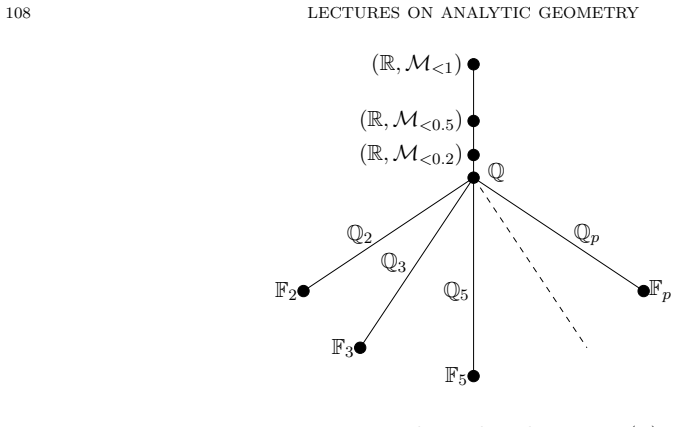
Lectures on Analytic Geometry

Lecture notes develop liquid real vector spaces to unify adic and complex-analytic spaces, with surrounding ideas still relevant for stacks.

Figure from the paper full image
abstract click to expand
This is a slightly updated version of lectures notes for a course on analytic geometry taught in the winter term 2019/20 at the University of Bonn. The material presented is part of joint work with Dustin Clausen. This is intended as a stable citable version of the material. In the first half of this course, we develop the basic theory of liquid real vector spaces, which we used in another course to give a new approach to complex-analytic geometry. In the second half, we gave a tentative definition of a category of analytic spaces that contains (for example) adic spaces and complex-analytic spaces. While the precise definition of analytic spaces represents an abandoned stepping stone on our way to define analytic stacks and hence should be seen as a historical artifact, much of the surrounding discussion stays very relevant.
1 0
0
math.AG 2026-05-06

Twisted cohomology compares directly between algebraic and analytic varieties

Twisted cohomology on algebraic and analytic varieties

Review defines two analytic twisting parameters, reviews algebraic twisting, and shows isomorphisms hold for cohomologous parameters under a

abstract click to expand
In this article, we study and review some aspects of twisted cohomologies on algebraic and analytic varieties. We compared such cohomologies in both the algebraic and analytic categories and defined two types of twisting parameters in the analytic setting, and also discussed algebraic twisting. Several computations are given. We have also reviewed some isomorphisms of such cohomologies for cohomologous twisting parameters. We discussed constraints on the algebraic varieties that should be assumed so that the algebraic de Rham cohomologies on the variety can be twisted.
0
0
math.AG 2026-05-06

Cyclic Higgs bundles match sheaves on noncommutative surfaces

Spectral correspondence for cyclic Higgs bundles

The bijection generalizes known results for U(p,p) bundles and links U(p,q) spectral data to modules over even Clifford algebras of conicibr

abstract click to expand
In this paper, we describe the spectral correspondence for cyclic Higgs bundles from the viewpoint of quiver bundles. Under this framework, we establish a one-to-one correspondence between cyclic Higgs bundles on a curve and sheaves on a noncommutative surface whose noncommutative structure originates from the path algebra associated to the cyclic quiver. As applications, this correspondence generalizes the known spectral correspondence for $U(p,p)$-Higgs bundles and establish a connection between the spectral data for $U(p,q)$-Higgs bundles and modules over the sheaf of even Clifford algebras of a conic fibration.
0
0
math.AG 2026-05-05

Finite groups split by 2-primary extensions satisfy real approximation

Real approximation for homogeneous spaces with finite stabilizers

This holds for homogeneous spaces over number fields with finite stabilizers using Brauer-Manin results for supersolvable cases.

abstract click to expand
We prove some new cases of real appoximation for homogeneous spaces with finite stabilizers and describe the state of the art around this question, giving proofs that are well-known to experts but that, to our knowledge, cannot be found in the literature. Our main new result needs the latest advances in the topic of the Brauer--Manin obstruction for homogeneous spaces with supersolvable stabilizers. It states that any finite $k$-group that is split by a $2$-primary extension satisfies real approximation.
0
0
math.AG 2026-05-05

Atiyah class encodes entire obstruction tower for supermanifold splitting

Formal moduli and the splitting theory of supermanifolds

A filtered dg Lie algebra recovers all Green obstructions from one cocycle and produces Kuranishi relations for families.

abstract click to expand
We develop a formal moduli theory for the splitting problem of complex supermanifolds. Starting from Green's obstruction tower, we construct a finite-step filtered dg Lie algebra which controls splittings by filtered Maurer-Cartan theory. We prove that the classical successive obstruction classes are recovered as the leading terms of adapted Maurer-Cartan representatives, and we transfer the theory to a minimal filtered $L_\infty$-model whose higher brackets give the intrinsic Kuranishi relations among the obstruction coordinates. We also prove that, in a precise filtered sense, the affine Atiyah class contains the entire Green obstruction tower: the Donagi-Witten component gives the primary obstruction, while the higher obstructions arise as successive projected defects and residual classes of the same Atiyah cocycle. We then pass to families, by constructing the fixed-retract formal moduli problem with prescribed split model and by identifying the formal neighbourhood of the split section with the fibrewise deformation theory of the split model; under standard finiteness, base-change, and descent hypotheses this yields relative tangent-obstruction and Kuranishi presentations. Finally, we work out explicit examples of non-split supergeometries, including cases with residual higher obstructions and a first nonlinear Kuranishi relation. These examples illustrate the interaction between Green obstructions, Atiyah classes, and higher $L_\infty$-operations.
0
0
math.AG 2026-05-05

Sp(2n) Gaiotto locus is Bialynicki-Birula closure inside nilpotent cone

Gaiotto Loci and the Nilpotent Cone for Sp_{2n}(mathbb C)

The component linked to Sp(2n-2) meets the stable cotangent chart in the conormal closure to the one-spinor theta stratum.

abstract click to expand
Fix a theta characteristic on a compact Riemann surface and let $G$ be a connected complex semisimple Lie group equipped with a symplectic representation. The moment map sends a nonzero spinor with values in the associated representation bundle to a $G$-Higgs field, and the Zariski closure of the stable Higgs bundles obtained in this way is the corresponding Gaiotto locus. For an arbitrary symplectic representation, the Gaiotto locus is isotropic, and we give a Petri-type criterion for it to be Lagrangian. For the standard representation of $\mathrm{Sp}_{2n}(\mathbb C)$, with $n\geq 2$, where the moment map is $\psi\mapsto\psi\otimes\psi$, the Gaiotto locus lies in the nilpotent cone. We prove that it is the irreducible component obtained as the Bialynicki-Birula closure associated with $\mathcal U(\mathrm{Sp}_{2n-2}(\mathbb C))$. Its intersection with the stable cotangent chart is the closure of the conormal bundle to the one-spinor stratum of the generalized theta divisor.
0
0
math.AG 2026-05-05

Full support holds for pushforwards from universal compactified Jacobians

Support theorem of universal compactified Jacobians

Every summand in the BBDG decomposition of the derived pushforward has support over the entire moduli space of stable curves.

abstract click to expand
We prove a full support theorem for the relative good moduli space of the universal compactified Jacobian $\bar{\pi}\colon \overline{J}_{g,n}^{d,\phi}\to \overline{\mathcal{M}}_{g,n}$, showing that every direct summand appearing in the BBDG decomposition of $\mathrm{R}\bar{\pi}_*\mathrm{IC}(\overline{J}_{g,n}^{d,\phi})$ has full support on the base $\overline{\mathcal{M}}_{g,n}$. Moreover, we explicitly describe this decomposition governed by the derived pushforward of the constant sheaf on the universal curve. The first proof synthesizes Maulik and Shen's generalization of Ng\^{o}'s support theorem, a decomposition theorem for the good moduli space morphism, and equivariant perverse sheaves. We also provide an independent second proof by variation of stability conditions and the support theorem for relative Jacobians by Migliorini, Shende, and Viviani.
0
0
math.AG 2026-05-05

Bures geodesics stay inside Kronecker model only for one-factor cases

Bures Geodesics and Restricted Barycenters for Kronecker Positive Definite Matrices

Ambient geodesics remain in the determinant-normalized set precisely when one factor is fixed or the other is a scalar multiple.

Figure from the paper full image
abstract click to expand
We study the extrinsic Bures--Wasserstein geometry of the determinant-normalized Kronecker model $\mcK_n=\{V\ot U:U,V\in\Sp^n,\ \det U=1\}\subset\Sp^{n^2}$, asking when the ambient Bures geodesic between two Kronecker positive definite matrices can remain in this lower-dimensional model. Local membership near an endpoint is shown to be equivalent to membership of the whole segment, and this happens exactly in the one-factor cases: either $U_1=U_0$ or $V_1$ is a positive scalar multiple of $V_0$. Consequently, any endpoint pair not confined to these one-factor alternatives leaves the model immediately. The criterion is expressed by a partial-trace residual. In fixed commuting charts it becomes an equivalent rank-one square-root profile and yields computable departure diagnostics. We also obtain exact formulas for two restricted barycenter problems: fixed commuting-coordinate slices, solved by Perron singular vectors, and one-factor subfamilies, reduced to standard Bures--Wasserstein barycenters on $\Sp^n$.
0
0
math.AG 2026-05-05

K-holomorphic functions characterized by real-part analyticity

K-holomorphic functions with definable real part

In the semialgebraic case the full function is definable exactly when its real part is definable and strongly R-analytic.

abstract click to expand
Let $R$ be a real closed field and $K:=R(i)$ its algebraic closure. Let $U\subset K^n$ be an open and definable set in a fixed o-minimal structure. In this note, we study the relationship between definability of a $K$-holomorphic function $f=f_1+if_2:U\to K$ and the definability and (strong) $R$-analyticity of its real part $f_1:U\to R$. Our results turn out to be the best possible {in general}, and their precision depends on the considered o-minimal structure. We obtain a complete characterisation in the semialgebraic case.
0
0
math.AG 2026-05-05

Higher Amitsur groups invariant under stable G-birational maps

Birational invariance of higher Amitsur groups

The invariance holds for all n at least 2 on smooth projective varieties with finite group action over characteristic-zero fields.

abstract click to expand
Let $k$ be a field of characteristic zero and $G$ a finite group. We prove that for all $n\geq 2$, the $n$th Amitsur group is a stable $G$-birational invariant of smooth projective $G$-varieties over $k$. This was previously known for $n=2,3$. For smooth projective $G$-varieties with free and finitely generated Picard group, we also prove that the vanishing of the $G$-equivariant universal torsor obstruction implies the vanishing of the $n$th Amitsur group, for all $n\geq 2$. This was known for $n=2$. Our approach allows for effective computations of these obstructions; we illustrate this with several examples.
0

browse all of math.AG → full archive · search · sub-categories