REVIEW 3 major objections 5 minor 2 cited by
Seeing Beyond Views: Multi-View Driving Scene Video Generation with Holistic Attention
T0 review · 3 major / 5 minor · reviewed 2026-08-11 · deepseek-v4-flash
Pith's one-line read CogDriving claims that one holistic attention pass over all views and frames—rather than separate spatial, temporal, and view attention modules—is what makes multi-view driving video generation consistent, and supports the claim with an…
desk verdict The internal ablation supports holistic attention, but the headline FVD comparison to prior work is not protocol-matched and needs verification. read the letter →
The pith
A machine-rendered reading of the paper's core claim, the machinery that carries it, and where it could break.
The reading
What carries the argument
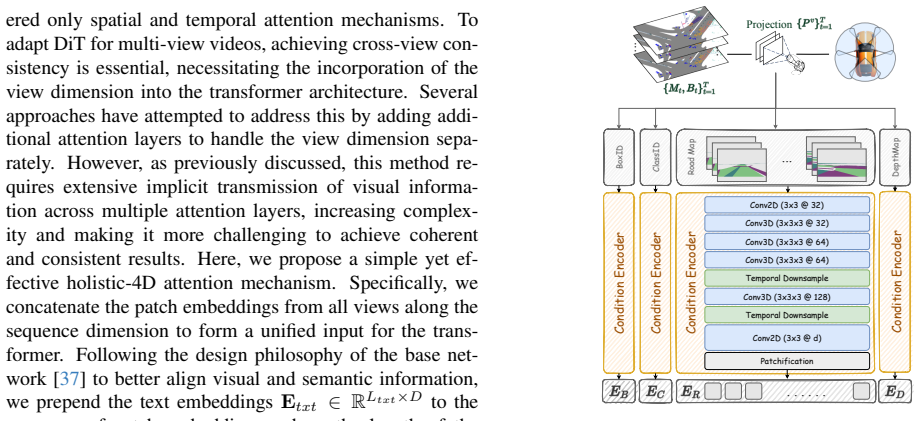
The machinery is the holistic-4D attention module (Eq. 4): one self-attention layer whose input sequence contains every patch token from every view and every frame, plus text tokens, so any token can attend directly to any other regardless of camera or time. The positional encoding (Eq. 3) maps the view coordinate into the existing 3D positional encoding by adding an offset $(v-1)\cdot T'$, allowing pre-trained single-view video weights to be reused without new positional parameters. The paper complements this with the Micro-Controller, a set of four small encoders (road map, box ID, class ID, depth) that inject conditions through cross-normalization at an intermediate transformer layer using roughly 10.53M parameters (about 1.1% of a ControlNet branch), and a re-weighted diffusion loss that multiplies the noise-prediction error by a target mask over object instances to counter foreground-background imbalance.
What would settle it
Generate the full nuScenes validation set with a decoupled-attention model (for instance the paper's own Decouple ST-V variant, or public MagicDrive-V weights) under the exact CogDriving protocol of 16 frames at 720x480, and recompute FVD with identical metric code and clip sampling; if the gap to 37.8 shrinks below statistical noise or reverses, the claimed superiority of holistic-4D attention over decoupled attention would not stand.
Extended reading notes
Core claim
The central claim is that decoupled attention is a bottleneck: views, time, and space should be associated in one self-attention operation. CogDriving concatenates patch embeddings from all six cameras and all 16 frames into a single sequence, prepends text tokens, and applies standard self-attention (Eq. 4), with the 4D positional encoding (Eq. 3) treating the view index as an extension of time. The paper reports FVD 37.8 on nuScenes validation, compared with 139.0 for Panacea and 164.7 for MagicDrive-V, while its own decoupled view-temporal variant (Decouple ST-V) reaches only 69.1. It further claims that replacing the Micro-Controller with a ControlNet-style branch raises FVD to 80.3, and that training perception models with synthetic CogDriving frames lifts Road mIoU from 71.6 to 79.9, Vehicle mIoU from 35.8 to 40.4, mAP from 32.9 to 35.7, and NDS from 37.8 to 39.7.
Load-bearing premise
The headline comparison assumes the published FVD and FID numbers for DriveDreamer, Panacea, DrivingDiffusion, and MagicDrive-V were produced under the same generation and evaluation protocol as CogDriving (clip length, resolution, number of clips, and metric implementation), so that the reported SOTA gap and ranking reflect a real architectural advantage rather than protocol differences.
Editorial extensions
If this is right
- If holistic-4D attention is the cause of the quality gain, other multi-view or surround-view generation tasks could adopt a single joint attention sequence without separate view-specific modules.
- Controllable generation can be achieved with a tiny injected controller rather than a duplicated backbone, making joint 4D attention computationally feasible for training on larger datasets.
- Synthetic driving video at the reported quality can serve as training data: adding CogDriving frames lifts BEV segmentation and 3D detection metrics beyond real-only training.
- The re-weighted objective suggests that foreground/background imbalance is a measurable bottleneck, and upweighting small-object regions during denoising improves downstream detection at fixed inference cost.
- Because the 4D positional encoding reuses the 3D scheme by treating view as an extension of time, adapting a pre-trained single-view video Diffusion Transformer to multi-view generation requires no new positional parameters, easing fine-tuning.
Reading between the lines
- If the comparison protocol is fair, the large FVD gap versus decoupled baselines hints that attention design, not model scale, is the dominant factor in cross-view consistency; a direct follow-up could insert holistic attention into the baselines' own backbones to isolate the mechanism.
- The paper does not test how holistic attention scales with more views or longer clips, where quadratic sequence-length cost may outweigh quality gains; a windowed or block-sparse approximation that keeps cross-view edges could be a natural extension.
- The synthetic-data gains in Table 2 are compared against real-only training and a MagicDrive augmentation baseline; an ablation adding the same number of frames from a decoupled-attention generator would clarify whether the gain comes from video quality or from data diversity and label alignment.
- The re-weighted loss uses projected bounding-box masks; a testable extension is to re-weight by LiDAR density or by a downstream detection loss, which the paper leaves unexplored.
Signed reviews
Editorial analysis
A structured set of objections, weighed in public.
Referee Report
Summary. The paper presents CogDriving, a Diffusion Transformer (DiT) based multi-view driving video generator. The core architectural contribution is a holistic-4D attention module that performs standard self-attention over all spatial tokens from all six camera views and all frames simultaneously, in contrast to the decoupled view/temporal attention used by prior works. It also introduces a lightweight conditioning branch called Micro-Controller (about 1.1% of a full ControlNet's parameters) for BEV layout control, and a re-weighted learning objective that emphasizes object instances. On the nuScenes validation set, the paper reports an FVD of 37.8, which is substantially lower than published FVD values for MagicDrive-V (164.7), Panacea (139.0), and DrivingDiffusion (346.0). The paper further shows that adding CogDriving synthetic data improves CVT BEV segmentation and BEVFusion 3D detection, and provides ablations supporting the holistic-attention design, the Micro-Controller injection layer, and the re-weighted loss.
Significance. If the results hold, the work would be a strong empirical demonstration that a single fully-jointed attention pass over all views and frames is both practical and superior to decoupled attention for multi-view driving video generation. The internal ablation (Table 3) cleanly supports this architectural conclusion under a fixed protocol, and the downstream perception experiments address a practically important use case. The Micro-Controller's parameter efficiency and the re-weighted objective are additional contributions that could benefit the community. However, the headline SOTA claim depends on cross-paper FVD comparisons that are not shown to be protocol-matched, and there is an inconsistency between the Oracle detection baseline in Table 1 and the real-data-only baseline in Table 2; these issues currently prevent the paper from fully establishing the claimed superiority over prior work.
major comments (3)
- [§5.2, Table 1] The headline claim of state-of-the-art generation quality (FVD 37.8 versus 164.7 for MagicDrive-V and 139.0 for Panacea) is not supported by a protocol-matched comparison. The paper specifies its own evaluation protocol in §5.1 (complete nuScenes validation set, 16 frames, 720×480) but provides no evidence that the baseline FVD/FID numbers in Table 1 were computed under the same clip length, resolution, number of clips, or metric implementation. The supplementary material re-runs MagicDrive-V and Panacea only for controllability (Tables 5 and 6), not for generation-quality metrics. Since FVD is sensitive to these choices, the ranking and the magnitude of the SOTA gap could change if baselines were re-evaluated under a common protocol. The internal ablation in Table 3 (FVD 37.8 vs. 69.1 for decoupled attention) supports the benefit of holistic attention within a fixed protocol, but it does not validate the cross-paper SOTA claim.
- [§5.2, Tables 1 and 2] There is an inconsistency in the 3D detection baselines. Table 1 lists the Oracle NDS for BEVFusion trained on the nuScenes training set as 41.2, whereas Table 2's 'w/o synthetic data' row, which should be the same configuration, reports NDS 37.8. This 3.4-point discrepancy indicates that the two tables use different training or evaluation protocols for the detection baseline. Because the downstream-augmentation claim in §5.2—that adding CogDriving data improves perception performance—is based on comparing the 'w/ CogDriving' row (39.7) to the 'w/o synthetic data' row (37.8), the inconsistency undermines the quantitative support for that claim. The authors should reconcile these numbers or explicitly describe the differing protocols.
- [§4.4, Eq. (6)] The re-weighted loss in Eq. (6) is not typeset correctly: the expression 'Mtar ·(ϵ−ϵθ(...))P Mtar' is malformed, and it is unclear whether the loss is normalized by the number of masked pixels or by the mask sum, and where the L2 norm is taken. Because the re-weighted objective is one of the paper's main contributions, the exact formulation must be given in unambiguous mathematical notation. In addition, the text says the objective 'dynamically adjusts' the weights, but λ is fixed at 0.1 and the mask is static per sample; please clarify what is dynamic.
minor comments (5)
- [§5.1] The text states that the first training phase runs for '104 iterations'; this should be written as 10^4 iterations to avoid confusion, and the later '1.5 × 10⁴ iterations' should be written as 1.5 × 10^4 iterations.
- [§4.3, Table 3] The text says that duplicating the 4D attention branch for a ControlNet-like design leads to 'significant challenges in convergence and training stability,' but the CondControlNet ablation in Table 3 reports a finite FVD (80.3). Please clarify whether this variant was trained to convergence or early-stopped, since the reader cannot infer training stability from the final numbers alone.
- [§4.4, Eq. (5)] Eq. (5) refers to R(v,t,h,w) without defining it. Please specify whether R is the projected depth map, the class-ID map, or another condition tensor, because the derivation of the target mask Mtar depends on this definition.
- [Tables 1–3] All quantitative results are based on single runs without error bars or significance tests. Reporting multiple seeds or at least the evaluation protocol (e.g., number of clips, random seed) would strengthen the claims, especially given the large FVD differences.
- [General] The paper would be improved by a short limitations section discussing failure cases, such as rare scenarios or extreme weather conditions, and by acknowledging that the hyperparameters (injection layer 10, λ=0.1) were selected using validation-set feedback.
Circularity Check
No circular derivation; the model is trained and evaluated on held-out data, and the FVD protocol caveat is an evaluation-validity concern, not circularity.
full rationale
CogDriving's central claims are empirical: a DiT with holistic-4D attention is trained on nuScenes and evaluated for FVD/FID on the validation split, while controllability and data-augmentation value are measured with external perception models (CVT and BEVFusion). Nothing in the derivation fits a parameter to the target metric and then reports it as a prediction. The re-weighted objective (Eq. 6) uses the same BEV box annotations that also condition the Micro-Controller, but that is a training-weighting choice, not a circular prediction. The position-encoding identity (Eq. 3) is a definition, not a derived result. The paper's only self-citation is a related-work pointer to ControlVideo [41], which shares co-author Wangmeng Zuo but is not load-bearing for any conclusion. The strongest claim depends on FVD numbers for prior methods (Table 1: MagicDrive-V 164.7, Panacea 139.0, DrivingDiffusion 346.0 vs. CogDriving 37.8) whose evaluation protocols are not shown to match the paper's 16-frame/720x480 protocol; the supplement (Sec. 7) re-runs MagicDrive-V and Panacea only for controllability, not for generation-quality metrics. This is a legitimate verification gap and a fairness caveat, but it is not circularity: those numbers are external measurements rather than consequences of the paper's own definitions or fitted constants.
Assumptions & free parameters
free parameters (3)
- reweighted loss weight lambda =
0.1
- Micro-Controller injection layer index =
10
- LoRA rank =
256
assumptions (4)
- domain assumption Pre-trained CogVideoX weights transfer to multi-view driving video generation
- domain assumption View dimension has low redundancy, so per-view 3D-VAE encoding without view compression is appropriate
- domain assumption BEV layout projections (road maps, box IDs, class IDs, depth) are sufficient conditioning for controllable generation
- domain assumption FVD and FID with standard feature extractors are valid proxies for generation quality and are comparable across methods
Cite this review
Pith. "Pith review of Seeing Beyond Views: Multi-View Driving Scene Video Generation with Holistic Attention." pith.science (2026). https://pith.science/paper/EZVIDK23
@misc{pith2026241203520,
  author       = {Pith},
  title        = {Pith review of: Seeing Beyond Views: Multi-View Driving Scene Video Generation with Holistic Attention},
  year         = {2026},
  howpublished = {\url{https://pith.science/paper/EZVIDK23}},
  note         = {Machine review of arXiv:2412.03520}
}
read the original abstract
Generating multi-view videos for autonomous driving training has recently gained much attention, with the challenge of addressing both cross-view and cross-frame consistency. Existing methods typically apply decoupled attention mechanisms for spatial, temporal, and view dimensions. However, these approaches often struggle to maintain consistency across dimensions, particularly when handling fast-moving objects that appear at different times and viewpoints. In this paper, we present CogDriving, a novel network designed for synthesizing high-quality multi-view driving videos. CogDriving leverages a Diffusion Transformer architecture with holistic-4D attention modules, enabling simultaneous associations across the spatial, temporal, and viewpoint dimensions. We also propose a lightweight controller tailored for CogDriving, i.e., Micro-Controller, which uses only 1.1% of the parameters of the standard ControlNet, enabling precise control over Bird's-Eye-View layouts. To enhance the generation of object instances crucial for autonomous driving, we propose a re-weighted learning objective, dynamically adjusting the learning weights for object instances during training. CogDriving demonstrates strong performance on the nuScenes validation set, achieving an FVD score of 37.8, highlighting its ability to generate realistic driving videos. The project can be found at https://luhannan.github.io/CogDrivingPage/.
Figures


Figures from the paper (5 more)


Forward citations
Cited by 2 Pith papers
-
OpenLongTail: Generative Scaling of Long-Tail Driving Data
Pose-informed diffusion with Plücker rays, depth warps, and cross-view memory converts monocular long-tail videos into multi-view assets that improve closed-loop driving robustness nearly to ground-truth multi-view levels.
-
3D and 4D World Modeling: A Survey
A survey that defines 3D/4D world modeling, organizes methods into VideoGen, OccGen, and LiDARGen categories, and compiles datasets, metrics, and benchmark numbers.
Reference graph
Works this paper leans on
-
[1]
Align your latents: High-resolution video synthesis with la- tent diffusion models
Andreas Blattmann, Robin Rombach, Huan Ling, Tim Dock- horn, Seung Wook Kim, Sanja Fidler, and Karsten Kreis. Align your latents: High-resolution video synthesis with la- tent diffusion models. In Proceedings of the IEEE/CVF Con- ference on Computer Vision and Pattern Recognition, pages 22563–22575, 2023. 2, 3
2023
-
[2]
Video generation models as world simulators
Tim Brooks, Bill Peebles, Connor Holmes, Will DePue, Yufei Guo, Li Jing, David Schnurr, Joe Taylor, Troy Luh- man, Eric Luhman, Clarence Ng, Ricky Wang, and Aditya Ramesh. Video generation models as world simulators
-
[3]
nuscenes: A multi- modal dataset for autonomous driving
Holger Caesar, Varun Bankiti, Alex H Lang, Sourabh V ora, Venice Erin Liong, Qiang Xu, Anush Krishnan, Yu Pan, Gi- ancarlo Baldan, and Oscar Beijbom. nuscenes: A multi- modal dataset for autonomous driving. In Proceedings of the IEEE/CVF conference on computer vision and pattern recognition, pages 11621–11631, 2020. 6, 1
2020
-
[4]
Videocrafter1: Open diffusion models for high-quality video generation
Haoxin Chen, Menghan Xia, Yingqing He, Yong Zhang, Xiaodong Cun, Shaoshu Yang, Jinbo Xing, Yaofang Liu, Qifeng Chen, Xintao Wang, et al. Videocrafter1: Open diffusion models for high-quality video generation. arXiv preprint arXiv:2310.19512, 2023. 2
-
[5]
Videocrafter2: Overcoming data limitations for high-quality video diffusion models
Haoxin Chen, Yong Zhang, Xiaodong Cun, Menghan Xia, Xintao Wang, Chao Weng, and Ying Shan. Videocrafter2: Overcoming data limitations for high-quality video diffusion models. arXiv preprint arXiv:2401.09047, 2024. 2
arXiv 2024
-
[6]
Persformer: 3d lane detection via perspective transformer and the openlane benchmark
Li Chen, Chonghao Sima, Yang Li, Zehan Zheng, Jiajie Xu, Xiangwei Geng, Hongyang Li, Conghui He, Jianping Shi, Yu Qiao, et al. Persformer: 3d lane detection via perspective transformer and the openlane benchmark. In European Con- ference on Computer Vision, pages 550–567. Springer, 2022. 1
work page 2022
-
[7]
Magicdrive3d: Controllable 3d genera- tion for any-view rendering in street scenes
Ruiyuan Gao, Kai Chen, Zhihao Li, Lanqing Hong, Zhenguo Li, and Qiang Xu. Magicdrive3d: Controllable 3d genera- tion for any-view rendering in street scenes. arXiv preprint arXiv:2405.14475, 2024. 1, 2, 3, 6, 7
arXiv 2024
-
[8]
Magicdrive: Street view generation with diverse 3d geometry control
Ruiyuan Gao, Kai Chen, Enze Xie, Lanqing Hong, Zhen- guo Li, Dit-Yan Yeung, and Qiang Xu. Magicdrive: Street view generation with diverse 3d geometry control. In In- ternational Conference on Learning Representations (ICLR),
Show all 45 references
-
[9]
Denoising dif- fusion probabilistic models
Jonathan Ho, Ajay Jain, and Pieter Abbeel. Denoising dif- fusion probabilistic models. Advances in neural information processing systems, 33:6840–6851, 2020. 2
2020
-
[10]
Cogvideo: Large-scale pretraining for text-to-video generation via transformers
Wenyi Hong, Ming Ding, Wendi Zheng, Xinghan Liu, and Jie Tang. Cogvideo: Large-scale pretraining for text-to-video generation via transformers. arXiv preprint arXiv:2205.15868, 2022. 2
2022 arXiv
-
[11]
Lora: Low-rank adaptation of large language models
Edward J Hu, Yelong Shen, Phillip Wallis, Zeyuan Allen- Zhu, Yuanzhi Li, Shean Wang, Lu Wang, and Weizhu Chen. Lora: Low-rank adaptation of large language models. arXiv preprint arXiv:2106.09685, 2021. 6
2021 arXiv
-
[12]
Monocular quasi-dense 3d object tracking
Hou-Ning Hu, Yung-Hsu Yang, Tobias Fischer, Trevor Dar- rell, Fisher Yu, and Min Sun. Monocular quasi-dense 3d object tracking. IEEE Transactions on Pattern Analysis and Machine Intelligence, 45(2):1992–2008, 2022. 1
1992
-
[13]
Bevdet: High-performance multi-camera 3d object de- tection in bird-eye-view
Junjie Huang, Guan Huang, Zheng Zhu, Yun Ye, and Dalong Du. Bevdet: High-performance multi-camera 3d object de- tection in bird-eye-view. arXiv preprint arXiv:2112.11790,
-
[14]
An- chor3dlane: Learning to regress 3d anchors for monocular 3d lane detection
Shaofei Huang, Zhenwei Shen, Zehao Huang, Zi-han Ding, Jiao Dai, Jizhong Han, Naiyan Wang, and Si Liu. An- chor3dlane: Learning to regress 3d anchors for monocular 3d lane detection. In Proceedings of the IEEE/CVF Con- ference on Computer Vision and Pattern Recognition, pages ...
2023
-
[15]
Polarformer: Multi- camera 3d object detection with polar transformer
Yanqin Jiang, Li Zhang, Zhenwei Miao, Xiatian Zhu, Jin Gao, Weiming Hu, and Yu-Gang Jiang. Polarformer: Multi- camera 3d object detection with polar transformer. In Pro- ceedings of the AAAI conference on Artificial Intelligence , pages 1042–1050, 2023. 1
2023
-
[16]
Drivingdif- fusion: Layout-guided multi-view driving scene video 9 generation with latent diffusion model
Xiaofan Li, Yifu Zhang, and Xiaoqing Ye. Drivingdif- fusion: Layout-guided multi-view driving scene video 9 generation with latent diffusion model. arXiv preprint arXiv:2310.07771, 2023. 1, 2, 3, 6, 7
2023 arXiv
-
[17]
Bevformer: Learning bird’s-eye-view representation from multi-camera images via spatiotemporal transformers
Zhiqi Li, Wenhai Wang, Hongyang Li, Enze Xie, Chong- hao Sima, Tong Lu, Yu Qiao, and Jifeng Dai. Bevformer: Learning bird’s-eye-view representation from multi-camera images via spatiotemporal transformers. In European con- ference on computer vision, pages 1–18. Springer, 2022. 1
2022
-
[18]
Nuwa-infinity: Autoregressive over autoregressive generation for infinite visual synthesis
Jian Liang, Chenfei Wu, Xiaowei Hu, Zhe Gan, Jianfeng Wang, Lijuan Wang, Zicheng Liu, Yuejian Fang, and Nan Duan. Nuwa-infinity: Autoregressive over autoregressive generation for infinite visual synthesis. Advances in Neural Information Processing Systems, 35:15420–15432, 2022. 2
2022
-
[19]
Petrv2: A unified framework for 3d perception from multi-camera images
Yingfei Liu, Junjie Yan, Fan Jia, Shuailin Li, Aqi Gao, Tian- cai Wang, and Xiangyu Zhang. Petrv2: A unified framework for 3d perception from multi-camera images. InProceedings of the IEEE/CVF International Conference on Computer Vi- sion, pages 3262–3272, 2023. 1
2023
-
[20]
Bevfusion: Multi- task multi-sensor fusion with unified bird’s-eye view repre- sentation
Zhijian Liu, Haotian Tang, Alexander Amini, Xinyu Yang, Huizi Mao, Daniela L Rus, and Song Han. Bevfusion: Multi- task multi-sensor fusion with unified bird’s-eye view repre- sentation. In 2023 IEEE international conference on robotics and automation (ICRA), pages 2774–2781. I...
2023
-
[21]
On aliased resizing and surprising subtleties in gan evaluation
Gaurav Parmar, Richard Zhang, and Jun-Yan Zhu. On aliased resizing and surprising subtleties in gan evaluation. In Proceedings of the IEEE/CVF Conference on Computer Vision and Pattern Recognition, pages 11410–11420, 2022. 6
2022
-
[22]
Scalable diffusion models with transformers
William Peebles and Saining Xie. Scalable diffusion models with transformers. In Proceedings of the IEEE/CVF Inter- national Conference on Computer Vision, pages 4195–4205,
-
[23]
Controlnext: Powerful and effi- cient control for image and video generation
Bohao Peng, Jian Wang, Yuechen Zhang, Wenbo Li, Ming- Chang Yang, and Jiaya Jia. Controlnext: Powerful and effi- cient control for image and video generation. arXiv preprint arXiv:2408.06070, 2024. 2, 3, 5
2024 arXiv
-
[24]
Colin Raffel, Noam Shazeer, Adam Roberts, Katherine Lee, Sharan Narang, Michael Matena, Yanqi Zhou, Wei Li, and Peter J. Liu. Exploring the limits of transfer learning with a unified text-to-text transformer. Journal of Machine Learn- ing Research, 21(140):1–67, 2020. 5
2020
-
[25]
Frame-recurrent video super-resolution
Mehdi SM Sajjadi, Raviteja Vemulapalli, and Matthew Brown. Frame-recurrent video super-resolution. In Proceed- ings of the IEEE conference on computer vision and pattern recognition, pages 6626–6634, 2018. 7
2018
-
[26]
Score-based generative modeling through stochastic differential equa- tions
Yang Song, Jascha Sohl-Dickstein, Diederik P Kingma, Ab- hishek Kumar, Stefano Ermon, and Ben Poole. Score-based generative modeling through stochastic differential equa- tions. arXiv preprint arXiv:2011.13456, 2020. 2
2011 arXiv
-
[27]
Street- view image generation from a bird’s-eye view layout
Alexander Swerdlow, Runsheng Xu, and Bolei Zhou. Street- view image generation from a bird’s-eye view layout. IEEE Robotics and Automation Letters, 2024. 3, 6, 7
2024
-
[28]
To- wards accurate generative models of video: A new metric & challenges
Thomas Unterthiner, Sjoerd Van Steenkiste, Karol Kurach, Raphael Marinier, Marcin Michalski, and Sylvain Gelly. To- wards accurate generative models of video: A new metric & challenges. arXiv preprint arXiv:1812.01717, 2018. 6
2018 arXiv
-
[29]
Modelscope text-to-video technical report
Jiuniu Wang, Hangjie Yuan, Dayou Chen, Yingya Zhang, Xiang Wang, and Shiwei Zhang. Modelscope text-to-video technical report. arXiv preprint arXiv:2308.06571, 2023. 2
2023 arXiv
-
[30]
Videofactory: Swap at- tention in spatiotemporal diffusions for text-to-video gener- ation
Wenjing Wang, Huan Yang, Zixi Tuo, Huiguo He, Junchen Zhu, Jianlong Fu, and Jiaying Liu. Videofactory: Swap at- tention in spatiotemporal diffusions for text-to-video gener- ation. arXiv preprint arXiv:2305.10874, 2023. 2
2023 arXiv
-
[31]
Drivedreamer: Towards real-world- driven world models for autonomous driving
Xiaofeng Wang, Zheng Zhu, Guan Huang, Xinze Chen, Jia- gang Zhu, and Jiwen Lu. Drivedreamer: Towards real-world- driven world models for autonomous driving. arXiv preprint arXiv:2309.09777, 2023. 3, 6, 7
2023 arXiv
-
[32]
End-to-end video instance segmentation with transformers
Yuqing Wang, Zhaoliang Xu, Xinlong Wang, Chunhua Shen, Baoshan Cheng, Hao Shen, and Huaxia Xia. End-to-end video instance segmentation with transformers. In Proceed- ings of the IEEE/CVF conference on computer vision and pattern recognition, pages 8741–8750, 2021. 4
2021
-
[33]
Lavie: High-quality video gener- ation with cascaded latent diffusion models
Yaohui Wang, Xinyuan Chen, Xin Ma, Shangchen Zhou, Ziqi Huang, Yi Wang, Ceyuan Yang, Yinan He, Jiashuo Yu, Peiqing Yang, et al. Lavie: High-quality video gener- ation with cascaded latent diffusion models. arXiv preprint arXiv:2309.15103, 2023. 2
2023 arXiv
-
[34]
Panacea: Panoramic and controllable video generation for autonomous driving
Yuqing Wen, Yucheng Zhao, Yingfei Liu, Fan Jia, Yanhui Wang, Chong Luo, Chi Zhang, Tiancai Wang, Xiaoyan Sun, and Xiangyu Zhang. Panacea: Panoramic and controllable video generation for autonomous driving. In Proceedings of the IEEE/CVF Conference on Computer Vision and Patter...
2024
-
[35]
Godiva: Gen- erating open-domain videos from natural descriptions
Chenfei Wu, Lun Huang, Qianxi Zhang, Binyang Li, Lei Ji, Fan Yang, Guillermo Sapiro, and Nan Duan. Godiva: Gen- erating open-domain videos from natural descriptions. arXiv preprint arXiv:2104.14806, 2021. 2
2021 arXiv
-
[36]
Bevcontrol: Accurately controlling street- view elements with multi-perspective consistency via bev sketch layout
Kairui Yang, Enhui Ma, Jibin Peng, Qing Guo, Di Lin, and Kaicheng Yu. Bevcontrol: Accurately controlling street- view elements with multi-perspective consistency via bev sketch layout. arXiv preprint arXiv:2308.01661 , 2023. 1, 2, 3, 6, 7
2023 arXiv
-
[37]
Cogvideox: Text-to-video diffusion models with an expert transformer
Zhuoyi Yang, Jiayan Teng, Wendi Zheng, Ming Ding, Shiyu Huang, Jiazheng Xu, Yuanming Yang, Wenyi Hong, Xiao- han Zhang, Guanyu Feng, et al. Cogvideox: Text-to-video diffusion models with an expert transformer. arXiv preprint arXiv:2408.06072, 2024. 2, 4, 5, 6
2024 arXiv
-
[38]
Adding conditional control to text-to-image diffusion models
Lvmin Zhang, Anyi Rao, and Maneesh Agrawala. Adding conditional control to text-to-image diffusion models. In Proceedings of the IEEE/CVF International Conference on Computer Vision, pages 3836–3847, 2023. 2
2023
-
[39]
Mutr3d: A multi-camera tracking frame- work via 3d-to-2d queries
Tianyuan Zhang, Xuanyao Chen, Yue Wang, Yilun Wang, and Hang Zhao. Mutr3d: A multi-camera tracking frame- work via 3d-to-2d queries. In Proceedings of the IEEE/CVF Conference on Computer Vision and Pattern Recognition , pages 4537–4546, 2022. 1
2022
-
[40]
Bytetrackv2: 2d and 3d multi-object tracking by associating every detection box
Y Zhang, X Wang, X Ye, W Zhang, J Lu, X Tan, E Ding, P Sun, and J Wang. Bytetrackv2: 2d and 3d multi-object tracking by associating every detection box. arXiv preprint arXiv:2303.15334. 1
-
[41]
Controlvideo: Training-free controllable text-to-video generation
Yabo Zhang, Yuxiang Wei, Dongsheng Jiang, Xiaopeng Zhang, Wangmeng Zuo, and Qi Tian. Controlvideo: Training-free controllable text-to-video generation. arXiv preprint arXiv:2305.13077, 2023. 2
2023 arXiv
-
[42]
Cross-view transform- ers for real-time map-view semantic segmentation
Brady Zhou and Philipp Kr ¨ahenb¨uhl. Cross-view transform- ers for real-time map-view semantic segmentation. In Pro- 10 ceedings of the IEEE/CVF conference on computer vision and pattern recognition, pages 13760–13769, 2022. 6 11 Seeing Beyond Views: Multi-View Driving Scene ...
2022
-
[43]
For MagicDrive-V , we utilize the official pretrained weights to generate videos on the nuScenes validation split
Quantitative Analysis: Controllability As a supplement to Sec.5.2 and Tab.1 of the main manuscript, we include additional evaluations of the controllabil- ity of MagicDrive-V [7] and Panacea [34], which are state-of-the-art multi-view driving video generation methods. For Magi...
1955
-
[44]
Since MagicDrive-V [7] is the only multi-view video generation method that releases model weights, we use the generation results from MagicDrive-V for comparison
Qualitative Analysis: Controllability As a supplement to Sec.5.3 of the main manuscript, we provide additional visualization results for qualitative analysis in Fig 8. Since MagicDrive-V [7] is the only multi-view video generation method that releases model weights, we use the...
-
[45]
We preprocess these videos by segmenting them into clips of 16 frames
Training Details The training split of the NuScenes [3] dataset contains 700 video clips, each lasting about 20 seconds, with a spatial resolution of 900×1600. We preprocess these videos by segmenting them into clips of 16 frames. The resolution of these clips is resized to 40...
Reviewed August 11, 2026 · model on record in the stance chip above.
Discussion (0). Continue with ORCID to comment.