REVIEW 4 major objections 6 minor 58 references
A nuclear spiral in a dusty star-forming galaxy at $z=2.78$
T0 review · 4 major / 6 minor · reviewed 2026-08-11 · deepseek-v4-flash
Pith's one-line read Long-baseline ALMA observations and pixellated lens modelling resolve the central kiloparsec of the z=2.78 dusty star-forming galaxy SPT0538-50 into a dual spiral arm morphology with a tentative nuclear bar, implying a compact…
desk verdict First sub-kpc look at a DSFG nucleus: a careful lensing reconstruction with a tentative spiral and bar, but the morphology rests on one pipeline and wants a smooth-source null test. read the letter →
The pith
A machine-rendered reading of the paper's core claim, the machinery that carries it, and where it could break.
The reading
What carries the argument
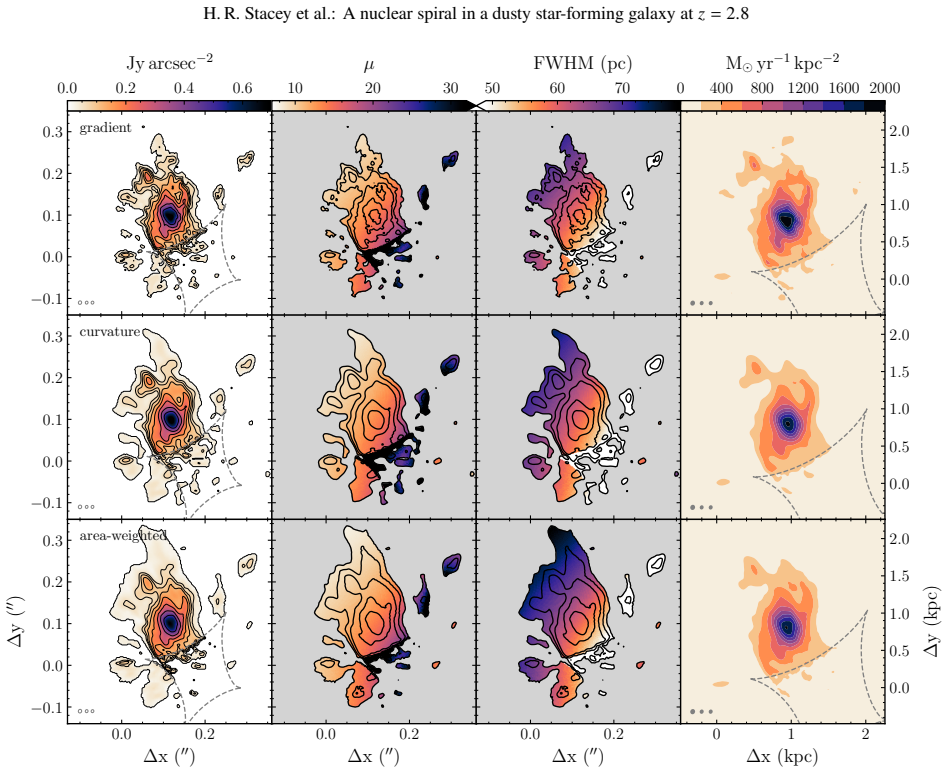
The load-bearing tool is pixellated gravitational lens modelling: a semi-linear inversion that solves for lens parameters and source surface brightness simultaneously, with the source placed on a Delaunay grid adapted to the lens magnification. Long-baseline ALMA observations at 350 GHz (rest-frame about 230 $\mu$m) provide the data, and gravitational magnification boosts the effective resolution to a mean of about 55 pc. The paper tests robustness by repeating the inversion with three regularisation types (gradient, curvature, and area-weighted gradient), then uses isophote fitting with Fourier harmonics to identify the bar's signature in ellipticity and position-angle swing.
What would settle it
A concrete test would be resolved molecular-gas kinematics, for example CO or [CII] line emission at matched sub-kiloparsec resolution: if the reconstructed spiral arms and bar do not trace coherent, rotating gas motions with non-circular streaming along the arms, the morphological features would be artefacts or transient tidal debris rather than a secular nuclear disc. Imaging the lens environment to establish whether the lens is in a group would also decide whether the mass-sheet degeneracy rescales the reported physical numbers.
Extended reading notes
Core claim
The central claim, stated on the paper's own terms, is that the central kiloparsec of SPT0538-50 exhibits a dual spiral arm morphology and a potential nuclear bar that could facilitate gas inflow, feeding the nuclear starburst and supermassive black hole. The authors reconstruct the dust emission at an effective resolution of about 55 pc (varying from below 50 to 80 pc across the source) and show the same morphology emerges under gradient, curvature, and area-weighted gradient source regularisation. A two-dimensional Sérsic fit gives an effective radius of $0.6\pm0.1$ kpc and a Sérsic index of $1.2\pm0.2$, consistent with a compact exponential disc, but the residuals and isophote fits reveal the spiral arms and a position-angle swing of roughly 45 degrees that is a typical signature of a bar. The central region is resolved into two clumps rather than a point source, and the inferred star formation rate density reaches about $2000\ M_\odot\,\mathrm{yr}^{-1}\,\mathrm{kpc}^{-2}$, which the authors call super-Eddington relative to the limit for local ultraluminous infrared galaxies.
Load-bearing premise
The load-bearing premise is that the foreground lens can be treated as an isolated mass distribution; if it actually belongs to a galaxy group, the inferred physical size and star formation rate of the source would be rescaled, although the spiral morphology itself would survive.
Editorial extensions
If this is right
- If the nuclear spiral and bar are real, compact rotationally supported discs existed at z=2.8, with effective radii near 0.6 kpc, 5 to 10 times smaller than typical stellar discs of dusty star-forming galaxies.
- Secular dynamical processes could supply gas to the central 100 pc at rates consistent with the apparent super-Eddington starburst, reducing the need for major mergers to explain compact spheroid formation.
- Strong lensing combined with long-baseline ALMA can reach roughly 55 pc in dusty star-forming galaxies, and smoothing to the native 30 mas resolution erases the spiral, so lensing is currently the only feasible route to these scales.
- Applying the same approach to a sample of lensed dusty star-forming galaxies could determine how common nuclear discs, spirals, and bars are in this population.
- Resolved gas kinematics at matched resolution would test whether the spiral arms and bar trace genuine non-circular gas flows rather than transient tidal debris.
Reading between the lines
- Not in the paper: if nuclear bars are common in dusty star-forming galaxies at cosmic noon, the usual picture in which gas-rich mergers dominate angular-momentum transport would need to share the stage with internal secular evolution.
- Not in the paper: the super-Eddington surface density estimate assumes uniform dust temperature; a radially decreasing temperature gradient would raise the central value, while AGN heating would lower the inferred star formation rate, so multi-frequency dust observations could distinguish these cases.
- Not in the paper: the same lensing technique applied to rest-frame optical or infrared data could test whether these nuclear structures sit inside larger stellar bars or discs, linking nuclear spirals to the large-scale morphology seen by other high-redshift surveys.
Editorial analysis
A structured set of objections, weighed in public.
Referee Report
Summary. The paper presents long-baseline ALMA Band 7 (350 GHz) observations of the gravitationally lensed dusty star-forming galaxy SPT0538-50 at z=2.78, reconstructed in the source plane with the semi-linear pixellated lens-modelling code pronto. The authors use three source-regularisation choices (gradient, curvature, area-weighted gradient) and additional angular freedom in the lens potential, and report a rest-frame ~230 micron map with a surface-brightness-weighted effective resolution of ~55 pc. They find that the central kiloparsec has an exponential profile with effective radius 0.6±0.1 kpc and Sérsic index 1.2±0.2, a dual spiral arm morphology with ~100 pc clumps at 3–9 sigma, a possible nuclear bar within ~300 pc, and a super-Eddington central star-formation-rate surface density of about 2000 M_sun yr^-1 kpc^-2. They interpret these features as evidence that secular dynamical processes can funnel gas into the nucleus, and argue that gravitational lensing combined with long-baseline ALMA is the only way to reach these physical scales at cosmic noon.
Significance. If the reconstruction is faithful, this is a rare and important result: a compact, rotationally supported nuclear disc with spiral structure and a possible bar in a DSFG at z=2.78, at physical scales that are otherwise inaccessible. The paper has real strengths: the morphology is stable across three regularisation types; the reconstructed total flux agrees with an independent APEX/LABOCA measurement; the significance maps come from 1000 noise realisations; and the authors honestly discuss the mass-sheet degeneracy and the uniform dust-temperature assumption. However, the central claim is morphological, so its support depends on the absence of pipeline-induced structure. The evidence does not yet include a smooth-source control or an independent lens-modelling code, and the bar identification rests on isophote position-angle swings that have not been compared with an arm-only model. These gaps are fixable within the manuscript's scope and should be addressed before the result is stated as established.
major comments (4)
- [Section 3, Figs. 2-4] The dual-arm spiral and associated clumps are the central result, but they come from a single inversion pipeline (pronto) whose Delaunay source grid is adapted to the lens magnification. No control experiment is shown in which a known smooth source is passed through the same pipeline and reconstructed, to check that the magnification-adapted grid and the regularisation prior do not imprint coherent elongated structures near the tangential caustics. The 3-sigma mask accounts for noise, data artefacts and non-linear lensing effects, but not for this possible pipeline-level imprinting. The reference to Galan et al. (2024) concerns mock optical data and does not cover the present interferometric case. I request a mock-injection test or an independent source-grid/code reconstruction before the spiral-arm morphology is asserted.
- [Section 3, Fig. 4] The 'potential nuclear bar' is inferred from a swing of the isophote position angle (from about 25 deg at 0.2 kpc to -20 deg at 0.6 kpc) together with ellipticity peaks in Fig. 4. These signatures are also expected for a two-arm spiral or an off-centre clump, and no quantitative comparison is made between a barred-spiral model and an arm-only model (for example, via the Fourier m=2 phase, bar/interarm contrast, or a model-selection statistic). Since the bar appears in the abstract and conclusions, the evidence should be strengthened, or the conclusion should be explicitly limited to 'tentative' and the bar claim removed from the abstract's definitive list.
- [Sections 2 and 3] The source-plane uncertainties and significance maps are generated from 1000 noise realisations at the maximum a posteriori lens model, and the text states that the posterior is narrow. However, the lens model parameters, including the multipole coefficients and the regularisation hyper-parameter, were determined jointly with the source surface brightness, so their covariance contributes to the total uncertainty. Neglecting these terms may understate the uncertainties on clump significance and on the isophote parameters used for the bar claim. Please report or bound the effect of lens-model parameter variations, or justify quantitatively why the narrow posterior implies a negligible contribution to the source-plane maps.
- [Section 4] The mass-sheet/group-environment degeneracy is acknowledged, and the authors correctly note that it would not change the morphology; however, it directly changes the physical scale (including the quoted ~55 pc resolution and the 0.6 kpc effective radius) and the super-Eddington surface-density interpretation. Because the lens environment of SPT0538-50 is unknown, this degeneracy is a live source of error in the astrophysical conclusions, not merely a caveat. At minimum, please estimate the range of magnification and physical-scale shifts allowed by plausible group contributions, or state more explicitly how the main conclusions would move under such a transform.
minor comments (6)
- [Section 2, second paragraph] Please clarify how the Delaunay source-grid vertex density is set relative to the magnification map and whether the same grid is used for all three regularisation types; this affects the interpretation of the median vertex spacing of ~50 pc quoted in Section 3.
- [Section 3, first paragraph] The definition of the 'surface-brightness-weighted mean FWHM of 55 pc' should be more explicit: state whether this is computed from the magnification-corrected beam in Fig. 2 and whether the three regularisation types give individually consistent values.
- [Section 3, Sérsic fit] The statement that the Sérsic fit is poor (Fig. 3) would benefit from a quantitative goodness-of-fit statistic and from reporting the priors, chain length, and convergence of the emcee fit.
- [Section 3, Fig. 2 caption] The phrase 'contours of signal-to-noise ratio in steps of 3-sigma' is ambiguous; specify whether these contours come from the noise-realisation significance maps or from the lensed image, and define the sigma used.
- [Section 4, first paragraph] There is a typographical double parenthesis after the citation 'Erwin et al. 2015))' that should be corrected.
- [Section 4, third paragraph] The statement that smoothing the source to the native 30 mas resolution erases any evidence of the spiral is expected given the resolution loss; it should not be used as a robustness argument without a forward-modelled low-resolution mock source.
Circularity Check
No significant circularity: the spiral and bar claims are descriptive outputs of the lens inversion, not fitted inputs, and the self-cited lens model is an independent prior fit to the same data.
full rationale
The paper's central claims are morphological: the reconstructed source is described as having a dual spiral arm morphology and a possible nuclear bar. These features are properties of the pixellated lens-inversion output, not parameters that were fitted to the data and then relabelled as predictions. The lens model itself is taken from Stacey et al. (2024), a self-citation, but that work fitted the lens to the same ALMA visibilities, and this paper extends it by testing three regularisation types and additional angular freedom. The paper explicitly states that the three regularisation types produce consistent source morphologies, and it masks regions below 3-sigma significance. No equation or definition in the paper reduces a predicted quantity to an input fitted value. The acknowledged mass-sheet degeneracy changes the physical scale and inferred star formation rate but not the structure, so it does not make the morphological claim circular. The absence of an independent lens-modelling code or a smooth-source null test is a robustness concern, not a circularity concern. Overall, there is no load-bearing circular step that meets the evidentiary bar of quoting a specific reduction by construction.
Assumptions & free parameters
free parameters (4)
- Lens model parameters (power-law slope, ellipticity, position angle, external shear, multipole coefficients) =
Posterior distributions from Stacey et al. (2024); not restated here
- Source regularisation hyper-parameter =
Chosen by Bayesian evidence; exact value not quoted
- Sersic profile parameters (effective radius, index, position angle) =
Re = 0.6 +/- 0.1 kpc, n = 1.2 +/- 0.2, PA = 4 +/- 3 deg
- Assumed uniform dust temperature and emissivity =
From the SED fit of Reuter et al. (2020); values not restated
assumptions (5)
- domain assumption The lens mass distribution is well described by an ellipsoidal power-law with external shear and multipole perturbations up to fourth order.
- domain assumption The source surface brightness is smooth on the Delaunay grid, enforced by a regularisation prior.
- domain assumption Dust temperature and emissivity are uniform over the source when computing SFR surface density.
- ad hoc to paper There is no significant mass-sheet degeneracy or unmodelled group contribution to the lens potential.
- domain assumption Rest-frame 230 micron continuum traces obscured star formation with a Kroupa IMF and a modified blackbody SED.
Cite this review
Pith. "Pith review of A nuclear spiral in a dusty star-forming galaxy at $z=2.78$." pith.science (2026). https://pith.science/paper/7KO3KRFG
@misc{pith2026241203644,
  author       = {Pith},
  title        = {Pith review of: A nuclear spiral in a dusty star-forming galaxy at $z=2.78$},
  year         = {2026},
  howpublished = {\url{https://pith.science/paper/7KO3KRFG}},
  note         = {Machine review of arXiv:2412.03644}
}
abstract
The nuclear structure of dusty star-forming galaxies is largely unexplored but harbours critical information about their structural evolution. Here, we present long-baseline Atacama Large (sub-)Millimetre Array (ALMA) continuum observations of a gravitationally lensed dusty star-forming galaxy at $z=2.78$. We use a pixellated lens modelling analysis to reconstruct the rest-frame 230 $\rm\mu$m dust emission with a mean resolution of $\approx55$ pc and demonstrate that the inferred source properties are robust to changes in lens modelling methodology. The central 1 kpc is characterised by an exponential profile, a dual spiral arm morphology and an apparent super-Eddington compact central starburst. We find tentative evidence for a nuclear bar in the central 300 pc. These features may indicate that secular dynamical processes play a role in accumulating a high concentration of cold gas that fuels the rapid formation of a compact stellar spheroid and black hole accretion. We propose that the high spatial resolution provided by long-baseline ALMA observations and strong gravitational lensing will give key insights into the formation mechanisms of massive galaxies.
Figures


Figures from the paper (1 more)

Reference graph
Works this paper leans on
-
[1]
2024, arXiv e-prints, arXiv:2404.01918 Anglés-Alcázar, D., Quataert, E., Hopkins, P
Amvrosiadis, A., Lange, S., Nightingale, J., et al. 2024, arXiv e-prints, arXiv:2404.01918 Anglés-Alcázar, D., Quataert, E., Hopkins, P. F., et al. 2021, ApJ, 917, 53 AstropyCollaboration,Price-Whelan,A.M.,Sipőcz,B.M.,etal.2018,AJ,156, 123 Astropy Collaboration, Robitaille, T. P., Tollerud, E. J., et al. 2013, A&A, 558, A33
arXiv 2024
-
[2]
2019, A&A, 632, A33 Barcos-Muñoz, L., Leroy, A
Audibert, A., Combes, F., García-Burillo, S., et al. 2019, A&A, 632, A33 Barcos-Muñoz, L., Leroy, A. K., Evans, A. S., et al. 2017, ApJ, 843, 117
work page 2019
-
[3]
Bothwell, M. S., Aguirre, J. E., Chapman, S. C., et al. 2013, ApJ, 779, 67
work page 2013
-
[4]
2023, astropy/photutils: 1.10.0
Bradley, L., Sipőcz, B., Robitaille, T., et al. 2023, astropy/photutils: 1.10.0
work page 2023
-
[5]
& Crocker, D
Buta, R. & Crocker, D. A. 1993, AJ, 105, 1344
1993
-
[6]
M., Narayanan, D., & Cooray, A
Casey, C. M., Narayanan, D., & Cooray, A. 2014, Phys. Rep., 541, 45
2014
-
[7]
2013, A&A, 558, A124
Combes, F., García-Burillo, S., Casasola, V., et al. 2013, A&A, 558, A124
2013
-
[8]
Conselice, C. J. 2014, ARA&A, 52, 291
2014
Show all 58 references
-
[9]
G., Guo, Y., et al
Costantin, L., Pérez-González, P. G., Guo, Y., et al. 2023, Nature, 623, 499
2023
-
[10]
I., Maciejewski, W., Hicks, E
Davies, R. I., Maciejewski, W., Hicks, E. K. S., et al. 2009, ApJ, 702, 114
2009
-
[11]
& Burkert, A
Dekel, A. & Burkert, A. 2014, MNRAS, 438, 1870 Di Mascia, F., Carniani, S., Gallerani, S., et al. 2023, MNRAS, 518, 3667
2014
-
[12]
L., Theis, C., Pringle, J
Dobbs, C. L., Theis, C., Pringle, J. E., & Bate, M. R. 2010, MNRAS, 403, 625
2010
-
[13]
& Shlosman, I
Englmaier, P. & Shlosman, I. 2000, ApJ, 528, 677
2000
-
[14]
& Shlosman, I
Englmaier, P. & Shlosman, I. 2004, ApJ, 617, L115
2004
-
[15]
P., Fabricius, M., et al
Erwin, P., Saglia, R. P., Fabricius, M., et al. 2015, MNRAS, 446, 4039
2015
-
[16]
W., Lang, D., & Goodman, J
Foreman-Mackey, D., Hogg, D. W., Lang, D., & Goodman, J. 2013, PASP, 125, 306
2013
-
[17]
2021, A&A, 647, A194
Fraternali, F., Karim, A., Magnelli, B., et al. 2021, A&A, 647, A194
2021
-
[18]
A., Athanassoula, E., Carrasco, L., et al
Gadotti, D. A., Athanassoula, E., Carrasco, L., et al. 2007, MNRAS, 381, 943
2007
-
[19]
A., Bittner, A., Falcón-Barroso, J., et al
Gadotti, D. A., Bittner, A., Falcón-Barroso, J., et al. 2020, A&A, 643, A14 Galan,A.,Vernardos,G.,Minor,Q.,etal.2024,arXive-prints,arXiv:2406.08484 García-Burillo, S., Combes, F., Schinnerer, E., Boone, F., & Hunt, L. K. 2005, A&A, 441, 1011
2020 arXiv
-
[20]
2024, A&A, 691, A299
Gillman, S., Smail, I., Gullberg, B., et al. 2024, A&A, 691, A299
2024
-
[21]
R., Millman, K
Harris, C. R., Millman, K. J., van der Walt, S. J., et al. 2020, Nature, 585, 357
2020
-
[22]
Hodge, J. A. & da Cunha, E. 2020, Royal Society Open Science, 7, 200556
2020
-
[23]
A., da Cunha, E., Kendrew, S., et al
Hodge, J. A., da Cunha, E., Kendrew, S., et al. 2024, arXiv e-prints, arXiv:2407.15846
2024 arXiv
-
[24]
A., Smail, I., Walter, F., et al
Hodge, J. A., Smail, I., Walter, F., et al. 2019, ApJ, 876, 130
2019
-
[25]
F., Bundy, K., Murray, N., et al
Hopkins, P. F., Bundy, K., Murray, N., et al. 2009, MNRAS, 398, 898
2009
-
[26]
Hunter, J. D. 2007, Computing in Science & Engineering, 9, 90
2007
-
[27]
2006, Physics of Active Galactic Nuclei at all Scales, 693, 143 Knapen,J.H.,Beckman,J.E.,Heller,C.H.,Shlosman,I.,&deJong,R.S.1995, ApJ, 454, 623
Jogee, S. 2006, Physics of Active Galactic Nuclei at all Scales, 693, 143 Knapen,J.H.,Beckman,J.E.,Heller,C.H.,Shlosman,I.,&deJong,R.S.1995, ApJ, 454, 623
2006
-
[28]
2022, MNRAS, 510, 3266
Kretschmer, M., Dekel, A., & Teyssier, R. 2022, MNRAS, 510, 3266
2022
-
[29]
2001, MNRAS, 322, 231
Kroupa, P. 2001, MNRAS, 322, 231
2001
-
[30]
R., Burkhart, B., Forbes, J
Krumholz, M. R., Burkhart, B., Forbes, J. C., & Crocker, R. M. 2018, MNRAS, 477, 2716
2018
-
[31]
2024, ApJ, 968, L15 Le Conte, Z
Kuhn, V., Guo, Y., Martin, A., et al. 2024, ApJ, 968, L15 Le Conte, Z. A., Gadotti, D. A., Ferreira, L., et al. 2024, MNRAS, 530, 1984
2024
-
[32]
A., Bureau, M., et al
Lelli, F., Davis, T. A., Bureau, M., et al. 2022, MNRAS, 516, 4066
2022
-
[33]
M., Fraternali, F., et al
Lelli, F., Di Teodoro, E. M., Fraternali, F., et al. 2021, Science, 371, 713
2021
-
[34]
G., et al
Lelli, F., Zhang, Z.-Y., Bisbas, T. G., et al. 2023, A&A, 672, A106 Liu,D.,FörsterSchreiber,N.M.,Harrington,K.C.,etal.2024,NatureAstronomy Martini,P.,Regan,M.W.,Mulchaey,J.S.,&Pogge,R.W.2003,ApJS,146,353
2023
-
[35]
Mihos, J. C. & Hernquist, L. 1996, ApJ, 464, 641
1996
-
[36]
M., & McKean, J
Ndiritu, S., Vegetti, S., Powell, D. M., & McKean, J. P. 2024, arXiv e-prints, arXiv:2407.19015 Planck Collaboration, Aghanim, N., Akrami, Y., et al. 2020, A&A, 641, A6
2024 arXiv
-
[37]
P., et al
Powell, D., Vegetti, S., McKean, J. P., et al. 2021, MNRAS, 501, 515
2021
-
[38]
M., Vegetti, S., McKean, J
Powell, D. M., Vegetti, S., McKean, J. P., et al. 2022, MNRAS, 516, 1808 Prieto,M.A.,Fernandez-Ontiveros,J.A.,Bruzual,G.,etal.2019,MNRAS,485, 3264
2022
-
[39]
S., et al
Reddish, J., Kraljic, K., Petersen, M. S., et al. 2022, MNRAS, 512, 160
2022
-
[40]
D., Spilker, J
Reuter, C., Vieira, J. D., Spilker, J. S., et al. 2020, ApJ, 902, 78
2020
-
[41]
2019, MNRAS, 485, 2179
Ritondale, E., Vegetti, S., Despali, G., et al. 2019, MNRAS, 485, 2179
2019
-
[42]
2024, A&A, 689, A273
Rizzo, F., Bacchini, C., Kohandel, M., et al. 2024, A&A, 689, A273
2024
-
[43]
2023, A&A, 679, A129
Rizzo, F., Roman-Oliveira, F., Fraternali, F., et al. 2023, A&A, 679, A129
2023
-
[44]
2018, MNRAS, 481, 5606
Rizzo, F., Vegetti, S., Fraternali, F., & Di Teodoro, E. 2018, MNRAS, 481, 5606
2018
-
[45]
R., & Powell, D
Rizzo, F., Vegetti, S., Fraternali, F., Stacey, H. R., & Powell, D. 2021, MNRAS, 507, 3952
2021
-
[46]
2023, MNRAS, 521, 1045
Roman-Oliveira, F., Fraternali, F., & Rizzo, F. 2023, MNRAS, 521, 1045
2023
-
[47]
P., Vegetti, S., Andreani, P., & White, S
Rybak, M., McKean, J. P., Vegetti, S., Andreani, P., & White, S. D. M. 2015, MNRAS, 451, L40
2015
-
[48]
Sanders, D. B. & Mirabel, I. F. 1996, ARA&A, 34, 749
1996
-
[49]
M., et al
Sheth, K., Melbourne, J., Elmegreen, D. M., et al. 2012, ApJ, 758, 136
2012
-
[50]
Shlosman, I., Frank, J., & Begelman, M. C. 1989, Nature, 338, 45
1989
-
[51]
R., McKean, J
Stacey, H. R., McKean, J. P., Powell, D. M., et al. 2021, MNRAS, 500, 3667
2021
-
[52]
R., Powell, D
Stacey, H. R., Powell, D. M., Vegetti, S., et al. 2024, A&A, 688, A110
2024
-
[53]
1981, Structure and Evolution of Normal Galaxies, 111
Toomre, A. 1981, Structure and Evolution of Normal Galaxies, 111
1981
-
[54]
& Iguchi, S
Tsukui, T. & Iguchi, S. 2021, Science, 372, 1201
2021
-
[55]
2024, MNRAS, 527, 8941
Tsukui, T., Wisnioski, E., Bland-Hawthorn, J., et al. 2024, MNRAS, 527, 8941
2024
-
[56]
& Koopmans, L
Vegetti, S. & Koopmans, L. V. E. 2009, MNRAS, 392, 945
2009
-
[57]
E., et al
Virtanen, P., Gommers, R., Oliphant, T. E., et al. 2020, Nature Methods, 17, 261
2020
-
[58]
2022, ApJ, 927, 21
Walter, F., Neeleman, M., Decarli, R., et al. 2022, ApJ, 927, 21
2022
Reviewed August 11, 2026 · model on record in the stance chip above.
Discussion (0). Continue with ORCID to comment.