REVIEW 3 major objections 4 minor 1 cited by
Constraining the link between the 2175{\AA} dust absorption feature and PAHs in Nearby Star-Forming Galaxies using Swift/UVOT and JWST/MIRI
T0 review · 3 major / 4 minor · reviewed 2026-08-11 · deepseek-v4-flash
Pith's one-line read This paper tests whether the 2175 Å dust absorption bump and PAH abundance are linked within galaxies, measuring both in resolved regions of 15 nearby star-forming galaxies and controlling for the radiation field.
desk verdict First multi-galaxy resolved test of the 2175A bump-PAH link with JWST/MIRI, but the partial-correlation test is only as good as the RPAH proxy, and that proxy has a known dust-heating degeneracy. read the letter →
The pith
A machine-rendered reading of the paper's core claim, the machinery that carries it, and where it could break.
The reading
What carries the argument
The load-bearing machinery is two photometric indices and one statistical test. The bump strength $k_{\mathrm{bump}}=A_{\mathrm{bump}}/E(B-V)_{\mathrm{gas}}$ is formed from three Swift/UVOT filters, with the UVM2 filter sampling the 2175 Å feature and the two wide filters defining the UV continuum; the PAH abundance proxy $R_{\mathrm{PAH}}=(F770W+F1130W)/F2100W$ uses JWST/MIRI filters on the 7.7 and 11.3 µm PAH features over a warm-dust continuum baseline. The statistical test is the partial Spearman correlation of Eq. (13), which asks whether the bump–PAH correlation survives after controlling for $\Sigma_{\mathrm{SFR}}$; it does not, giving $\rho_{AB|C}=0.02$. The machinery also includes a comparison of the $\Sigma_{\mathrm{SFR}}$ dependence of mid-infrared luminosity ratios, which shows that the $R_{\mathrm{PAH}}$ trend can be produced by dust heating as well as by PAH destruction.
What would settle it
Measure the 7.7 and 11.3 µm PAH features spectroscopically in these 15 galaxies, fit the underlying dust continuum, and redo the partial-correlation test with the resulting dust-independent PAH abundance; if that abundance still correlates with $k_{\mathrm{bump}}$ at fixed $\Sigma_{\mathrm{SFR}}$, the paper's conclusion is overturned.
Extended reading notes
Core claim
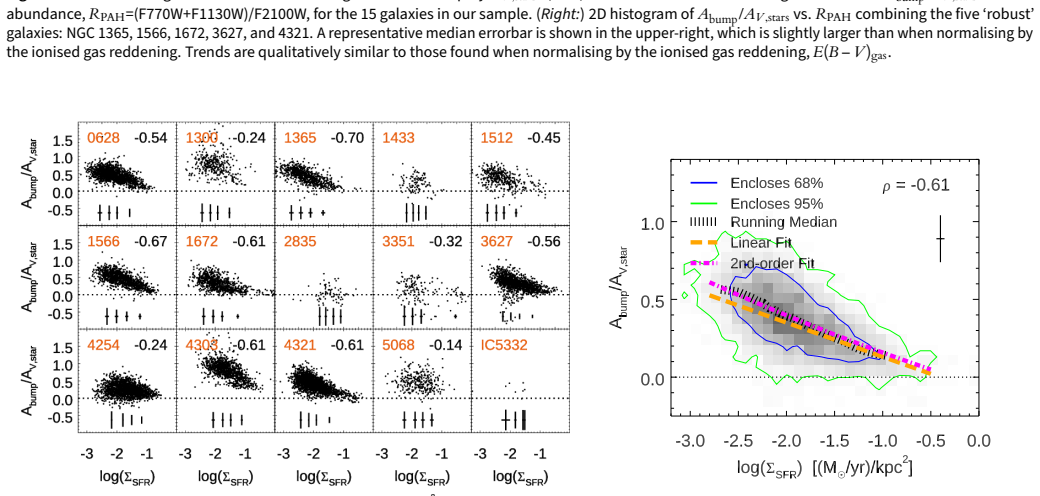
The paper's central claim is that the apparent correlation between the intrinsic 2175 Å bump strength $k_{\mathrm{bump}}=A_{\mathrm{bump}}/E(B-V)_{\mathrm{gas}}$ and the PAH proxy $R_{\mathrm{PAH}}=(F770W+F1130W)/F2100W$ is largely an artefact of both quantities responding to the ionizing radiation field. In the five galaxies with the most reliable bump measurements, the raw Spearman correlation is only $\rho \approx 0.3$–$0.5$, with large intrinsic scatter, while $k_{\mathrm{bump}}$ and $R_{\mathrm{PAH}}$ each correlate more strongly with $\Sigma_{\mathrm{SFR}}$ and sSFR ($\rho \approx -0.6$). A partial-correlation calculation holding $\Sigma_{\mathrm{SFR}}$ fixed gives $\rho_{AB|C}=0.02$, and subdividing regions into $\Sigma_{\mathrm{SFR}}$ quartiles leaves $\rho \lesssim 0.3$; the paper therefore concludes that the data disfavour a direct physical link between the bump carrier and PAHs. The same qualitative conclusion holds when the bump is normalised by stellar reddening from SED fitting instead of gas reddening.
Load-bearing premise
The analysis assumes the photometric ratio $R_{\mathrm{PAH}}=(F770W+F1130W)/F2100W$ tracks PAH abundance rather than being lowered by dust heating in high star-formation regions; if dust heating drives its trend, the partial-correlation result that disfavours a direct PAH link is biased.
Editorial extensions
If this is right
- If correct, the moderate bump–PAH correlation seen in galaxy spectra should not be read as evidence that PAHs are the 2175 Å carrier without first controlling for the radiation field.
- Dust corrections in strongly star-forming regions should not assume a fixed bump strength, since the bump weakens with increasing $\Sigma_{\mathrm{SFR}}$ and sSFR.
- The $R_{\mathrm{PAH}}$ anti-correlation with $\Sigma_{\mathrm{SFR}}$ is ambiguous: it can flag PAH destruction by UV photons or simply hotter dust raising the F2100W baseline, so mid-IR spectroscopy is needed to separate the two.
- The paper's prescriptions for $k_{\mathrm{bump}}$ and $R_{\mathrm{PAH}}$ as functions of $\Sigma_{\mathrm{SFR}}$ and sSFR apply to local massive, metal-rich galaxies, but the $k_{\mathrm{bump}}$ values should be treated as lower limits because the Swift/UVOT filters underestimate the bump.
- Within the narrow metallicity range $8.40<12+\log(\mathrm{O/H})<8.65$, no significant metallicity trends are found for either quantity.
Reading between the lines
- Inference: a decisive follow-up is mid-IR spectroscopy that isolates the PAH features from the dust continuum; if a spectroscopically measured PAH abundance still correlates with $k_{\mathrm{bump}}$ at fixed $\Sigma_{\mathrm{SFR}}$, the null result would be overturned.
- Inference: the same partial-correlation strategy could be applied to unresolved high-redshift galaxies using sSFR as the control, where the bump–sSFR relation from earlier spectroscopic work should line up with the local relation after accounting for main-sequence evolution.
- Inference: the preliminary inclination trend suggests line-of-sight diffuse dust adds 2175 Å absorption without corresponding PAH emission, so face-on galaxies should show stronger bump–PAH correlations than edge-on ones in a larger sample.
- Inference: if broad-band UV filters underestimate bump strengths by factors of roughly three to four, photometric surveys may need calibration corrections before their bump measurements can be used as quantitative dust tracers.
Editorial analysis
A structured set of objections, weighed in public.
Referee Report
Summary. This paper uses Swift/UVOT three-filter (UVW2, UVM2, UVW1) photometry and JWST/MIRI (F770W, F1130W, F2100W) plus Spitzer/IRAC data to measure, in spatially resolved regions of 15 nearby PHANGS galaxies (with a 'robust' subset of five), the 2175Å bump strength kbump and a photometric PAH abundance proxy RPAH = (F770W + F1130W)/F2100W. The authors find a moderate positive correlation between kbump and RPAH (Spearman rho ~ 0.3-0.5) but also stronger negative correlations of both quantities with SFR surface density and specific SFR (rho ~ -0.6). Using a partial Spearman correlation (Eq. 13), they obtain rho_AB|C = 0.02 when controlling for Sigma_SFR, and rho_AB|C = 0.19 when controlling for sSFR. They interpret this as evidence that the apparent kbump-RPAH correlation is an indirect consequence of both quantities declining with ionizing radiation intensity, 'disfavouring a direct link' between the bump carrier and PAHs. The paper provides fitting prescriptions for kbump and RPAH as functions of Sigma_SFR and sSFR, and includes extensive appendices on the reliability of the UVOT bump measurement and on the choice of reddening normalization. The authors explicitly acknowledge that the RPAH proxy may be influenced by dust heating and that mid-IR spectroscopy is needed to break this degeneracy.
Significance. If the central claim holds, this is a valuable observational constraint on the carrier of the 2175Å bump in external galaxies, using resolved data that connect UV absorption to mid-IR PAH emission for the first time at ~100 pc scales. The paper is careful in its data handling, uses public PHANGS data products, and provides transparent caveats about the limitations of photometric proxies. The appendices (especially Appendix 1, which calibrates the UVOT-derived kbump against simulated intrinsic bumps, and Appendix 2, which checks the reddening normalization) are a strength. However, the headline conclusion rests on the assumption that RPAH faithfully traces PAH abundance, which is undermined by the dust-heating degeneracy that the authors themselves describe, and on a partial correlation coefficient reported without uncertainty. These issues are fixable and do not invalidate the dataset, but they currently limit the strength of the claim that PAHs are not directly linked to the 2175Å carrier.
major comments (3)
- [Section 5.1, Eq. (13)] The partial correlation rho_AB|C = 0.02 is interpreted as 'disfavouring a direct link' between the 2175Å bump and PAHs. This interpretation presupposes that RPAH is a faithful PAH abundance proxy. However, RPAH uses F2100W (warm-dust continuum) in the denominator, and the authors themselves state in Section 5.1 that the RPAH-Sigma_SFR trend 'can be also explained with dust heating, rather than PAH destruction' (see also Eq. 14 and Figure 13). If dust heating drives part of the RPAH-Sigma_SFR anti-correlation, then residualising both kbump and RPAH on Sigma_SFR removes a dust-temperature signal from RPAH, and the near-zero partial correlation is not evidence against a direct bump-PAH link. The paper should either provide a PAH index that is robust against dust-heating variations (e.g., a PAH-feature-to-total-IR ratio, or a version of RPAH using a cooler continuum band) or explicitly re-frame the conclusion as conditional on the PAH proxy being unaffected by dust heating. A concrete test would be to repeat the partial-correlation analysis using a PAH measure that does not divide by F2100W or another warm-dust continuum.
- [Section 5.1, Eq. (13)] The partial correlation coefficient is reported as a point estimate (0.02) without any measure of uncertainty. The underlying Spearman coefficients in Table 3 are based on a finite sample of five galaxies (with a few hundred to a few thousand regions per galaxy, but the combined fit gives equal weight per region), and the sampling uncertainty on rho_AB|C could be substantial. A bootstrap or jackknife confidence interval, or at least a p-value, is needed to support the claim that the partial correlation is consistent with zero and significantly smaller than the uncontrolled kbump-RPAH correlation of ~0.3-0.5. Without this, the strength of the conclusion 'disfavouring a direct link' is not quantified.
- [Appendix 1, Figure 15] The mapping between the UVOT-derived kbump and the intrinsic bump strength is shown to be linear with slope 0.30 (FWHM=470Å) and 0.26 (FWHM=274Å), but the Drude FWHM is not measured per region. If the true FWHM of the 2175Å feature varies region-to-region, or correlates with Sigma_SFR or other environmental properties, the scaling factor is not constant and the rank order of kbump_obs may not preserve the rank order of the intrinsic bump strength. Because the central claim uses Spearman (rank) correlations, the authors should demonstrate via simulation that plausible FWHM variations (e.g., a distribution of FWHM values drawn from the range in Figure 14, possibly correlated with Sigma_SFR) do not change the sign or significance of the partial correlation in Eq. (13). The current Appendix 1 tests only two discrete FWHM values and shows that the mapping is insensitive to E(B-V) variation, which is not sufficient to rule out FWHM-induced bias in the correlations.
minor comments (4)
- [Abstract] The abstract's statement that the results are 'disfavouring a direct link' is stronger than the body's more cautious phrasing, where the authors note that the RPAH trend 'can be also explained with dust heating, rather than PAH destruction.' Consider softening the abstract to match the caveats in Section 5.1.
- [Section 3.3, Eq. (7)] The stellar continuum subtraction for RPAH assumes a single blackbody temperature T_eff = 5000 K. The median fraction of emission removed is ~5.6% in F770W and ~1-2% in the other bands; this is not negligible for F770W and could introduce scatter in RPAH if the true stellar population varies. The authors could propagate this assumption as a systematic uncertainty or test the sensitivity with T_eff = 4000-6000 K.
- [Table 3] The table would be more informative if it reported the number of regions used in the combined five-galaxy fits and the p-values (or significance levels) of the Spearman correlation coefficients, allowing readers to assess the statistical weight behind the partial correlation value in Eq. (13).
- [Section 3.1 and Appendix 1] The statement in Section 3.1 that 'the correlations observed and presented in this work should be robust' relies on the linear mapping in Appendix 1, but the FWHM dependence of the scaling factor is not discussed there. A brief sentence noting this limitation (and referring to Appendix 1) would help readers interpret the robustness claim.
Circularity Check
No significant circularity: kbump, RPAH, and Sigma_SFR are independently measured, the partial-correlation test is not a fitted prediction, and the acknowledged dust-heating degeneracy is a stated caveat rather than a circular step.
full rationale
The paper's derivation chain is not circular. The three central quantities are built from independent data: kbump from Swift/UVOT photometry normalized by MUSE Balmer-decrement reddening (Section 3.1), RPAH from JWST/MIRI PAH-filter fluxes with an IRAC-based stellar-continuum subtraction (Section 3.3), and Sigma_SFR from extinction-corrected MUSE H-alpha (Section 3.4). The partial-correlation coefficient in Eq. 13 is a standard statistic applied to measured Spearman ranks from Table 3, not a fitted parameter relabeled as a prediction, and the 'prescriptions' in Section 4 are fits to the data, not claimed predictions. The RPAH proxy is adopted from external PHANGS-JWST work (Chastenet et al. 2023; Sutter et al. 2024), not from the authors' own prior results; self-citations such as Calzetti et al. (2024) and Battisti et al. (2020) are used as empirical calibrations or robustness checks and are not load-bearing for the main conclusion. The paper explicitly acknowledges in Section 5.1 and Section 6 that the F2100W-based RPAH trend with Sigma_SFR and sSFR can be explained by dust heating rather than PAH destruction, and that resolving this requires mid-IR spectroscopy; this is an honest unverified premise, not a definitional reduction. Appendix 1 is a calibration of the UVOT bump estimator, and Appendix 2 repeats the analysis with independently derived AV,star from MAGPHYS, finding qualitatively the same results, which further demonstrates that the central correlation results are not forced by construction. No specific equation reduces the conclusion to an input, so circularity is minimal.
Assumptions & free parameters
free parameters (3)
- Assumed stellar effective temperature T_eff for continuum subtraction in RPAH =
5000 K
- Stellar mass-to-light ratio M/L at 3.6 um =
0.6
- k(H-beta) - k(H-alpha) = 1.160 from assumed MW extinction curve =
1.160
assumptions (5)
- domain assumption Case B recombination with Te = 10^4 K gives F(H-alpha)/F(H-beta) = 2.86 for unreddened gas.
- domain assumption E(B-V)_gas tracks E(B-V)_star with a roughly constant offset/slope (~0.5) across the resolved regions.
- domain assumption The ratio RPAH = (F770W + F1130W)/F2100W traces PAH abundance independently of dust heating.
- domain assumption The UVOT three-filter estimate of the bump is monotonically (approximately linearly) related to the true bump strength.
- standard math Spearman-based partial correlation formula (Kendall 1942) is valid; assumes monotonic relations.
Cite this review
Pith. "Pith review of Constraining the link between the 2175{\AA} dust absorption feature and PAHs in Nearby Star-Forming Galaxies using Swift/UVOT and JWST/MIRI." pith.science (2026). https://pith.science/paper/SRWS6FHT
@misc{pith2026241203690,
  author       = {Pith},
  title        = {Pith review of: Constraining the link between the 2175\AA dust absorption feature and PAHs in Nearby Star-Forming Galaxies using Swift/UVOT and JWST/MIRI},
  year         = {2026},
  howpublished = {\url{https://pith.science/paper/SRWS6FHT}},
  note         = {Machine review of arXiv:2412.03690}
}
read the original abstract
The 2175{\AA} bump is a prominent absorption feature at ultraviolet (UV) wavelengths in dust extinction and attenuation curves. Understanding the relative strength of this feature is important for accurate dust corrections at both low- and high-redshift. This feature is postulated to arise from polycyclic aromatic hydrocarbon (PAH) dust grains; however, the carrier has not been definitively established. We present results on the correlation between the 2175{\AA} feature and PAH abundances in a spatially-resolved manner for 15 local galaxies in the PHANGS-JWST survey that have NUV and mid-IR imaging data from Swift/UVOT and JWST/MIRI, respectively. We find a moderate positive correlation between the 2175{\AA} feature strength and PAH abundance, albeit with large intrinsic scatter. However, most of this trend can be attributed to a stronger negative correlation of both quantities with SFR surface density and specific-SFR (proxies of ionising radiation). The latter trends are consistent with previous findings that both the 2175{\AA} carrier and PAHs are small grains that are easily destroyed by UV photons, although the proxy for PAH abundance could also be influenced by dust heating. When controlling for SFR surface density, we find weaker correlations between the 2175{\AA} feature and PAH abundances, disfavouring a direct link. However, analyses based on spectroscopic measurements of the 2175{\AA} feature and PAH features are required to verify our findings. No significant trends with gas-phase metallicity are found for the 2175{\AA} feature and PAHs, however the metallicity range of our sample is limited. We provide prescriptions for the strength of the 2175{\AA} feature and PAHs in local massive (metal-rich) galaxies with SFR surface density and specific-SFR, however the former should be used with caution since bump strengths measured from Swift/UVOT are expected to be underestimated.
Figures


Figures from the paper (19 more)


Forward citations
Cited by 1 Pith paper
-
Mapping Dust Attenuation at Kiloparsec Scales. III. The 2175\AA\ Bump
The 2175Å attenuation bump is strongest at low Σ_Hα/Σ_* (especially non-SF regions) while absolute strength tracks dust column, supporting local radiation-field processing of its carriers.
Reference graph
Works this paper leans on
-
[1]
, " * write output.state after.block = add.period write newline
ENTRY address archivePrefix author booktitle chapter doi edition editor eprint howpublished institution journal key month note number organization pages publisher school series title type volume year label extra.label sort.label short.list INTEGERS output.state before.all mid.sentence after.sentence after.block FUNCTION init.state.consts #0 'before.all :=...
-
[2]
write newline
" write newline "" before.all 'output.state := FUNCTION format.doi doi empty "" "doi:" doi * if FUNCTION format.eprint eprint empty "" archivePrefix empty "" archivePrefix ":" * if eprint field.or.null * if FUNCTION format.pid eprint empty format.doi format.eprint if FUNCTION n.dashify 't := "" t empty not t #1 #1 substring "-" = t #1 #2 substring "--" = ...
-
[3]
T., Gordon , K
Aniano , G., Draine , B. T., Gordon , K. D., & Sandstrom , K. 2011, , 123, 1218
2011
-
[4]
A., Phillips , M
Baldwin , J. A., Phillips , M. M., & Terlevich , R. 1981, , 93, 5
1981
-
[5]
J., Calzetti , D., & Chary , R.-R
Battisti , A. J., Calzetti , D., & Chary , R.-R. 2016, , 818, 13
2016
-
[6]
2017, , 851, 90
---. 2017, , 851, 90
2017
-
[7]
J., da Cunha , E., Shivaei , I., & Calzetti , D
Battisti , A. J., da Cunha , E., Shivaei , I., & Calzetti , D. 2020, , 888, 108
2020
-
[8]
J., da Cunha , E., Grasha , K., et al
Battisti , A. J., da Cunha , E., Grasha , K., et al. 2019, , 882, 61
2019
Show all 140 references
-
[9]
P., et al
Belles , A., Decleir , M., Bowman , W. P., et al. 2023, , 953, 54
2023
-
[10]
2022, , 134, 054301
Bern \'e , O., Habart , \'E ., Peeters , E., et al. 2022, , 134, 054301
2022
-
[11]
2010, SWarp: Resampling and Co-adding FITS Images Together , ascl:1010.068
Bertin , E. 2010, SWarp: Resampling and Co-adding FITS Images Together , ascl:1010.068
2010
-
[12]
C., Bohlin , R
Bianchi , L., Clayton , G. C., Bohlin , R. C., Hutchings , J. B., & Massey , P. 1996, , 471, 203
1996
-
[13]
R., Erni , R., et al
Bradley , J., Dai , Z. R., Erni , R., et al. 2005, Science, 307, 244
2005
-
[14]
2011, , 533, A93
Buat , V., Giovannoli , E., Heinis , S., et al. 2011, , 533, A93
2011
-
[15]
2012, , 545, A141
Buat , V., Noll , S., Burgarella , D., et al. 2012, , 545, A141
2012
-
[16]
A., Law , D
Bundy , K., Bershady , M. A., Law , D. R., et al. 2015, , 798, 7
2015
-
[17]
2013, Star Formation Rate Indicators , ed
Calzetti , D. 2013, Star Formation Rate Indicators , ed. J. Falc \'o n-Barroso & J. H. Knapen , 419
2013
-
[18]
C., et al
Calzetti , D., Armus , L., Bohlin , R. C., et al. 2000, , 533, 682
2000
-
[19]
L., & Storchi-Bergmann , T
Calzetti , D., Kinney , A. L., & Storchi-Bergmann , T. 1994, , 429, 582
1994
-
[20]
C., Engelbracht , C
Calzetti , D., Kennicutt , R. C., Engelbracht , C. W., et al. 2007, , 666, 870
2007
-
[21]
T., et al
Calzetti , D., Adamo , A., Linden , S. T., et al. 2024, arXiv e-prints, arXiv:2406.01831
2024 arXiv
-
[22]
2015, Astronomy and Computing, 9, 20
Camps , P., & Baes , M. 2015, Astronomy and Computing, 9, 20
2015
-
[23]
2020, Astronomy and Computing, 31, 100381
---. 2020, Astronomy and Computing, 31, 100381
2020
-
[24]
A., Clayton , G
Cardelli , J. A., Clayton , G. C., & Mathis , J. S. 1989, , 345, 245
1989
-
[25]
2003, , 115, 763
Chabrier , G. 2003, , 115, 763
2003
-
[26]
Charlot , S., & Fall , S. M. 2000, , 539, 718
2000
-
[27]
2023, , 944, L11
Chastenet , J., Sutter , J., Sandstrom , K., et al. 2023, , 944, L11
2023
-
[28]
M., Leroy , A
Chastenet , J., Sandstrom , K. M., Leroy , A. K., et al. 2024, arXiv e-prints, arXiv:2410.03835
2024 arXiv
-
[29]
K., Sandstrom , K., et al
Chown , R., Leroy , A. K., Sandstrom , K., et al. 2024, arXiv e-prints, arXiv:2410.05397
2024 arXiv
-
[30]
Clark , C. J. R., Verstocken , S., Bianchi , S., et al. 2018, , 609, A37
2018
-
[31]
C., Gordon , K
Clayton , G. C., Gordon , K. D., Bianchi , L. C., et al. 2015, , 815, 14
2015
-
[32]
C., Gordon , K
Clayton , G. C., Gordon , K. D., & Wolff , M. J. 2000, , 129, 147
2000
-
[33]
C., Gordon , K
Clayton , G. C., Gordon , K. D., Salama , F., et al. 2003, , 592, 947
2003
-
[34]
2013, , 51, 393
Conroy , C. 2013, , 51, 393
2013
-
[35]
Conroy , C., Schiminovich , D., & Blanton , M. R. 2010, , 718, 184
2010
-
[36]
M., Skrutskie , M
Cutri , R. M., Skrutskie , M. F., van Dyk , S., et al. 2003, VizieR Online Data Catalog: 2MASS All-Sky Catalog of Point Sources (Cutri+ 2003) , VizieR On-line Data Catalog: II/246. Originally published in: 2003yCat.2246....0C
2003
-
[37]
2008, , 388, 1595
da Cunha , E., Charlot , S., & Elbaz , D. 2008, , 388, 1595
2008
-
[38]
2019, PhD thesis, Ghent University, Belgium
Decleir , M. 2019, PhD thesis, Ghent University, Belgium
2019
-
[39]
2019, , 486, 743
Decleir , M., De Looze , I., Boquien , M., et al. 2019, , 486, 743
2019
-
[40]
D., Andrews , J
Decleir , M., Gordon , K. D., Andrews , J. E., et al. 2022, , 930, 15
2022
-
[41]
Draine , B. T. 2003, , 41, 241
2003
-
[42]
T., & Li , A
Draine , B. T., & Li , A. 2007, , 657, 810
2007
-
[43]
T., Li , A., Hensley , B
Draine , B. T., Li , A., Hensley , B. S., et al. 2021, , 917, 3
2021
-
[44]
T., Dale , D
Draine , B. T., Dale , D. A., Bendo , G., et al. 2007, , 663, 866
2007
-
[45]
V., Kreckel , K., Sandstrom , K
Egorov , O. V., Kreckel , K., Sandstrom , K. M., et al. 2023, , 944, L16
2023
-
[46]
2022, , 659, A191
Emsellem , E., Schinnerer , E., Santoro , F., et al. 2022, , 659, A191
2022
-
[47]
2024, arXiv e-prints, arXiv:2405.13491
Euclid Collaboration , Mellier , Y., Abdurro'uf , et al. 2024, arXiv e-prints, arXiv:2405.13491
2024
-
[48]
2021, , 505, 283
Ferreras , I., Tress , M., Bruzual , G., et al. 2021, , 505, 283
2021
-
[49]
2011, , 533, A117
Fischera , J., & Dopita , M. 2011, , 533, A117
2011
-
[50]
Fitzpatrick , E. L. 1999, , 111, 63
1999
-
[51]
L., & Massa , D
Fitzpatrick , E. L., & Massa , D. 1986, , 307, 286
1986
-
[52]
1990, , 72, 163
---. 1990, , 72, 163
1990
-
[53]
L., Massa , D., Gordon , K
Fitzpatrick , E. L., Massa , D., Gordon , K. D., Bohlin , R., & Clayton , G. C. 2019, , 886, 108
2019
-
[54]
2010, , 523, A85
Gallerani , S., Maiolino , R., Juarez , Y., et al. 2010, , 523, A85
2010
-
[55]
Galliano , F., Galametz , M., & Jones , A. P. 2018, , 56, 673
2018
-
[56]
2004, , 611, 1005
Gehrels , N., Chincarini , G., Giommi , P., et al. 2004, , 611, 1005
2004
-
[57]
D., Calzetti , D., & Witt , A
Gordon , K. D., Calzetti , D., & Witt , A. N. 1997, , 487, 625
1997
-
[58]
D., Cartledge , S., & Clayton , G
Gordon , K. D., Cartledge , S., & Clayton , G. C. 2009, , 705, 1320
2009
-
[59]
D., Clayton , G
Gordon , K. D., Clayton , G. C., Misselt , K. A., Landolt , A. U., & Wolff , M. J. 2003, , 594, 279
2003
-
[60]
D., Misselt , K
Gordon , K. D., Misselt , K. A., Bouwman , J., et al. 2021, , 916, 33
2021
-
[61]
D., Fitzpatrick , E
Gordon , K. D., Fitzpatrick , E. L., Massa , D., et al. 2024, arXiv e-prints, arXiv:2405.12792
2024 arXiv
-
[62]
2024, arXiv e-prints, arXiv:2405.09667
Gregg , B., Calzetti , D., Adamo , A., et al. 2024, arXiv e-prints, arXiv:2405.09667
2024 arXiv
-
[63]
2023, , 520, 4902
Groves , B., Kreckel , K., Santoro , F., et al. 2023, , 520, 4902
2023
-
[64]
Hagen , L. M. Z., Siegel , M. H., Hoversten , E. A., et al. 2017, , 466, 4540
2017
-
[65]
S., & Draine , B
Hensley , B. S., & Draine , B. T. 2020, , 895, 38
2020
-
[66]
2021, , 906, 73
---. 2021, , 906, 73
2021
-
[67]
2023, , 948, 55
---. 2023, , 948, 55
2023
-
[68]
F., Strauss , M
Hopkins , P. F., Strauss , M. A., Hall , P. B., et al. 2004, , 128, 1112
2004
-
[69]
A., Gronwall , C., Vanden Berk , D
Hoversten , E. A., Gronwall , C., Vanden Berk , D. E., et al. 2011, , 141, 205
2011
-
[70]
J., Silverman , J
Kashino , D., Lilly , S. J., Silverman , J. D., et al. 2021, , 909, 213
2021
-
[71]
M., Tremonti , C., et al
Kauffmann , G., Heckman , T. M., Tremonti , C., et al. 2003, , 346, 1055
2003
-
[72]
Kendall , M. G. 1942, Biometrika, 32, 277
1942
-
[73]
C., & Evans , N
Kennicutt , R. C., & Evans , N. J. 2012, , 50, 531
2012
-
[74]
J., Dopita , M
Kewley , L. J., Dopita , M. A., Sutherland , R. S., Heisler , C. A., & Trevena , J. 2001, , 556, 121
2001
-
[75]
J., Nicholls , D
Kewley , L. J., Nicholls , D. C., & Sutherland , R. S. 2019, , 57, 511
2019
-
[76]
2013, , 771, 62
Kreckel , K., Groves , B., Schinnerer , E., et al. 2013, , 771, 62
2013
-
[77]
T., Blanc , G
Kreckel , K., Ho , I. T., Blanc , G. A., et al. 2019, , 887, 80
2019
-
[78]
2013, , 775, L16
Kriek , M., & Conroy , C. 2013, , 775, L16
2013
-
[79]
2001, , 322, 231
Kroupa , P. 2001, , 322, 231
2001
-
[80]
R., Harrison , F
Kulkarni , S. R., Harrison , F. A., Grefenstette , B. W., et al. 2021, arXiv e-prints, arXiv:2111.15608
2021 arXiv
-
[81]
E., Rosolowsky , E., et al
Lang , P., Meidt , S. E., Rosolowsky , E., et al. 2020, , 897, 122
2020
-
[82]
C., Sandstrom , K
Lee , J. C., Sandstrom , K. M., Leroy , A. K., et al. 2023, , 944, L17
2023
-
[83]
D., et al
Leitherer , C., Schaerer , D., Goldader , J. D., et al. 1999, , 123, 3
1999
-
[84]
K., Sandstrom , K
Leroy , A. K., Sandstrom , K. M., Lang , D., et al. 2019, , 244, 24
2019
-
[85]
K., Schinnerer , E., Hughes , A., et al
Leroy , A. K., Schinnerer , E., Hughes , A., et al. 2021, , 257, 43
2021
-
[86]
K., Schinnerer , E., Liu , D., et al
Leslie , S. K., Schinnerer , E., Liu , D., et al. 2020, , 899, 58
2020
-
[87]
2020, Nature Astronomy, 4, 339
Li , A. 2020, Nature Astronomy, 4, 339
2020
-
[88]
Li , A., & Draine , B. T. 2001, , 554, 778
2001
-
[89]
J., & Li , A
Lin , Q., Yang , X. J., & Li , A. 2023, , 525, 2380
2023
-
[90]
2017, , 472, 2196
Ma , J., Ge , J., Zhao , Y., et al. 2017, , 472, 2196
2017
-
[91]
R., Engelbracht , C
Marble , A. R., Engelbracht , C. W., van Zee , L., et al. 2010, , 715, 506
2010
-
[92]
2024, arXiv e-prints, arXiv:2402.05996
Markov , V., Gallerani , S., Ferrara , A., et al. 2024, arXiv e-prints, arXiv:2402.05996
2024 arXiv
-
[93]
Markwardt , C. B. 2009, in Astronomical Society of the Pacific Conference Series, Vol. 411, Astronomical Data Analysis Software and Systems XVIII, ed. D. A. Bohlender , D. Durand , & P. Dowler , 251
2009
-
[94]
J., Cullen , F., et al
M \'a rmol-Queralt \'o , E., McLure , R. J., Cullen , F., et al. 2016, , 460, 3587
2016
-
[95]
D., & Fitzpatrick , E
Massa , D., Gordon , K. D., & Fitzpatrick , E. L. 2022, , 925, 19
2022
-
[96]
2024, arXiv e-prints, arXiv:2407.15093
Mathew , J., Battisti , A., Vaughn , I., et al. 2024, arXiv e-prints, arXiv:2407.15093
2024 arXiv
-
[97]
Mathis , J. S. 1994, , 422, 176
1994
-
[98]
2020, , 251, 11
Molina , M., Ajgaonkar , N., Yan , R., et al. 2020, , 251, 11
2020
-
[99]
2009, , 499, 69
Noll , S., Pierini , D., Cimatti , A., et al. 2009, , 499, 69
2009
-
[100]
Osterbrock , D. E. 1989, Astrophysics of gaseous nebulae and active galactic nuclei (University Science Books)
1989
-
[101]
E., & Ferland , G
Osterbrock , D. E., & Ferland , G. J. 2006, Astrophysics of gaseous nebulae and active galactic nuclei (University Science Books)
2006
-
[102]
J., & Papoular , R
Papoular , R. J., & Papoular , R. 2009, , 394, 2175
2009
-
[103]
2024, arXiv e-prints, arXiv:2406.01666
Pedrini , A., Adamo , A., Calzetti , D., et al. 2024, arXiv e-prints, arXiv:2406.01666
2024 arXiv
-
[104]
S., & Grebel , E
Pilyugin , L. S., & Grebel , E. K. 2016, , 457, 3678
2016
-
[105]
S., Breeveld , A
Poole , T. S., Breeveld , A. A., Page , M. J., et al. 2008, , 383, 627
2008
-
[106]
2023, , 519, 1526
Popesso , P., Concas , A., Cresci , G., et al. 2023, , 519, 1526
2023
-
[107]
E., Schinnerer , E., et al
Querejeta , M., Meidt , S. E., Schinnerer , E., et al. 2015, , 219, 5
2015
-
[108]
2021, , 656, A133
Querejeta , M., Schinnerer , E., Meidt , S., et al. 2021, , 656, A133
2021
-
[109]
A., Kriek , M., Shapley , A
Reddy , N. A., Kriek , M., Shapley , A. E., et al. 2015, , 806, 259
2015
-
[110]
Roming , P. W. A., Kennedy , T. E., Mason , K. O., et al. 2005, , 120, 95
2005
-
[111]
2024, Sensors, 24, 4709
Sahoo , A., Mathew , J., Battisti , A., & Tucker , B. 2024, Sensors, 24, 4709
2024
-
[112]
Salim , S., Boquien , M., & Lee , J. C. 2018, , 859, 11
2018
-
[113]
2020, , 58, 529
Salim , S., & Narayanan , D. 2020, , 58, 529
2020
-
[114]
2016, , 827, 20
Salmon , B., Papovich , C., Long , J., et al. 2016, , 827, 20
2016
-
[115]
2019, Nature Astronomy, 3, 212
Salvato , M., Ilbert , O., & Hoyle , B. 2019, Nature Astronomy, 3, 212
2019
-
[116]
J., et al
Schady , P., Dwelly , T., Page , M. J., et al. 2012, , 537, A15
2012
-
[117]
2015, , 800, 108
Scoville , N., Faisst , A., Capak , P., et al. 2015, , 800, 108
2015
-
[118]
Seon , K.-I., & Draine , B. T. 2016, , 833, 201
2016
-
[119]
L., et al
Sheth , K., Regan , M., Hinz , J. L., et al. 2010, , 122, 1397
2010
-
[120]
2020, , 899, 117
Shivaei , I., Reddy , N., Rieke , G., et al. 2020, , 899, 117
2020
-
[121]
2022, , 514, 1886
Shivaei , I., Boogaard , L., D \' az-Santos , T., et al. 2022, , 514, 1886
2022
-
[122]
Smith , D. J. B., & Hayward , C. C. 2018, , 476, 1705
2018
-
[123]
S., Steinhardt , C
Speagle , J. S., Steinhardt , C. L., Capak , P. L., & Silverman , J. D. 2014, , 214, 15
2014
-
[124]
2024, arXiv e-prints, arXiv:2405.15102
Sutter , J., Sandstrom , K., Chastenet , J., et al. 2024, arXiv e-prints, arXiv:2405.15102
2024 arXiv
-
[125]
Tielens , A. G. G. M. 2008, , 46, 289
2008
-
[126]
A., Clayton , G
Valencic , L. A., Clayton , G. C., & Gordon , K. D. 2004, , 616, 912
2004
-
[127]
2020, , 637, A24
Verstocken , S., Nersesian , A., Baes , M., et al. 2020, , 637, A24
2020
-
[128]
2022 a , , 260, 41
Wang , Y., Gao , J., Ren , Y., & Chen , B. 2022 a , , 260, 41
2022
-
[129]
2022 b , , 928, 1
Wang , Y., Zhai , Z., Alavi , A., et al. 2022 b , , 928, 1
2022
-
[130]
C., & Draine , B
Weingartner , J. C., & Draine , B. T. 2001, , 548, 296
2001
-
[131]
2011, , 417, 1760
Wild , V., Charlot , S., Brinchmann , J., et al. 2011, , 417, 1760
2011
-
[132]
J., Bureau , M., & Cappellari , M
Williams , M. J., Bureau , M., & Cappellari , M. 2010, , 409, 1330
2010
-
[133]
2023, , 621, 267
Witstok , J., Shivaei , I., Smit , R., et al. 2023, , 621, 267
2023
-
[134]
N., & Gordon , K
Witt , A. N., & Gordon , K. D. 2000, , 528, 799
2000
-
[135]
G., Khare , P., Vanden Berk , D., et al
York , D. G., Khare , P., Vanden Berk , D., et al. 2006, , 367, 945
2006
-
[136]
Zafar , T., Watson , D., Fynbo , J. P. U., et al. 2011, , 532, A143
2011
-
[137]
2012, , 753, 82
Zafar , T., Watson , D., El \' asd \'o ttir , \'A ., et al. 2012, , 753, 82
2012
-
[138]
2018, , 479, 1542
Zafar , T., Watson , D., M ller , P., et al. 2018, , 479, 1542
2018
-
[139]
R., Ciardullo , R., Gronwall , C., et al
Zeimann , G. R., Ciardullo , R., Gronwall , C., et al. 2015, , 814, 162
2015
-
[140]
2023, , 957, 75
Zhou , S., Li , C., Li , N., et al. 2023, , 957, 75
2023
Reviewed August 11, 2026 · model on record in the stance chip above.
Discussion (0). Continue with ORCID to comment.