REVIEW 4 major objections 5 minor 66 references
PathletRL++: Optimizing Trajectory Pathlet Extraction and Dictionary Formation via Reinforcement Learning
T0 review · 4 major / 5 minor · reviewed 2026-08-11 · deepseek-v4-flash
Pith's one-line read This paper claims that bottom-up merging of road segments, guided by a deep Q-network, builds trajectory pathlet dictionaries up to 65.8% smaller and up to 24,000 times cheaper to initialize than top-down baselines, while half the…
desk verdict Bottom-up RL pathlet merging is a real idea and the experiments look honest, but the 24,000x memory claim rests on a broken proof and a mismatched comparison. read the letter →
The pith
A machine-rendered reading of the paper's core claim, the machinery that carries it, and where it could break.
The reading
What carries the argument
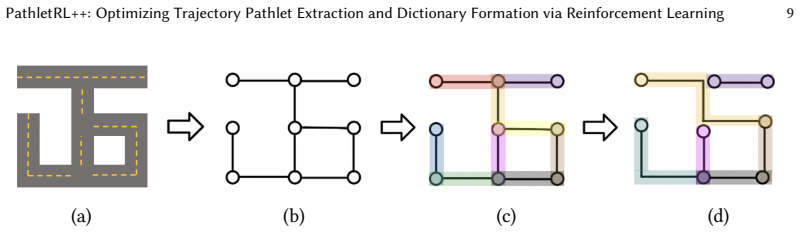
The load-bearing mechanism is the iterative merge loop on a pathlet graph. All road segments start as length-1 edge-disjoint pathlets; at each step the Deep Q-Network chooses keep or merge with a neighbor, subject to a maximum pathlet length $k$, and a merge rewrites the graph, updates the traversal sets $\Lambda(\rho)$, and recomputes trajectory representability $\mu(\tau) = \sum_{\rho'\in\Phi_i(\tau)}\ell(\rho') / \sum_{\rho\in\Phi_0(\tau)}\ell(\rho)$, trajectory loss $L_{\mathrm{traj}} = |\{\tau : \mu(\tau)=0\}|$, and the average pathlet count $\phi$. The reward is a weighted sum of changes in $|S|$, $\phi$, $L_{\mathrm{traj}}$, and $\bar{\mu}$; the Deep Q-Network approximates the utility function that decides which merges are worth taking, eliminating the candidate enumeration of top-down methods.
What would settle it
Run the reconstruction test on the complete trajectory set without removing any trajectory: keep all test trajectories, including those whose representability reaches zero during merging, and measure what fraction reach representability at least 0.75 using a random half of the dictionary. If the fraction is substantially below 85% because the discarded trajectories are counted, the coverage claim fails. The memory claim can be checked directly by recording the peak memory of the initial pathlet structure on the Rome dataset and comparing it with the baseline's candidate set.
Extended reading notes
Core claim
The paper's central claim is that pathlet dictionary construction can be solved as a learned bottom-up merge problem instead of a top-down selection problem. On a road network, each edge is an initial length-1 pathlet; the agent's state tracks dictionary size, average pathlets per trajectory, trajectory loss, and average representability, enriched in PathletRL++ by the weights of the current pathlet and its neighbors. The reward combines changes in those four objectives, and a Deep Q-Network approximates the utility of each keep-or-merge decision. The authors report that this yields dictionaries smaller than the baselines by up to 65.8%, initial memory savings of up to 24,000 times (from $\Theta(n)$ versus $\Omega(n^2)$ storage), and that a random half of the dictionary reconstructs about 85% of test trajectories at a 75% representability threshold, with PathletRL++ further shrinking the dictionary while holding average representability at the 80% threshold.
Load-bearing premise
The load-bearing premise is that it is acceptable to discard up to 25% of trajectories—those whose representability falls to zero—and to report dictionary quality only on the trajectories that remain.
Editorial extensions
If this is right
- A city-scale trajectory dictionary can be initialized with memory linear in the number of road segments rather than quadratic in candidate pathlets, removing the main scalability barrier of top-down methods.
- Because only half the dictionary pathlets reconstruct roughly 85% of trajectories at a 75% representability threshold, storage can be cut further for approximate reconstruction tasks.
- The same learned merge policy could be retrained per city using only map-matched trajectories, since the state is built from global statistics and local pathlet weights.
- If the 65.8% size reduction transfers to other road networks, downstream tasks such as offline route planning and trajectory compression inherit a drastically smaller index.
Reading between the lines
- The paper's quality metrics are computed after discarding trajectories with zero representability; a fair comparison with top-down baselines would also report coverage of the original, pre-discard trajectory set.
- The merging policy is trained per dataset; a natural extension the paper leaves implicit is to test whether a policy trained on one city transfers to another without retraining, which the local state features might support.
- The reconstruction experiment samples pathlets uniformly; a testable extension is to measure reconstruction with the most-traversed pathlets chosen greedily, which would likely lower the fraction needed below one half.
- Since pathlets are edge-disjoint, the final dictionary is effectively a partition of the used road edges into reusable subpaths, suggesting a direct comparison with graph-compression or road-network summarization methods.
Editorial analysis
A structured set of objections, weighed in public.
Referee Report
Summary. This manuscript proposes a bottom-up, edge-disjoint pathlet dictionary construction method. Starting from length-1 pathlets, a DQN policy decides which neighboring pathlets to merge, with a reward that is the instantaneous change of a scalarized utility over four objectives: dictionary size, average number of pathlets per trajectory, trajectory loss, and average representability. The paper introduces PathletRL, two scalarization variants, and PathletRL++ with a richer state representation, and evaluates them on synthetic Toronto and real-world Rome taxi data. The headline claims are a dictionary up to 65.8% smaller than baselines, initial memory savings up to 24,000x, and reconstruction of 85% of trajectories from half of the dictionary.
Significance. If the central claims were fully supported, the paper would make a useful contribution: formulating pathlet dictionary construction as a sequential merging problem solved by RL is a plausible new direction, and the trajectory representability and trajectory loss metrics are natural quantities for dictionary quality. The paper is also strong in breadth: it provides pseudocode, two datasets, several ablations, sensitivity analyses, and a link to an open-source repository. However, the most prominent quantitative claims are not yet established. The 24,000x memory saving rests on an invalid formal proof and a mismatched empirical comparison, and the representability/reconstruction numbers are computed after discarding trajectories. The RL framework may still be viable, but the paper as written substantially overstates its headline results.
major comments (4)
- [§3.4, Theorem 3.2, Appendix C, §4.5 (Q2), Fig. 2] The central memory-saving claim of up to 24,000x is not supported. In Appendix C, the proof asserts that a graph with n edges must have at least n vertices; this is false, since n edges can be embedded on O(sqrt(n)) vertices in a simple graph, so the claimed Theta(n^2) lower bound does not follow. In addition, Fact 2 uses the bound x^T A^l x >= lambda_min ||x||^2_2, but an adjacency matrix of a road network can have negative eigenvalues, making this lower bound vacuous, and the entries of A^l count all walks of length l, including repeated vertices and edges, rather than the simple sub-paths that constitute pathlets. Independently of the proof, Fig. 2 compares raw trajectory storage (~900 MB) with the final dictionary (~100 KB), not the initial candidate-pathlet storage of top-down methods with the length-1 pathlets used by PathletRL. The theorem and the experiment must be replaced before the memory-efficiency contribution can be evaluated.
- [Algorithm 1 lines 8 and 24, Definition 2.10, Table 5, §4.5 (Q5)] All downstream quality metrics are computed after trajectories with zero representability are removed from T, and the loss threshold M is set to 25%. Table 5 reports L_traj = 15.2% for Toronto and 20.4% for Rome under PathletRL, so roughly one sixth to one fifth of the training trajectories are discarded before the reported average representability and reconstruction rates are computed. The abstract's statement that half of the dictionary suffices to reconstruct 85% of the original trajectory data therefore overstates coverage of the full input set. The authors should either report coverage on the full trajectory set, counting discarded trajectories as unreconstructable, or make the conditional nature of these numbers explicit in the abstract and conclusions.
- [§3.3 and §5.2.1] The action and state spaces are not specified enough to make the DQN implementation reproducible. The action space is the union of a keep action and one merge action per neighbor of the current pathlet, but the paper never states how the network's output layer represents a variable-sized set of neighbors. Similarly, the PathletRL++ state is described as four global scalars plus the weights of the current pathlet and all of its neighbors, a vector of variable length, but §4.2 describes only a fixed-size MLP with layers of 128, 64, and 32 units. Without an explicit action encoding, padding scheme, or graph embedding, the reader cannot tell whether the reported training curves are produced by the stated policy or by an unspecified implementation detail.
- [Table 5, §4.5 (Q1), abstract] The advertised 65.8% reduction in dictionary size is computed relative to Sgt, the singleton baseline that performs no merging, and not relative to the two top-down baselines. The reductions relative to Chen et al. and Agarwal et al. are substantially larger in terms of |S|, so the empirical result may be sound, but the abstract and Section 1 should state unambiguously which reference point is used for the headline number. Presenting a no-op null model as the benchmark for the key advertised improvement is misleading, especially because Sgt achieves L_traj = 0% and average representability 100%, and the comparison should also discuss the trade-off created by the trajectory loss incurred by PathletRL.
minor comments (5)
- [Theorem 3.1 and Eq. (2)] Theorem 3.1 is not a theorem in the usual sense: Eq. (2) is just Definition 2.9 applied to the pathlet-based representation at iteration i, and the three proof cases verify that the definition is preserved under merges. Renaming it as an observation or lemma would be more accurate and would not weaken the paper.
- [§4.5 (Q5) and Fig. 9] The reconstruction statement in the abstract and conclusion should include the definition used in the experiment: a trajectory is counted as reconstructable when its representability is at least 75%, the evaluation is on the testing set, and the loss threshold has already excluded a fraction of training trajectories.
- [Eq. (1)] The displayed objective function contains a formatting error: 'min sum_{alpha_i=1} alpha_1|S| + ...' is garbled, and the constraint that the alpha_i sum to 1 should be written separately and clearly.
- [§5.1.2 and Eq. (5)] The dynamic weights w_traj(t) and w_mu(t) are defined with hard-coded constants 0.01 and 0.2, but the paper does not explain how these weights are normalized relative to the alpha coefficients or whether the same formulas were used in both datasets; a short worked example would improve clarity.
- [Table 6 and §5.3.2] PathletRL++ is described as producing 'higher-quality' dictionaries, but Table 6 shows that it worsens trajectory loss on Toronto (17.4% vs. 15.8%) and slightly worsens phi on both datasets; the paper should present the comparison as a trade-off in which PathletRL++ trades a small loss in coverage for a smaller dictionary, rather than as uniform superiority.
Circularity Check
The central RL and memory claims are not circular; the only definitional issue is Theorem 3.1 restating the definition of representability.
-
self definitional
[Section 3.1, Theorem 3.1 (Eq. 2); compare Definition 2.9 and Definition 2.7]
"Theorem 3.1 (Trajectory Representability Theorem). At any step i of the iterative Algorithm 1, then the trajectory representability μ of some trajectory τ∈T by the end of that iteration i is equal to: μ_i(τ) = Σ_{ρ′∈Φ_i(τ)} ℓ(ρ′) / Σ_{ρ∈Φ_0(τ)} ℓ(ρ) (2)"
Definition 2.9 already defines the same quantity: μ(τ) = Σ_{∀ρ∈Φ(τ)} ℓ(ρ)/|τ| for the unweighted case, and Definition 2.7 sets each trajectory's pathlet length equal to Σ_{∀ρ∈Φ(τ)} ℓ(ρ). Since the initial representation Φ_0 has total pathlet length equal to |τ|, substituting into Eq. (2) gives exactly Definition 2.9 with Φ_i in place of Φ. The 'theorem' is therefore a restatement of the metric's own definition, not a derived result; its induction proof only re-derives the definitional identity.
full rationale
The rest of the derivation is self-contained and not circular. The DQN is trained on the reward in Eq. (3), which is intentionally identical to the scalarized objective in Eq. (1), so optimizing the reward is equivalent to optimizing the stated utility by design rather than by hidden circularity. Dictionary size, φ, L_traj, and μ are measured against independent baselines and ablations on held-out data, and no external constant is fitted. The paper does not rely on any load-bearing self-citation or imported uniqueness theorem. The skeptical objections to the 24,000x memory claim—invalid lower bounds and walk-versus-pathlet counting in Theorem 3.2's proof, and the mismatched comparison in Fig. 2—are correctness and evidence concerns, not circularity, so they do not raise the circularity score beyond the minor definitional restatement.
Assumptions & free parameters
free parameters (5)
- alpha_1, alpha_2, alpha_3, alpha_4 =
0.25 each in experiments
- M (max trajectory loss threshold) =
25%
- mu_hat (average representability threshold) =
80%
- k (maximum pathlet length) =
10
- Dynamic scalarization constants =
0.01, 0.2
assumptions (4)
- domain assumption The road network is undirected.
- domain assumption Map-matched trajectories are accurate enough for pathlet merging.
- ad hoc to paper Edge-disjoint pathlets are a desirable dictionary constraint.
- ad hoc to paper A 4-dimensional global state is sufficient for a DQN to learn a good merging policy.
Cite this review
Pith. "Pith review of PathletRL++: Optimizing Trajectory Pathlet Extraction and Dictionary Formation via Reinforcement Learning." pith.science (2026). https://pith.science/paper/CM7KHCYQ
@misc{pith2026241203715,
  author       = {Pith},
  title        = {Pith review of: PathletRL++: Optimizing Trajectory Pathlet Extraction and Dictionary Formation via Reinforcement Learning},
  year         = {2026},
  howpublished = {\url{https://pith.science/paper/CM7KHCYQ}},
  note         = {Machine review of arXiv:2412.03715}
}
read the original abstract
Advances in tracking technologies have spurred the rapid growth of large-scale trajectory data. Building a compact collection of pathlets, referred to as a trajectory pathlet dictionary, is essential for supporting mobility-related applications. Existing methods typically adopt a top-down approach, generating numerous candidate pathlets and selecting a subset, leading to high memory usage and redundant storage from overlapping pathlets. To overcome these limitations, we propose a bottom-up strategy that incrementally merges basic pathlets to build the dictionary, reducing memory requirements by up to 24,000 times compared to baseline methods. The approach begins with unit-length pathlets and iteratively merges them while optimizing utility, which is defined using newly introduced metrics of trajectory loss and representability. We develop a deep reinforcement learning framework, PathletRL, which utilizes Deep Q-Networks (DQN) to approximate the utility function, resulting in a compact and efficient pathlet dictionary. Experiments on both synthetic and real-world datasets demonstrate that our method outperforms state-of-the-art techniques, reducing the size of the constructed dictionary by up to 65.8%. Additionally, our results show that only half of the dictionary pathlets are needed to reconstruct 85% of the original trajectory data. Building on PathletRL, we introduce PathletRL++, which extends the original model by incorporating a richer state representation and an improved reward function to optimize decision-making during pathlet merging. These enhancements enable the agent to gain a more nuanced understanding of the environment, leading to higher-quality pathlet dictionaries. PathletRL++ achieves even greater dictionary size reduction, surpassing the performance of PathletRL, while maintaining high trajectory representability.
Figures


Figures from the paper (11 more)


Reference graph
Works this paper leans on
-
[1]
Agarwal, Kyle Fox, Kamesh Munagala, Abhinandan Nath, Jiangwei Pan, and Erin Taylor
Pankaj K. Agarwal, Kyle Fox, Kamesh Munagala, Abhinandan Nath, Jiangwei Pan, and Erin Taylor. 2018. Subtrajectory Clustering: Models and Algorithms. In Proc. of the 37th ACM SIGMOD-SIGACT-SIGAI Symposium on Principles of Database Sys. (PODS ’18) . 75–87
work page 2018
-
[2]
Fuad Aleskerov, Denis Bouyssou, and Bernard Monjardet. 2007. Utility Maximization, Choice and Preference . Springer Berlin Heidelberg, Berlin, Heidelberg
work page 2007
-
[3]
Gian Alix, Nina Yanin, Tilemachos Pechlivanoglou, Jing Li, Farzaneh Heidari, and Manos Papagelis. 2022. A Mobility- based Recommendation System for Mitigating the Risk of Infection during Epidemics. In 2022 23rd IEEE Intl. Conf. on Mobile Data Mgt. (MDM) . 292–5
work page 2022
-
[4]
Mahmoud Alsaeed, Ameeta Agrawal, and Manos Papagelis. 2023. Trajectory-User Linking using Higher-order Mobility Flow Representations. In 2023 24th IEEE International Conference on Mobile Data Management (MDM) . 158–167
work page 2023
-
[5]
Fazel Arasteh, Soroush SheikhGarGar, and Manos Papagelis. 2022. Network-Aware Multi-Agent Reinforcement Learning for the Vehicle Navigation Problem. In Proc. of the 30th Intl. Conf. on Adv. in Geographic Info. Sys. (ACM SIGSPATIAL ’22). Article 69
work page 2022
-
[6]
Gowtham Atluri, Anuj Karpatne, and Vipin Kumar. 2018. Spatio-Temporal Data Mining: A Survey of Problems and Methods. ACM Comp. Surveys 51, 4, Article 83 (Aug 2018)
work page 2018
-
[7]
Lorenzo Bracciale, Marco Bonola, Pierpaolo Loreti, Giuseppe Bianchi, Raul Amici, and Antonello Rabuffi. 2014. CRAWDAD Roma/taxi dataset. https://crawdad.org/roma/taxi/20140717
arXiv 2014
-
[8]
Chen Chen, Hao Su, Qixing Huang, Lin Zhang, and Leonidas Guibas. 2013. Pathlet Learning for Compressing and Planning Trajectories. In Proc. of the 21st ACM SIGSPATIAL Intl. Conf. on Adv. in Geographic Info. Sys. (ACM SIGSPATIAL’13). 392—-5
work page 2013
Show all 66 references
-
[9]
Wei Chen, Yuxuan Liang, Yuanshao Zhu, Yanchuan Chang, Kang Luo, Haomin Wen, Lei Li, Yanwei Yu, Qingsong Wen, Chao Chen, Kai Zheng, Yunjun Gao, Xiaofang Zhou, and Yu Zheng. 2024. Deep Learning for Trajectory Data Management and Mining: A Survey and Beyond. arXiv:2403.14151 [cs....
2024
-
[10]
Yuqi Chen, Hanyuan Zhang, Weiwei Sun, and Baihua Zheng. 2022. RNTrajRec: Road Network Enhanced Trajectory Recovery with Spatial-Temporal Transformer
2022
-
[11]
Anusuya Datta. 2022. Seizing The Future: Geospatial Industry Technology Trends and Directions. GWPrime (Feb 2022)
2022
-
[12]
Ziquan Fang, Yuntao Du, Xinjun Zhu, Danlei Hu, Lu Chen, Yunjun Gao, and Christian S. Jensen. 2022. Spatio-Temporal Trajectory Similarity Learning in Road Networks. In Proc. of the 28th ACM SIGKDD Conf. on Knowledge Discovery & Data Mining (ACM SIGKDD ’22) . 347–56. , Vol. 1, N...
2022
-
[13]
Ali Faraji, Jing Li, Gian Alix, Mahmoud Alsaeed, Nina Yanin, Amirhossein Nadiri, and Manos Papagelis. 2023. Point2Hex: Higher-order Mobility Flow Data and Resources. In Proc. of the 31st Intl. Conf. on Adv. in Geographic Info. Sys. (SIGSPATIAL ’23)
2023
-
[14]
William Fedus, Prajit Ramachandran, Rishabh Agarwal, Yoshua Bengio, Hugo Larochelle, Mark Rowland, and Will Dabney. 2020. Revisiting Fundamentals of Experience Replay. In Proc. of the 37th Intl. Conf. on Machine Learning (ICML’20). JMLR, Article 287
2020
-
[15]
Yuanzhe Geng, Erwu Liu, Rui Wang, and Yiming Liu. 2020. Deep Reinforcement Learning Based Dynamic Route Planning for Minimizing Travel Time. CoRR (2020)
2020
-
[16]
Ali Hamdi, Khaled Shaban, Abdelkarim Erradi, Amr Mohamed, Shakila Khan Rumi, and Flora D. Salim. 2022. Spa- tiotemporal data mining: a survey on challenges and open problems. Artificial Intelligence Review 55, 2 (Feb 2022), 1441–1488
2022
-
[17]
Nan Han, Shaojie Qiao, Kun Yue, Jianbin Huang, Qiang He, Tingting Tang, Faliang Huang, Chunlin He, and Chang-An Yuan. 2022. Algorithms for Trajectory Points Clustering in Location-Based Social Networks. ACM Trans. Intell. Syst. Technol. 13, 3, Article 43 (mar 2022)
2022
-
[18]
Qingwen Han, Yu Lei, Lingqiu Zeng, Guangyan He, Lei Ye, and Lingfeng Qi. 2021. Research on Travel Time Prediction of Multiple Bus Trips Based on MDARNN. In 2021 IEEE Intl. Intelligent Transportation Sys. Conf. (ITSC) . 3718–3725
2021
-
[19]
Hayes, Roxana Rădulescu, Eugenio Bargiacchi, Johan Källström, Matthew Macfarlane, Mathieu Reymond, Timothy Verstraeten, Luisa M
Conor F. Hayes, Roxana Rădulescu, Eugenio Bargiacchi, Johan Källström, Matthew Macfarlane, Mathieu Reymond, Timothy Verstraeten, Luisa M. Zintgraf, Richard Dazeley, and Fredrik Heintz. 2022. A Practical Guide to Multi- Objective Reinforcement Learning and Planning. Autonomous ...
2022 doi
-
[20]
Zhanjun He, Liufeng Tao, Zhong Xie, and Chong Xu. 2020. Discovering spatial interaction patterns of near repeat crime by spatial association rules mining. Sci. Reports 10, 1 (Oct 2020)
2020
-
[21]
Zhengxing Lan, Hongbo Li, Lingshan Liu, Bo Fan, Yisheng Lv, Yilong Ren, and Zhiyong Cui. 2024. Traj-LLM: A New Exploration for Empowering Trajectory Prediction with Pre-trained Large Language Models. arXiv:2405.04909 [cs.CV] https://arxiv.org/abs/2405.04909
2024 arXiv
-
[22]
Jae-Gil Lee, Jiawei Han, and Kyu-Young Whang. 2007. Trajectory Clustering: A Partition-and-Group Framework. In Proc. of the 2007 ACM SIGMOD Intl. Conf. on Mgt. of Data (ACM SIGMOD ’07) . 593–604
2007
-
[23]
Li Li, Rui Jiang, Zhengbing He, Xiqun (Michael) Chen, and Xuesong Zhou. 2020. Trajectory data-based traffic flow studies: A revisit. Transportation Research Part C: Emerging Technologies 114 (2020), 225–240
2020
-
[24]
Mingqian Li, Panrong Tong, Mo Li, Zhongming Jin, Jianqiang Huang, and Xian-Sheng Hua. 2021. Traffic Flow Prediction with Vehicle Trajectories. Proceedings of the AAAI Conference on Artificial Intelligence 35, 1 (May 2021), 294–302
2021
-
[25]
Tang Li, Jing Gao, and Xi Peng. 2021. Deep Learning for Spatiotemporal Modeling of Urbanization. In Proc. of the 35th Conf. on Neural Info. Proc. Sys. (NeurIPS 2021)
2021
-
[26]
Yang Li, Dimitrios Gunopulos, Cewu Lu, and Leonidas J. Guibas. 2019. Personalized Travel Time Prediction Using a Small Number of Probe Vehicles. ACM Trans. Spatial Algorithms Syst. 5, 1, Article 4 (may 2019)
2019
-
[27]
Yin Lou, Chengyang Zhang, Yu Zheng, Xing Xie, Wei Wang, and Yan Huang. 2009. Map-Matching for Low-Sampling- Rate GPS Trajectories. In Proc. of the 17th ACM SIGSPATIAL Intl. Conf. on Adv. in Geographic Info. Sys. (Seattle, Washington) (GIS ’09). Assoc. for Comp. Machinery, New ...
2009
-
[28]
Ken McCormick. ’97. An Essay on the Origin of the Rational Utility Maximization Hypothesis and a Suggested Modification. Eastern Eco. Journal 23 (’97), 17–30
-
[29]
Saim Mehmood and Manos Papagelis. 2020. Learning Semantic Relationships of Geographical Areas based on Trajectories. In 2020 21st IEEE Intl. Conf. on Mobile Data Mgt. (MDM) . 109–118
2020
-
[30]
Lawson, and S
Jonathan Muckell, Jeong-Hyon Hwang, Catherine T. Lawson, and S. S. Ravi. 2010. Algorithms for Compressing GPS Trajectory Data: An Empirical Evaluation. In Proc. of the 18th SIGSPATIAL Intl. Conf. on Adv. in Geographic Info. Sys. (ACM GIS ’10). 402–405
2010
-
[31]
Ali Nematichari, Tilemachos Pechlivanoglou, and Manos Papagelis. 2022. Evaluating and Forecasting the Operational Performance of Road Intersections. In Proc. of the 30th Intl. Conf. on Adv. in Geographic Info. Sys. (ACM SIGSPATIAL ’22). Article 31
2022
-
[32]
Mark E. J. Newman. 2018. Networks (second edition ed.). Oxford University Press, Oxford, United Kingdom; New York, NY, United States of America
2018
-
[33]
Paul Newson and John Krumm. 2009. Hidden Markov Map Matching through Noise and Sparseness. In Proc. of the 17th ACM SIGSPATIAL Intl. Conf. on Adv. in Geographic Info. Sys. (GIS ’09) . 336–343
2009
-
[34]
Exposure Track
Marguerite Nyhan, Sebastian Grauwin, Rex Britter, Bruce Misstear, Aonghus McNabola, Francine Laden, Steven R. H. Barrett, and Carlo Ratti. 2016. “Exposure Track”—The Impact of Mobile-Device-Based Mobility Patterns on Quantifying Population Exposure to Air Pollution. Environmen...
2016
-
[35]
Olver and Chehrzad Shakiban
Peter J. Olver and Chehrzad Shakiban. 2018.Applied Linear Algebra (2nd ed. 2018 ed.). Springer International Publishing: Imprint: Springer, Cham
2018
-
[36]
Costas Panagiotakis, Nikos Pelekis, Ioannis Kopanakis, Emmanuel Ramasso, and Yannis Theodoridis. 2012. Segmenta- tion and Sampling of Moving Object Trajectories Based on Representativeness. IEEE Trans. on Knowledge and Data Eng. 24, 7 (2012), 1328–1343
2012
-
[37]
Manish Kumar Pandey, Prashant Srivastava, and George Petropoulos. 2021. Chapter 21 - Future pathway for research and emerging applications in GPS/GNSS. In GPS and GNSS Technology in Geosciences . Elsevier, 429–438
2021
-
[38]
Tilemachos Pechlivanoglou, Gian Alix, Nina Yanin, Jing Li, Farzaneh Heidari, and Manos Papagelis. 2022. Microscopic Modeling of Spatiotemporal Epidemic Dynamics. In Proc. of the 3rd ACM SIGSPATIAL Intl. Workshop on Spatial Comp. for Epidemiology (SpatialEpi ’22) . 11–21
2022
-
[39]
Tilemachos Pechlivanoglou and Manos Papagelis. 2018. Fast and Accurate Mining of Node Importance in Trajectory Networks. In 2018 IEEE Intl. Conf. on Big Data (Big Data) . 781–790
2018
-
[40]
Tom Ruth. 2022. Why Location Services and IoT are Leading the 5G Trends of 2022. Quuppa (Sep 2022)
2022
-
[41]
Agarwal, Thomas Mølhave, Jiangwei Pan, and Arnold P
Swaminathan Sankararaman, Pankaj K. Agarwal, Thomas Mølhave, Jiangwei Pan, and Arnold P. Boedihardjo. 2013. Model-Driven Matching and Segmentation of Trajectories. In Proc. of the 21st ACM SIGSPATIAL Intl. Conf. on Adv. in Geographic Info. Sys. (Orlando, Florida) (SIGSPATIAL’1...
2013
-
[42]
Abdullah Sawas, Abdullah Abuolaim, Mahmoud Afifi, and Manos Papagelis. 2018. Tensor Methods for Group Pattern Discovery of Pedestrian Trajectories. In 19th IEEE Intl. Conf. on Mobile Data Mgt. (MDM) . 76–85
2018
-
[43]
Abdullah Sawas, Abdullah Abuolaim, Mahmoud Afifi, and Manos Papagelis. 2019. A versatile computational framework for group pattern mining of pedestrian trajectories. GeoInformatica 23, 4 (Oct 2019), 501–531
2019
-
[44]
Artur Strzelecki. 2022. The Apple Mobility Trends Data in Human Mobility Patterns during Restrictions and Prediction of COVID-19: A Systematic Review and Meta-Analysis. Healthcare 10, 12 (2022)
2022
-
[45]
Shao-Hua Sun, Te-Lin Wu, and Joseph J. Lim. 2020. Program Guided Agent. In Intl. Conf. on Learning Representations
2020
-
[46]
Marc van Kreveld and Lionov Wiratma. 2011. Median Trajectories Using Well-Visited Regions and Shortest Paths. In Proc. of the 19th ACM SIGSPATIAL Intl. Conf. on Adv. in Geographic Info. Sys. (GIS ’11) . 241–250
2011
-
[47]
Drugan, and Ann Nowé
Kristof Van Moffaert, Madalina M. Drugan, and Ann Nowé. 2013. Scalarized Multi-Objective Reinforcement Learning: Novel Design Techniques. In 2013 IEEE Symposium on Adaptive Dynamic Programming and Reinforcement Learning (ADPRL). IEEE, Singapore. https://doi.org/10.1109/ADPRL.2...
2013
-
[48]
Jingyuan Wang, Ning Wu, and Wayne Zhao. 2022. Personalized Route Recommendation With Neural Network Enhanced Search Algorithm. IEEE Transactions on Knowledge & Data Engineering 34, 12 (Dec 2022), 5910–5924
2022
-
[49]
Shane Culpepper, Timos Sellis, and Xiaolin Qin
Sheng Wang, Zhifeng Bao, J. Shane Culpepper, Timos Sellis, and Xiaolin Qin. 2019. Fast Large-Scale Trajectory Clustering. Proc. VLDB Endow. 13, 1 (Sep 2019), 29–42
2019
-
[50]
Senzhang Wang, Jiannong Cao, and Philip Yu. 2022. Deep Learning for Spatio-Temporal Data Mining: A Survey. IEEE Trans. on Knowledge & Data Eng. 34, 08 (Aug 2022), 3681–700
2022
-
[51]
Shane Culpepper, and Reza Arablouei
Tingting Wang, Shixun Huang, Zhifeng Bao, J. Shane Culpepper, and Reza Arablouei. 2022. Representative Routes Discovery from Massive Trajectories. In Proc. of the 28th ACM SIGKDD Conf. on Knowledge Discovery and Data Mining (Washington DC, USA) (KDD ’22). Assoc. for Comp. Mach...
2022
-
[52]
Zheng Wang, Cheng Long, and Gao Cong. 2021. Trajectory Simplification with Reinforcement Learning. In 2021 IEEE 37th Intl. Conf. on Data Eng. (ICDE) . 684–695
2021
-
[53]
Zhaobo Wang, Yanmin Zhu, Qiaomei Zhang, Haobing Liu, Chunyang Wang, and Tong Liu. 2022. Graph-Enhanced Spatial-Temporal Network for Next POI Recommendation.ACM Trans. Knowl. Discov. Data 16, 6, Article 104 (Jul 2022)
2022
-
[54]
Jiajie Xu, Jing Zhao, Rui Zhou, Chengfei Liu, Pengpeng Zhao, and Lei Zhao. 2021. Predicting Destinations by a Deep Learning based Approach. IEEE Trans. on Knowledge and Data Eng. 33, 2 (2021), 651–666
2021
-
[55]
Hao Xue, Bhanu Prakash Voutharoja, and Flora D. Salim. 2022. Leveraging Language Foundation Models for Human Mobility Forecasting. In Proc. of the 30th Intl. Conf. on Adv. in Geographic Info. Sys. (ACM SIGSPATIAL ’22) . Article 90
2022
-
[56]
R. K. Yadav, Giriraj Kishor, Himanshu, and Kishan Kashyap. 2020. Comparative Analysis of Route Planning Algorithms on Road Networks. In 2020 5th Intl. Conf. on Comm. and Electronics Sys. (ICCES) . 401–406
2020
-
[57]
Mohamad Yassin and Elias Rachid. 2015. A survey of positioning techniques and location based services in wireless networks. In 2015 IEEE Intl. Conf. on Signal Processing, Informatics, Communication and Energy Systems (SPICES) . 1–5
2015
-
[58]
Jing Yuan, Yu Zheng, Chengyang Zhang, Xing Xie, and Guang-Zhong Sun. 2010. An Interactive-Voting Based Map Matching Algorithm. In 2010 11th Intl. Conf. on Mobile Data Mgt. 43–52
2010
-
[59]
Jing Zhao, Jiajie Xu, Rui Zhou, Pengpeng Zhao, Chengfei Liu, and Feng Zhu. 2018. On Prediction of User Destination by Sub-Trajectory Understanding: A Deep Learning Based Approach. In Proc. of the 27th ACM Intl. Conf. on Info. and Knowledge Mgt. (ACM CIKM 2018) . 1413–1422
2018
-
[60]
Yan Zhao, Shuo Shang, Yu Wang, Bolong Zheng, Quoc Viet Hung Nguyen, and Kai Zheng. 2018. REST: A Reference- Based Framework for Spatio-Temporal Trajectory Compression. In Proc. of the 24th ACM SIGKDD Intl. Conf. on Knowledge Discovery & Data Mining (ACM SIGKDD ’18) . 2797–2806...
2018
-
[61]
Yaya Zhao, Kaiqi Zhao, Zhiqian Chen, Yuanyuan Zhang, Yalei Du, and Xiaoling Lu. 2024. A Graph-based Representation Framework for Trajectory Recovery via Spatiotemporal Interval-Informed Seq2Seq. In Proceedings of the Thirty-Third International Joint Conference on Artificial In...
2024 doi
-
[62]
Yu Zheng. 2015. Trajectory Data Mining: An Overview. ACM Trans. Intell. Syst. Technol. 6, 3, Article 29 (May 2015)
2015
-
[63]
Yue Zhou and Thomas S. Huang. 2008. ‘Bag of segments’ for motion trajectory analysis. In 2008 15th IEEE Intl. Conf. on Image Processing. 757–760
2008
-
[64]
Yuanshao Zhu, Yongchao Ye, Shiyao Zhang, Xiangyu Zhao, and James J. Q. Yu. 2023. DiffTraj: Generating GPS Trajectory with Diffusion Probabilistic Model. arXiv:2304.11582 [cs.LG] https://arxiv.org/abs/2304.11582 , Vol. 1, No. 1, Article . Publication date: December 2024. Pathle...
2023 arXiv
-
[65]
To see why Ω(|| x|| 2
= Ω(𝑛) as a consequence of the Fact 2 in Equation (10). To see why Ω(|| x|| 2
-
[66]
Therefore, its squared𝐿2-norm is: √ 12+ 12+...+ 12 2 = √𝑛 2 =𝑛
reduces to Ω(𝑛), first note that x is a column vector of ones with dimension 𝑛× 1. Therefore, its squared𝐿2-norm is: √ 12+ 12+...+ 12 2 = √𝑛 2 =𝑛. Note however that the eigenvalue𝜆𝑚𝑖𝑛 should not be relevant towards the space complexity expressed in terms of the number of road ...
2024
Reviewed August 11, 2026 · model on record in the stance chip above.
Discussion (0). Continue with ORCID to comment.