REVIEW 4 major objections 5 minor 58 references
Computing sessile droplet shapes on arbitrary surfaces with a new pairwise force smoothed particle hydrodynamics model
T0 review · 4 major / 5 minor · reviewed 2026-08-11 · deepseek-v4-flash
Pith's one-line read A new polynomial pairwise-force profile for smoothed particle hydrodynamics makes simulated surface tension and contact angle scale-independent, so equilibrium sessile droplet shapes can be computed on arbitrary rough and chemically…
desk verdict New polynomial PF-SPH force profiles give a genuinely scale-independent surface tension calibration, but the contact-angle side leans on a suspect density isosurface and a partly self-referential fit—worth peer review all the same. read the letter →
The pith
A machine-rendered reading of the paper's core claim, the machinery that carries it, and where it could break.
The reading
What carries the argument
The load-bearing object is the pairwise force term $\mathbf{F}^{(\mathrm{pf})}_i = (H/m_i) \sum_j s_{ij} f_{ij}(\|\mathbf{x}_{ij}\|/H) \, \mathbf{x}_{ij}/\|\mathbf{x}_{ij}\|$, where $f_{ij}$ is a quartic polynomial force profile (equation 8) with a repulsive core, an attractive tail, and a zero crossing placed at $1.1\Delta x$ for fluid-fluid pairs and $2\Delta x$ for fluid-solid pairs. The quartic is the lowest-degree polynomial satisfying the endpoint and smoothness constraints, and the fluid-fluid zero crossing is motivated by the nearest-neighbour distance in an optimally packed particle arrangement. The explicit factor $H$ outside the sum makes $s_{ij}$ have the units of an interfacial tension, which is what renders the simulated surface tension independent of resolution. On top of that force, the calibration machinery consists of the virial-pressure measurement of Laplace pressure, the droplet-oscillation frequency, and whole-shape Young-Laplace fitting to the density isosurface $\langle \rho(\mathbf{x}) \rangle = \rho_0/2$, whose vertices give the contact angle.
What would settle it
Run the calibrated model at particle widths smaller than $2\times 10^{-5}$ m or larger than $8\times 10^{-5}$ m on a flat surface, measure the Laplace-pressure slope $\sigma = 30.96 s_{\mathrm{ff}}$ and the fitted Young-Laplace contact angle for a fixed $s_{\mathrm{fs}}/s_{\mathrm{ff}}$, and check whether both stay on the calibration curves; any drift with resolution would falsify the scale-independence claim. A second check is to compare the volume enclosed by the density isosurface with the known droplet volume near the contact line, since the paper already discards droplets whose isosurface volume is off by more than 10 percent.
Extended reading notes
Core claim
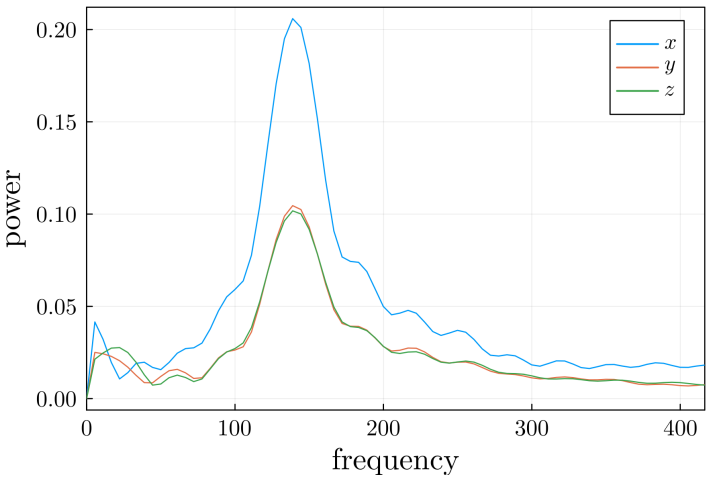
The central discovery is that the pairwise force profiles chosen in equation (8), together with the $H$-scaled force term in equation (7), remove the resolution dependence that has plagued earlier PF-SPH formulations and turn the simulated surface tension and contact angle into controllable, calibration-ready quantities. In the model, surface tension is produced by fluid-fluid cohesive forces and wetting by fluid-solid adhesive forces, both implemented as short-range repulsive-attractive polynomial forces between particles; the prefactor $H$ in the force term gives the interaction strength the units of N/m, so the resulting surface tension does not change when the particle spacing is refined. The paper calibrates $\sigma = 30.96 s_{\mathrm{ff}}$ by measuring Laplace pressure in static spherical droplets and by matching the Rayleigh oscillation frequency of perturbed droplets, and it calibrates the contact angle by fitting semi-analytical Young-Laplace profiles to the density isosurface of simulated sessile droplets. Across different surface tensions and volumes the measured contact angles collapse onto a single curve in the ratio $s_{\mathrm{fs}}/s_{\mathrm{ff}}$, supporting the model's scale independence. The same machinery then produces sessile droplet shapes on a square-pillared superhydrophobic surface, on a hydrophobic surface with a hydrophilic stripe, and on a reconstructed wheat leaf with roughness and hairs.
Load-bearing premise
Every contact-angle measurement and case-study conclusion assumes that the density isosurface at half the reference density, $\langle \rho(\mathbf{x}) \rangle = \rho_0/2$, reliably marks the liquid-gas interface and that the contact line lies exactly two particle widths ($2\Delta x$) from the substrate, so a systematic bias of that isosurface near the contact line would shift the calibrated $s_{\mathrm{fs}}/s_{\mathrm{ff}}$-to-angle curve and the computed droplet shapes.
Editorial extensions
If this is right
- Surface tension can be prescribed directly as $s_{\mathrm{ff}} = \sigma/30.96$ at any tested resolution, replacing per-resolution tuning with a single linear calibration.
- Equilibrium contact angle can be set by interpolating the ratio $s_{\mathrm{fs}}/s_{\mathrm{ff}}$ from the calibrated curve, with the angle emerging naturally at the contact line rather than being imposed.
- The model reproduces the suspended-to-collapsed wetting-state transition on square-pillared surfaces when the droplet has a small impact velocity, matching the qualitative behaviour of the experimental study it follows.
- Chemically patterned substrates are handled by simply varying the adhesive strength $s_{\mathrm{fs}}$ across the surface, as demonstrated by the smooth contact-angle transition around a hydrophilic stripe.
- Because no interface tracking is required, the same code runs on physically rough and chemically heterogeneous surfaces such as the reconstructed wheat leaf, giving a contact-line shape that would otherwise require a separate free-boundary calculation.
Reading between the lines
- If the scale independence extends below the tested particle widths, the same calibration curve could predict surface tension and contact angle for microfluidic droplets without re-fitting; the paper only demonstrates the linear law between $2\times 10^{-5}$ m and $8\times 10^{-5}$ m.
- The whole-shape Young-Laplace fitting used for calibration could serve as a standard benchmark for comparing other pairwise force profiles, since the paper notes the literature lacks consensus without performing that comparison itself.
- The paper's own 10 percent volume filter suggests the density isosurface can mislocate the interface; a more accurate interface reconstruction near the contact line would likely sharpen the contact-angle calibration and the wheat-leaf contact-line visualisation.
- The wheat-leaf contact line could be fed directly into an evaporation or retention model as an initial condition; the paper lists this as future work rather than a demonstrated capability.
Editorial analysis
A structured set of objections, weighed in public.
Referee Report
Summary. The manuscript proposes a pairwise-force smoothed particle hydrodynamics (PF-SPH) model with new polynomial force profiles (Eq. 8) and an H-scaled interaction (Eq. 7) intended to make simulated surface tension and contact angle scale-independent. The model is calibrated by measuring surface tension from Laplace pressure in static spherical droplets and from ellipsoidal droplet oscillation frequencies, both giving a linear relation sigma = 30.96 s_ff. The contact angle is calibrated by fitting semi-analytical Young-Laplace profiles to density isosurfaces of sessile droplets and plotting the fitted angle against s_fs/s_ff. The method is then demonstrated on a pillared superhydrophobic-type surface, a chemically patterned surface with a hydrophilic stripe, and a reconstructed wheat leaf, with the contact line obtained without explicit tracking.
Significance. If the calibration is reliable, the paper makes a useful contribution: the linear sigma-s_ff relation is corroborated by two independent tests, the H-scaling addresses a known resolution dependence in PF-SPH, and the case studies show the model can handle complex substrates without explicit contact-line tracking. The open-source implementation is a further strength. However, the contact-angle calibration is partly self-referential and rests on an isosurface definition whose accuracy near the substrate is not established. These issues affect the central predictive claim, so the contribution is not yet fully supported, although the underlying modelling idea is promising and the Laplace-pressure and oscillation results provide a solid core.
major comments (4)
- [Section 3.3, Eq. (13), Figures 10-11] The contact-angle calibration is partly circular: theta_CA is defined as the best-fit parameter of a Young-Laplace profile fitted to the simulated isosurface, and the same fitted values are then presented as agreement with Young-Laplace. This establishes that the simulated shapes are Young-Laplace-like, but it does not independently validate the model's wetting behaviour. Please provide an independent measurement of the contact angle (for example, a tangent construction at the contact line, or comparison with an independent numerical method) or explicitly reframe the claim as calibration rather than validation.
- [Section 2.2.4 versus Eq. (12)] The interface in Eq. (12) is defined from a fluid-only density sum, whereas the density evolved in Eq. (3) and used in the pressure and pairwise forces includes fixed solid particles. Near the substrate the fluid-only sum is truncated, so the half-density isosurface may be displaced by an O(Delta x) offset relative to the density field that actually controls the forces. Since the contact line is defined as the intersection of this isosurface with the 2 Delta x offset surface (Section 4.3), any systematic isosurface bias propagates into the calibration curve and the wheat-leaf contact line. Please test the sensitivity of the calibration to an alternative interface definition based on the full density field, or demonstrate convergence with resolution.
- [Figures 10 and 11] Droplets are excluded when the isosurface-enclosed volume differs from the true droplet volume by more than 10%, which is direct evidence that the isosurface can be inaccurate. The filter may bias the s_fs/s_ff-theta_CA curve if exclusions correlate with the force ratio. Please report the number and parameter values of excluded cases and show that the calibration is unchanged when the threshold is varied or when a corrected interface is used.
- [Section 4.2, Figure 14] The contact angle along the contact line is measured using the surface normal of the isosurface at a fixed height H/2 above the substrate, rather than at the contact line itself. This offset is not physically calibrated and may depend on resolution; it should be justified or replaced by a definition tied to the actual contact line, especially because the transition plot is used to support the chemically patterned surface claim.
minor comments (5)
- [Section 3.1] The claim that sigma = 30.96 s_ff is resolution-independent over Delta x in [2e-5, 8e-5] m is stated but not shown in any figure or table; please include the supporting data or a convergence plot.
- [Figures 10 and 11] The main text should state how many droplets were excluded by the 10% volume filter and whether exclusions are concentrated at particular s_fs/s_ff values.
- [Section 4.1, Figure 13] The comparison with Dupuis and Yeomans (2005) is qualitative; please state this explicitly and describe any quantitative metrics used.
- [References] The reference list contains a rendering issue ('M¨ uller') that should be corrected to 'Müller'.
- [Section 3.3] Equation (12) is introduced as an isosurface of the SPH-interpolated density, but the text does not specify the smoothing length used for the interpolation grid in the marching cubes step; a sentence clarifying this would help reproducibility.
Circularity Check
Contact-angle validation is self-referential (theta_CA is the Young-Laplace fit parameter), while surface-tension calibration is independently checked and the complex-surface case studies are not circular.
-
fitted input called prediction
[Section 3.3 (Eqs. 12-13, Figures 9-11)]
"Then, to determine the contact angle of the droplet, we fit the shape of an axisymmetric sessile droplet determined by the Young-Laplace (Y-L) equation (Danov et al., 2016) to the vertices of the SPH droplet isosurface ... With this validation of the droplet shape and calibration of the contact angle, we now have a simple procedure for specifying the surface tension σ and contact angle θ_CA in the PF-SPH scheme."
The contact angle is not measured by an independent protocol; θ_CA is the free parameter that best fits a Y-L solution to the SPH isosurface. Therefore the paper's claim that flat-surface SPH interfaces agree with Y-L solutions is a restatement of the fitting procedure, and the s_fs/s_ff versus θ_CA calibration curve in Figures 10-11 is an interpolation of those fitted values. This makes the flat-surface contact-angle 'validation' self-referential. The later rough-surface and wheat-leaf computations are not circular because they use the calibrated s_fs/s_ff as an input and compute the droplet shape without fitting θ_CA, though they inherit any bias in the interface definition (Eq. 12) used for calibration.
full rationale
The surface-tension branch of the derivation is not circular: σ is calibrated from the Laplace-pressure slope (Fig. 4) and independently corroborated by Rayleigh oscillation frequencies (Fig. 5), i.e. two different physical laws. The new force profile and H-scaling are a modelling ansatz, not a hidden reuse of the target result. The only substantive circularity is the contact-angle validation in Section 3.3, where the Young-Laplace profile itself supplies the definition of θ_CA via least-squares fitting, so 'good agreement' with Y-L is partly built into the measurement. This does not destroy the central claim, because the calibration curve is then used as an input for complex-surface predictions that are not fitted. Limitations worth noting, but not circular: the fluid-only density isosurface (Eq. 12) is used to measure interfaces although solid particles enter the simulated density sums (Section 2.2.4), and the 10% volume-exclusion filter in Figures 10-11 shows the isosurface can be inaccurate; this is a correctness risk for the contact-angle curve and case-study contact lines, not a definitional equivalence. The self-citation to Whebell et al. (2025) supplies only the wheat-leaf geometry from a microCT-based reconstruction and is not load-bearing for any theoretical claim. Overall score 4: one fitted-input-as-validation step, but the model's independent content (dynamic surface tension, scale-independence collapse, complex-surface demonstrations) remains.
Assumptions & free parameters
free parameters (4)
- surface tension calibration constant 30.96 =
30.96 (dimensionless)
- contact angle calibration curve s_fs/s_ff vs theta_CA =
interpolated from Figure 10
- fluid-fluid zero crossing kappa*_ff = 1.1 =
1.1 (multiples of Delta-x)
- fluid-solid zero crossing kappa*_fs = 2 =
2.0 (multiples of Delta-x)
assumptions (7)
- domain assumption Weakly compressible barotropic Navier-Stokes equations govern droplet flow
- ad hoc to paper Pairwise forces can emulate surface tension and wetting at SPH resolution
- domain assumption The density isosurface at rho0/2 represents the liquid-gas interface
- domain assumption The Wendland kernel with H/Delta-x = 4 is a suitable interpolation kernel
- domain assumption Dummy boundary particles with zero velocity approximate the no-slip condition
- standard math Young-Laplace semi-analytical solutions (Danov et al., 2016) are the correct benchmark for sessile droplet shapes
- domain assumption The equilibrium contact angle depends only on the ratio s_fs/s_ff (not on volume, surface tension, or resolution)
Cite this review
Pith. "Pith review of Computing sessile droplet shapes on arbitrary surfaces with a new pairwise force smoothed particle hydrodynamics model." pith.science (2026). https://pith.science/paper/HNB6J2RY
@misc{pith2026241203810,
  author       = {Pith},
  title        = {Pith review of: Computing sessile droplet shapes on arbitrary surfaces with a new pairwise force smoothed particle hydrodynamics model},
  year         = {2026},
  howpublished = {\url{https://pith.science/paper/HNB6J2RY}},
  note         = {Machine review of arXiv:2412.03810}
}
read the original abstract
The study of the shape of droplets on surfaces is an important problem in the physics of fluids and has applications in multiple industries, from agrichemical spraying to microfluidic devices. Motivated by these real-world applications, computational predictions for droplet shapes on complex substrates -- rough and chemically heterogeneous surfaces -- are desired. Grid-based discretisations in axisymmetric coordinates form the basis of well-established numerical solution methods in this area, but when the problem is not axisymmetric, the shape of the contact line and the distribution of the contact angle around it are unknown. Recently, particle methods, such as pairwise force smoothed particle hydrodynamics (PF-SPH), have been used to conveniently forego explicit enforcement of the contact angle. The pairwise force model, however, is far from mature, and there is no consensus in the literature on the choice of pairwise force profile. We propose a new pair of polynomial force profiles with a simple motivation and validate the PF-SPH model in both static and dynamic tests. We demonstrate its capabilities by computing droplet shapes on a physically structured surface, a surface with a hydrophilic stripe, and a virtual wheat leaf with both micro-scale roughness and variable wettability. We anticipate that this model can be extended to dynamic scenarios, such as droplet spreading or impaction, in the future.
Figures
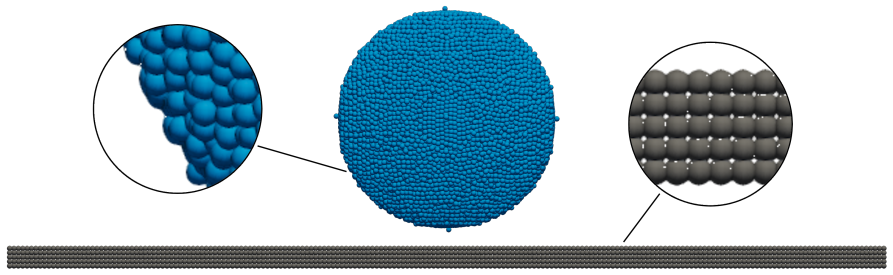


Figures from the paper (13 more)




Reference graph
Works this paper leans on
-
[1]
Computer Simulation of Liquids
Allen, MP and Tildesley, DJ (1989). Computer Simulation of Liquids. Clarendon Press, Oxford, corrected edition. ISBN 0-19-855645-4
work page 1989
-
[2]
Antuono, M; Marrone, S; and Colagrossi, A (2025). Coalescing and break-up of viscous drops with surface tension through the Smoothed Particle Hydrodynamics . Computer Methods in Applied Mechanics and Engineering, 442:118014. doi:10.1016/j.cma.2025.118014
-
[3]
Arai, E; Tartakovsky, A; Holt, RG; Grace, S; and Ryan, E (2020). Comparison of surface tension generation methods in smoothed particle hydrodynamics for dynamic systems. Computers & Fluids, 203:104540. doi:10.1016/j.compfluid.2020.104540
arXiv 2020
-
[4]
Smoothed particle hydrodynamics for coastal engineering problems
Barreiro, A; Crespo, A; Dom \'i nguez, J; and G \'o mez-Gesteira , M (2013). Smoothed particle hydrodynamics for coastal engineering problems. Computers & Structures, 120:96--106. doi:10.1016/j.compstruc.2013.02.010
-
[5]
Surface tension and wetting at free surfaces in smoothed particle hydrodynamics
Blank, M; Nair, P; and P \"o schel, T (2024). Surface tension and wetting at free surfaces in smoothed particle hydrodynamics. Journal of Fluid Mechanics, 987:A23. doi:10.1017/jfm.2024.410
-
[6]
Variational and momentum preservation aspects of smooth particle hydrodynamic formulations
Bonet, J and Lok, TS (1999). Variational and momentum preservation aspects of smooth particle hydrodynamic formulations. Computer Methods in Applied Mechanics and Engineering, 180:97--115. doi:10.1016/S0045-7825(99)00051-1
-
[7]
Physics of Wetting: Phenomena and Applications of Fluids on Surfaces
Bormashenko, EY (2017). Physics of Wetting: Phenomena and Applications of Fluids on Surfaces . De Gruyter, Berlin & Boston. ISBN 978-3-11-044481-0. doi:doi:10.1515/9783110444810
-
[8]
A continuum method for modeling surface tension
Brackbill, J; Kothe, D; and Zemach, C (1992). A continuum method for modeling surface tension. Journal of Computational Physics, 100:335--354. doi:10.1016/0021-9991(92)90240-Y
Show all 58 references
-
[9]
Static drop on an inclined plate: Analysis by the finite element method
Brown, R; Orr, F; and Scriven, L (1980). Static drop on an inclined plate: Analysis by the finite element method. Journal of Colloid and Interface Science, 73:76--87. doi:10.1016/0021-9797(80)90124-1
1980 doi
-
[10]
Progress in modeling wetting phenomena on structured substrates
Chamakos, NT; Sema, DG; and Papathanasiou, AG (2021). Progress in modeling wetting phenomena on structured substrates. Archives of Computational Methods in Engineering, 28:1647--1666. doi:10.1007/s11831-020-09431-3
2021 doi
-
[11]
Fast and accurate SPH modelling of 3D complex wall boundaries in viscous and non viscous flows
Chiron, L; De Leffe, M; Oger, G; and Le Touz \'e , D (2019). Fast and accurate SPH modelling of 3D complex wall boundaries in viscous and non viscous flows. Computer Physics Communications, 234:93--111. doi:10.1016/j.cpc.2018.08.001
2019 doi
-
[12]
Theoretical considerations on the free-surface role in the smoothed-particle-hydrodynamics model
Colagrossi, A; Antuono, M; and Le Touz \'e , D (2009). Theoretical considerations on the free-surface role in the smoothed-particle-hydrodynamics model. Physical Review E, 79:056701. doi:10.1103/PhysRevE.79.056701
2009 doi
-
[13]
Underwater Explosions
Cole, RH (1948). Underwater Explosions. Princeton University Press, Princeton, N.J
1948
-
[14]
DualSPHysics : Open-source parallel CFD solver based on smoothed particle hydrodynamics ( SPH )
Crespo, A; Dom \'i nguez, J; Rogers, B; G \'o mez-Gesteira , M; Longshaw, S; Canelas, R; Vacondio, R; Barreiro, A; and Garc \'i a-Feal , O (2015). DualSPHysics : Open-source parallel CFD solver based on smoothed particle hydrodynamics ( SPH ). Computer Physics Communications, ...
2015 doi
-
[15]
GPUs , a new tool of acceleration in CFD : Efficiency and reliability on smoothed particle hydrodynamics methods
Crespo, AC; Dominguez, JM; Barreiro, A; G \'o mez-Gesteira , M; and Rogers, BD (2011). GPUs , a new tool of acceleration in CFD : Efficiency and reliability on smoothed particle hydrodynamics methods. PLoS ONE, 6:e20685. doi:10.1371/journal.pone.0020685
2011 doi
-
[16]
Shape analysis of a rotating axisymmetric drop in gravitational field: Comparison of numerical schemes for real-time data processing
Danov, KD; Dimova, SN; Ivanov, TB; and Novev, JK (2016). Shape analysis of a rotating axisymmetric drop in gravitational field: Comparison of numerical schemes for real-time data processing. Colloids and Surfaces A: Physicochemical and Engineering Aspects, 489:75--85. doi:10.1...
2016 doi
-
[17]
Improving convergence in smoothed particle hydrodynamics simulations without pairing instability: SPH without pairing instability
Dehnen, W and Aly, H (2012). Improving convergence in smoothed particle hydrodynamics simulations without pairing instability: SPH without pairing instability. Monthly Notices of the Royal Astronomical Society, 425:1068--1082. doi:10.1111/j.1365-2966.2012.21439.x
2012
-
[18]
Neighbour lists in smoothed particle hydrodynamics
Dom \'i nguez, JM; Crespo, AJC; G \'o mez-Gesteira , M; and Marongiu, JC (2011). Neighbour lists in smoothed particle hydrodynamics. International Journal for Numerical Methods in Fluids, 67:2026--2042. doi:10.1002/fld.2481
2011 doi
-
[19]
DualSPHysics : From fluid dynamics to multiphysics problems
Dom \'i nguez, JM; Fourtakas, G; Altomare, C; Canelas, RB; Tafuni, A; Garc \'i a-Feal , O; Mart \'i nez-Est \'e vez , I; Mokos, A; Vacondio, R; Crespo, AJC; Rogers, BD; Stansby, PK; and G \'o mez-Gesteira , M (2022). DualSPHysics : From fluid dynamics to multiphysics problems....
2022 doi
-
[20]
Spray retention on whole plants: Modelling, simulations and experiments
Dorr, GJ; Forster, WA; Mayo, LC; McCue, SW; Kempthorne, DM; Hanan, J; Turner, IW; Belward, JA; Young, J; and Zabkiewicz, JA (2016). Spray retention on whole plants: Modelling, simulations and experiments. Crop Protection, 88:118--130. doi:10.1016/j.cropro.2016.06.003
2016 doi
-
[21]
Impaction of spray droplets on leaves: Influence of formulation and leaf character on shatter, bounce and adhesion
Dorr, GJ; Wang, S; Mayo, LC; McCue, SW; Forster, WA; Hanan, J; and He, X (2015). Impaction of spray droplets on leaves: Influence of formulation and leaf character on shatter, bounce and adhesion. Experiments in Fluids, 56:143. doi:10.1007/s00348-015-2012-9
2015 doi
-
[22]
Modeling droplets on superhydrophobic surfaces: Equilibrium states and transitions
Dupuis, A and Yeomans, JM (2005). Modeling droplets on superhydrophobic surfaces: Equilibrium states and transitions. Langmuir, 21:2624--2629. doi:10.1021/la047348i
2005 doi
-
[23]
Smoothed particle hydrodynamics: Theory and application to non-spherical stars
Gingold, RA and Monaghan, JJ (1977). Smoothed particle hydrodynamics: Theory and application to non-spherical stars. Monthly Notices of the Royal Astronomical Society, 181:375--389. doi:10.1093/mnras/181.3.375
1977 doi
-
[24]
Axisymmetric Fluid-Liquid Interfaces: Tables Giving the Shape of Sessile and Pendant Drops and External Menisci, with Examples of Their Use
Hartland, S and Hartley, RW (1976). Axisymmetric Fluid-Liquid Interfaces: Tables Giving the Shape of Sessile and Pendant Drops and External Menisci, with Examples of Their Use . Elsevier Scientific Pub. Co, Amsterdam & New York. ISBN 978-0-444-41396-3
1976
-
[25]
Rival contact-angle models and the spreading of drops
Hocking, LM (1992). Rival contact-angle models and the spreading of drops. Journal of Fluid Mechanics, 239:671--681. doi:10.1017/S0022112092004579
1992 doi
-
[26]
Isomorphism linking smooth particles and embedded atoms
Hoover, WG (1998). Isomorphism linking smooth particles and embedded atoms. Physica A: Statistical Mechanics and its Applications, 260:244--254. doi:10.1016/S0378-4371(98)00357-4
1998 doi
-
[27]
A parallel SPH implementation on multi-core CPUs
Ihmsen, M; Akinci, N; Becker, M; and Teschner, M (2011). A parallel SPH implementation on multi-core CPUs . Computer Graphics Forum, 30:99--112. doi:10.1111/j.1467-8659.2010.01832.x
2011
-
[28]
Numerical simulation of two-phase droplets on a curved surface using Surface Evolver
Jamali, M and Tafreshi, HV (2021). Numerical simulation of two-phase droplets on a curved surface using Surface Evolver . Colloids and Surfaces A: Physicochemical and Engineering Aspects, 629:127418. doi:10.1016/j.colsurfa.2021.127418
2021
-
[29]
Simulating anisotropic droplet shapes on chemically striped patterned surfaces
Jansen, HP; Bliznyuk, O; Kooij, ES; Poelsema, B; and Zandvliet, HJW (2012). Simulating anisotropic droplet shapes on chemically striped patterned surfaces. Langmuir, 28:499--505. doi:10.1021/la2039625
2012 doi
-
[30]
On the determination of molecular fields.--- I
Jones, JE (1924). On the determination of molecular fields.--- I . From the variation of the viscosity of a gas with temperature. Proceedings of the Royal Society of London. Series A, 106:441--462. doi:10.1098/rspa.1924.0081
1924
-
[31]
A smoothed particle hydrodynamics model for droplet and film flow on smooth and rough fracture surfaces
Kordilla, J; Tartakovsky, AM; and Geyer, T (2013). A smoothed particle hydrodynamics model for droplet and film flow on smooth and rough fracture surfaces. Advances in Water Resources, 59:1--14. doi:10.1016/j.advwatres.2013.04.009
2013 doi
-
[32]
Fluid mechanics , volume 6 of Course of Theoretical Physics
Landau, LD and Lifshitz, EM (1987). Fluid mechanics , volume 6 of Course of Theoretical Physics . Pergamon Press, Oxford, England; New York, 2nd edition. ISBN 978-0-08-033933-7
1987
-
[33]
Molecular Dynamics: With Deterministic and Stochastic Numerical Methods , volume 39 of Interdisciplinary Applied Mathematics
Leimkuhler, B and Matthews, C (2015). Molecular Dynamics: With Deterministic and Stochastic Numerical Methods , volume 39 of Interdisciplinary Applied Mathematics . Springer International Publishing, Cham. ISBN 978-3-319-16374-1. doi:10.1007/978-3-319-16375-8
2015 doi
-
[34]
Dissipative particle dynamics with attractive and repulsive particle-particle interactions
Liu, M; Meakin, P; and Huang, H (2006). Dissipative particle dynamics with attractive and repulsive particle-particle interactions. Physics of Fluids, 18:017101. doi:10.1063/1.2163366
2006 doi
-
[35]
A numerical approach to the testing of the fission hypothesis
Lucy, LB (1977). A numerical approach to the testing of the fission hypothesis. The Astronomical Journal, 82:1013. doi:10.1086/112164
1977 doi
-
[36]
Theoretical analysis of the no-slip boundary condition enforcement in SPH methods
Macia, F; Antuono, M; Gonzalez, LM; and Colagrossi, A (2011). Theoretical analysis of the no-slip boundary condition enforcement in SPH methods. Progress of Theoretical Physics, 125:1091--1121. doi:10.1143/PTP.125.1091
2011 doi
-
[37]
Simulating droplet motion on virtual leaf surfaces
Mayo, LC; McCue, SW; Moroney, TJ; Forster, WA; Kempthorne, DM; Belward, JA; and Turner, IW (2015). Simulating droplet motion on virtual leaf surfaces. Royal Society Open Science, 2:140528. doi:10.1098/rsos.140528
2015 doi
-
[38]
Simulating free surface flows with SPH
Monaghan, JJ (1994). Simulating free surface flows with SPH . Journal of Computational Physics, 110:399--406. doi:10.1006/jcph.1994.1034
1994
-
[39]
Smoothed particle hydrodynamics
Monaghan, JJ (2005). Smoothed particle hydrodynamics. Reports on Progress in Physics, 68:1703--1759. doi:10.1088/0034-4885/68/8/R01
2005 doi
-
[40]
Shock simulation by the particle method SPH
Monaghan, JJ and Gingold, R (1983). Shock simulation by the particle method SPH . Journal of Computational Physics, 52:374--389. doi:10.1016/0021-9991(83)90036-0
1983 doi
-
[41]
Simulating surface tension with smoothed particle hydrodynamics
Morris, JP (2000). Simulating surface tension with smoothed particle hydrodynamics. International Journal for Numerical Methods in Fluids, 33:333--353. doi:10.1002/1097-0363(20000615)33:3<333::AID-FLD11>3.0.CO;2-7
2000 doi
-
[42]
Interactive blood simulation for virtual surgery based on smoothed particle hydrodynamics
M \"u ller, M; Schirm, S; and Teschner, M (2004). Interactive blood simulation for virtual surgery based on smoothed particle hydrodynamics. Technology & Health Care, 12:25--31. doi:10.3233/thc-2004-12103
2004 doi
-
[43]
Dynamic capillary phenomena using incompressible SPH
Nair, P and P \"o schel, T (2018). Dynamic capillary phenomena using incompressible SPH . Chemical Engineering Science, 176:192--204. doi:10.1016/j.ces.2017.10.042
2018 doi
-
[44]
Droplet retention on an incline
Ravi Annapragada, S; Murthy, JY; and Garimella, SV (2012). Droplet retention on an incline. International Journal of Heat and Mass Transfer, 55:1457--1465. doi:10.1016/j.ijheatmasstransfer.2011.09.057
2012 doi
-
[45]
On the capillary phenomena of jets
Rayleigh, L (1879). On the capillary phenomena of jets. Proceedings of the Royal Society of London, 29:71--97. doi:10.1098/rspl.1879.0015
-
[46]
A pair potential force model for surface tension calculations with smoothed particle hydrodynamics
Santacruz-Yunga , E; Guerrero-Rodr \'i guez , B; Silva-Rojas , P; P \'e rez-Roa , R; Sigalotti, LDG; Trejo, C; and Plaza, E (2025). A pair potential force model for surface tension calculations with smoothed particle hydrodynamics. Computational Particle Mechanics. doi:10.1007...
2025 doi
-
[47]
Smoothed particle hydrodynamics study of the roughness effect on contact angle and droplet flow
Shigorina, E; Kordilla, J; and Tartakovsky, AM (2017). Smoothed particle hydrodynamics study of the roughness effect on contact angle and droplet flow. Physical Review E, 96:033115. doi:10.1103/physreve.96.033115
2017 doi
-
[48]
Smoothed particle hydrodynamics in astrophysics
Springel, V (2010). Smoothed particle hydrodynamics in astrophysics. Annual Review of Astronomy and Astrophysics, 48:391--430. doi:10.1146/annurev-astro-081309-130914
2010 doi
-
[49]
Modeling of surface tension and contact angles with smoothed particle hydrodynamics
Tartakovsky, A and Meakin, P (2005). Modeling of surface tension and contact angles with smoothed particle hydrodynamics. Physical Review E, 72:026301. doi:10.1103/PhysRevE.72.026301
2005 doi
-
[50]
Pairwise force smoothed particle hydrodynamics model for multiphase flow: Surface tension and contact line dynamics
Tartakovsky, A and Panchenko, A (2016). Pairwise force smoothed particle hydrodynamics model for multiphase flow: Surface tension and contact line dynamics. Journal of Computational Physics, 305:1119--1146. doi:10.1016/j.jcp.2015.08.037
2016 doi
-
[51]
Evaporating droplets on inclined plant leaves and synthetic surfaces: Experiments and mathematical models
Tredenick, EC; Forster, WA; Pethiyagoda, R; van Leeuwen , RM; and McCue, SW (2021). Evaporating droplets on inclined plant leaves and synthetic surfaces: Experiments and mathematical models. Journal of Colloid and Interface Science, 592:329--341. doi:10.1016/j.jcis.2021.01.070
2021 doi
-
[52]
Tuning drop motion by chemical patterning of surfaces
Varagnolo, S; Schiocchet, V; Ferraro, D; Pierno, M; Mistura, G; Sbragaglia, M; Gupta, A; and Amati, G (2014). Tuning drop motion by chemical patterning of surfaces. Langmuir, 30:2401--2409. doi:10.1021/la404502g
2014 doi
-
[53]
C- CSF : Accurate , robust and efficient surface tension and contact angle models for single-phase flows using SPH
Vergnaud, A; Oger, G; Le Touz \'e , D; DeLeffe, M; and Chiron, L (2022). C- CSF : Accurate , robust and efficient surface tension and contact angle models for single-phase flows using SPH . Computer Methods in Applied Mechanics and Engineering, 389:114292. doi:10.1016/j.cma.20...
2022
-
[54]
An overview of smoothed particle hydrodynamics for simulating multiphase flow
Wang, ZB; Chen, R; Wang, H; Liao, Q; Zhu, X; and Li, SZ (2016). An overview of smoothed particle hydrodynamics for simulating multiphase flow. Applied Mathematical Modelling, 40:9625--9655. doi:10.1016/j.apm.2016.06.030
2016 doi
-
[55]
Piecewise polynomial, positive definite and compactly supported radial functions of minimal degree
Wendland, H (1995). Piecewise polynomial, positive definite and compactly supported radial functions of minimal degree. Advances in Computational Mathematics, 4:389--396. doi:10.1007/BF02123482
1995 doi
-
[56]
Data Fusion for a Multiscale Model of a Wheat Leaf Surface : A Unifying Approach Using a Radial Basis Function Partition of Unity Method
Whebell, RM; Moroney, TJ; Turner, IW; Pethiyagoda, R; Wille, ML; Cooper-White , JJ; Kumar, A; Taylor, P; and McCue, SW (2025). Data Fusion for a Multiscale Model of a Wheat Leaf Surface : A Unifying Approach Using a Radial Basis Function Partition of Unity Method . SIAM Journa...
2025 doi
-
[57]
Smoothed particle hydrodynamics ( SPH ) for complex fluid flows: Recent developments in methodology and applications
Ye, T; Pan, D; Huang, C; and Liu, M (2019). Smoothed particle hydrodynamics ( SPH ) for complex fluid flows: Recent developments in methodology and applications. Physics of Fluids, 31:011301. doi:10.1063/1.5068697
2019 doi
-
[58]
Smoothed particle hydrodynamics model for diffusion through porous media
Zhu, Y and Fox, PJ (2001). Smoothed particle hydrodynamics model for diffusion through porous media. Transport in Porous Media, 43:441--471. doi:10.1023/a:1010769915901
2001 doi
Reviewed August 11, 2026 · model on record in the stance chip above.
Discussion (0). Continue with ORCID to comment.