REVIEW 3 major objections 5 minor 2 cited by
The puzzling long GRB 191019A: Evidence for Kilonova Light
T0 review · 3 major / 5 minor · reviewed 2026-08-11 · deepseek-v4-flash
Pith's one-line read The paper argues that GRB 191019A, a 65-second burst once attributed to a collapsing massive star, was instead a compact binary merger whose optical light contained a kilonova, and that its long duration was intrinsic rather than a…
desk verdict A careful reanalysis that makes a plausible but not airtight case for kilonova light in GRB 191019A; the low-density claim is more robust than the kilonova claim. read the letter →
The pith
A machine-rendered reading of the paper's core claim, the machinery that carries it, and where it could break.
The reading
What carries the argument
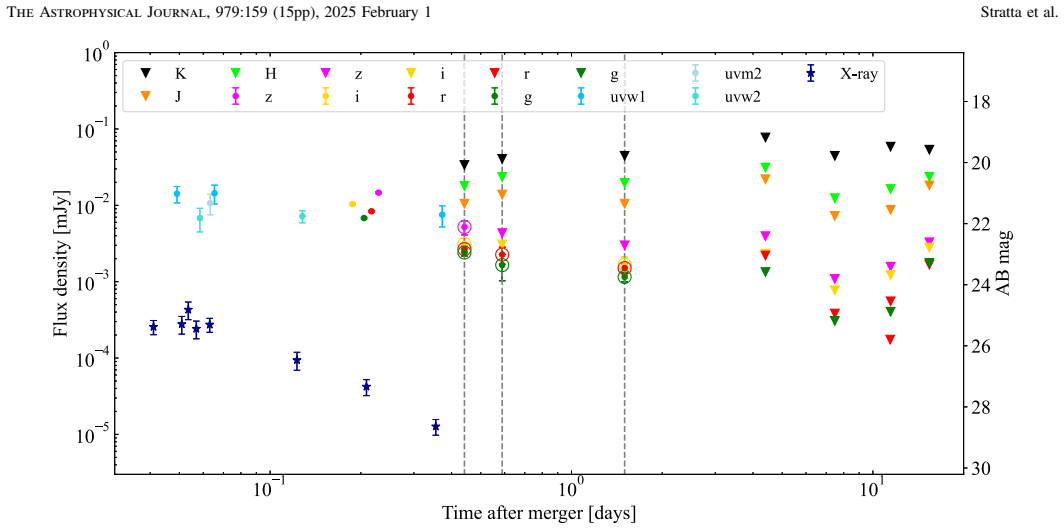
The load-bearing machinery is a joint Bayesian fit of a forward-shock afterglow model with a Gaussian jet profile and standard microphysics, combined with a two-component kilonova radiation-transport model, applied to the combined X-ray and multi-color optical light curves. The afterglow is anchored mainly by the X-ray data, and the kilonova component explains the late optical excess that the afterglow alone underpredicts by more than 3 sigma at 1.5 days. A second probe is the minimum variability timescale of the prompt emission, a diagnostic that separates compact mergers from collapsars independently of burst duration; GRB 191019A's roughly 20 ms variability places it among merger-type long bursts. The kilonova model is defined by dynamical ejecta plus a slower wind component, with the grid calibrated on the kilonova AT2017gfo from the neutron-star merger GW170817, and the model comparison uses Bayesian evidence to weigh afterglow-only versus afterglow-plus-kilonova.
What would settle it
Fit the same X-ray and optical data with an afterglow model that includes reverse-shock emission, energy injection, or a structured jet, using the same priors and Bayesian evidence; if any of these alternatives reproduces the optical flattening without a kilonova, or brings the Bayes factor below the threshold the paper treats as strong, the kilonova interpretation would no longer be unique and the central conclusion would be undermined.
Extended reading notes
Core claim
The central claim is that the 65-second gamma-ray burst GRB 191019A, long attributed to a collapsing massive star because of its duration, was in fact produced by a compact binary merger and that a kilonova contributed to its optical light. Two independent lines of evidence support this. The burst's minimum variability timescale of about 20 ms places it in the region of the duration-versus-variability diagram occupied by short GRBs with soft extended emission and by the two established long-merger bursts GRB 211211A and GRB 230307A. And new optical photometry shows a steep-to-shallow flattening that a forward-shock afterglow cannot reproduce, with the X-ray-scaled afterglow underpredicting the optical flux by more than 3 $\sigma$ at 1.5 days. The joint fit yields a dynamical ejecta mass of roughly 0.02 solar masses and a wind ejecta mass of roughly 0.04 solar masses, similar to AT2017gfo but about four times brighter, and the afterglow-plus-kilonova model is preferred over afterglow only by a log Bayes factor of -7.0. It also finds a circumburst density near 1 $cm^{-3}$, in contrast to the earlier $10^{7}$-$10^{8}$ $cm^{-3}$ inference, so the long duration is intrinsic.
Load-bearing premise
The argument depends on the assumption that the forward-shock afterglow model with a Gaussian jet and standard microphysics is an adequate baseline for the optical emission between 0.4 and 1.5 days, so the measured steep-to-shallow flattening, a more than 3 sigma excess at 1.5 days, is an extra component rather than an afterglow effect.
Editorial extensions
If this is right
- GRB 191019A would become the third long burst with kilonova light, after GRB 211211A and GRB 230307A, reinforcing the conclusion that burst duration alone does not identify the progenitor.
- A circumburst density near 1 cm^-3 would invalidate the dense-environment explanation for the burst's long duration, shifting the explanation to intrinsic properties such as fallback accretion onto the merger remnant.
- A total ejected mass of about 0.06 solar masses, comparable to AT2017gfo, would imply that such mergers are significant r-process element sources even when they appear as long GRBs in old galactic nuclei.
- The minimum-variability-timescale diagnostic would be validated as a way to find hidden compact mergers among long GRBs without supernovae.
- The data do not distinguish among the more sophisticated kilonova models, so the inferred ejecta masses should be treated as order-of-magnitude estimates of a multi-component outflow.
Reading between the lines
- If the low density holds, the kilonova ejecta from GRB 191019A should show no significant interaction with a dense circumstellar medium at late radio times; a future radio nondetection would be consistent, while a bright late radio rebrightening would challenge the low-density picture.
- Applying the minimum-variability-timescale criterion systematically to the full sample of nearby long GRBs without supernovae could uncover additional hidden kilonovae and sharpen the statistics of the long-merger class.
- The small projected offset from the host center, about 100 pc, need not imply formation in a dense AGN disk; if the line of sight is nearly along the offset, a merger far off center can project onto the nucleus, which would weaken the gas-capture formation argument for this event.
Editorial analysis
A structured set of objections, weighed in public.
Referee Report
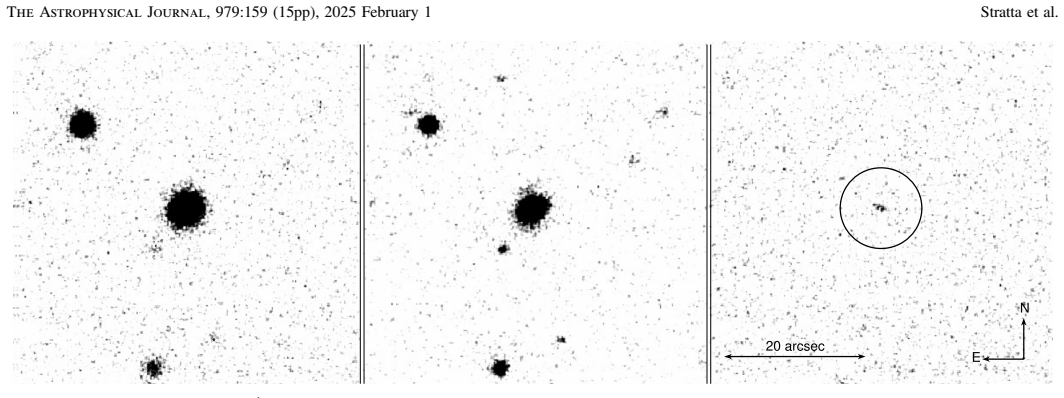
Summary. The paper reanalyzes the optical and X-ray data of the long-duration GRB 191019A (z = 0.248). The authors use the minimum variability timescale diagnostic to suggest a compact binary merger origin, and they present new GROND multicolor photometry obtained between 0.4 and 15 days after the burst. After image subtraction, the optical transient is detected in the first three epochs and fades until 1.5 days. A broken power-law fit to the early optical light curve shows a steep-to-shallow flattening, and a Bayesian joint fit with the NMMA framework, using an Afterglowpy Gaussian-jet afterglow plus a POSSIS kilonova model, yields ln(B) = −7.0 relative to an afterglow-only model. The inferred kilonova has dynamical and wind ejecta masses of ~0.02 and ~0.04 solar masses, respectively, and the circumburst density is found to be low (n0 ~ 1 cm^-3), in contrast to earlier claims of a very dense environment. The authors conclude that GRB 191019A is a nearby long GRB from a compact binary merger with kilonova light, and that its long duration is intrinsic rather than due to a dense external medium.
Significance. If the kilonova claim holds, this paper adds a new member to the small but growing class of long GRBs produced by compact binary mergers, and it directly challenges the dense-circumnuclear-environment interpretation of GRB 191019A. The work benefits from careful image subtraction, use of publicly available Swift-XRT data, and a Bayesian model-comparison framework that tests several kilonova models. The photometric reduction and the documentation of upper limits are thorough. However, the central evidence for kilonova light is conditional on the adequacy of a single forward-shock afterglow template and on a flattening that is quantified with a fixed break time and only two late optical epochs; therefore the conclusion is suggestive rather than definitive.
major comments (3)
- [§3.2.2, Figure 4] The broken-power-law test that establishes the steep-to-shallow flattening fixes the temporal break at 0.44 days, which is the epoch of the first GROND observation. Because only two epochs (1b and 2) fall after this break, and epoch 1b has uncertainties of 0.27–0.40 mag, the reported p-values (1.7 × 10^-5 in r' and 4 × 10^-4 in g' for a single power law) are sensitive to this a priori choice. Please repeat the fit with the break time as a free parameter and report the resulting significance, or justify explicitly why fixing the break at the first observation is a conservative procedure.
- [§3.3 and Table 5] The Bayesian model comparison uses a single Afterglowpy Gaussian-jet forward-shock model as the afterglow baseline. The alternative afterglow interpretations mentioned in §3.2.2 (reverse shock, energy injection, off-axis structured jet) are discussed qualitatively but not fitted to the data. Since the ln(B) = −7.0 preference for the kilonova model is conditional on this baseline, the central claim would be substantially strengthened by modeling at least one representative alternative (for example, an energy-injection afterglow) and showing that it is disfavored by the joint X-ray/optical data. Without such a test, the evidence is better phrased as 'consistent with' kilonova light than as unique evidence.
- [§3.3, epochs 1b and 2 in Table 1] The >3σ excess at T0 + 1.5 days is driven essentially by a single epoch (epoch 2) in the g' and r' bands, with epoch 1b providing only weak post-break constraints. Please state how the significance changes if epoch 2 were subject to an unrecognized systematic error (for example, in the image subtraction or photometric calibration), and quantify the contribution of each post-break epoch to the reported deviation. This is load-bearing because the klionova evidence rests entirely on this flattening.
minor comments (5)
- [Discussion, first paragraph] Typo: 'GRB 1901910A' should read 'GRB 191019A'.
- [Discussion, fourth paragraph] Typo: 'GRB 111210A' should read 'GRB 211211A'.
- [§3.3, Bayes factor] The notation for the Bayesian evidence is confusing: ln(Z) is used for the afterglow-only model and ln(Z0) for the joint model, so that ln(B) = ln(Z/Z0) = −7.0. Standard convention would set the null model as Z0; please clarify the notation so that a negative value is immediately interpretable as favoring the kilonova model.
- [Figure 4 caption] Grammar: 'the flux of a AT2017gfo-like kilonova' should be 'the flux of an AT2017gfo-like kilonova'.
- [Table 2] The formatting of the confidence intervals (e.g., '0.14 1.94−+ 0.16' for log n0) is difficult to read; please use standard interval notation such as '0.14^{+0.16}_{−1.94}'.
Circularity Check
No significant circularity: the kilonova evidence is derived from external GROND/Swift data against externally calibrated AT2017gfo models; the MVT self-citation is motivational only.
full rationale
The paper's central claim is that GRB 191019A's optical flattening is better described by an afterglow plus kilonova model than by afterglow alone. The derivation chain is: (i) image-subtracted GROND photometry (external data) shows a steep-to-shallow flattening; (ii) a broken power law with break at 0.44 d gives acceptable p-values while a single power law does not; (iii) NMMA/Afterglowpy+POSSIS joint fits yield ln(B) = -7.0 favoring the kilonova model; (iv) inferred ejecta masses are compared to AT2017gfo. No step defines the inferred quantity in terms of the conclusion. The MVT classification from Camisasca et al. 2023 is a self-citation with overlapping authorship (Guidorzi, Camisasca), but it is used only to motivate the reanalysis and to provide a consistency argument; the kilonova evidence itself is computed from independent photometry and does not depend on the MVT classification. The POSSIS/NMMA codes are co-authored, but the models were independently calibrated on AT2017gfo and the Bayes factor is evaluated on the GRB data, so the comparison is not circular. The skeptic's concern about the break time fixed at 0.44 d and single forward-shock baseline is a modeling-adequacy/robustness issue, not a case where a prediction reduces to an input by construction.
Assumptions & free parameters
free parameters (13)
- log10 E0 (isotropic-equivalent kinetic energy) =
52.14 (+0.53, -0.37) erg, prior U(49,53)
- log10 n0 (circumburst density) =
Best-fit below 1 cm^-3, prior U(-3,7)
- theta_c (jet core half-opening angle) =
0.05 (+0.06, -0.05) rad, prior U(0.01, pi/10)
- theta_w (jet wing half-opening angle) =
0.38 (+0.13, -0.19) rad, prior U(0.01, pi/4)
- iota (viewing angle) =
0.07 (+0.03, -0.05) rad, sine prior on (0, pi/8)
- p (electron spectral index) =
2.75 (+0.05, -0.04), prior U(2.01,3.0)
- log10 eps_e =
-0.69 (+0.34, -0.39), prior U(-5,0)
- log10 eps_B =
-4.60 (+1.19, -1.56), prior U(-10,0)
- log10 M_dyn (dynamical ejecta mass) =
-1.73 (+0.24, -0.25) solar masses, prior U(-3,-1)
- log10 M_wind (wind ejecta mass) =
-1.36 (+0.31, -0.39) solar masses, prior U(-3,-0.5)
- Phi (half-opening angle of lanthanide-rich equatorial ejecta) =
40.13 (+10.30, -11.88) degrees, prior U(15,75)
- em_syserr (additional magnitude error budget) =
Not quoted; prior U(0,2) mag
- t_break in broken power-law fit =
0.44 days
assumptions (5)
- domain assumption Forward-shock synchrotron afterglow model in Afterglowpy with a Gaussian jet and ξ_N=1 is an adequate baseline.
- domain assumption Kilonova emission is described by POSSIS two-component ejecta models for an NS-NS merger (Dietrich et al. 2020).
- domain assumption The minimum variability timescale criterion of Camisasca et al. 2023 reliably identifies compact-merger progenitors regardless of burst duration.
- domain assumption Host galaxy extinction AV_host = 0.06 mag and the adopted Planck cosmology are correct.
- domain assumption Image subtraction with HOTPANTS cleanly removes the bright host nucleus without introducing residual flux at the transient position.
Cite this review
Pith. "Pith review of The puzzling long GRB 191019A: Evidence for Kilonova Light." pith.science (2026). https://pith.science/paper/TCEFA6NT
@misc{pith2026241204059,
  author       = {Pith},
  title        = {Pith review of: The puzzling long GRB 191019A: Evidence for Kilonova Light},
  year         = {2026},
  howpublished = {\url{https://pith.science/paper/TCEFA6NT}},
  note         = {Machine review of arXiv:2412.04059}
}
read the original abstract
GRB 191019A was a long Gamma-ray burst (GRB) lasting about 65 s and, as such, originally thought to be linked to a core-collapse supernova. However, even though follow-up observations identified the optical counterpart close to the bright nucleus of a nearby ancient galaxy (z=0.248), no associated supernova was found. This led to the suggestion that the burst was caused by the merger of two compact stellar objects, likely in a dense circumnuclear environment. By using a recently developed diagnostic tool based on prompt emission temporal properties, we noticed that GRB 191019A falls among those long GRBs which are associated with compact mergers and with evidence of kilonova light. We thus re-analyzed unpublished GROND multi-color (g'r'i'z'JHK_s) data obtained between 0.4 and 15 days post trigger. Image subtraction confirmed the optical counterpart in all four optical bands, with GROND tracking its fading until 1.5 days post-burst. Incorporating publicly available Swift-XRT data, a joint fit of an afterglow plus a kilonova model revealed a better match than an afterglow-only scenario. The resulting kilonova properties resemble those of AT2017gfo associated with the binary neutron star merger GW170817, with a total ejected mass of about 0.06 solar mass. Contrary to previous findings inferring a high-density circumburst environment (n0=10^7-10^8 cm^-3), our analysis finds standard conditions (n0 = 1 cm^-3), suggesting the long duration of GRB 191019A was intrinsic rather than due to jet interaction with a dense external medium.
Figures

Figures from the paper (4 more)


Forward citations
Cited by 2 Pith papers
-
Gamma-ray burst progenitors revisited
About 30–40% of long gamma-ray bursts at z<0.3 lack supernova emission and likely arise from compact object mergers, at rates comparable to short GRBs.
-
The Cosmological Population of Gamma-Ray Bursts from the Disks of Active Galactic Nuclei
A Monte Carlo population model predicts that AGN-disk GRBs are rarely detectable, and detectable events are concentrated at low redshift, high black hole mass, and large disk radius.
Reference graph
Works this paper leans on
-
[1]
P., et al
Abbott, B. P., et al. 2017, ApJ, 848, L13
2017
-
[2]
P., Anand, S., et al
Ahumada, T., Singer, L. P., Anand, S., et al. 2021, NatAs, 5, 917 Astropy Collaboration, Robitaille, T. P., Tollerud, E. J., et al. 2013, A&A, 558, A33 Astropy Collaboration, Price-Whelan, A. M., Sip őcz, B. M., et al. 2018, AJ, 156, 123
2021
-
[3]
2021, A&A, 651, A81
Barbarino, C., Sollerman, J., Taddia, F., et al. 2021, A&A, 651, A81
2021
-
[4]
V., & Pozanenko, A
Barkov, M. V., & Pozanenko, A. S. 2011, MNRAS, 417, 2161
2011
-
[5]
D., Barbier, L
Barthelmy, S. D., Barbier, L. M., Cummings, J. R., et al. 2005, SSRv, 120, 143
2005
-
[6]
Becker, A., 2015 HOTPANTS: High Order Transform of PSF ANd Template
2015
-
[7]
2020, MNRAS, 492, 2847
Beniamini, P., Duque, R., Daigne, F., & Mochkovitch, R. 2020, MNRAS, 492, 2847
2020
-
[8]
2014, ARA&A, 52, 43
Berger, E. 2014, ARA&A, 52, 43
2014
Show all 97 references
-
[9]
2020, GReGr, 52, 108 Björnsson, G., Hjorth, J., Jakobsson, P., Christensen, L., & Holland, S
Bernuzzi, S. 2020, GReGr, 52, 108 Björnsson, G., Hjorth, J., Jakobsson, P., Christensen, L., & Holland, S. 2001, ApJL, 552, L121
2020
-
[10]
2019, MNRAS, 489, 5037
Bulla, M. 2019, MNRAS, 489, 5037
2019
-
[11]
2023, MNRAS, 520, 2558
Bulla, M. 2023, MNRAS, 520, 2558
2023
-
[12]
N., Hill, J
Burrows, D. N., Hill, J. E., Nousek, J. A., et al. 2005, SSRv, 120, 165
2005
-
[13]
E., Guidorzi, C., Amati, L., et al
Camisasca, A. E., Guidorzi, C., Amati, L., et al. 2023, A&A, 671, A112
2023
-
[14]
2017, AdAst, 2017, 8929054
Cano, Z., Wang, S.-Q., Dai, Z.-G., & Wu, X.-F. 2017, AdAst, 2017, 8929054
2017
-
[15]
C., Magnier, E
Chambers, K. C., Magnier, E. A., Metcalfe, N., et al. 2016, arXiv: 1612.05560
2016 arXiv
-
[16]
A., Foley, R
Coulter, D. A., Foley, R. J., Kilpatrick, C. D., et al. 2017, Sci, 358, 1556
2017
-
[17]
M., Gendre, B., Tanga, P., et al
Coward, D. M., Gendre, B., Tanga, P., et al. 2017, PASA, 34, e005
2017
-
[18]
G., De Simone, B., Islam, K
Dainotti, M. G., De Simone, B., Islam, K. M., et al. 2022, ApJ, 938, 41 Della Valle, M., Malesani, D., Benetti, S., et al. 2003, A&A, 406, L33
2022
-
[19]
W., Pang, P
Dietrich, T., Coughlin, M. W., Pang, P. T. H., et al. 2020, Sci, 370, 1450
2020
-
[20]
A., Beardmore, A
Evans, P. A., Beardmore, A. P., Page, K. L., et al. 2007, A&A, 469, 379
2007
-
[21]
A., Beardmore, A
Evans, P. A., Beardmore, A. P., Page, K. L., et al. 2009, MNRAS, 397, 1177
2009
-
[22]
A., Osborne, J
Evans, P. A., Osborne, J. P., Burrows, D. N., et al. 2019, GCN, 26034, 1
2019
-
[23]
A., Willingale, R., Osborne, J
Evans, P. A., Willingale, R., Osborne, J. P., et al. 2010, A&A, 519, A102
2010
-
[24]
A., Zeh, A., et al
Ferrero, P., Kann, D. A., Zeh, A., et al. 2006, A&A, 457, 857
2006
-
[25]
Fong, W., Berger, E., Margutti, R., & Zauderer, B. A. 2015, ApJ, 815, 102
2015
-
[26]
E., Dong, Y., et al
Fong, W.-f., Nugent, A. E., Dong, Y., et al. 2022, ApJ, 940, 56
2022
-
[27]
S., Paris, D., et al
Fontana, A., Dunlop, J. S., Paris, D., et al. 2014, A&A, 570, A11
2014
-
[28]
Fynbo, J. P. U., Perley, D. A., de Ugarte Postigo, A., et al. 2019, GCN, 26041, 1
2019
-
[29]
Fynbo, J. P. U., Watson, D., Thöne, C. C., et al. 2006, Natur, 444, 1047
2006
-
[30]
2004, ApJ, 611, 1005
Gehrels, N., Chincarini, G., Giommi, P., et al. 2004, ApJ, 611, 1005
2004
-
[31]
2019, GCN, 26098, 1
Gendre, B., Crisp, H., Coward, D., et al. 2019, GCN, 26098, 1
2019
-
[32]
2010, MNRAS, 405, 2372
Gendre, B., Klotz, A., Palazzi, E., et al. 2010, MNRAS, 405, 2372
2010
-
[33]
K., & Hosseinzadeh, G
Gomez, S., Berger, E., Nicholl, M., Blanchard, P. K., & Hosseinzadeh, G. 2022, ApJ, 941, 107
2022
-
[34]
P., Ravasio, M
Gompertz, B. P., Ravasio, M. E., Nicholl, M., et al. 2023, NatAs, 7, 67
2023
-
[35]
2008, PASP, 120, 405
Greiner, J., Bornemann, W., Clemens, C., et al. 2008, PASP, 120, 405
2008
-
[36]
A., Kann, D
Greiner, J., Mazzali, P. A., Kann, D. A., et al. 2015, Natur, 523, 189
2015
-
[37]
2013, RSPTA, 371, 20120275
Hjorth, J. 2013, RSPTA, 371, 20120275
2013
-
[38]
Hjorth, J., & Bloom, J. S. 2012, in Gamma-Ray Bursts, ed. C. Kouveliotou, R. A. M. J. Wijers, & S. Woosley (Cambridge: Cambridge Univ. Press ), 169
2012
-
[39]
2022, ApJ, 936, 157
Hu, L., Wang, L., Chen, X., & Yang, J. 2022, ApJ, 936, 157
2022
-
[40]
2015, ApJL, 811, L22
Jin, Z.-P., Li, X., Cano, Z., et al. 2015, ApJL, 811, L22
2015
-
[41]
A., Klose, S., Zhang, B., et al
Kann, D. A., Klose, S., Zhang, B., et al. 2010, ApJ, 720, 1513 Table 5 The 90% Con fidence Interval and Median Values for Each Parameter Inferred from Joint Afterglow and Kilonova and Afterglow-only Jet Modeling Performed by Using the NMMA Code Bu19-BNS-Jet Bu19-NSBH-Jet Kasen1...
2010
-
[42]
A., Schady, P., Olivares, E
Kann, D. A., Schady, P., Olivares, E. F., et al. 2019, A&A, 624, A143
2019
-
[43]
2017, Natur, 551, 80
Kasen, D., Metzger, B., Barnes, J., Quataert, E., & Ramirez-Ruiz, E. 2017, Natur, 551, 80
2017
-
[44]
2015, ApJL, 804, L16
Kisaka, S., & Ioka, K. 2015, ApJL, 804, L16
2015
-
[45]
A., et al
Klose, S., Schmidl, S., Kann, D. A., et al. 2019, A&A, 622, A138
2019
-
[46]
A., Fishman, G
Kouveliotou, C., Meegan, C. A., Fishman, G. J., et al. 1993, ApJL, 413, L101
1993
-
[47]
A., Barthelmy, S
Krimm, H. A., Barthelmy, S. D., Cummings, J. R., et al. 2019, GCN, 26046, 1 Krühler, T., Küpcü Yolda ş, A., Greiner, J., et al. 2008, ApJ, 685, 376
2019
-
[48]
2024, MNRAS, 527, 3900
Kunert, N., Antier, S., Nedora, V., et al. 2024, MNRAS, 527, 3900
2024
-
[49]
Labrie, K., Anderson, K., Cárdenes, R., Simpson, C., & Turner, J. E. H. 2019, in ASP Conf. Ser. 523, Astronomical Data Analysis Software and Systems XXVII, ed. P. J. Teuben et al. (San Francisco, CA: ASP ), 321
2019
-
[50]
J., Simpson, K
LaPorte, S. J., Simpson, K. K. & Swift /UVOT Team 2019, GCN, 26053, 1
2019
-
[51]
P., & Levan, A
Lazzati, D., Perna, R., Gompertz, B. P., & Levan, A. J. 2023, ApJL, 950, L20
2023
-
[52]
2022, ApJL, 938, L18
Lazzati, D., Soares, G., & Perna, R. 2022, ApJL, 938, L18
2022
-
[53]
J., Malesani, D
Levan, A. J., Malesani, D. B., Gompertz, B. P., et al. 2023, NatAs, 7, 976
2023
-
[54]
1998, ApJL, 507, L59
Li, L.-X., & Paczy ński, B. 1998, ApJL, 507, L59
1998
-
[55]
2022, Natur, 612, 236
Mei, A., Banerjee, B., Oganesyan, G., et al. 2022, Natur, 612, 236
2022
-
[56]
2014, A&A, 567, A29
Melandri, A., Pian, E., D'Elia, V., et al. 2014, A&A, 567, A29
2014
-
[57]
Metzger, B. D. 2017, LRR, 20, 3 MichałowskI, M. J., Xu, D., Stevens, J., et al. 2018, A&A, 616, A169
2017
-
[58]
Y., Pozanenko, A
Minaev, P. Y., Pozanenko, A. S., & Loznikov, V. M. 2010, AstL, 36, 707
2010
-
[59]
2019, in ASP Conf
Mink, J. 2019, in ASP Conf. Ser. 523, Astronomical Data Analysis Software and Systems XXVII, ed. P. J. Teuben et al. (San Francisco, CA: ASP ), 281
2019
-
[60]
2024, ApJL, 966, L31
Musolino, C., Duqué, R., & Rezzolla, L. 2024, ApJL, 966, L31
2024
-
[61]
2004, MNRAS, 353, 647
Nakar, E., & Piran, T. 2004, MNRAS, 353, 647
2004
-
[62]
2013, ApJ, 778, 67
Nakauchi, D., Kashiyama, K., Suwa, Y., & Nakamura, T. 2013, ApJ, 778, 67
2013
-
[63]
2021, ApJ, 906, 98 Nicuesa Guelbenzu, A
Nedora, V., Bernuzzi, S., Radice, D., et al. 2021, ApJ, 906, 98 Nicuesa Guelbenzu, A. 2019, GCN, 26042, 1
2021
-
[64]
P., & Bonnell, J
Norris, J. P., & Bonnell, J. T. 2006, ApJ, 643, 266
2006
-
[65]
2022, MNRAS, 515, 4890
O'Connor, B., Troja, E., Dichiara, S., et al. 2022, MNRAS, 515, 4890
2022
-
[66]
F., Greiner, J., Schady, P., et al
Olivares, E. F., Greiner, J., Schady, P., et al. 2012, A&A, 539, A76
2012
-
[67]
F., Greiner, J., Schady, P., et al
Olivares, E. F., Greiner, J., Schady, P., et al. 2015, A&A, 577, A44
2015
-
[68]
Pang, P. T. H., Dietrich, T., Coughlin, M. W., et al. 2023, NatCo, 14, 8352
2023
-
[69]
A., Masetti, N., et al
Pian, E., Mazzali, P. A., Masetti, N., et al. 2006, Natur, 442, 1011 Planck Collaboration, Aghanim, N., Akrami, Y., et al. 2020, A&A, 641, A6
2006
-
[70]
C., Gompertz, B
Rastinejad, J. C., Gompertz, B. P., Levan, A. J., et al. 2022, Natur, 612, 223
2022
-
[71]
2019, GCN, 26036, 1
Reva, I., Pozanenko, A., Krugov, M., et al. 2019, GCN, 26036, 1
2019
-
[72]
2014, A&A, 572, A47
Rossi, A., Piranomonte, S., Savaglio, S., et al. 2014, A&A, 572, A47
2014
-
[73]
2022, ApJ, 932, 1
Rossi, A., Rothberg, B., Palazzi, E., et al. 2022, ApJ, 932, 1
2022
-
[74]
2011, A&A, 529, A142
Rossi, A., Schulze, S., Klose, S., et al. 2011, A&A, 529, A142
2011
-
[75]
2020, MNRAS, 493, 3379
Rossi, A., Stratta, G., Maiorano, E., et al. 2020, MNRAS, 493, 3379
2020
-
[76]
2020, ApJ, 896, 166
Ryan, G., van Eerten, H., Piro, L., & Troja, E. 2020, ApJ, 896, 166
2020
-
[77]
1998, ApJL, 497, l17 Schlafly, E
Sari, R., Piran, T., & Narayan, R. 1998, ApJL, 497, l17 Schlafly, E. F., & Finkbeiner, D. P. 2011, ApJ, 737, 103
1998
-
[78]
J., Finkbeiner, D
Schlegel, D. J., Finkbeiner, D. P., & Davis, M. 1998, ApJ, 500, 525 Science Software Branch at STScI, 2012 PyRAF: Python alternative for IRAF, http://ascl.net/1207.011
1998
-
[79]
K., Barthelmy, S
Simpson, K. K., Barthelmy, S. D., Gropp, J. D., et al. 2019, GCN, 26031, 1
2019
-
[80]
F., Cutri, R
Skrutskie, M. F., Cutri, R. M., Stiening, R., et al. 2006, AJ, 131, 1163
2006
-
[81]
M., Kulkarni, S
Soderberg, A. M., Kulkarni, S. R., Price, P. A., et al. 2006, ApJ, 636, 391
2006
-
[82]
Starling, R. L. C., Wiersema, K., Levan, A. J., et al. 2011, MNRAS, 411, 2792
2011
-
[83]
2019, A&A, 621, A71
Taddia, F., Sollerman, J., Fremling, C., et al. 2019, A&A, 621, A71
2019
-
[84]
2020, ApJ, 898, 25
Tagawa, H., Haiman, Z., & Kocsis, B. 2020, ApJ, 898, 25
2020
-
[85]
2018, A&A, 615, A136
Tanga, M., Krühler, T., Schady, P., et al. 2018, A&A, 615, A136
2018
-
[86]
R., Levan, A
Tanvir, N. R., Levan, A. J., Fruchter, A. S., et al. 2013, Natur, 500, 547
2013
-
[87]
1993, in ASP Conf
Tody, D. 1993, in ASP Conf. Ser. 52, Astronomical Data Analysis Software and Systems II, ed. R. J. Hanisch, R. J. V. Brissenden, & J. Barnes (San
1993
-
[88]
J., Becerra González, J., et al
Troja, E., Castro-Tirado, A. J., Becerra González, J., et al. 2019, MNRAS, 489, 2104
2019
-
[89]
L., O'Connor, B., et al
Troja, E., Fryer, C. L., O'Connor, B., et al. 2022, Natur, 612, 228
2022
-
[90]
2018, NatCo, 9, 4089
Troja, E., Ryan, G., Piro, L., et al. 2018, NatCo, 9, 4089
2018
-
[91]
2024, ApJ, 963, 156
Wang, S.-N., Lü, H.-J., Yuan, Y., et al. 2024, ApJ, 963, 156
2024
-
[92]
J., Kann, D
Wiersema, K., van der Horst, A. J., Kann, D. A., et al. 2008, A&A, 481, 319
2008
-
[93]
2022, Natur, 612, 232 Yoldaş, A
Yang, J., Ai, S., Zhang, B.-B., et al. 2022, Natur, 612, 232 Yoldaş, A. K., Krühler, T., Greiner, J., et al. 2008, in AIP Conf. Ser. 1000, American Institute of Physics Conference Series, ed. M. Galassi, D. Palmer, & E. Fenimore (Melville, NY: AIP ), 227
2022
-
[94]
Zeh, A., Klose, S., & Hartmann, D. H. 2004, ApJ, 609, 952
2004
-
[95]
2001, ApJL, 552, L35
Zhang, B., & Mészáros, P. 2001, ApJL, 552, L35
2001
-
[96]
2024, ApJ, 976, 63
Zhang, H.-H., Zhu, J.-P., & Yu, Y.-W. 2024, ApJ, 976, 63
2024
-
[97]
P., Yu, B
Zhu, Z. P., Yu, B. Y., Xu, D., & Gao, X. 2019, GCN, 26059, 1 15 The Astrophysical Journal, 979:159 (15pp), 2025 February 1 Stratta et al
2019
Reviewed August 11, 2026 · model on record in the stance chip above.
Discussion (0). Continue with ORCID to comment.