REVIEW 4 major objections 4 minor 49 references
Intent-based Meta-Scheduling in Programmable Networks: A Research Agenda
T0 review · 4 major / 4 minor · reviewed 2026-08-11 · deepseek-v4-flash
Pith's one-line read This position paper claims that active inference, a causal-reasoning method, can design and implement optimal meta-schedulers for programmable networks, automatically turning high-level intents into coordinated, conflict-free scheduling…
desk verdict A clear, honest research agenda for intent-based meta-scheduling in O-RAN, but the central active-inference optimality claim is asserted, not demonstrated; fine as a position paper, not as evidence. read the letter →
The pith
A machine-rendered reading of the paper's core claim, the machinery that carries it, and where it could break.
The reading
What carries the argument
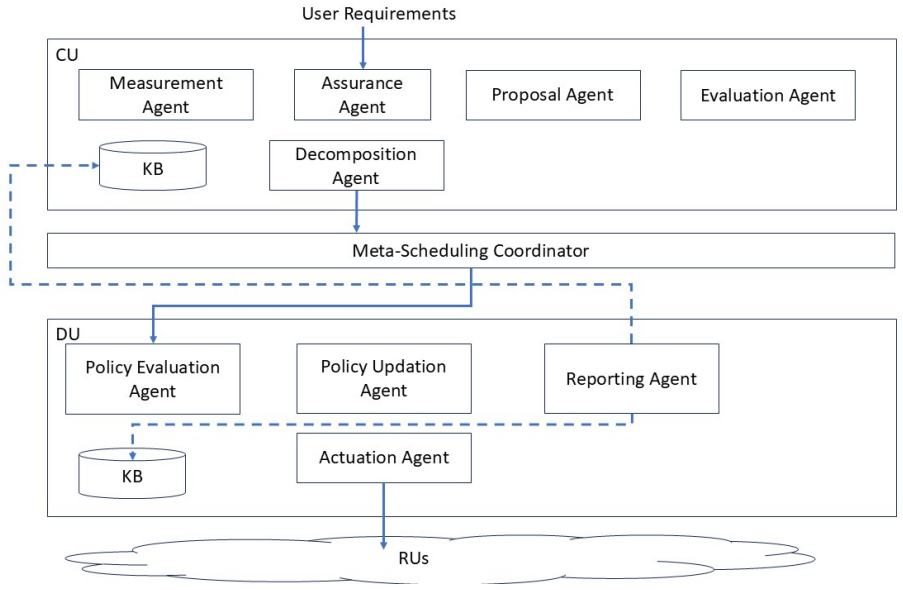
The central object is the two-level meta-scheduling architecture: at the CU level, a set of agents—Assurance, Measurement, Proposal, Evaluation, Decomposition, and a Meta-Scheduling Coordinator—maintain causal models and decompose intents into scheduling policies; at the DU level, Policy Evaluation, Policy Updation, Actuation, and Reporting agents execute and report on those policies. The mechanism that carries the argument is the active-inference action-perception cycle, in which the scheduler predicts the latency outcome of its policy, compares the prediction to reality using a free-energy objective based on Kullback-Leibler divergence, and updates its beliefs accordingly. The knowledge bases in the CU and DU are where prediction and belief updating happen.
What would settle it
Run the Algorithm 1 loop on a software-defined base-station testbed with several simultaneous intents and measure the wall-clock time from intent arrival to RU actuation. If the active-inference state update plus policy computation cannot fit within the sub-millisecond budget under representative load, then the central claim—that active inference can implement optimal meta-schedulers for programmable networks—is not supported by the proposed architecture.
Extended reading notes
Core claim
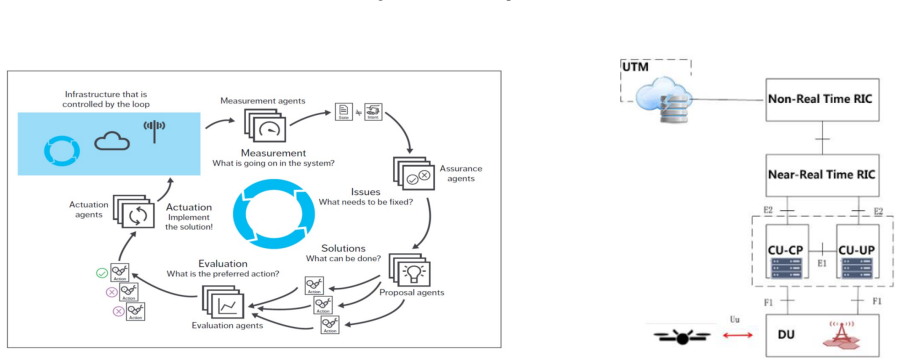
The paper's central claim is that active inference can design and implement optimal meta-schedulers for programmable networks. Applied to a disaggregated base station, the proposal places a meta-scheduler at the central unit (CU) that decomposes high-level intents into per-distributed-unit (DU) scheduling policies, while each DU retains its own knowledge base and can evaluate, update, and actuate the policy locally. The intent-management loop runs down from the business-support layer to the radio units, so user requirements expressed as intents become concrete radio-resource allocations. The paper's contribution is a strawman architecture, a concrete algorithm (Algorithm 1) example, and a research agenda of open questions.
Load-bearing premise
The approach hinges on the assumption that the active-inference action-perception cycle—predicting a scheduling decision's outcome and updating the causal model in the CU/DU knowledge bases—can finish inside the sub-millisecond scheduling window that 6G requires.
Editorial extensions
If this is right
- Operators would express service requirements as intents once, and the network would automatically decompose each intent into per-DU scheduling policies without manual per-slice tuning.
- A CU-level meta-scheduler would arbitrate among competing schedulers using causal models of the network, reducing the performance loss that comes from conflicting resource-allocation algorithms.
- Feeding schedulers only the Markov-blanket variables of the target quality metric (for example, latency) could make machine-learning schedulers faster and more robust to model drift.
- The proposed extensions to open-radio-access-network-style interfaces would give intent-based management a standard path from business-level requirements to individual radio transmissions.
Reading between the lines
- Editorial inference: The same CU-as-meta-scheduler / DU-as-local-agent split could be lifted to any programmable system with a global goal and many fast local actuators, such as transport-network optimization or edge-compute orchestration.
- Editorial inference: Because the paper's algorithm treats the meta-scheduling policy as a function of intent, slice differentiator, buffer status, CQI, and BLER, one could test active-inference belief updates against a black-box baseline on a recorded RAN trace without building the full architecture.
- Editorial inference: If the sub-millisecond constraint cannot be met, a fallback that keeps the two-level decomposition but runs active inference only at the slower meta-scheduling tier (tens of milliseconds) would preserve most of the coordination benefit.
Editorial analysis
A structured set of objections, weighed in public.
Referee Report
Summary. This position paper proposes a research agenda for intent-based meta-scheduling in programmable 5G/B5G networks. It builds on intent decomposition in O-RAN, proposes a two-layer architecture in which a CU-level meta-scheduler coordinates DU-level schedulers (Fig. 7), and argues that active inference—a form of causal inference based on free-energy minimization—can model and manage this meta-scheduling loop. The paper presents an illustrative meta-scheduling algorithm (Algorithm 1), discusses causal models and Markov blankets for scheduling variables (Fig. 8, Sections IV-C and IV-D), and lists modeling and implementation research questions (Section V). It includes a substantial appendix summarizing an existing intent-decomposition method from [11].
Significance. The value of the paper lies in synthesizing intent-based management, O-RAN hierarchy, and active inference into a concrete strawman architecture, and in identifying a plausible set of research challenges (causal model discovery, inference latency, heterogeneous schedulers). The paper is honest in framing itself as a research agenda rather than a completed system, and the detailed appendix on prior intent decomposition is helpful for orientation. However, the central claim that active inference enables 'optimal' meta-schedulers is not demonstrated: no generative model, free-energy objective, or complexity bound is given. The significance is therefore as a thought-provoking agenda, not as a validated design; the claims must be softened or supported for journal publication.
major comments (4)
- [Section I and Section IV-D] The paper claims that active inference 'can help design and implement optimal meta-schedulers' (Section I), but no optimality argument is provided. Section IV-D reproduces the generic free-energy equations (1) and (2) from [13] without instantiating a generative model for scheduling variables (e.g., RLC buffer, CQI, BLER in Fig. 10) and without defining a free-energy objective whose minimizer maps to intent fulfillment. With no states, actions, observations, or policy prior defined, the claimed optimality is an assertion. Please either provide a concrete active-inference formulation for the meta-scheduling problem or explicitly weaken the claim to a hypothesis that the research agenda will test.
- [Algorithm 1 (lines 4-6)] Algorithm 1 defines 'DRB = f(Intent, 5QI)', 'Meta Scheduling policy = g(Intent, Slice differentiator, Buffer status, CQI, Block Error rate)', and 'RAN scheduling policy = h(Meta scheduling policy, Buffer status, CQI, Block error rate)' without specifying the functions f, g, and h. Since the algorithm is presented as showing how 'the meta-scheduler can help fulfill intents', the reader cannot evaluate correctness or feasibility. At minimum, the intended input/output semantics and any assumed properties (e.g., deterministic mappings, monotonicity, constraints) should be stated, or the algorithm should be labeled as purely illustrative pseudocode.
- [Section IV-A and IV-B] The paper asserts that sub-millisecond scheduling required in 6G can accommodate active-inference action-perception cycles in the CU/DU knowledge bases, but it provides no complexity analysis or feasibility bound for belief updates and policy evaluation within the 1 ms budget. This is a load-bearing premise for the practicality of the proposed architecture. Please provide an order-of-magnitude complexity estimate, cite existing low-latency active-inference implementations, or explicitly list this feasibility question as an open problem that the agenda must resolve.
- [Section V and Conclusion] Section V lists causal model discovery at scale (RQ 2) and integration of active inference over heterogeneous schedulers (RQ 4) as unsolved research questions, yet the Conclusion states 'we have shown' that active inference can be used to model and manage the framework. This overstates the contribution of a position paper whose own research questions remain open. Recommend revising the conclusion to 'we have argued' or 'we have outlined' to match the evidence presented.
minor comments (4)
- [Section IV-D] There is a typo: 'Kullkack-Leibler' should be 'Kullback-Leibler'.
- [Algorithm 1, line 7] The phrase 'Intent is zero' is awkward; consider 'if there is no intent' or 'Intent = None' for clarity.
- [Section III] The 50 ms end-to-end latency decomposition example (20 ms + 30 ms, then 18 ms + 12 ms) is described before the paper states the sub-millisecond scheduling requirement in Section IV-A; the relationship between these different time budgets is not explained and could confuse readers.
- [Throughout] Several figures are reproduced from other sources (e.g., Figs. 1, 2, 9, 11-15); the paper would benefit from explicit permission or license notes for these reproductions.
Circularity Check
No circularity: the paper is a research agenda with no fitted inputs or derived predictions; open research questions explicitly concede what remains to be done.
full rationale
The paper makes no quantitative prediction and fits no parameter, so no fitted-input-called-prediction pattern appears. Its use of active inference is explicitly illustrative: Equations (1) and (2) are reproduced from reference [13] and are never instantiated as a generative model for scheduling, so whatever gap exists between the claim and the evidence is one of missing specification, not definitional circularity. Algorithm 1 defines the mapping functions g and h without giving their functional forms; undefined functions cannot be equivalent to their outputs by construction, and the paper itself lists causal model discovery and active-inference integration as open research questions in Section V. No self-citation is load-bearing: the cited prior work, including [12] and [13], is external and is used as a building block or design lens rather than as the sole justification for the paper's own conclusion. The strongest criticism available is that the central claim is unsupported or unevaluable, which is a correctness and evidence concern, not a circularity concern. The paper explicitly frames itself as a research agenda and admits that key components remain unsolved, so there is no derivation chain that reduces to its own inputs. Therefore the appropriate finding is no significant circularity.
Assumptions & free parameters
assumptions (5)
- domain assumption Intents can be formally specified and decomposed from the BSS layer down to the RU layer without meaning loss.
- domain assumption Multiple scheduler instances operating concurrently will conflict and need a meta-scheduler to coordinate them.
- domain assumption Active inference is an appropriate computational model for scheduling decisions.
- domain assumption Causal models of network variables, including Markov blankets, can be discovered online with enough accuracy to drive scheduling.
- ad hoc to paper Active inference belief updates can be completed within the sub-millisecond scheduling budget required in 6G networks.
invented entities (2)
-
Meta-Scheduling Coordinator
-
Policy Evaluation Agent at the DU
Cite this review
Pith. "Pith review of Intent-based Meta-Scheduling in Programmable Networks: A Research Agenda." pith.science (2026). https://pith.science/paper/S6UBB7OB
@misc{pith2026241204232,
  author       = {Pith},
  title        = {Pith review of: Intent-based Meta-Scheduling in Programmable Networks: A Research Agenda},
  year         = {2026},
  howpublished = {\url{https://pith.science/paper/S6UBB7OB}},
  note         = {Machine review of arXiv:2412.04232}
}
read the original abstract
The emergence and growth of 5G and beyond 5G (B5G) networks has brought about the rise of so-called ''programmable'' networks, i.e., networks whose operational requirements are so stringent that they can only be met in an automated manner, with minimal/no human involvement. Any requirements on such a network would need to be formally specified via intents, which can represent user requirements in a formal yet understandable manner. Meeting the user requirements via intents would necessitate the rapid implementation of resource allocation and scheduling in the network. Also, given the expected size and geographical distribution of programmable networks, multiple resource scheduling implementations would need to be implemented at the same time. This would necessitate the use of a meta-scheduler that can coordinate the various schedulers and dynamically ensure optimal resource scheduling across the network. To that end, in this position paper, we propose a research agenda for modeling, implementation, and inclusion of intent-based dynamic meta-scheduling in programmable networks. Our research agenda will be built on active inference, a type of causal inference. Active inference provides some level of autonomy to each scheduler while the meta-scheduler takes care of overall intent fulfillment. Our research agenda will comprise a strawman architecture for meta-scheduling and a set of research questions that need to be addressed to make intent-based dynamic meta-scheduling a reality.
Figures


Figures from the paper (10 more)




Reference graph
Works this paper leans on
-
[11]
Decentralized intent-driven coordination of multi-domain ip-optical networks,
F. Christou, “Decentralized intent-driven coordination of multi-domain ip-optical networks,” in 2022 18th International Conference on Network and Service Management (CNSM) , 2022, pp. 359–363
work page 2022
-
[13]
Active inference on the edge: A design study,
B. Sedlak, V . C. Pujol, P. K. Donta, and S. Dustdar, “Active inference on the edge: A design study,” in 2024 IEEE International Conference on Pervasive Computing and Communications Workshops and other Affiliated Events (PerCom Workshops). IEEE, 2024, pp. 550–555
work page 2024
-
[1]
A survey of scheduling in 5g urllc and outlook for emerging 6g systems,
M. E. Haque, F. Tariq, M. R. Khandaker, K.-K. Wong, and Y . Zhang, “A survey of scheduling in 5g urllc and outlook for emerging 6g systems,” IEEE access, vol. 11, pp. 34 372–34 396, 2023
work page 2023
-
[2]
Autonomous networks with multi-layer, intent-based operation,
J. Niem ¨oller, J. Silvander, P. Stjernholm, L. Angelin, and U. Eriksson, “Autonomous networks with multi-layer, intent-based operation,” Eric- sson Technology Review, vol. 2023, no. 8, pp. 2–13, 2023
work page 2023
-
[4]
An intent-driven orchestration of cognitive autonomous networks for ran management,
A. Banerjee, S. S. Mwanje, and G. Carle, “An intent-driven orchestration of cognitive autonomous networks for ran management,” in 2021 17th International Conference on Network and Service Management (CNSM). IEEE, 2021, pp. 380–384
work page 2021
-
[5]
K. Mehmood, K. Kralevska, and D. Palma, “Intent-driven autonomous network and service management in future cellular networks: A struc- tured literature review,” Computer Networks, vol. 220, p. 109477, 2023
work page 2023
-
[6]
Un- derstanding o-ran: Architecture, interfaces, algorithms, security, and research challenges,
M. Polese, L. Bonati, S. D’Oro, S. Basagni, and T. Melodia, “Un- derstanding o-ran: Architecture, interfaces, algorithms, security, and research challenges,” arXiv preprint arXiv:2202.01032 , 2022
arXiv 2022
-
[7]
23.501 3gpp spec: https://tinyurl.com/552e3jdn
Show all 49 references
-
[8]
38.300 3gpp spec: https://tinyurl.com/muw8fytt
-
[9]
38.413 3gpp spec: https://tinyurl.com/5f4dpxw9
-
[10]
A genetic scheduling strategy with spatial reuse for dense wireless networks,
V . Fulber-Garcia, F. Engel, and E. P. Duarte, “A genetic scheduling strategy with spatial reuse for dense wireless networks,” International Journal of Hybrid Intelligent Systems , no. Preprint, pp. 1–15, 2024
2024
-
[12]
Meta-scheduling framework with cooperative learning toward beyond 5g,
K. Min, Y . Kim, and H.-S. Lee, “Meta-scheduling framework with cooperative learning toward beyond 5g,”IEEE Journal on Selected Areas in Communications, vol. 41, no. 6, pp. 1810–1824, 2023
2023
-
[14]
Deepslos for the computing continuum,
V . Casamayor Pujol, B. Sedlak, Y . Xu, P. K. Donta, and S. Dustdar, “Deepslos for the computing continuum,” in Proceedings of the 2024 Workshop on Advanced Tools, Programming Languages, and PLatforms for Implementing and Evaluating algorithms for Distributed systems , 2024, pp. 1–10
2024
-
[15]
Pearl, M
J. Pearl, M. Glymour, and N. P. Jewell, Causal inference in statistics: A primer. John Wiley & Sons, 2016
2016
-
[16]
Intent-driven intelligent control and orchestration in o-ran via hierarchical reinforcement learn- ing,
M. A. Habib, H. Zhou, P. E. Iturria-Rivera, M. Elsayed, M. Bavand, R. Gaigalas, Y . Ozcan, and M. Erol-Kantarci, “Intent-driven intelligent control and orchestration in o-ran via hierarchical reinforcement learn- ing,” in 2023 IEEE 20th International Conference on Mobile Ad Ho...
2023
-
[17]
Federated meta- learning for traffic steering in o-ran,
H. Erdol, X. Wang, P. Li, J. D. Thomas, R. Piechocki, G. Oikonomou, R. Inacio, A. Ahmad, K. Briggs, and S. Kapoor, “Federated meta- learning for traffic steering in o-ran,” 2022. [Online]. Available: https://arxiv.org/abs/2209.05874
2022 arXiv
-
[18]
Intent in autonomous networks v1.3.0 (ig1253): https://www.tmforum.org/resources/introductory-guide/ig1253-intent-in- autonomous-networks-v1-3-0/
-
[19]
I2bn: Intelligent intent based networks,
P. Szil ´agyi, “I2bn: Intelligent intent based networks,” Journal of ICT Standardization, vol. 9, no. 2, pp. 159–200, 2021
2021
-
[20]
Ericsson’s ai-powered intent-based operations to deliver 5g pre- mium services; https://www.ericsson.com/en/news/2024/2/ericssons-ai- powered-intent-based-operations-deliver-premium-5g-services
2024
-
[21]
CONRAD: cognitive intent driven 5g network slice planning and design,
A. Kattepur, S. K. Mohalik, I. Burdick, M. Orlic, and L. Mokrushin, “CONRAD: cognitive intent driven 5g network slice planning and design,” in Proceedings of the Third International Conference on AI-ML Systems, AIMLSystems 2023, Bangalore, India, October 25-28, 2023 . ACM, 202...
2023
-
[22]
Network intent decomposition and optimization for energy-aware radio access network,
Y . Wang, Y . Yu, Y . Li, D. Li, X. Zhao, and C. Yang, “Network intent decomposition and optimization for energy-aware radio access network,” 2024. [Online]. Available: https://arxiv.org/abs/2404.18386
2024 arXiv
-
[23]
Intent-driven closed-loop control and management frame- work for 6g open ran,
J. Zhang, C. Yang, R. Dong, Y . Wang, A. Anpalagan, Q. Ni, and M. Guizani, “Intent-driven closed-loop control and management frame- work for 6g open ran,” IEEE Internet of Things Journal , 2023
2023
-
[24]
Decomposition and propagation of intents for network slice design,
N. Gritli, F. Khendek, and M. Toeroe, “Decomposition and propagation of intents for network slice design,” in 2021 IEEE 4th 5G World Forum (5GWF), 2021, pp. 165–170
2021
-
[25]
O-ran specifications : https://specifications.o-ran.org/specifications
-
[26]
Intent manager capability profiles v1.0.0 (ig1253d): https://www.tmforum.org/resources/how-to-guide/ig1253d-intent- manager-capability-profiles-v1-0-0/
-
[27]
Multi- agent online optimization with delays: Asynchronicity, adaptivity, and optimism,
Y .-G. Hsieh, F. Iutzeler, J. Malick, and P. Mertikopoulos, “Multi- agent online optimization with delays: Asynchronicity, adaptivity, and optimism,” Journal of Machine Learning Research , vol. 23, no. 78, pp. 1–49, 2022
2022
-
[28]
Adaptive6g: Adaptive resource man- agement for network slicing architectures in current 5g and future 6g systems,
A. Thantharate and C. Beard, “Adaptive6g: Adaptive resource man- agement for network slicing architectures in current 5g and future 6g systems,” Journal of Network and Systems Management , vol. 31, no. 1, p. 9, 2023
2023
-
[29]
Towards efficient conflict mitigation in the converged 6g open ran control plane,
M. Corici, R. Modroiu, F. Eichhorn, E. Troudt, and T. Magedanz, “Towards efficient conflict mitigation in the converged 6g open ran control plane,” Annals of Telecommunications, pp. 1–11, 2024
2024
-
[30]
Scheduling optimization of heterogeneous services by resolving conflicts,
S. Skaperas, N. Ferdosian, A. Chorti, and L. Mamatas, “Scheduling optimization of heterogeneous services by resolving conflicts,” arXiv preprint arXiv:2103.01897, 2021
2021 arXiv
-
[31]
Qos aware resource allocation for coexistence mechanisms between embb and urllc: Issues, challenges, and future directions in 5g,
R. Kumar, D. Sinwar, and V . Singh, “Qos aware resource allocation for coexistence mechanisms between embb and urllc: Issues, challenges, and future directions in 5g,” Computer Communications, 2023
2023
-
[32]
Enabling proportionally-fair mobility management with reinforcement learning in 5g networks,
A. Prado, F. St ¨ockeler, F. Mehmeti, P. Kr ¨amer, and W. Kellerer, “Enabling proportionally-fair mobility management with reinforcement learning in 5g networks,” IEEE Journal on Selected Areas in Commu- nications, vol. 41, no. 6, pp. 1845–1858, 2023
2023
-
[33]
Tr290b intent common model – intent reporting v3.0.0: https://tinyurl.com/5c2e2kwp
-
[34]
dapps: Distributed applications for real-time inference and control in o-ran,
S. D’Oro, M. Polese, L. Bonati, H. Cheng, and T. Melodia, “dapps: Distributed applications for real-time inference and control in o-ran,” IEEE Communications Magazine , vol. 60, no. 11, pp. 52–58, 2022
2022
-
[35]
Causal reasoning: Charting a revolutionary course for next-generation ai-native wireless networks,
C. K. Thomas, C. Chaccour, W. Saad, M. Debbah, and C. S. Hong, “Causal reasoning: Charting a revolutionary course for next-generation ai-native wireless networks,” IEEE Vehicular Technology Magazine , 2024
2024
-
[36]
Model drift in dynamic networks,
D. M. Manias, A. Chouman, and A. Shami, “Model drift in dynamic networks,” IEEE Communications Magazine, vol. 61, no. 10, pp. 78–84, 2023
2023
-
[37]
The markov blankets of life: autonomy, active inference and the free energy principle,
M. Kirchhoff, T. Parr, E. Palacios, K. Friston, and J. Kiverstein, “The markov blankets of life: autonomy, active inference and the free energy principle,” Journal of The royal society interface , vol. 15, no. 138, p. 20170792, 2018
2018
-
[38]
Algorithms for large scale markov blanket discovery
I. Tsamardinos, C. F. Aliferis, A. R. Statnikov, and E. Statnikov, “Algorithms for large scale markov blanket discovery.” in FLAIRS, vol. 2, 2003, pp. 376–81
2003
-
[39]
Enhancing ro- bustness for automated mobile network optimization by uncovering causal relationships,
M. Sousa, P. Vieira, M. Queluz, and A. Rodrigues, “Enhancing ro- bustness for automated mobile network optimization by uncovering causal relationships,” in 2024 19th International Symposium on Wireless Communication Systems (ISWCS) . IEEE, 2024, pp. 1–6
2024
-
[40]
System-agnostic meta-learning for mdp-based dynamic scheduling via descriptive policy,
H.-S. Lee, “System-agnostic meta-learning for mdp-based dynamic scheduling via descriptive policy,” in International Conference on Arti- ficial Intelligence and Statistics . PMLR, 2022, pp. 169–187
2022
-
[41]
Online learning for autonomous management of intent- based 6g networks,
E. Karakaya, O. Ercetin, H. Ozkan, M. Karaca, E. D. Biyar, and A. Palaios, “Online learning for autonomous management of intent- based 6g networks,” arXiv preprint arXiv:2407.17767 , 2024
2024 arXiv
-
[42]
Towards the use of unsupervised causal learning in wireless networks operation,
M. Sousa, P. Vieira, M. P. Queluz, and A. Rodrigues, “Towards the use of unsupervised causal learning in wireless networks operation,” Journal of King Saud University-Computer and Information Sciences , vol. 35, no. 9, p. 101764, 2023
2023
-
[43]
Causal machine learning: a survey and open problems (2022),
J. Kaddour, A. Lynch, Q. Liu, M. J. Kusner, and R. Silva, “Causal machine learning: a survey and open problems (2022),” arXiv preprint arXiv:2206.15475, 2022
2022 arXiv
-
[44]
Causality- driven reinforcement learning for joint communication and sensing,
A. Roy, S. Banerjee, J. Sadasivan, A. Sarkar, and S. Dey, “Causality- driven reinforcement learning for joint communication and sensing,”
-
[45]
On 5g-v2x use cases and enabling technologies: A comprehensive survey,
A. Alalewi, I. Dayoub, and S. Cherkaoui, “On 5g-v2x use cases and enabling technologies: A comprehensive survey,” Ieee Access , vol. 9, pp. 107 710–107 737, 2021
2021
-
[46]
Enabling technologies for next-generation smart cities: A comprehensive review and research directions,
S. A. Ali, S. A. Elsaid, A. A. Ateya, M. ElAffendi, and A. A. A. El-Latif, “Enabling technologies for next-generation smart cities: A comprehensive review and research directions,” Future Internet, vol. 15, no. 12, p. 398, 2023
2023
-
[47]
Toward multi-connectivity in beyond 5g non-terrestrial networks: Challenges and possible solutions,
M. Majamaa, “Toward multi-connectivity in beyond 5g non-terrestrial networks: Challenges and possible solutions,” IEEE Communications Magazine, 2024
2024
-
[48]
Perfor- mance and availability challenges in designing resilient 5g architectures,
L. De Simone, M. Di Mauro, R. Natella, and F. Postiglione, “Perfor- mance and availability challenges in designing resilient 5g architectures,” IEEE Transactions on Network and Service Management , 2024
2024
-
[49]
Routing and spectrum allocation in elastic optical networks: A tutorial,
B. C. Chatterjee, N. Sarma, and E. Oki, “Routing and spectrum allocation in elastic optical networks: A tutorial,” IEEE Communications Surveys & Tutorials, vol. 17, no. 3, pp. 1776–1800, 2015. APPENDIX A INTENT DECOMPOSITION METHOD FROM [11] A. Description of [11] The intent d...
2015
-
[2024]
Available: https://arxiv.org/abs/2409.15329
[Online]. Available: https://arxiv.org/abs/2409.15329
Reviewed August 11, 2026 · model on record in the stance chip above.
Discussion (0). Continue with ORCID to comment.