REVIEW 3 major objections 4 minor 5 cited by
Block Lanczos algorithm for lattice QCD spectroscopy and matrix elements
T0 review · 3 major / 4 minor · reviewed 2026-08-11 · deepseek-v4-flash
Pith's one-line read This paper establishes that the generalized eigenvalue problem (GEVP) spectroscopy method is exactly one iteration of block Lanczos, so running more iterations yields strictly better lattice QCD spectra, two-sided bounds, and matrix…
desk verdict A solid, genuinely new method—block Lanczos for correlator matrices—that cleanly contains GEVP as a one-step limit, though its noisy-data validation rests on a thin example and the ZCW filter can silently drop physical states. read the letter →
The pith
A machine-rendered reading of the paper's core claim, the machinery that carries it, and where it could break.
The reading
What carries the argument
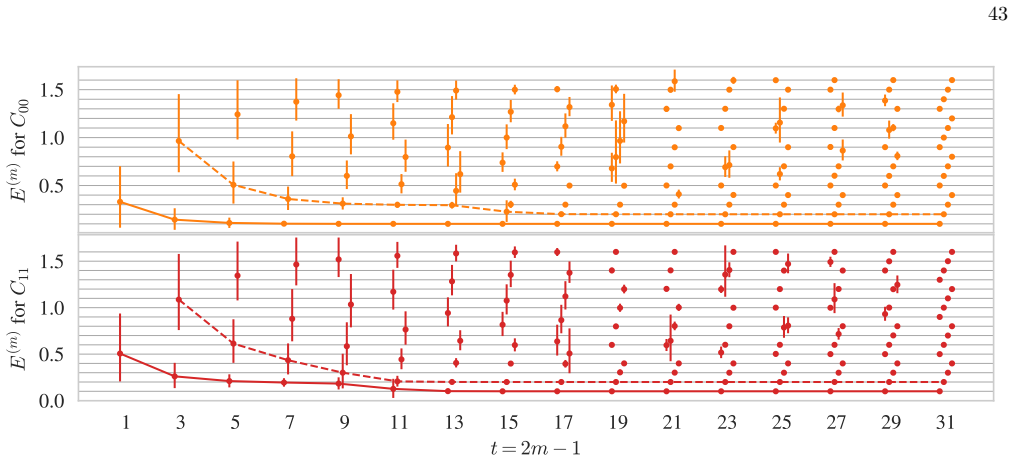
The carrying mechanism is the oblique block Lanczos recursion applied to the $r\times r$ correlator matrix $C_{ab}(t)=\langle\chi_a|T^t|\psi_b\rangle$. At each of $m$ iterations the algorithm generates new left and right Lanczos vectors and the block-tridiagonal matrix $T^{(m)}$; diagonalizing $T^{(m)}$ gives Ritz values $\lambda_k^{(m)}$ that estimate transfer-matrix eigenvalues, with energies $E_k^{(m)}=-\ln\lambda_k^{(m)}$. Spurious states from noise are filtered by the block ZCW test, which cuts on the total overlap sum $\sum_a \omega_{1ak}^{(m)}(\omega^{-1})^{(m)}_{k1a}$, with threshold $\varepsilon_{\mathrm{ZCW}}$ fixed by the minimum physical overlap at the last clean iteration and the hyperparameter $F_{\mathrm{ZCW}}=10$. Residual bounds computed from Ritz-vector residuals give two-sided intervals for the distance between each Ritz value and the closest true eigenvalue.
What would settle it
Apply block Lanczos to a lattice correlator matrix built from interpolators that deliberately exclude a known low-lying state, such as a Roper-like level with a small overlap on all operators, and give the data enough statistics; if the $F_{\mathrm{ZCW}}=10$ filter does not return that level, or if the residual-bound windows for the surviving neighboring levels exclude its known energy, the claim that noisy-data spectra remain reliable for small-overlap physical states fails.
Extended reading notes
Core claim
On the paper's own terms, the discovery is that GEVP is the one-step limit of block Lanczos. Concretely, with a reindexed correlation function $\tilde C(t)=C(t_0+t_d t)$, the GEVP eigenvalues $\lambda_k(t_d,t_0)$ equal the Ritz values of a single block Lanczos step, $\lambda_k(t_d,t_0)=\tilde\lambda_k^{(1)}$, and the GEVP eigenvectors are related to one-step Lanczos eigenvectors by an explicit change of basis. Because block Lanczos continues orthogonalizing against more Lanczos vectors, its Ritz values converge exponentially faster, at a rate governed by $e^{-2t\sqrt{E_r-E_0}}$ rather than $e^{-t(E_r-E_0)}$. The method also provides two-sided residual bounds on every Ritz value, overlap factors with relative signs, and current matrix elements from three-point functions by multiplication with Ritz coefficients, with no fits or statistical inference beyond bootstrap resampling. Proof-of-principle tests on noiseless mock data and a two-by-two proton correlator matrix show the promised faster convergence, improved state resolution, and constant signal-to-noise.
Load-bearing premise
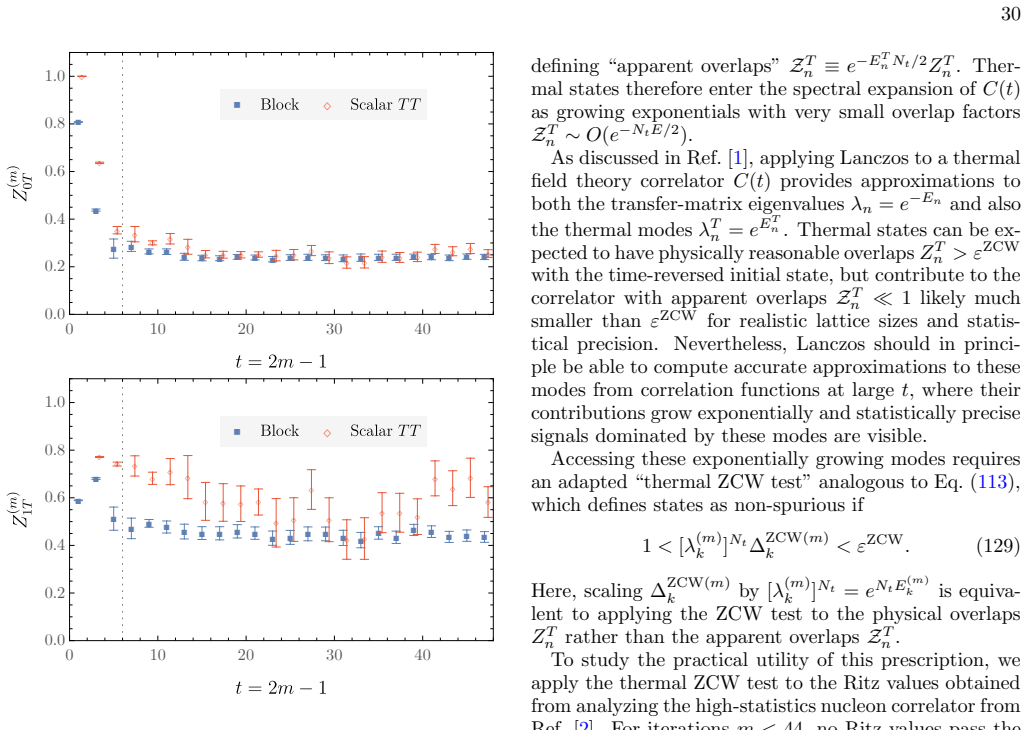
The filter that removes spurious states assumes that every physical state in the chosen quantum-number sector has an overlap with at least one interpolating operator that is not pathologically small; the threshold is set with a single hyperparameter $F_{\mathrm{ZCW}}=10$, and states below it are treated as noise even though they could be genuine but weakly coupled states.
Editorial extensions
If this is right
- Any analysis currently using GEVP eigenvalues can be rerun with extra block Lanczos iterations on the same correlator matrices, and the GEVP answers appear as the $m=1$ output.
- Energies of ground and excited states carry rigorous two-sided error bars from residual bounds, replacing one-sided variational upper bounds.
- Overlap factors and external-current matrix elements are available from the same run by contracting three-point functions with Ritz coefficients, including relative signs between overlaps.
- When the gap to the first state outside the block is small, the expected speedup is exponential: block Lanczos converges like $e^{-2t\sqrt{E_r-E_0}}$ whereas GEVP converges like $e^{-t(E_r-E_0)}$.
Reading between the lines
- If the one-step coincidence is as general as stated, block Lanczos should also replace GEVP in any non-lattice setting where a matrix time series $C(t)$ comes from an underlying transfer matrix, such as nuclear structure problems, with the same recursions and bounds applied with no QCD-specific input.
- The ZCW filter's overlap cut implies a practical diagnostic: when the number of surviving states plateaus below expectation, the operator set is likely missing a physical state nearly orthogonal to all interpolators, and adding a distinct operator should be the first response.
- Because block Lanczos reconstructs the correlator exactly for all $t \le 2m-1$, the difference between reconstructed and raw correlators at fixed $m$ could serve as a fit-free diagnostic of residual noise artifacts.
Editorial analysis
A structured set of objections, weighed in public.
Referee Report
Summary. The paper extends the Lanczos-based analysis framework for lattice QCD correlation functions from scalar correlators to correlator matrices. It constructs an oblique block Lanczos algorithm, derives recursion relations for block-tridiagonal matrix elements, Ritz values/vectors, overlap factors, and operator matrix elements, and develops a physically motivated reformulation of the Cullum-Willoughby test (the ZCW test) for filtering spurious states. The method is tested on noiseless mock data and on a 2x2 nucleon correlator matrix from 80 lattice configurations, with comparisons to GEVP and scalar Lanczos. The central formal claim is that GEVP is the one-step limit of block Lanczos, making block Lanczos a direct extension and superset of GEVP methods with faster convergence, two-sided residual bounds, and asymptotically constant signal-to-noise.
Significance. If the claims hold, this is a substantial methodological contribution: it provides a parameter-free deterministic analysis pipeline for correlator matrices, with explicit two-sided error bounds and no fits, and it unifies several existing approaches (GEVP, Prony-type methods, scalar Lanczos) in a single framework. The algebraic derivations in Sections II and IV and the noiseless demonstrations are careful and internally consistent, and the explicit construction of residual bounds and the KPS bound generalization are valuable. The main weakness is that the noisy-data claims, especially the advantage over GEVP for excited states, rest on a single 80-configuration example with acknowledged state-identification ambiguities, and on a ZCW spurious-state filter whose overlap-dependence can in principle discard physical states.
major comments (3)
- [Sec. V C 3, Eq. (117)] The ZCW cutoff defined in Eq. (117) is set by the minimum overlap factor over early iterations, and the text immediately following explicitly concedes that "physical states below the cut will not be extracted." This is load-bearing for the claim, repeated in the abstract and in Sec. VI A, that block Lanczos is a direct extension and superset of GEVP methods. GEVP provides rigorous variational upper bounds for the lowest r eigenvalues irrespective of the overlap of the interpolators with those states, whereas the block Lanczos pipeline can silently drop a true state whose total overlap with all interpolating operators falls below epsilon_ZCW. The paper's only noisy demonstration uses two nucleon interpolators that differ only in the quark smearing radius and therefore couple similarly to the same low-lying states; the realistic multi-particle regime with nearly disjoint interpolator support is not tested. The robustness check over F_ZCW in [2,20] is also performed only on this same dataset. I request either a demonstration with qualitatively different interpolators, or a clear statement that ZCW filtering is a practical heuristic whose guaranteed-state property is weaker than that of GEVP.
- [Sec. V D and Tables I-II] The noisy-data energy extraction depends on a filter-and-sort state identification scheme, which the authors themselves describe as having "some ambiguities" and "obvious misidentifications." The final block Lanczos result E1 = 0.792(30) is in 1.4-sigma agreement with the high-statistics scalar Lanczos value 0.735(25), while the GEVP fit result is 0.879(25), a 4-sigma difference. With a single 80-configuration dataset and acknowledged state-misidentification issues, the claim of a qualitative improvement in excited-state resolution is not yet convincingly established. A higher-statistics block-Lanczos analysis, or a more robust state-identification protocol, would be needed to support the strength of the present conclusions.
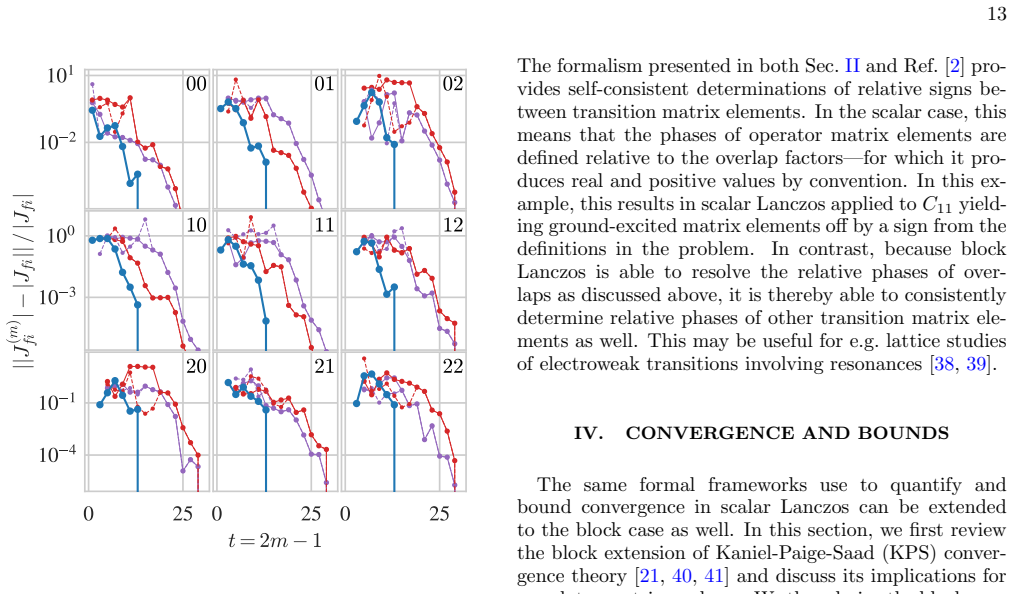
- [Sec. V A and Sec. VI B 4] The advertised advantages of block Lanczos for matrix elements are demonstrated only on noiseless mock data; no noisy three-point correlator application is presented. The matrix-element estimator in Eq. (58) inherits the same state-identification and ZCW-filtering dependence as the spectrum, so the abstract's claim that matrix elements are "straightforward[ly]" extracted should be qualified as applying to the infinite-statistics or noiseless limit until a noisy three-point demonstration is provided.
minor comments (4)
- [Throughout] The name "Lanczos" is misspelled as "Lanzcos" in several places, including the caption of Fig. 2 and Sec. V B; please correct this globally.
- [Sec. V F] The word "arithmetic" is misspelled as "arithematic" in the note about high-precision eigensolves; please fix this typo.
- [Sec. V C 1, Eq. (111)] The residual-bound identity in Eq. (111) is stated to have been "numerically verified" for oblique Lanczos, but no details of the verification are given; since this identity motivates the CW-ZCW equivalence, please state the range of m and the datasets for which it was checked.
- [Eq. (55)] In Eq. (55) the right-hand side is proportional to a product of sums over a, with the no-summation-over-a convention stated only in prose; please make this explicit in the notation, e.g., by adding a parenthetical or using a dummy index distinct from the free a.
Circularity Check
No significant circularity: the block Lanczos derivation is self-contained, the GEVP equivalence is a proved identity, and the ZCW filter is a stated heuristic limitation rather than a fitted prediction.
full rationale
The paper's central derivation is a constructive algorithm: oblique block Lanczos is defined by recursion relations on correlator matrices in Sec. II, and the resulting Ritz values, overlaps, and matrix elements are computed without fitting parameters to target energies. The claim that GEVP is the one-step limit of block Lanczos is proved in Sec. VI A: both the one-step Ritz values and the GEVP eigenvalues for t0=0, t=1 are eigenvalues of C(0)^-1 C(1), as shown in Eqs. (131)-(134). This is a mathematical identity, not a definition of GEVP in terms of block Lanczos or vice versa. The subsequent numerical comparisons use block Lanczos at m>1 against GEVP at the one-step limit, which is a legitimate benchmark rather than circular reasoning. The ZCW spurious-state filter is the only data-dependent element, but it is not fitted to the energies being extracted: epsilon_ZCW is set from the minimum small-m overlap via Eq. (117) with F_ZCW=10, and the paper reports robustness checks over F_ZCW in [2,20]. The paper explicitly concedes in Sec. V C 3 that physical states below the cut will not be extracted, and footnote 13 acknowledges that approximately orthogonal physical states could be discarded. This is an honest limitation and a correctness/robustness risk, not a circular reduction of the predicted spectrum to the filter input. The comparisons to high-statistics scalar Lanczos and to GEVP fits are external benchmarks. Self-citations to Refs. [1,2] establish the scalar Lanczos framework and provide a higher-statistics dataset, but they do not supply the block Lanczos derivation, which is self-contained, nor do they assume the target result. Accordingly, the paper's core claims have independent mathematical and numerical content, and no load-bearing circular step is present.
Assumptions & free parameters
free parameters (3)
- F_ZCW =
10 (default)
- epsilon_float =
1e-8
- Nboot =
200 (outer and inner)
assumptions (5)
- domain assumption The transfer matrix T is Hermitian and positive-definite
- domain assumption Correlator matrices built from commonly used interpolating operators are real, symmetric in expectation
- ad hoc to paper The Cullum-Willoughby test can be reinterpreted as filtering states with zero overlap with all interpolating operators
- standard math Krylov-space approximations converge and residual bounds apply for Hermitian T
- standard math The block Lanczos recursion relations are valid for general invertible correlator matrices
Cite this review
Pith. "Pith review of Block Lanczos algorithm for lattice QCD spectroscopy and matrix elements." pith.science (2026). https://pith.science/paper/ZENNYJO6
@misc{pith2026241204444,
  author       = {Pith},
  title        = {Pith review of: Block Lanczos algorithm for lattice QCD spectroscopy and matrix elements},
  year         = {2026},
  howpublished = {\url{https://pith.science/paper/ZENNYJO6}},
  note         = {Machine review of arXiv:2412.04444}
}
read the original abstract
Recent work introduced a new framework for analyzing correlation functions with improved convergence and signal-to-noise properties, as well as rigorous quantification of excited-state effects, based on the Lanczos algorithm and spurious eigenvalue filtering with the Cullum-Willoughby test. Here, we extend this framework to the analysis of correlation-function matrices built from multiple interpolating operators in lattice quantum chromodynamics (QCD) by constructing an oblique generalization of the block Lanczos algorithm, as well as a new physically motivated reformulation of the Cullum-Willoughby test that generalizes to block Lanczos straightforwardly. The resulting block Lanczos method directly extends generalized eigenvalue problem (GEVP) methods, which can be viewed as applying a single iteration of block Lanczos. Block Lanczos provides qualitative and quantitative advantages over GEVP methods analogous to the benefits of Lanczos over the standard effective mass, including faster convergence to ground- and excited-state energies, explicitly computable two-sided error bounds, straightforward extraction of matrix elements of external currents, and asymptotically constant signal-to-noise. No fits or statistical inference are required. Proof-of-principle calculations are performed for noiseless mock-data examples as well as two-by-two proton correlation-function matrices in lattice QCD.
Figures


Figures from the paper (29 more)







Forward citations
Cited by 5 Pith papers
-
Lattice evidence that scalar glueballs are small
First lattice extraction of scalar glueball gravitational form factors gives a mass radius of 0.263(31) fm, smaller than typical hadrons.
-
First constraints on the nonperturbative gluon Collins-Soper kernel
First lattice-QCD constraints on the nonperturbative gluon Collins-Soper kernel are obtained at near-physical pion mass with uNNLL LaMET matching on a single a=0.15 fm ensemble.
-
Unbiased Krylov subspace method for the extraction of ground state from lattice correlators
SVD low-rank approximation plus variance extrapolation removes bias from Krylov subspace ground-state extraction in lattice correlators.
-
Estimating energy levels from lattice QCD correlation functions using a transfer matrix formalism
A generalized eigenvalue formulation of the transfer matrix, equivalent to the oblique Lanczos method, with a KDE-based filtering scheme for spurious eigenvalues, extracts stable ground and excited state energies from...
-
Approaching the Inverse Problem: Toward Lattice QCD Calculations of Inclusive Hadronic Quantities
For lattice QCD spectral reconstruction, the Wertevorrat from Nevanlinna-Pick interpolation bounds the analytic-continuation uncertainty, and in a model test this bound falls roughly exponentially with the number of d...
Reference graph
Works this paper leans on
-
[1]
The Dirac-Pauli basis in which γ4 = diag(1, 1, −1, −1) is used throughout this section; see Ref
C, P , and R2π symmetry Charge conjugation ( C) transformations are defined for LQCD gauge fields as U (C)Uµ(x)U (C)† = Uµ(x)∗, (D1) and for quark fields as U (C)q(x)U (C)† = CqT U (C)q(x)U (C)† = qT C †, (D2) where C = γ4γ2 satisfies C T = C † = C −1 = −C. The Dirac-Pauli basis in which γ4 = diag(1, 1, −1, −1) is used throughout this section; see Ref. [9...
-
[2]
Spectrum We first compare block Lanczos with GEVP in appli- cation to the noiseless mock-data example from Sec. III, Eq. (72). The faster convergence of block Lanczos over GEVP extractions of the spectrum is unambiguous, as shown in Fig. 25, which compares block Lanczos with both the moving-pivot scheme with t0 = ⌊td/2⌋ as well as a fixed-pivot GEVP with ...
-
[3]
III, Figure 29 com- pares convergence of different Lanczos and GEVP esti- mators of overlaps with ψT and ψW for the lowest-lying two states
Overlap factors For the noiseless example of Sec. III, Figure 29 com- pares convergence of different Lanczos and GEVP esti- mators of overlaps with ψT and ψW for the lowest-lying two states. As with the spectrum, while GEVP provides a comparable-quality estimate at early times, block Lanc- zos estimators converge exponentially more rapidly. In practice, i...
-
[4]
spuriously small
Matrix elements For the noiseless mock-data example of Sec. III, Fig. 31 compares convergence of block Lanczos estimates of the diagonal matrix elements J00 and J11 with the moving- pivot GEVP estimator Eq. (148), as well as different es- timators constructed from the fixed-pivot GEVP three- point function Eq. (149). As expected, the moving-pivot GEVP est...
-
[5]
, ⃗ yK, ⃗ v1,
Correlator matrix definitions Consider a generic correlator matrix Cab(t) = χa(t)ψb(0) , (D15) 44 with source interpolating operator ψb(0) = X ⃗ y1,...,⃗ yK X ⃗ v1,...,⃗ vL e−i[ P i ⃗ pi·⃗ yi+P j ⃗kj ·⃗ vj] × q(⃗ y1, 0) · · ·q(⃗ yK, 0) × q(⃗ v1, 0)T · · ·q(⃗ vL, 0)T × ψb(U(0), ⃗ y1, . . . , ⃗ yK, ⃗ v1, . . . , ⃗ vL), (D16) where ψb(U(0), ⃗ y1, . . . , ⃗ y...
-
[6]
, ⃗ xN , ⃗ u1,
Correlator matrix transformations Applying a CR 2π transformation to C σp ab (t) gives U (CR 2π)C σp ab (t)U (CR 2π)† = X ⃗ x1,...,⃗ xK′ X ⃗ u1,...,⃗ uL′ X ⃗ y1,...,⃗ yK X ⃗ v1,...,⃗ vL × ei[ P i ⃗ p′ i·⃗ xi+P j ⃗k′ j ·⃗ uj]e−i[ P i ⃗ pi·⃗ yi+P j ⃗kj ·⃗ vj] × Ξa(U ∗ (t), S∗ (t), ⃗ x1, . . . , ⃗ xN , ⃗ u1, . . . , ⃗ uM ′)† × NO i,j=1 S((⃗ xi, t), (⃗ yp(j),...
-
[7]
the block PGEVM approach introduced in Ref. [8]
Correlator matrix reality conditions It is straightforward to obtain corresponding re- ality conditions for the quark-field coefficient func- tions appearing in the interpolating operator definitions Eqs. (D16)-(D17). Define a quark-field-parity decompo- sition of these wavefunctions by χT a = X ⃗ τ∈ZK′ +L′ 2 χT a⃗ τ, ψ b = X ⃗ τ∈ZK+L 2 ψb⃗ τ, (D41) where...
-
[8]
M. L. Wagman, Lanczos Algorithm, the Transfer Ma- trix, and the Signal-to-Noise Problem, Phys. Rev. Lett. 134, 241901 (2025), arXiv:2406.20009 [hep-lat]
arXiv 2025
Show all 108 references
-
[9]
D. C. Hackett and M. L. Wagman, Lanczos for lattice QCD matrix elements, (2024), arXiv:2407.21777 [hep- lat]
2024 arXiv
-
[10]
G. Fox, R. Gupta, O. Martin, and S. Otto, Monte Carlo Estimates of the Mass Gap of the O(2) and O(3) Spin Models in (1+1)-dimensions, Nucl. Phys. B 205, 188 (1982)
1982
-
[11]
Michael and I
C. Michael and I. Teasdale, Extracting Glueball Masses From Lattice QCD, Nucl. Phys. B 215, 433 (1983)
1983
-
[12]
L¨ uscher and U
M. L¨ uscher and U. Wolff, How to Calculate the Elastic Scattering Matrix in Two-dimensional Quantum Field Theories by Numerical Simulation, Nucl. Phys. B 339, 222 (1990)
1990
-
[13]
Blossier, M
B. Blossier, M. Della Morte, G. von Hippel, T. Mendes, and R. Sommer, On the generalized eigenvalue method for energies and matrix elements in lattice field theory, JHEP 04, 094, arXiv:0902.1265 [hep-lat]
-
[14]
G. T. Fleming, Beyond Generalized Eigenvalues in Lat- tice Quantum Field Theory, in 40th International Sym- posium on Lattice Field Theory (2023) arXiv:2309.05111 [hep-lat]
2023 arXiv
-
[15]
Fischer, B
M. Fischer, B. Kostrzewa, J. Ostmeyer, K. Ottnad, M. Ueding, and C. Urbach, On the generalised eigen- value method and its relation to Prony and generalised pencil of function methods, Eur. Phys. J. A 56, 206 (2020), arXiv:2004.10472 [hep-lat]
2020 arXiv
-
[16]
G. C. F. M. Prony, Essai Experimental et Analytique. Journal de l’´ ecole Polytechnique de Paris1, 24 (1795)
-
[17]
G. T. Fleming, What can lattice QCD theorists learn from NMR spectroscopists?, in 3rd International Work- shop on Numerical Analysis and Lattice QCD (2004) pp. 143–152, arXiv:hep-lat/0403023
2004 arXiv
-
[18]
Lin and S
H.-W. Lin and S. D. Cohen, Lattice QCD be- yond ground states, in 4th International Workshop on Numerical Analysis and Lattice QCD (2007) arXiv:0709.1902 [hep-lat]
2007 arXiv
-
[19]
G. T. Fleming, S. D. Cohen, H.-W. Lin, and V. Pereyra, Excited-State Effective Masses in Lattice QCD, Phys. Rev. D 80, 074506 (2009), arXiv:0903.2314 [hep-lat]
2009 arXiv
-
[20]
Aubin and K
C. Aubin and K. Orginos, A new approach for Delta form factors, AIP Conf. Proc. 1374, 621 (2011), arXiv:1010.0202 [hep-lat]
2011 arXiv
-
[21]
Aubin and K
C. Aubin and K. Orginos, An improved method for ex- tracting matrix elements from lattice three-point func- tions, PoS LA TTICE2011, 148 (2011)
2011
-
[22]
J. R. Green, J. W. Negele, A. V. Pochinsky, S. N. Syritsyn, M. Engelhardt, and S. Krieg, Nucleon electro- magnetic form factors from lattice QCD using a nearly physical pion mass, Phys. Rev. D 90, 074507 (2014), arXiv:1404.4029 [hep-lat]
2014 arXiv
-
[23]
Ottnad, T
K. Ottnad, T. Harris, H. Meyer, G. von Hippel, J. Wil- helm, and H. Wittig, Nucleon average quark momentum fraction with Nf = 2 + 1 Wilson fermions, EPJ Web Conf. 175, 06026 (2018), arXiv:1710.07816 [hep-lat]
2018 arXiv
-
[24]
Ottnad, Excited states in nucleon structure calcula- tions, Eur
K. Ottnad, Excited states in nucleon structure calcula- tions, Eur. Phys. J. A 57, 50 (2021), arXiv:2011.12471 [hep-lat]
2021 arXiv
-
[25]
G. H. Golub, Some uses of the Lanczos algorithm in nu- merical algebra, in Topics in numerical analysis: Pro- 50 ceedings of the Royal Irish Academy Conference on Nu- merical Analysis, Dublin, 14–18 August, 1972, edited by J. J. H. Miller (Academic Press, New York, USA, 1973) ...
1972
-
[26]
Cullum and W
J. Cullum and W. E. Donath, A block lanczos algo- rithm for computing the q algebraically largest eigen- values and a corresponding eigenspace of large, sparse, real symmetric matrices, in 1974 IEEE Conference on Decision and Control including the 13th Symposium on Adaptive Pr...
1974
-
[27]
Golub and R
G. Golub and R. Underwood, The block lanczos method for computing eigenvalues, in Mathematical Software , edited by J. R. Rice (Academic Press, 1977) pp. 361– 377
1977
-
[28]
Saad, On the rates of convergence of the Lanczos and the block-Lanczos methods, SIAM Journal on Numeri- cal Analysis 17, 687 (1980)
Y. Saad, On the rates of convergence of the Lanczos and the block-Lanczos methods, SIAM Journal on Numeri- cal Analysis 17, 687 (1980)
1980
-
[29]
Parlett, The Symmetric Eigenvalue Problem , Clas- sics in Applied Mathematics (Society for Industrial and Applied Mathematics, 1980)
B. Parlett, The Symmetric Eigenvalue Problem , Clas- sics in Applied Mathematics (Society for Industrial and Applied Mathematics, 1980)
1980
-
[30]
H. M. Kim and R. R. Craig Jr., Structural dy- namics analysis using an unsymmetric block lanczos algorithm, International Journal for Nu- merical Methods in Engineering 26, 2305 (1988), https://onlinelibrary.wiley.com/doi/pdf/10.1002/nme.1620261012
1988 doi
-
[31]
H. M. Kim and R. R. Craig Jr., Computa- tional enhancement of an unsymmetric block lanczos algorithm, International Journal for Nu- merical Methods in Engineering 30, 1083 (1990), https://onlinelibrary.wiley.com/doi/pdf/10.1002/nme.1620300509
1990 doi
-
[32]
Z. Bai, D. Day, and Q. Ye, Able: An adap- tive block lanczos method for non-hermitian eigenvalue problems, SIAM Journal on Ma- trix Analysis and Applications 20, 1060 (1999), https://doi.org/10.1137/S0895479897317806
1999 doi
-
[33]
A. M. Abdel-Rehim, A. Stathopoulos, and K. Orginos, Extending the eigcg algorithm to nonsymmetric lanczos for linear systems with multiple right-hand sides, Numerical Lin- ear Algebra with Applications 21, 473 (2014), https://onlinelibrary.wiley.com/doi/pdf/10.1002/nla.1893
2014 doi
-
[34]
L¨ uscher and P
M. L¨ uscher and P. Weisz, Definition and General Prop- erties of the Transfer Matrix in Continuum Limit Im- proved Lattice Gauge Theories, Nucl. Phys. B 240, 349 (1984)
1984
-
[35]
J. B. Kogut and L. Susskind, Hamiltonian Formulation of Wilson’s Lattice Gauge Theories, Phys. Rev. D 11, 395 (1975)
1975
-
[36]
Y. Saad, The Lanczos biorthogonalization al- gorithm and other oblique projection methods for solving large unsymmetric systems, SIAM Journal on Numerical Analysis 19, 485 (1982), https://doi.org/10.1137/0719031
1982 doi
-
[37]
mpmath development team, mpmath: a Python li- brary for arbitrary-precision floating-point arithmetic (version 1.3.0) (2023), http://mpmath.org/
T. mpmath development team, mpmath: a Python li- brary for arbitrary-precision floating-point arithmetic (version 1.3.0) (2023), http://mpmath.org/
2023
-
[38]
B. Parlett, Misconvergence in the Lanc- zos algorithm, in Reliable Numerical Comm- putation (Oxford University Press, 1990) https://academic.oup.com/book/0/chapter/422058476/chapter- pdf/52393581/isbn-9780198535645-book-part-2.pdf
1990
-
[39]
A. B. J. Kuijlaars, Which eigenvalues are found by the Lanczos method?, SIAM Journal on Ma- trix Analysis and Applications 22, 306 (2000), https://doi.org/10.1137/S089547989935527X
2000 doi
-
[40]
Garza-Vargas and A
J. Garza-Vargas and A. Kulkarni, The Lanczos algo- rithm under few iterations: Concentration and location of the output, SIAM Journal on Matrix Analysis and Applications 41, 1312–1346 (2020)
2020
-
[41]
Maiani, G
L. Maiani, G. Martinelli, M. L. Paciello, and B. Tagli- enti, Scalar Densities and Baryon Mass Differences in Lattice QCD With Wilson Fermions, Nucl. Phys. B293, 420 (1987)
1987
-
[42]
S. J. Dong, K. F. Liu, and A. G. Williams, Lattice calculation of the strangeness magnetic moment of the nucleon, Phys. Rev. D 58, 074504 (1998), arXiv:hep- ph/9712483
1998
-
[43]
Capitani, M
S. Capitani, M. Della Morte, G. von Hippel, B. Jager, A. Juttner, B. Knippschild, H. B. Meyer, and H. Wit- tig, The nucleon axial charge from lattice QCD with controlled errors, Phys. Rev. D 86, 074502 (2012), arXiv:1205.0180 [hep-lat]
2012 arXiv
-
[44]
D. C. Hackett, P. R. Oare, D. A. Pefkou, and P. E. Shanahan, Gravitational form factors of the pion from lattice QCD, Phys. Rev. D 108, 114504 (2023), arXiv:2307.11707 [hep-lat]
2023 arXiv
-
[45]
R. A. Brice˜ no, M. T. Hansen, and A. Walker-Loud, Mul- tichannel 1 → 2 transition amplitudes in a finite volume, Phys. Rev. D 91, 034501 (2015), arXiv:1406.5965 [hep- lat]
2015 arXiv
-
[46]
Leskovec, Electroweak transitions involving resonances, PoS LA TTICE2023, 119 (2024), arXiv:2401.02495 [hep-lat]
L. Leskovec, Electroweak transitions involving resonances, PoS LA TTICE2023, 119 (2024), arXiv:2401.02495 [hep-lat]
2024 arXiv
-
[47]
Kaniel, Estimates for some computational techniques in linear algebra, Mathematics of Computation 20, 369 (1966)
S. Kaniel, Estimates for some computational techniques in linear algebra, Mathematics of Computation 20, 369 (1966)
1966
-
[48]
C. C. Paige, The Computation of Eigenvalues and Eigenvectors of Very Large Sparse Matrices, Ph.D. the- sis, London University, London, UK (1971)
1971
-
[49]
B. N. Parlett and D. S. Scott, The Lanczos algorithm with selective orthogonalization, Mathematics of Com- putation 33, 217 (1979)
1979
-
[50]
B. N. Parlett, Do we fully understand the symmetric Lanczos algorithm yet (1995)
1995
-
[51]
Cullum and R
J. Cullum and R. A. Willoughby, Computing eigenval- ues of very large symmetric matrices—an implementa- tion of a Lanczos algorithm with no reorthogonalization, Journal of Computational Physics 44, 329 (1981)
1981
-
[52]
J. K. Cullum and R. A. Willoughby, Lanczos pro- cedures, in Lanczos Algorithms for Large Symmetric Eigenvalue Computations Vol. I Theory (Birkh¨ auser Boston, Boston, MA, 1985) pp. 92–163
1985
-
[53]
D. C. Hackett, D. A. Pefkou, and P. E. Shanahan, Grav- itational Form Factors of the Proton from Lattice QCD, Phys. Rev. Lett. 132, 251904 (2024), arXiv:2310.08484 [hep-lat]
2024 arXiv
-
[54]
S. Park, R. Gupta, B. Yoon, S. Mondal, T. Bhat- tacharya, Y.-C. Jang, B. Jo´ o, and F. Winter (Nucleon Matrix Elements (NME)), Precision nucleon charges and form factors using (2+1)-flavor lattice QCD, Phys. Rev. D 105, 054505 (2022), arXiv:2103.05599 [hep-lat]
2022 arXiv
-
[55]
Yoon et al
B. Yoon et al. , Isovector charges of the nucleon from 2+1-flavor QCD with clover fermions, Phys. Rev. D 95, 074508 (2017), arXiv:1611.07452 [hep-lat]
2017 arXiv
-
[56]
Mondal, R
S. Mondal, R. Gupta, S. Park, B. Yoon, T. Bhat- tacharya, B. Jo´ o, and F. Winter (Nucleon Matrix El- ements (NME)), Nucleon momentum fraction, helicity and transversity from 2+1-flavor lattice QCD, JHEP 51 21, 004, arXiv:2011.12787 [hep-lat]
2011 arXiv
-
[57]
Edwards, R
R. Edwards, R. Gupta, N. Jo´ o, K. Orginos, D. Richards, F. Winter, and B. Yoon, U.S. 2+1 flavor clover lattice generation program, unpublished (2016)
2016
-
[58]
L¨ uscher and P
M. L¨ uscher and P. Weisz, On-shell improved lattice gauge theories, Commun. Math. Phys. 98, 433 (1985), [Erratum: Commun.Math.Phys. 98, 433 (1985)]
1985
-
[59]
Sheikholeslami and R
B. Sheikholeslami and R. Wohlert, Improved Con- tinuum Limit Lattice Action for QCD with Wilson Fermions, Nucl. Phys. B 259, 572 (1985)
1985
-
[60]
Morningstar and M
C. Morningstar and M. J. Peardon, Analytic smearing of SU(3) link variables in lattice QCD, Phys. Rev. D 69, 054501 (2004), arXiv:hep-lat/0311018
2004 arXiv
-
[61]
Gusken, U
S. Gusken, U. Low, K. H. Mutter, R. Sommer, A. Patel, and K. Schilling, Nonsinglet Axial Vector Couplings of the Baryon Octet in Lattice QCD, Phys. Lett. B 227, 266 (1989)
1989
-
[62]
Gusken, A Study of smearing techniques for hadron correlation functions, Nucl
S. Gusken, A Study of smearing techniques for hadron correlation functions, Nucl. Phys. B Proc. Suppl. 17, 361 (1990)
1990
-
[63]
G. S. Bali, B. Lang, B. U. Musch, and A. Sch¨ afer, Novel quark smearing for hadrons with high momenta in lattice QCD, Phys. Rev. D 93, 094515 (2016), arXiv:1602.05525 [hep-lat]
2016 arXiv
-
[64]
P. B. Denton, S. J. Parke, T. Tao, and X. Zhang, Eigen- vectors from Eigenvalues: a survey of a basic identity in linear algebra, Bull. Am. Math. Soc. 59, 31 (2022), arXiv:1908.03795 [math.RA]
2022 arXiv
-
[65]
C. Jacobi, De binis quibuslibet functionibus homogeneis secundi ordinis per substitutiones lineares in alias bi- nas tranformandis, quae solis quadratis variabilium con- stant; una cum variis theorematis de tranformatione et- determinatione integralium multiplicium., Journal f...
-
[66]
Efron, The Jackknife, the bootstrap and other re- sampling plans , Regional Conference Series in applied mathematics No
B. Efron, The Jackknife, the bootstrap and other re- sampling plans , Regional Conference Series in applied mathematics No. 38 (Society for Industrial and Applied Mathematics, Philadelphia, Pa., 1982)
1982
-
[67]
T. J. DiCiccio and B. Efron, Bootstrap confidence in- tervals, Statistical Science 11, 189 (1996)
1996
-
[68]
A. C. Davison and D. V. Hinkley, The basic boot- straps, in Bootstrap Methods and their Application , Cambridge Series in Statistical and Probabilistic Math- ematics (Cambridge University Press, 1997) p. 11–69
1997
-
[69]
Young, Everything you wanted to know about data analysis and fitting but were afraid to ask (2014), arXiv:1210.3781 [physics.data-an]
P. Young, Everything you wanted to know about data analysis and fitting but were afraid to ask (2014), arXiv:1210.3781 [physics.data-an]
2014 arXiv
-
[70]
Amarasinghe, R
S. Amarasinghe, R. Baghdadi, Z. Davoudi, W. Detmold, M. Illa, A. Parre˜ no, A. V. Pochinsky, P. E. Shanahan, and M. L. Wagman, Variational study of two-nucleon systems with lattice QCD, Phys. Rev. D 107, 094508 (2023), arXiv:2108.10835 [hep-lat]
2023 arXiv
-
[71]
Detmold, M
W. Detmold, M. Illa, W. I. Jay, A. Parre˜ no, R. J. Perry, P. E. Shanahan, and M. L. Wagman (NPLQCD), Constraints on the finite volume two-nucleon spectrum at m π≈806 MeV, Phys. Rev. D 111, 114501 (2025), arXiv:2404.12039 [hep-lat]
2025 arXiv
-
[72]
Bulava, R
J. Bulava, R. G. Edwards, E. Engelson, B. Joo, H.-W. Lin, C. Morningstar, D. G. Richards, and S. J. Wallace, Nucleon, ∆ and Ω excited states in Nf = 2 + 1 lattice QCD, Phys. Rev. D 82, 014507 (2010), arXiv:1004.5072 [hep-lat]
2010 arXiv
-
[73]
Bulava, B
J. Bulava, B. Fahy, B. H¨ orz, K. J. Juge, C. Morningstar, and C. H. Wong, I = 1 and I = 2 π − π scattering phase shifts from Nf = 2 + 1 lattice QCD, Nucl. Phys. B 910, 842 (2016), arXiv:1604.05593 [hep-lat]
2016 arXiv
-
[74]
Dragos, R
J. Dragos, R. Horsley, W. Kamleh, D. B. Leinweber, Y. Nakamura, P. E. L. Rakow, G. Schierholz, R. D. Young, and J. M. Zanotti, Nucleon matrix elements us- ing the variational method in lattice QCD, Phys. Rev. D 94, 074505 (2016), arXiv:1606.03195 [hep-lat]
2016 arXiv
-
[75]
S. R. Beane et al. (NPLQCD, QCDSF), Charged mul- tihadron systems in lattice QCD+QED, Phys. Rev. D 103, 054504 (2021), arXiv:2003.12130 [hep-lat]
2021 arXiv
-
[76]
C. Stein, Inadmissibility of the usual estimator for the mean of a multivariate normal distribution, in Proceed- ings of the Third Berkeley Symposium on Mathematical Statistics and Probability, Volume 1: Contributions to the Theory of Statistics (University of California Press...
1956
-
[77]
Ledoit and M
O. Ledoit and M. Wolf, A well-conditioned estimator for large-dimensional covariance matrices, Journal of Mul- tivariate Analysis 88, 365 (2004)
2004
-
[78]
Akaike, A new look at the statistical model identi- fication, IEEE Transactions on Automatic Control 19, 716 (1974)
H. Akaike, A new look at the statistical model identi- fication, IEEE Transactions on Automatic Control 19, 716 (1974)
1974
-
[79]
Rinaldi, S
E. Rinaldi, S. Syritsyn, M. L. Wagman, M. I. Buchoff, C. Schroeder, and J. Wasem, Lattice QCD determina- tion of neutron-antineutron matrix elements with phys- ical quark masses, Phys. Rev. D 99, 074510 (2019), arXiv:1901.07519 [hep-lat]
2019 arXiv
-
[80]
Ostmeyer, A
J. Ostmeyer, A. Sen, and C. Urbach, On the equivalence of Prony and Lanczos methods for Euclidean correlation functions, (2024), arXiv:2411.14981 [hep-lat]
2024 arXiv
-
[81]
Chakraborty, D
D. Chakraborty, D. Sood, A. Radhakrishnan, and N. Mathur, Estimating energy levels from lattice QCD correlation functions using a transfer matrix formalism, (2024), arXiv:2412.01900 [hep-lat]
2024 arXiv
-
[82]
R. G. Edwards and B. Jo´ o (SciDAC, LHPC, UKQCD), The Chroma software system for lattice QCD, Nucl. Phys. B Proc. Suppl. 140, 832 (2005), arXiv:hep- lat/0409003
2005
-
[83]
M. A. Clark, R. Babich, K. Barros, R. C. Brower, and C. Rebbi (QUDA), Solving Lattice QCD systems of equations using mixed precision solvers on GPUs, Com- put. Phys. Commun. 181, 1517 (2010), arXiv:0911.3191 [hep-lat]
2010 arXiv
-
[84]
Babich, M
R. Babich, M. A. Clark, B. Jo´ o, G. Shi, R. C. Brower, and S. Gottlieb (QUDA), Scaling lattice QCD beyond 100 GPUs, in International Conference for High Perfor- mance Computing, Networking, Storage and Analysis (2011) arXiv:1109.2935 [hep-lat]
2011 arXiv
-
[85]
M. A. Clark, B. Jo´ o, A. Strelchenko, M. Cheng, A. Gambhir, and R. C. Brower (QUDA), Accelerating lattice QCD multigrid on GPUs using fine-grained par- allelization, in International Conference for High Per- formance Computing, Networking, Storage and Analy- sis (2016) arXiv:...
2016 arXiv
-
[86]
Winter, M
F. Winter, M. Clark, R. Edwards, and B. Jo´ o, A frame- work for lattice qcd calculations on gpus, in 2014 IEEE 28th International Parallel and Distributed Processing Symposium (2014) pp. 1073–1082
2014
-
[87]
Romero and C
E. Romero and C. Kallidonis, chromaform, https://github.com/eromero-vlc/chromaform
-
[88]
C. R. Harris, K. J. Millman, S. J. van der Walt, R. Gom- mers, P. Virtanen, D. Cournapeau, E. Wieser, J. Tay- lor, S. Berg, N. J. Smith, R. Kern, M. Picus, S. Hoyer, M. H. van Kerkwijk, M. Brett, A. Haldane, J. F. del R ´ ıo, 52 M. Wiebe, P. Peterson, P. G´ erard-Marchant, K. ...
2020
-
[89]
Virtanen, R
P. Virtanen, R. Gommers, T. E. Oliphant, M. Haber- land, T. Reddy, D. Cournapeau, E. Burovski, P. Pe- terson, W. Weckesser, J. Bright, S. J. van der Walt, M. Brett, J. Wilson, K. J. Millman, N. Mayorov, A. R. J. Nelson, E. Jones, R. Kern, E. Larson, C. J. Carey, ˙I. Polat, Y. ...
2020
-
[90]
Reback, W
J. Reback, W. McKinney, jbrockmendel, J. V. den Bossche, T. Augspurger, P. Cloud, gfyoung, Sinhrks, A. Klein, M. Roeschke, S. Hawkins, J. Tratner, C. She, W. Ayd, T. Petersen, M. Garcia, J. Schendel, A. Hay- den, MomIsBestFriend, V. Jancauskas, P. Battiston, S. Seabold, chris ...
2020
-
[91]
Wes McKinney, Data Structures for Statistical Com- puting in Python, in Proceedings of the 9th Python in Science Conference, edited by St´ efan van der Walt and Jarrod Millman (2010) pp. 56 – 61
2010
-
[92]
G. P. Lepage, lsqfit v. 11.7 doi:10.5281/zenodo.4037174 (2020), https://github.com/gplepage/lsqfit
2020 doi
-
[93]
G. P. Lepage, gvar v. 11.9.1 doi:10.5281/zenodo.4290884 (2020), https://github.com/gplepage/gvar
2020 doi
-
[94]
Wolfram Research Inc., Mathematica, Version 14.0, https://www.wolfram.com/mathematica
-
[95]
J. D. Hunter, Matplotlib: A 2d graphics environment, Computing in Science & Engineering 9, 90 (2007)
2007
-
[96]
M. L. Waskom, seaborn: statistical data visualization, Journal of Open Source Software 6, 3021 (2021)
2021
-
[97]
M. L. Wagman and M. J. Savage, Statistics of baryon correlation functions in lattice QCD, Phys. Rev. D 96, 114508 (2017), arXiv:1611.07643 [hep-lat]
2017 arXiv
-
[98]
Detmold, W
W. Detmold, W. I. Jay, G. Kanwar, P. E. Shanahan, and M. L. Wagman, Multiparticle interpolating operators in quantum field theories with cubic symmetry, Phys. Rev. D 109, 094516 (2024), arXiv:2403.00672 [hep-lat]
2024 arXiv
-
[99]
D. B. Leinweber, R. M. Woloshyn, and T. Draper, Elec- tromagnetic structure of octet baryons, Phys. Rev. D 43, 1659 (1991)
1991
-
[100]
Melnitchouk, S
W. Melnitchouk, S. O. Bilson-Thompson, F. D. R. Bonnet, J. N. Hedditch, F. X. Lee, D. B. Leinweber, A. G. Williams, J. M. Zanotti, and J. B. Zhang, Ex- cited baryons in lattice QCD, Phys. Rev. D 67, 114506 (2003), arXiv:hep-lat/0202022
2003 arXiv
-
[101]
J. E. Mandula, G. Zweig, and J. Govaerts, COV ARI- ANT LATTICE GLUEBALL FIELDS, Nucl. Phys. B 228, 109 (1983)
1983
-
[102]
J. E. Mandula, G. Zweig, and J. Govaerts, Representa- tions of the Rotation Reflection Symmetry Group of the Four-dimensional Cubic Lattice, Nucl. Phys. B 228, 91 (1983)
1983
-
[103]
Basak, R
S. Basak, R. G. Edwards, G. T. Fleming, U. M. Heller, C. Morningstar, D. Richards, I. Sato, and S. Wallace, Group-theoretical construction of extended baryon op- erators in lattice QCD, Phys. Rev. D 72, 094506 (2005), arXiv:hep-lat/0506029
2005 arXiv
-
[104]
Basak, R
S. Basak, R. Edwards, G. T. Fleming, U. M. Heller, C. Morningstar, D. Richards, I. Sato, and S. J. Wal- lace (Lattice Hadron Physics (LHPC)), Clebsch-Gordan construction of lattice interpolating fields for excited baryons, Phys. Rev. D 72, 074501 (2005), arXiv:hep- lat/0508018
2005
-
[105]
Luu and M
T. Luu and M. J. Savage, Extracting Scattering Phase-Shifts in Higher Partial-Waves from Lattice QCD Calculations, Phys. Rev. D 83, 114508 (2011), arXiv:1101.3347 [hep-lat]
2011 arXiv
-
[106]
C. E. Thomas, R. G. Edwards, and J. J. Dudek, Helicity operators for mesons in flight on the lattice, Phys. Rev. D 85, 014507 (2012), arXiv:1107.1930 [hep-lat]
2012 arXiv
-
[107]
Morningstar, J
C. Morningstar, J. Bulava, B. Fahy, J. Foley, Y. C. Jhang, K. J. Juge, D. Lenkner, and C. H. Wong, Ex- tended hadron and two-hadron operators of definite mo- mentum for spectrum calculations in lattice QCD, Phys. Rev. D 88, 014511 (2013), arXiv:1303.6816 [hep-lat]
2013 arXiv
-
[108]
Prelovsek, U
S. Prelovsek, U. Skerbis, and C. B. Lang, Lattice opera- tors for scattering of particles with spin, JHEP 01, 129, arXiv:1607.06738 [hep-lat]
Reviewed August 11, 2026 · model on record in the stance chip above.
Discussion (0). Continue with ORCID to comment.