Fluid-structure coupled simulation framework for lightweight explosion containment structures under large deformations
Pith reviewed 2026-05-23 08:07 UTC · model grok-4.3
The pith
Coupled fluid-structure simulation shows decoupled blast models overestimate plastic strain by 44 percent.
A machine-rendered reading of the paper's core claim, the machinery that carries it, and where it could break.
Core claim
The paper establishes a partitioned coupling procedure that tracks fluid-fluid and fluid-structure interfaces with level-set and embedded-boundary methods and computes interfacial fluxes by locally solving one-dimensional bi-material Riemann problems. Applied to an internal explosion in a thin-walled steel chamber, the procedure captures a 30 percent volume expansion from plastic deformation, shows that later reflected pulses contribute meaningfully to strain, and reveals large errors when fluid-structure interaction is omitted or approximated by a transient pressure load fitted only to the initial shock.
What carries the argument
The partitioned coupling procedure that solves locally constructed one-dimensional bi-material Riemann problems at the fluid-structure interface to transmit mass, momentum, and energy fluxes during large deformations.
If this is right
- Accurate strain predictions for lightweight explosion chambers require full fluid-structure coupling rather than decoupling or single-pulse pressure approximations.
- Reflected shock pulses after the initial blast contribute substantially to total plastic deformation.
- The high compressibility and energy of explosion products produce spatially and temporally varying shock speeds that affect structural response.
- Containment structures can be sized to remain below fracture while allowing up to 30 percent volume increase under internal blast loading.
Where Pith is reading between the lines
- The same coupling approach could be tested on other high-speed fluid-structure problems such as underwater explosions or rapid gas inflation of flexible membranes.
- Direct comparison of simulated interface motion against high-speed video of a physical test would check whether the Riemann-problem flux transmission holds during extreme deformation.
- If the method scales to even lighter materials, designers might need to include coupling from the outset to avoid both overbuilt and underbuilt containment vessels.
Load-bearing premise
The partitioned coupling procedure with locally solved one-dimensional bi-material Riemann problems accurately transmits mass, momentum, and energy fluxes without introducing significant numerical artifacts during large structural deformations.
What would settle it
A physical experiment measuring the final plastic strain in an identical thin-walled steel chamber after a 250 g TNT internal explosion would falsify the central claim if the measured strain does not lie between the decoupled-model overestimate and the pressure-load underestimate reported in the simulations.
Figures







read the original abstract
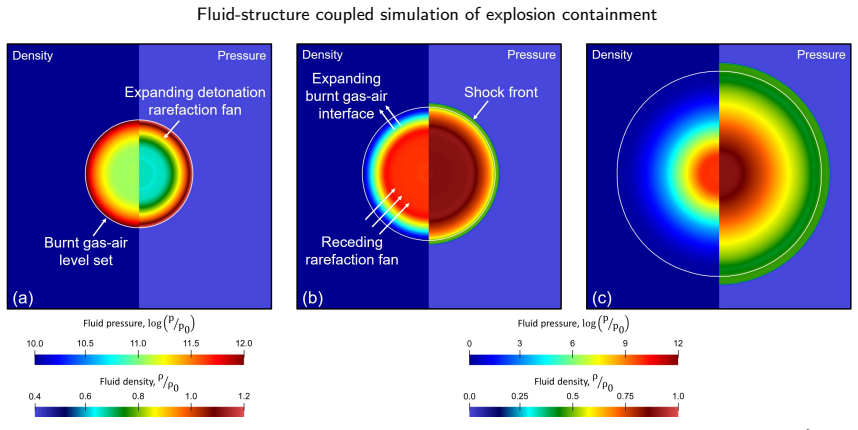
Lightweight, single-use explosion containment structures provide an effective solution for neutralizing rogue explosives, combining affordability with ease of transport. This paper introduces a three-stage simulation framework that captures the distinct physical processes and time scales involved in detonation, shock propagation, and large, plastic structural deformations. The hypothesis is that as the structure becomes lighter and more flexible, its dynamic interaction with the gaseous explosion products becomes increasingly significant. Unlike previous studies that rely on empirical models to approximate pressure loads, this framework employs a partitioned procedure to couple a finite volume compressible fluid dynamics solver with a finite element structural dynamics solver. The level set and embedded boundary methods are utilized to track the fluid-fluid and fluid-structure interfaces. The interfacial mass, momentum, and energy fluxes are computed by locally constructing and solving one-dimensional bi-material Riemann problems. A case study is presented involving a thin-walled steel chamber subjected to an internal explosion of $250~\text{g}$ TNT. The result shows a $30\%$ increase in the chamber volume due to plastic deformation, with its strains remaining below the fracture limit. Although the incident shock pulse carries the highest pressure, the subsequent pulses from wave reflections also contribute significantly to structural deformation. The high energy and compressibility of the explosion products lead to highly nonlinear fluid dynamics, with shock speeds varying across both space and time. Comparisons with simpler simulation methods reveal that decoupling the fluid and structural dynamics overestimates the plastic strain by $43.75\%$, while modeling the fluid dynamics as a transient pressure load fitted to the first shock pulse underestimates the plastic strain by $31.25\%$.
Editorial analysis
A structured set of objections, weighed in public.
Referee Report
Summary. The manuscript presents a three-stage partitioned fluid-structure interaction framework coupling a finite-volume compressible fluid solver to a finite-element structural solver via level-set/embedded-boundary tracking and local one-dimensional bi-material Riemann problems for interface fluxes. Applied to a thin-walled steel chamber under internal 250 g TNT detonation, it reports 30% volume increase from plastic deformation and claims that decoupling overestimates plastic strain by 43.75% while a first-shock pressure-load approximation underestimates it by 31.25%.
Significance. If the interface treatment is shown to be accurate, the result establishes that full fluid-structure coupling is quantitatively important for lightweight flexible containment structures, where explosion-product compressibility and multiple shock reflections drive nonlinear loading; this would inform design of portable neutralization devices beyond empirical pressure approximations.
major comments (2)
- [Abstract] Abstract (paragraph on partitioned procedure and interfacial flux computation): the reported 43.75% and 31.25% plastic-strain differences are load-bearing for the central claim that coupling matters, yet no benchmark verification, manufactured-solution test, or standard FSI benchmark (e.g., shock-tube flexible plate) is provided to confirm that the 1D bi-material Riemann solves transmit correct mass/momentum/energy fluxes without O(1) artifacts once wall velocity becomes comparable to post-shock gas velocity during 30% volume change.
- [Abstract] Abstract (case-study results): quantitative strain differences are presented without mesh-convergence data, material-model parameters (plasticity law, yield surface), or error bars, leaving the 30% volume-increase and percentage-difference claims without demonstrated numerical reliability.
Simulated Author's Rebuttal
We thank the referee for the constructive comments, which highlight important aspects of verification and numerical reliability. We address each major comment below and will revise the manuscript accordingly to strengthen the presentation of the partitioned FSI framework and case-study results.
read point-by-point responses
-
Referee: [Abstract] Abstract (paragraph on partitioned procedure and interfacial flux computation): the reported 43.75% and 31.25% plastic-strain differences are load-bearing for the central claim that coupling matters, yet no benchmark verification, manufactured-solution test, or standard FSI benchmark (e.g., shock-tube flexible plate) is provided to confirm that the 1D bi-material Riemann solves transmit correct mass/momentum/energy fluxes without O(1) artifacts once wall velocity becomes comparable to post-shock gas velocity during 30% volume change.
Authors: We acknowledge that the current manuscript does not include dedicated benchmark verification for the interfacial flux computation specifically under conditions where structural wall velocities become comparable to post-shock gas velocities during large (30%) volume changes. The 1D bi-material Riemann solver follows established embedded-boundary techniques, but explicit tests confirming absence of O(1) artifacts in this regime are absent. To directly address this, we will add a verification subsection in the revised manuscript that applies the method to a standard FSI benchmark (shock-tube flexible plate) and reports flux accuracy metrics. revision: yes
-
Referee: [Abstract] Abstract (case-study results): quantitative strain differences are presented without mesh-convergence data, material-model parameters (plasticity law, yield surface), or error bars, leaving the 30% volume-increase and percentage-difference claims without demonstrated numerical reliability.
Authors: The referee is correct that the quantitative claims in the case study lack supporting mesh-convergence data, explicit material-model parameters, and error bars. While the full text describes the overall setup, these elements are not presented for the reported 30% volume increase or the 43.75%/31.25% strain differences. In the revision we will incorporate mesh-convergence studies for both solvers, detail the plasticity law and yield-surface parameters employed for the steel, and add error estimates or sensitivity results to substantiate the numerical reliability of the findings. revision: yes
Circularity Check
No significant circularity; comparisons rest on independent simulations
full rationale
The paper presents a partitioned FSI framework (level-set/embedded-boundary tracking plus local 1D bi-material Riemann solves) and reports plastic-strain differences versus two separately described simpler methods (fully decoupled dynamics and a transient pressure load fitted only to the first shock pulse). No equation or procedure in the provided text reduces the reported 43.75% or 31.25% differences to quantities that are fitted or defined inside the coupled simulation itself. No self-citation chain, uniqueness theorem, or ansatz smuggling is invoked to justify the central numerical results. The derivation chain therefore remains self-contained against external benchmarks.
Axiom & Free-Parameter Ledger
axioms (2)
- standard math Conservation of mass, momentum, and energy govern both the compressible fluid and the elastoplastic solid.
- domain assumption The level-set and embedded-boundary methods correctly represent moving fluid-fluid and fluid-structure interfaces.
Reference graph
Works this paper leans on
-
[1]
" write newline "" before.all 'output.state := FUNCTION n.dashify 't := "" t empty not t #1 #1 substring "-" = t #1 #2 substring "--" = not "--" * t #2 global.max substring 't := t #1 #1 substring "-" = "-" * t #2 global.max substring 't := while if t #1 #1 substring * t #2 global.max substring 't := if while FUNCTION word.in bbl.in ":" * " " * FUNCTION f...
-
[2]
https://bitbucket.org/frg/aero-f/src/master/
author AeroF , year 2023 . https://bitbucket.org/frg/aero-f/src/master/
work page 2023
-
[3]
https://bitbucket.org/frg/aero-s/src/master/
author AeroS , year 2023 . https://bitbucket.org/frg/aero-s/src/master/
work page 2023
-
[4]
author Alia, A. , author Souli, M. , year 2006 . title High explosive simulation using multi-material formulations . journal Applied thermal engineering volume 26 , pages 1032--1042
work page 2006
-
[5]
author Army, U. , year 1986 . title Fundamentals of protective design for conventional weapons . journal Technical manual TM , pages 5--855
work page 1986
-
[6]
author Aune, V. , author Fagerholt, E. , author Langseth, M. , author Børvik, T. , year 2016 . title A shock tube facility to generate blast loading on structures . journal International Journal of Protective Structures volume 7 , pages 340--366
work page 2016
-
[7]
author Aune, V. , author Valsamos, G. , author Casadei, F. , author Langseth, M. , author B rvik, T. , year 2021 . title Fluid-structure interaction effects during the dynamic response of clamped thin steel plates exposed to blast loading . journal International Journal of Mechanical Sciences volume 195 , pages 106263
work page 2021
-
[8]
author Baker, W.E. , year 1960 . title The elastic-plastic response of thin spherical shells to internal blast loading
work page 1960
-
[9]
author Belytschko, T. , author Lin, J.I. , author Chen-Shyh, T. , year 1984 . title Explicit algorithms for the nonlinear dynamics of shells . journal Computer Methods in Applied Mechanics and Engineering volume 42 , pages 225--251
work page 1984
-
[10]
author Cao, S. , author Wang, G. , author Coutier-Delgosha, O. , author Wang, K. , year 2021 . title Shock-induced bubble collapse near solid materials: effect of acoustic impedance . journal Journal of Fluid Mechanics volume 907 . :10.1017/jfm.2020.810
-
[11]
author Cao, S. , author Zhang, Y. , author Liao, D. , author Zhong, P. , author Wang, K.G. , year 2019 . title Shock-induced damage and dynamic fracture in cylindrical bodies submerged in liquid . journal International journal of solids and structures volume 169 , pages 55--71
work page 2019
-
[12]
author Chang, S.C. , year 1995 . title The method of space-time conservation element and solution element—a new approach for solving the navier-stokes and euler equations . journal Journal of computational Physics volume 119 , pages 295--324
work page 1995
-
[13]
author Dobratz, B.M. , year 1981 . title Llnl explosives handbook: properties of chemical explosives and explosives and explosive simulants https://www.osti.gov/biblio/6530310, :10.2172/6530310
-
[14]
author Dong, Q. , author Li, Q.M. , author Zheng, J.Y. , year 2010 . title Interactive mechanisms between the internal blast loading and the dynamic elastic response of spherical containment vessels . journal International journal of impact engineering volume 37 , pages 349--358
work page 2010
-
[15]
author Duffey, T. , author Mitchell, D. , year 1973 . title Containment of explosions in cylindrical shells . journal International Journal of Mechanical Sciences volume 15 , pages 237--249
work page 1973
-
[16]
author Duffey, T.A. , author Rodriguez, E.A. , author Romero, C. , year 2002 . title Detonation-induced dynamic pressure loading in containment vessels . journal Rep. LA-UR-02-0366, Los Alamos National Laboratory, Los Alamos, NM
work page 2002
-
[17]
author Duffey, T.A. , author Romero, C. , year 2003 . title Strain growth in spherical explosive chambers subjected to internal blast loading . journal International Journal of Impact Engineering volume 28 , pages 967--983
work page 2003
-
[18]
author Farhat, C. , author Gerbeau, J.F. , author Rallu, A. , year 2012 . title Fiver: A finite volume method based on exact two-phase riemann problems and sparse grids for multi-material flows with large density jumps . journal Journal of Computational Physics volume 231 , pages 6360--6379
work page 2012
-
[19]
author Farhat, C. , author Rallu, A. , author Wang, K. , author Belytschko, T. , year 2010 . title Robust and provably second-order explicit-explicit and implicit-explicit staggered time-integrators for highly non-linear compressible fluid-structure interaction problems . journal International Journal for Numerical Methods in Engineering volume 84 , pages...
-
[20]
author Farhat, C. , author Wang, K. , author Main, A. , author Kyriakides, S. , author Lee, L.H. , author Ravi-Chandar, K. , author Belytschko, T. , year 2013 . title Dynamic implosion of underwater cylindrical shells: experiments and computations . journal International Journal of Solids and Structures volume 50 , pages 2943--2961
work page 2013
-
[21]
author Fickett, W. , author Davis, W.C. , year 2000 . title Detonation: theory and experiment . publisher Courier Corporation
work page 2000
-
[22]
author Friedlander, F.G. , year 1946 . title The diffraction of sound pulses I . Diffraction by a semi-infinite plane . journal Proceedings of the Royal Society of London. Series A. Mathematical and Physical Sciences volume 186 , pages 322--344
work page 1946
-
[23]
author Islam, S.T. , author Ma, W. , author Michopoulos, J.G. , author Wang, K. , year 2023 a. title Fluid-solid coupled simulation of hypervelocity impact and plasma formation . journal International Journal of Impact Engineering , pages 104695
work page 2023
-
[24]
author Islam, S.T. , author Ma, W. , author Michopoulos, J.G. , author Wang, K. , year 2023 b. title Plasma formation in ambient fluid from hypervelocity impacts . journal Extreme Mechanics Letters volume 58 , pages 101927
work page 2023
-
[25]
author Kinney, G.F. , author Graham, K.J. , year 2013 . title Explosive shocks in air . publisher Springer Science & Business Media
work page 2013
-
[26]
author Langdon, G.S. , author Ozinsky, A. , author Yuen, S.C.K. , year 2014 . title The response of partially confined right circular stainless steel cylinders to internal air-blast loading . journal International journal of impact engineering volume 73 , pages 1--14
work page 2014
-
[27]
author Li, J. , author Qin, Q. , author Zhang, J. , year 2021 . title Internal blast resistance of sandwich cylinder with lattice cores . journal International Journal of Mechanical Sciences volume 191 , pages 106107
work page 2021
-
[28]
author Liu, X. , author Gu, W.B. , author Liu, J.Q. , author Xu, J.L. , author Hu, Y.H. , author Hang, Y.M. , year 2020 . title Dynamic response of cylindrical explosion containment vessels subjected to internal blast loading . journal International journal of impact engineering volume 135 , pages 103389
work page 2020
-
[29]
https://github.com/kevinwgy/m2c
author M2C , year 2023 . https://github.com/kevinwgy/m2c
work page 2023
-
[30]
author Ma, L. , author Hu, Y. , author Zheng, J. , author Deng, G. , author Chen, Y. , year 2010 . title Failure analysis for cylindrical explosion containment vessels . journal Engineering Failure Analysis volume 17 , pages 1221--1229
work page 2010
-
[31]
author Ma, L. , author Xin, J. , author Hu, Y. , author Zheng, J. , year 2013 . title Ductile and brittle failure assessment of containment vessels subjected to internal blast loading . journal International journal of impact engineering volume 52 , pages 28--36
work page 2013
-
[32]
author Ma, W. , author Zhao, X. , author Gilbert, C. , author Wang, K. , year 2022 . title Computational analysis of bubble–structure interactions in near-field underwater explosion . journal International Journal of Solids and Structures volume 242 , pages 111527
work page 2022
-
[33]
author Main, A. , author Zeng, X. , author Avery, P. , author Farhat, C. , year 2017 . title An enhanced FIVER method for multi-material flow problems with second-order convergence rate . journal Journal of Computational Physics volume 329 , pages 141--172 . :10.1016/j.jcp.2016.10.028
-
[34]
author Main, G.A. , year 2014 . title Implicit and higher-order discretization methods for compressible multi-phase fluid and fluid-structure problems . publisher Stanford University
work page 2014
-
[35]
author Pickerd, V. , author Bornstein, H. , author McCarthy, P. , author Buckland, M. , year 2016 . title Analysis of the structural response and failure of containers subjected to internal blast loading . journal International journal of impact engineering volume 95 , pages 40--53
work page 2016
-
[36]
author Rokhy, H. , author Mostofi, T.M. , year 2023 . title Tracking the explosion characteristics of the hydrogen-air mixture near a concrete barrier wall using cese ibm fsi solver in ls-dyna incorporating the reduced chemical kinetic model . journal International Journal of Impact Engineering volume 172 , pages 104401
work page 2023
-
[37]
author Rokhy, H. , author Soury, H. , year 2022 . title Investigation of the confinement effects on the blast wave propagated from gas mixture detonation utilizing the cese method with finite rate chemistry model . journal Combustion Science and Technology volume 194 , pages 3003--3020
work page 2022
-
[38]
author Simo, J. , author Hughes, T. , year 2006 . title Computational Inelasticity . publisher Springer Science & Business Media
work page 2006
-
[39]
author Souli, M. , author Ouahsine, A. , author Lewin, L. , year 2000 . title ALE formulation for fluid–structure interaction problems . journal Computer Methods in Applied Mechanics and Engineering volume 190 , pages 659--675
work page 2000
-
[40]
author Taylor, G.I. , year 1950 . title The dynamics of the combustion products behind plane and spherical detonation fronts in explosives . journal Proceedings of the Royal Society of London. Series A. Mathematical and Physical Sciences volume 200 , pages 235--247
work page 1950
-
[41]
author Wang, K. , author Grétarsson, J. , author Main, A. , author Farhat, C. , year 2012 . title Computational algorithms for tracking dynamic fluid-structure interfaces in embedded boundary methods . journal International Journal for Numerical Methods in Fluids volume 70 , pages 515--535 . :10.1002/fld.3659
-
[42]
author Wang, K.G. , year 2017 . title Multiphase fluid-solid coupled analysis of shock-bubble-stone interaction in shockwave lithotripsy . journal International journal for numerical methods in biomedical engineering volume 33 , pages e2855
work page 2017
-
[43]
author Wang, K.G. , author Lea, P. , author Farhat, C. , year 2015 . title A computational framework for the simulation of high‐speed multi‐material fluid–structure interaction problems with dynamic fracture . journal International Journal for Numerical Methods in Engineering volume 104 , pages 585--623
work page 2015
-
[44]
author Zhao, X. , author Ma, W. , author Chen, J. , author Xiang, G. , author Zhong, P. , author Wang, K. , year 2023 a. title Long-pulse laser-induced cavitation: A race between advection and phase transition . journal arXiv preprint arXiv:2308.11866
-
[45]
author Zhao, X. , author Ma, W. , author Wang, K. , year 2023 b. title Simulating laser-fluid coupling and laser-induced cavitation using embedded boundary and level set methods . journal Journal of Computational Physics volume 472 , pages 111656
work page 2023
discussion (0)
Sign in with ORCID, Apple, or X to comment. Anyone can read and Pith papers without signing in.