REVIEW 4 major objections 5 minor 1 cited by
Impact of Two-Population $\alpha$-particle Distributions on Plasma Stability
T0 review · 4 major / 5 minor · reviewed 2026-08-11 · deepseek-v4-flash
Pith's one-line read Solar wind alpha particles must be modeled as core plus beam to predict observed wave signatures.
desk verdict A credible one-day case that alpha core/beam splitting changes stability predictions and matches observed waves, but the matching modes depend on an unvalidated clustering split. read the letter →
The pith
A machine-rendered reading of the paper's core claim, the machinery that carries it, and where it could break.
The reading
What carries the argument
The central machinery is a pair of linear stability solvers fed by a five-component bi-Maxwellian description of the ion velocity distribution. The PLUMAGE solver integrates the determinant of the linear wave equation around contours in the upper half of the complex frequency plane, using the Nyquist criterion to count unstable modes and isolate the most unstable mode; the PLUME solver then returns that mode's real frequency, polarization, and the power emitted by each velocity-distribution component. The input five-component parameters are obtained from Solar Orbiter SWA-PAS measurements through a cluster-analysis decomposition that separates proton core, proton beam, alpha core, and alpha beam without assuming a fixed functional form. The Doppler-shifted predictions are compared with Morlet-wavelet and minimum-variance-analysis estimates of observed magnetic-field polarization in the spacecraft frame.
What would settle it
Re-fit the same March 2, 2022 SWA-PAS intervals using an independent two-alpha-component fitting method, such as direct bi-Maxwellian fitting, and recompute the most unstable modes with PLUMAGE/PLUME; if the new 5-component predictions no longer match the observed wavelet polarization and spacecraft-frame frequency in the afternoon intervals, the claim that the 5-component model is necessary would be undermined.
Extended reading notes
Core claim
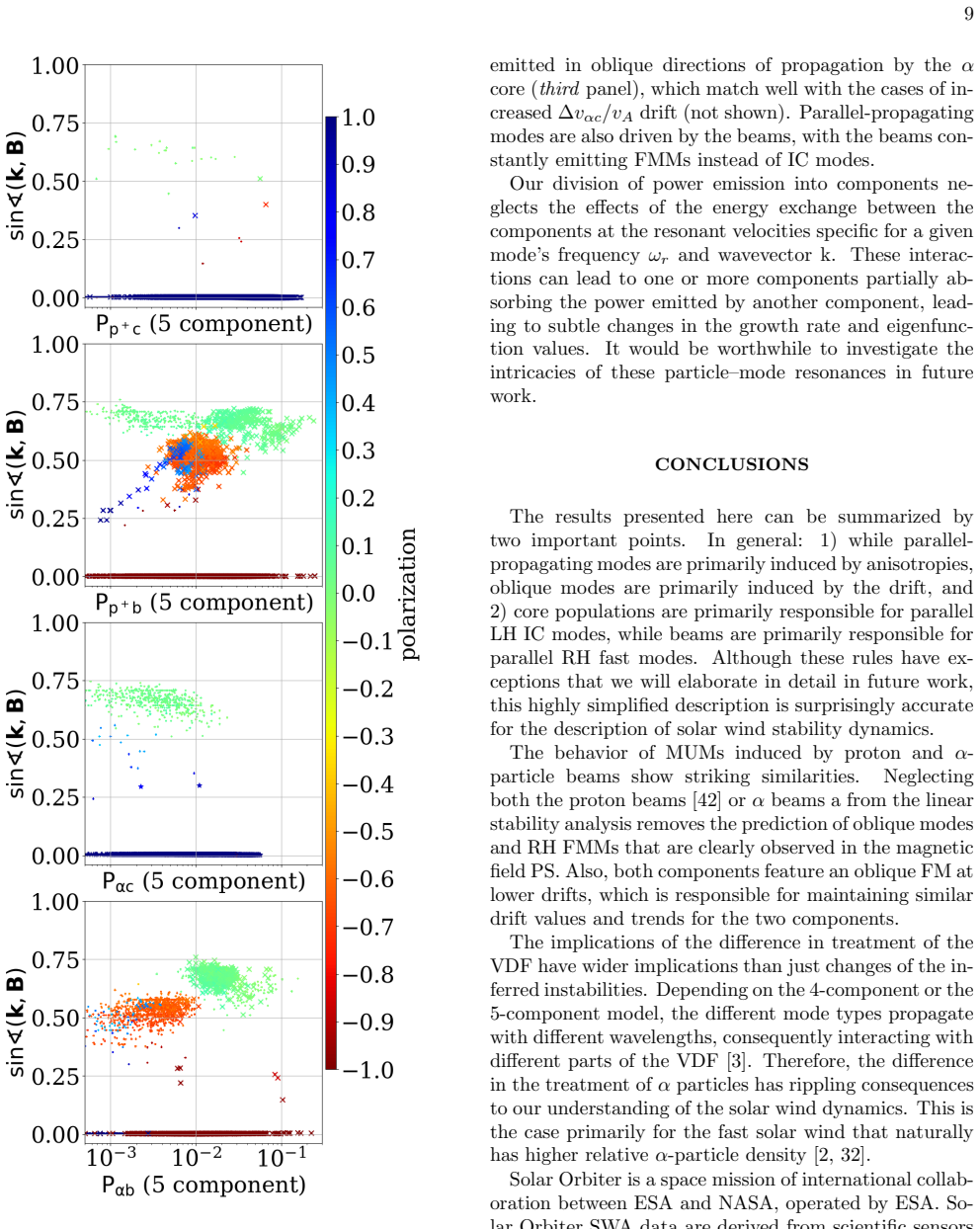
The paper claims that resolving the alpha-particle beam is not a refinement but a necessity: a velocity distribution function built from five bi-Maxwellian components—proton core, proton beam, alpha core, alpha beam, and electrons—reproduces the observed coherent wave signatures in the solar wind where the traditional four-component model fails. When treated as a single population, alpha particles appear as a moderately drifting, parallel-elongated component; when split, the alpha core has a roughly three times larger perpendicular anisotropy and the alpha beam has a large drift (often exceeding the Alfvén speed). Linear Vlasov–Maxwell stability analysis using these two parameter sets yields different most-unstable modes, and only the 5-component set predicts the left-hand polarized waves and the right-hand fast magnetosonic modes actually observed in the spacecraft-frame power spectrum. The authors also attribute specific free-energy sources to specific modes: the drifts of beam components are the main drivers of oblique fast magnetosonic modes, and the temperature anisotropies of beam components are the primary source of parallel fast magnetosonic modes.
Load-bearing premise
The cluster-analysis decomposition of the measured ion velocity distributions into separate proton and alpha core and beam populations correctly recovers the true densities, drifts, and anisotropies of each component, especially for the alpha beam; if it misassigns particles between alpha core and beam, the predicted wave modes would change.
Editorial extensions
If this is right
- Solar wind stability surveys should adopt five-component ion models, since four-component fits miss the alpha-beam-driven modes that appear in observed power spectra.
- The alpha core temperature anisotropy inferred from five-component fits is roughly a factor of three larger, which changes the predicted instability thresholds and the associated wave-particle heating rates.
- Oblique fast magnetosonic modes should be understood as predominantly drift-driven, and parallel fast magnetosonic modes as predominantly anisotropy-driven, offering a simple interpretive rule for observed wave polarizations.
- Reported anomalously high alpha-to-proton temperature ratios in some fast solar wind intervals may be artifacts of blending the alpha beam with the alpha core, rather than evidence of exotic heating mechanisms.
- Because the four- and five-component models predict waves with different wavelengths and propagation angles, the two models also predict different parts of the velocity distribution to resonate with the emitted waves.
Reading between the lines
- The same four-versus-five component distinction likely applies to other high-resolution ion instruments, including Parker Solar Probe's SPAN-I, and may change stability predictions at closer heliocentric distances; the paper calls for but does not perform this test.
- If the drift-driven oblique fast-magnetosonic mechanism is generic, one could search for a correlation between alpha beam drift speed and the occurrence of oblique right-handed waves across a large survey of Solar Orbiter and Parker Solar Probe intervals.
- The cluster-decomposition technique might generalize to separate the electron strahl from the electron core, or to resolve beams of other minor ions, potentially improving stability analyses beyond alpha particles.
- A direct consequence the authors leave implicit: single-population alpha fits may systematically bias estimates of the free energy available for instabilities in the solar wind, affecting global models of solar wind heating and turbulence.
Editorial analysis
A structured set of objections, weighed in public.
Referee Report
Summary. The paper investigates whether resolving the alpha-particle velocity distribution into separate core and beam components changes the predicted linear stability properties of solar wind plasma. Using one day of Solar Orbiter SWA-PAS data, the authors fit 4-component (proton core, proton beam, single alpha, electrons) and 5-component (proton core, proton beam, alpha core, alpha beam, electrons) VDF models, run the PLUMAGE/PLUME linear solvers to find the most unstable mode for each interval, Doppler-shift the predicted frequencies into the spacecraft frame, and compare the results with wavelet/MVA-derived polarization signatures in the magnetic field power spectrum. They report that the 5-component model is necessary to explain the observed coherent wave signatures, particularly left-handed modes attributed to alpha-core temperature anisotropy, and that alpha-beam drifts drive oblique fast-magnetosonic modes while alpha-beam anisotropies drive parallel fast-magnetosonic modes.
Significance. If the central claim holds, the paper would demonstrate that secondary alpha populations are not benign additions to solar wind VDF models but can qualitatively change the predicted unstable-mode spectrum. The work has clear strengths: it applies forward linear stability calculations to a large sample of 16,655 intervals, uses state-of-the-art solvers, and provides a detailed decomposition of emitted power and mode polarization as functions of alpha-beam drift. The alpha-core/alpha-beam split is physically motivated and connects to earlier work by De Marco et al. However, the necessity claim is currently supported only by a qualitative, single-day comparison, and the key decomposition step is not validated in this manuscript. With added quantitative matching statistics and robustness tests, this could be an important contribution to solar wind kinetic stability studies.
major comments (4)
- [Fits of the Velocity Distribution Parameters; Table I] The central claim that the alpha-beam component is necessary rests on the difference in alpha-core temperature anisotropy between the 4- and 5-component models: Table I reports T_perp,alpha_c/T_par,alpha_c = 0.70 for the single-alpha fit and 1.73 for the alpha core in the 5-component fit, and the text states that the matching LH modes in Fig. 4 (middle) are 'induced by alpha core anisotropy, which is increased by approximately a factor of 3 for 5-component cases.' No validation of the clustering-based decomposition (De Marco et al. 2023) is shown in this manuscript: there are no recovery tests on synthetic VDFs, no uncertainty estimates on n_alpha_c, Delta_v_alpha_c, T_perp,alpha_c, or T_par,alpha_c, and no independent cross-check that the split is physically meaningful. Because the paper itself cites [31] to note that even subtle VDF parameter changes alter stability results, the factor-of-~2.5 anisotropy increase could be an artifact of the specific clustering partition rather than a property of the plasma. I request a quantitative robustness test, e.g., perturbing the clustering boundary or comparing with an alternative two-component fit, to show that the predicted LH modes are not contingent on the decomposition.
- [Comparison of Inferred Waves with Observed Power Spectra; Figs. 3-4] The comparison between predictions and observations is qualitative. The paper concludes 'consistent agreement' and 'more consistent emission' without a quantitative metric, error bars, or a matching criterion. The observed wave signatures are identified by |sigma| >= 0.6 (Eq. 3), but the predicted and observed frequencies and polarizations are only overplotted; no count of matched intervals, no tolerance in omega_sc or sigma, and no comparison of success rates for the 4- versus 5-component models is provided. This makes it difficult to evaluate the necessity claim. I recommend defining an explicit matching rule (e.g., predicted MUM frequency within a fractional band of a coherent observed feature with matching polarization sign) and reporting the match statistics for both models.
- [Results and Discussion; Figure 4 (middle)] The attribution of the observed LH waves to alpha-core anisotropy is underdetermined. The stability calculation reports only the most unstable mode (MUM), while the observed power spectrum may contain any of the unstable modes; the text also states that from MVA alone one cannot distinguish which component emits the observed waves. The paper does not demonstrate that the single-alpha model fails because of the unresolved alpha beam specifically, as opposed to other parameter uncertainties (e.g., proton beam drift or alpha density). A stronger test would be to vary the single-alpha parameters within plausible uncertainties and show that no 4-component parameter set reproduces the observed LH signatures.
- [Dataset and Methodology; Conclusions] The conclusion that the alpha-beam component is 'necessary to predict the coherent wave signatures' is based on a single day (March 2, 2022). Given the strong generality of the claim and the variability of solar wind conditions, the absence of additional intervals weakens the statistical basis. I suggest either softening the claim to a demonstration of principle or adding more intervals to support the necessity statement.
minor comments (5)
- [Equation (1)] The denominator in the exponential term uses w_parallel without the component index j; this should be w_parallel_j to match the prefactor.
- [Analysis of Mode Characteristics] The text states that beams feature 'both spherical and linear polarizations'; the intended term is almost certainly 'circular', not 'spherical'.
- [Conclusions] There is a typo: 'Neglecting both the proton beams [42] or alpha beams a from the linear stability analysis' should read 'alpha beams from'.
- [Analysis of Mode Characteristics] The symbol P_alpha_b is used without definition; it should be defined explicitly as the emitted power by the alpha beam component, consistent with P_j.
- [Fits of the Velocity Distribution Parameters] The manuscript does not state the criteria for selecting the representative day March 2, 2022, or the data-quality filters applied to the 16,655 intervals; please add a brief description.
Circularity Check
No circularity: forward linear-stability predictions are compared with independent polarization measurements; the α-beam necessity claim rests on an observed match, not on a fitted parameter renamed as a prediction.
full rationale
The paper's derivation chain is a forward modeling exercise. Measured 3D velocity distributions are decomposed into 4- and 5-component bi-Maxwellian models, giving parameter sets P; these P are input to the PLUMAGE/PLUME dispersion solvers to compute the most unstable modes; the predicted spacecraft-frame frequencies and polarizations are then compared with independently measured magnetic-field polarization from wavelet and minimum-variance analysis. Observed wave signatures are not used to adjust P, so this is not a case of a fitted input being called a prediction. The α core/beam separation does increase the inferred α-core anisotropy and thereby drives the LH modes that match the observed spectra, but the match is to external observations, not to the fitting procedure itself. The clustering method is cited from prior work by overlapping authors (De Marco et al. 2023), and this citation is load-bearing for the input parameters; however, the central claim that the 5-component model is necessary is supported by the comparison to measured power spectra, not derived solely from the citation. No equation is shown to reduce to its own inputs, and no fitted parameter is re-presented as a prediction. Concerns about the validity or uncertainty of the clustering split are correctness and validation issues, not circularity.
Assumptions & free parameters
free parameters (4)
- alpha beam density ratio n_alpha_b/n_pc =
varies per interval, e.g., 1.7% in representative fit (Table I)
- alpha beam drift Delta v_alpha_b / v_A =
varies per interval, e.g., 1.48 in representative fit (Table I)
- alpha beam temperature anisotropy T_perp,alpha_b / T_par,alpha_b =
varies per interval, e.g., 1.52 in representative fit (Table I)
- coherent wave detection threshold |sigma| >= 0.6 =
0.6
assumptions (4)
- domain assumption The observed plasma can be represented as a sum of drifting bi-Maxwellian (or Gaussian) components for each particle species and sub-population.
- standard math Linear Vlasov-Maxwell theory and the Nyquist stability criterion (as implemented in PLUMAGE) correctly predict the most unstable modes for the given VDF parameters.
- domain assumption The observed coherent magnetic field fluctuations are the instability-driven waves predicted by linear theory and are not due to other sources (e.g., advection of pre-existing structures).
- domain assumption The Doppler shift relation omega_sc = omega_plasma + k dot v_sw(sc) applies with the inferred wavevector direction.
Cite this review
Pith. "Pith review of Impact of Two-Population $\alpha$-particle Distributions on Plasma Stability." pith.science (2026). https://pith.science/paper/QQUYPKNT
@misc{pith2026241204885,
  author       = {Pith},
  title        = {Pith review of: Impact of Two-Population $\alpha$-particle Distributions on Plasma Stability},
  year         = {2026},
  howpublished = {\url{https://pith.science/paper/QQUYPKNT}},
  note         = {Machine review of arXiv:2412.04885}
}
abstract
The stability of weakly collisional plasmas is well represented by linear theory, and the generated waves play an essential role in the thermodynamics of these systems. The velocity distribution functions (VDF) characterizing kinetic particle behavior are commonly represented as a sum of anisotropic bi-Maxwellians. For the majority of in situ observations of solar wind plasmas enabled by heliospheric missions, a three bi-Maxwellian model is commonly applied for the ions, assuming that the VDF consists of a proton core, proton beam, and a single He ($\alpha$) particle population, each with their own density, bulk velocity, and anisotropic temperature. Resolving an $\alpha$-beam component was generally not possible due to instrumental limitations. The Solar Orbiter Solar Wind Analyser Proton and Alpha Sensor (SWA PAS) resolves velocity space with sufficient coverage and accuracy to routinely characterize secondary $\alpha$ populations consistently. This design makes the SWA PAS dataset ideal for examining effects of the $\alpha$-particle beam on the plasma's kinetic stability. We test the wave signatures observed in the magnetic field power spectrum at ion scales and compare them to the predictions from linear plasma theory, Doppler-shifted into the spacecraft reference frame. We find that taking into account the $\alpha$-particle beam component is necessary to predict the coherent wave signatures in the observed power spectra, emphasizing the importance of separating the $\alpha$-particle populations as is traditionally done for protons. Moreover, we demonstrate that the drifts of beam components are responsible for the majority of the modes that propagate in oblique direction to the magnetic field, while their temperature anisotropies are the primary source of parallel Fast Magnetosonic Modes in the solar wind.
Figures


Figures from the paper (3 more)


Forward citations
Cited by 1 Pith paper
-
Observational Constraints on the Radial Evolution of O$^{6+}$ Temperature and Differential Flow in the Inner Heliosphere
O6+ ions in the solar wind cool adiabatically between 0.3 and 1 au, with differential flow relative to protons decreasing with distance, based on first in situ inner-heliosphere heavy-ion measurements from Solar Orbiter.
Reference graph
Works this paper leans on
-
[31]
J. Walters, K. G. Klein, E. Lichko, M. L. Stevens, D. Ver- scharen, and B. D. G. Chandran, The Effects of Nonequi- librium Velocity Distributions on Alfv´ en Ion-cyclotron Waves in the Solar Wind, The Astrophysical Journal 955, 97 (2023), arXiv:2308.14944 [astro-ph.SR]
work page Pith review arXiv 2023
-
[1]
Marsch, Helios: Evolution of Distribution Functions 0.3-1 AU, Space Science Reviews 172, 23 (2012)
E. Marsch, Helios: Evolution of Distribution Functions 0.3-1 AU, Space Science Reviews 172, 23 (2012)
work page 2012
-
[2]
core populations are primarily responsible for parallel LH IC modes, while beams are primarily responsible for parallel RH fast modes. Although these rules have ex- ceptions that we will elaborate in detail in future work, this highly simplified description is surprisingly accurate for the description of solar wind stability dynamics. The behavior of MUMs...
work page 2018
-
[3]
D. Verscharen, K. G. Klein, and B. A. Maruca, The multi-scale nature of the solar wind, Living Re- views in Solar Physics 16, 5 (2019), arXiv:1902.03448 [physics.space-ph]
arXiv 2019
- [4]
-
[5]
R. Bruno, R. De Marco, R. D’Amicis, D. Perrone, M. F. Marcucci, D. Telloni, R. Marino, L. Sorriso-Valvo, V. Fortunato, G. Mele, F. Monti, A. Fedorov, P. Louarn, C. J. Owen, and S. Livi, Comparative Study of the Kinetic Properties of Proton and Alpha Beams in the Alfv´ enic Wind Observed by SW A-PAS On Board So- lar Orbiter, The Astrophysical Journal 969, ...
work page Pith review arXiv 2024
-
[6]
B. L. Alterman, J. C. Kasper, M. L. Stevens, and A. Ko- val, A Comparison of Alpha Particle and Proton Beam Differential Flows in Collisionally Young Solar Wind, The Astrophysical Journal 864, 112 (2018), arXiv:1809.01693 [astro-ph.SR]
work page Pith review arXiv 2018
-
[7]
L. Matteini, S. Landi, P. Hellinger, F. Pantellini, M. Mak- simovic, M. Velli, B. E. Goldstein, and E. Marsch, Evo- lution of the solar wind proton temperature anisotropy from 0.3 to 2.5 AU, Geophysical Research Letters 34, L20105 (2007)
work page 2007
Show all 68 references
-
[8]
Maksimovi´ c, Y
M. Maksimovi´ c, Y. Zouganelis, J. Y. Chaufray, K. Is- sautier, E. E. Scime, J. E. Littleton, E. Marsch, D. J. McComas, C. Salem, R. P. Lin, and H. Elliot, Radial evolution of the electron distribution functions in the fast solar wind between 0.3 and 1.5 au, Journal of Geophys...
2005
-
[9]
T. K. Fowler, Thermodynamics of Unstable Plasmas, Ad- vances in Plasma Physics 1, 201 (1968)
1968
-
[10]
ˇDurovcov´ a, J.ˇSafr´ ankov´ a, and Z
T. ˇDurovcov´ a, J.ˇSafr´ ankov´ a, and Z. Nˇ emeˇ cek, Evolution of Relative Drifts in the Expanding Solar Wind: Helios Observations, Solar Physics 294, 97 (2019)
2019
-
[11]
K. G. Klein, B. L. Alterman, M. L. Stevens, D. Vech, and J. C. Kasper, Majority of solar wind intervals support ion-driven instabilities, Physical Review Letters 120, 205102 (2018)
2018
-
[12]
C. H. K. Chen, L. Matteini, A. A. Schekochihin, M. L. Stevens, C. S. Salem, B. A. Maruca, M. W. Kunz, and S. D. Bale, Multi-species Measurements of the Firehose and Mirror Instability Thresholds in the Solar Wind, ”The Astrophysical Journal Letters” 825, L26 (2016), arXiv:1606...
2016 arXiv
-
[13]
S. P. Gary, Theory of Space Plasma Microinstabilities (Cambridge University Press, 1993)
1993
-
[14]
M. M. Martinovi´ c and K. G. Klein, Ion-driven Instabili- ties in the Inner Heliosphere. II. Classification and Mul- tidimensional Mapping, The Astrophysical Journal 952, 14 (2023), arXiv:2306.06060 [astro-ph.SR]
2023 arXiv
-
[15]
W. Liu, J. Zhao, T. Wang, X. Dong, J. C. Kasper, S. D. Bale, C. Shi, and D. Wu, The Radial Distribution of Ion- scale Waves in the Inner Heliosphere, The Astrophysical Journal 951, 69 (2023), arXiv:2305.08424 [astro-ph.SR]
2023 arXiv
-
[16]
S. P. Gary, L. K. Jian, T. W. Broiles, M. L. Stevens, J. J. Podesta, and J. C. Kasper, Ion-driven instabilities in the solar wind: Wind observations of 19 March 2005, Journal of Geophysical Research (Space Physics) 121, 30 (2016)
2016
-
[17]
F. S. Mozer, I. Y. Vasko, and J. L. Verniero, Triggered Ion-acoustic Waves in the Solar Wind, The Astrophys- ical Journal Letters 919, L2 (2021), arXiv:2108.07802 [physics.space-ph]
2021 arXiv
-
[18]
M. M. Martinovi´ c, K. G. Klein, T.ˇDurovcov´ a, and B. L. Alterman, Ion-driven Instabilities in the Inner Helio- sphere. I. Statistical Trends, The Astrophysical Journal 923, 116 (2021), arXiv:2110.07772 [astro-ph.SR]
2021 arXiv
-
[19]
D. M. Malaspina, J. Halekas, L. Berˇ ciˇ c, D. Larson, P. Whittlesey, S. D. Bale, J. W. Bonnell, T. Dudok de Wit, R. E. Ergun, G. Howes, K. Goetz, K. Goodrich, P. R. Harvey, R. J. MacDowall, M. Pulupa, A. W. Case, J. C. Kasper, K. E. Korreck, R. Livi, and M. L. Stevens, Plasma...
2020 arXiv
-
[20]
D. Vech, M. M. Martinovi´ c, K. G. Klein, D. M. Malaspina, T. A. Bowen, J. L. Verniero, K. Paulson, T. Dudok de Wit, J. C. Kasper, J. Huang, M. L. Stevens, A. W. Case, K. Korreck, F. S. Mozer, K. A. Goodrich, S. D. Bale, P. L. Whittlesey, R. Livi, D. E. Larson, M. Pulupa, J. B...
2021 arXiv
-
[21]
Shankarappa, K
N. Shankarappa, K. G. Klein, M. M. Martinovi´ c, and T. Bowen, Estimated Heating Rates Due to Cyclotron Damping of Ion-scale Waves Observed by Parker Solar Probe, The Astronomical Journal in review(2024)
2024
-
[22]
T. A. Bowen, A. Mallet, J. Huang, K. G. Klein, D. M. Malaspina, M. Stevens, S. D. Bale, J. W. Bonnell, A. W. Case, B. D. G. Chandran, C. C. Chaston, C. H. K. Chen, T. Dudok de Wit, K. Goetz, P. R. Harvey, G. G. Howes, J. C. Kasper, K. E. Korreck, D. Larson, R. Livi, R. J. MacD...
2020 arXiv
-
[23]
Verscharen, K
D. Verscharen, K. G. Klein, B. D. G. Chandran, M. L. Stevens, C. S. Salem, and S. D. Bale, ALPS: the Arbi- trary Linear Plasma Solver, Journal of Plasma Physics 84, 905840403 (2018), arXiv:1803.04697 [physics.space- ph]
2018 arXiv
-
[24]
Matteini, P
L. Matteini, P. Hellinger, S. Landi, P. M. Tr´ avn ´ ıˇ cek, and M. Velli, Ion Kinetics in the Solar Wind: Coupling Global Expansion to Local Microphysics, Space Science Reviews 172, 373 (2012)
2012
-
[25]
Roennmark, Waves in homogeneous, anisotropic multicomponent plasmas (WHAMP), Technical Report (1982)
K. Roennmark, Waves in homogeneous, anisotropic multicomponent plasmas (WHAMP), Technical Report (1982)
1982
-
[26]
T. H. Stix, Waves in plasmas (Springer, 1992)
1992
-
[27]
K. G. Klein and G. G. Howes, Predicted impacts of pro- ton temperature anisotropy on solar wind turbulence, Physics of Plasmas 22, 032903 (2015), arXiv:1503.00695 [physics.space-ph]
2015 arXiv
-
[28]
Astfalk, T
P. Astfalk, T. G¨ orler, and F. Jenko, DSHARK: A dis- persion relation solver for obliquely propagating waves in bi-kappa-distributed plasmas, Journal of Geophysical Research (Space Physics) 120, 7107 (2015)
2015
-
[29]
Verscharen and B
D. Verscharen and B. D. G. Chandran, NHDS: The New Hampshire Dispersion Relation Solver, Research Notes of the American Astronomical Society2, 13 (2018), arXiv:1804.10096 [physics.space-ph]
2018 arXiv
-
[30]
K. G. Klein, J. C. Kasper, K. E. Korreck, and M. L. Stevens, Applying Nyquist’s method for stability deter- mination to solar wind observations, Journal of Geophys- ical Research (Space Physics) 122, 9815 (2017)
2017
-
[32]
Wilson, Lynn B., K
I. Wilson, Lynn B., K. A. Goodrich, D. L. Turner, I. J. Cohen, P. L. Whittlesey, and S. J. Schwartz, The need for accurate measurements of thermal velocity distribution functions in the solar wind, Frontiers in Astronomy and Space Sciences 9, 369 (2022)
2022
-
[33]
J. D. Scudder, Radial Variation of the Solar Wind Proton Temperature: Heat Flow or Addition?, The Astrophysi- cal Journal 809, 126 (2015)
2015
-
[34]
J. C. Kasper, A. J. Lazarus, J. T. Steinberg, K. W. Ogilvie, and A. Szabo, Physics-based tests to identify the accuracy of solar wind ion measurements: A case study with the Wind Faraday Cups, Journal of Geophysical Re- search (Space Physics) 111, A03105 (2006)
2006
-
[35]
C. J. Owen, R. Bruno, S. Livi, P. Louarn, K. Al Jan- abi, F. Allegrini, C. Amoros, R. Baruah, A. Barthe, M. Berthomier, S. Bordon, C. Brockley-Blatt, C. Brys- baert, G. Capuano, M. Collier, R. DeMarco, A. Fedorov, J. Ford, V. Fortunato, I. Fratter, A. B. Galvin, B. Han- cock, ...
2020
-
[36]
R. Livi, D. E. Larson, J. C. Kasper, R. Abiad, A. W. Case, K. G. Klein, D. W. Curtis, G. Dalton, M. Stevens, K. E. Korreck, G. Ho, M. Robinson, C. Tiu, P. L. Whit- tlesey, J. L. Verniero, J. Halekas, J. McFadden, M. Mar- ckwordt, A. Slagle, M. Abatcha, A. Rahmati, and M. D. Mc...
2022
-
[37]
De Marco, R
R. De Marco, R. Bruno, V. K. Jagarlamudi, R. D’Amicis, M. F. Marcucci, V. Fortunato, D. Perrone, D. Telloni, C. J. Owen, P. Louarn, A. Fedorov, S. Livi, and T. Hor- bury, Innovative technique for separating proton core, proton beam, and alpha particles in solar wind 3D veloc- ...
2023
-
[38]
M. D. McManus, K. G. Klein, S. D. Bale, T. A. Bowen, J. Huang, D. Larson, R. Livi, A. Rahmati, O. Romeo, J. Verniero, and P. Whittlesey, Proton- and Alpha-driven Instabilities in an Ion Cyclotron Wave Event, The As- trophysical Journal 961, 142 (2024), arXiv:2310.14136 [astro-ph.SR]
2024 arXiv
-
[39]
Huang, G
R. Huang, G. G. Howes, and A. J. McCubbin, The velocity-space signature of transit-time damp- ing, Journal of Plasma Physics 90, 535900401 (2024), arXiv:2401.16697 [physics.plasm-ph]
2024 arXiv
-
[40]
K. G. Klein, The kinetic plasma physics of solar wind turbulence, Ph.D. thesis, The University of Iowa (2013)
2013
-
[41]
M. M. Martinovi´ c, K. G. Klein, J. Huang, B. D. G. Chandran, J. C. Kasper, E. Lichko, T. Bowen, C. H. K. Chen, L. Matteini, M. Stevens, A. W. Case, and S. D. Bale, Multiscale Solar Wind Turbulence Properties in- side and near Switchbacks Measured by the Parker So- lar Probe, ...
2021 arXiv
-
[42]
K. G. Klein, M. Martinovi´ c, D. Stansby, and T. S. Horbury, Linear Stability in the Inner Heliosphere: He- lios Re-evaluated, The Astrophysical Journal 887, 234 (2019), arXiv:1912.00250 [astro-ph.SR]
2019 arXiv
-
[43]
T. S. Horbury, H. O’Brien, I. Carrasco Blazquez, 12 M. Bendyk, P. Brown, R. Hudson, V. Evans, T. M. Oddy, C. M. Carr, T. J. Beek, E. Cupido, S. Bhat- tacharya, J. A. Dominguez, L. Matthews, V. R. Myk- lebust, B. Whiteside, S. D. Bale, W. Baumjohann, D. Burgess, V. Carbone, P. ...
2020
-
[44]
K. G. Klein, J. L. Verniero, B. Alterman, S. Bale, A. Case, J. C. Kasper, K. Korreck, D. Larson, E. Lichko, R. Livi, M. McManus, M. Martinovi´ c, A. Rahmati, M. Stevens, and P. Whittlesey, Inferred Linear Stabil- ity of Parker Solar Probe Observations Using One- and Two-compon...
2021 arXiv
-
[45]
B. U. ¨O. Sonnerup and M. Scheible, Minimum and Maxi- mum Variance Analysis, ISSI Scientific Reports Series 1, 185 (1998)
1998
-
[46]
Torrence and G
C. Torrence and G. P. Compo, A Practical Guide to Wavelet Analysis., Bulletin of the American Meteorolog- ical Society 79, 61 (1998)
1998
-
[47]
L. D. Woodham, R. T. Wicks, D. Verscharen, J. M. TenBarge, and G. G. Howes, Dependence of Solar Wind Proton Temperature on the Polarization Properties of Alfv´ enic Fluctuations at Ion-kinetic Scales, The As- trophysical Journal 912, 101 (2021), arXiv:2003.09346 [physics.space-ph]
2021 arXiv
-
[48]
W. H. Matthaeus and M. L. Goldstein, Measurement of the rugged invariants of magnetohydrodynamic turbu- lence in the solar wind, Journal of Geophysical Research 87, 6011 (1982)
1982
-
[49]
Stansby, C
D. Stansby, C. Salem, L. Matteini, and T. Horbury, A New Inner Heliosphere Proton Parameter Dataset from the Helios Mission, Solar Physics 293, 155 (2018), arXiv:1807.04376 [astro-ph.SR]
2018 arXiv
-
[50]
S. R. Cranmer, Coronal Holes and the High-Speed Solar Wind, Space Science Reviews 101, 229 (2002)
2002
-
[51]
Lichko, J
E. Lichko, J. Egedal, W. Daughton, and J. Kasper, Mag- netic Pumping as a Source of Particle Heating and Power- law Distributions in the Solar Wind, The Astrophysi- cal Journal Letters 850, L28 (2017), arXiv:1710.02106 [physics.plasm-ph]
2017 arXiv
-
[52]
Shankarappa, K
N. Shankarappa, K. G. Klein, and M. M. Martinovi´ c, Estimation of Turbulent Proton and Electron Heating Rates via Landau Damping Constrained by Parker Solar Probe Observations, The Astronomical Journal 946, 85 (2023), arXiv:2301.09713 [astro-ph.SR]
2023 arXiv
-
[53]
Montag and G
P. Montag and G. G. Howes, A field-particle correlation analysis of magnetic pumping, Physics of Plasmas 29, 032901 (2022)
2022
-
[54]
Lichko and J
E. Lichko and J. Egedal, Magnetic pumping model for energizing superthermal particles applied to observations of the Earth’s bow shock, Nature Communications 11, 2942 (2020)
2020
-
[55]
T. A. Bowen, I. Y. Vasko, S. D. Bale, B. D. G. Chan- dran, A. Chasapis, T. Dudok de Wit, A. Mallet, M. Mc- Manus, R. Meyrand, M. Pulupa, and J. Squire, Ex- tended Cyclotron Resonant Heating of the Turbulent So- lar Wind, The Astrophysical Journall 972, L8 (2024), arXiv:2406.10...
2024 arXiv
-
[56]
S. R. Cranmer and A. A. van Ballegooijen, Proton, Elec- tron, and Ion Heating in the Fast Solar Wind from Nonlinear Coupling between Alfv´ enic and Fast-mode Turbulence, The Astrophysical Journal 754, 92 (2012), arXiv:1205.4613 [astro-ph.SR]
2012 arXiv
-
[57]
B. D. G. Chandran, B. Li, B. N. Rogers, E. Quataert, and K. Germaschewski, Perpendicular ion heating by low- frequency alfv´ en-wave turbulence in the solar wind, The Astrophysical Journal 720, 503 (2010)
2010
-
[58]
Afshari, G
A. Afshari, G. Howes, J. Shuster, K. Klein, D. McGin- nis, M. Martinovi´ c’, S. Boardsen, C. R. Brown, R. Huang, D. Hartley, and C. Kletzing, Direct observation of ion cy- clotron damping of turbulence in Earth’s magnetosheath plasma, Nature Communications 15, L2 (2024)
2024
-
[59]
M. M. Martinovi´ c, K. G. Klein, and S. Bourouaine, Radial Evolution of Stochastic Heating in Low- β So- lar Wind, The Astrophysical Journal 879, 43 (2019), arXiv:1905.13355 [physics.space-ph]
2019 arXiv
-
[60]
M. M. Martinovi´ c, K. G. Klein, J. C. Kasper, A. W. Case, K. E. Korreck, D. Larson, R. Livi, M. Stevens, P. Whit- tlesey, B. D. G. Chandran, B. L. Alterman, J. Huang, C. H. K. Chen, S. D. Bale, M. Pulupa, D. M. Malaspina, J. W. Bonnell, P. R. Harvey, K. Goetz, T. Dudok de Wit...
2020 arXiv
-
[61]
C. Y. Tu and E. Marsch, On cyclotron wave heating and acceleration of solar wind ions in the outer corona, Jour- nal of Geophysical Research 106, 8233 (2001)
2001
-
[62]
J. C. Kasper, A. J. Lazarus, and S. P. Gary, Hot Solar- Wind Helium: Direct Evidence for Local Heating by Alfv´ en-Cyclotron Dissipation, Physical Review Letters 101, 261103 (2008)
2008
-
[63]
Daughton and S
W. Daughton and S. P. Gary, Electromagnetic pro- ton/proton instabilities in the solar wind, Journal of Geo- physical Research 103, 20613 (1998)
1998
-
[64]
Marsch and C
E. Marsch and C. Y. Tu, Evidence for pitch angle diffusion of solar wind protons in resonance with cy- clotron waves, Journal of Geophysical Research 106, 8357 (2001)
2001
-
[65]
Pezzini, A
L. Pezzini, A. N. Zhukov, F. Bacchini, G. Arr` o, R. A. L´ opez, A. Micera, M. E. Innocenti, and G. Lapenta, Fully Kinetic Simulations of Proton-Beam-Driven In- stabilities from Parker Solar Probe Observations, arXiv e-prints , arXiv:2405.08196 (2024), arXiv:2405.08196 [astro-ph.SR]
2024 arXiv
-
[66]
Ofman, S
L. Ofman, S. A. Boardsen, L. K. Jian, J. L. Verniero, and D. Larson, Modeling Ion Beams, Kinetic Instabili- ties, and Waves Observed by the Parker Solar Probe near Perihelia, The Astrophysical Journal 926, 185 (2022), arXiv:2112.02357 [astro-ph.SR]
2022 arXiv
-
[68]
S. M. Shaaban, M. Lazar, R. A. L´ opez, P. H. Yoon, and S. Poedts, Decoding the formation of hammerhead ion populations observed by Parker Solar Probe, arXiv e-prints , arXiv:2409.01997 (2024), arXiv:2409.01997 [astro-ph.SR]
2024 arXiv
-
[2022]
Special thanks are extended to IRAP/CNRS for PAS operations and data calibration, and to the MAG team for providing Solar Orbiter magnetic field data. M. M. Martinovi´ c and K. G. Klein were finan- cially supported by NASA grants: 80NSSC22K1011, 80NSSC19K1390, 80NSSC23K0693, 8...
Reviewed August 11, 2026 · model on record in the stance chip above.
Discussion (0). Continue with ORCID to comment.