Learning Hidden Physics and System Parameters with Deep Operator Networks
Pith reviewed 2026-05-23 07:41 UTC · model grok-4.3
The pith
Deep operator networks can discover unknown PDE terms and identify governing parameters from sparse noisy observations across multiple equation families.
A machine-rendered reading of the paper's core claim, the machinery that carries it, and where it could break.
Core claim
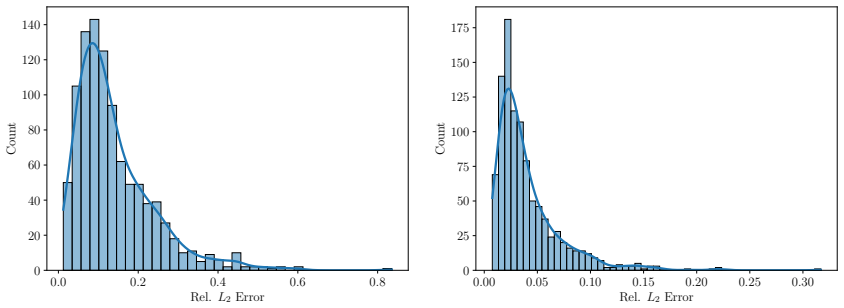
The central claim is that the Deep Hidden Physics Operator identifies mappings of unknown physical operators to discover hidden PDE terms across families of equations, while a second framework that pairs pretrained DeepONet with physics-informed inverse modeling infers system parameters from sparse sensor data; both achieve relative solution errors on the order of 10 to the minus 2 and parameter errors on the order of 10 to the minus 3 on benchmarks including the Reaction-Diffusion system, Burgers' equation, the 2D Heat equation, and the 2D Helmholtz equation, even with limited and noisy observations.
What carries the argument
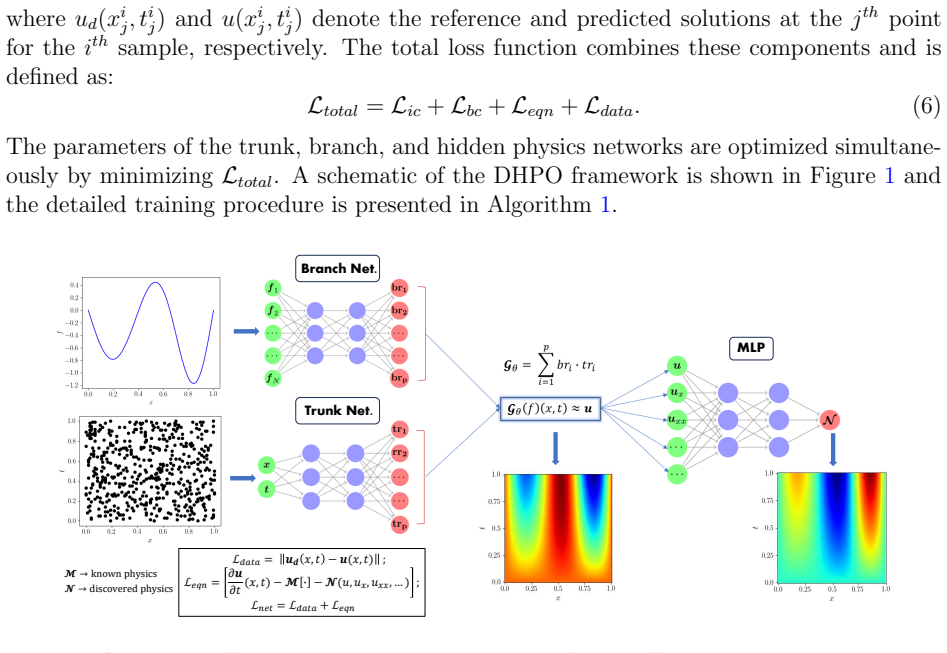
The Deep Hidden Physics Operator (DHPO), which maps inputs to unknown physical operators to discover hidden terms in PDEs without case-by-case retraining.
If this is right
- The same operator can recover unknown terms in multiple distinct PDE families without retraining for each new equation.
- Parameter values can be extracted directly from sparse sensor readings once an operator is pretrained.
- Accuracy holds when data contain noise levels typical of real measurements.
- The approach supplies a single framework that performs both physics discovery and parameter identification.
Where Pith is reading between the lines
- The method could reduce the data volume needed for inverse problems in engineering systems where only partial sensor coverage is feasible.
- It might extend naturally to time-evolving systems by treating the operator as a time-stepping map.
- A practical test would involve feeding the learned operator experimental data from a physical device rather than simulated benchmarks.
Load-bearing premise
The learned operator mappings stay accurate and generalize across different PDE families even when observations are sparse and noisy.
What would settle it
Apply the DHPO framework to a PDE family outside the reported benchmarks using only 10 percent of the usual sensor points and check whether solution errors remain below order 10 to the minus 2.
Figures




read the original abstract
Discovering hidden physical laws and identifying governing system parameters from sparse observations are central challenges in computational science and engineering. Existing data-driven methods, such as physics-informed neural networks (PINNs) and sparse regression, are limited by their need for extensive retraining, sensitivity to noise, or inability to generalize across families of partial differential equations (PDEs). In this work, we introduce two complementary frameworks based on deep operator networks (DeepONet) to address these limitations. The first, termed the Deep Hidden Physics Operator (DHPO), extends hidden-physics modeling into the operator-learning paradigm, enabling the discovery of unknown PDE terms across diverse equation families by identifying the mapping of unknown physical operators. The second is a parameter identification framework that combines pretrained DeepONet with physics-informed inverse modeling to infer system parameters directly from sparse sensor data. We demonstrate the effectiveness of these approaches on benchmark problems, including the Reaction-Diffusion system, Burgers' equation, the 2D Heat equation, and 2D Helmholtz equation. Across all cases, the proposed methods achieve high accuracy, with relative solution errors on the order of O(10^-2) and parameter estimation errors on the order of O(10^-3), even under limited and noisy observations. By uniting operator learning with physics-informed modeling, this work offers a unified and data-efficient framework for physics discovery and parameter identification, paving the way for robust inverse modeling in complex dynamical systems.
Editorial analysis
A structured set of objections, weighed in public.
Referee Report
Summary. The paper introduces two complementary DeepONet-based frameworks for discovering hidden physical laws and identifying system parameters from sparse and noisy observations. The first is the Deep Hidden Physics Operator (DHPO), which extends hidden-physics modeling into the operator-learning setting to identify mappings of unknown physical operators across PDE families. The second combines a pretrained DeepONet with physics-informed inverse modeling to infer parameters directly from sensor data. Effectiveness is demonstrated on the Reaction-Diffusion system, Burgers' equation, the 2D Heat equation, and the 2D Helmholtz equation, with reported relative solution errors of O(10^{-2}) and parameter estimation errors of O(10^{-3}).
Significance. If the numerical results are supported by proper validation, the work would provide a data-efficient alternative to PINNs and sparse regression for inverse problems by uniting operator learning with physics-informed modeling, potentially improving generalization across PDE families without per-case retraining.
major comments (1)
- Abstract: The abstract states that the proposed methods achieve relative solution errors on the order of O(10^{-2}) and parameter estimation errors on the order of O(10^{-3}) across four benchmarks, but supplies no derivation details, baseline comparisons, error-bar analysis, or ablation studies. This absence makes it impossible to verify whether the reported errors support the central claims or result from post-hoc tuning.
Simulated Author's Rebuttal
We thank the referee for the constructive review. We address the single major comment below and propose revisions to strengthen the presentation.
read point-by-point responses
-
Referee: Abstract: The abstract states that the proposed methods achieve relative solution errors on the order of O(10^{-2}) and parameter estimation errors on the order of O(10^{-3}) across four benchmarks, but supplies no derivation details, baseline comparisons, error-bar analysis, or ablation studies. This absence makes it impossible to verify whether the reported errors support the central claims or result from post-hoc tuning.
Authors: The abstract is intended as a concise high-level summary and therefore omits methodological details that appear in the main text. Section 3.2 derives the DHPO loss and the physics-informed inverse objective; Section 4 reports all numerical experiments, including direct comparisons against PINN and sparse-regression baselines, standard-error bars computed over five independent runs with different random seeds, and ablation tables varying sensor density and noise amplitude. We acknowledge that the abstract could better signpost these validations. We will revise the abstract to add one sentence noting that results are obtained from systematic comparisons and ablations detailed in Sections 3–4. revision: yes
Circularity Check
No significant circularity detected
full rationale
The paper introduces two DeepONet-based frameworks (DHPO for hidden physics and a pretrained-operator inverse model for parameters) and validates them empirically on four standard PDE benchmarks, reporting concrete relative errors of O(10^-2) for solutions and O(10^-3) for parameters under sparse/noisy data. No derivation chain is present that reduces a claimed prediction to a fitted input by construction, nor does any load-bearing step rely on a self-citation whose content is itself unverified or tautological. The work is framed as data-driven operator learning plus physics-informed inversion, with results that are externally falsifiable on the cited benchmarks.
Axiom & Free-Parameter Ledger
Forward citations
Cited by 2 Pith papers
-
Multimodal Neural Operators for Real-Time Biomechanical Modelling of Traumatic Brain Injury
Multimodal neural operators predict full-field brain displacement from MRE data with high accuracy and fast inference by fusing volumetric imaging, demographics, and acquisition parameters.
-
Harnessing AI for Inverse Partial Differential Equation Problems: Past, Present, and Prospects
A survey organizing AI methods for inverse PDE problems into inverse problems, inverse design, and control categories, covering applications and future challenges like physics-informed models and uncertainty quantification.
Reference graph
Works this paper leans on
-
[1]
P. Perdikaris, G. E. Karniadakis, Model inversion via multi-fidelity Bayesian optimiza- tion: a new paradigm for parameter estimation in haemodynamics, and beyond, Journal of The Royal Society Interface 13 (118) (2016) 20151107
work page 2016
-
[2]
B. F. Kennedy, P. Wijesinghe, D. D. Sampson, The emergence of optical elastography in biomedicine, Nature Photonics 11 (4) (2017) 215–221
work page 2017
-
[3]
J.-L. Gennisson, T. Deffieux, M. Fink, M. Tanter, Ultrasound elastography: principles and techniques, Diagnostic and interventional imaging 94 (5) (2013) 487–495
work page 2013
-
[4]
C.-T. Chen, G. X. Gu, Learning hidden elasticity with deep neural networks, Proceed- ings of the National Academy of Sciences 118 (31) (2021) e2102721118
work page 2021
-
[5]
I. G. Kevrekidis, C. W. Gear, G. Hummer, Equation-free: The computer-aided analysis of complex multiscale systems, AIChE Journal 50 (7) (2004) 1346–1355
work page 2004
-
[6]
M. Raissi, Deep Hidden Physics Models: Deep Learning of Nonlinear Partial Differential Equations, Journal of Machine Learning Research 19 (25) (2018) 1–24
work page 2018
-
[7]
H. J. Motulsky, L. A. Ransnas, Fitting curves to data using nonlinear regression: a practical and nonmathematical review, The FASEB journal 1 (5) (1987) 365–374
work page 1987
- [8]
-
[9]
B. C. Daniels, I. Nemenman, Automated adaptive inference of phenomenological dy- namical models, Nature communications 6 (1) (2015) 8133
work page 2015
-
[10]
Koza, On the programming of computers by means of natural selection, Genetic programming (1992)
J. Koza, On the programming of computers by means of natural selection, Genetic programming (1992)
work page 1992
- [11]
-
[12]
S. L. Brunton, J. L. Proctor, J. N. Kutz, Discovering governing equations from data by sparse identification of nonlinear dynamical systems, Proceedings of the national academy of sciences 113 (15) (2016) 3932–3937
work page 2016
- [13]
-
[14]
S. Cai, Z. Mao, Z. Wang, M. Yin, G. E. Karniadakis, Physics-informed neural networks (PINNs) for fluid mechanics: a review, Acta Mechanica Sinica 37 (12) (2021)
work page 2021
- [15]
-
[16]
G. Kissas, Y. Yang, E. Hwuang, W. R. Witschey, J. A. Detre, P. Perdikaris, Machine learning in cardiovascular flows modeling: Predicting arterial blood pressure from non- invasive 4D flow MRI data using physics-informed neural networks, Computer Methods in Applied Mechanics and Engineering 358 (2020) 112623
work page 2020
- [17]
- [18]
-
[19]
L. Lu, P. Jin, G. Pang, Z. Zhang, G. E. Karniadakis, Learning nonlinear operators via DeepONet based on the universal approximation theorem of operators, Nature machine intelligence 3 (3) (2021) 218–229
work page 2021
-
[20]
S. Goswami, A. Bora, Y. Yu, G. E. Karniadakis, Physics-Informed Neural Operators, arXiv preprint arXiv:2207.05748 (2022)
-
[21]
Z. Li, N. Kovachki, K. Azizzadenesheli, B. Liu, K. Bhattacharya, A. Stuart, A. Anand- kumar, Fourier Neural Operator for Parametric Partial Differential Equations (2021). arXiv:2010.08895
work page internal anchor Pith review Pith/arXiv arXiv 2021
-
[22]
T. Tripura, S. Chakraborty, Wavelet Neural Operator for solving parametric partial differential equations in computational mechanics problems, Computer Methods in Ap- plied Mechanics and Engineering 404 (2023) 115783
work page 2023
-
[23]
A. Anandkumar, K. Azizzadenesheli, K. Bhattacharya, N. Kovachki, Z. Li, B. Liu, A. Stuart, Neural operator: Graph kernel network for partial differential equations, in: ICLR 2020 Workshop on Integration of Deep Neural Models and Differential Equations, 2020
work page 2020
- [24]
-
[25]
Q. Cao, S. Goswami, G. E. Karniadakis, Laplace neural operator for solving differential equations, Nature Machine Intelligence 6 (6) (2024) 631–640
work page 2024
-
[26]
T. Ingebrand, A. J. Thorpe, S. Goswami, K. Kumar, U. Topcu, Basis-to-basis operator learning using function encoders, arXiv preprint arXiv:2410.00171 (2024)
-
[27]
B. Bahmani, S. Goswami, I. G. Kevrekidis, M. D. Shields, A resolution independent neural operator, arXiv preprint arXiv:2407.13010 (2024)
-
[28]
T. Chen, H. Chen, Universal approximation to nonlinear operators by neural networks with arbitrary activation functions and its application to dynamical systems, IEEE transactions on neural networks 6 (4) (1995) 911–917. 23
work page 1995
- [29]
-
[30]
N. Borrel-Jensen, S. Goswami, A. P. Engsig-Karup, G. E. Karniadakis, C.-H. Jeong, Sound propagation in realistic interactive 3D scenes with parameterized sources using deep neural operators, Proceedings of the National Academy of Sciences 121 (2) (2024) e2312159120
work page 2024
-
[31]
K. Kontolati, S. Goswami, M. D. Shields, G. E. Karniadakis, On the influence of over- parameterization in manifold based surrogates and deep neural operators, Journal of Computational Physics (2023) 112008
work page 2023
- [32]
- [33]
-
[34]
S. Goswami, D. S. Li, B. V. Rego, M. Latorre, J. D. Humphrey, G. E. Karniadakis, Neural operator learning of heterogeneous mechanobiological insults contributing to aortic aneurysms, Journal of the Royal Society Interface 19 (193) (2022) 20220410
work page 2022
- [35]
- [36]
-
[37]
S. Goswami, K. Kontolati, M. D. Shields, G. E. Karniadakis, Deep transfer operator learning for partial differential equations under conditional shift, Nature Machine Intel- ligence (2022) 1–10
work page 2022
-
[38]
S. Wang, H. Wang, P. Perdikaris, Learning the solution operator of parametric partial differential equations with physics-informed DeepONets, Science advances 7 (40) (2021) eabi8605
work page 2021
- [39]
- [40]
-
[41]
S. Karumuri, L. Graham-Brady, S. Goswami, Efficient training of deep neural operator networks via randomized sampling, arXiv preprint arXiv:2409.13280 (2024)
-
[42]
J. He, S. Koric, D. Abueidda, A. Najafi, I. Jasiuk, Geom-deeponet: A point-cloud-based deep operator network for field predictions on 3d parameterized geometries, Computer Methods in Applied Mechanics and Engineering 429 (2024) 117130
work page 2024
-
[43]
K. Kontolati, S. Goswami, G. Em Karniadakis, M. D. Shields, Learning nonlinear oper- ators in latent spaces for real-time predictions of complex dynamics in physical systems, Nature Communications 15 (1) (2024) 5101
work page 2024
-
[44]
J. Smoller, Shock waves and reaction diffusion equations, 2nd Edition, Springer Science, Bussiness media LLC, 2012
work page 2012
-
[45]
M. D. McKay, R. J. Beckman, W. J. Conover, A Comparison of Three Methods for Selecting Values of Input Variables in the Analysis of Output from a Computer Code, Technometrics 21 (2) (1979) 239–245
work page 1979
-
[46]
D. R. Sarkar, C. Annavarapu, P. Roy, Adaptive Interface-Pinns (Adai-Pinns) for Inverse Problems: Determining Material Properties for Heterogeneous Systems, Available at SSRN 4993297. Appendix A. Hyperparameter tuning In the deep learning community, Weights & Biases (WandB) is a popular online platform that provides tools for monitoring and controlling hyp...
discussion (0)
Sign in with ORCID, Apple, or X to comment. Anyone can read and Pith papers without signing in.