REVIEW 3 major objections 6 minor 1 cited by
Examining hadronic resonance dynamics at energies available at the CERN Large Hadron Collider: Insights from EPOS4
T0 review · 3 major / 6 minor · reviewed 2026-08-11 · deepseek-v4-flash
Pith's one-line read Resonance-to-stable yield ratios imply a non-zero hadronic-phase lifetime that grows from high-multiplicity pp to central Pb–Pb collisions at LHC energies.
desk verdict Solid EPOS4 benchmark for Run 3 resonance data, but the headline hadronic-phase lifetimes are differential (high-mult minus min-bias), not absolute, because the chemical baseline already includes UrQMD rescattering. read the letter →
The pith
A machine-rendered reading of the paper's core claim, the machinery that carries it, and where it could break.
The reading
What carries the argument
The central object is the yield ratio of a short-lived resonance to a stable hadron of similar quark content, read through the exponential decay law $[h^*/h]_{\mathrm{kinetic}} = [h^*/h]_{\mathrm{chemical}} \, e^{-\tau/\tau_{h^*}}$. Choosing ratios such as $K^{*0}/K$ cancels strangeness-related production effects and isolates rescattering in the hadronic phase, converting a measured suppression into a time. The simulations use EPOS4 with a core–corona separation and microcanonical hadronization, plus UrQMD as a hadronic afterburner; toggling UrQMD on and off is what isolates the hadronic-phase signal.
What would settle it
Run the same high-multiplicity pp events through EPOS4 with UrQMD turned off: if $K^{*0}/K$ no longer falls below the minimum-bias pp baseline, the non-zero $\tau$ is a genuine afterburner effect, whereas if the suppression remains, the signal is produced before the hadronic phase and the exponential-decay interpretation would be wrong.
Extended reading notes
Core claim
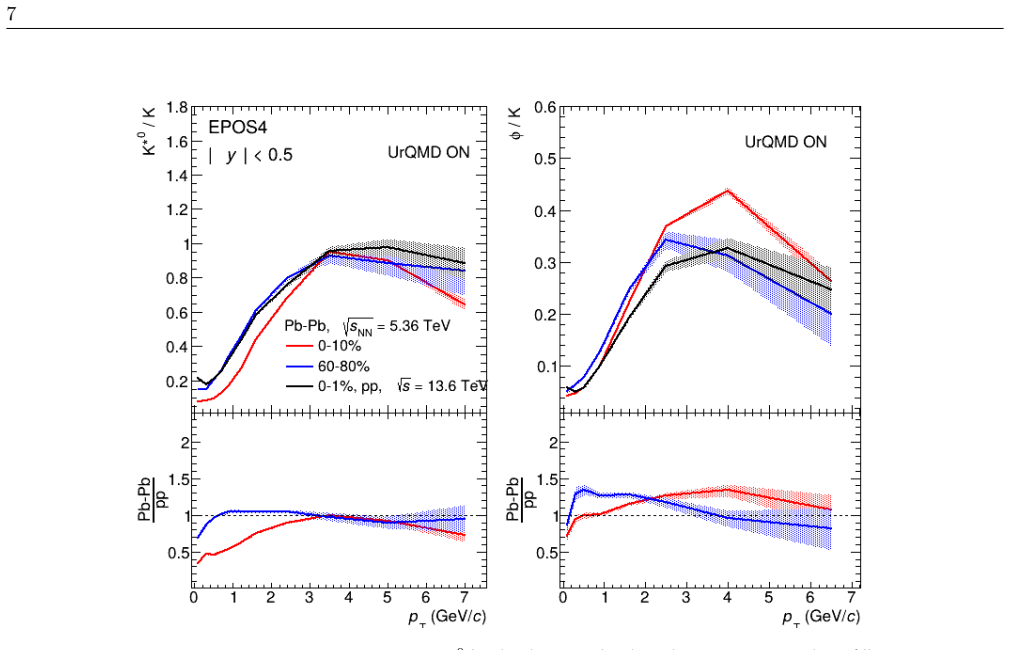
The paper reports that switching UrQMD on makes short-lived resonance spectra and yields fall relative to stable hadrons at low $p_{\mathrm{T}}$, with suppression ordered roughly by vacuum lifetime ($\rho^0 < \Delta^{++} < K^{*0} < \Sigma^{*\pm} \sim \Lambda^{*} < \Xi^{*0} < \phi$), while the long-lived $\phi$ stays nearly unchanged. It then estimates the hadronic-phase duration $\tau$ from integrated resonance-to-stable ratios using $[h^*/h]_{\mathrm{kinetic}} = [h^*/h]_{\mathrm{chemical}} \, e^{-\tau/\tau_{h^*}}$, taking the result as a lower limit because regeneration is neglected. The extracted $\tau$ increases with charged-particle multiplicity and system size, and it is non-zero, about 0.5–1 fm/c, in high-multiplicity pp collisions. Different resonances give different values of $\tau$, which the paper attributes to regeneration and decay-daughter cross-sections beyond the simple exponential model.
Load-bearing premise
The extraction assumes that minimum-bias pp collisions have no hadronic rescattering, so their resonance-to-stable ratios stand in for the undamaged starting values, and if that reference system rescatters decay products, every extracted $\tau$ is shifted.
Editorial extensions
If this is right
- A non-zero hadronic-phase duration in high-multiplicity pp collisions would mean small collision systems do have a measurable late hadronic stage, not only a hydrodynamical core.
- The increasing lower-limit $\tau$ with charged-particle multiplicity provides a single curve connecting small and large collision systems, making resonance ratios a system-size clock.
- The species-dependent $\tau$ values found for $\rho^0$, $K^{*0}$, and $\Lambda^{*}$ imply that regeneration and decay-daughter cross-sections must be modeled explicitly rather than absorbed into a single freeze-out temperature.
- EPOS4 with UrQMD reproduces the measured suppression order and the $K^{*0}/K$ multiplicity trend, so the same setup can give quantitative predictions for unmeasured resonances such as $\Delta^{++}$ and heavier baryonic states.
Reading between the lines
- Because the minimum-bias pp ratio is assumed to be the no-hadronic-phase reference, the absolute value of $\tau$ is only as reliable as that assumption; the increasing trend with multiplicity would survive, but the 0.5–1 fm/c number is a differential estimate.
- A natural extension is to apply the same $\tau$ extraction to p–Pb collisions at matched multiplicity; if the paper's picture is right, the resonance ratios should fall on the same curve as pp and Pb–Pb, directly testing multiplicity scaling.
- The spread among $\rho^0$, $K^{*0}$, and $\Lambda^{*}$ suggests that fitting all three simultaneously with an equation that includes regeneration would yield both a more physical $\tau$ and a handle on resonance–medium cross-sections.
Editorial analysis
A structured set of objections, weighed in public.
Referee Report
Summary. The manuscript presents an EPOS4 study of hadronic resonance production in pp collisions at sqrt(s)=13.6 TeV and Pb-Pb collisions at sqrt(s_NN)=5.36 TeV, comparing simulations with the UrQMD hadronic afterburner enabled and disabled. It reports pT spectra, resonance-to-stable yield ratios, baryon-to-meson ratios, mean pT versus reduced mass, and strangeness enhancement, and it uses the exponential-decay formula (Eq. 1) to estimate a lower limit for the hadronic phase duration tau from the suppression of rho, K*0, and Lambda* relative to stable hadrons. The main claims are that EPOS4+UrQMD reproduces the qualitative system-size dependence of resonance suppression seen by ALICE, and that tau increases with multiplicity, remaining non-zero at about 0.5-1 fm/c in high-multiplicity pp collisions.
Significance. If the central claims hold, the paper offers a useful model-based diagnostic of the hadronic phase and demonstrates the value of the EPOS4 UrQMD ON/OFF comparison. The strengths are the systematic confrontation with ALICE data, the internal consistency of the suppression ordering with resonance lifetimes, and the absence of parameter fitting in the tau extraction. The main risk is the chemical baseline assumption in Section 3.5, which directly controls the numerical headline claim; because the baseline is taken from minimum-bias pp with UrQMD ON, the extracted tau may be an excess over hadronic rescattering already present in the baseline rather than an absolute hadronic phase duration. The paper flags this assumption but does not test its sensitivity, even though the UrQMD-OFF calculation in the same model provides a ready chemical reference.
major comments (3)
- [3.5, Eq. (1)] The chemical reference [h*/h]_chemical is taken from minimum-bias pp collisions simulated with UrQMD ON, despite the stated assumption that no hadronic phase forms in pp. Since the UrQMD ON simulation includes hadronic rescattering, the minimum-bias pp ratio already contains suppression relative to the true chemical value. Under the exponential-decay model, the tau extracted for high-multiplicity pp is therefore tau_high-mult - tau_min-bias, not an absolute hadronic phase duration; this directly affects the headline claim of a non-zero ~0.5-1 fm/c duration in high-multiplicity pp collisions. The authors have the UrQMD-OFF calculation available, which would provide an actual chemical reference, and I request a sensitivity test using that baseline, or a clear report of both interpretations, before the numerical claim is accepted. The current text flags the assumption but provides no quantitative assessment of its impact.
- [3.5 vs 3.1/3.4] Assumption (i) of Eq. (1) states that regeneration effects are negligible, but Sections 3.1 and 3.4 attribute the comparable net suppression of Sigma* and Lambda* to substantial regeneration for Sigma*, and state that regeneration contributions follow the order R_{K+p} < R_{K+pi} < R_{Lambda+pi}. The tau extraction uses rho, K*0, and Lambda*, so the assumption may be acceptable, but the paper should justify that this hierarchy makes regeneration negligible for exactly those resonances, or quantify the systematic bias introduced by regeneration. As written, the same paper both relies on and disputes the negligible-regeneration assumption without reconciliation, which weakens the interpretation of tau as a lower limit.
- [3.5, Fig. 11] Fig. 11 shows that the extracted tau differs substantially among rho, K*0, and Lambda*, with longer-lived resonances giving larger timescales. If tau were a common hadronic-phase property, all resonances would give the same value within regeneration effects; the spread suggests that the exponential-decay model is incomplete. The paper acknowledges this but does not assess how the central trend of 'tau increases with system size and is non-zero in high-multiplicity pp' depends on the choice of resonance. I recommend adding a systematic variation or stating explicitly that the claim is per-resonance and not a single common phase duration.
minor comments (6)
- [Fig. 2 caption] The word 'multiplicity' is misspelled as 'multiplicty' in the caption.
- [3.3] 'handel' should be 'handle' in 'It is important to properly handel feed-down contribution'.
- [3.6] The sentence 'The EPOS4 model with MCE framework, which reproduces the observed behavior seen in the experimental measurements.' is a fragment; it should be rephrased as a complete sentence.
- [Section 2, Table 1] There is a formatting glitch in 'T able 1' at the start of the table caption.
- [Abstract] In 'lifetimes of a few fm/care', a space is missing between 'fm/c' and 'are'.
- [3.5] The central quantitative result would be easier to assess if the extracted tau values and their statistical uncertainties were collected in a table for each resonance and multiplicity class, rather than only shown in Fig. 11.
Circularity Check
Chemical baseline for the hadronic-phase lifetime is taken from minimum-bias pp simulated with UrQMD ON, so the extracted tau is a differential excess over the MB-pp hadronic phase rather than an absolute duration; otherwise the derivation is self-contained.
-
self definitional
[Section 3.5, Eq. (1) and the paragraph following it]
"For this calculation, it is further assumed that no hadronic phase forms in pp collisions due to the small system size. Therefore, the yield ratio in minimum bias pp collisions is used as a proxy for [h*/h]_chemical."
The proxy [h*/h]_chemical is taken from EPOS4 simulations with UrQMD ON, i.e., from the same afterburner that the paper uses to generate hadronic-phase rescattering. Under Eq. (1), if minimum-bias pp has any hadronic phase of duration tau_MB, its UrQMD-ON ratio equals the true chemical ratio times exp(-tau_MB/tau*). Inserting this proxy into Eq. (1) gives exp(-tau_calc/tau*) = exp(-tau_class/tau*)/exp(-tau_MB/tau*), so tau_calc = tau_class - tau_MB. The headline 'non-zero time duration (~0.5-1 fm/c) in high-multiplicity pp' is therefore an excess over the unquantified MB-pp hadronic phase in the same model, not an absolute hadronic-phase duration.
full rationale
The paper does not fit parameters to data; tau is obtained from the exponential decay law, and the UrQMD ON/OFF comparison is a model diagnostic rather than a fitted input. The central suppression trends are checked against independent ALICE measurements, and the EPOS4 model documentation is cited as external support, not as a self-citation chain. The main circularity concern is the chemical baseline in Section 3.5: the minimum-bias pp ratio used as [h*/h]_chemical comes from the same UrQMD-ON simulations that include hadronic afterburner effects, so the extracted tau is algebraically a difference tau_class - tau_MB rather than an absolute hadronic-phase duration if the stated no-hadronic-phase assumption fails. Since the paper explicitly flags the assumption but provides no sensitivity test using its own UrQMD-OFF reference, this is a partial, load-bearing circularity in the headline numerical claim. Because the trend and the model-data comparisons retain independent content, the overall circularity is moderate rather than total.
Assumptions & free parameters
free parameters (2)
- eta/s (specific shear viscosity in EPOS4 core) =
0.08
- epsilon_H (hadronization energy density) =
0.57 GeV/fm^3
assumptions (5)
- domain assumption Exponential decay law [h*/h]_kinetic = [h*/h]_chemical exp(-tau/tau_h*), Eq. 1
- domain assumption Negligible regeneration in the hadronic phase (assumption i in Sec. 3.5)
- domain assumption Simultaneous freeze-out for all particle species (assumption ii in Sec. 3.5)
- ad hoc to paper No hadronic phase forms in minimum-bias pp collisions, used as chemical baseline
- domain assumption EPOS4 with UrQMD faithfully represents the late hadronic phase of heavy-ion collisions
Cite this review
Pith. "Pith review of Examining hadronic resonance dynamics at energies available at the CERN Large Hadron Collider: Insights from EPOS4." pith.science (2026). https://pith.science/paper/2P4BMPMS
@misc{pith2026241205178,
  author       = {Pith},
  title        = {Pith review of: Examining hadronic resonance dynamics at energies available at the CERN Large Hadron Collider: Insights from EPOS4},
  year         = {2026},
  howpublished = {\url{https://pith.science/paper/2P4BMPMS}},
  note         = {Machine review of arXiv:2412.05178}
}
abstract
Hadronic resonances, with lifetimes of a few $\mathrm{fm}/c$, are key tools for studying the hadronic phase in high-energy collisions. This work investigates resonance production in pp collisions at $\sqrt{s}=13.6~\mathrm{TeV}$ and Pb--Pb collisions at $\sqrt{s_{\mathrm{NN}}}=5.36~\mathrm{TeV}$ using the EPOS4 model. By switching the Ultra-Relativistic Quantum Molecular Dynamics (UrQMD) hadronic afterburner ON or OFF, EPOS4 enables the study of final-state hadronic interactions. The production of strange and non-strange hadrons is also investigated using transverse momentum ($p_{\mathrm{T}}$) spectra and particle ratios to study rescattering, regeneration, baryon-to-meson production, and strangeness enhancement. Rescattering effects and strangeness enhancement dominate the low-$p_{\mathrm{T}}$ region, while enhanced baryon-to-meson yield ratios and strong mass-dependent radial flow are observed at intermediate $p_{\mathrm{T}}$ in central Pb--Pb collisions. The average $p_{\mathrm{T}}$ scaled by the reduced hadron mass deviates from a linear trend for short-lived resonances, indicating hadronic phase effects. The hadronic phase lifetime ($\tau$), estimated from yield ratios of short-lived resonances to stable hadrons, increases with charged-particle multiplicity and system size, while remaining non-zero in high-multiplicity pp collisions. The production of non-strange (p), strange ($\Lambda$), and multi-strange ($\Xi$, $\Omega$) baryons in central Pb--Pb collisions is governed by the competing effects of strangeness enhancement and baryon--antibaryon annihilation. These results provide valuable insights into the hadronic phase and particle production at LHC energies.
Figures


Figures from the paper (10 more)


Forward citations
Cited by 1 Pith paper
-
Investigation of hadronic effects on resonance productions in small collision systems using the EPOS4 model
In EPOS4, resonance yields and mean transverse momenta are governed by a species-dependent balance between hadronic rescattering and regeneration even in pp, p-O, and O-O collisions.
Reference graph
Works this paper leans on
-
[1]
J. W. Harris and B. Muller, Ann. Rev. Nucl. Part. Sci.46, 71 (1996),hep-ph/9602235
arXiv 1996
- [2]
- [3]
-
[4]
S. Acharya et al. (ALICE), JHEP05, 317 (2024), 2308.16116
work page Pith review arXiv 2024
-
[5]
S. Acharya et al. (ALICE), Phys. Rev. C99, 064901 (2019),1805.04365
work page Pith review arXiv 2019
-
[6]
S. Acharya et al. (ALICE), Eur. Phys. J. C80, 160 (2020),1909.00486
work page Pith review arXiv 2020
- [7]
- [8]
Show all 45 references
-
[9]
B. I. Abelev et al. (STAR), Phys. Rev. Lett.97, 132301 (2006),nucl-ex/0604019
2006 arXiv
- [10]
- [11]
- [12]
- [13]
- [14]
-
[15]
Z.-W. Lin, C. M. Ko, B.-A. Li, B. Zhang, and S. Pal, Phys. Rev. C72, 064901 (2005),nucl-th/0411110
2005 arXiv
-
[16]
Oliinychenko and C
D. Oliinychenko and C. Shen, arXiv preprint (2021), [hep-ph],2105.07539
2021 arXiv
-
[17]
Motornenko, V
A. Motornenko, V. Vovchenko, C. Greiner, and H. Stoecker, Phys. Rev. C102, 024909 (2020), 1908.11730
2020 arXiv
-
[18]
A. G. Knospe, C. Markert, K. Werner, J. Stein- heimer, and M. Bleicher, Phys. Rev. C104, 054907 (2021),2102.06797
2021 arXiv
-
[19]
A. G. Knospe, C. Markert, K. Werner, J. Stein- heimer, and M. Bleicher, Phys. Rev. C93, 014911 (2016),1509.07895
2016 arXiv
-
[20]
B. B. Abelev et al. (ALICE), Int. J. Mod. Phys. A 29, 1430044 (2014),1402.4476
2014 arXiv
-
[21]
Werner, Phys
K. Werner, Phys. Rev. C109, 014910 (2024),2306. 10277
2024
-
[22]
V. N. Gribov, Zh. Eksp. Teor. Fiz.53, 654 (1967)
1967
-
[23]
V. N. Gribov, Sov. Phys. JETP29, 483 (1969)
1969
-
[24]
V. N. Gribov and L. N. Lipatov, Sov. J. Nucl. Phys. 15, 438 (1972)
1972
-
[25]
V. A. Abramovsky, V. N. Gribov, and O. V. Kancheli, Yad. Fiz.18, 595 (1973)
1973
-
[26]
Altarelli and G
G. Altarelli and G. Parisi, Nucl. Phys. B126, 298 (1977)
1977
-
[27]
Y. L. Dokshitzer, Sov. Phys. JETP46, 641 (1977)
1977
-
[28]
L. V. Gribov, E. M. Levin, and M. G. Ryskin, Phys. Rept.100, 1 (1983)
1983
-
[29]
L. D. McLerran and R. Venugopalan, Phys. Rev. D 49, 3352 (1994),hep-ph/9311205
1994 arXiv
-
[30]
L. D. McLerran and R. Venugopalan, Phys. Rev. D 49, 2233 (1994),hep-ph/9309289
1994 arXiv
-
[31]
Kovner, L
A. Kovner, L. D. McLerran, and H. Weigert, Phys. Rev. D52, 3809 (1995),hep-ph/9505320
1995 arXiv
-
[32]
Y. V. Kovchegov, Phys. Rev. D54, 5463 (1996), hep-ph/9605446
1996 arXiv
-
[33]
Pierog, I
T. Pierog, I. Karpenko, J. M. Katzy, E. Yatsenko, and K. Werner, Phys. Rev. C92, 034906 (2015), 1306.0121. 20
2015 arXiv
- [34]
-
[35]
Werner, I
K. Werner, I. Karpenko, T. Pierog, M. Bleicher, and K. Mikhailov, Phys. Rev. C82, 044904 (2010), 1004.0805
2010 arXiv
-
[36]
Werner, B
K. Werner, B. Guiot, I. Karpenko, and T. Pierog, Phys. Rev. C89, 064903 (2014),1312.1233
2014 arXiv
- [37]
- [38]
- [39]
-
[40]
R. J. Fries, B. Muller, C. Nonaka, and S. A. Bass, Phys. Rev. Lett.90, 202303 (2003),nucl-th/ 0301087
2003
- [41]
- [42]
- [43]
-
[44]
B. B. Abelev et al. (ALICE), Phys. Rev. C91, 024609 (2015),1404.0495
2015 arXiv
-
[45]
Seifert and W
E. Seifert and W. Cassing, Phys. Rev. C97, 024913 (2018), URLhttps://link.aps.org/doi/ 10.1103/PhysRevC.97.024913
2018 doi
Reviewed August 11, 2026 · model on record in the stance chip above.
Discussion (0). Continue with ORCID to comment.