REVIEW 2 major objections 4 minor 2 cited by
Conditions for uniform in time convergence: applications to averaging, numerical discretisations and mean-field systems
T0 review · 2 major / 4 minor · reviewed 2026-08-11 · deepseek-v4-flash
Pith's one-line read This paper proves that three sufficient conditions—exponential contractivity, a finite-time local error estimate, and a uniform moment control—turn finite-time approximation bounds into uniform-in-time bounds, and applies this recipe to…
desk verdict Sound unified framework for uniform-in-time convergence, but Example 2.10 has a wrong averaged drift that breaks the advertised parameter ranges. read the letter →
The pith
A machine-rendered reading of the paper's core claim, the machinery that carries it, and where it could break.
The reading
What carries the argument
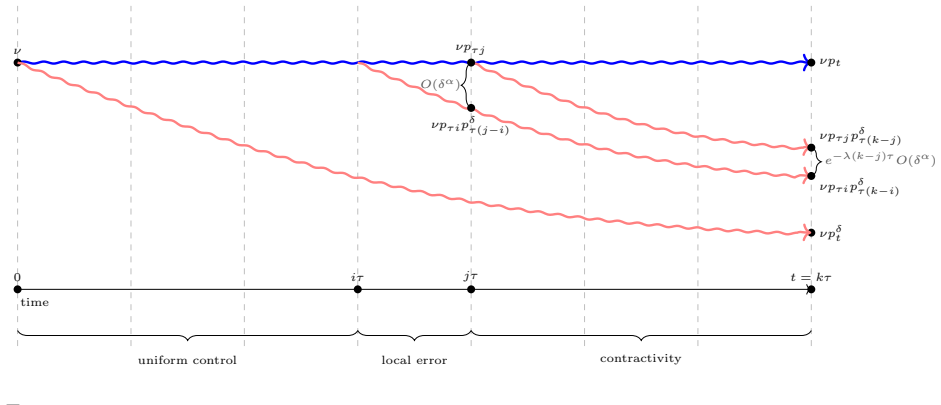
The load-bearing object is the pair of transition semigroups $p_t$ and $p^\delta_t$ together with a metric $\mathrm{dist}$ on probability measures. The proof mechanism is the telescoping sum along a grid: split time into blocks of length $\tau$ (or length 1 in the discretisation case), compare the two processes only at grid points, and write the total distance as a sum of distances between neighbouring paths. Each term is bounded by the finite-time local error, then discounted by the exponential contraction factor $e^{-\lambda \cdot \text{remaining time}}$; the uniform control makes the $M$-factor bounded at every grid point. The three assumptions are exactly what make each step of this sum work, and the sum converges as a geometric series, so the final constant does not grow with time.
What would settle it
Use the paper's Appendix A example as a test: for $dX_t=-X_t\,dt+dW_t$ and $dX^\delta_t=(-X^\delta_t+\mathbf{1}_{[1/\delta,1/\delta+1]})\,dt+dW_t$, the processes are close on every fixed finite interval and share the same equilibrium, yet the error equals $1$ at $t=1/\delta+1$, so no uniform-in-time bound holds. Since the only obstruction is that the approximating kernel is time-inhomogeneous, the decisive check is whether a time-homogeneous kernel can reproduce the same error runaway while satisfying all three General assumptions 1; if such a kernel exists the theorem is false, and if not, time homogeneity is an essential fourth condition.
Extended reading notes
Core claim
The paper's central claim is Theorem 1.1: whenever General assumptions 1 hold, namely (1) contractivity $\mathrm{dist}(\nu p_t,\eta p_t)\le e^{-\lambda t}\mathrm{dist}(\nu,\eta)$ for some $\lambda>0$, (2) a finite-time local error $\sup_{t\le\tau}\mathrm{dist}(\nu p_t,\nu p^\delta_t)\le\delta^\alpha M(\nu)$, and (3) a uniform control $\sup_{t\ge0}M(\nu p^\delta_t)\le C(\nu)$, then for every $t\ge0$ there is a constant $\widetilde C$, independent of $t$ and $\delta$, with $\mathrm{dist}(\nu p_t,\nu p^\delta_t)\le\widetilde C\delta^\alpha$. The proof telescopes the distance over a time grid of step $\tau$ and uses the contraction to weight each local error by $e^{-\lambda(\text{remaining time})}$, which makes the total a geometric sum. The same mechanism, with the roles of the processes adapted to each setting, yields Theorem 2.1 for the method of averaging, Theorem 3.1 for numerical discretisations, and Theorem 4.1 for mean-field particle systems; in Wasserstein metrics, strong-error corollaries (Corollary 2.2 and Corollary 3.2) follow as well. The authors present this as a common rubric that unifies existing isolated uniform-in-time results and lets finite-time estimates be leveraged into global ones.
Load-bearing premise
The load-bearing premise is that at least one of the two processes has exponential contraction in the chosen metric; without a factor $e^{-\lambda t}$, the discounted sum of local errors need not converge, and the paper's own examples only establish this contraction under strong convexity or small-parameter conditions.
Editorial extensions
If this is right
- For slow-fast SDEs, Theorem 2.1 gives $\sup_{t\ge0}\mathrm{dist}(\nu_x\bar p_t,(\nu p^\delta_t)_x)\le\widetilde C\delta^\alpha$, and Corollary 2.2 converts this into a uniform-in-time strong $L^2$ error bound under a finite-time strong error condition.
- For numerical discretisations, Theorem 3.1 yields $\sup_{l\in\mathbb N}\mathrm{dist}(\nu\pi_\delta^l,\nu p_{\delta l})\le\widetilde C\delta^\alpha$ whenever the scheme has a local error bound and uniform moments; the paper verifies this for the Euler-Maruyama scheme for overdamped Langevin dynamics and for higher-order splitting schemes such as UBU.
- For mean-field systems, Theorem 4.1 gives uniform-in-time propagation of chaos, $\sup_{t\ge0}\mathrm{dist}((\nu\bar p_t)^{\otimes N},\nu^{\otimes N}p_t^N)\le\widetilde C N^{-\alpha}$, under contractivity of the particle system, finite-time chaos, and a uniform control of the limit law.
- Because the bound is uniform in time, the limits $\delta\to0$ and $t\to\infty$ commute for the associated semigroups and observables, so the invariant measure of the approximation converges to the invariant measure of the limiting process (Remark 2.5).
- In the general theorem and the numerical setting the two processes can be relabelled, so contractivity or uniform control may be checked on whichever side is easier; the averaging setting is the exception because the two laws live on different state spaces (Remark 2.4).
Reading between the lines
- Since $\delta^\alpha$ can be replaced by any $g(\delta)\to0$, the same template should cover approximation families with non-polynomial local error, such as projection or spectral approximations, provided their uniform control and contraction conditions can be verified.
- The paper's 'leverage existing finite-time results' point implies a practical workflow for new approximations: establish a local error bound, then check exponential contraction of either side and a uniform moment bound; the uniform-in-time result follows automatically. The paper demonstrates the workflow but does not present it as a checklist.
- The Appendix A counterexample suggests that time-homogeneity is doing essential work: approximations whose error-inducing mechanism acts on a time scale that diverges as $\delta\to0$ can satisfy local checks and still fail globally. Quantifying how the uniform constant must depend on such a time-scale ratio would be a natural extension to nearly time-homogeneous approximations.
- Because the proof only uses the triangle inequality and the metric axioms needed for a pseudometric, the same three assumptions could be specialised to total variation or relative-entropy metrics by plugging in the corresponding contraction and local-error estimates, potentially yielding uniform-in-time entropic propagation of chaos.
Signed reviews
Editorial analysis
A structured set of objections, weighed in public.
Referee Report
Summary. This paper proposes three general sufficient conditions under which the distance between a stochastic process and an approximating process can be bounded uniformly in time: exponential contraction of one of the two semigroups in a chosen metric, a finite-time local error estimate, and a uniform-in-time control of a moment-type functional. The authors prove a general theorem (Theorem 1.1) using a telescoping-sum argument, then specialize the framework to averaging for slow-fast SDEs (Theorem 2.1 and Theorem 2.8), numerical discretisations of SDEs (Theorem 3.1), and mean-field particle systems (Theorem 4.1). Each section contains examples intended to verify the assumptions. The paper also includes a warning example, Appendix A, showing that time-inhomogeneous approximations need not admit uniform-in-time bounds. The central proofs appear sound; the main problems lie in the advertised worked examples, particularly the averaging example in Section 2.2.
Significance. If corrected, the framework would provide a useful unified rubric for a type of result that is usually proved case by case. The proof of Theorem 1.1 is transparent, does not rely on hidden parameter fitting, and applies to a general metric, which is a genuine strength. The paper is also honest about limitations: it flags the time-homogeneity requirement and explains why the roles of the two processes cannot be swapped in the averaging setting. However, the current version contains a material error in the averaging example: the averaged drift is miscomputed, which invalidates the verification of the contraction assumptions for the stated parameter ranges. A second example in the mean-field section states a rate that diverges as N grows. These issues affect the paper's claim to provide verified examples in all three advertised settings and require correction before the paper can be accepted.
major comments (2)
- [Section 2.2, Eq. (17) and Example 2.10] The averaged drift is computed incorrectly. For the fast dynamics (16) frozen at x, the invariant measure is N(r sin x, 1), so E[cos(Y)] = e^{-1/2} cos(r sin x). Hence the averaged drift should be -x - r e^{-1/2} cos(r sin x), not -x - r e^{-1/2} cos(sin x) as printed in (17). This changes the Lipschitz constant of the drift from r e^{-1/2} to r^2 e^{-1/2}; the synchronous-coupling calculation in the example then yields contraction only for |r| ≤ e^{1/4}, not |r| ≤ e^{1/2}. The same incorrect drift also undermines the claim that Assumption 2(1) holds for |r| ≤ 3.5 because the drift is monotone: the derivative of the printed drift is -1 + r e^{-1/2} sin(sin x) cos x, and of the corrected drift is -1 + r^2 e^{-1/2} sin(r sin x) cos x, so the drift is not monotone for |r| up to 3.5 under the stated derivative criterion. The verification of Assumption 1(1) and Assumption 2(1) in this example is therefore invalid as written, and the example does not currently support the abstract's claim that the joint conditions are verified in the averaging setting.
- [Section 4.2, Example 4.3] The displayed propagation of chaos bound sup_{t≥0} E[N^{-1} ∑_{i=1}^N |\bar X^i_t - X^{i,N}_t|] ≤ \tilde C \sqrt{N} cannot be correct as a convergence statement, because the right-hand side diverges as N → ∞. The intended bound is presumably \tilde C / \sqrt{N} or an equivalent N^{-1/2} rate. As printed, the example states a false conclusion.
minor comments (4)
- [Section 2.2, Example 2.10, Itô computation for Y^δ] In the computation of d|Y^δ_t|^2, the martingale term is written with dW_t, but the fast process is driven by the independent Brownian motion B_t; this should read dB_t.
- [Section 2.2, proof of Theorem 2.8, k=2 step] In the bound for |A_{1,2}|, the argument of φ is written as φ(\bar X_τ, Y^δ_τ); it should be φ(X^δ_τ, Y^δ_τ), since the local error is evaluated at the state of the coupled process after one step.
- [Section 2.2, Example 2.10, final display] The final bound W2(νx \bar p_t, (νp^δ_t)_x)^2 ≤ \tilde C δ is equivalent to a δ^{1/2} bound in W2; the authors should state this explicitly to avoid confusion about the rate α in Assumption 1(2).
- [Section 4.2, Example 4.3] The phrase 'verify first Assumption 4' appears to be a typo; presumably 'verify Assumption 4' is intended.
Circularity Check
No circularity: Theorem 1.1 and its specializations are conditional theorems proved directly from independent assumptions; self-citations are ancillary, not load-bearing.
full rationale
The paper's central result, Theorem 1.1, is a conditional theorem: the three General Assumptions (contractivity, finite-time local error, uniform control) are stated independently of the conclusion, and the proof is a self-contained telescoping-sum argument that bounds the distance at time t by a geometric series with ratio e^{-lambda tau}, giving a time-uniform O(delta^alpha) bound. None of the assumptions is defined in terms of the target quantity, and no parameter is fitted to the quantity being predicted. The same structure is specialized to averaging (Theorem 2.1), numerical discretisation (Theorem 3.1), and mean-field systems (Theorem 4.1) with proofs that use only the corresponding assumptions and triangle inequalities. The self-citations that appear ([11] in Example 2.10, [30] and [35] in the numerical examples, [59] in Example 4.3) are either pointers to previously proved auxiliary estimates or are used to verify an assumption in a concrete example; they are not used to establish the general framework, and no uniqueness or ansatz is imported from them. Appendix A provides a genuine counterexample to uniform-in-time convergence when time homogeneity fails, which further confirms that the assumptions are doing real work. A possible algebraic issue in Example 2.10's averaged drift (the argument of cosine) is a correctness concern about that verification, not a circularity, and does not affect the independence of the main derivation.
Assumptions & free parameters
assumptions (4)
- domain assumption Contractivity of one of the two processes in the chosen metric (General assumptions 1(1); Assumption 1(1); Assumption 3(1); Assumption 4(1)).
- domain assumption Finite-time local convergence with a delta-independent time horizon tau (General assumptions 1(2); Assumption 1(2); Assumption 3(2); Assumption 4(2)).
- domain assumption Uniform control of the uncontracted process via a moment-like function M (General assumptions 1(3); Assumption 1(3); Assumption 3(3); Assumption 4(3)).
- domain assumption Time homogeneity of both processes (stated after the proof sketch of Theorem 1.1).
Cite this review
Pith. "Pith review of Conditions for uniform in time convergence: applications to averaging, numerical discretisations and mean-field systems." pith.science (2026). https://pith.science/paper/Z7FR6YM6
@misc{pith2026241205239,
  author       = {Pith},
  title        = {Pith review of: Conditions for uniform in time convergence: applications to averaging, numerical discretisations and mean-field systems},
  year         = {2026},
  howpublished = {\url{https://pith.science/paper/Z7FR6YM6}},
  note         = {Machine review of arXiv:2412.05239}
}
read the original abstract
We establish general conditions under which there exists uniform in time convergence between a stochastic process and its approximated system. These standardised conditions consist of a local in time estimate between the original and the approximated process as well as of a contraction property for one of the processes and a uniform control for the other one. Specifically, the results we present provide global in time error bounds for multiscale methods and numerical discretisations as well as uniform in time propagation of chaos bounds for mean-field particle systems. We provide a general method of proof which can be applied to many types of approximation. In all three scenarios, examples where the joint conditions are verified and uniform in time convergence is achieved are given.
Figures
Forward citations
Cited by 2 Pith papers
-
Geometric ergodicity of modified Euler schemes for SDEs with super-linearity
A general class of modified Euler schemes for SDEs with super-linear drift is proven geometrically ergodic via couplings, including an O(δ^θ) L1-Wasserstein bound between exact and tamed invariant measures.
-
Coarse graining of stochastic differential equations: averaging and projection method
The projection method for coarse-graining stochastic differential equations does not generally match stochastic averaging under time-scale separation, and this paper gives conditions and counterexamples showing when t...
Reference graph
Works this paper leans on
-
[51]
L. Angeli, D. Crisan, and M. Ottobre, “Uniform in time convergen ce of numerical schemes for stochastic differential equations via strong exponen tial stability: Euler methods, split-step and tamed schemes,” arXiv preprint arXiv:2303.15463 , 2023
arXiv 2023
-
[20]
Asymptotic bias of inexact Markov ch ain Monte Carlo methods in high dimension,
A. Durmus and A. Eberle, “Asymptotic bias of inexact Markov ch ain Monte Carlo methods in high dimension,” Ann. Appl. Probab. , vol. 34, no. 4, pp. 3435–3468, 2024
work page 2024
-
[11]
D. Crisan, P. Dobson, B. Goddard, M. Ottobre, and I. Soutta r, “Poisson equations with locally-lipschitz coefficients and uniform in time averaging for stochas tic differential equations via strong exponential stability,” 2024
work page 2024
-
[1]
A survey of Ricci curvature for metric spaces and Ma rkov chains,
Y. Ollivier, “A survey of Ricci curvature for metric spaces and Ma rkov chains,” in Probabilistic approach to geometry , vol. 57 of Adv. Stud. Pure Math. , pp. 343–381, Math. Soc. Japan, Tokyo, 2010
work page 2010
-
[2]
Villani, Optimal transport , vol
C. Villani, Optimal transport , vol. 338 of Grundlehren der mathematischen Wis- senschaften [Fundamental Principles of Mathematical Scie nces]. Springer-Verlag, Berlin, 2009. Old and new
work page 2009
-
[3]
Weinan, Principles of multiscale modeling
E. Weinan, Principles of multiscale modeling . Cambridge University Press, 2011
work page 2011
-
[4]
G. A. Pavliotis and A. Stuart, Multiscale methods: averaging and homogenization , vol. 53. Springer Science & Business Media, 2008
work page 2008
-
[5]
Strong and weak convergence in the averaging principle for SDEs with H\"older coefficients
M. R¨ ockner, X. Sun, and L. Xie, “Strong and weak convergenc e in the averaging prin- ciple for sdes with h¨ older coefficients,” arXiv preprint arXiv:1907.09256 , 2019
work page Pith review arXiv 1907
Show all 58 references
-
[6]
Diffusion approximation for fully coupled stochastic differential equations,
M. R¨ ockner and L. Xie, “Diffusion approximation for fully coupled stochastic differential equations,” 2020
2020
-
[7]
On the poisson equation an d diffusion approxi- mation. i,
E. Pardoux and A. Y. Veretennikov, “On the poisson equation an d diffusion approxi- mation. i,” Ann. Probab., vol. 29, pp. 1061–1085, 07 2001
2001
-
[8]
On poisson equation and diff usion approximation 2,
E. Pardoux and A. Y. Veretennikov, “On poisson equation and diff usion approximation 2,” Ann. Probab., vol. 31, pp. 1166–1192, 07 2003
2003
-
[9]
Strong convergence rates in averag ing principle for slow- fast mckean-vlasov spdes,
W. Hong, S. Li, and W. Liu, “Strong convergence rates in averag ing principle for slow- fast mckean-vlasov spdes,” Journal of Differential Equations , vol. 316, pp. 94–135, 2022
2022
-
[10]
Strong and weak orders in averaging for SPDE s,
C.-E. Br´ ehier, “Strong and weak orders in averaging for SPDE s,” Stochastic Processes and their Applications , vol. 122, no. 7, pp. 2553–2593, 2012
2012
-
[12]
Global averaging of dissipative dynamical systems,
A. A. Ilyin, “Global averaging of dissipative dynamical systems,” Rendiconti Academia Nazionale delle Scidetta dli XL. Memorie di Matematica e App licazioni, vol. 116, pp. 165–191, 1998. 21
1998
-
[13]
Eddy heat exchange at the b oundary under white noise turbulence,
F. Flandoli, L. Galeati, and D. Luo, “Eddy heat exchange at the b oundary under white noise turbulence,” Philosophical Transactions of the Royal Society A: Mathema tical, Physical and Engineering Sciences , vol. 380, no. 2219, p. 20210096, 2022
2022
-
[14]
A simple framework to justify linear r esponse theory,
M. Hairer and A. J. Majda, “A simple framework to justify linear r esponse theory,” Nonlinearity, vol. 23, no. 4, p. 909, 2010
2010
-
[15]
Longtime convergence of t he temperature- accelerated molecular dynamics method,
G. Stoltz and E. Vanden-Eijnden, “Longtime convergence of t he temperature- accelerated molecular dynamics method,” Nonlinearity, vol. 31, no. 8, p. 3748, 2018
2018
-
[16]
G. N. Milstein and M. V. Tretyakov, Stochastic numerics for mathematical physics . Scientific Computation, Springer-Verlag, Berlin, 2004
2004
-
[17]
P. E. Kloeden and E. Platen, Numerical solution of stochastic differential equations , vol. 23 of Applications of Mathematics (New York) . Springer-Verlag, Berlin, 1992
1992
-
[18]
Uniform in time estimate s for the weak error of the Euler method for SDEs and a pathwise approach to derivative estimates for diffusion semigroups,
D. Crisan, P. Dobson, and M. Ottobre, “Uniform in time estimate s for the weak error of the Euler method for SDEs and a pathwise approach to derivative estimates for diffusion semigroups,” Transactions of the American Mathematical Society , vol. 374, pp. 3289–3330, May 2021
2021
-
[19]
Ergodic numerical approximation to periodic measures of stochastic differential equations,
C. Feng, Y. Liu, and H. Zhao, “Ergodic numerical approximation to periodic measures of stochastic differential equations,” Journal of Computational and Applied Mathematics , vol. 398, p. 113701, dec 2021
2021
-
[21]
Theoretical guarantees for approximate sam pling from smooth and log- concave densities,
A. S. Dalalyan, “Theoretical guarantees for approximate sam pling from smooth and log- concave densities,” J. R. Stat. Soc. Ser. B. Stat. Methodol. , vol. 79, no. 3, pp. 651–676, 2017
2017
-
[22]
Nonasymptotic convergence analy sis for the unadjusted Langevin algorithm,
A. Durmus and E. Moulines, “Nonasymptotic convergence analy sis for the unadjusted Langevin algorithm,” Ann. Appl. Probab. , vol. 27, no. 3, pp. 1551–1587, 2017
2017
-
[23]
High-dimensional Bayesian inferenc e via the unadjusted Langevin algorithm,
A. Durmus and E. Moulines, “High-dimensional Bayesian inferenc e via the unadjusted Langevin algorithm,” Bernoulli, vol. 25, no. 4A, pp. 2854–2882, 2019
2019
-
[24]
Nonasymptotic bounds for sampling al- gorithms without log-concavity,
M. B. Majka, A. Mijatovi´ c, and L. Szpruch, “Nonasymptotic bounds for sampling al- gorithms without log-concavity,” Ann. Appl. Probab. , vol. 30, no. 4, pp. 1534–1581, 2020
2020
-
[25]
Unadjusted Langevin algorithm with multiplicative noise: total variation and Wasserstein bounds,
G. Pag` es and F. Panloup, “Unadjusted Langevin algorithm with multiplicative noise: total variation and Wasserstein bounds,” Ann. Appl. Probab. , vol. 33, no. 1, pp. 726– 779, 2023
2023
-
[26]
L2-Wasserstein contraction for Euler schemes of elliptic diffusions and interacting particle systems,
L. Liu, M. B. Majka, and P. Monmarch´ e, “ L2-Wasserstein contraction for Euler schemes of elliptic diffusions and interacting particle systems,” Stochastic Process. Appl., vol. 179, p. Paper No. 104504, 2025
2025
-
[27]
Contraction and c onvergence rates for discretized kinetic Langevin dynamics,
B. J. Leimkuhler, D. Paulin, and P. A. Whalley, “Contraction and c onvergence rates for discretized kinetic Langevin dynamics,” SIAM J. Numer. Anal. , vol. 62, no. 3, pp. 1226–1258, 2024. 22
2024
-
[28]
High-dimensional MCMC with a standard splittin g scheme for the underdamped Langevin diffusion.,
P. Monmarch´ e, “High-dimensional MCMC with a standard splittin g scheme for the underdamped Langevin diffusion.,” Electron. J. Stat. , vol. 15, no. 2, pp. 4117–4166, 2021
2021
-
[29]
Wasserstein distance e stimates for the distribu- tions of numerical approximations to ergodic stochastic differentia l equations,
J. M. Sanz-Serna and K. C. Zygalakis, “Wasserstein distance e stimates for the distribu- tions of numerical approximations to ergodic stochastic differentia l equations,” J. Mach. Learn. Res., vol. 22, pp. Paper No. 242, 37, 2021
2021
-
[30]
Convergence of kinetic langevin sam plers for non-convex potentials,
K. Schuh and P. A. Whalley, “Convergence of kinetic langevin sam plers for non-convex potentials,” arxiv preprint arXiv:2405.09992 , 2024
2024 arXiv
-
[31]
Hy brid Monte Carlo,
S. Duane, A. D. Kennedy, B. J. Pendleton, and D. Roweth, “Hy brid Monte Carlo,” Phys. Lett. B , vol. 195, no. 2, pp. 216–222, 1987
1987
-
[32]
MCMC using Hamiltonian dynamics,
R. M. Neal, “MCMC using Hamiltonian dynamics,” in Handbook of Markov chain Monte Carlo, Chapman & Hall/CRC Handb. Mod. Stat. Methods, pp. 113–162, CR C Press, Boca Raton, FL, 2011
2011
-
[33]
Rapid mixing of geodesic walks on manif olds with positive curvature,
O. Mangoubi and A. Smith, “Rapid mixing of geodesic walks on manif olds with positive curvature,” Ann. Appl. Probab. , vol. 28, no. 4, pp. 2501–2543, 2018
2018
-
[34]
Coupling and converg ence for Hamiltonian Monte Carlo,
N. Bou-Rabee, A. Eberle, and R. Zimmer, “Coupling and converg ence for Hamiltonian Monte Carlo,” Ann. Appl. Probab. , vol. 30, no. 3, pp. 1209–1250, 2020
2020
-
[35]
Convergence of unadjusted Ha miltonian Monte Carlo for mean-field models,
N. Bou-Rabee and K. Schuh, “Convergence of unadjusted Ha miltonian Monte Carlo for mean-field models,” Electron. J. Probab. , vol. 28, pp. Paper No. 91, 40, 2023
2023
-
[36]
Mixing time guarantees for unadj usted Hamiltonian Monte Carlo,
N. Bou-Rabee and A. Eberle, “Mixing time guarantees for unadj usted Hamiltonian Monte Carlo,” Bernoulli, vol. 29, no. 1, pp. 75–104, 2023
2023
-
[37]
Reflection coupling for unadjust ed generalized Hamil- tonian Monte Carlo in the nonconvex stochastic gradient case,
M. Chak and P. Monmarch´ e, “Reflection coupling for unadjust ed generalized Hamil- tonian Monte Carlo in the nonconvex stochastic gradient case,” arxiv preprint arXiv:2310.18774, 2023
2023 arXiv
-
[38]
Foundations of kinetic theory,
M. Kac, “Foundations of kinetic theory,” in Proceedings of the Third Berkeley Sym- posium on Mathematical Statistics and Probability, 1954–1 955, vol. III , pp. 171–197, Univ. California Press, Berkeley-Los Angeles, Calif., 1956
1954
-
[39]
Propagation of chaos for a class of non-line ar parabolic equations,
H. P. McKean, Jr., “Propagation of chaos for a class of non-line ar parabolic equations,” in Stochastic Differential Equations (Lecture Series in Differ ential Equations, Session 7, Catholic Univ., 1967) , vol. Session 7 of Lecture Series in Differential Equations , pp. 41– 57, A...
1967
-
[40]
Topics in propagation of chaos,
A.-S. Sznitman, “Topics in propagation of chaos,” in ´Ecole d’ ´Et´ e de Probabilit´ es de Saint-Flour XIX—1989 , vol. 1464 of Lecture Notes in Math. , pp. 165–251, Springer, Berlin, 1991
1989
-
[41]
Asymptotic behaviour of some interacting par ticle systems; McKean- Vlasov and Boltzmann models,
S. M´ el´ eard, “Asymptotic behaviour of some interacting par ticle systems; McKean- Vlasov and Boltzmann models,” in Probabilistic models for nonlinear partial differential equations (Montecatini Terme, 1995) , vol. 1627 of Lecture Notes in Math. , pp. 42–95, Springer, Berlin,...
1995
-
[42]
Logarithmic Sobolev inequalities for some nonlinear PD E’s,
F. Malrieu, “Logarithmic Sobolev inequalities for some nonlinear PD E’s,” Stochastic Process. Appl., vol. 95, no. 1, pp. 109–132, 2001
2001
-
[44]
Kac’s program in kinetic theory,
S. Mischler and C. Mouhot, “Kac’s program in kinetic theory,” Inventiones mathemat- icae, vol. 193, no. 1, pp. 1–147, 2013
2013
-
[45]
Pathwise convergence of the hard spheres K ac process,
D. Heydecker, “Pathwise convergence of the hard spheres K ac process,” The Annals of Applied Probability, vol. 29, no. 5, pp. 3062 – 3127, 2019
2019
-
[46]
Propagation of chaos: a review of models, methods and applications. I. Models and methods,
L.-P. Chaintron and A. Diez, “Propagation of chaos: a review of models, methods and applications. I. Models and methods,” Kinet. Relat. Models, vol. 15, no. 6, pp. 895–1015, 2022
2022
-
[47]
Propagation of chaos: a review of models, methods and applications. II. Applications,
L.-P. Chaintron and A. Diez, “Propagation of chaos: a review of models, methods and applications. II. Applications,” Kinet. Relat. Models, vol. 15, no. 6, pp. 1017–1173, 2022
2022
-
[48]
Backward Itˆ o-Ventzell and sto chastic interpolation for- mulae,
P. D. Moral and S. S. Singh, “Backward Itˆ o-Ventzell and sto chastic interpolation for- mulae,” Stochastic Processes and their Applications , 2022
2022
-
[49]
Converg ence of numerical time- averaging and stationary measures via Poisson equations,
J. C. Mattingly, A. M. Stuart, and M. V. Tretyakov, “Converg ence of numerical time- averaging and stationary measures via Poisson equations,” SIAM J. Numer. Anal. , vol. 48, no. 2, pp. 552–577, 2010
2010
-
[50]
Rudin et al
W. Rudin et al. , Principles of mathematical analysis , vol. 3. McGraw-hill New York, 1964
1964
-
[52]
G. A. Pavliotis, Stochastic processes and applications, vol. 60 of Texts in Applied Mathe- matics. Springer, New York, 2014. Diffusion processes, the Fokker-Plan ck and Langevin equations
2014
-
[53]
Convergence to equilibrium in W asserstein distance for Fokker-Planck equations,
F. c. Bolley, I. Gentil, and A. Guillin, “Convergence to equilibrium in W asserstein distance for Fokker-Planck equations,” J. Funct. Anal. , vol. 263, no. 8, pp. 2430–2457, 2012
2012
-
[54]
Reflection couplings and contraction rates for diffu sions,
A. Eberle, “Reflection couplings and contraction rates for diffu sions,” Probab. Theory Related Fields, vol. 166, no. 3-4, pp. 851–886, 2016
2016
-
[55]
Word series for the numerical integration of stochastic differential equations,
A. Alamo Zapatero, “Word series for the numerical integration of stochastic differential equations,” PhD thesis, Universidad de Valladolid , 2019
2019
-
[56]
Correction to “wasserstein distanc e estimates for the distributions of numerical approximations to ergodic stochastic diff erential equations
D. Paulin and P. A. Whalley, “Correction to “wasserstein distanc e estimates for the distributions of numerical approximations to ergodic stochastic diff erential equations”,” arXiv preprint arXiv:2402.08711 , 2024
2024 arXiv
-
[57]
Optimal convergence rate of Hamilt onian Monte Carlo for strongly logconcave distributions,
Z. Chen and S. S. Vempala, “Optimal convergence rate of Hamilt onian Monte Carlo for strongly logconcave distributions,” Theory Comput., vol. 18, pp. Paper No. 9, 18, 2022. 24
2022
-
[58]
An elementary ap proach to uniform in time propagation of chaos,
A. Durmus, A. Eberle, A. Guillin, and R. Zimmer, “An elementary ap proach to uniform in time propagation of chaos,” Proc. Amer. Math. Soc. , vol. 148, no. 12, pp. 5387–5398, 2020
2020
-
[59]
Global contractivity for Langevin dynamics with dist ribution-dependent forces and uniform in time propagation of chaos,
K. Schuh, “Global contractivity for Langevin dynamics with dist ribution-dependent forces and uniform in time propagation of chaos,” Annales de l’Institut Henri Poincar´ e, Probabilit´ es et Statistiques, vol. 60, no. 2, pp. 753 – 789, 2024. 25
2024
Reviewed August 11, 2026 · model on record in the stance chip above.
Discussion (0). Continue with ORCID to comment.