pith. machine review for the scientific record. sign in

math.PR

Probability

Theory and applications of probability and stochastic processes: e.g. central limit theorems, large deviations, stochastic differential equations, models from statistical mechanics, queuing theory

0
math.PR 2026-05-13 2 theorems

CLT proven for homozygosity in hierarchical Pitman-Yor process

Central limit theorem for the homozygosity of the hierarchical Pitman-Yor process

Explicit variances show how each level in the hierarchy shapes Gaussian fluctuations in the weights.

abstract click to expand
The hierarchical Pitman-Yor process is a discrete random measure used as a prior in Bayesian nonparametrics. It is motivated by the study of groups of clustered data exhibiting power law behavior. Our focus in this paper is on the Gaussian behavior of a family of statistics, namely the power sum symmetric polynomials for the vector of weights of the process, as the concentration parameters tend to infinity. We establish a central limit theorem and obtain explicit representations for the asymptotic variance, with the latter clearly showing the impact of each component in the hierarchical structure. These results are crucial for understanding the asymptotic behavior of the sampling formulas associated with the process. In comparison with the known results for the hierarchical Dirichlet process, the results for the hierarchical Pitman-Yor process are mathematically more challenging and structurally more revealing of power law behavior.
0
0
math.PR 2026-05-13 Recognition

Itô integral defined for two-sided Lévy processes

It\^o integral for a two-sided L\'evy process

Moment bounds follow from martingale approximations and equivalence to the Hitsuda-Skorohod integral is proved via Poisson-Malliavin methods

abstract click to expand
In this article, we construct an It\^o integral with respect to a two-sided finite-variance L\'evy process $\{L(x)\}_{x\in \mathbb{R}}$, without a Gaussian component. Using Rosenthal inequality for discrete-time martingales, we give an estimate for the $p$-th moment of this integral, for any even integer $p\geq 2$. Then, using Poisson-Malliavin calculus, we show that the It\^o integral is an extension of the Hitsuda-Skorohod integral with respect to the compensated Poisson random measure associated to the L\'evy process.
0
0
math.PR 2026-05-13 2 theorems

SE(2) Langevin dynamics yield effective diffusion on R²

Hypocoercive Langevin dynamics on the Lie group SE(2)

Averaging over the compact rotation subgroup extracts macroscopic plane diffusion from the oriented generator via kernel projection.

abstract click to expand
We consider a Langevin-type diffusion on the planar motion group $\mathrm{SE}(2)$, describing the coupled evolution of position and orientation with degenerate noise acting only in the rotational direction. Although hypocoercivity for related models on $\mathbb{R}^2 \times \mathbb{S}^1$ is well understood, our purpose is to present an intrinsic formulation on the Lie group $\mathrm{SE}(2)$, and to highlight the underlying geometric mechanism. By expressing the generator in terms of invariant vector fields and using the natural projection onto the kernel of the symmetric part, we show how an effective macroscopic diffusion on $\mathbb{R}^2$ emerges through averaging over the compact rotation subgroup.
0
0
math.PR 2026-05-13 2 theorems

Filtering equations now cover predictable jumps

Nonlinear filtering with stochastic discontinuities

Kushner-Stratonovich and Zakai equations are derived for signals and observations that jump at known times, covering clinical visits and div

Figure from the paper full image
abstract click to expand
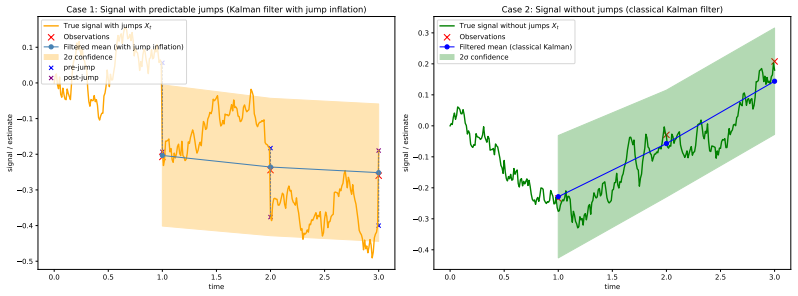
Filtering problems with jumps in both the signal and the observation have been extensively studied, typically under the assumption that jump times are totally inaccessible. In many applications, however, jump times are known in advance (i.e., predictable), such as scheduled clinical visits, dividend payment dates, or inspection times in engineering systems. Taking predictable jump times as a starting point, we investigate a filtering problem in which both the signal and the observations can exhibit jumps at predictable times. We derive the corresponding Kushner-Stratonovich and Zakai equations, thereby extending classical nonlinear filtering results to a setting with predictable discontinuities. We illustrate the framework on a Kalman filtering model with predictable jumps and on applications to longitudinal clinical studies, such as spinal muscular atrophy (SMA), as well as to machine learning models (neural jump ODEs) and credit risk.
0
0
math.PR 2026-05-13 3 theorems

ℓ_p-balls have intrinsic volumes given by one-dimensional integrals

Intrinsic volumes of ell_p-balls and a continuum of Maxwell--Poincar\'e--Borel laws for their curvature measures

Curvature measures yield limit laws in which scaled boundary coordinates become independent draws from an explicit distribution depending on

abstract click to expand
For $p>1$, we derive explicit formulas for the intrinsic volumes $V_0(\mathbb B_p^n),\dots,V_{n-1}(\mathbb B_p^n)$ of the $n$-dimensional $\ell_p$-balls $$ \mathbb B_p^n = \{x\in\mathbb R^n:\ |x_1|^p+\ldots+|x_n|^p\le 1\} $$ and, more generally, of their coordinate-weighted analogues. The formula is given in terms of a one-dimensional integral involving the special function $$ \mathcal F_p(t;\nu) = \int_{\mathbb R}|u|^\nu e^{-|u|^p-t|u|^{2p-2}}\,du. $$ Previously known formulas for the intrinsic volumes of ellipsoids, weighted crosspolytopes, and rectangular boxes arise as special or limiting cases. We also obtain asymptotic formulas for $V_{j(n)}(\mathbb B_p^n)$ in the high-dimensional regime $n\to\infty$, where the index $j(n)$ is allowed to depend on $n$. We further investigate the curvature measures of $\mathbb B_p^n$. These are finite measures $$ \Phi_0(\mathbb B_p^n,\cdot),\dots,\Phi_{n-1}(\mathbb B_p^n,\cdot) $$ on $\partial\mathbb B_p^n$ that localize the intrinsic volumes. We prove a Maxwell--Poincar\'{e}--Borel type limit theorem: if $X_n$ is a random boundary point of $\mathbb B_p^n$ distributed according to the normalized curvature measure $\Phi_{j(n)}(\mathbb B_p^n,\cdot)/V_{j(n)}(\mathbb B_p^n)$, where $j(n)/n\to\alpha\in[0,1]$ as $n\to\infty$, then for every fixed $r\in\mathbb N$, the joint distribution of the first $r$ coordinates of $n^{1/p}X_n$ converges weakly to the product measure $\nu_{p,\alpha}^{\otimes r}$. Here $\nu_{p,\alpha}$ is an explicit probability measure on $\mathbb R$ depending on $p>1$ and $\alpha\in[0,1]$. The main tool underlying these results is an explicit characterization of the curvature measures of coordinate-weighted $\ell_p$-balls, and in particular an explicit formula for their mixed moments.
0
0
math.PR 2026-05-13 Recognition

Radial component admits small-noise expansion under state-dependent impulses

Fluctuation analysis for a randomly perturbed dynamical system with state-dependent impulse effects

Explicit perturbative description with Skorohod error control holds for any fixed time horizon in the planar case.

abstract click to expand
The principal aim of the present work is to explore limit theorems for small random perturbations of a planar impulsive dynamical system, where impulses occur at hitting times of a suitable switching surface, and are thus state-dependent. Working with a simplified example in polar coordinates, we obtain-for any fixed time horizon-a small noise expansion for the radial component, together with rigorous error estimates in the Skorohod space of right-continuous functions with left limits.
0
0
math.PR 2026-05-13 2 theorems

Existence and uniqueness hold for singular nonlocal Fokker-Planck PDE

A non-local singular non-linear Fokker-Planck PDE

The proof yields well-posedness for the linked McKean SDE and shows the PDE conserves mass while preserving positivity.

abstract click to expand
The focus of this paper is a non-local singular non-linear Fokker-Planck partial differential equation (PDE). The peculiarity of this PDE feature is in its divergence coefficient, which presents a product between a Besov distribution and a non-linearity. The latter involves the convolution between an integrable kernel K and the solution of the PDE, which leads to a non-locality of the first order term in the PDE. We prove existence and uniqueness of a solution to the PDE as well as continuity results on its coefficients. Previous analytical results are then applied to the study of well-posedness in law for a non-local singular McKean stochastic differential equation. As byproduct of that probabilistic representation, we establish mass conservation and positivity preserving for the PDE.
0
0
math.PR 2026-05-13 2 theorems

Common noise yields unique weak solutions for measurable mean-field drifts

Regularization of a mean-field SDE by an additive common noise: The conditional expectation case

Existence and uniqueness hold for bounded measurable drifts in position and conditional expectation when additive common and individual are

abstract click to expand
We investigate a McKean-Vlasov stochastic differential equation with an additive common noise and in which the interaction is through the conditional expectation. We show that, in the presence of an additive individual noise, existence and uniqueness of a weak solution hold for any drift given by a bounded and measurable function of the position and the conditional expectation. When there is no individual noise, existence and uniqueness still hold if the drift is in addition Lipschitz in the position variable. This shows that the presence of a finite dimensional common noise may allow to overcome the discontinuity of the drift with respect to the interaction term, provided that this interaction term is a conditional expectation. We also prove propagation of chaos for systems of particles where the conditional expectation is replaced by the empirical mean of the positions or by a closely related contribution with better prepared noise.
0
0
math.PR 2026-05-13 2 theorems

Quadratic variation convergence stabilizes compensated jump integrals

Stability of Compensated Jump Integrals under Quadratic Variation Convergence

When integrands grow linearly locally, [X^n - X] to 0 in probability yields ucp convergence without semimartingale assumptions.

abstract click to expand
We study the stability of compensated jump integrals under convergence of quadratic variation alone. Let \(X\) and \(\{X^n\}_{n\ge1}\) be c\`adl\`ag processes with jump measures \(\mu,\mu_n\) and predictable compensators \(\nu,\nu_n\). Under the assumption \[ [X^n-X]_t \to 0 \qquad\text{in probability}, \] we establish ucp convergence of compensated jump integrals of the form \[ \int_0^. \int_{\mathbb R} f_n(s,x)(\mu_n-\nu_n)(ds,dx) \] under local linear growth and locally uniform convergence assumptions on the integrands. The proof is based on two structural mechanisms. The first is a forbidden bands principle, showing that quadratic variation convergence prevents jumps from crossing suitably chosen moving threshold regions. The second is a compensator mass control mechanism, which combines threshold-separated alignment of large predictable jumps with a counting argument for the associated compensator atoms. The results require neither semimartingale convergence, convergence of characteristics, uniform tightness, nor global structural assumptions such as independence, stationarity, or Markovianity. More broadly, they show that quadratic variation convergence imposes a substantially stronger rigidity on the jump organization of c\`adl\`ag processes than one might initially expect.
0
0
math.PR 2026-05-13 2 theorems

Explicit measure makes entropy fifth derivative positive

A Counterexample to the Gaussian Completely Monotone Conjecture

This violates the conjectured sign pattern under heat flow and overturns Gaussian optimality and entropy power claims.

abstract click to expand
We provide an explicit probability measure on $\mathbb{R}$ for which the fifth time derivative of the entropy along the heat flow is positive at some time. This disproves the Gaussian completely monotone (GCM) conjecture (Cheng-Geng '15) and therefore also the Gaussian optimality conjecture (McKean '66) and the entropy power conjecture (Toscani '15). Our proof also implies the existence of a log-concave probability measure on $\mathbb{R}$ for which the GCM conjecture fails at some order. The explicit counterexample was found by GPT-5.5 Pro.
0
0
math.PR 2026-05-13 Recognition

Tree min-max game value converges for d of 3 or more

A noisy min-max game on trees

With random ±1 cookies on edges, the first player's guaranteed payoff V_n stabilizes in distribution as turns increase, remaining only tight

Figure from the paper full image
abstract click to expand
We study a noisy version of a min-max type zero-sum game on the $d$-ary tree. Each edge of the tree is assigned an i.i.d.\ cookie, distributed uniformly on $\{+1,-1\}$. The game is played as follows: starting at the root, two players alternate turns in choosing a child to move to, with the game ending after each player took $n$ turns. Both players have full knowledge of the cookies on the whole tree. The cookies along the traversed edges are picked up and placed in a shared cookie jar. The first player's payoff is the sum of the cookies in the cookie jar, while the second player pays that sum. The value $V_n$ of the $n$-round game is the largest signed sum which can be guaranteed by the first player. We analyze the value $V_n$ and show that as $n \to \infty$, the value is tight for $d=2$, converges in distribution for $d \ge 3$, and converges almost surely for $d \ge 15$. Along the way, we prove various tightness and double exponential tail decay results. The analysis is a mix of percolation-type arguments for large $d$, and iterations on distributions combined with interval arithmetic for small $d$. For $d=2$ we prove the existence of a continuum of fixed points for this iteration, highlighting surprising qualitative differences with the case $d \ge 3$. The question of convergence for $d=2$ remains open.
0
0
math.PR 2026-05-13 2 theorems

Coordinate directions maximize central densities of ℓ_p balls

Convex order and heat flow for projection profiles of ell_p^n balls

Majorization on squared coordinates plus a heat-flow identity extends the classical central-section ordering to all positive times.

abstract click to expand
Let $B_p^n$ be the unit ball of $\ell_p^n$, with $1\le p<2$. We study central densities of one-dimensional marginals of the uniform measure on $B_p^n$ and of its Gaussian heat-flow regularizations. The profile is standardized by multiplying the central density by the standard deviation of the marginal. The key comparison is distributional: if the squared coordinates of one direction majorize those of another, then the corresponding squared projection is larger in convex order. A heat-flow identity turns this distributional comparison into strict Schur convexity of the smoothed central profile at every positive time. Together with the classical central-section theorem at $t=0$, this gives coordinate maximizers and diagonal minimizers for every $t\ge0$. We also evaluate the endpoint constants along the standard coordinate-to-diagonal chain and give a fourth-cumulant criterion for monotonicity of the coordinate profile.
0
0
math.PR 2026-05-12 1 theorem

Stochastic heat equation explodes with positive probability in intermediate regimes

Positive probability of explosion for stochastic heat equation with superlinear accretive reaction term and polynomially growing multiplicative noise

Mild solutions blow up in finite time when beta and gamma fall into specific ranges that were previously unclear.

Figure from the paper full image
abstract click to expand
This paper studies the finite time explosion of the stochastic heat equation $\frac{\partial u}{\partial t}(t,x)=\frac{\partial^2}{\partial x^2} u(t,x)+(u(t,x))^{\beta}+\sigma(u(t,x))\dot{W}(t,x)$. We consider an interval $D=[-\pi,\pi]$ under periodic boundary condition where $\dot{W}(t,x)$ is a space-time white noise and $\sigma(u)\approx u^{\gamma}$ near $\infty$. Our results refine existing results by identifying behavior in a previously less understood regime, where we show that if $\beta\in(1,3),\gamma\in(\frac{\beta}{2},\frac{\beta+3}{4})$ or $\beta>1,\gamma\in(0,\frac{\beta}{2}]$ then mild solutions can explode with positive probability. This paper provides a partial characterization of the explosion behavior in an intermediate parameter regime, and contribute to the understanding of the interplay between the drift and diffusion terms.
0
0
math.PR 2026-05-12 3 theorems

Two-type particles converge to McKean-Vlasov limit with traveling waves

Flocking with Multiple Types: Competition, Fluid Limits and Traveling Waves

Order-based switching produces a deterministic equation; exponential jumps reduce it to ODEs whose phase plane yields explicit heteroclinic,

Figure from the paper full image
abstract click to expand
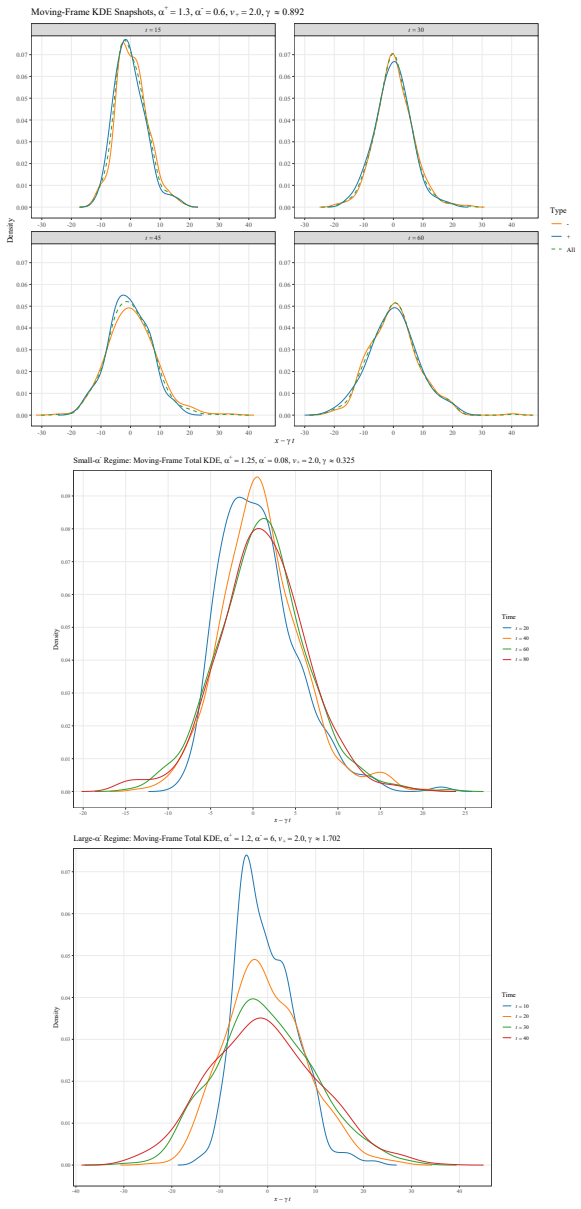
We study a class of interacting particle systems on $\mathbb{R}$ with two types. Particles evolve by independent jumps sampled from a fixed distribution, with type-dependent jump rates $v_+$, $v_-$ and stochastic type switching driven by non-local order-based interactions. The switching rates depend on the empirical distribution through the proportion of opposite-type particles located ahead, leading to a nonlinear and discontinuous dependence on the empirical measure outside the standard Lipschitz McKean-Vlasov framework. Our first main result is a law of large numbers for the empirical measure process: we prove convergence, along subsequences, to a deterministic measure-valued process characterized by a McKean-Vlasov equation. The proof combines tightness in Wasserstein space with a martingale characterization of limit points. A uniqueness argument based on a Kolmogorov-Smirnov-type distance adapted to the ordering structure yields convergence of the full empirical measure sequence and, in turn, propagation of chaos on finite time intervals. We then study the long-time behavior of the limiting dynamics. Because the system has persistent drift, invariant distributions do not arise; instead, we analyze traveling waves, corresponding to stationary profiles in a moving frame. For exponential jump distributions, the associated non-local integro-differential system admits a local description. In the regime $v_+>v_-=0$, this further reduces to a coupled system of non-linear ODEs, allowing a phase-plane analysis that yields a traveling wave as a heteroclinic orbit connecting two equilibria. We also identify the wave speed and mass partition, and derive tail asymptotics by spectral analysis of the linearized system.
0
0
math.PR 2026-05-12 Recognition

K-spine decomposition gives uniform samples of multitype branching genealogies

Uniform sampling of multitype continuous-time Bienaym\'e-Galton-Watson trees

The construction explicitly tracks splitting times and type-dependent offspring distributions that have no single-type analogue.

abstract click to expand
We study the genealogy of a sample of $k$ individuals taken uniformly without replacement from a continuous-time multitype Bienaym\'e--Galton--Watson process at fixed times. Our results are quite general, requiring only that the process be non-simple and conservative, and that every type has a positive probability to ``eventually lead to'' all other types within the population. The corresponding single-type case has recently been studied by Johnston (2019), Harris, Johnston, and Roberts (2020), and Harris, Johnston, and Pardo (2024). Our approach is based on a $k$-spine decomposition and a suitable change of measure under which the distinguished spines form a uniform sample at time $T$, while the population size is subject to $k$-size biasing and exponential discounting. This construction preserves a branching Markov property and yields an explicit description of the genealogical tree at fixed times. In particular, we characterise spine splitting times, offspring distributions, and type-dependent ancestral structures, revealing rich interactions between types that are absent in the single-type setting. The present results form the basis of a forthcoming series of papers in which limiting genealogical behaviour is analysed under various asymptotic regimes and more general sampling schemes by the authors, see Angtuncio et al. (2026b), (2026c) and (2026d).
0
0
math.PR 2026-05-12 2 theorems

Even-order GW functionals converge at rate n^{-2/max{min(d,4)}}

Empirical Convergence of Even-Order Gromov-Wasserstein Functionals

The bound holds for any fixed even power between compactly supported measures on Euclidean spaces.

abstract click to expand
We study the sample complexity of empirical plug-in estimation for the powered even-order Gromov-Wasserstein functional between compactly supported probability measures on $\mathbb{R}^{d_x}$ and $\mathbb{R}^{d_y}$. For every fixed pair of integers $r,k\geq 1$, we prove that the two-sample empirical error is bounded at the rate $n^{-2/\max\{\min\{d_x,d_y\},4\}}$, up to a logarithmic factor in the critical case $\min\{d_x,d_y\}=4$. This extends the known quadratic Euclidean upper rate to the full powered even-order family. The proof uses a polynomial decomposition of the even-order GW functional, a generalized duality formula reducing the coupling-dependent term to a compact family of ordinary optimal transport problems, and entropy estimates for semiconcave dual potentials.
0
0
math.PR 2026-05-12 Recognition

Modularity shows overlap gap on stochastic block model

The stochastic block model has the overlap graph property for modularity

Near-optimal partitions are either close to the planted communities or far from them.

abstract click to expand
The overlap gap property (OGP) is a statement about the geometry of near-optimal solutions. Exhibiting OGP implies failure of a class of local algorithms; and has been observed to coincide with conjectured algorithmic limits in problems with statistical computational gap. We consider the Stochastic Block Model (SBM), where the graph has a planted partition with $k$ equal-size blocks which form the `communities', and where, for parameters $p>q$, vertices within the same community connect with probability $p$, while vertices in different communities connect with probability $q$, independently across pairs of vertices. Modularity--based clustering algorithms have become ubiquitous in applications. This article studies theoretical limits of local algorithms based on the modularity score on the SBM. We establish that modularity exhibits OGP on the SBM. This rules out a class of local algorithms based on modularity for recovery in the SBM, and shows slow mixing time for a related Markov Chain. Theoretically this is one of the few instances where OGP has been established for a `planted' model, as most such analyses to date consider the `null' model. As part of our analysis, we extend a result by Bickel and Chen 2009, who established that with high probability, the modularity optimal partition of SBM is $o(n)$ local moves away from the planted partition, where $n$ is the graph size. We show that, with high probability, any partition with modularity score sufficiently near the optimal value is close to the planted partition.
0
0
math.PR 2026-05-12 2 theorems

Subgaussian vectors equal sum of fixed Gaussians in any dimension

On Talagrand's Convexity Conjecture

The decomposition holds with a universal number of terms and resolves Talagrand's convexity conjecture plus its combinatorial version.

abstract click to expand
We prove that any centered $1$-subgaussian random vector in $\mathbb{R}^{n}$ can be written as the sum of a universal number of standard Gaussian vectors. Following the work of the second-named author, this solves M. Talagrand's convexity problem, which in turn implies a combinatorial analogue of the problem.
0
0
math.PR 2026-05-12 2 theorems

Random conductances preserve scaling limits for nonlinear Gaussian functionals

Scaling limits for nonlinear functionals of the discrete Gaussian free field with degenerate random conductances

Nonlinear functionals converge almost surely to continuum versions in negative Sobolev space for supercritical percolation clusters and like

abstract click to expand
We consider nonlinear functionals of discrete Gaussian free fields with ergodic random conductances on a class of random subgraphs of $\mathbb{Z}^{2}$, including i.i.d. supercritical percolation clusters, where the conductances are possibly unbounded but satisfy an integrability condition. As our main result, we show that, for almost every realisation of the environment, the nonlinear functionals of the rescaled field converge to their continuum counterparts in the Sobolev space $H^{-s}(D)$ for suitable $s > 0$. To obtain the latter, we establish pointwise bounds for the Green's function of the associated random walk among random conductances with Dirichlet boundary conditions, which are valid for all $d \geq 2$.
0
0
math.PR 2026-05-12 Recognition

Log scaling turns sweeps into tents or houses

Logarithmic scaling of selective sweep curves: from tents to houses

Strong selection yields linear tents; moderate selection adds jumps to make houses, with uniform and Skorokhod M1 convergence proved for the

Figure from the paper full image
abstract click to expand
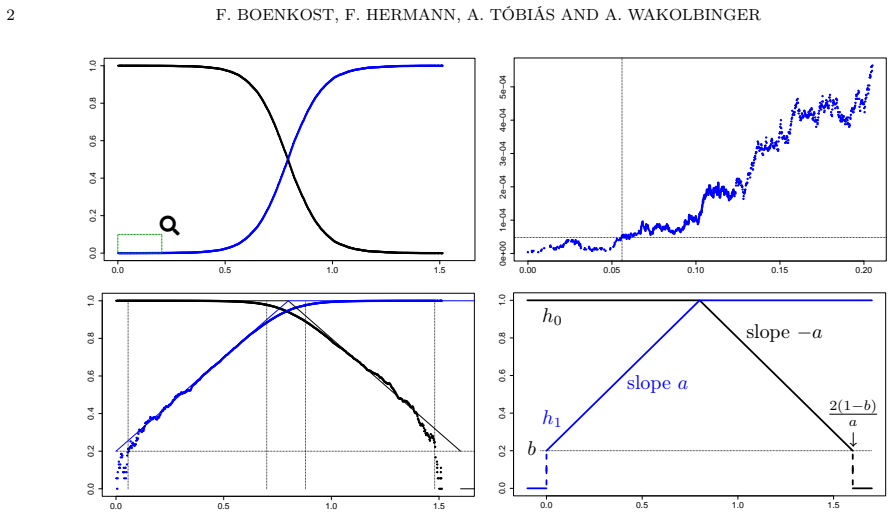
One of the classical results of mathematical population genetics states that the frequency of a beneficial mutant's offspring, on its way to fixation in a large population, looks like a logistic curve. A logarithmic scaling (both in height and time) of these selective sweep curves leads (in the case of strong selection) to a tent-like shape in the large population limit: First the logarithmic frequency of the mutant increases linearly from 0 to 1, then that of the former resident decreases from 1 to 0. For moderate selection the logarithmic frequencies develop (in the large population limit) a jump at the beginning/the end of the sweep, which takes the shape of the tent into that of a house. Our main result (proved for the Moran model) assesses the regularity of this convergence in the large population limit: It is uniform in the house's roof (phases of linear growth and decline) and "Skorokhod $M_1$" in the house's walls (closely around the jumps). Apart from interest in its own right, we anticipate that this result and the proof techniques will be instrumental for extending the description of clonal interference by Poissonian interacting trajectories (as it was done in Hermann et al. (2024) for strong selection) also to moderate selection.
0
0
math.PR 2026-05-12 2 theorems

Curve shortening flow with jump noise decays exponentially to zero

Stochastic curve shortening flow driven by a transport-type pure jump L\'evy noise

Strong solutions exist, gain improved regularity, and converge pathwise at an exponential rate despite weak dissipativity.

abstract click to expand
We study the existence and uniqueness, the regularity, and the long-time behavior of strong solutions to stochastic curve shortening flow driven by a transport-type pure jump L\'evy noise. To obtain the existence and uniqueness of strong solutions, we transform the equation into its equivalent It\^{o}-type stochastic partial differential equation via a transport equation, and apply the monotone method with Lyapunov-type conditions. The obstacles to investigate the long-time behavior are the weak dissipativity and singularity inherent in the equation. To this end, we establish an improved regularity and prove that these solutions converge pathwise to zero at an exponential rate.
0
0
math.PR 2026-05-12 Recognition

Infinite measures admit unique cyclically monotone zero-couplings

Zero-couplings of infinite measures with cyclically monotone support and multivariate regular variation

The result extends the Brenier-McCann theorem and shows that tail limits of couplings for regularly varying distributions coincide with zero

abstract click to expand
We study cyclically monotone transport plans between measures in $\mathrm{M}_0(\mathbb{R}^d)$, the class of Borel measures on $\mathbb{R}^d \setminus \{0\}$ that are finite on sets bounded away from the origin but may have infinite total mass. We avoid moment assumptions and allow the transport cost to be infinite. This framework naturally arises for exponent measures in multivariate regular variation and includes other examples such as L\'evy measures. We introduce the notion of a zero-coupling and establish existence of cyclically monotone zero-couplings for arbitrary pairs of measures in $\mathrm{M}_0(\mathbb{R}^d)$. Under a Hausdorff-dimension condition on the first measure and when at least one of the two measures has infinite mass, we prove uniqueness of the cyclically monotone zero-coupling, yielding an analogue of the Brenier--McCann theorem in this infinite-measure setting. We further derive a representation of such couplings through gradients of closed convex functions and identify conditions under which the zero-coupling is proper in the sense that the second measure is equal to the restriction to the punctured space of the push-forward of the first measure by a cyclically monotone transport map. Finally, we apply these results to regularly varying probability measures. We show that a cyclically monotone coupling between two such distributions admits a tail limit that coincides with the unique proper cyclically monotone zero-coupling between the corresponding exponent measures.
0
0
math.PR 2026-05-12 Recognition

Random lattices approximate Poisson points with exp-small error

Poisson approximation of random lattices

For sets of volume linear in n without antipodal pairs, total variation distance between the two processes is at most C exp(-c' n).

abstract click to expand
Fix a subset $S \subset \mathbb{R}^n$ of volume at most $c n$ that satisfies $S \cap (-S) = \emptyset$. We consider two point processes in $S$: the first is the Poisson point process of intensity one, and the second is the restriction of a random lattice to $S$, where the random lattice is distributed uniformly in the space of covolume-one lattices. We show that the total variation distance between these two point processes is at most $C e^{-c' n}$, where $c, C, c' > 0$ are universal constants.
0
0
math.PR 2026-05-12 Recognition

Secretary problem probabilities match exactly for Luce and Mallows

A secretary for Messrs. Luce and Mallows

For every n and every strategy the success rates coincide when the smallest label ranks highest, allowing shared limiting analysis.

abstract click to expand
We analyze the secretary problem in the case that the $n$ ranked items arrive not in uniformly random order but rather according to a certain type of Luce distribution or according to a Mallows distribution on the set $S_n$ of permutations of $[n]$. The secretary problem for the Mallows distributions with parameter $q\in(0,1)$ was analyzed in a previous paper; in this paper the case $q>1$ is also analyzed. The Luce distribution with the class $\{q_j\}_{j=1}^\infty$ of weights is related in a certain sense to the Mallows distribution with parameter $q$, but is more difficult to analyze. It turns out that for every $n$ and every strategy, the probabilities for the secretary problem when the smallest number is considered of highest rank for the Luce distribution with this class of weights coincides with those for the corresponding Mallows distribution. We analyze the asymptotic optimal strategy and corresponding limiting probability for the above cases, as well as for the Luce distributions with other classes of weights, such as the Sukhatme weights.
0
0
math.PR 2026-05-12 Recognition

Stochastic sandpiles stabilize to symmetric intervals on the line

Limit shape of single-source stochastic sandpiles with p-topplings on mathbb{Z}

n particles at the origin under random p-topplings fill a centered interval of length proportional to n, with boundaries obeying a Gaussian,

abstract click to expand
We investigate the limit shape of the single-source model for stochastic sandpiles on the integer line subject to $p$--topplings. In this model, an initial configuration of $n\in\mathbb{N}$ particles is placed at the origin and stabilized according to a random toppling rule depending on $p\in (0,1)$: an unstable vertex sends exactly one particle to its left neighbor with probability $p$, and independently sends exactly one particle to its right neighbor with probability $p$. We prove that as $n \to \infty$, the macroscopic limit shape of the final stable configuration is a symmetric interval around the origin. Furthermore, by analyzing the center of mass martingale, we establish a central limit theorem for the boundary fluctuations, showing that after proper rescaling, they converge to a Gaussian distribution.
0
0
math.PR 2026-05-12 Recognition

Martingale quadratic variation density forces exponential L2 decay in stochastic NLS

Exponential Decay of L²-Solutions to Stochastic Nonlinear Schr\"odinger Equations Driven by Continuous Martingales

Rescaling produces a damping potential whose strength is set by the positive density, extending Brownian stabilization to general continuous

abstract click to expand
We investigate the global well-posedness and asymptotic behavior of $L^2$-solutions to stochastic nonlinear Schr\"odinger equations with multiplicative noise driven by continuous square integrable martingales with density. Our approach relies on a rescaling transformation that converts the stochastic system into a random nonlinear Schr\"odinger equation with a potential acting as a damping term. Unlike the standard Brownian motion case, this induced potential plays a critical role in the dynamics. We establish the global existence of solutions and prove the pathwise exponential decay of the $L^2$-norm. Crucially, the strict positivity of the decay rate is intrinsically induced by the density of the martingale\rq{}s quadratic variation. This result generalizes the stabilization known for standard Brownian motion, thereby characterizing the stabilizing effect of the martingale noise.
0
0
math.PR 2026-05-12 2 theorems

Notes outline rough path theory for rough PDEs and SPDE applications

Rough path theory and an introduction to rough partial differential equations

Condensed presentation supplies the minimal tools from rough paths needed to introduce rough partial differential equations and apply them

abstract click to expand
The goal of these notes is to provide an introduction to rough partial differential equations. For this purpose, we will present the theory of rough paths to the extend as it is required. Applications to stochastic partial differential equations are presented as well.
0
0
math.PR 2026-05-11 Recognition

Stochastic Wright equation has two invariant measures

Stochastic Wright's Equation: Existence of Invariant Measures

Bounded Lipschitz noise added to the transformed delay equation produces a trivial measure at -1 and a nontrivial one on (-1, ∞).

Figure from the paper full image
abstract click to expand
Wright's delay differential equation is one of the prime examples of a fully nonlinear equation without an explicit solution and whose dynamics can be understood by analytic means. In this paper, we introduce stochastic perturbations by adding Brownian noise with a bounded Lipschitz noise coefficient to a transformed version of Wright's equation. The transformation considered plays an important role in the deterministic theory as well. We demonstrate that this stochastically perturbed equation has (at least) two invariant measures: a trivial measure concentrated at $-1$ and a nontrivial measure on $(-1,\infty)$. The crucial and most challenging step of the proof is showing that every solution is bounded away from $-1$ in probability. In addition, a major part of our analysis is devoted to deriving detailed estimates for It\^o processes with a negative drift.
0
0
math.PR 2026-05-11 2 theorems

Dyadic limits of Doob kernels build Markov family for 3D point interaction

A dyadic construction of a three-dimensional attractive point interaction Markov family

Iterated transforms on punctured domains converge to a transition kernel extended by a cemetery state, yielding càdlàg interpolations with f

Figure from the paper full image
abstract click to expand
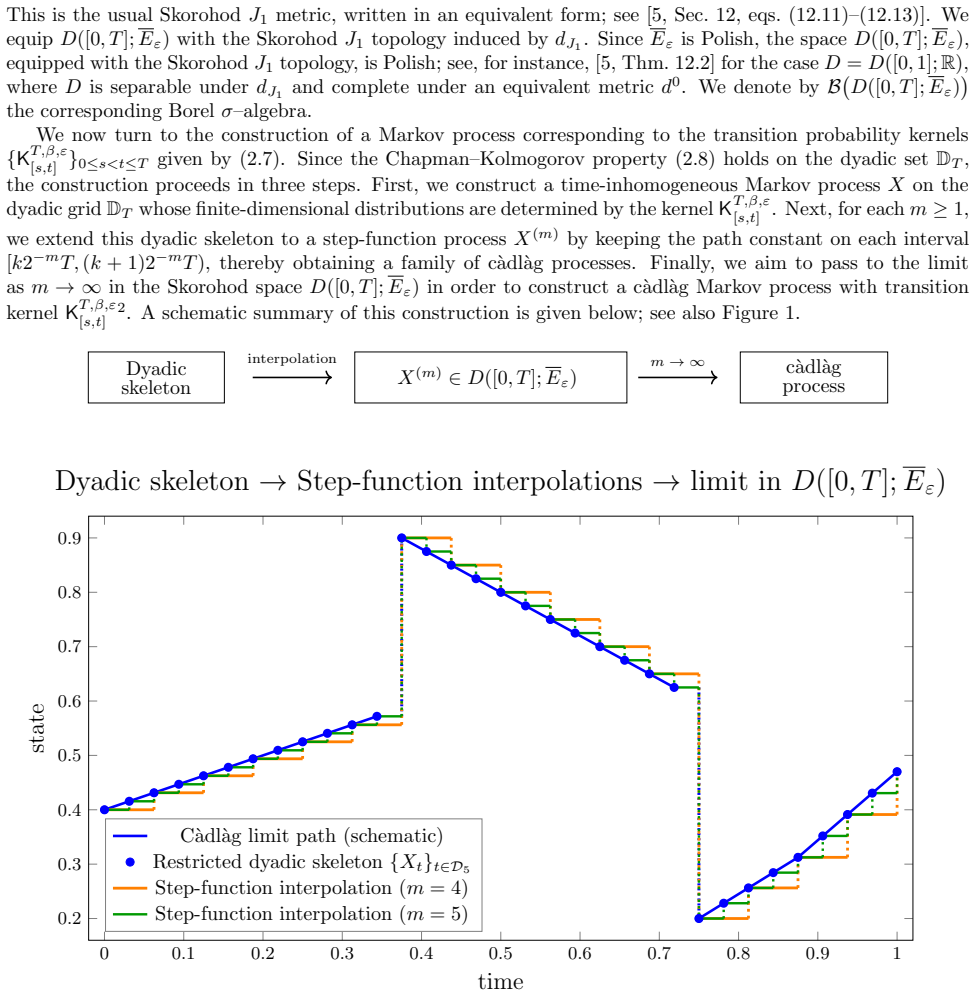
We discuss a probabilistic framework associated with the three-dimensional attractive point interaction under a survival constraint on the punctured domain $E_\varepsilon=\{x\in\mathbb R^3: |x|>\varepsilon\}$. By iterating the Doob-transforms of the fundamental solution of the corresponding singular heat equation, we obtain sub-probability kernels along finite partitions which yield a limiting sub-probability kernel via refinement along global dyadic partitions, and we extend this limit to a transition probability kernel on an enlarged space obtained by adjoining a cemetery state. These kernels determine a time-inhomogeneous Markov process on the set of dyadic times, and its step-function interpolations yield c\`adl\`ag processes with consistent finite-dimensional distributions and partial tightness properties. The analysis of the continuous-time limit of the interpolated processes, as well as the limiting procedure $\varepsilon\downarrow 0$, which recovers the process associated with the three-dimensional point interaction, is deferred to future work.
0
0
math.PR 2026-05-11 2 theorems

Coupon collector ballot probability ~2/d

The Ballot Event for Two-Player Coupon Collection: A Renewal--Catalan Asymptotic

The chance the eventual winner was never behind decays as two divided by the number of coupon types, via renewal at ties and Catalan harmony

abstract click to expand
We study the two-player coupon-collector competition in which two independent collectors draw one coupon each per round from a set of $d$ equally likely coupon types. Myers and Wilf gave finite formulae for several two-player events and explicitly left open the ballot-type problem of finding the probability that the ultimate winner was never behind. We prove that this probability satisfies $$ b_d \sim \frac{2}{d}, \qquad d\to\infty .$$ The proof uses a renewal decomposition at the tie boundary. The first one-sided tie-break has an explicit entrance distribution; its level, scaled by $d^{1/2}$, converges to a Rayleigh law; and, after the break, the leader's survival probability is governed by a Catalan, or gambler's-ruin, harmonic. The main estimate shows that the accumulated defect of this comparison harmonic in the exact simultaneous-round chain is negligible.
0
0
math.PR 2026-05-11 Recognition

Static counts yield sharp bounds on non-giant components near criticality

Counting subgraphs in bounded-size Achlioptas processes

Expectation of k-vertex trees equals c n with error O(k/sqrt(n)), giving the limiting fluctuation law for the largest small component.

abstract click to expand
Achlioptas processes such as the Bohman--Frieze process are much harder to analyse than the classical Erd\H{o}s--R\'enyi process, due to the dependence between edges added at different stages. This dependence means that most analysis so far is dynamic, often based on the differential equation method. In the Erd\H{o}s--R\'enyi case there is an alternative static approach, pioneered by Erd\H{o}s, R\'enyi and Bollob\'as, based on evaluating the expectation (and higher moments) of various subgraph counts, and using this to study the component structure. Here we show that this latter approach can be applied (with some complications) to the Bohman--Frieze process. For example, we are able to show that the expected number $\mu_{k,t,n}$ of $k$-vertex tree components after $tn$ steps satisfies (essentially) $\mu_{k,t,n}=c_{k,t}n(1+O(k/\sqrt{n}))$. Our method gives a very complicated formula for $c_{k,t}$, which seems to be unusable. However, since $c_{k,t}$ does not depend on $n$, we may use recent results obtained by the differential equation method and branching process analysis to find the asymptotics of $c_{k,t}$ as $k\to\infty$. The latter results also give a formula for $\mu_{k,t,n}$ of the form $c_{k,t}n$ plus an error term, with a much more usable description of $c_{k,t}$ but a much worse error term. We combine the best of both worlds to prove a number of new results about the process near criticality. In particular, we obtain extremely sharp bounds on the size of the largest non-giant component near criticality, including the limiting distribution of its fluctuations.
0
0
math.PR 2026-05-11 2 theorems

Two points connect via at most ceiling(d/4) interlacement trajectories

Multipoint connectivity in the branching interlacement process

The bound is sharp almost surely and extends to k points with a similar formula in the branching model.

Figure from the paper full image
abstract click to expand
We consider the branching interlacement model introduced by Zhu as an analog of Sznitman's random interlacement for branching random walks. We show that two points of the interlacement are connected via at most $\lceil d/4 \rceil$ trajectories of the interlacement, using a different proof than Procaccia and Zhang. This upper bound is sharp, in the sense that almost surely there exist two points not connected by $\lceil d/4\rceil - 1$ trajectories. We extend this result by proving that $k$ points of the interlacement are connected via at most $\lceil d(k-1)/4\rceil -(k-2)$ trajectories, and that this bound is also sharp.
0
0
math.PR 2026-05-11 2 theorems

Partition function factors up to sub-ballistic scales

A factorization formula for the partition function in the semi-discrete parabolic Anderson model

In the high-temperature regime the point-to-point partition function decomposes into independent terms, with positive limits existing as t->

abstract click to expand
We consider a continuous-time simple symmetric random walk on the integer lattice $\mathbb{Z}^d$ in dimension $d \geq 3$, subject to a random potential given by a field of two-sided Wiener processes. In the high-temperature regime, we prove the existence of the $L^2$- and almost sure limits of the partition function as time $t \to \pm \infty$, and show that these limiting partition functions are positive almost surely. Our main result is a factorization formula for the point-to-point partition function, which is shown to be valid up to any sub-ballistic scale.
0
0
math.PR 2026-05-11 2 theorems

Sparse domination yields sharp matrix-weighted bounds for martingale squares

Sharp weighted norm estimates for martingale square functions

The L_p norm of S_W is controlled by an explicit power of the matrix A_p characteristic, optimal for p up to 2.

abstract click to expand
This paper is devoted to the study of quantitative weighted norm estimates for martingale square functions in both scalar-weighted and matrix-weighted settings. In particular, we introduce the martingale square functions $S_W$ via matrix weights $W$, and then use the matrix $A_p$ condition, introduced in our previous work \cite{ChenQuanJiaoWu}, to characterize the $L_p$ estimate for $S_W$. Our proof mainly relies on the idea of sparse dominations, which leads to the explicit information on the characteristic of the matrix weight involved. For the range $1<p\leq 2$, our result is sharp in terms of the characteristic of the matrix weight. With some modification on the arguments, we can further improve the result in scalar settings by obtaining the optimal exponent of the characteristic of the weight involved for all indices $1<p<\infty$, addressing a fundamental problem from the classical martingale theory.
0
0
math.PR 2026-05-11 2 theorems

Critical Bose gas exponents depend on domain geometry

Fluctuations for the critical free Bose gas

The second term in the heat kernel expansion controls macroscopic loops and yields non-Gaussian fluctuation laws in three dimensions.

Figure from the paper full image
abstract click to expand
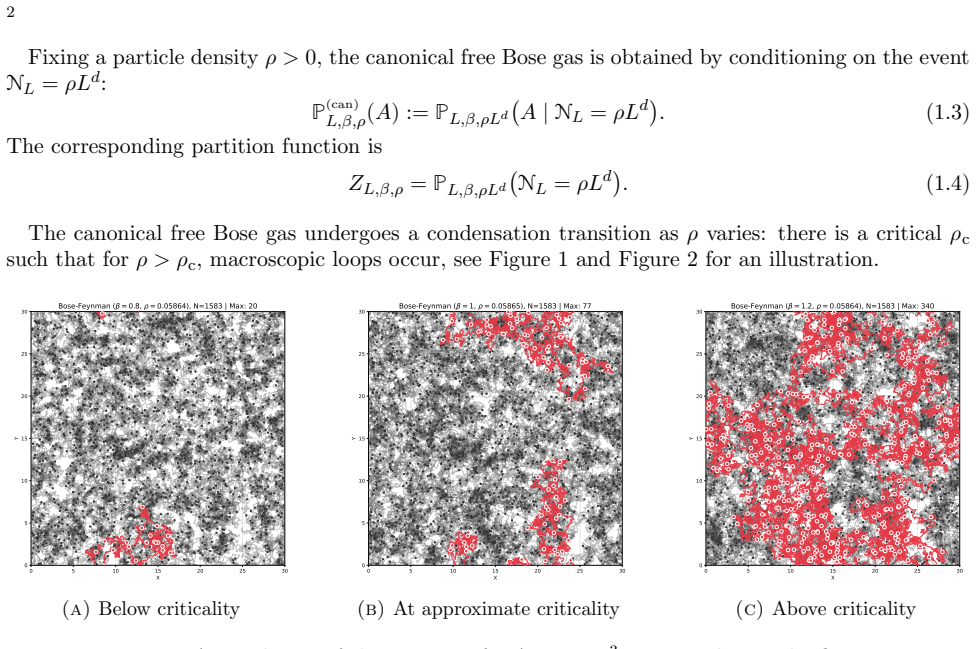
We study the critical free Bose gas from a probabilistic vantage with a focus on the three-dimensional case. We obtain the critical exponents. These exponents and the occurrence of macroscopic loops subtly depend on the geometry of the domain and the boundary conditions, contrary to the subcritical and supercritical case. In particular, the second term of the Minakshisundaram-Pleijel expansion determines the emergence of large loops. We furthermore obtain non-Gaussian limit laws for the fluctuations, governed by the regularized Fredholm determinant of the Green operator.
0
0
math.PR 2026-05-11 2 theorems

Self-normalized linear processes converge in M2 topology

A functional limit theorem for self-normalized linear processes with random coefficients and i.i.d. heavy-tailed innovations

The result holds for strictly stationary processes with i.i.d. heavy-tailed innovations when partial sums of the random coefficients stay a.

abstract click to expand
In this article we derive a self-normalized functional limit theorem for strictly stationary linear processes with i.i.d. heavy-tailed innovations and random coefficients under the condition that all partial sums of the series of coefficients are a.s. bounded between zero and the sum of the series. The convergence takes part in the space of c\`{a}dl\`{a}g functions on $[0,1]$ with the Skorokhod $M_{2}$ topology.
0
0
math.PR 2026-05-11 Recognition

Rough paths solve signature and Schwinger-Dyson kernel equations

Signature Kernel and Schwinger-Dyson Kernel Equations as Two-Parameter Rough Differential Equations

Two-parameter framework proves well-posedness for rough drivers and supplies a numerical scheme with complexity bounds.

Figure from the paper full image
abstract click to expand
We develop a rough-path framework for two-parameter rough differential equations on rectangular and simplicial domains, motivated by the signature kernel and Schwinger--Dyson kernel equations. The theory is formulated in spaces of jointly controlled rough paths and is based on a robust two-parameter rough integration framework. In particular, we introduce a notion of rough integration over two-dimensional simplices at low regularity extending previous results in the literature. Within this setting, we show that the signature kernel equation arises naturally as a two-parameter rough differential equation and establish well-posedness and stability. We also extend the Schwinger--Dyson kernel equation, previously formulated for bounded-variation paths, to rough driving signals, proving existence and uniqueness in appropriate controlled rough path spaces. In the smooth rough path regime, we relate the resulting equations to PDE and integro-differential formulations. Finally, we derive and analyse a numerical scheme for the rough Schwinger--Dyson equation, including runtime and memory complexity estimates, and illustrate its performance with numerical experiments.
0
0
math.PR 2026-05-11 2 theorems

Averaging time scales as n to the power max(3-p

Edge-averaging dynamics on finite graphs: moment dependence

The expected time until opinions differ by at most epsilon grows polynomially when only moments are bounded, and the scaling is tight on a n

abstract click to expand
We study the edge-averaging process on a finite, connected graph $G = (V, E)$. Initially, the vertices in $V$ are endowed with i.i.d.\ real-valued opinions $(f_0(v))_{v \in V}$. Edges are activated according to i.i.d.\ Poisson clocks of rate $1$; when an edge is activated, the opinions at its endpoints are replaced by their average. Let $f_t(v)$ denote the opinion at $v$ at time $t$.Define the $\epsilon$-convergence time $\tau_\epsilon$ as the first time when the maximum and the minimum of $f_t$ differ by at most $\epsilon$. It is known that if the initial opinions $(f_0(v))_{v \in V}$ are bounded in $L^\infty$, then $\mathbb{E}(\tau_\epsilon)$ is at most $C_\epsilon \log^2 n$ for $\epsilon \in (0, 1]$. We assume instead that the $L^p$ norm of $f_0(v)$ is at most $1$ for every $v \in V$. For fixed $\epsilon \in (0, 1]$, and show that $\mathbb{E}(\tau_\epsilon) = \widetilde{O}(n^{\beta_p})$ up to logarithmic terms, where $\beta_p := \max(3 - p, 2/p)$. Moreover, this power law is tight on cycle graphs.
0
0
math.PR 2026-05-11 Recognition

Normal approximation holds for isolated edges and 2-stars in fixed-degree graphs

Normal approximation of the numbers of isolated edges and isolated 2-stars in uniform simple graphs with given vertex degrees

First explicit finite-sample bounds obtained by joint normal-Poisson approximation in the configuration model followed by conditioning on a

abstract click to expand
We consider the configuration model and the uniform simple graph with given degree sequence $\boldsymbol{d}=\left(d_i\right)_{i=1}^n$. We derive quantitative bounds for the errors in (i) joint normal-Poisson approximation to the numbers of isolated edges, isolated 2-stars, self-loops and double edges in the configuration model, and (ii) normal approximation to the numbers of isolated edges and isolated 2-stars conditioned on that the configuration model is simple. The latter provides the first finite sample normal approximation results for the uniform simple graph with given vertex degrees. To achieve this, we develop a new Stein's method for joint normal-Poisson approximation and a new coupling approach to sums of indicators, which may be of independent interest.
0
0
math.PR 2026-05-11 1 theorem

Maki-Thompson model obeys moderate deviation principle

Moderate deviations for the Maki--Thompson rumour model

The result fills the scale gap between Gaussian fluctuations and exponential tails for the final number of ignorants.

abstract click to expand
The final proportion of ignorants in the classical Maki--Thompson rumour model is known to satisfy the law of large numbers, the central limit theorem, and the large deviation principle. In this note, we establish the corresponding moderate deviation principle, thereby bridging the Gaussian fluctuation regime and the large deviation regime. The proof rests on the exact final-size distribution, sharp asymptotics for the associated automata numbers, and a uniform point probability expansion at the moderate deviation scale.
0
0
math.PR 2026-05-11 2 theorems

Binary tree martingale makes Cusick conjecture a special case

The martingale evolution of probability measures defined via the sum-of-digits functions

Densities of binary digit sum changes evolve as marginals of a stopped random walk whose median preservation implies the conjectured bias.

abstract click to expand
Let $s(n)$ denote the number of ones in the binary expansion of a natural number $n\in\mathbb{N}$. For any $t\in\mathbb{N}$ and $d\in\mathbb{Z}$, let $\mu_t(d)$ denote the asymptotic density of the set of those natural numbers $n$ for which $s(n+t)-s(n)=d$. It is well known that $\mu_t$ are properly defined probability measures on $\mathbb{Z}$, and the Cusick conjecture states that $\mu_t(\mathbb{N})>\frac{1}{2}$ for any $t\in\mathbb{N}$. In this paper, we investigate the properties of the family $\{\mu_t\}_{t\in\mathbb{N}}$ by reindexing the odd integers via a suitable partial order. This construction leads to the nonautonomous dynamics on pairs of probability measures on $\mathbb{Z}$, and admits a natural interpretation in terms of evolution of planar binary trees and the corresponding stopping times. The measures $\mu_t$ correspond to the marginal distributions of the associated stopped random walk. We will assume that the random walk starts from zero, and thus we will work with the family of measures $P_t$ determined by the convolution $\mu_t=\mu_1\ast P_t$. The martingale associated with the stopped random walk allows a transparent structural description of those measures, including their support, symmetries, variance, and the asymptotic behaviour. At the end we discuss the median preserving property of this martingale, and show that the Cusick conjecture is a special case of a more general claim about the asymmetric evolution of the binary trees associated to the martingale. This last claim is supported numerically at the end of the paper.
0
0
math.PR 2026-05-11 2 theorems

Bursting gene networks reach unique equilibria with explicit rates

Quantitative ergodicity for gene regulatory networks with transcriptional bursting

Coupling arguments prove existence, uniqueness, and Wasserstein convergence bounds for any number of genes under regular jump rates.

Figure from the paper full image
abstract click to expand
We study the long-term behavior of two piecewise-deterministic Markov processes used to model stochastic gene regulatory networks with bursting dynamics. Under regularity assumptions on the jump rate, we prove the existence and uniqueness of the stationary distribution for an arbitrary number of interacting genes and an arbitrary strength of interaction. Using coupling methods, we also provide explicit upper bounds for the convergence to equilibrium in terms of Wasserstein distances.
0
0
math.PR 2026-05-11 2 theorems

Biased Ising spins reach plus phase rapidly at low temperature

Rapid phase ordering of Ising dynamics on mathbb Z²

Glauber dynamics started with mostly plus spins converges quickly to equilibrium on the infinite plane for any temperature above critical.

Figure from the paper full image
abstract click to expand
We consider the phase ordering problem for the low-temperature Ising dynamics initialized from a biased and disordered initialization. Work of Fontes, Schonmann, Sidoravicius (2002) showed that at zero-temperature, Ising Glauber dynamics on $\mathbb Z^d$ for $d\ge 2$ initialized from i.i.d. spins on each vertex that are $+1$ with sufficiently large probability, absorbs into the all-plus configuration quickly. We prove that analogous behavior holds throughout the low-temperature regime of the Ising model in two dimensions. Namely, there exists $p_0 <1$ such that Ising Glauber dynamics initialized from i.i.d. spins that are $+1$ with probability $p>p_0$, run at any low temperature $\beta>\beta_c$ converges rapidly to the plus phase measure $\pi^+$. The result is proved using a spacetime multiscale coupling valid in any $d\ge 2$, that boosts a uniform-in-$\beta$ quasi-polynomial bound on the mixing time of Ising dynamics with plus boundary conditions, into rapid phase ordering from biased initializations with no boundary conditions.
0
0
math.PR 2026-05-11 2 theorems

Primitive sequences uniquely represent measures on compact intervals

Primitive Sequences for Probability Measures on Compact Intervals

Repeated antiderivatives of the CDF create a sequence that is homeomorphic to the space of measures, enabling characterization and sharp f

Figure from the paper full image
abstract click to expand
We introduce a sequence representation of a random variable $X$ supported on a compact interval $[a,b]$, which we call a primitive sequence. We construct this sequence by repeatedly antidifferentiating the associated cumulative distribution function of $X$ and evaluating the antiderivatives at the endpoint $b$. We show that the primitive sequence of $X$ can be identified as a factorially rescaled moment sequence of the reflected random variable $b-X$. Through this identification, we show that the primitive sequence transparently captures qualitative features of the distribution of $X$. We then connect primitive sequences directly to classical moment theory and exploit this connection to characterize admissible primitive sequences and to show that under natural topologies, the map from probability measures to primitive sequences is a homeomorphism. We end by examining the set of probability measures whose first $m$ primitive sequence terms are fixed, and thereby obtaining sharp upper and lower bounds on two functionals of those measures.
0
0
math.PR 2026-05-11 2 theorems

Bismut-Elworthy formula works with degenerate noise

A Bismut-Elworthy formula for BSDEs with degenerate noise

Gradient estimates extend to BSDEs and wave equations when weaker noise conditions replace full non-degeneracy.

abstract click to expand
In this paper we derive a Bismut-Elworthy formula under assumptions weaker than the non degeneracy of the noise. By Bismut-Elworthy formula we mean a gradient type estimate on the transition semigroup of a stochastic differential equation in a possibly infinite dimensional Hilbert space. We also consider a nonlinear version of the Bismut formula for a backward stochastic differential equation, in analogy to what is done in \cite{futeBismut}, where a non-degenerate noise is considered. Our study is motivated by applications to stochastic wave equations and to stochastic damped wave equation.
0
0
math.PR 2026-05-11 Recognition

Second eigenvalue nonnegative in 4x4 tridiagonal stochastic matrices

Nonnegativity of the second largest eigenvalue of 4 times 4 tridiagonal stochastic matrices

Proof settles conjecture for irreducible cases and extends the result to all reducible 4x4 matrices.

abstract click to expand
The spectral study of nonnegative and more specifically stochastic matrices is an important topic in matrix theory. In this paper, we prove a conjecture, formulated by Ran and Teng, which states that the second largest eigenvalue of an irreducible $4\times4$ tridiagonal stochastic matrix is nonnegative. We establish this conjecture and extend the result to arbitrary $4\times4$ tridiagonal stochastic matrices, including both irreducible and reducible cases.
0
0
math.PR 2026-05-11 2 theorems

Additive decomposition gives Besov-Orlicz path regularity

On the Besov-Orlicz path regularity of some Gaussian processes

A unified proof using fractional Brownian motion covers bifractional and subfractional Brownian motions along with self-similar processes.

abstract click to expand
In this paper, we rely on the additive decomposition in law satisfied by a class of stochastic processes, combined with the well-known regulariy properties of fractional Brownian motion, to establish Besov-Orlicz regularity of their sample paths. This provides a unified and direct proof for a broad class of processes, including bifractional Brownian motion with parameters $H\in (0, 1]$, $ K\in (0, 2)$ such that $HK \in (0, 1)$, subfractional Brownian motion with Hurst parameter $H\in (0, 1)$, and certain class of self-similar processes. %associated with the stochastic heat equation.
0
0
math.PR 2026-05-11 Recognition

Super-Poincaré inequality equivalent to log-Sobolev forms

A note on the equivalence of super-Poincar\'e inequality

Explicit relations link their rate functions under standard conditions for probability measures.

abstract click to expand
In this paper we will study the equivalence between super-Poincar\'e inequality and some log-Sobolev type inequalities, including weak log-Sobolev inequality and super log-Sobolev inequality. The explicit relations between associated rate functions will also be established.
0
0
math.PR 2026-05-11 Recognition

Stochastic approximation process satisfies moderate deviation principle

Moderate Deviation Principle for a Stochastic Approximation Process

The recursion with bounded martingale noise yields exponential estimates for moderate-scale deviations from typical behavior.

abstract click to expand
In this paper, we investigate a stochastic approximation procedure $\left(X_n\right)_{n\ge 0}$ taking values in $R$. The process is adapted to a filtration $(F_n)_{n\ge 0}$ and satisfies the recursion $X_{n+1}=X_n+\frac{b}{n+1}\big[g(X_n)+U_{n+1}\big]$, where $b>0$, $g:R \to R$ is a function and $\left(U_n\right)_{n\ge 1}$ is a sequence of bounded martingale differences adapted to the filtration $(F_n)_{n\ge 1}$. We establish the moderate deviation principle for the stochastic process $(X_n)_{n\ge 0}$. As auxiliary results, we also obtain the exponential inequality for $(X_n)_{n\ge 0}$ and the moderate deviation principle for weighted sums of bounded martingale differences.
0
0
math.PR 2026-05-11 2 theorems

Adele random walks converge to Lévy processes under scaling

A Scaling Limit of Random Walks in the Rational Adeles

Weak convergence in J1 Skorokhod topology follows after survival-time analysis shows the walks stay adelic almost surely.

abstract click to expand
This paper shows the convergence of adele-valued random walks to an adelic L\'evy process under scaling limits. We use random walks on the $p$-adic numbers to construct random walks initially on the infinite product space, and use survival time analysis to prove that the random walks are almost surely adelic for all time. The adelic random walks are shown to be small perturbations of processes that are supported on a finite product of path spaces. Weak convergence to an adelic L\'evy process is established in the $J_1$ Skorokhod topology.
0
0
math.PR 2026-05-11 Recognition

Large deviations and central limits hold for noisy multivalued SDEs

Small noise asymptotic behaviors for path-dependent multivalued McKean-Vlasov stochastic differential equations

Weak convergence establishes LDP for path-dependent McKean-Vlasov equations under non-Lipschitz conditions; auxiliary equations give MDP and

abstract click to expand
This paper investigates the asymptotic behavior of path-dependent multivalued McKean-Vlasov stochastic differential equations perturbed by small noise. Specifically, we first establish a large deviation principle for such equations under non-Lipschitz coefficients by the weak convergence approach. Subsequently, we introduce an auxiliary equation and apply it to derive the moderate deviation principle. Finally, we construct another auxiliary equation and a limit equation, and prove the central limit theorem.
0
0
math.PR 2026-05-11 Recognition

Growing batches let SGD converge at fixed step size under infinite variance

Convergence of Stochastic Gradient Descent with mini-batching and infinite variance

When gradients follow an α-stable law, increasing mini-batch sizes give moment bounds and distributional limits to a stable Ornstein-Uhlenh

abstract click to expand
Stochastic gradient descent (SGD) with mini-batching is a standard tool in large-scale optimization, yet its theoretical properties under heavy-tailed gradient noise remain largely unexplored. In this paper we study SGD with increasing batch sizes when the gradient noise belongs to the domain of attraction of an $\alpha$-stable law with $\alpha\in(1,2)$. Building on existing results for the finite-variance regime and for heavy-tailed SGD without batching, we establish three main results. First, we derive $L^p$ moment bounds for the SGD error and show that increasing batch sizes lead to faster convergence rates. In particular, batching enables convergence in probability even for a constant stepsize. Second, we prove that the properly normalized SGD iterates converge in distribution to the stationary law of an Ornstein-Uhlenbeck process driven by an $\alpha$-stable L\'evy process. Third, for Polyak-Ruppert averaging we obtain a stable limit theorem with a normalization that explicitly depends on the batch-size schedule.
0
0
math.PR 2026-05-11 2 theorems

Modified ruin probability matches classical one under heavy tails

Modified ruin probability for a Cram\'er-Lundberg model driven by a compound mixed Poisson process

When claim sizes are subexponential and mixing stays below the net-profit boundary, the two ruin probabilities are asymptotically equivalent

abstract click to expand
We study modified ruin probabilities in a Cram\'er-Lundberg model driven by a compound mixed Poisson process. In the heavy-tailed regime, if the integrated claim-size distribution is subexponential and the upper endpoint of the mixing distribution stays below the net-profit boundary, the modified and classical ruin probabilities are asymptotically equivalent. In the light-tailed regime, we prove a fixed-intensity ratio theorem and obtain both an endpoint-atom result and a sharp endpoint-density asymptotic with an explicit constant.
0
0
math.PR 2026-05-08 2 theorems

Fluctuations in SK and Wigner models converge to Gaussians

Universality of the fluctuations of the free energy in generalized Sherrington-Kirkpatrick models and the log likelihood ratio in spiked Wigner models

Limits are universal, depending only on means and variances of the disorder and prior in the high-temperature regime.

Figure from the paper full image
abstract click to expand
We consider the fluctuations of the free energy in generalized Sherrington-Kirkpatrick models and the log likelihood ratio of spiked Wigner models in the high temperature/subcritical regime. We prove that the limiting laws of the fluctuations are Gaussian under suitable assumptions, and the result is universal in the sense that it does not depend on the distribution of the disorder or the prior except that the means and the variances of the limiting laws depend on a few parameters of the model. The proof is based on the multigraph expansion that provides a unified approach to analyze both models.
0
0
math.PR 2026-05-08 Recognition

Change of measure theorem holds for Brownian-time processes

Brownian-time Change of measure

The result supplies a probability reweighting tool for SDEs and SPDEs driven by these time-changed noises.

abstract click to expand
We prove a fundamental change of measure theorem for the Brownian-time Brownian motion and its associated Brownian-time processes class introduced by Allouba and Zheng in 2001. This result, together with Allouba's prior work on (1) Brownian-time processes and their PDEs/SPDEs links and on (2) change of measure for SPDEs, is a critical building block in analyzing the behaviors of SDEs and SPDEs -- of different types and orders -- driven by Brownian-time noises and their relatives.
0
0
math.PR 2026-05-08 Recognition

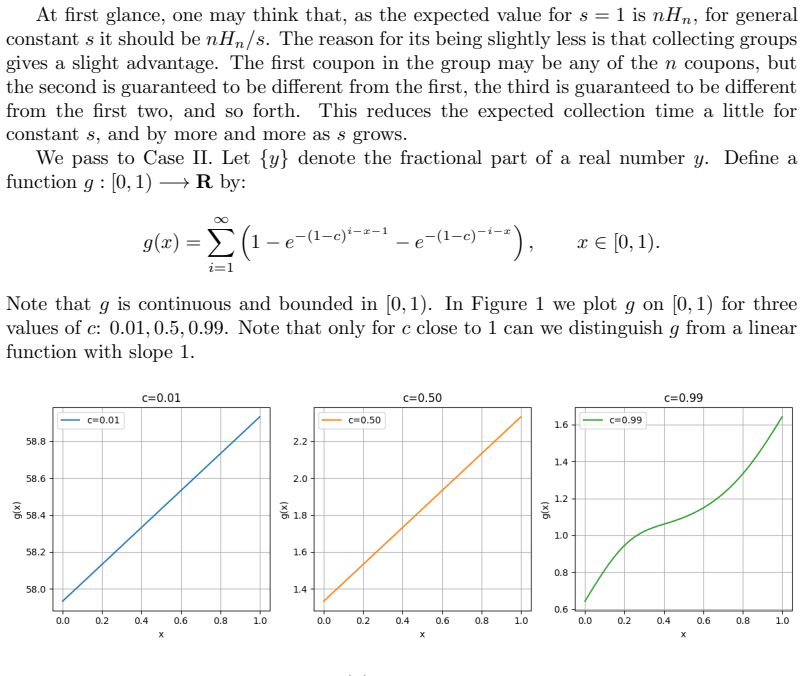
Precise asymptotics for expected draws in group coupon collection

Asymptotic Results for Uniform Group Drawing in the Coupon Collector's Problem

Formulas cover constant s, s linear in n, and s nearly n, replacing simulation with scaling rules for large totals

Figure from the paper full image
abstract click to expand
The article explores the asymptotic behavior of the expected number of drawings in the Coupon Collector's Problem with group-drawing under the uniform distribution. In this variant, each draw consists of a package of $s$ distinct coupons selected uniformly at random from a set of $n$ coupons. We focus on three regimes of the package size $s$: (i) constant $s$, (ii) $s$ proportional to $n$, and (iii) $s$ "very close" to $n$. For each case, we provide precise asymptotic expressions for the expected collection time. Keywords: Coupon Collector's Problem, Group Drawings, Uniform Distribution, Asymptotic Analysis, Expected Collection Time
0
0
math.PR 2026-05-08 Recognition

Activated random walks on villages obey law of large numbers

Law of large numbers for activated random walk on villages

As replica count n grows, stable particle counts and total activity converge to unique nonlinear equation solutions under subcriticality.

abstract click to expand
We consider activated random walk (ARW), an interacting particle system and prototypical model of self-organized criticality in a setting which combines mean-field behavior with the geometry of an arbitrary graph, which we call the village model of ARW, or VARW for short. VARW is obtained from a fixed graph by replacing each vertex with a 'village' that consists of n replicas of that vertex. We focus on VARW where particles walk according to a strictly sub-stochastic transition kernel on a finite underlying graph, so mass is sometimes lost (which guarantees that the system eventually stabilizes almost surely). Under a subcriticality assumption on the initial state we prove a law of large numbers as n goes to infinity for the resulting stable configuration of particles and the odometer of the process, to a limit which is uniquely characterized by a system of non-linear equations.
0
0
math.PR 2026-05-08

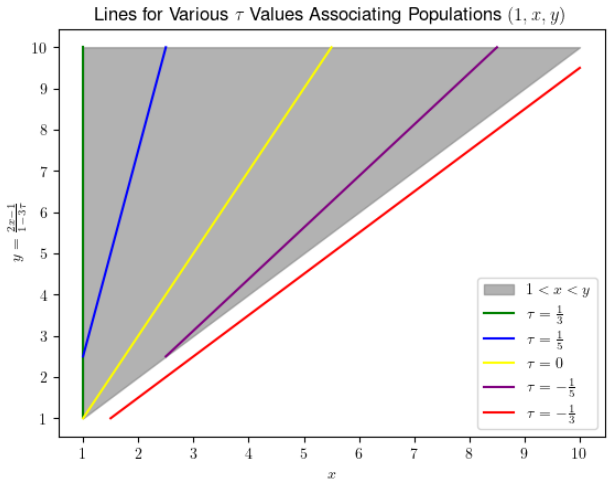
Quota violation probabilities stabilize in divisor methods

Probability of Quota Violations in Divisor Apportionment Methods with Nonzero Allocations

For fixed τ in three states, exact formulas show convergence to method-specific constants as seats increase.

Figure from the paper full image
abstract click to expand
Apportionment assigns indivisible items among groups. By the Balinski-Young theorem, no method can satisfy both house monotonicity and the quota rule. This paper investigates quota violations caused by nonzero allocation constraints, and derives exact probability formulas for their frequency. Such violations occur in systems like the U.S. House of Representatives, where each state is guaranteed at least one seat. We analyze the three-state case, introduce the $\tau$ statistic to parametrize population distributions, and prove an Asymptotic Quota Stabilization theorem: for fixed $\tau$, quota behavior stabilizes as populations grow, yielding probability results for quota violations determined by the set of ultimately violatory $\tau$ values. Applying this framework to the five classical divisor methods, we derive exact probability formulas. Additionally, we show that as the number of seats $M \to \infty$, these probabilities converge to method-specific constants. These results provide a precise, quantitative foundation for evaluating the fairness and frequency of quota violations in constrained apportionment systems.
0
0
math.PR 2026-05-08

Random walk mixes in log time on fast dynamical random-cluster graphs

Logarithmic Mixing of Random Walks on Dynamical Random Cluster Models

The joint mixing time is Θ(log n) when the update rate reaches ε log n in the subcritical regime, matching the static graph case.

Figure from the paper full image
abstract click to expand
We study random walks on dynamically evolving graphs, where the environment is given by a time-dependent subset of the edges of an underlying graph. Concretely, following the recently introduced framework of Lelli and Stauffer, we consider a random walk interacting with a dynamical random-cluster environment, in which edges are updated with rate $\mu>0$ according to Glauber dynamics with parameters $p$ and $q$, and the walker moves at rate 1 but may only traverse edges that are present at the time of the move. This setting introduces strong dependencies between the walk and the environment, as edge-update probabilities depend on the global connectivity structure. We focus on the case where the underlying graph is a random $d$-regular graph and the parameters lie in the subcritical regime $p < p_{\mathrm{u}}(q, d)$ where it is known that the Glauber dynamics mixes quickly. Our main result is to show that for any $\varepsilon >0$ and all $q \ge 1$, for all $p$ in the subcritical regime, the mixing time of the joint process is $\Theta(\log n)$ (in continuous time) whenever $\mu\geq \varepsilon \log n$. This matches the mixing time of the simple random walk on a static random regular graph, showing that in this regime the evolving environment does not slow down mixing. Our proof is based on a coupling argument that uses path-count techniques to overcome the dependencies in the edge dynamics by controlling the structure of the environment along typical trajectories.
0
0
math.PR 2026-05-08

Lévy-Khintchine drift swaps branching and interaction via Laplace duality

Continuous-state branching processes with L\'evy-Khintchine drift-interaction: Laplace duality and Fellerian extensions

The exchange uniquely determines the law of the process stopped at zero or infinity and supports Feller extensions at non-Lipschitz bounds.

Figure from the paper full image
abstract click to expand
We investigate the class of continuous-state branching processes with interaction driven by a L\'evy-Khintchine type drift (CBDI). These $[0,\infty]$-valued processes capture both dynamics of branching and density-dependence, allowing for cooperation at low population sizes and competition at high densities. Although the interaction breaks the branching property, the L\'evy--Khintchine form of the drift induces a Laplace duality. This duality expresses the Laplace transform of a CBDI process in terms of that of another CBDI process, in which the branching and drift-interaction mechanisms are exchanged. The process, stopped upon hitting either boundary $0$ or $\infty$, is uniquely characterized in law by these mechanisms. A Fellerian extension is constructed when the drift is non-Lipschitz and sufficiently strong at a boundary, allowing the process to leave this boundary continuously and possibly re-enter it. We identify parameters, defined in terms of the mechanisms and their associated scale function and potential measure, that determine the boundary behavior at $0$ and $\infty$ (entrance, exit or regular). Settings exhibiting all regimes, including regular-for-itself and non-sticky boundaries, arise when the mechanisms are assumed to be regularly varying. Our approach combines Laplace duality, which facilitates the analysis of semigroups and the construction of sharp Lyapunov functions for the associated generators, with comparison principles for a class of stochastic equations that ensure monotonicity and convergence properties of first-passage times.
0
0
math.PR 2026-05-08

GL_N(C) Brownian singular values scale to infinite SDE system and SPDE

mathsf{GL}_N(mathbb{C}) Brownian motion and stochastic PDE on entire functions

The edge limit satisfies log-interacting dynamics with exponential-bridge resampling and its characteristic polynomial obeys a nonlinear SP

abstract click to expand
We construct the full edge scaling limit of the singular values of Brownian motion on the general linear group $\mathsf{GL}_N(\mathbb{C})$ starting from general conditions. We show that the limiting paths solve an infinite system of SDE with log-interaction and have a Gibbs resampling property with exponential Brownian bridges. Moreover, we show that the evolution of the limiting rescaled reverse characteristic polynomial solves a stochastic partial differential equation with a non-linear multiplicative noise and linear drift. From a special initial condition the resulting line ensemble coincides, in logarithmic coordinates, with a line ensemble constructed by Ahn which arises as a universal scaling limit of singular values of products of random matrices. We prove some analogous results on the evolution of limiting characteristic polynomials for two models whose stationary measures are given by the Hua-Pickrell and Bessel stochastic zeta functions respectively.
0
0
math.PR 2026-05-08

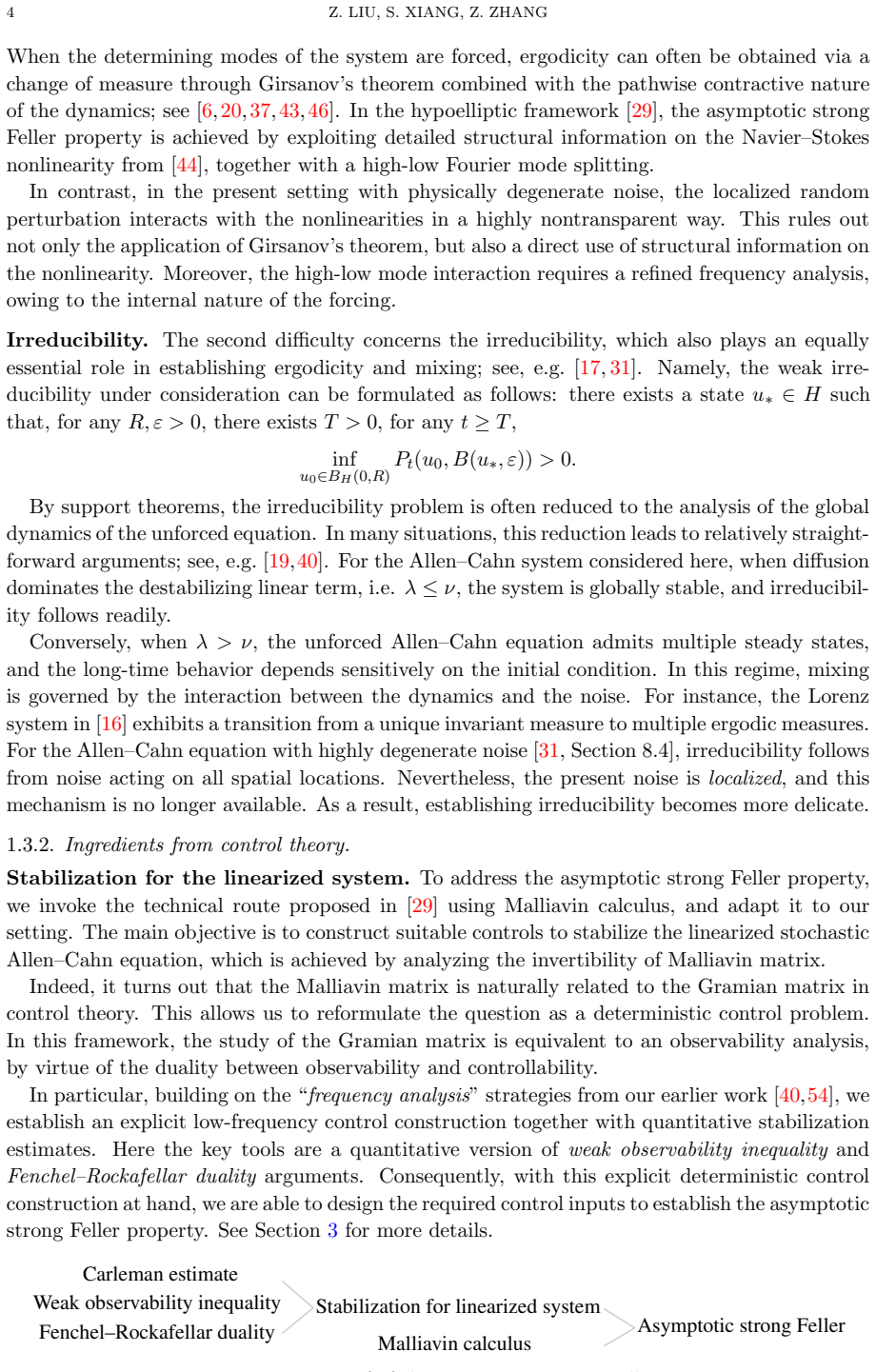
Localized noise yields unique invariant measure for Allen-Cahn

Exponential mixing for the stochastic Allen--Cahn equation with localized white noise

The Markov process converges exponentially to equilibrium even when the noise acts only on a subinterval of the bounded domain.

Figure from the paper full image
abstract click to expand
This paper studies the 1D stochastic Allen--Cahn equation on a bounded domain driven by localized white noise. We prove that the associated Markov process admits a unique invariant measure and is exponential mixing. The main challenge lies in the interaction between localized nature of the noise and non-trivial global dynamics of the system. To overcome this, our approach relies on two ingredients from PDE control theory: stabilization for the linearized system and global steady-state controllability for the nonlinear equation. The stabilization result is derived using the weak observability and Fenchel--Rockafellar duality, while the global controllability relies on quasi-static deformations combined with global dynamics.
0
0
math.PR 2026-05-08

Occupation measures match mixing rates for non-stationary processes

Convergence rate of the occupation measure of classes of ergodic processes toward their invariant distribution in mean Wasserstein distance

Conditional equilibrium convergence extends the rates to diffusions and fractional SDEs without regularization.

abstract click to expand
N. Fournier and A. Guillin obtained in their 2015 PTRF paper some bounds of the L^p-mean rate of convergence in Wasserstein distance of empirical distributions for a class of stationary mixing processes. In this paper, we propose to extend their strategy of proof and provide general criterions which allow to keep similar rates for a larger class of processes. These results (which do not require regularization techniques) lead to various applications to occupation measures of ergodic processes which may be not stationary or not Markovian under an assumption of {\em conditional} convergence to equilibrium in Total Variation or Wasserstein distance. We then provide explicit conditions which lead to these rates for Brownian diffusions and additive SDEs driven by fractional Brownian Motions {or by Gaussian processes with stationary increments}.
0
0
math.PR 2026-05-08

Constrained bridges solve Schrödinger problems

Schr\"odinger's problem with constraints

This yields convergence of equilibria with trading costs to the classical Kyle model as costs vanish.

abstract click to expand
Motivated by the connection between the Kyle equilibrium with static private signal and the Brownian bridge, we study a much broader class of bridges that allow one to consider more general equilibrium models, for example ones including trading costs and default risk. We show that such bridges are solutions to problems of the Schr\"odinger-type. Leveraging this connection, we obtain that the equilibria in models with trading costs converge to equilibria in the classical Kyle model.
0
0
math.PR 2026-05-08

Kato class equals finite-energy Radon measures

Classification and Metrization of Classes of Smooth measures

Classification by denseness and locality plus a Miyadera metric yields continuity of the Revuz correspondence.

abstract click to expand
We classify the several classes of the set of smooth measures from the perspective of the denseness and the locality, and consider their relationships, in particular, that of the Kato class and Radon measures of finite energy integrals. We also introduce the Miyadera metric on the Dynkin class, and obtain the continuity of the Revuz correspondence.
0
0
math.PR 2026-05-08

Polymer turns superdiffusive exactly at full replica symmetry breaking

Wandering Exponents and the Free Energy of the High-Dimensional Elastic Polymer

Infinite-dimensional limit yields explicit free energy and shows diffusive-to-superdiffusive transition coincides with one-step to full RSB.

Figure from the paper full image
abstract click to expand
We study the behavior of the elastic polymer, a model of a directed polymer in a continuous Gaussian random environment that is independent in time and correlated in space, as the dimension of the environment is taken to infinity. We give an explicit asymptotic formula for the free energy, which is given in terms of the distribution of the inner product of two sampled configurations, which we also obtain an implicit formula for. From this, we provide an explicit characterization of both the low- and high-temperature phases of this model in terms of the spatial correlation function of the environment. We find asymptotics for the wandering exponent when the spatial correlation function is either an exponential or a power-law decay. Our results show that when the correlations are either suitably weak or short ranged, the model is asymptotically diffusive. On the other hand, for suitably strong long ranged correlations, the model is asymptotically superdiffusive. Moreover, we show that this transition coincides exactly with another transition where the model goes from being one-step replica symmetry breaking to full-step replica symmetry breaking. This rigorously confirms many of the findings of Mezard and Parisi [53] in the physics literature.
0
0
math.PR 2026-05-07

Dimension conditions solve Wick stochastic equations on rough spaces

Wick Renormalized Parabolic Stochastic Quantization Equations on Rough Metric Measure Spaces

Hausdorff and walk dimensions plus heat kernel regularity determine when local and global solutions exist and carry invariant measures.

Figure from the paper full image
abstract click to expand
On metric measure spaces with sub-Gaussian heat kernel behavior in small time, we obtain a sufficient condition to solve Wick renormalized stochastic quantization equations with polynomial interaction. Given the power of the nonlinearity, the local solution condition depends on the Hausdorff dimension $d_h$, the walk dimension $d_w$, and the maximal spatial H\"older regularity of the heat kernel $\Theta$. A slightly more restrictive condition based on the same parameters is required for a global solution. For all global solutions, we construct an invariant measure for the Markov process defined by the solution. Our results apply to many rough spaces such as Barlow--Kigami type fractals as well as their Cartesian products and open up the possibility of making rigorous various structures in quantum field theory and statistical mechanics in non-integer dimensions. In the process, we build entirely from the short-time heat semigroup the necessary analytic framework that accommodates the issues which come with allowing rough local geometry.
0
0
math.PR 2026-05-07

Telegraph process exit distributions converge to Brownian motion

Dirichlet problems and exit distributions for the telegraph process and its planar extensions

Derived Dirichlet problems for intervals and strips reduce to diffusion results under high-velocity scaling

Figure from the paper full image
abstract click to expand
In this paper, we study boundary-value problems describing the exit distribution of finite-velocity random motions from prescribed domains. For the standard telegraph process, with and without drift, we derive the Dirichlet problems governing the exit point and mean exit time from a closed interval. We then extend the analysis to a planar finite-velocity model with orthogonal directions, for which we obtain the associated Laplace and Poisson-type equations for the exit distribution and mean exit time. In the special case of an infinite strip, explicit solutions are obtained. In all cases, we show that our equations and results converge, in the hydrodynamic limit, to the corresponding ones for Brownian motion.
0
0
math.PR 2026-05-07

Random walk returns connect to beta moments in any dimension

A Unified Approach to Beta Moments, Combinatorial Identities, and Random Walks

A unified probabilistic method proves combinatorial identities with beta and gamma functions and yields new ones.

abstract click to expand
The study of random walks has increasingly been popular across diverse disciplines such as statistics, mathematics, quantum physics, where they are used to model paths consisting of successive random steps in a mathematical space. A fundamental quantity of interest is the probability that a simple symmetric random walk returns to the origin after 2n steps. In this paper, we develop a unified probabilistic approach that connects the return probabilities in arbitrary dimensions with moment representations. Using this framework, we provide probabilistic proofs of several combinatorial identities involving beta and gamma functions, and derive new combinatorial identities in general dimensions.
0
0
math.PR 2026-05-07

Efron-Stein inequality holds for exchangeable pairs but not i.i.d

The Efron-Stein inequality for identically distributed pairs

A trigonometric counterexample shows the bound can worsen by a factor of n when pairs are only identically distributed.

abstract click to expand
We prove that the classical Efron--Stein inequality holds for independent exchangeable pairs \((X_i,Y_i)\). The same inequality fails for independent identically distributed pairs; a simple trigonometric counterexample shows that the trivial Cauchy--Schwarz bound of factor \(n\) is sharp. When each random variable takes at most \(k_i\) values, a useful bound still holds with explicit constant \(\rho(k)\le\max_i k_i/2\).
0
0
math.PR 2026-05-07

Five inequalities found via Grok collaboration

Grokability in five inequalities

Authors prove improvements to Gaussian perimeters, hypercube moments, autoconvolutions, Sidon sets, and Szarek bounds

abstract click to expand
In this note, we report five mathematical discoveries made in collaboration with Grok, all of which have been subsequently verified by the authors. These include an improved lower bound on the maximal Gaussian perimeter of convex sets in $\mathbb{R}^n$, sharper $L_2$-$L_1$ moment comparison inequalities on the Hamming cube $\{-1,1\}^n$, a strengthened autoconvolution inequality, improved asymptotic bounds on the size of the largest $g$-Sidon sets in $\{1,\dots,n\}$, and an optimal balanced Szarek's inequality.
0
0
math.PR 2026-05-07

Extending sigma-algebra restores L1-L∞ duality for uncertain measures

Can the L¹-L^infty duality be restored for non-dominated families of probability measures?

The smallest complete extension makes quasi-surely bounded functions the dual of signed measures continuous to some member of the family.

abstract click to expand
The duality $L^{\infty}\simeq (L^{1})'$ frequently breaks down in the presence of model uncertainty, where a single reference measure $P$ is replaced by a non-dominated family of probability measures $\mathcal{P}$. The unavailability of classical measure-theoretic and functional-analytic tools in this regime poses a significant obstacle to developing robust probabilistic frameworks. We show that this duality can be restored for a broad class of robust statistical models by extending the underlying probability space. Specifically, on the extended model, the space $\mathbb{L}^{\infty}(\mathcal{P})$ of $\mathcal{P}$-quasi-surely bounded functions is isometrically isomorphic to the dual of the space of finite signed measures absolutely continuous with respect to at least one element of $\mathcal{P}$. The proposed extension is canonical: it is the smallest $\mathcal{P}$-complete extension of the original $\sigma$-algebra for which $\mathbb{L}^{\infty}(\mathcal{P})$ is the dual of any normed space. Our assumptions encompass several prominent non-dominated settings, including infinite product measures, Gaussian processes, the Black-Scholes model with uncertain constant volatility and drift, robust binomial models, and, more generally, infinite sequences from any parametric model with almost surely estimable parameters. Furthermore, we unify the existing frameworks of Cohen (2012) and Liebrich et al. (2022), demonstrating that our construction is equivalent to the capacity-based approach under mild assumptions satisfied by the aforementioned examples. Finally, we apply our theory to extend Kraft's (1955) characterization of strictly unbiased hypothesis tests to non-dominated cases.
0
0
math.PR 2026-05-07

First server shifts expected tennis games by at most one

First server effect on the expected number of games in tennis

The change occurs only in specific ranges of serve strengths and is supported by professional match data under fixed probabilities.

Figure from the paper full image
abstract click to expand
We show that information on the first server influences the expected total number of games and margin in a tennis match under the standard assumption that each player's serve point win probability remains constant, and identify the exact regions, in terms of these probabilities, in which this effect is non-negligible. We confirm numerically that this effect is bounded by at most one game at both the set and match level. We complement the analysis with an empirical comparison on professional match data, illustrating the adequacy of the constant-probability assumption for modelling the total number of games.
0
0
math.PR 2026-05-07

Rank-based killing yields reaction-diffusion limits

Branching Brownian motion with rank-based selection and reaction-diffusion equations

Branching Brownian motion with rank-dependent killing converges to a PDE whose nonlinearity depends on the killing function, generalizing N-

Figure from the paper full image
abstract click to expand
We consider a family of branching-selection particle systems in which particles branch at time dependent rate $r$ and are killed with a probability which is dependent on their rank via some function $\psi$. We show that, under fairly minimal conditions, the hydrodynamic limit of such a system is given by the reaction-diffusion equation $U_t = \frac12 U_{xx} + r(t)G(U)$ with nonlinearity $G(U)$ which is a function of $\psi$. This is a significant generalisation of the well-studied $N$-BBM process, and is similar to the family of `$(b,D)$-BBM' processes described by Groisman \& Soprano-Loto (arXiv:2008.09460). On the one hand, this allows us to understand common reaction-diffusion equations as limits of interacting particle systems with simple descriptions. On the other hand, the asymptotic behaviour of solutions of the reaction-diffusion PDEs can help us predict the asymptotic properties of the associated particle systems. We give general conditions under which the branching-selection particle system has an asymptotic velocity, and describe the velocity up to order $(\log N)^{-2}$; furthermore, we describe the connection between this velocity and the spreading speeds and travelling waves of the corresponding reaction-diffusion equation. This provides a partial weak selection principle.
0
0
math.PR 2026-05-07

Independence defined before probability yields extension theorem

Revisiting the logical independence

Sigma-logical independence plus identical ranges suffice for classical limit theorems to hold.

abstract click to expand
It has been widely acknowledged that probabilistic independence and logical independence cannot be coherently reconciled. By bridging these two notions, this paper addresses three long-standing problems that have puzzled the field of probability theory: Should probability be defined prior to independence, or independence prior to probability? How ought independence to be formulated for signed measures and families of probability measures? Why do the conclusions of classical limit theorems remain valid even when practical scenarios violate their underlying assumptions? By introducing logical independence and $\sigma$-logical independence, we establish the probability extension theorem. This result not only demonstrates that independence ought to be defined before probability, but also endows logical independence with probabilistic machinery, thereby rendering it computationally tractable in the same manner as probabilistic independence. Then, we investigate how independence should be defined when multiple measures are involved. Finally, we prove that limit theorems can hold true under two intuitive conditions: $\sigma$-logical independence and identical range of random variables.
0
0
math.PR 2026-05-07

Delayed jump equations converge to one long-run distribution

Ergodicity of stochastic functional differential equation with jumps and finite delay

Exponential decay of coupled processes plus a support theorem yield ergodicity in Wasserstein distance for these memory-dependent stochastic

abstract click to expand
This paper investigates the ergodicity of stochastic functional differential equations with jumps under the Wasserstein distance by the generalized coupling method. Two key conditions are verified. The first is verified by establishing an exponential decay bound for the coupled segment processes and applying the Girsanov theorem for It\^o-L\'evy processes. The second is verified through a support theorem developed for an auxiliary process and then extended to the underlying process. Combining these results yields the desired ergodicity.
0
0
math.PR 2026-05-06

Unique solutions exist for reflected BSDEs with default and irregular barriers

Well-posedness of reflected BSDEs with default time and irregular barrier: An application to optimal control

Stochastic Lipschitz drivers and a modified penalization method yield existence and uniqueness; semi-continuity turns the solution into an f

abstract click to expand
We consider a reflected backward stochastic differential equations with default time and an optional barrier in a filtration generated by a one-dimensional Brownian motion and a defaultable process. We suppose that the barrier have trajectories with left and right finite limits. We provide the existence and uniqueness result when the coefficient is scholastic Lipschitz by using a modified penalization method. Under an additional assumption of right-upper semi-continuity along stopping times on the trajectories of the barrier, we characterize the state process for such RBSDEs as the value function of an optimal stopping problem associated with a non-linear $f$-expectation.
0
0
math.PR 2026-05-06 2 theorems

Sobolev norms yield convergence rates for fractional SDE fitting

Error analysis for learning fractional stochastic differential equations with applications in neural approximations

Unified bounds on discretization, coefficient approximation and fitting errors incorporate trajectory regularity for neural estimators.

Figure from the paper full image
abstract click to expand
This paper develops a framework for the error analysis in nonparametric model fitting of fractional stochastic differential equations based on discrete observations. We identify and quantify the main error sources -- time discretization, coefficient approximation, and model fitting error -- within a unified framework. Through Sobolev-type norms, we derive convergence rates that incorporate the regularity of trajectories, thereby capturing the interaction of these error components. To demonstrate the applicability of the theory, we introduce a training scheme for coefficient function estimation based on shallow neural networks and a recurrent architecture. Numerical experiments validate the theoretical findings and illustrate the effectiveness of the approach.
0
0
math.PR 2026-05-06 3 theorems

One log-mean criterion settles four dispersal rules at once

Catastrophe-dispersion models in random and varying environments across generations

Catastrophe-dispersion populations live or die by Σ log μ_k, and a fixed ordering of mean offspring makes the threshold universal.

abstract click to expand
We study a class of branching processes in which the offspring distribution is not specified directly but is induced by a cycle of internal colony growth, catastrophic reduction and structured dispersal. The parameters governing growth, survival and dispersal are allowed to vary deterministically or randomly from one generation to the next, giving rise to branching processes in varying and random environments with implicitly defined offspring laws. We show that survival and extinction are governed entirely by the associated log-mean process, exactly as in the classical theory. The paper treats four qualitatively different dispersal mechanisms and establishes a universal ordering of the induced offspring means. For Poissonian growth with binomial survival, explicit thresholds are obtained that determine extinction or survival uniformly over all four mechanisms. A series of ecologically motivated examples with Yule-Simon growth illustrates the versatility of the framework.
0
0
math.PR 2026-05-06 2 theorems

Log-mean process alone decides survival in varying branching models

Catastrophe-dispersion models in random and varying environments across generations

Catastrophe-dispersal cycles with changing parameters retain the classical extinction criterion across four mechanisms

abstract click to expand
We study a class of branching processes in which the offspring distribution is not specified directly but is induced by a cycle of internal colony growth, catastrophic reduction and structured dispersal. The parameters governing growth, survival and dispersal are allowed to vary deterministically or randomly from one generation to the next, giving rise to branching processes in varying and random environments with implicitly defined offspring laws. We show that survival and extinction are governed entirely by the associated log-mean process, exactly as in the classical theory. The paper treats four qualitatively different dispersal mechanisms and establishes a universal ordering of the induced offspring means. For Poissonian growth with binomial survival, explicit thresholds are obtained that determine extinction or survival uniformly over all four mechanisms. A series of ecologically motivated examples with Yule-Simon growth illustrates the versatility of the framework.
0

browse all of math.PR → full archive · search · sub-categories