REVIEW 3 major objections 6 minor 57 references
Exact distribution-free tests of spherical symmetry applicable to high dimensional data
T0 review · 3 major / 6 minor · reviewed 2026-08-11 · deepseek-v4-flash
Pith's one-line read Spherical symmetry can be tested distribution-free in any dimension by reading string signs and ranks off a shortest covering path in an augmented data set.
desk verdict The exact distribution-free null result is secure; the open gap is whether the implemented Prim heuristic inherits the consistency theorems proven for the exact path. read the letter →
The pith
A machine-rendered reading of the paper's core claim, the machinery that carries it, and where it could break.
The reading
What carries the argument
The load-bearing object is the shortest covering path on the augmented complete graph: given $X_1,\dots,X_n$ and independent spherical copies $X_1',\dots,X_n'$, the path minimizes the sum of edge costs $\theta(Z_i,Z_j)=\exp\{-(Z_i^\top Z_j/d)^2\}$ (or $\tilde\theta$ for scale alternatives) while visiting exactly one member of each pair $\{X_i,X_i'\}$. The binary choice at each pair is the string sign $S_i$; the position along the path is the string rank $R_i$. Under the null the pairs are exchangeable, which forces $(S,R)$ to be uniform on $\{0,1\}^n \times S_n$ and independent; this uniformity is the mechanism that transfers the classical univariate distribution-free property to arbitrary dimension.
What would settle it
For a fixed small sample size such as $n=6$ or $n=8$, simulate many datasets from an alternative satisfying condition (3.1) at large $d$ (for example, a spiked covariance model), enumerate all covering paths to find the exact shortest path $P$, and compare the sign and runs statistics on $P$ with those on the Prim heuristic path $P_0$; if $P_0$ gives $T_S < n$ or $T_R > 1$ with non-negligible frequency while $P$ gives $T_S = n$ and $T_R = 1$, the consistency theorem does not apply to the implemented test.
Extended reading notes
Core claim
The central claim is that spherical symmetry of a $d$-dimensional distribution can be tested by comparing each observation $X_i$ with an independent spherically symmetric copy $X_i' = \|X_i\|U_i$, $U_i \sim \mathrm{Unif}(S^{d-1})$, in a graph whose edge costs are $\theta(Z_i,Z_j)=\exp\{-(Z_i^\top Z_j/d)^2\}$. The shortest covering path through the $2n$ augmented points chooses exactly one of $\{X_i, X_i'\}$ for each $i$; the choices form the string sign vector $S$ and the positions form the string rank vector $R$. Theorem 2.1 shows that under the null, $S \sim \mathrm{Unif}(\{0,1\}^n)$, $R \sim \mathrm{Unif}(S_n)$, and $S$ and $R$ are independent, so $T_S = \sum_i S_i$ and $T_R = 1 + \sum_{i=1}^{n-1} I\{S_{\pi_i} \ne S_{\pi_{i+1}}\}$ have exact null distributions equal to the classical univariate sign and runs tests in every dimension. Under condition (3.1) the sign vector converges to all ones in high dimension, giving consistency of sign and runs tests in the HDLSS regime; with a modified cost $\tilde\theta(Z_i,Z_j)=\exp\{-\frac1d \sum_q Z_{iq}^2 Z_{jq}^2\}$, detection of scale alternatives is proved, and the two are combined into modified tests consistent under either signal. The unknown-center case is handled by applying the tests to the differences $X_i - X_{n/2+i}$, which retain the exact distribution-free property.
Load-bearing premise
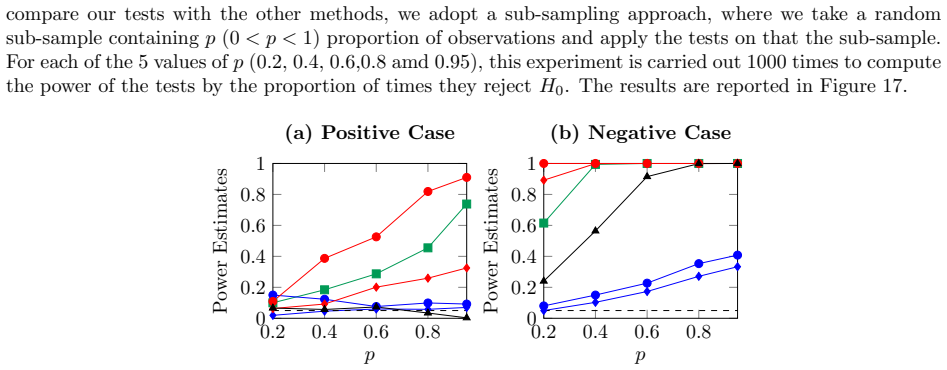
The consistency theorems are proved for the exact shortest covering path, but the implemented algorithm is a Prim-based heuristic that can return a suboptimal path; the paper assumes, without proof, that the heuristic yields the same sign and runs statistics under alternatives in the high-dimensional regimes, supported by a simulation with only five observations.
Editorial extensions
If this is right
- A practitioner can test spherical symmetry when $d \gg n$ using ordinary univariate sign-test and runs-test tables; no permutation resampling or dimension-dependent critical values are needed.
- In the high-dimension, low-sample-size regime, the sign statistic converges to $n$ and the runs statistic to $1$ in probability for alternatives satisfying condition (3.1), so both tests are consistent once $n$ is large enough that $2^n > 1/\alpha$ for the sign test.
- In the high-dimension, high-sample-size regime, the null distributions of $T_S$ and $T_R$ are asymptotically normal with variance $1/4$, still independent of dimension.
- The modified cost function $\tilde\theta$ yields consistent tests against alternatives where only the diagonal scales of the covariance differ, and the Bonferroni-combined modified tests are consistent under either the inner-product condition or the scale condition.
- When the center of symmetry is unknown, replacing observations by pairwise differences $X_i - X_{n/2+i}$ gives an exact distribution-free test and avoids the inflated Type I error caused by centering in high dimensions.
Reading between the lines
- The same exchangeability argument would produce exact distribution-free tests for other composite nulls in which each observation has a family of alternatives definable by a cost on an augmented graph; for example, tests of elliptical symmetry after a robust whitening step, though standardization would likely destroy exactness and need calibration.
- The practical gap between the exact path $P$ and the Prim heuristic $P_0$ is the main unproved step; a natural extension is to prove or test that $P_0$ tracks $P$ under condition (3.1), or to use exact enumeration for small $n$ as a gold-standard benchmark.
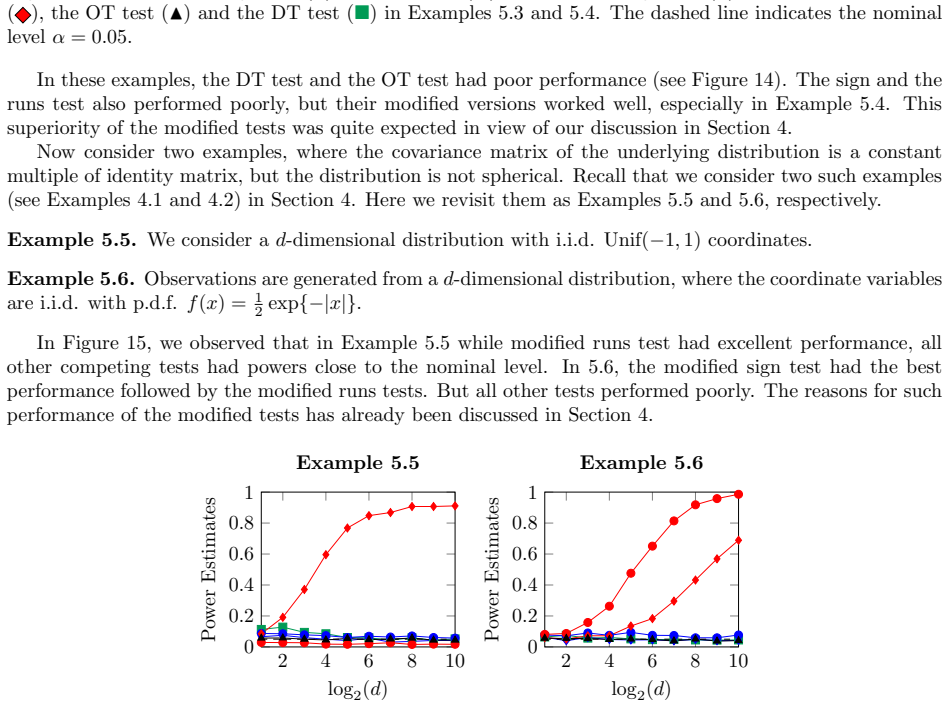
- Alternatives with scalar covariance but non-spherical coordinates (e.g., i.i.d. Laplace coordinates) are not covered by either consistency theorem; the paper shows empirical power for two such examples, suggesting a possible regime where the tests are consistent but the proof would need new conditions beyond (3.1) and (4.2).
- Pairwise differencing for unknown center halves the effective sample size; using overlapping differences could improve power but would break exact independence, an extension worth exploring.
Signed reviews
Editorial analysis
A structured set of objections, weighed in public.
Referee Report
Summary. The paper proposes new tests of spherical symmetry for multivariate distributions based on data augmentation and a graph-based notion of string signs and string ranks. A shortest covering path is constructed on the augmented set of original observations and their spherically symmetric variants, and test statistics are built from the sign and rank sequences along that path. The central theoretical result, Theorem 2.1, states that under the null hypothesis of spherical symmetry the string signs are uniform on {0,1}^n, the string ranks are uniform on the permutation group, and the two are independent, irrespective of the dimension. Consistency is claimed in the HDLSS regime under condition (3.1) for the original sign/runs tests and under condition (4.2) for the modified tests, and in the HDHSS regime under additional assumptions. The paper also presents a sample-splitting extension for an unknown center of symmetry and reports simulations and a real-data analysis comparing the proposed tests with optimal-transport and density-based competitors.
Significance. If the main claims hold, the paper makes a useful contribution: it provides genuinely distribution-free tests of spherical symmetry that work even when the dimension is much larger than the sample size, and it gives a new way to convert a high-dimensional symmetry problem into univariate sign and runs problems. The null distribution result in Theorem 2.1 is elegant and appears correct, and the observation that the test statistics are exactly distribution-free regardless of dimension is valuable in an area where many high-dimensional tests are only asymptotically calibrated. The paper also includes R code in supplementary material, and the consistency theorems are stated under explicit conditions rather than being left entirely to heuristics. The main weakness is that the consistency theorems are proved for the exact shortest covering path P, while the implemented algorithm is a Prim-based heuristic P0; the paper only provides a small simulation study linking the two. This leaves the alternative-side theory of the actual implemented test incomplete.
major comments (3)
- [§2.3 and §3.1, Theorem 3.2 / Theorem 4.1(b) / Theorem 4.2] The consistency theorems are proved for the exact shortest covering path P defined by the minimizer in (2.2) and (4.1), but the tests implemented and simulated in Section 5 and Section 6 use the Prim-based heuristic P0 described in Section 2.3. The paper explicitly concedes that P0 may be suboptimal and supports the identification of P0 with P only by the n=5 simulation in Figure 4. No theorem shows that P0 inherits the key degeneracy property S → 1_n (or T_M^S → n and T_M^R → 1) under the alternatives covered by conditions (3.1) and (4.2). Since a suboptimal path could in principle contain many spherically symmetric variants X'_i even when the exact path is all-X, the claimed consistency of the tests actually shipped is not established. This is a load-bearing gap between theory and implementation.
- [§3.2, Theorem 3.4 and following paragraph; §3.2 Theorem 3.6] The claimed HDHSS consistency of the sign and runs tests is conditional on inequalities that are not derived from explicit distributional assumptions. For the sign test, the text states that under H1, p_S is 'expected to be higher' than 0.5, and consistency is asserted when p_S > 0.5; for the runs test, consistency is asserted when p_R < 0.5. No theorem establishes p_S > 0.5 or p_R < 0.5 for any concrete class of non-spherical alternatives beyond the already-proven degeneracies under condition (3.1), which are again stated for the exact P. Similarly, Theorem 4.4 assumes the relevant limits of E[TS/n] or E[~TS/n] are away from 0.5 without giving sufficient conditions on P. Thus the HDHSS consistency statement in the abstract is stronger than what is proved.
- [§6, sample-splitting extension] The sample-splitting procedure for the unknown-center case is presented as a generalization with the exact distribution-free property and asymptotic properties 'similar' to those in Sections 3 and 4, but no proofs are given for these claims. Lemma 6.1 establishes only that spherical symmetry of the differenced distribution is equivalent to spherical symmetry of the original distribution; it does not establish the distribution-free property of the resulting test or its consistency under the HDLSS/HDHSS alternatives. Since this section is advertised in the introduction and abstract, the missing formal support should be either supplied or explicitly left as a conjecture.
minor comments (6)
- [§2.2] There are several typos: 'string' is written as 'sting' in 'signs and string ranks' and 'sting ranks'; 'δ denotes the the indicator function' has a doubled article.
- [§3.2, first sentence] The sentence begins 'In thus section' instead of 'In this section'.
- [§4, before Theorem 4.1] The phrase 'where we do have no signals from the diagonal part' appears in the discussion of Example 3.1; the intended meaning is clear but the wording should be corrected.
- [Figure 2 caption vs. §2.2 text] The caption of Figure 2 says 'over 100 simulations', but the text of §2.2 says the experiment was repeated 1000 times; these numbers should be reconciled.
- [§5.1] The text contains a typo: 'he DT test' instead of 'the DT test'.
- [§3.1, Theorem 3.2, displayed condition] The notation in condition (3.1) writes the probability with 'P[...] → 1 for all M > 0'; since the quantity inside depends on d, it would be clearer to write the limit as d → ∞ explicitly.
Circularity Check
No material circularity: the null distribution follows from exchangeability of the augmented sample, and the consistency results are conditional on stated sufficient conditions about the alternative, not on the target conclusion.
full rationale
I walked the derivation chain. The key distribution-free result, Theorem 2.1(a), is proved from the exchangeability of (X_i, X'_i) under spherical symmetry: in the proof, the probability that (S, Pi) equals (s0, pi0) is P[T(s0, pi0) <= T(s, pi) for all s, pi], and because the T(s, pi) are exchangeable under H0, this probability is identical for every (s0, pi0), giving uniformity and independence. No fitted parameter, estimated quantity, or prior conclusion is used in that derivation. The consistency theorems are explicitly conditional statements: Theorem 3.2 assumes condition (3.1), and Theorem 4.1(b) assumes Assumption (A3) and condition (4.2). These conditions describe when original-original inner products (or their squared-coordinate analogs) dominate original-augmented and augmented-augmented ones, which then forces the string signs to converge to 1_n. That is a genuine sufficient-condition proof, not a restatement of the test statistic's definition. Self-citations appear (Biswas et al. 2015 for the Prim-based heuristic; Banerjee and Ghosh 2024 for a density formula and a contiguity proposition in the auxiliary Pitman-efficiency theorem), but they are used for algorithmic motivation or technical support, not to assume the current paper's main claims. Section 2.3 openly concedes that the implemented heuristic P0 may be suboptimal and validates the sign/runs statistics only by a small n=5 simulation; this is a real gap between the exact-path consistency theorems and the implemented algorithm, and it is a correctness risk rather than a circularity, because the null distribution is claimed for P0 directly via exchangeability and the consistency theorems are not claimed to transfer automatically to P0. No fitted input is renamed as a prediction, and no uniqueness theorem from the authors' prior work is invoked to force the construction. The paper is therefore not circular in its central derivation.
Assumptions & free parameters
free parameters (1)
- kernel inverse-scale 1/d in theta and e_theta =
1/d (chosen, not fitted)
assumptions (6)
- standard math Lemma 2.1 (Fang et al.) characterization of spherical symmetry: X is spherical iff X D= ||X||U with U uniform on the unit sphere independent of X.
- standard math Lemma 2.2 (Maa et al. 1996) characterization via interpoint distances: distributional equality of h(X1,X2), h(X1,X'2), h(X'1,X'2) iff P is spherical, under regularity conditions and square-integrable density.
- domain assumption Assumptions (A1)-(A2) from Jung and Marron (2009): zero mean, bounded fourth moments, rho-mixing, and sphericity condition epsilon -> 0 for Theorem 3.1.
- domain assumption Alternative condition (3.1): d(X1^T X2)^2/(||X1||^2||X2||^2) -> infinity in probability for non-spherical P, used for HDLSS consistency.
- domain assumption Assumption (A3): concentration of coordinate-wise squared products at rate d^{-alpha} with nonzero limit, used for Theorem 4.1.
- ad hoc to paper The Prim-based heuristic P0 asymptotically reproduces the test statistics of the exact shortest covering path P under alternatives.
Cite this review
Pith. "Pith review of Exact distribution-free tests of spherical symmetry applicable to high dimensional data." pith.science (2026). https://pith.science/paper/5L5ZY5CP
@misc{pith2026241205608,
  author       = {Pith},
  title        = {Pith review of: Exact distribution-free tests of spherical symmetry applicable to high dimensional data},
  year         = {2026},
  howpublished = {\url{https://pith.science/paper/5L5ZY5CP}},
  note         = {Machine review of arXiv:2412.05608}
}
read the original abstract
We develop some graph-based tests for spherical symmetry of a multivariate distribution using a method based on data augmentation. These tests are constructed using a new notion of signs and ranks that are computed along a path obtained by optimizing an objective function based on pairwise dissimilarities among the observations in the augmented data set. The resulting tests based on these signs and ranks have the exact distribution-free property, and irrespective of the dimension of the data, the null distributions of the test statistics remain the same. These tests can be conveniently used for high-dimensional data, even when the dimension is much larger than the sample size. Under appropriate regularity conditions, we prove the consistency of these tests in high dimensional asymptotic regime, where the dimension grows to infinity while the sample size may or may not grow with the dimension. We also propose a generalization of our methods to take care of the situations, where the center of symmetry is not specified by the null hypothesis. Several simulated data sets and a real data set are analyzed to demonstrate the utility of the proposed tests.
Figures


Figures from the paper (18 more)





Reference graph
Works this paper leans on
-
[1]
Ahn, J., Lee, M. H., and Yoon, Y. J. (2012). Clustering high dimension, low sample size data using the maximal data piling distance. Statist. Sinica , 22(2):443--464
work page 2012
-
[2]
Ahn, J., Marron, J., Muller, K. M., and Chi, Y.-Y. (2007). The high-dimension, low-sample-size geometric representation holds under mild conditions. Biometrika , 94(3):760--766
work page 2007
-
[3]
Albisetti, I., Balabdaoui, F., and Holzmann, H. (2020). Testing for spherical and elliptical symmetry. J. Multivariate Anal. , 180:104667
work page 2020
-
[4]
Banerjee, B. and Ghosh, A. K. (2024). A consistent test of spherical symmetry for multivariate and high-dimensional data via data augmentation. arXiv preprint arXiv:2403.12491
arXiv 2024
-
[5]
Banerjee, B. and Ghosh, A. K. (2025). On high dimensional behaviour of some two-sample tests based on ball divergence. Statist. Sinica (To appear) , 35(3)
work page 2025
-
[6]
Baringhaus, L. (1991). Testing for spherical symmetry of a multivariate distribution. Ann. Statist. , 19(2):899--917
work page 1991
-
[7]
Benjamini, Y. and Hochberg, Y. (1995). Controlling the false discovery rate: a practical and powerful approach to multiple testing. J. R. Stat. Soc. Ser. B. Stat. Methodol. , 57(1):289--300
work page 1995
-
[8]
Benjamini, Y. and Yekutieli, D. (2001). The control of the false discovery rate in multiple testing under dependency. Ann. Statist. , 29(4):1165--1188
work page 2001
Show all 57 references
-
[9]
Bhattacharya, B. B. (2019). A general asymptotic framework for distribution-free graph-based two-sample tests. J. R. Stat. Soc. Ser. B. Stat. Methodol. , 81(3):575--602
2019
-
[10]
Biswas, M., Mukhopadhyay, M., and Ghosh, A. K. (2014). A distribution-free two-sample run test applicable to high-dimensional data. Biometrika , 101(4):913--926
2014
-
[11]
Biswas, M., Mukhopadhyay, M., and Ghosh, A. K. (2015). On some exact distribution-free one-sample tests for high dimension low sample size data. Statist. Sinica , 25(4):1421--1435
2015
-
[12]
Brown, B. M. (1971). Martingale central limit theorems. Ann. Math. Statist. , 42:59--66
1971
-
[13]
and Hall, P
Chan, Y.-B. and Hall, P. (2009). Scale adjustments for classifiers in high-dimensional, low sample size settings. Biometrika , 96(2):469--478
2009
-
[14]
Chaudhuri, P. (1996). On a geometric notion of quantiles for multivariate data. J. Amer. Statist. Assoc. , 91(434):862--872
1996
-
[15]
and Sengupta, D
Chaudhuri, P. and Sengupta, D. (1993). Sign tests in multidimension: inference based on the geometry of the data cloud. J. Amer. Statist. Assoc. , 88(424):1363--1370
1993
-
[16]
and Tong, H
Diks, C. and Tong, H. (1999). A test for symmetries of multivariate probability distributions. Biometrika , 86(3):605--614
1999
-
[17]
Ding, X. (2020). Some sphericity tests for high dimensional data based on ratio of the traces of sample covariance matrices. Statist. Probab. Lett. , 156:108613
2020
-
[18]
and Ghosh, A
Dutta, S. and Ghosh, A. K. (2016). On some transformations of high dimension, low sample size data for nearest neighbor classification. Mach. Learn. , 102(1):57--83
2016
-
[19]
Dutta, S., Sarkar, S., and Ghosh, A. K. (2016). Multi-scale classification using localized spatial depth. J. Mach. Learn. Res. , 17:Paper No. 218, 30
2016
-
[20]
T., Kotz, S., and Ng, K
Fang, K. T., Kotz, S., and Ng, K. W. (1990). Symmetric M ultivariate and R elated D istributions , volume 36 of Monographs on Statistics and Applied Probability . Chapman and Hall, London
1990
-
[21]
T., Zhu, L
Fang, K. T., Zhu, L. X., and Bentler, P. M. (1993). A necessary test of goodness of fit for sphericity. J. Multivariate Anal. , 45(1):34--55
1993
-
[22]
and Liu, B
Feng, L. and Liu, B. (2017). High-dimensional rank tests for sphericity. J. Multivariate Anal. , 155:217--233
2017
-
[23]
E., and Wells, M
Fourdrinier, D., Strawderman, W. E., and Wells, M. T. (2018). Shrinkage E stimation . Springer Series in Statistics. Springer, Cham
2018
-
[24]
Friedman, J. H. and Rafsky, L. C. (1979). Multivariate generalizations of the W ald- W olfowitz and S mirnov two-sample tests. Ann. Statist. , 7(4):697--717
1979
-
[25]
Garey, M. R. and Johnson, D. S. (1979). Computers and I ntractability . A Series of Books in the Mathematical Sciences. W. H. Freeman and Co., San Francisco, CA
1979
-
[26]
Ghosh, A. K. and Biswas, M. (2016). Distribution-free high-dimensional two-sample tests based on discriminating hyperplanes. TEST , 25(3):525--547
2016
-
[27]
Ghosh, A. K. and Chaudhuri, P. (2005). On maximum depth and related classifiers. Scand. J. Statist. , 32(2):327--350
2005
-
[28]
e., and Sen, P
H\'ajek, J., Sid\'ak, Z. e., and Sen, P. K. (1999). Theory of R ank T ests . Probability and Mathematical Statistics. Academic Press, Inc., San Diego, CA
1999
-
[29]
S., and Neeman, A
Hall, P., Marron, J. S., and Neeman, A. (2005). Geometric representation of high dimension, low sample size data. J. R. Stat. Soc. Ser. B Stat. Methodol. , 67(3):427--444
2005
-
[30]
Henze, N. (1988). A multivariate two-sample test based on the number of nearest neighbor type coincidences. Ann. Statist. , 16(2):772--783
1988
-
[31]
Henze, N., Hl\' a vka, Z., and Meintanis, S. G. (2014). Testing for spherical symmetry via the empirical characteristic function. Statistics , 48(6):1282--1296
2014
-
[32]
and Sen, B
Huang, Z. and Sen, B. (2023). Multivariate symmetry: Distribution-free testing via optimal transport. arXiv preprint arXiv:2305.01839
2023 arXiv
-
[33]
J \"o rnsten, R. (2004). Clustering and classification based on the L_1 data depth. J. Multivariate Anal. , 90(1):67--89
2004
-
[34]
and Marron, J
Jung, S. and Marron, J. S. (2009). PCA consistency in high dimension, low sample size context. Ann. Statist. , 37(6B):4104--4130
2009
-
[35]
Kim, I., Balakrishnan, S., and Wasserman, L. (2020). Robust multivariate nonparametric tests via projection averaging. Ann. Statist. , 48(6):3417--3441
2020
-
[36]
Koltchinskii, V. I. and Li, L. (1998). Testing for spherical symmetry of a multivariate distribution. J. Multivariate Anal. , 65(2):228--244
1998
-
[37]
Lehmann, E. L. and Romano, J. P. (2021). Testing S tatistical H ypotheses . Springer Texts in Statistics. Springer, Cham
2021
-
[38]
A., and Liu, R
Li, J., Cuesta-Albertos, J. A., and Liu, R. Y. (2012). DD -classifier: N onparametric classification procedure based on DD -plot. J. Amer. Statist. Assoc. , 107(498):737--753
2012
-
[39]
Liang, J., Fang, K.-T., and Hickernell, F. J. (2008). Some necessary uniform tests for spherical symmetry. Ann. Inst. Statist. Math. , 60(3):679--696
2008
-
[40]
and Modarres, R
Liu, Z. and Modarres, R. (2011). A triangle test for equality of distribution functions in high dimensions. J. Nonparametr. Stat. , 23(3):605--615
2011
-
[41]
K., and Bartoszy\' n ski, R
Maa, J.-F., Pearl, D. K., and Bartoszy\' n ski, R. (1996). Reducing multidimensional two-sample data to one-dimensional interpoint comparisons. Ann. Statist. , 24(3):1069--1074
1996
-
[42]
K., Mondal, P
Pal, A. K., Mondal, P. K., and Ghosh, A. K. (2016). High dimensional nearest neighbor classification based on mean absolute differences of inter-point distances. Pattern Recognit. Lett. , 74:1--8
2016
-
[43]
Prim, R. C. (1957). Shortest connection networks and some generalizations. Bell System Tech. J. , 36(6):1389--1401
1957
-
[44]
Randles, R. H. (1989). A distribution-free multivariate sign test based on interdirections. J. Amer. Statist. Assoc. , 84(408):1045--1050
1989
-
[45]
Rousseeuw, P. J. and Driessen, K. V. (1999). A fast algorithm for the minimum covariance determinant estimator. Technometrics , 41(3):212--223
1999
-
[46]
Roy, S., Sarkar, S., Dutta, S., and Ghosh, A. K. (2022). On generalizations of some distance based classifiers for HDLSS data. J. Mach. Learn. Res. , 23:Paper No. 14, 41
2022
-
[47]
and Ghosh, A
Sarkar, S. and Ghosh, A. K. (2020). On perfect clustering of high dimension, low sample size data. IEEE Trans. Pattern Anal. Mach. Intell. , 42(9):2257--2272
2020
-
[48]
Schilling, M. F. (1986). Multivariate two-sample tests based on nearest neighbors. J. Amer. Statist. Assoc. , 81(395):799--806
1986
-
[49]
Smith, P. J. (1977). A nonparametric test for bivariate circular symmetry based on the empirical CDF . Comm. Statist.---Theory Methods , 6(3):209--220
1977
-
[50]
Tsukada, S.-i. (2019). High dimensional two-sample test based on the inter-point distance. Comput. Statist. , 34(2):599--615
2019
-
[51]
and Rousseeuw, P
Van Aelst, S. and Rousseeuw, P. (2009). Minimum volume ellipsoid. WIREs Computational Statistics , 1(1):71--82
2009
-
[52]
Van der Vaart, A. W. (1998). Asymptotic S tatistics , volume 3 of Cambridge Series in Statistical and Probabilistic Mathematics . Cambridge University Press, Cambridge
1998
-
[53]
and Ramdas, A
Wang, R. and Ramdas, A. (2022). False discovery rate control with e-values. J. R. Stat. Soc. Ser. B. Stat. Methodol. , 84(3):822--852
2022
-
[54]
Wei, S., Lee, C., Wichers, L., and Marron, J. S. (2016). Direction-projection-permutation for high-dimensional hypothesis tests. J. Comput. Graph. Statist. , 25(2):549--569
2016
-
[55]
Wheeden, R. L. and Zygmund, A. (1977). Measure and I ntegral: A n I ntroduction to R eal A nalysis. , volume 26. Dekker, New York
1977
-
[56]
and Aoshima, M
Yata, K. and Aoshima, M. (2012). Effective pca for high-dimension, low-sample-size data with noise reduction via geometric representations. J. Multivariate Anal. , 105(1):193--215
2012
-
[57]
Zou, C., Peng, L., Feng, L., and Wang, Z. (2014). Multivariate sign-based high-dimensional tests for sphericity. Biometrika , 101(1):229--236
2014
Reviewed August 11, 2026 · model on record in the stance chip above.
Discussion (0). Continue with ORCID to comment.