REVIEW 3 major objections 7 minor 1 cited by
A comprehensive study of type I (thermonuclear) bursts in the new transient SRGA J144459.2$-$604207
T0 review · 3 major / 7 minor · reviewed 2026-08-11 · deepseek-v4-flash
Pith's one-line read Type I X-ray bursts from the accreting millisecond pulsar SRGA J144459.2-604207 follow a recurrence-time versus accretion-rate power law with index -0.91±0.02, which the paper interprets as evidence for a neutron star more massive than…
desk verdict A thorough catalog of a new clocked burster with a large HXMT sample, but the −0.91 recurrence–accretion index is less secure than the quoted uncertainty suggests, and the hard X-ray deficit needs background systematics work. read the letter →
The pith
A machine-rendered reading of the paper's core claim, the machinery that carries it, and where it could break.
The reading
What carries the argument
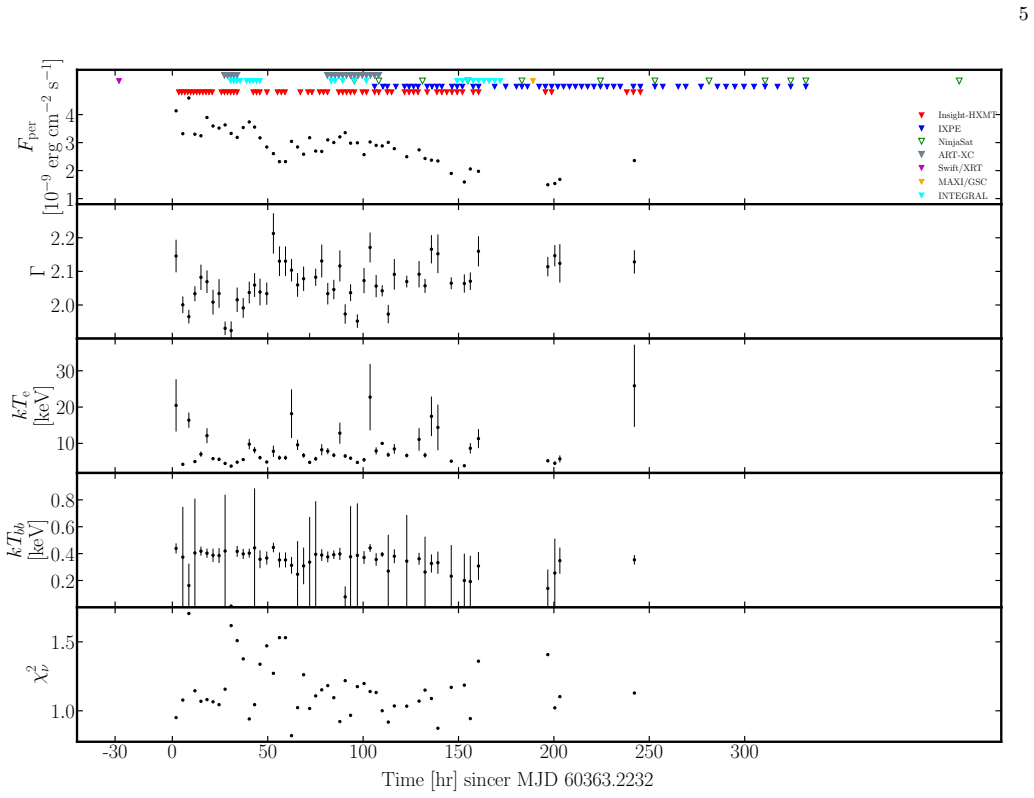
The argument turns on the recurrence-time–accretion-rate power law $\Delta T_{\rm rec}\sim \dot{m}^{\beta}$, with $\beta=-0.91\pm0.02$, built from 60 Insight-HXMT bursts plus bursts from IXPE, NinjaSat, and INTEGRAL. The local mass accretion rate $\dot{m}$ is derived from the persistent flux through the standard formula (Equation 6), and observed recurrence intervals are corrected by dividing by $N+1$ whenever gaps suggest missed bursts, an assumption checked in one gap by an IXPE burst. The fuel analysis uses the fluence ratio $\alpha=\Delta T_{\rm rec}F_{\rm per}/f_b$ and the $Q_{\rm nuc}(\bar{X})$ relation to infer ignition composition, while PRE bursts act as standard candles for the distance.
What would settle it
A targeted search of the NICER, NuSTAR, or XMM-Newton burst lists for bursts falling inside the gaps of Table 1 — or a continuous, gap-free X-ray monitoring campaign of about 20 hours — that yields recurrence intervals differing from the $N+1$-corrected values would break the $\Delta T_{\rm rec}\sim \dot{m}^{-0.91\pm0.02}$ fit.
Extended reading notes
Core claim
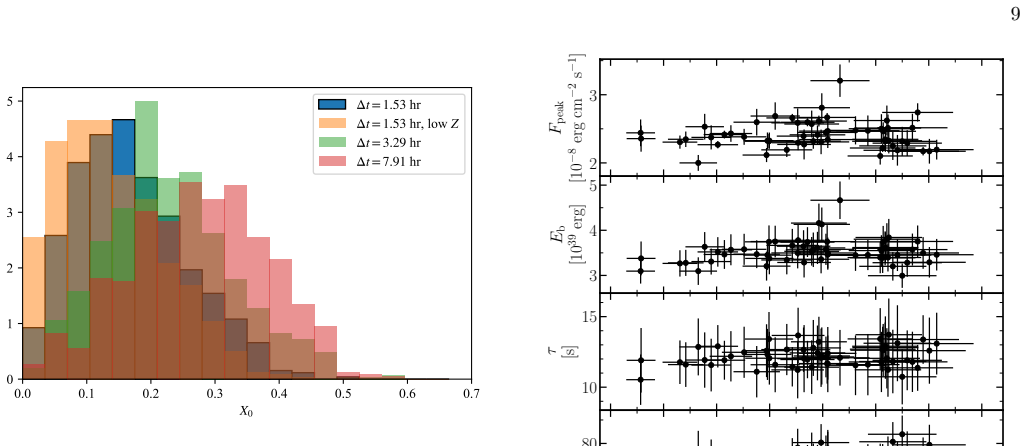
The central discovery is that the burst recurrence time in SRGA J144459.2-604207 scales as $\Delta T_{\rm rec}\sim \dot{m}^{-0.91\pm0.02}$ over recurrence times from 1.55 to 8 hours, a slightly flatter dependence than the canonical $\Delta T_{\rm rec}\sim \dot{m}^{-1}$ clocked-burster relation. The paper also establishes a distance of $10.03\pm0.71$ kpc using the Eddington flux of 14 PRE bursts, a mean burst-to-persistent fluence ratio $\alpha=71\pm7$, and a mean ignition hydrogen fraction $\bar{X}=0.342\pm0.033$; the fuel composition is constrained to $X_0\lesssim0.4$, i.e., hydrogen-deficient. On the basis of published simulations, the sub-unity power-law index is read as evidence that this neutron star may be more massive than $2\,M_\odot$, which would tighten constraints on the equation of state of dense matter.
Load-bearing premise
The central calculation assumes that every gap in the data hides a whole number of missed bursts, so dividing the observed interval by $N+1$ recovers the true recurrence time; only one gap has been confirmed by an independent IXPE burst.
Editorial extensions
If this is right
- If the recurrence relation holds, SRGA J144459.2-604207 joins the short list of "clocked" bursters and extends that list to a source whose exponent is measurably below $-1$.
- A neutron star mass above roughly $2\,M_\odot$ would rule out softer equations of state and sharpen the maximum-mass constraint from burst timing.
- The hydrogen-poor fuel ($X_0\lesssim0.4$) implies that the accreted layer is processed or the donor is helium-rich, informing models of burst fuel composition in accreting millisecond pulsars.
- The 40-70 keV hard X-ray deficit at $4\sigma$, lagging the burst by about $0.8$ s, supports corona models that can cool and recover within seconds, favoring magnetic reconnection over disk evaporation.
Reading between the lines
- I would not yet treat the $2\,M_\odot$ conclusion as secure: the same $-0.91$ index could in principle arise from a systematic drift in burst fuel composition or from the $N+1$ gap corrections, and a dedicated re-analysis varying those corrections would test it.
- The $N+1$ correction method could be stress-tested with the independent NICER, NuSTAR, and XMM-Newton burst lists; if those instruments saw bursts inside the same gaps, the slope would be confirmed independently.
- If the trend is real, the recurrence-time–accretion-rate slope may serve as a distance-independent probe of neutron star mass for other clocked bursters, complementing PRE distances.
- A future 20-hour continuous monitoring campaign with a high-duty-cycle X-ray instrument could directly count every burst and bypass the missed-burst assumption altogether.
Editorial analysis
A structured set of objections, weighed in public.
Referee Report
Summary. The paper analyzes Insight-HXMT observations of the newly discovered accreting millisecond pulsar SRGA J144459.2–604207, reporting 60 type I X-ray bursts, time-resolved spectroscopy of 58 of them, a stacked hard X-ray deficit in 40–70 keV, a distance of 10.03±0.71 kpc from 14 photospheric radius expansion bursts, a mean hydrogen fraction at ignition of 0.342±0.033, and a recurrence-time relation ΔT_rec ∼ ṁ^{−0.91±0.02} interpreted as evidence for a neutron star mass above 2 M⊙.
Significance. The paper benefits from a large, homogeneous burst sample from a single instrument with a consistent analysis pipeline, explicit handling of GTI-filtering losses, and a clear statement of the main assumption underlying recurrence-time corrections. The inferred recurrence-time versus accretion-rate slope, if robust, would provide a rare observational constraint on neutron star mass and equation of state, and the paper connects it to published simulations. The distance and fuel-composition estimates use standard, transparent methods. The data set and cross-instrument comparisons (IXPE, NinjaSat, INTEGRAL, ART-XC) add value. The main uncertainty is whether the headline slope is robust against the systematics identified below; those systematics are concrete and testable.
major comments (3)
- [Section 4.3, Figure 9, Table 1] The fitted power-law index is sensitive to bursts #58–60, whose measured recurrence times are longer than the preceding bursts despite higher inferred accretion rates: Table 1 lists ṁ = 1.43±0.11 × 10^4 g cm^{-2} s^{-1} and ΔT_rec = 3.47–3.65 hr for #58–60 versus ṁ = 0.89×10^4 g cm^{-2} s^{-1} and ΔT_rec = 3.29 hr for #56–57. These three points therefore oppose the fitted anti-correlation. The Figure 8 caption explicitly states that the pre-burst persistent flux is inaccurate for the last three bursts and omits their α values; the ṁ values used in Figure 9 are interpolated from the same persistent flux. Including these points flattens the fitted slope, while the quoted ±0.02 uncertainty reflects only the ṁ uncertainties and not this systematic. Please refit the relation excluding #58–60, and also with plausible alternative estimates of their pre-burst flux, and report the resulting index and significance.
- [Section 3.1, Table 1] The corrected recurrence times are obtained by dividing observed gaps by N+1 under the assumption that missed bursts are integer and the underlying burst train is perfectly regular. Only one gap (#40–#41) is independently confirmed by an IXPE burst; the corrections for #13, #22, #23, #26, #27, and #29 are inferred from the regularity assumption. If any of these N values is wrong, the corresponding ΔT_rec shifts by a factor of order 2, which can bias the fitted slope in Figure 9 by more than the quoted statistical uncertainty. Please quantify the sensitivity of the power-law index to alternative N choices for each corrected gap, or provide independent confirmation of the missing bursts from other instruments.
- [Section 4.1, Figure 6] The reported hard X-ray deficit is 120%±30% of the persistent source flux in 40–70 keV, derived from a decrement of about 6 cts/s against a background of about 121 cts/s and a source contribution of about 5 cts/s. The stated 4σ significance and 30% uncertainty appear to be based only on counting statistics. Background variability over the stacked interval (e.g., due to Earth occultation, South Atlantic Anomaly passages, or long-term particle background changes) is not characterized, and the systematic uncertainty in the deficit fraction is not discussed. Please provide a background-stability estimate for the stacked 40–70 keV light curve and include a systematic term in the quoted deficit.
minor comments (7)
- [Section 4.3] The word 'verifiy' should be 'verify'.
- [Section 1] The name 'Poynting-Robterson' should be 'Poynting-Robertson'.
- [Section 4.1] The word 'Compntonization' should be 'Comptonization'.
- [Section 3.1] The instrument name is spelled 'Insight-HMXT' in one place; it should be 'Insight-HXMT'.
- [Abstract and Section 4.2] The hydrogen fraction is written as X in the abstract and as X̄ in the text; please use a consistent notation throughout.
- [Table 1] Consider providing Table 1 as a machine-readable file in addition to the printed table, to support reproducibility of the recurrence-time and accretion-rate analysis.
- [Figure 7 caption] The caption describes 'three pairs of bursts' but does not specify which pairs are shown in the figure and whether the pairs are independent or overlapping; please clarify.
Circularity Check
No significant circularity: the ΔT–ṁ index is a direct fit to measured burst times and persistent fluxes, and the derived α, X, and distance come from standard external formulas rather than from the paper's own target claims.
full rationale
The paper's central results are empirical measurements or inversions of standard physical relations, not identities that reduce to their inputs. The α ratio is defined directly from observables in Eq. (1), α = ΔT_rec F_per / f_b, and the mean hydrogen fraction is inverted from α using the nuclear Q_nuc(X) formula of Goodwin et al. (2019) and its rearrangement in Eq. (4); neither formula contains the paper's fitted ΔT–ṁ index, so X is not forced by the target claim. The distance in Eq. (5) is computed from the measured mean PRE peak flux and the Eddington relation, and because it enters Eq. (6) only as a constant scale factor, it cannot set the slope of the ṁ–ΔT relation. The relation ΔT_rec ∼ ṁ^{-0.91±0.02} (Section 4.3, Figure 9) is a direct power-law fit to the HXMT, IXPE, INTEGRAL, and NinjaSat points, with ṁ computed from persistent flux via Eq. (6) and ΔT_rec measured from burst onset times. The N+1 correction for missed bursts (Section 3.1, Table 1) is an explicitly stated regularity assumption, verified for one gap by an IXPE burst; it is a modeling assumption whose failure would bias the slope, but it is not a circular reduction of the fitted relation. The paper itself flags the inaccurate pre-burst persistent flux for the last three bursts in the Figure 8 caption, omitting their α values; this is a systematic data-quality concern for a correctness review rather than a circularity. Self-citations such as Galloway et al. (2022) for Eq. (4) and Li et al. (2018) for the expected ΔT ∼ ṁ^{-1} provide standard, parameter-free results whose assumptions do not include the present target claim, so they constitute independent support and do not raise the circularity score.
Assumptions & free parameters
free parameters (4)
- Hydrogen column density NH =
1.87 x 10^22 cm^-2 (fixed after fitting)
- Cross-calibration constants for ME and HE
- nthcomp spectral parameters (Gamma, kTe, kTbb, normalization) =
varies per observation; see Figure 3
- Normalization of the mdot-Delta T power-law fit =
not quoted
assumptions (7)
- domain assumption Canonical neutron star parameters: M=1.4 M_sun, R=11.2 km, 1+z=1.259
- domain assumption Anisotropy factors xi_b = xi_p = 1
- domain assumption PRE peak flux is the Eddington limit for a hydrogen-free atmosphere
- domain assumption Qnuc formula from Goodwin et al. (2019)
- domain assumption Persistent emission invariant during bursts (or only normalization changes)
- ad hoc to paper Missed bursts are integer and regular, so observed gaps divided by N+1
- domain assumption CNO metallicity roughly solar (Z=0.02) for the fuel-composition inference
Cite this review
Pith. "Pith review of A comprehensive study of type I (thermonuclear) bursts in the new transient SRGA J144459.2$-$604207." pith.science (2026). https://pith.science/paper/EANVYWDH
@misc{pith2026241205779,
  author       = {Pith},
  title        = {Pith review of: A comprehensive study of type I (thermonuclear) bursts in the new transient SRGA J144459.2$-$604207},
  year         = {2026},
  howpublished = {\url{https://pith.science/paper/EANVYWDH}},
  note         = {Machine review of arXiv:2412.05779}
}
abstract
We report an analysis of Insight-HXMT observations of the newly discovered accreting millisecond pulsar SRGA J144459.2$-$604207. During the outburst, detected in 2024 February by SRG/ART-XC, the broadband persistent spectrum was well fitted by an absorbed Comptonization model. We detected 60 type I X-ray bursts in the Insight-HXMT medium energy (ME) data, and 37 were also detected with the low-energy (LE) telescope. By superimposing the Insight-HXMT/LE/ME/HE light curves of 37 bursts with similar profiles and intensities, we measured a deficit of X-rays in the $40-70$ keV energy band. By analyzing the time-resolved X-ray burst spectra, we determine the mean ratio of persistent to burst flux of $\alpha=71\pm7$. We estimate the average hydrogen mass fraction in the fuel at ignition, as $\bar{X} =0.342\pm0.033$, and constrain the burst fuel composition as $X_0\leq0.4$. We found that 14 out of 60 X-ray bursts exhibited photospheric expansion, and thus we estimated the distance to the source as $10.0\pm0.71$ kpc. Combined with IXPE observations, the burst recurrence time increased from 1.55 to 8 hr as the local mass accretion rate decreased, which can be described as $\Delta T_{\rm rec}\sim \dot{m}^{-0.91\pm0.02}$.
Figures


Figures from the paper (5 more)



Forward citations
Cited by 1 Pith paper
-
Quenching and recovery of persistent X-ray emission during a superburst in 4U 1820$-$30
NICER and MAXI data show the 2021 superburst in 4U 1820-30 suppressed the persistent X-ray emission, which recovered over about 1.8 hours as the inner disk refilled; a drifting absorption line suggests the disk moved ...
Reference graph
Works this paper leans on
-
[1]
Arnaud, K. A. 1996, in Astronomical Society of the Pacific Conference Series, Vol. 101, Astronomical Data Analysis Software and Systems V, ed. G. H. Jacoby & J. Barnes, 17
1996
-
[2]
Ballantyne, D. R., & Strohmayer, T. E. 2004, ApJL, 602, L105, doi: 10.1086/382703
doi:10.1086/382703 2004
-
[3]
Bult, P., Jaisawal, G. K., G¨ uver, T., et al. 2019, ApJL, 885, L1, doi: 10.3847/2041-8213/ab4ae1
-
[4]
Chandra, A. D. 2024, ATel, 16471, 1
work page 2024
-
[5]
2013, ApJL, 777, L9, doi: 10.1088/2041-8205/777/1/L9
Chen, Y.-P., Zhang, S., Zhang, S.-N., et al. 2013, ApJL, 777, L9, doi: 10.1088/2041-8205/777/1/L9
-
[6]
2012, ApJL, 752, L34, doi: 10.1088/2041-8205/752/2/L34
Chen, Y.-P., Zhang, S., Zhang, S.-N., Li, J., & Wang, J.-M. 2012, ApJL, 752, L34, doi: 10.1088/2041-8205/752/2/L34
-
[7]
Chen, Y. P., Zhang, S., Qu, J. L., et al. 2018, ApJL, 864, L30, doi: 10.3847/2041-8213/aadc0e
-
[8]
Chen, Y. P., Zhang, S., Zhang, S. N., et al. 2019, Journal of High Energy Astrophysics, 24, 23, doi: 10.1016/j.jheap.2019.09.001
Show all 51 references
-
[9]
2022, ApJL, 936, L21, doi: 10.3847/2041-8213/ac8c2c
Chen, Y.-P., Zhang, S., Ji, L., et al. 2022, ApJL, 936, L21, doi: 10.3847/2041-8213/ac8c2c
2022 doi
-
[10]
B., Nishimura, N., et al
Dohi, A., Iwakiri, W. B., Nishimura, N., et al. 2024, ApJ, 960, 14, doi: 10.3847/1538-4357/ad0a67
2024 doi
-
[11]
1992, Accretion power in astrophysics., Vol
Frank, J., King, A., & Raine, D. 1992, Accretion power in astrophysics., Vol. 21 (Cambridge university press)
1992
- [12]
-
[13]
K., Cumming, A., Kuulkers, E., et al
Galloway, D. K., Cumming, A., Kuulkers, E., et al. 2004, ApJ, 601, 466, doi: 10.1086/380445
2004 doi
-
[14]
K., Johnston, Z., Goodwin, A., & He, C.-C
Galloway, D. K., Johnston, Z., Goodwin, A., & He, C.-C. 2022, ApJS, 263, 30, doi: 10.3847/1538-4365/ac98c9
2022 doi
-
[15]
K., & Keek, L
Galloway, D. K., & Keek, L. 2021, in Timing Neutron Stars: Pulsations, Oscillations and Explosions, ed. T. M
2021
-
[16]
M´ endez, & C
Belloni, M. M´ endez, & C. Zhang, Astrophysics and Space Science Library, 209–262, doi: 10.1007/978-3-662-62110-3 5
-
[17]
K., Muno, M
Galloway, D. K., Muno, M. P., Hartman, J. M., Psaltis, D., & Chakrabarty, D. 2008, ApJS, 179, 360, doi: 10.1086/592044
2008 doi
-
[18]
K., Psaltis, D., Muno, M
Galloway, D. K., Psaltis, D., Muno, M. P., & Chakrabarty, D. 2006, ApJ, 639, 1033, doi: 10.1086/499579
2006 doi
-
[19]
J., Heger, A., & Galloway, D
Goodwin, A. J., Heger, A., & Galloway, D. K. 2019, ApJ, 870, 64, doi: 10.3847/1538-4357/aaeed2
2019 doi
-
[20]
2023, in AAS/High Energy Astrophysics Division, 116.11 13
Guichandut, S., & Cumming, A. 2023, in AAS/High Energy Astrophysics Division, 116.11 13
2023
-
[21]
2020, Journal of High Energy Astrophysics, 27, 44, doi: 10.1016/j.jheap.2020.02.008
Guo, C.-C., Liao, J.-Y., Zhang, S., et al. 2020, Journal of High Energy Astrophysics, 27, 44, doi: 10.1016/j.jheap.2020.02.008
2020 doi
-
[22]
2024, ATel, 16510, 1
Illiano, G., Coti Zelati, F., Marino, A., et al. 2024, ATel, 16510, 1
2024
-
[23]
2024, ApJL, 966, L3, doi: 10.3847/2041-8213/ad3c29
Ji, L., Ge, M., Chen, Y., et al. 2024, ApJL, 966, L3, doi: 10.3847/2041-8213/ad3c29
2024 doi
-
[24]
2013, MNRAS, 432, 2773, doi: 10.1093/mnras/stt625
Ji, L., Zhang, S., Chen, Y., et al. 2013, MNRAS, 432, 2773, doi: 10.1093/mnras/stt625
2013 doi
-
[25]
R., Kuulkers, E., & Strohmayer, T
Keek, L., Ballantyne, D. R., Kuulkers, E., & Strohmayer, T. E. 2014, ApJL, 797, L23, doi: 10.1088/2041-8205/797/2/L23
2014 doi
-
[26]
R., in’t Zand, J
Kuulkers, E., den Hartog, P. R., in’t Zand, J. J. M., et al. 2003, A&A, 399, 663, doi: 10.1051/0004-6361:20021781
2003 doi
-
[27]
Lewin, W. H. G., & van der Klis, M. 2006, Compact Stellar X-ray Sources, Vol. 39 (Cambridge University Press)
2006
-
[28]
Lewin, W. H. G., van Paradijs, J., & Taam, R. E. 1993, SSRv, 62, 223, doi: 10.1007/BF00196124
1993 doi
-
[29]
2018, A&A, 620, A114, doi: 10.1051/0004-6361/201833857
Li, Z., De Falco, V., Falanga, M., et al. 2018, A&A, 620, A114, doi: 10.1051/0004-6361/201833857
2018 doi
-
[30]
2024, ATel, 16548, 1
Li, Z., Kuiper, L., Falanga, M., et al. 2024, ATel, 16548, 1
2024
-
[31]
2020, Journal of High Energy Astrophysics, 27, 24, doi: 10.1016/j.jheap.2020.02.010
Liao, J.-Y., Zhang, S., Chen, Y., et al. 2020, Journal of High Energy Astrophysics, 27, 24, doi: 10.1016/j.jheap.2020.02.010
2020 doi
-
[32]
2020, Science China
Liu, C., Zhang, Y., Li, X., et al. 2020, Science China
2020
-
[33]
Physics, Mechanics, and Astronomy, 63, 249503, doi: 10.1007/s11433-019-1486-x
-
[34]
2024, ApJ, 969, 15, doi: 10.3847/1538-4357/ad4d86
Lu, Y., Li, Z., Yu, W., Pan, Y., & Falanga, M. 2024, ApJ, 969, 15, doi: 10.3847/1538-4357/ad4d86
2024 doi
-
[35]
2023, A&A, 670, A87, doi: 10.1051/0004-6361/202244984
Lu, Y., Li, Z., Pan, Y., et al. 2023, A&A, 670, A87, doi: 10.1051/0004-6361/202244984
2023 doi
-
[36]
V., Lutovinov, A
Molkov, S. V., Lutovinov, A. A., Tsygankov, S. S., et al. 2024, A&A, 690, A353, doi: 10.1051/0004-6361/202450581
2024 doi
-
[37]
2024, ATel, 16483, 1
Negoro, H., Mihara, T., Serino, M., et al. 2024, ATel, 16483, 1
2024
-
[38]
S., Sanna, A., et al
Ng, M., Ray, P. S., Sanna, A., et al. 2024, ApJL, 968, L7, doi: 10.3847/2041-8213/ad4edb
2024 doi
- [39]
-
[40]
2024, ATel, 16507, 1
Chenevez, J., & Del Santo, M. 2024, ATel, 16507, 1
2024
-
[41]
2024, ATel, 16493, 1
Sguera, V., & Sidoli, L. 2024, ATel, 16493, 1
2024
-
[42]
R., & Fragile, P
Speicher, J., Ballantyne, D. R., & Fragile, P. C. 2024, ApJ, 976, 44, doi: 10.3847/1538-4357/ad863d
2024 doi
-
[43]
2024, NinjaSat Monitoring of Type-I X-ray Bursts from the Clocked Burster SRGA J144459.2−604207
Takeda, T., Tamagawa, T., Enoto, T., et al. 2024, NinjaSat Monitoring of Type-I X-ray Bursts from the Clocked Burster SRGA J144459.2−604207. https://arxiv.org/abs/2411.10992
2024 arXiv
-
[44]
J., Chen, Y
Wang, P. J., Chen, Y. P., Ji, L., et al. 2024, A&A, 689, A47, doi: 10.1051/0004-6361/202348352
2024 doi
-
[45]
K., & Price, D
Worpel, H., Galloway, D. K., & Price, D. J. 2013, ApJ, 772, 94, doi: 10.1088/0004-637X/772/2/94 —. 2015, ApJ, 801, 60, doi: 10.1088/0004-637X/801/1/60
2013 doi
-
[46]
2024, A&A, 683, A93, doi: 10.1051/0004-6361/202348195
Yu, W., Li, Z., Lu, Y., et al. 2024, A&A, 683, A93, doi: 10.1051/0004-6361/202348195
2024 doi
-
[47]
Zhang, S. N. 2007, Highlights of Astronomy, 14, 41, doi: 10.1017/S1743921307009842
2007 doi
-
[48]
N., Cui, W., Chen, W., et al
Zhang, S. N., Cui, W., Chen, W., et al. 2000, Science, 287, 1239, doi: 10.1126/science.287.5456.1239
2000
-
[49]
2020, Science China
Zhang, S.-N., Li, T., Lu, F., et al. 2020, Science China
2020
-
[50]
Physics, Mechanics, and Astronomy, 63, 249502, doi: 10.1007/s11433-019-1432-6
-
[51]
2022, A&A, 660, A31, doi: 10.1051/0004-6361/202142801
Zhao, G., Li, Z., Pan, Y., et al. 2022, A&A, 660, A31, doi: 10.1051/0004-6361/202142801
2022 doi
Reviewed August 11, 2026 · model on record in the stance chip above.
Discussion (0). Continue with ORCID to comment.