REVIEW 3 major objections 5 minor 1 cited by
GraPE: A Generate-Plan-Edit Framework for Compositional T2I Synthesis
T0 review · 3 major / 5 minor · reviewed 2026-08-11 · deepseek-v4-flash
Pith's one-line read The paper's central claim is that complex text-to-image prompts are better handled by generating a rough draft, planning object-level corrections with a multimodal LLM, and executing them as a sequence of atomic edits.
desk verdict Solid modular post-hoc correction pipeline with a real evaluation gap: GPT-4o is both planner and judge, so expect the headline gains to shrink under independent scoring. read the letter →
The pith
A machine-rendered reading of the paper's core claim, the machinery that carries it, and where it could break.
The reading
What carries the argument
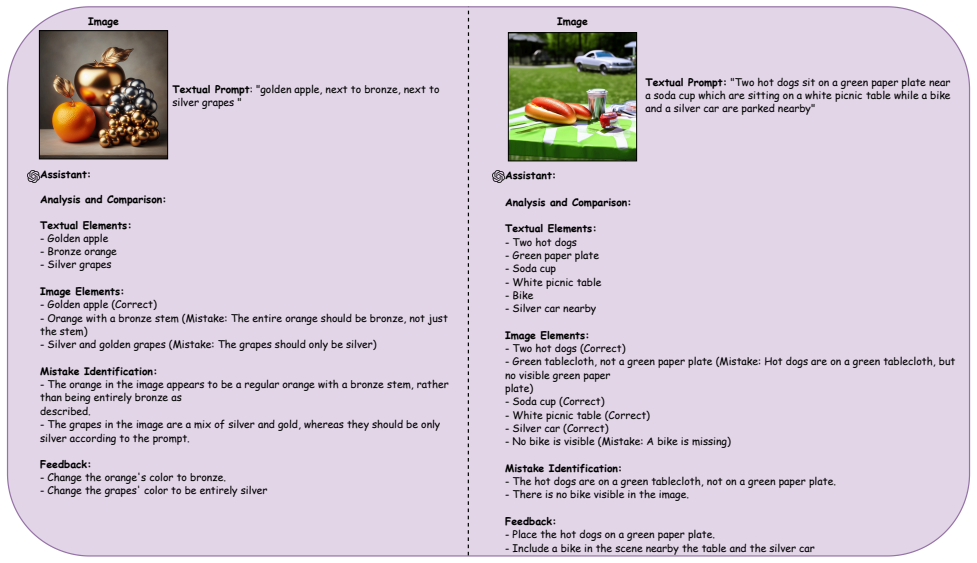
The load-bearing object is the edit plan produced by the planner. The planner is prompted to decompose its assessment into four named stages -- textual elements, image elements, mistake identification, and feedback generation -- and the feedback instructions are constrained to be atomic and object-centric. This decomposition is what lets a general-purpose editor fix a complex prompt through a series of simple, composable edits. The second piece of machinery is PixEdit, a text-guided editor built on PixArt-Sigma with a T5-XXL text encoder and trained on reasoning-centric editing data, which the paper shows outperforms other editors inside the GraPE loop.
What would settle it
Take a random sample of ConceptMix K=7 prompts, run the base generator and GraPE with the same generator, and have independent human raters judge which image better follows the prompt; the central claim fails if human preference does not track the reported GPT-4o QA improvements.
Extended reading notes
Core claim
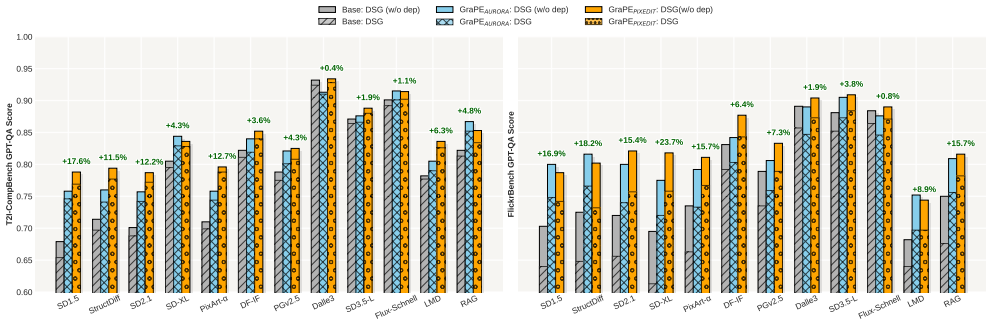
GraPE's central discovery is that a sequential, object-centric edit plan can repair a partially faithful generation. Given a text prompt $T$ and an initial image $I_g$ from any diffusion model, a multimodal LLM produces a structured plan: extract the objects and attributes mentioned in the text, extract what is actually present in the image, identify the discrepancies, and emit a list of atomic corrective instructions $T_{e_1},\ldots,T_{e_n}$. An editing model then executes these instructions in order, $I_{e_{k+1}} = E(I_{e_k}, T_{e_{k+1}})$, to produce the final image. The authors show this decomposition improves prompt following for every one of the thirteen generators tested, with larger absolute gains on weaker models, and that the average plan length grows with prompt complexity, meaning the planner recognises when more corrective steps are needed.
Load-bearing premise
All headline gains are measured by GPT-4o answering yes/no questions about whether the image matches the prompt, and the same model also wrote the edit plans; the human study rates plan quality rather than the correctness of the final images.
Editorial extensions
If this is right
- Any existing text-to-image model can be improved at inference time by appending a planner and an editor, with no retraining of the generator.
- Weak generators gain more than strong ones, so the performance gap between smaller and state-of-the-art models narrows under GraPE.
- Performance on compositional prompts rises with the number of editing steps, giving a direct compute-to-fidelity trade-off.
- The gains are not limited to compositional benchmarks; the paper reports improvements on Flickr-Bench prompts as well.
- The planner's mistake analysis can itself serve as an evaluation signal, correlating with the LLMScore metric.
Reading between the lines
- Because the loop is modular, the same planner could be run iteratively until the planner reports no remaining mistakes, converting a fixed plan into a convergence loop; the paper does not test this.
- The evaluation design leaves open a self-consistency risk: if the judge and the planner share the same visual priors, the reported gains may partly reflect agreement with GPT-4o's own editing taste rather than human-visible fidelity.
- The error analysis isolates the editor as the main bottleneck, which suggests that investing in better compositional editors -- or adding an RL feedback loop on failed edits -- may yield larger gains than improving the planner.
- A similar generate-plan-edit loop could extend to other generative modalities, like video or 3D scenes, wherever a 'planner' can inspect an intermediate output and an 'editor' can apply atomic corrections.
Editorial analysis
A structured set of objections, weighed in public.
Referee Report
Summary. The paper proposes GraPE, a training-free generate-plan-edit pipeline for compositional text-to-image generation. A base T2I model generates an initial image; a GPT-4o planner compares textual and visual object-attribute elements and emits atomic edit instructions; an instruction-guided editing model (AURORA or the authors' newly trained PixEdit) applies these edits sequentially. The authors evaluate on T2I-Compbench, ConceptMix, and Flickr-Bench across 13 T2I models, reporting DSG and GPT-4o QA gains, ablations of the planner prompt, a human study of plan quality, error analyses, and cost/runtime estimates.
Significance. GraPE is a simple and practical recipe: it requires no training, is modular across generator/editor pairs, and its object-centric planner decomposition is interpretable. The breadth of experiments (13 T2I models, two editors, three benchmarks) and the explicit cost and runtime analysis are strengths; the paper also introduces a new editor, PixEdit, and evaluates it on standard editing benchmarks. If the headline gains survive independent final-image evaluation, the approach would be a useful inference-time tool for improving compositional fidelity and for narrowing the gap between weaker and stronger generators.
major comments (3)
- [§4.4, Supp. §10, Fig. 3, Tables 10–11] The final-image evaluation is carried out almost entirely by GPT-4o QA (DSG in Fig. 3/Tables 10–11 and ConceptMix in Table 2), while GPT-4o is also the model that generates the edit plans. The human study in §4.4 (Table 4) does not score the actual GraPE output: Q1 asks about the pre-edit image, Q2 asks raters to judge the hypothetical effect of the plan, and Q3 asks about atomicity. This creates a self-consistency risk: the judge may be more likely to recognize its own intended corrections as present, even when the edit was not visually realized. Supp. §10's own breakdown (only about 12.5 of 100 final images from initially erroneous cases are judged completely correct) suggests that final-image correctness is not yet established. Please add a human evaluation of the final GraPE images or an evaluation with a different, independent VQA model, and report those scores alongside the GPT-4o scores.
- [Supp. §8, Table 2, Fig. 3] The RPG comparison is not on a comparable evaluation set. Supp. §8 states that RPG fails to generate valid plans for over 50% of samples and that the reported numbers are on the successfully generated samples only. Because the other rows in Table 2 and Fig. 3 are computed on the full sample, the RPG row is not an apples-to-apples baseline. Please either report RPG on the full sample (e.g., scoring failed samples as zero) or re-evaluate all methods on the common subset of prompts for which RPG produces valid plans.
- [Table 2 and Tables 10–11] Several of the headline gains are within one standard deviation, e.g., Flux-schnell at K=7 (0.775±0.004 vs. 0.779±0.004) and SD3.5-Large at K=3 (0.815±0.002 vs. 0.817±0.002) in Table 2. Since the central claim is that GraPE improves all 13 models, the paper should provide paired significance tests or clearly restrict the claim to gains that are statistically distinguishable. The current 'improvements up to 3 points' phrasing overstates the evidence for the strongest models.
minor comments (5)
- [§5] The limitations paragraph says 'over 10 different models', but §4.1 lists 13 models; please correct the inconsistency.
- [Algorithm 1] With `Ie0 ← Ig` and a plan of n edits, the loop `for k = 1, ..., n-1` executes only n-1 edits; either loop to n or index the edits from 0.
- [§4.1] The T2I-Compbench and Flickr-Bench evaluations use 100-prompt subsets; please state how the prompts were sampled and, if feasible, report results on the full benchmarks or multiple sampling seeds.
- [Table 4] No inter-annotator agreement measure is reported for the human study; because Q2 and Q3 are subjective, please include an agreement metric such as Cohen's kappa.
- [Table 2] The column header 'GraPE PixEdit' is ambiguous; clarify that the two numeric columns show the base model and GraPE-with-PixEdit, respectively.
Circularity Check
GPT-4o acts as both the planner and the VQA judge, creating a self-evaluation loop; no fitted-parameter or self-citation circularity is present.
-
other
[Section 3.4 (Implementation Details) and Section 4.1 (Evaluation Metrics).]
"We utilize a frontier multi-modal model, GPT-4o as a multi-modal planner ... We therefore follow [14] to generate grounded binary questions for T2I-Compbench and Flickr-Bench and utilize GPT-4o as the choice VQA model following [59]."
The same model, GPT-4o, both produces the corrective edit plan and scores whether the edited image satisfies the prompt. The reported DSG and VQA gains are therefore not independent measurements of fidelity: the judge shares the planner's visual and linguistic priors, so it is more likely to credit edits matching its own proposed corrections. This is a self-evaluation loop rather than a derivation by construction; the editing model is an independent, fallible component, so the gains are not logically forced, but the magnitudes of the reported improvements are confounded by this overlap.
full rationale
GraPE's central claim is an empirical pipeline result, not a mathematical derivation. No parameters are fitted, no quantity is defined in terms of the target, and no load-bearing self-citation or imported uniqueness theorem appears. The only self-referential element is evaluative: GPT-4o is used as the MLLM planner (Section 3.4) and as the VQA judge for all headline metrics (Section 4.1). Because the editing model is separate and can fail, the reported gains are not equivalent to the plan by construction; the paper's own error analysis (Supplement Section 10) shows many plans are not realized in the final image. The human study (Section 4.4) evaluates plan quality and atomicity, not final-image correctness, which leaves the shared-model judge as the main validity concern. This is a confound that could overstate fidelity gains, but it is not a circular reduction of the kind where the prediction equals its input by definition. Hence score 2.
Assumptions & free parameters
free parameters (1)
- Planner few-shot prompt template =
hand-designed
assumptions (4)
- domain assumption GPT-4o can accurately detect object-level discrepancies between a generated image and a text prompt.
- domain assumption Each atomic edit can be executed by the editing model without degrading previously correct content.
- domain assumption GPT-4o answer-verification scores are a reliable proxy for human judgment of prompt-image alignment.
- domain assumption The 100-prompt subsets sampled per benchmark are representative of the full benchmark.
invented entities (1)
-
PixEdit
independent evidence
Cite this review
Pith. "Pith review of GraPE: A Generate-Plan-Edit Framework for Compositional T2I Synthesis." pith.science (2026). https://pith.science/paper/MVGOTCZZ
@misc{pith2026241206089,
  author       = {Pith},
  title        = {Pith review of: GraPE: A Generate-Plan-Edit Framework for Compositional T2I Synthesis},
  year         = {2026},
  howpublished = {\url{https://pith.science/paper/MVGOTCZZ}},
  note         = {Machine review of arXiv:2412.06089}
}
abstract
Text-to-image (T2I) generation has seen significant progress with diffusion models, enabling generation of photo-realistic images from text prompts. Despite this progress, existing methods still face challenges in following complex text prompts, especially those requiring compositional and multi-step reasoning. Given such complex instructions, SOTA models often make mistakes in faithfully modeling object attributes, and relationships among them. In this work, we present an alternate paradigm for T2I synthesis, decomposing the task of complex multi-step generation into three steps, (a) Generate: we first generate an image using existing diffusion models (b) Plan: we make use of Multi-Modal LLMs (MLLMs) to identify the mistakes in the generated image expressed in terms of individual objects and their properties, and produce a sequence of corrective steps required in the form of an edit-plan. (c) Edit: we make use of an existing text-guided image editing models to sequentially execute our edit-plan over the generated image to get the desired image which is faithful to the original instruction. Our approach derives its strength from the fact that it is modular in nature, is training free, and can be applied over any combination of image generation and editing models. As an added contribution, we also develop a model capable of compositional editing, which further helps improve the overall accuracy of our proposed approach. Our method flexibly trades inference time compute with performance on compositional text prompts. We perform extensive experimental evaluation across 3 benchmarks and 10 T2I models including DALLE-3 and the latest -- SD-3.5-Large. Our approach not only improves the performance of the SOTA models, by upto 3 points, it also reduces the performance gap between weaker and stronger models. $\href{https://dair-iitd.github.io/GraPE/}{https://dair-iitd.github.io/GraPE/}$
Figures


Figures from the paper (7 more)




Forward citations
Cited by 1 Pith paper
-
What Can I Edit? Open-Ended Strategy Discovery and the Emotion Editability Landscape
An open-ended 'what can I edit' planner that discovers image-specific emotional affordances before editing produces edits humans strongly prefer over fixed-taxonomy emotional image editors, while standard emotion clas...
Reference graph
Works this paper leans on
-
[1]
A-star: Test-time attention segregation and retention for text-to-image synthesis, 2023
Aishwarya Agarwal, Srikrishna Karanam, K J Joseph, Apoorv Saxena, Koustava Goswami, and Balaji Vasan Srini- vasan. A-star: Test-time attention segregation and retention for text-to-image synthesis, 2023. 2
work page 2023
-
[2]
DeepFloyd Lab at StabilityAI. DeepFloyd IF: a novel state- of-the-art open-source text-to-image model with a high de- gree of photorealism and language understanding. https: //www.deepfloyd.ai/deepfloyd- if , 2023. Re- trieved on 2023-11-08. 5, 6
work page 2023
-
[3]
Jinze Bai, Shuai Bai, Shusheng Yang, Shijie Wang, Sinan Tan, Peng Wang, Junyang Lin, Chang Zhou, and Jingren Zhou. Qwen-vl: A versatile vision-language model for un- derstanding, localization, text reading, and beyond, 2023. 7
work page 2023
-
[4]
Hrs-bench: Holistic, reliable and scalable benchmark for text-to-image models
Eslam Mohamed Bakr, Pengzhan Sun, Xiaoqian Shen, Faizan Farooq Khan, Li Erran Li, and Mohamed Elhoseiny. Hrs-bench: Holistic, reliable and scalable benchmark for text-to-image models. In Proceedings of the IEEE/CVF In- ternational Conference on Computer Vision , pages 20041– 20053, 2023. 2
work page 2023
-
[5]
Improving image generation with better captions
James Betker, Gabriel Goh, Li Jing, Tim Brooks, Jianfeng Wang, Linjie Li, Long Ouyang, Juntang Zhuang, Joyce Lee, Yufei Guo, et al. Improving image generation with better captions. Computer Science, 2(3):8, 2023. 5, 6
work page 2023
-
[6]
Tim Brooks, Aleksander Holynski, and Alexei A. Efros. In- structpix2pix: Learning to follow image editing instructions,
-
[7]
Language models are few-shot learners
Tom Brown, Benjamin Mann, Nick Ryder, Melanie Sub- biah, Jared D Kaplan, Prafulla Dhariwal, Arvind Neelakan- tan, Pranav Shyam, Girish Sastry, Amanda Askell, Sand- hini Agarwal, Ariel Herbert-V oss, Gretchen Krueger, Tom Henighan, Rewon Child, Aditya Ramesh, Daniel Ziegler, Jeffrey Wu, Clemens Winter, Chris Hesse, Mark Chen, Eric Sigler, Mateusz Litwin, S...
work page 2020
-
[8]
Getting it right: Improving spatial consis- tency in text-to-image models, 2024
Agneet Chatterjee, Gabriela Ben Melech Stan, Estelle Aflalo, Sayak Paul, Dhruba Ghosh, Tejas Gokhale, Ludwig Schmidt, Hannaneh Hajishirzi, Vasudev Lal, Chitta Baral, and Yezhou Yang. Getting it right: Improving spatial consis- tency in text-to-image models, 2024. 2
work page 2024
Show all 79 references
-
[9]
Attend-and-excite: Attention-based se- mantic guidance for text-to-image diffusion models, 2023
Hila Chefer, Yuval Alaluf, Yael Vinker, Lior Wolf, and Daniel Cohen-Or. Attend-and-excite: Attention-based se- mantic guidance for text-to-image diffusion models, 2023. 2
2023
-
[10]
Pixart-α: Fast training of dif- fusion transformer for photorealistic text-to-image synthesis,
Junsong Chen, Jincheng Yu, Chongjian Ge, Lewei Yao, Enze Xie, Yue Wu, Zhongdao Wang, James Kwok, Ping Luo, Huchuan Lu, and Zhenguo Li. Pixart-α: Fast training of dif- fusion transformer for photorealistic text-to-image synthesis,
-
[11]
Pixart- σ: Weak-to-strong training of diffu- sion transformer for 4k text-to-image generation, 2024
Junsong Chen, Chongjian Ge, Enze Xie, Yue Wu, Lewei Yao, Xiaozhe Ren, Zhongdao Wang, Ping Luo, Huchuan Lu, and Zhenguo Li. Pixart- σ: Weak-to-strong training of diffu- sion transformer for 4k text-to-image generation, 2024. 2, 4, 3
2024
-
[12]
Region-aware text-to-image generation via hard binding and soft refinement, 2024
Zhennan Chen, Yajie Li, Haofan Wang, Zhibo Chen, Zhengkai Jiang, Jun Li, Qian Wang, Jian Yang, and Ying Tai. Region-aware text-to-image generation via hard binding and soft refinement, 2024. 5, 6
2024
-
[13]
Visual pro- gramming for text-to-image generation and evaluation
Jaemin Cho, Abhay Zala, and Mohit Bansal. Visual pro- gramming for text-to-image generation and evaluation. In NeurIPS, 2023. 2
2023
-
[14]
Davidsonian scene graph: Improving reliability in fine-grained evaluation for text-to-image gener- ation, 2024
Jaemin Cho, Yushi Hu, Roopal Garg, Peter Anderson, Ran- jay Krishna, Jason Baldridge, Mohit Bansal, Jordi Pont- Tuset, and Su Wang. Davidsonian scene graph: Improving reliability in fine-grained evaluation for text-to-image gener- ation, 2024. 6
2024
-
[15]
Diffusion models beat gans on image synthesis
Prafulla Dhariwal and Alex Nichol. Diffusion models beat gans on image synthesis. ArXiv, abs/2105.05233, 2021. 1
2021 arXiv
-
[16]
Alaaeldin El-Nouby, Shikhar Sharma, Hannes Schulz, De- von Hjelm, Layla El Asri, Samira Ebrahimi Kahou, Yoshua Bengio, and Graham W. Taylor. Tell, draw, and repeat: Gen- erating and modifying images based on continual linguistic instruction. In Proceedings of the IEEE/CVF Inte...
2019
-
[17]
Training-free structured diffusion guidance for compositional text-to-image synthesis, 2023
Weixi Feng, Xuehai He, Tsu-Jui Fu, Varun Jampani, Arjun Akula, Pradyumna Narayana, Sugato Basu, Xin Eric Wang, and William Yang Wang. Training-free structured diffusion guidance for compositional text-to-image synthesis, 2023. 2, 5, 6
2023
-
[18]
Training- free structured diffusion guidance for compositional text-to- image synthesis
Weixi Feng, Xuehai He, Tsu-Jui Fu, Varun Jampani, Ar- jun Reddy Akula, Pradyumna Narayana, Sugato Basu, Xin Eric Wang, and William Yang Wang. Training- free structured diffusion guidance for compositional text-to- image synthesis. In The Eleventh International Conference on Le...
2023
-
[19]
Ranni: Taming text-to-image diffusion for accurate instruction following, 2024
Yutong Feng, Biao Gong, Di Chen, Yujun Shen, Yu Liu, and Jingren Zhou. Ranni: Taming text-to-image diffusion for accurate instruction following, 2024. 2
2024
-
[20]
Lumina-t2x: Trans- forming text into any modality, resolution, and duration via flow-based large diffusion transformers, 2024
Peng Gao, Le Zhuo, Dongyang Liu, Ruoyi Du, Xu Luo, Longtian Qiu, Yuhang Zhang, Chen Lin, Rongjie Huang, Shijie Geng, Renrui Zhang, Junlin Xi, Wenqi Shao, Zhengkai Jiang, Tianshuo Yang, Weicai Ye, He Tong, Jing- wen He, Yu Qiao, and Hongsheng Li. Lumina-t2x: Trans- forming text...
2024
-
[21]
Seed-data-edit technical report: A hybrid dataset for instruc- tional image editing, 2024
Yuying Ge, Sijie Zhao, Chen Li, Yixiao Ge, and Ying Shan. Seed-data-edit technical report: A hybrid dataset for instruc- tional image editing, 2024. 3
2024
-
[22]
Benchmarking spatial relationships in text-to-image generation, 2023
Tejas Gokhale, Hamid Palangi, Besmira Nushi, Vibhav Vi- neet, Eric Horvitz, Ece Kamar, Chitta Baral, and Yezhou Yang. Benchmarking spatial relationships in text-to-image generation, 2023. 2, 6
2023
-
[23]
Prompt-to-prompt im- age editing with cross attention control
Amir Hertz, Ron Mokady, Jay Tenenbaum, Kfir Aberman, Yael Pritch, and Daniel Cohen-Or. Prompt-to-prompt im- age editing with cross attention control. arXiv preprint arXiv:2208.01626, 2022. 3
2022 arXiv
-
[24]
Gans trained by a two time-scale update rule converge to a local nash equilib- rium, 2018
Martin Heusel, Hubert Ramsauer, Thomas Unterthiner, Bernhard Nessler, and Sepp Hochreiter. Gans trained by a two time-scale update rule converge to a local nash equilib- rium, 2018. 5
2018
-
[25]
Ella: Equip diffusion models with llm for en- hanced semantic alignment, 2024
Xiwei Hu, Rui Wang, Yixiao Fang, Bin Fu, Pei Cheng, and Gang Yu. Ella: Equip diffusion models with llm for en- hanced semantic alignment, 2024. 2
2024
-
[26]
Tifa: Accurate and interpretable text-to-image faithfulness evaluation with question answering, 2023
Yushi Hu, Benlin Liu, Jungo Kasai, Yizhong Wang, Mari Os- tendorf, Ranjay Krishna, and Noah A Smith. Tifa: Accurate and interpretable text-to-image faithfulness evaluation with question answering, 2023. 6
2023
-
[27]
T2i-compbench: A comprehensive benchmark for open-world compositional text-to-image generation, 2023
Kaiyi Huang, Kaiyue Sun, Enze Xie, Zhenguo Li, and Xi- hui Liu. T2i-compbench: A comprehensive benchmark for open-world compositional text-to-image generation, 2023. 2, 5
2023
-
[28]
Comat: Aligning text-to-image diffusion model with image- to-text concept matching, 2024
Dongzhi Jiang, Guanglu Song, Xiaoshi Wu, Renrui Zhang, Dazhong Shen, Zhuofan Zong, Yu Liu, and Hongsheng Li. Comat: Aligning text-to-image diffusion model with image- to-text concept matching, 2024. 2
2024
-
[29]
Text encoders bottleneck compositionality in contrastive vision- language models, 2023
Amita Kamath, Jack Hessel, and Kai-Wei Chang. Text encoders bottleneck compositionality in contrastive vision- language models, 2023. 2, 4
2023
-
[30]
Learning action and reasoning-centric image editing from videos and simulations, 2024
Benno Krojer, Dheeraj Vattikonda, Luis Lara, Varun Jam- pani, Eva Portelance, Christopher Pal, and Siva Reddy. Learning action and reasoning-centric image editing from videos and simulations, 2024. 3, 4, 1, 2
2024
-
[31]
Black Forest Labs. Flux. https://github.com/ black-forest-labs/flux, 2024. 5, 6
2024
-
[32]
Playground v2.5: Three insights towards enhancing aesthetic quality in text-to-image genera- tion, 2024
Daiqing Li, Aleks Kamko, Ehsan Akhgari, Ali Sabet, Lin- miao Xu, and Suhail Doshi. Playground v2.5: Three insights towards enhancing aesthetic quality in text-to-image genera- tion, 2024. 1, 5, 6, 7
2024
-
[33]
Llm- grounded diffusion: Enhancing prompt understanding of text-to-image diffusion models with large language models,
Long Lian, Boyi Li, Adam Yala, and Trevor Darrell. Llm- grounded diffusion: Enhancing prompt understanding of text-to-image diffusion models with large language models,
-
[34]
Playground v3: Improving text-to- image alignment with deep-fusion large language models,
Bingchen Liu, Ehsan Akhgari, Alexander Visheratin, Aleks Kamko, Linmiao Xu, Shivam Shrirao, Joao Souza, Suhail Doshi, and Daiqing Li. Playground v3: Improving text-to- image alignment with deep-fusion large language models,
-
[35]
Visual instruction tuning, 2023
Haotian Liu, Chunyuan Li, Qingyang Wu, and Yong Jae Lee. Visual instruction tuning, 2023. 2
2023
-
[36]
LLMScore: Unveiling the power of large language models in text-to-image synthesis evaluation
Yujie Lu, Xianjun Yang, Xiujun Li, Xin Eric Wang, and William Yang Wang. LLMScore: Unveiling the power of large language models in text-to-image synthesis evaluation. In Thirty-seventh Conference on Neural Information Pro- cessing Systems, 2023. 8
2023
-
[37]
Improved denoising dif- fusion probabilistic models
Alex Nichol and Prafulla Dhariwal. Improved denoising dif- fusion probabilistic models. ArXiv, abs/2102.09672, 2021. 1
2021 arXiv
-
[38]
Compositional text-to-image gen- eration with dense blob representations
Weili Nie, Sifei Liu, Morteza Mardani, Chao Liu, Benjamin Eckart, and Arash Vahdat. Compositional text-to-image gen- eration with dense blob representations. In International Conference on Machine Learning (ICML), 2024. 2
2024
-
[39]
Plummer, Liwei Wang, Chris M
Bryan A. Plummer, Liwei Wang, Chris M. Cervantes, Juan C. Caicedo, Julia Hockenmaier, and Svetlana Lazeb- nik. Flickr30k entities: Collecting region-to-phrase corre- spondences for richer image-to-sentence models, 2016. 5
2016
-
[40]
Sdxl: Improving latent diffusion models for high-resolution image synthesis, 2023
Dustin Podell, Zion English, Kyle Lacey, Andreas Blattmann, Tim Dockhorn, Jonas M ¨uller, Joe Penna, and Robin Rombach. Sdxl: Improving latent diffusion models for high-resolution image synthesis, 2023. 1, 5, 6, 7
2023
-
[41]
Learning transferable visual models from natural language supervision, 2021
Alec Radford, Jong Wook Kim, Chris Hallacy, Aditya Ramesh, Gabriel Goh, Sandhini Agarwal, Girish Sastry, Amanda Askell, Pamela Mishkin, Jack Clark, Gretchen Krueger, and Ilya Sutskever. Learning transferable visual models from natural language supervision, 2021. 2, 4
2021
-
[42]
Colin Raffel, Noam Shazeer, Adam Roberts, Katherine Lee, Sharan Narang, Michael Matena, Yanqi Zhou, Wei Li, and Peter J. Liu. Exploring the limits of transfer learning with a unified text-to-text transformer, 2023. 2, 4
2023
-
[43]
Hierarchical text-conditional image gener- ation with clip latents, 2022
Aditya Ramesh, Prafulla Dhariwal, Alex Nichol, Casey Chu, and Mark Chen. Hierarchical text-conditional image gener- ation with clip latents, 2022. 2
2022
-
[44]
High-resolution image synthesis with latent diffusion models
Robin Rombach, Andreas Blattmann, Dominik Lorenz, Patrick Esser, and Bj ¨orn Ommer. High-resolution image synthesis with latent diffusion models. In Proceedings of the IEEE/CVF Conference on Computer Vision and Pattern Recognition (CVPR), pages 10684–10695, 2022. 5, 6, 7
2022
-
[45]
Denton, Seyed Kamyar Seyed Ghasemipour, Burcu Karagol Ayan, Seyedeh Sara Mah- davi, Raphael Gontijo Lopes, Tim Salimans, Jonathan Ho, David J
Chitwan Saharia, William Chan, Saurabh Saxena, Lala Li, Jay Whang, Emily L. Denton, Seyed Kamyar Seyed Ghasemipour, Burcu Karagol Ayan, Seyedeh Sara Mah- davi, Raphael Gontijo Lopes, Tim Salimans, Jonathan Ho, David J. Fleet, and Mohammad Norouzi. Photorealistic text- to-image...
2022 arXiv
-
[46]
Image ma- nipulation via multi-hop instructions - a new dataset and weakly-supervised neuro-symbolic approach
Harman Singh, Poorva Garg, Mohit Gupta, Kevin Shah, Ashish Goswami, Satyam Modi, Arnab Mondal, Dinesh Khandelwal, Dinesh Garg, and Parag Singla. Image ma- nipulation via multi-hop instructions - a new dataset and weakly-supervised neuro-symbolic approach. In Proceed- ings of t...
2023
-
[47]
Weiss, Niru Mah- eswaranathan, and Surya Ganguli
Jascha Sohl-Dickstein, Eric A. Weiss, Niru Mah- eswaranathan, and Surya Ganguli. Deep unsupervised learning using nonequilibrium thermodynamics, 2015. 1
2015
-
[48]
Stable diffusion 3.5
stability.ai. Stable diffusion 3.5. https://stability. ai/news/introducing- stable- diffusion- 3- 5, 2024. 5, 6, 7
2024
-
[49]
Gemma Team, Thomas Mesnard, Cassidy Hardin, Robert Dadashi, Surya Bhupatiraju, Shreya Pathak, Laurent Sifre, Morgane Rivi`ere, Mihir Sanjay Kale, Juliette Love, Pouya Tafti, L ´eonard Hussenot, Pier Giuseppe Sessa, Aakanksha Chowdhery, Adam Roberts, Aditya Barua, Alex Botev, A...
2024
-
[50]
Winoground: Probing vision and language models for visio- linguistic compositionality
Tristan Thrush, Ryan Jiang, Max Bartolo, Amanpreet Singh, Adina Williams, Douwe Kiela, and Candace Ross. Winoground: Probing vision and language models for visio- linguistic compositionality. 2022 IEEE/CVF Conference on Computer Vision and Pattern Recognition (CVPR) , pages 52...
2022
-
[51]
Llama 2: Open foundation and fine- tuned chat models, 2023
Hugo Touvron, Louis Martin, Kevin Stone, Peter Al- bert, Amjad Almahairi, Yasmine Babaei, Nikolay Bash- lykov, Soumya Batra, Prajjwal Bhargava, Shruti Bhos- ale, Dan Bikel, Lukas Blecher, Cristian Canton Ferrer, Moya Chen, Guillem Cucurull, David Esiobu, Jude Fer- nandes, Jere...
2023
-
[52]
Genartist: Multimodal llm as an agent for unified image gen- eration and editing
Zhenyu Wang, Aoxue Li, Zhenguo Li, and Xihui Liu. Genartist: Multimodal llm as an agent for unified image gen- eration and editing. arXiv preprint arXiv:2407.05600, 2024. 2
2024 arXiv
-
[53]
Tokencompose: Text-to-image diffusion with token-level supervision, 2024
Zirui Wang, Zhizhou Sha, Zheng Ding, Yilin Wang, and Zhuowen Tu. Tokencompose: Text-to-image diffusion with token-level supervision, 2024. 2
2024
-
[54]
Omniedit: Building image editing generalist models through specialist supervision, 2024
Cong Wei, Zheyang Xiong, Weiming Ren, Xinrun Du, Ge Zhang, and Wenhu Chen. Omniedit: Building image editing generalist models through specialist supervision, 2024. 2
2024
-
[55]
Chain-of-thought prompting elicits reasoning in large language models, 2023
Jason Wei, Xuezhi Wang, Dale Schuurmans, Maarten Bosma, Brian Ichter, Fei Xia, Ed Chi, Quoc Le, and Denny Zhou. Chain-of-thought prompting elicits reasoning in large language models, 2023. 3
2023
-
[56]
Revisiting text-to-image evaluation with gecko: On metrics, prompts, and human ratings, 2024
Olivia Wiles, Chuhan Zhang, Isabela Albuquerque, Ivana Kaji´c, Su Wang, Emanuele Bugliarello, Yasumasa Onoe, Chris Knutsen, Cyrus Rashtchian, Jordi Pont-Tuset, and Aida Nematzadeh. Revisiting text-to-image evaluation with gecko: On metrics, prompts, and human ratings, 2024. 6
2024
-
[57]
Self-correcting llm-controlled diffusion models
Tsung-Han Wu, Long Lian, Joseph E Gonzalez, Boyi Li, and Trevor Darrell. Self-correcting llm-controlled diffusion models. arXiv preprint arXiv:2311.16090, 2023. 5, 1
2023 arXiv
-
[58]
Paragraph-to-image generation with information-enriched diffusion model, 2023
Weijia Wu, Zhuang Li, Yefei He, Mike Zheng Shou, Chun- hua Shen, Lele Cheng, Yan Li, Tingting Gao, Di Zhang, and Zhongyuan Wang. Paragraph-to-image generation with information-enriched diffusion model, 2023. 2
2023
-
[59]
Conceptmix: A compositional image generation benchmark with controllable difficulty, 2024
Xindi Wu, Dingli Yu, Yangsibo Huang, Olga Russakovsky, and Sanjeev Arora. Conceptmix: A compositional image generation benchmark with controllable difficulty, 2024. 5, 6
2024
-
[60]
Sana: Efficient high-resolution im- age synthesis with linear diffusion transformer, 2024
Enze Xie, Junsong Chen, Junyu Chen, Han Cai, Haotian Tang, Yujun Lin, Zhekai Zhang, Muyang Li, Ligeng Zhu, Yao Lu, and Song Han. Sana: Efficient high-resolution im- age synthesis with linear diffusion transformer, 2024. 2
2024
-
[61]
Mastering text-to-image diffu- sion: Recaptioning, planning, and generating with multi- modal llms
Ling Yang, Zhaochen Yu, Chenlin Meng, Minkai Xu, Ste- fano Ermon, and Bin Cui. Mastering text-to-image diffu- sion: Recaptioning, planning, and generating with multi- modal llms. In International Conference on Machine Learn- ing, 2024. 2, 3, 5, 6
2024
-
[62]
What you see is what you read? improving text- image alignment evaluation, 2023
Michal Yarom, Yonatan Bitton, Soravit Changpinyo, Roee Aharoni, Jonathan Herzig, Oran Lang, Eran Ofek, and Idan Szpektor. What you see is what you read? improving text- image alignment evaluation, 2023. 6
2023
-
[63]
When and why vision- language models behave like bags-of-words, and what to do about it?, 2023
Mert Yuksekgonul, Federico Bianchi, Pratyusha Kalluri, Dan Jurafsky, and James Zou. When and why vision- language models behave like bags-of-words, and what to do about it?, 2023. 2, 4
2023
-
[64]
Magicbrush: A manually annotated dataset for instruction- guided image editing, 2024
Kai Zhang, Lingbo Mo, Wenhu Chen, Huan Sun, and Yu Su. Magicbrush: A manually annotated dataset for instruction- guided image editing, 2024. 3
2024
-
[65]
Hive: Har- nessing human feedback for instructional visual editing
Shu Zhang, Xinyi Yang, Yihao Feng, Can Qin, Chia-Chih Chen, Ning Yu, Zeyuan Chen, Huan Wang, Silvio Savarese, Stefano Ermon, Caiming Xiong, and Ran Xu. Hive: Har- nessing human feedback for instructional visual editing. arXiv preprint arXiv:2303.09618, 2023
2023 arXiv
-
[66]
Text as neural operator: Image manipulation by text instruction
Tianhao Zhang, Hung-Yu Tseng, Lu Jiang, Weilong Yang, Honglak Lee, and Irfan Essa. Text as neural operator: Image manipulation by text instruction. In Proceedings of the 29th ACM International Conference on Multimedia, pages 1893– 1902, 2021. 3
1902
-
[67]
Tie: Revolutionizing text-based image edit- ing for complex-prompt following and high-fidelity editing,
Xinyu Zhang, Mengxue Kang, Fei Wei, Shuang Xu, Yuhe Liu, and Lin Ma. Tie: Revolutionizing text-based image edit- ing for complex-prompt following and high-fidelity editing,
-
[68]
Lumina-next: Making lumina-t2x stronger and faster with next-dit, 2024
Le Zhuo, Ruoyi Du, Han Xiao, Yangguang Li, Dongyang Liu, Rongjie Huang, Wenze Liu, Lirui Zhao, Fu-Yun Wang, Zhanyu Ma, Xu Luo, Zehan Wang, Kaipeng Zhang, Xi- angyang Zhu, Si Liu, Xiangyu Yue, Dingning Liu, Wanli Ouyang, Ziwei Liu, Yu Qiao, Hongsheng Li, and Peng Gao. Lumina-ne...
2024
-
[69]
Algorithm: We present the algorithm showcasing the sequence of steps in GraPE below. Algorithm 1 Generate-Plan-Edit : GraPE Require: Text Prompt: T , T2I Model: G, MLLM: P, Edit- ing Model: E and Few-Shot Examples: E1 · · ·Ep #Generate Ig ← G(T ) ▷ Initial Generated Image #Pla...
-
[70]
8 for the GraPE naive pipeline used in sec- tion 4.3
Ablations: We provide the system prompt and an in-context prompting example in Fig. 8 for the GraPE naive pipeline used in sec- tion 4.3. The planner follows the system prompt to gener- ate reasoning and editing instructions from the given image and text prompt, without the pr...
-
[71]
Unlike GraPE, SLD operates in image layout- space which is either generated using either LLMs or open- vocabulary object detectors
Additional and Detailed Results: Comparison with SOTA LLM-Based Approaches In this section, we extend our comparison to recently proposed SLD framework [57] that generates an image from the in- put prompt, assesses its alignment with the prompt, and performs self-corrections o...
-
[72]
golden apple, next to bronze, next to silver grapes
Implementation Details: 9.1. Prompts and Few-shot Examples: Figure 6 and Figure 7 illustrate the full system prompt and a selection of few-shot examples employed in the MLLM- based planner for GraPE. 9.2. Hyperparameters Generation To generate images using various diffusion mo...
-
[73]
Create the edit instructions with clarity , focussing on object-centric details
-
[74]
A woman wearing a white shirt and gray shorts using a shovel to dig in snow
Avoid generating vague or ambiguous edit instructions. Refer to the provided samples to guide your response: INPUT: A woman wearing a white shirt and grey shorts using a shovel to dig in snow. IMAGE: ASSISTANT: Let's think step by step: Alright, let's break down your example i...
-
[75]
Therefore we can use the following editing instructions to correct these
The woman is wearing a coat while the prompt requires her to wear white shirt with grey shorts. Therefore we can use the following editing instructions to correct these. Edits:
-
[76]
Make the woman wear shirt and shorts
-
[77]
Color the shirt white
-
[78]
Figure 8
Color the shorts grey. Figure 8. System-prompt and few-shot example format for GraPEnaive 32K steps with an effective batch size of 256 at this stage. We further fine-tune this model for 42K steps on the mixture of editing dataset proposed in [30] to create PixEdit. 9.3.1. Ana...
-
[79]
We look at the breakup of these 100 plans and how the planner and editing-model fare on them
Additional Qualitative Examples: Errors due to Planner vs Editing Model We try to un- derstand the broader context, consider a hypothetical set of 100 plans (randomly sampled from the human study on MLLM planners). We look at the breakup of these 100 plans and how the planner ...
Reviewed August 11, 2026 · model on record in the stance chip above.
Discussion (0). Continue with ORCID to comment.