REVIEW 3 major objections 4 minor 2 references
Protein Evolution as a Complex System
T0 review · 3 major / 4 minor · reviewed 2026-08-11 · deepseek-v4-flash
Pith's one-line read This perspective argues that protein evolution should be understood as a complex adaptive system, and that chaos-theory concepts—especially strange attractors—explain why evolutionary trajectories converge on recurrent folds and functions…
desk verdict A well-written perspective that oversells its central metaphor—the 'strange attractor' label needs to be softened, but the complex-systems framing and ML discussion are worth a serious look. read the letter →
The pith
A machine-rendered reading of the paper's core claim, the machinery that carries it, and where it could break.
The reading
What carries the argument
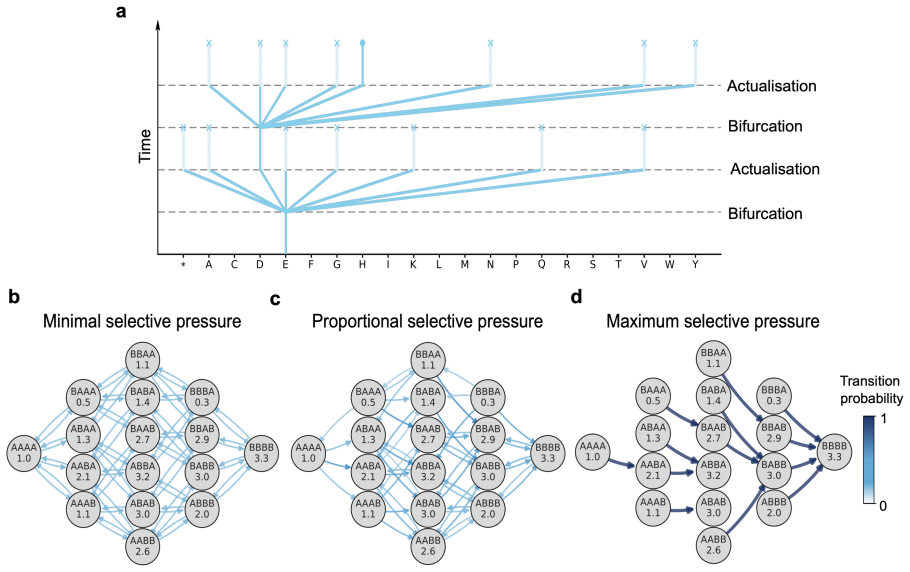
The central object is the strange attractor, a fractal subset of a dynamical system's phase space that nearby trajectories converge toward while remaining sensitive to perturbations. The paper maps protein sequence space to phase space, identifies stable folds and fitness maxima as attractors, and reads phylogenetic trees as fractal bifurcation patterns generated by repeated mutation-selection cycles. The strange attractor does the argument's main work: it explains why evolution appears to converge on the same functions and folds while never retracing the same sequence path. The treatment is analogical and illustrative; the paper does not compute fractal dimensions or Lyapunov exponents for any real protein system.
What would settle it
Take a fitness landscape measured by deep mutational scanning, evolve many populations from near-identical starting sequences under controlled selection, and ask whether outcomes diverge as predicted by sensitivity to initial conditions and whether the set of converged sequences has non-integer fractal dimension. If trajectories are largely reproducible from the starting sequence, or if converged sequence clusters have ordinary, non-fractal geometry, the strange-attractor description would be a metaphor rather than a mechanism.
Extended reading notes
Core claim
The central claim is that protein evolution embodies the defining characteristics of complex systems. In this view, mutation and selection are coupled nonlinear forces that make outcomes exquisitely sensitive to starting sequences, which the paper identifies with evolutionary contingency; epistasis makes each mutation's effect depend on genetic background; and the interplay of drift and selection can be described as turbulence, with selection acting as an external force that pushes a disordered pool of sequences toward low-entropy states such as stable folds. The paper's distinctive proposal is that native folds and fitness maxima behave like strange attractors in sequence space: trajectories converge toward them but, because of sensitivity to initial conditions and the vastness of sequence space, never exactly repeat. This is presented as a conceptual framework for interpreting existing data—phylogenetic trees, enzyme evolution experiments, deep mutational scans, and protein language model behavior—rather than as a mathematical derivation.
Load-bearing premise
The load-bearing premise is that mathematical ideas built for continuous dynamical systems—phase space, attractors, fractal geometry—transfer meaningfully to the discrete, finite, stochastic space of protein sequences, so that a cluster of similar sequences in a projection plot can be treated as a strange attractor.
Editorial extensions
If this is right
- Protein evolution models should abandon deterministic trajectory prediction and instead characterize basins of attraction and the statistical behavior of trajectories within them.
- Machine learning models trained on protein sequences should be evaluated not only on fitness prediction but on whether their latent spaces reproduce the attractor structure of real sequence space.
- In silico directed evolution should be framed as an exploration-exploitation problem, using bandit-style algorithms to balance mutation toward known folds against sampling unexplored regions.
- Consensus design and thermostability engineering are reinterpreted as applying selective order to counteract mutational turbulence, aligning sequences with a low-entropy equilibrium state.
- Irreversibility and entrenchment imply that reverse evolution experiments will typically fail even when ancestral functions are selected for, because epistatic ratchets have closed the reverse paths.
Reading between the lines
- Editorial extension: the paper uses 'strange attractor' as a metaphor, but the metaphor becomes a quantitative claim if future work estimates Lyapunov exponents or correlation dimensions from high-throughput evolutionary lineages, turning the analogy into a measurable dynamical property.
- Editorial extension: if the complex-systems view is correct, protein language models may be implicitly learning attractor geometry; probing their latent spaces for funnel-like structure could predict evolvability better than current fitness benchmarks.
- Editorial extension: the framework suggests that de novo gene birth and fold switching are not anomalies but expected turbulence-to-order transitions, which could guide experiments that deliberately search for weakly selective conditions favoring such transitions.
Editorial analysis
A structured set of objections, weighed in public.
Referee Report
Summary. This perspective argues that protein evolution should be understood as a complex system, exhibiting nonlinear dynamics, sensitivity to initial conditions, self-organization, and the emergence of order from chaos. It develops a series of analogies: evolutionary contingency as chaos-theoretic sensitivity to initial conditions, neutral drift as turbulence, fitness peaks and stable folds as attractors, UMAP sequence clusters as strange attractors, and phylogenetic trees as fractal objects. The paper then surveys machine-learning methods for modeling protein evolution and proposes future directions rooted in complex-systems tools such as bandit theory, information bottlenecks, and agent-based models. The central claim, restated in the Summary, is that the presence of strange attractors such as stable folds or functional states demonstrates a deep alignment between protein evolution and complex systems theory.
Significance. The paper is a synthesis rather than a new derivation, and its value lies in drawing together a broad and current literature on epistasis, entrenchment, contingency, de novo gene emergence, marginal stability, consensus design, and machine-learning models of protein evolution. It is commendably candid about the limitations of protein language models, including the observation that simple one-hot encodings can match or outperform LLM embeddings and that these models are best viewed as 'stochastic parrots.' If its proposed analogies were operationalized, the perspective could motivate quantitative tests using in silico evolution, ancestral sequence reconstruction, and high-throughput fitness measurements. However, the scientific significance of the central claim is currently limited because the most load-bearing concept, the 'strange attractor,' is used metaphorically rather than demonstrated, and no testable predictions follow from it beyond a general research agenda.
major comments (3)
- [Strange attractors and fractal geometry; Figure 2d; Summary] The identification of UMAP clusters as 'strange attractors' is unsupported and is load-bearing for the Summary's claim of 'deep alignment between protein evolution and complex systems theory.' UMAP is a dimensionality-reduction method; clusters in the embedding reflect sequence relatedness and functional conservation, not invariant sets of a dynamical flow. No Lyapunov exponents, fractal dimensions, or trajectory divergence rates are reported, so none of the defining properties of a strange attractor is established. Moreover, the paper explicitly describes protein evolution as 'discrete' and 'indeterministic' in an earlier section, whereas strange attractors are defined for deterministic dynamical systems. The authors should either provide a quantitative dynamical-systems analysis (e.g., measuring recurrence or divergence from reconstructed ancestral trajectories) or, more realistically for a perspective, reframe these objects as 'basins of attraction in a stochastic fitness landscape' and soften the Summary accordingly.
- [Initial conditions, contingency and directionality] The paper equates 'sensitivity to initial conditions' with evolutionary contingency, but these are different phenomena. In chaos theory, nearby deterministic initial states diverge exponentially under the same evolution rule; in protein evolution, divergent outcomes arise because stochastic mutation and epistasis produce different realized paths from similar or even identical starting sequences. The cited examples, such as hormone receptor evolution and directed-evolution reversibility, are cases of historical contingency and entrenchment, not demonstrations of deterministic chaos. A concrete discriminator would be replicate evolution experiments from identical starting sequences: chaotic determinism would require the same deterministic map with slightly different initial conditions, whereas the observed spread of outcomes is a distribution over stochastic trajectories. The authors should reframe this section as 'sensitivity to perturbations and historical contingency' and avoid implying that the chaos-theoretic definition has been satisfied.
- [Turbulence, entropy and self-organization] The 'turbulence' analogy is presented with the statement that neutral drift 'bears striking resemblance to turbulence,' but no quantitative aspect of fluid turbulence—such as an energy cascade, a Reynolds-number analog, or a defined disorder measure—is transferred to sequence space. The later discussion of laminar-to-turbulent transitions in protein disorder is also purely metaphorical. This would be acceptable as a heuristic if the paper consistently marked it as such, but the Summary elevates these analogies to evidence for 'deep alignment' with complex systems theory. The authors should either provide an operational definition of the proposed turbulence analog (for instance, in terms of variance in sequence entropies or flux across fitness thresholds) or explicitly downgrade these passages to intuitive illustrations.
minor comments (4)
- [Glossary] The glossary entry for 'Analytical solution' is unusual: the example 'sequence after ten generations, given the initial sequence' describes a forward simulation or recurrence, not an analytical solution in the usual closed-form sense. Please clarify the intended distinction.
- [Strange attractors and fractal geometry] The statement that phylogenetic trees 'mirror the fractal patterns observed in physical trees' is presented without any fractal-dimension analysis. Self-similar branching is a common property of random and neutral branching processes; calling it fractal requires a quantitative measure such as a scaling exponent.
- [Strange attractors and fractal geometry] The glossary defines a strange attractor as 'e.g. due to bifurcation through evolution.' Strange attractors arise through bifurcations in the parameters of a dynamical system, not 'through evolution'; this wording may confuse readers. Consider revising to distinguish parameter bifurcation from the paper's use of 'bifurcation' for mutational branching.
- [Machine learning in the study of complex systems] The passage on PINNs states that they are 'effective in modeling both chaotic systems, like the double pendulum, and systems with partial or noisy observations.' A double pendulum is chaotic but the cited PINN reference is specifically about PINNs failing to predict its chaotic motion; the paper should acknowledge this nuance or cite a more suitable example.
Circularity Check
No circularity: the paper is a perspective with no fitted-parameter predictions; self-citations are illustrative examples, not load-bearing derivations.
full rationale
This is a perspective essay rather than a derivation chain. It does not fit parameters, compute a quantity from data, or invoke a uniqueness theorem. The central claims are analogical: protein evolution is said to be nonlinear, sensitive to initial conditions, self-organizing, and to exhibit strange-attractor-like convergence. These are interpretations of existing observations, not results derived from definitions. Where the authors cite their own prior work (e.g., refs. 48, 56, 85, and 106), they use it as experimental or computational evidence or as an illustration, not as an authority that makes the argument circular. For example, the UMAP clusters labeled as 'strange attractors' in Fig. 2d are empirical dimensionality-reduction outputs from a prior study; labeling them as attractors is an unproven analogy, but the analogy is not a circular reduction because no definition or equation forces the conclusion. The glossary definition of 'strange attractor' contains the phrasing 'e.g. due to bifurcation through evolution,' which is imprecise, but the main-text definition is the standard dynamical-systems one, and the conclusion does not reduce to that glossary entry. Concerns that the transfer of chaos-theory concepts to discrete, stochastic evolution is unsupported belong to scientific validity, not circularity.
Assumptions & free parameters
assumptions (3)
- domain assumption Sequence space can be treated as a phase space for protein evolution.
- domain assumption Fitness maxima and native folds can be represented as attractors in sequence space.
- domain assumption Concepts from chaos theory apply to stochastic, discrete evolutionary processes.
Cite this review
Pith. "Pith review of Protein Evolution as a Complex System." pith.science (2026). https://pith.science/paper/PVU3L3SD
@misc{pith2026241206115,
  author       = {Pith},
  title        = {Pith review of: Protein Evolution as a Complex System},
  year         = {2026},
  howpublished = {\url{https://pith.science/paper/PVU3L3SD}},
  note         = {Machine review of arXiv:2412.06115}
}
read the original abstract
Protein evolution underpins life, and understanding its behavior as a system is of great importance. However, our current models of protein evolution are arguably too simplistic to allow quantitative interpretation and prediction of evolutionary trajectories. Viewing protein evolution as a complex system has the potential to advance our understanding and ability to model protein evolution. In this perspective, we discuss aspects of protein evolution that are typical of complex systems, from nonlinear dynamics, sensitivity to initial conditions, self-organization, and the emergence of order from chaos and disorder. We discuss how the growth in sequence and structural data, insights from laboratory evolution and new machine learning tools can advance the study of protein evolution and that by treating protein evolution as a complex adaptive system, we may gain new insights into the fundamental principles driving biological innovation and adaptation and apply this to protein engineering and design.
Figures


Reference graph
Works this paper leans on
-
[64]
Prigogine, I. (1978). Time, Structure, and Fluctuations. Science, 201(4358), 777–785. https://doi.org/10.1126/science.201.4358.777 65. Barenblatt, G. (1990). On a model of laminar–turbulent transition. Journal of Fluid Mechanics, 212, 487–496. 66. Zhang, Y., Stec, B., & Godzik, A. (2007). Between Order and Disorder in Protein Structures: Analysis of “Dual...
-
[120]
Tishby, N., Pereira, F. C., & Bialek, W. (2000). The information bottleneck method. https://doi.org/10.48550/arXiv.physics/0004057 121. Casert, C. (2019). Interpretable machine learning for inferring the phase boundaries in a nonequilibrium system. Physical Review E, 99(2). https://doi.org/10.1103/PhysRevE.99.023304 122. Bohl, K., Hummert, S., Werner, S.,...
Reviewed August 11, 2026 · model on record in the stance chip above.
Discussion (0). Continue with ORCID to comment.