REVIEW 4 major objections 5 minor 41 references
AIDE: Attribute-Guided MultI-Hop Data Expansion for Data Scarcity in Task-Specific Fine-tuning
T0 review · 4 major / 5 minor · reviewed 2026-08-11 · deepseek-v4-flash
Pith's one-line read From ten seed examples, AIDE synthesizes thousands of training points that fine-tune models to outperform human-curated gold data in the paper's experiments.
desk verdict A genuinely novel data-synthesis recipe is undercut by a test-set seeding leak for BIG-Bench and TruthfulQA; the framework deserves a redo, not a citation yet. read the letter →
The pith
A machine-rendered reading of the paper's core claim, the machinery that carries it, and where it could break.
The reading
What carries the argument
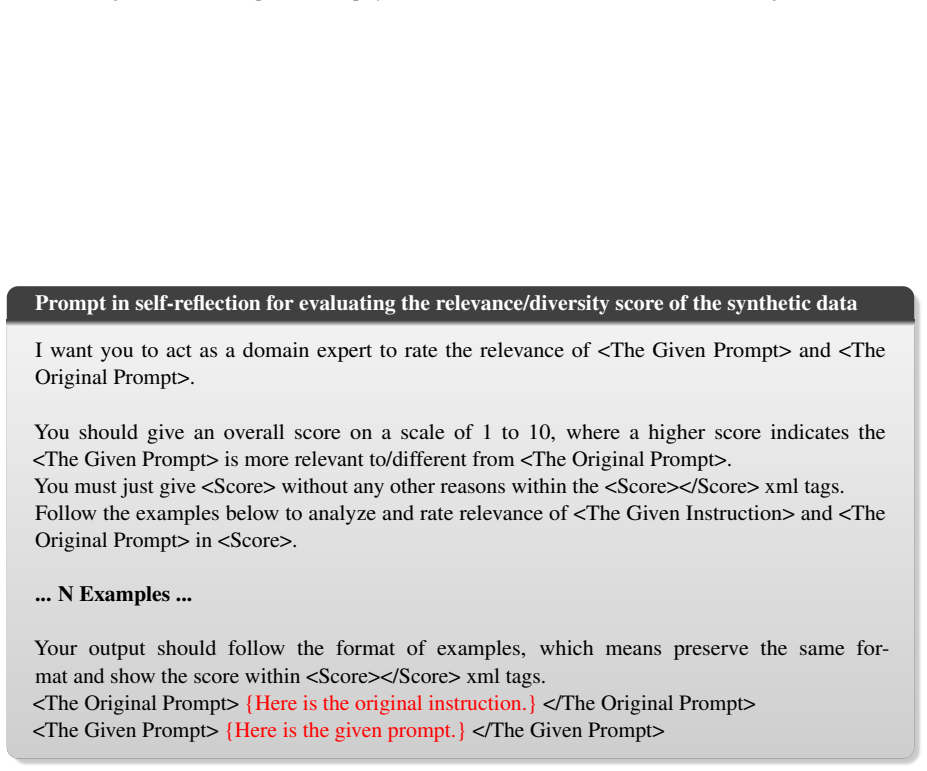
The central object is the multi-hop synthesis tree with attribute-based control. For each data point $X_i^{(K)}$, an LLM extractor produces a representation $A_i^{(K)} = \{\langle t, r, a\rangle\}$ containing one topic and three related knowledge attributes. A synthesizer LLM then generates new data from a triplet plus a predefined operation (concretizing, adding constraints, adding reasoning), task demonstrations, and—for diversity—a persona retrieved by topic similarity from a persona hub. The process repeats for $K$ hops, and a residual connection feeds the original seed $X_i^{(0)}$ into the prompt for depths $d \le L$ to keep generated data on task. A self-reflection grader scores each generated point for relevance and diversity, filtering or rewriting low-scoring data.
What would settle it
Run AIDE with an open-source synthesizer whose pretraining corpus is documented to exclude MMLU, ARC-Challenge, TruthfulQA, MedQA, and BIG-Bench test sets, then compare fine-tuned accuracy against gold-data fine-tuning. If the reported average improvements (over 6% for Mistral-7B vs. gold, over 30% vs. evolution-based synthesis) shrink or vanish, the original result was partly an artifact of test-set leakage; if they persist, the method itself carries the gain.
Extended reading notes
Core claim
The paper's central claim is that structured multi-hop expansion—not the volume of seed data—is what unlocks data synthesis for task-specific fine-tuning. AIDE represents each data point as knowledge triplets $\langle t, r, a\rangle$ (topic, relation, attribute) and uses those triplets, together with task demonstrations, predefined operations, and retrieved personas, to synthesize new questions. Each new question seeds the next hop, so ten seeds grow into roughly three thousand training points. A residual connection from the original seed into prompts up to depth $L$ prevents the topic drift that otherwise appears at deeper hops. Fine-tuning Mistral-7B, Llama-3.1-8B, and Llama-3.2-3B on AIDE data yields average relative improvements of about 6%, 0.7%, and 1.5% over gold-data fine-tuning across the evaluated benchmarks, and on BIG-Bench zero-shot tasks AIDE-trained Mistral-7B substantially outperforms Evol-Instruct, DataTune, and Prompt2Model.
Load-bearing premise
The comparisons to gold data assume the LLM used to generate synthetic data has not memorized the public test questions of MMLU, ARC, TruthfulQA, MedQA, or BIG-Bench, because the seeds come from public datasets and no contamination check is reported.
Editorial extensions
If this is right
- Fine-tuning from ten seeds can match or beat fine-tuning on full human-curated training sets, which would remove the need for large labeled collections in new task domains.
- Because Evol-Instruct used 250K synthetic points and AIDE used about 3K per task while still winning on BIG-Bench zero-shot tasks, task-relevance control can matter more than raw synthesis volume.
- Residual connections make deeper multi-hop expansion usable: increasing hop depth $K$ adds data and can improve accuracy, while residual depth $L$ tunes how tightly the generated data stays anchored to the original seeds.
- Persona-guided synthesis injects diversity without sacrificing task relevance, addressing the diversity–relevance trade-off that prior methods struggle with.
- Embedding analysis suggests AIDE's synthetic data covers the target task's distribution even for benchmarks without official training sets, implying the method could be applied to tasks that currently have no training data at all.
Reading between the lines
- If the result holds, the practical recipe for a new task becomes: gather roughly ten representative examples, let a capable synthesizer branch them under attribute and persona guidance, and fine-tune; specialist models could then be built without collecting large labeled datasets.
- Because the synthesizer is a closed model trained on unknown web data and the seeds are public, a contamination check would settle how much of the advantage over gold data comes from the method rather than from test-set leakage; this is the natural next experiment.
- The residual connection idea likely transfers to other recursive generation settings, such as iterative self-improvement or tree-of-thought data expansion, where maintaining a fixed anchor while branching is a general need.
- The experiments use small test subsets for some tasks, so a larger-scale sweep with full benchmarks and multiple random seed sets would show whether the reported margins are stable.
Editorial analysis
A structured set of objections, weighed in public.
Referee Report
Summary. The paper proposes AIDE (Attribute-guided MultI-hop Data Expansion), a framework that synthesizes task-specific fine-tuning data from a small number of seed examples. AIDE extracts topic/attribute triplets from seeds, uses these to guide iterative multi-hop synthesis, injects personas for diversity, and applies residual connections to limit topical drift at larger hop depths. The empirical study fine-tunes Mistral-7B, Llama-3.1-8B, and Llama-3.2-3B on AIDE-generated data and compares against fine-tuning on human-curated gold data and against SOTA synthesis methods such as Evol-Instruct, Prompt2Model, and DataTune. The main claimed results are that AIDE beats gold-data fine-tuning by small margins on average, and beats SOTA synthesis methods by over 30% on BIG-Bench.
Significance. If the empirical claims are sound, AIDE would be a useful contribution: it is a clearly described, modular synthesis recipe with released code, and the residual-connection idea for preserving relevance at increasing hop depth is plausible and well-motivated. The paper also ships concrete prompts and an ablation study, which are valuable for reproducibility. However, the current experimental design does not yet establish the headline claims. The BIG-Bench and TruthfulQA evaluations appear to use test-set questions as synthesis seeds, the Evol-Instruct comparison is not a controlled same-budget comparison, and gold-data training sizes are not matched. These issues directly affect the main quantitative conclusions, so the paper needs substantial experimental revision before its central claims can be accepted.
major comments (4)
- [Appendix E / Appendix H / Tables 2 and 3] The evaluation setup appears to use test-set questions as seeds for BIG-Bench and TruthfulQA, making the comparison circular for those benchmarks. Appendix E states that "Since BIG-Bench lacks a training set, we sample 10 task-related seed data points per task from Hugging Face datasets to generate synthetic data," while Appendix H reports that the five selected BIG-Bench tasks consist only of test sets (60, 153, 492, 7,688, and 1,000 points). Appendix H similarly lists TruthfulQA as 817 test questions with no training split, yet Table 2 reports TruthfulQA results using 10 seeds and a "Gold training data" baseline of unexplained provenance. If the 10 seeds are drawn from the test sets, then the synthetic training data is generated from the evaluation distribution, and fine-tuning on near-duplicates of the test questions can inflate accuracy. This would directly inflate the BIG-Bench gains in Table 3 and the TruthfulQA gains in Table 2. The authors must either clarify the exact source of the seeds (including the specific Hugging Face dataset splits) or rerun the BIG-Bench and TruthfulQA evaluations with seeds drawn from a genuinely disjoint training source, and report an overlap check between synthetic data and test questions.
- [Table 3 / Section 4.1 / Appendix E] The comparison against Evol-Instruct is not a controlled experiment. Table 3 compares Mistral-7B fine-tuned with AIDE data against "Mistral-7B with Evol-Instruct," which, according to Section 4.1 and footnote 1, is the external WizardLM-2-7B model fine-tuned on 250K Evol-Instruct examples. This differs from AIDE in three confounding ways: the amount of training data (250K versus roughly 3K), the fine-tuning recipe, and possibly the base model version. As a result, the claimed "over 30%" improvement over SOTA synthesis methods conflates data quantity, training budget, and synthesis quality. The authors should run Evol-Instruct on the same 10 seeds, the same data budget, and the same LoRA fine-tuning setup as AIDE, and report the variance across multiple runs.
- [Table 2 / Section 4.2] The gold-data baselines in Table 2 are not matched in data quantity. For MedQA, Appendix H reports a 10,178-point training set, while AIDE synthesizes 2,173 points; for FinBen, the gold training set is 804 points versus 893 synthetic points; for MMLU, ARC-Challenge, and TruthfulQA, the paper does not report how many gold training examples were used per task. Only GSM8K is explicitly matched at 3.2K. The claim that AIDE "surpasses models fine-tuned on human-curated data" is therefore misleading if the gold models are trained on substantially larger or smaller datasets. The authors should either match the number of training examples across conditions or explicitly report the gold training sizes and interpret the comparison accordingly.
- [Section 4.4 / Appendix N] The relevance and diversity analyses in Section 4.4 are partially circular because Claude Sonnet 3.5 both generates the synthetic data and serves as the grader for relevance and diversity. Section 4.4 and Appendix N report scores assigned by Claude to its own outputs, which does not provide an independent quality check. The self-reflection filter in Appendix E also uses the same model to grade and rewrite. The authors should add either human evaluation, a second independent LLM, or a quantitative overlap metric on a held-out set to support RQ3. This concern is secondary to the leakage issue but should still be addressed before the quality claims are accepted.
minor comments (5)
- [Table 4] The sentence "We highlight the best performance and the base performance is in Table 3" is incomplete and unclear; please state explicitly which row is the base model and which number should be compared.
- [Figure 11 / Appendix G.2] The text says the synthetic data clusters are "largely disjoint" from real data in the Code task but then says the synthetic data "covers all real test data" from two tasks; these statements are contradictory and need clarification.
- [Figure 4] There is a typo in the x-axis label: "Mistra-7B" should be "Mistral-7B".
- [Section 4.3 / Figure 4] The residual-connection experiment on LegalBench is not listed in the main benchmark table or described in Appendix H; please add the dataset statistics and explain why this task is used only in the ablation.
- [Appendix G.1] The claim that AIDE achieves "comparable complexity" to Evol-Instruct is based on a visual histogram comparison; please provide numerical scores, sample sizes, and a statistical comparison.
Circularity Check
BIG-Bench and TruthfulQA evaluations are seeded from the same test questions on which accuracy is reported, making part of the headline comparison circular.
-
other
[Appendix E (Data Synthesis Setup); Appendix H (Benchmark Statistics); Table 3 (BIG-Bench results)]
""Since BIG-Bench lacks a training set, we sample 10 task-related seed data points per task from Hugging Face datasets to generate synthetic data." "The selected tasks without training sets include 60, 153, 492, 7.688k and 1k data points in their test sets, respectively.""
Taken together, these statements show that the 10 seeds used to synthesize AIDE's BIG-Bench training data for Table 3 are sampled from the same test questions on which zero-shot accuracy is then reported. The synthetic training set therefore contains near-duplicates of the evaluation questions, so the reported gains over Evol-Instruct and the pretrained model on BIG-Bench are inflated by construction rather than measuring generalization to unseen data. No overlap check between synthesized data and test questions is reported.
-
other
[Appendix E (Data Synthesis Setup); Appendix H (TruthfulQA); Table 2 (TruthfulQA column)]
""For the remaining benchmarks, we similarly sample 10 seed data points per task from their respective training sets to produce synthetic data." "We select the multiple choice sets which contains 817 questions for testing.""
TruthfulQA is described in Appendix H as test-only (817 questions) with no training split, yet Table 2 reports AIDE fine-tuned from 10 TruthfulQA seeds and a 'Gold training data' baseline. Since Appendix E says seeds for non-BIG-Bench benchmarks are drawn from training sets, and TruthfulQA has none, the 10 seeds used for synthesis must come from the test set or from an unexplained source. Either way, the >15% average improvement over gold on TruthfulQA is not an independent held-out measurement; it is partly circular because the synthesis input and evaluation set overlap.
1 more flagged steps
-
other
[Section 4.4 (Relevance and Diversity); Appendix E (Data Synthesis Setup); Figure 17]
""We employ Claude Sonnet 3.5 as the LLM generator, the LLM synthesizer, the LLM grader and the LLM annotator in AIDE." "Additionally, we employ Claude Sonnet 3.5 to assess the relevance of synthetic data to the seed data across the three tasks.""
The relevance and diversity evidence for RQ3 is produced by the same Claude Sonnet 3.5 model that generated the synthetic data and that also serves as the grader in the self-reflection filter. These scores are therefore self-assessments rather than independent measurements; they do not validate the synthetic data against an external standard. This is a secondary issue and does not bear on the external accuracy comparisons.
full rationale
The core AIDE method is not a circular derivation: it is an empirical data-synthesis pipeline evaluated against external benchmarks, and there is no load-bearing self-citation chain or imported uniqueness theorem. Most benchmark families (MMLU, ARC-Challenge, GSM8K, MedQA) use proper train/test splits, so the central comparisons on those tasks retain independent content. However, the paper's own appendices establish a partial evaluation circularity for two benchmark families. Appendix E says BIG-Bench seeds are sampled from Hugging Face datasets, and Appendix H states those five tasks have only test sets; therefore the Table 3 BIG-Bench evaluation is seeded from the same test questions on which accuracy is reported. TruthfulQA is likewise test-only in Appendix H while Table 2 reports a 10-seed fine-tuning result, so its seeds and gold baseline are either drawn from the test set or unexplained. These two cases directly affect the headline claims of >30% improvement over SOTA synthesis methods and >15% improvement over gold data, so the central claim is partially circular. A secondary self-assessment issue is that Claude Sonnet 3.5 generates, grades, and filters the synthetic data in the RQ3 quality analysis, which weakens the relevance/diversity evidence but not the external accuracy results. Overall, the paper is not fully circular, but a substantial portion of the headline evaluation reduces to test-set-seeded synthesis.
Assumptions & free parameters
free parameters (6)
- hop_depth_K =
2 (main); 2-4 in Figure 3
- residual_depth_L =
2 when K=2 (implicit); 1-4 in Figure 4
- top_P_personas =
5
- num_attributes =
1 topic + 3 attributes
- synthesis_operations =
3 (concretizing, adding constraint, adding reasoning)
- self_reflection_threshold =
5
assumptions (4)
- domain assumption The 10 seed questions are representative of each target task distribution.
- domain assumption Claude Sonnet 3.5's pretraining does not leak the evaluation test sets into generated synthetic data.
- domain assumption LLM-generated labels in the synthetic data are correct enough for fine-tuning.
- domain assumption Embedding-similarity retrieval from Persona Hub and LLM scoring reflect real task relevance and diversity.
Cite this review
Pith. "Pith review of AIDE: Attribute-Guided MultI-Hop Data Expansion for Data Scarcity in Task-Specific Fine-tuning." pith.science (2026). https://pith.science/paper/XEZOFC52
@misc{pith2026241206136,
  author       = {Pith},
  title        = {Pith review of: AIDE: Attribute-Guided MultI-Hop Data Expansion for Data Scarcity in Task-Specific Fine-tuning},
  year         = {2026},
  howpublished = {\url{https://pith.science/paper/XEZOFC52}},
  note         = {Machine review of arXiv:2412.06136}
}
read the original abstract
Fine-tuning large language models (LLMs) for specific tasks requires diverse, high-quality training data. However, obtaining sufficient relevant data remains a significant challenge. Existing data synthesis methods either depend on extensive seed datasets or struggle to balance task relevance and data diversity. To address these challenges, we propose Attribute-guided multI-hop Data Expansion (AIDE), a novel data synthesis framework that uses a multi-hop process to expand very few seed data points while ensuring data diversity and task relevance. AIDE extracts the main topic and key knowledge attributes from the seeds to guide the synthesis steps. The process repeats for K hops, using the generated data as seeds. To prevent irrelevant data generation as the hop depth increases, AIDE incorporates a residual connection mechanism. Our empirical results show that AIDE enables fine-tuning of Mistral-7B, Llama-3.1-8B and Llama-3.2-3B from 10 seeds, surpassing the models fine-tuned on human curated data. Furthermore, AIDE outperforms state-of-the-art data synthesis methods, such as Evol-Instruct, by over 30% in task-specific fine-tuning. Code is available at https://github.com/Code4Graph/AIDE.
Figures


Figures from the paper (16 more)




Reference graph
Works this paper leans on
-
[1]
BIG bench authors. 2023. Beyond the imitation game: Quantifying and extrapolating the capabilities of language models. Transactions on Machine Learning Research
work page 2023
-
[2]
Xin Chan, Xiaoyang Wang, Dian Yu, Haitao Mi, and Dong Yu. 2024. https://arxiv.org/abs/2406.20094 Scaling synthetic data creation with 1,000,000,000 personas . Preprint, arXiv:2406.20094
arXiv 2024
-
[3]
Gonzalez, Ion Stoica, and Eric P
Wei-Lin Chiang, Zhuohan Li, Zi Lin, Ying Sheng, Zhanghao Wu, Hao Zhang, Lianmin Zheng, Siyuan Zhuang, Yonghao Zhuang, Joseph E. Gonzalez, Ion Stoica, and Eric P. Xing. 2023. Vicuna: An open-source chatbot impressing gpt-4 with 90\
work page 2023
-
[4]
Peter Clark, Isaac Cowhey, Oren Etzioni, Tushar Khot, Ashish Sabharwal, Carissa Schoenick, and Oyvind Tafjord. 2018. Think you have solved question answering? try arc, the ai2 reasoning challenge. ArXiv, abs/1803.05457
arXiv 2018
-
[5]
Karl Cobbe, Vineet Kosaraju, Mohammad Bavarian, Mark Chen, Heewoo Jun, Lukasz Kaiser, Matthias Plappert, Jerry Tworek, Jacob Hilton, Reiichiro Nakano, Christopher Hesse, and John Schulman. 2021. Training verifiers to solve math word problems. arXiv preprint arXiv:2110.14168
arXiv 2021
-
[6]
Saumya Gandhi, Ritu Gala, Vijay Viswanathan, Tongshuang Wu, and Graham Neubig. 2024. https://arxiv.org/abs/2404.14361 Better synthetic data by retrieving and transforming existing datasets . Preprint, arXiv:2404.14361
arXiv 2024
-
[7]
Neel Guha, Julian Nyarko, Daniel E. Ho, Christopher Ré, Adam Chilton, Aditya Narayana, Alex Chohlas-Wood, Austin Peters, Brandon Waldon, Daniel N. Rockmore, Diego Zambrano, Dmitry Talisman, Enam Hoque, Faiz Surani, Frank Fagan, Galit Sarfaty, Gregory M. Dickinson, Haggai Porat, Jason Hegland, Jessica Wu, Joe Nudell, Joel Niklaus, John Nay, Jonathan H. Cho...
arXiv 2023
-
[8]
Michael Günther, Jackmin Ong, Isabelle Mohr, Alaeddine Abdessalem, Tanguy Abel, Mohammad Kalim Akram, Susana Guzman, Georgios Mastrapas, Saba Sturua, Bo Wang, Maximilian Werk, Nan Wang, and Han Xiao. 2023. https://arxiv.org/abs/2310.19923 Jina embeddings 2: 8192-token general-purpose text embeddings for long documents . Preprint, arXiv:2310.19923
arXiv 2023
Show all 41 references
-
[9]
Dan Hendrycks, Collin Burns, Steven Basart, Andy Zou, Mantas Mazeika, Dawn Song, and Jacob Steinhardt. 2021. Measuring massive multitask language understanding. Proceedings of the International Conference on Learning Representations (ICLR)
2021
-
[10]
Edward J Hu, yelong shen, Phillip Wallis, Zeyuan Allen-Zhu, Yuanzhi Li, Shean Wang, Lu Wang, and Weizhu Chen. 2022. Lo RA : Low-rank adaptation of large language models. In International Conference on Learning Representations
2022
-
[11]
Bowen Jin, Gang Liu, Chi Han, Meng Jiang, Heng Ji, and Jiawei Han. 2023. Large language models on graphs: A comprehensive survey. arXiv preprint arXiv:2312.02783
2023 arXiv
-
[12]
Di Jin, Eileen Pan, Nassim Oufattole, Wei-Hung Weng, Hanyi Fang, and Peter Szolovits. 2020. What disease does this patient have? a large-scale open domain question answering dataset from medical exams. arXiv preprint arXiv:2009.13081
2020 arXiv
-
[13]
Stephanie Lin, Jacob Hilton, and Owain Evans. 2022. https://doi.org/10.18653/v1/2022.acl-long.229 T ruthful QA : Measuring how models mimic human falsehoods . In Proceedings of the 60th Annual Meeting of the Association for Computational Linguistics (Volume 1: Long Papers), pa...
2022 doi
-
[14]
Ilya Loshchilov and Frank Hutter. 2019. Decoupled weight decay regularization. In International Conference on Learning Representations
2019
-
[15]
Aman Madaan, Niket Tandon, Prakhar Gupta, Skyler Hallinan, Luyu Gao, Sarah Wiegreffe, Uri Alon, Nouha Dziri, Shrimai Prabhumoye, Yiming Yang, Shashank Gupta, Bodhisattwa Prasad Majumder, Katherine Hermann, Sean Welleck, Amir Yazdanbakhsh, and Peter Clark. 2023. Self-refine: It...
2023
-
[16]
Igor Melnyk, Pierre Dognin, and Payel Das. 2022. Knowledge graph generation from text. In Findings of the Association for Computational Linguistics: EMNLP 2022, pages 1610--1622, Abu Dhabi, United Arab Emirates. Association for Computational Linguistics
2022
-
[17]
Long Ouyang, Jeffrey Wu, Xu Jiang, Diogo Almeida, Carroll Wainwright, Pamela Mishkin, Chong Zhang, and et al. Agarwal. 2022. Training language models to follow instructions with human feedback. In Advances in Neural Information Processing Systems, pages 27730--27744
2022
-
[18]
Liangming Pan, Michael Saxon, Wenda Xu, Deepak Nathani, Xinyi Wang, and William Yang Wang. 2024. Automatically correcting large language models: Surveying the landscape of diverse automated correction strategies. Transactions of the Association for Computational Linguistics, 12
2024
-
[19]
Feifan Song, Bowen Yu, Hao Lang, Haiyang Yu, Fei Huang, Houfeng Wang, and Yongbin Li. 2024. https://arxiv.org/abs/2403.11124 Scaling data diversity for fine-tuning language models in human alignment . Preprint, arXiv:2403.11124
2024 arXiv
-
[20]
Hashimoto
Rohan Taori, Ishaan Gulrajani, Tianyi Zhang, Yann Dubois, Xuechen Li, Carlos Guestrin, Percy Liang, and Tatsunori B. Hashimoto. 2023. Stanford alpaca: An instruction-following llama model
2023
-
[21]
Laurens van der Maaten and Geoffrey Hinton. 2008. Visualizing data using t-sne. Journal of Machine Learning Research, 9(86):2579--2605
2008
-
[22]
Vijay Viswanathan, Chenyang Zhao, Amanda Bertsch, Tongshuang Wu, and Graham Neubig. 2023. https://doi.org/10.18653/v1/2023.emnlp-demo.38 P rompt2 M odel: Generating deployable models from natural language instructions . In Proceedings of the 2023 Conference on Empirical Method...
2023 doi
-
[23]
Chi, Sharan Narang, Aakanksha Chowdhery, and Denny Zhou
Xuezhi Wang, Jason Wei, Dale Schuurmans, Quoc V Le, Ed H. Chi, Sharan Narang, Aakanksha Chowdhery, and Denny Zhou. 2023. https://openreview.net/forum?id=1PL1NIMMrw Self-consistency improves chain of thought reasoning in language models . In The Eleventh International Conferenc...
2023
-
[24]
Zifeng Wang, Chun-Liang Li, Vincent Perot, Long Le, Jin Miao, Zizhao Zhang, Chen-Yu Lee, and Tomas Pfister. 2024. C odec LM : Aligning language models with tailored synthetic data. In Findings of the Association for Computational Linguistics: NAACL 2024, Mexico City, Mexico. A...
2024
-
[25]
Dai, and Quoc V Le
Jason Wei, Maarten Bosma, Vincent Zhao, Kelvin Guu, Adams Wei Yu, Brian Lester, Nan Du, Andrew M. Dai, and Quoc V Le. 2022. Finetuned language models are zero-shot learners. In International Conference on Learning Representations
2022
-
[26]
Yilin Wen, Zifeng Wang, and Jimeng Sun. 2024. Mindmap: Knowledge graph prompting sparks graph of thoughts in large language models. In Proceedings of the 62nd Annual Meeting of the Association for Computational Linguistics
2024
-
[27]
Qianqian Xie, Weiguang Han, Zhengyu Chen, Ruoyu Xiang, Xiao Zhang, Yueru He, Mengxi Xiao, Dong Li, Yongfu Dai, Duanyu Feng, Yijing Xu, Haoqiang Kang, Ziyan Kuang, Chenhan Yuan, Kailai Yang, Zheheng Luo, Tianlin Zhang, Zhiwei Liu, Guojun Xiong, Zhiyang Deng, Yuechen Jiang, Zhiy...
2024 arXiv
-
[28]
Qianqian Xie, Weiguang Han, Xiao Zhang, Yanzhao Lai, Min Peng, Alejandro Lopez-Lira, and Jimin Huang. 2023. https://arxiv.org/abs/2306.05443 Pixiu: A large language model, instruction data and evaluation benchmark for finance . Preprint, arXiv:2306.05443
2023 arXiv
-
[29]
Can Xu, Qingfeng Sun, Kai Zheng, Xiubo Geng, Pu Zhao, Jiazhan Feng, Chongyang Tao, Qingwei Lin, and Daxin Jiang. 2024. Wizard LM : Empowering large pre-trained language models to follow complex instructions. In The Twelfth International Conference on Learning Representations
2024
-
[30]
Hanwei Xu, Yujun Chen, Yulun Du, Nan Shao, Wang Yanggang, Haiyu Li, and Zhilin Yang. 2022. Z ero P rompt: Scaling prompt-based pretraining to 1,000 tasks improves zero-shot generalization. In Findings of the Association for Computational Linguistics: EMNLP 2022, pages 4235--42...
2022
-
[31]
Jiacheng Ye, Jiahui Gao, Qintong Li, Hang Xu, Jiangtao Feng, Zhiyong Wu, Tao Yu, and Lingpeng Kong. 2022 a . https://doi.org/10.18653/v1/2022.emnlp-main.801 Z ero G en: Efficient zero-shot learning via dataset generation . In Proceedings of the 2022 Conference on Empirical Met...
2022 doi
-
[32]
Jiacheng Ye, Jiahui Gao, Zhiyong Wu, Jiangtao Feng, Tao Yu, and Lingpeng Kong. 2022 b . https://doi.org/10.18653/v1/2022.findings-emnlp.269 P ro G en: Progressive zero-shot dataset generation via in-context feedback . In Findings of the Association for Computational Linguistic...
2022 doi
-
[33]
Chenyang Zhao, Xueying Jia, Vijay Viswanathan, Graham Neubig, and Tongshuang Wu. 2024 a . https://openreview.net/forum?id=Dt6qXZsgaU Self-guide: Better task-specific instruction following via self-synthetic finetuning . In First Conference on Language Modeling
2024
-
[34]
Wenting Zhao, Xiang Ren, Jack Hessel, Claire Cardie, Yejin Choi, and Yuntian Deng. 2024 b . https://arxiv.org/abs/2405.01470 Wildchat: 1m chatgpt interaction logs in the wild . Preprint, arXiv:2405.01470
2024 arXiv
-
[35]
Zhang, and Yongbin Li
Yingxiu Zhao, Bowen Yu, Binyuan Hui, Haiyang Yu, Minghao Li, Fei Huang, Nevin L. Zhang, and Yongbin Li. 2024 c . Tree-instruct: A preliminary study of the intrinsic relationship between complexity and alignment. In Proceedings of the 2024 Joint International Conference on Comp...
2024
-
[36]
Yaoming Zhu, Sidi Lu, Lei Zheng, Jiaxian Guo, Weinan Zhang, Jun Wang, and Yong Yu. 2018. https://doi.org/10.1145/3209978.3210080 Texygen: A benchmarking platform for text generation models . In The 41st International ACM SIGIR Conference on Research & Development in Informatio...
2018
-
[37]
online" 'onlinestring :=
ENTRY address archivePrefix author booktitle chapter edition editor eid eprint eprinttype howpublished institution journal key month note number organization pages publisher school series title type volume year doi pubmed url lastchecked label extra.label sort.label short.list...
-
[38]
write newline
" write newline "" before.all 'output.state := FUNCTION n.dashify 't := "" t empty not t #1 #1 substring "-" = t #1 #2 substring "--" = not "--" * t #2 global.max substring 't := t #1 #1 substring "-" = "-" * t #2 global.max substring 't := while if t #1 #1 substring * t #2 gl...
-
[39]
@esa (Ref
\@ifxundefined[1] #1\@undefined \@firstoftwo \@secondoftwo \@ifnum[1] #1 \@firstoftwo \@secondoftwo \@ifx[1] #1 \@firstoftwo \@secondoftwo [2] @ #1 \@temptokena #2 #1 @ \@temptokena \@ifclassloaded agu2001 natbib The agu2001 class already includes natbib coding, so you should ...
-
[40]
\@lbibitem[] @bibitem@first@sw\@secondoftwo \@lbibitem[#1]#2 \@extra@b@citeb \@ifundefined br@#2\@extra@b@citeb \@namedef br@#2 \@nameuse br@#2\@extra@b@citeb \@ifundefined b@#2\@extra@b@citeb @num @parse #2 @tmp #1 NAT@b@open@#2 NAT@b@shut@#2 \@ifnum @merge>\@ne @bibitem@firs...
-
[41]
( ) & 2 * Avg
@open @close @open @close and [1] URL: #1 \@ifundefined chapter * \@mkboth \@ifxundefined @sectionbib * \@mkboth * \@mkboth\@gobbletwo \@ifclassloaded amsart * \@ifclassloaded amsbook * \@ifxundefined @heading @heading NAT@ctr thebibliography [1] @ \@biblabel @NAT@ctr \@bibset...
Reviewed August 11, 2026 · model on record in the stance chip above.
Discussion (0). Continue with ORCID to comment.