REVIEW 3 major objections 5 minor 71 references
A Self-guided Multimodal Approach to Enhancing Graph Representation Learning for Alzheimer's Diseases
T0 review · 3 major / 5 minor · reviewed 2026-08-11 · deepseek-v4-flash
Pith's one-line read The paper claims that injecting uncurated PubMed abstracts into a multimodal graph neural network improves Alzheimer's disease classification and yields interpretable brain-region masks.
desk verdict Interesting framework, but the central claim that AD-specific knowledge drives the gains is untested and partially contradicted by the paper's own ablation. read the letter →
The pith
A machine-rendered reading of the paper's core claim, the machinery that carries it, and where it could break.
The reading
What carries the argument
The load-bearing object is a pair of learnable masks, one on the graph edges ($M_d$, parameterized by $\alpha$) and one on the fusion-graph edges between the brain node and knowledge nodes ($M_k$, parameterized by $\beta$), sampled with Gumbel-Softmax so the whole pipeline stays differentiable. The fusion graph is the bridge: a backbone GNN $f_B$ provides the graph embedding $E_d^G$, a pretrained language model followed by an MLP provides knowledge embeddings $E_K^i$, and the fusion GNN $f_F$ classifies from the graph that connects them. After pretraining, the masks are optimized with a loss that balances prediction consistency, label fit, sparsity, and discreteness, and the learned mask values then drive an edge-sampling augmentation to fine-tune the model.
What would settle it
Run the same multimodal GNN with a control knowledge set of, say, 20,000 abstracts from unrelated biomedical fields or shuffled AD abstracts; if classification accuracy and the learned masks stay essentially unchanged, the central claim that AD domain knowledge drives the improvement would be refuted.
Extended reading notes
Core claim
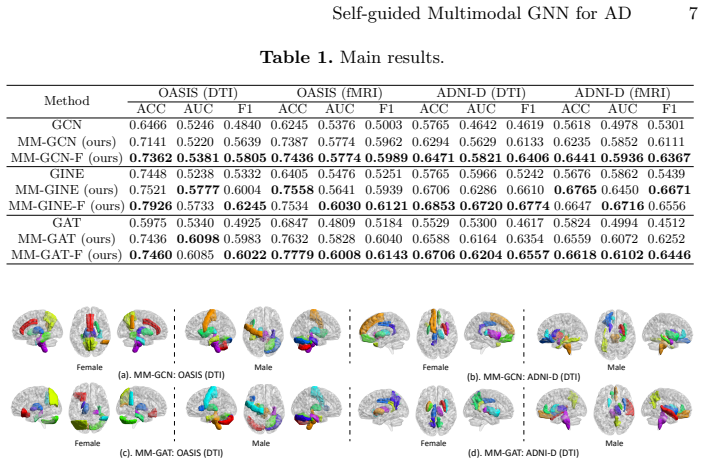
In the paper's own terms, the central discovery is that domain knowledge can be represented as natural language and injected into a GNN through a fusion graph: a backbone GNN embedding of the brain graph is connected to language-model embeddings of knowledge items, and a fusion GNN classifies from this combined graph. The model learns two real-valued masks, one over graph edges and one over knowledge edges, that act as explanations for both graph-wise and knowledge-wise importance, and it uses those masks to guide a graph-augmentation fine-tuning step. The authors show that this procedure improves ACC, AUC, and F1 over vanilla GNNs on DTI and fMRI versions of both OASIS and ADNI-D, and that the learned masks produce salient-ROI maps that differ by sex and by GNN backbone.
Load-bearing premise
The improvement over plain graph neural networks comes from the Alzheimer's-specific content of the injected text, not just from the extra model capacity of the new text-processing branch.
Editorial extensions
If this is right
- If the central claim holds, raw literature can serve as a knowledge source for GNN-based diagnosis, reducing the need for teams of human experts to manually tailor models.
- The learned graph masks could provide automatic, dataset-specific explanations of which brain regions drive AD versus MCI classification, and the reported sex-specific differences offer a testable hypothesis about sex-linked AD biomarkers.
- The ablation showing that the full 20,000-record knowledge set helps more than 200- or 2,000-record subsets suggests that scaling uncurated literature input may further improve performance.
- The same self-guided multimodal recipe could transfer to other graph-based medical prediction tasks where a body of literature is available.
Reading between the lines
- Editorial extension: the paper does not compare against a multimodal GNN with a non-AD or scrambled text corpus, so the attribution of gains to AD-specific knowledge content remains untested; a control-text experiment would clarify whether the improvement is content-driven or capacity-driven.
- Editorial extension: the knowledge-mask distributions in the paper show that most abstracts are downweighted, suggesting the model is performing a form of implicit retrieval; a direct comparison with sparse retrieval or retrieval-augmented generation over the same corpus could isolate the value of the learned soft retrieval mechanism.
- Editorial extension: the sex-specific mask differences are observational; linking them to external neuroimaging or genetic biomarkers of AD would be a natural next test, as would checking whether the masks generalize across cohorts.
- Editorial extension: the knowledge-size ablation hints at a critical mass of knowledge needed before gains appear; testing intermediate sizes between 10% and 100% could reveal where the transition occurs.
Editorial analysis
A structured set of objections, weighed in public.
Referee Report
Summary. The paper proposes a self-guided multimodal graph neural network (MM-GNN) for Alzheimer's disease (AD) classification that fuses brain connectome graphs with uncurated PubMed abstracts. A backbone GNN encodes the graph, a pretrained language model (BERT-Large) followed by an MLP encodes knowledge items, and a fusion GNN combines the two modalities to produce predictions. The method then learns data and knowledge masks via a Gumbel-Softmax parameterization, using them as explanations and to guide edge-sampling-based graph augmentation for fine-tuning. Experiments on OASIS and ADNI-D datasets with DTI and fMRI modalities compare MM-GNN and a fine-tuned variant (MM-GNN-F) against vanilla GCN, GINE, and GAT baselines, reporting accuracy, AUC, and F1. The paper also presents qualitative saliency maps and an ablation on the size of the knowledge set. The central claim is that injecting AD-specific domain knowledge significantly improves GNN performance and interpretability.
Significance. If the central claim were established, the framework would be a meaningful step toward replacing human-expert-guided knowledge injection with automatic retrieval from raw, uncurated literature, with potential value for brain-connectome analysis and explainable medical decision support. The method is clearly described, the multimodal architecture is reasonable, and the idea of using learned masks for both explanation and augmentation is coherent. However, the empirical support for the central claim is currently inadequate: the comparisons conflate knowledge content with additional model capacity, no uncertainty quantification is provided, and the knowledge-size ablation is non-monotonic in a way that contradicts the paper's own interpretation. The paper does not report code or data release, which limits reproducibility.
major comments (3)
- [Section 3, Table 1 and Main Results] The central claim that 'the performance can be improved significantly when the domain knowledge is injected into the inference of GNN' (Section 3, Main Results) is not supported by the experimental design. MM-GNN differs from the vanilla GNN baselines not only by the injected knowledge but also by the addition of a BERT-Large encoder, an MLP, a fusion GNN, and a mask-guided fine-tuning stage. Without a control that replaces the AD-specific PubMed abstracts with non-AD or randomly chosen text, or that removes the text modality while keeping the extra capacity, the observed accuracy gains cannot be attributed to AD-specific domain knowledge. The current comparisons only demonstrate that a more complex model outperforms a simpler one.
- [Section 3, Table 2 (Ablation Study on the Size of Domain Knowledge)] Table 2 contradicts the paper's conclusion that increasing the size of domain knowledge to a large scale provides a noticeable boost. For MM-GINE on OASIS (DTI), ACC at 100% knowledge is 0.7521, while at 10% it is 0.8184 and at 1% it is 0.8221. For MM-GINE on OASIS (fMRI), ACC decreases monotonically from 0.8221 (1%) to 0.7644 (10%) to 0.7558 (100%). The text states that 'the benefits from a larger set of domain knowledge become obvious when increasing the size of domain knowledge to more than 20,000 (100%)', but these rows show the opposite trend. This non-monotonic pattern suggests that the differences may be due to noise, regularization effects, or capacity, rather than a knowledge-driven mechanism, and it directly undermines the load-bearing assertion that AD-specific knowledge content is what drives the improvements.
- [All experimental tables (Tables 1 and 2)] No standard deviations, confidence intervals, repeated runs, or significance tests are reported anywhere in the paper. Every metric is a single point estimate. Several reported improvements are small (for example, MM-GCN-F versus MM-GCN on OASIS fMRI ACC: 0.7436 versus 0.7387), and given the absence of variance information, the reader cannot determine whether any of the differences are statistically meaningful. This is a load-bearing issue for the paper's central empirical claim, and it applies to both the main results and the knowledge-size ablation.
minor comments (5)
- [Abstract and Section 1] The abstract uses 'interoperability' where 'interpretability' is clearly intended; the same wording appears in Section 1 ('enhance performance and interoperability'). Please correct this typo.
- [Section 3, Datasets and Settings] There is a typo: 'multimodel GNN' should be 'multimodal GNN'.
- [Figure 3 caption] The caption states that color is used only to distinguish ROIs, but the figure is described as a saliency map; please clarify how the saliency values are encoded visually, since the current caption makes the figure's message ambiguous.
- [Section 3, Qualitative Analysis on Knowledge-wise Masks] The observations about the knowledge-wise masks are purely qualitative, with no quantitative metric such as overlap with known AD-related literature or downstream task performance of the selected knowledge. Adding such a metric would strengthen the interpretability claims.
- [Section 2, Eq. (1)] The loss and the fine-tuning procedure depend on hyperparameters λ1 through λ4, the temperature τ, and the threshold T, but no sensitivity analysis or discussion of their selection is provided. Reporting the chosen values and a small robustness study would improve reproducibility.
Circularity Check
No significant circularity: the claimed performance gains are empirical comparisons, not identities forced by construction.
full rationale
The paper's central claim is that injecting uncurated AD domain knowledge into a multimodal GNN improves performance and interpretability. The derivation chain is an end-to-end trained model: the multimodal GNN f uses graph data g and knowledge text K, learns masks Md and Mk via a loss that includes prediction consistency and label consistency, and then uses those masks to guide edge sampling during fine-tuning. The reported improvements (MM-GNN vs. vanilla GNN, and MM-GNN-F vs. MM-GNN) are measured on held-out test data against standard baselines. No equation in the paper defines the target prediction as equal to the masks or to the knowledge embeddings by construction, and no parameter fitted to the test set is renamed as a prediction. The method is self-referential in the sense that masks learned from training labels guide further training, but that is a standard self-training/attention procedure, not circularity in the sense of the target result being identical to an input. There are self-citations in the references, but none is load-bearing: the method relies on standard components (GCN, GINE, GAT, BERT, Gumbel-Softmax) and does not invoke any uniqueness theorem or prior-work ansatz to force its design. The absence of a control text corpus and the non-monotonic knowledge-size ablation are legitimate experimental concerns about attributing gains to AD-specific content versus extra model capacity, but those concerns concern confounds and robustness, not definitional circularity. Under the stated criteria, no circular step can be exhibited with a specific reduction, so the appropriate finding is no significant circularity.
Assumptions & free parameters
free parameters (4)
- Mask loss weights λ1-λ4
- Gumbel-Softmax temperature τ
- Edge-sampling threshold T
- Number of knowledge items N =
20,108
assumptions (3)
- domain assumption BERT-Large embeddings of PubMed abstracts carry AD-relevant signal for connectome classification
- domain assumption Complete bipartite fusion between the subject graph and all knowledge nodes lets the fusion GNN extract useful cross-modal structure
- domain assumption The train/test split and single-run results are representative
Cite this review
Pith. "Pith review of A Self-guided Multimodal Approach to Enhancing Graph Representation Learning for Alzheimer's Diseases." pith.science (2026). https://pith.science/paper/TAVIL74N
@misc{pith2026241206212,
  author       = {Pith},
  title        = {Pith review of: A Self-guided Multimodal Approach to Enhancing Graph Representation Learning for Alzheimer's Diseases},
  year         = {2026},
  howpublished = {\url{https://pith.science/paper/TAVIL74N}},
  note         = {Machine review of arXiv:2412.06212}
}
read the original abstract
Graph neural networks (GNNs) are powerful machine learning models designed to handle irregularly structured data. However, their generic design often proves inadequate for analyzing brain connectomes in Alzheimer's Disease (AD), highlighting the need to incorporate domain knowledge for optimal performance. Infusing AD-related knowledge into GNNs is a complicated task. Existing methods typically rely on collaboration between computer scientists and domain experts, which can be both time-intensive and resource-demanding. To address these limitations, this paper presents a novel self-guided, knowledge-infused multimodal GNN that autonomously incorporates domain knowledge into the model development process. Our approach conceptualizes domain knowledge as natural language and introduces a specialized multimodal GNN capable of leveraging this uncurated knowledge to guide the learning process of the GNN, such that it can improve the model performance and strengthen the interpretability of the predictions. To evaluate our framework, we curated a comprehensive dataset of recent peer-reviewed papers on AD and integrated it with multiple real-world AD datasets. Experimental results demonstrate the ability of our method to extract relevant domain knowledge, provide graph-based explanations for AD diagnosis, and improve the overall performance of the GNN. This approach provides a more scalable and efficient alternative to inject domain knowledge for AD compared with the manual design from the domain expert, advancing both prediction accuracy and interpretability in AD diagnosis.
Figures


Figures from the paper (1 more)

Reference graph
Works this paper leans on
-
[1]
arXiv preprint arXiv:1409.0473 (2014)
Bahdanau, D., Cho, K., Bengio, Y.: Neural machine translation by jointly learning to align and translate. arXiv preprint arXiv:1409.0473 (2014)
arXiv 2014
-
[2]
arXiv preprint arXiv:1806.01261 (2018)
Battaglia, P.W., Hamrick, J.B., Bapst, V., Sanchez-Gonzalez, A., Zambaldi, V., Malinowski, M., Tacchetti, A., Raposo, D., Santoro, A., Faulkner, R., et al.: Relational inductive biases, deep learning, and graph networks. arXiv preprint arXiv:1806.01261 (2018)
arXiv 2018
-
[3]
In: International conference on machine learning
Borgeaud, S., Mensch, A., Hoffmann, J., Cai, T., Rutherford, E., Millican, K., Van Den Driessche, G.B., Lespiau, J.B., Damoc, B., Clark, A., et al.: Improving language models by retrieving from trillions of tokens. In: International conference on machine learning. pp. 2206–2240. PMLR (2022)
work page 2022
-
[4]
IEEE Signal Processing Magazine 34(4), 18–42 (2017)
Bronstein, M.M., Bruna, J., LeCun, Y., Szlam, A., Vandergheynst, P.: Geometric deep learning: going beyond euclidean data. IEEE Signal Processing Magazine 34(4), 18–42 (2017)
2017
-
[5]
arXiv preprint arXiv:1312.6203 (2013)
Bruna, J., Zaremba, W., Szlam, A., LeCun, Y.: Spectral networks and locally connected networks on graphs. arXiv preprint arXiv:1312.6203 (2013)
arXiv 2013
-
[6]
In: International Conference on Medical Image Computing and Computer-Assisted Intervention
Cui, H., Dai, W., Zhu, Y., Li, X., He, L., Yang, C.: Interpretable graph neural net- works for connectome-based brain disorder analysis. In: International Conference on Medical Image Computing and Computer-Assisted Intervention. pp. 375–385. Springer (2022)
work page 2022
-
[7]
segmenta- tion and surface reconstruction
Dale, A.M., Fischl, B., Sereno, M.I.: Cortical surface-based analysis: I. segmenta- tion and surface reconstruction. Neuroimage 9(2), 179–194 (1999)
work page 1999
-
[8]
Neuroimage 31(3), 968–980 (2006)
Desikan, R.S., S´ egonne, F., Fischl, B., Quinn, B.T., Dickerson, B.C., Blacker, D., Buckner, R.L., Dale, A.M., Maguire, R.P., Hyman, B.T., et al.: An automated labeling system for subdividing the human cerebral cortex on mri scans into gyral based regions of interest. Neuroimage 31(3), 968–980 (2006)
2006
Show all 71 references
-
[9]
arXiv preprint arXiv:1810.04805 (2018)
Devlin, J., Chang, M.W., Lee, K., Toutanova, K.: Bert: Pre-training of deep bidirec- tional transformers for language understanding. arXiv preprint arXiv:1810.04805 (2018)
2018 arXiv
-
[10]
IEEE Transactions on knowledge and data engineering 19(3), 355–369 (2007)
Fouss, F., Pirotte, A., Renders, J.M., Saerens, M.: Random-walk computation of similarities between nodes of a graph with application to collaborative recommen- dation. IEEE Transactions on knowledge and data engineering 19(3), 355–369 (2007)
2007
-
[11]
arXiv preprint arXiv:2409.13893 (2024)
Gao, Y., Bao, R., Ji, Y., Sun, Y., Song, C., Ferraro, J.P., Ye, Y.: Transfer learn- ing with clinical concept embeddings from large language models. arXiv preprint arXiv:2409.13893 (2024)
2024 arXiv
-
[12]
In: International Conference on Machine Learning
Gilmer, J., Schoenholz, S.S., et al.: Neural message passing for quantum chemistry. In: International Conference on Machine Learning. pp. 1263–1272. PMLR (2017)
2017
-
[13]
Supervised sequence labelling with recurrent neural networks pp
Graves, A., Graves, A.: Long short-term memory. Supervised sequence labelling with recurrent neural networks pp. 37–45 (2012)
2012
-
[14]
IEEE transactions on neural networks and learning systems 28(10), 2222–2232 (2016)
Greff, K., Srivastava, R.K., Koutn ´ ık, J., Steunebrink, B.R., Schmidhuber, J.: Lstm: A search space odyssey. IEEE transactions on neural networks and learning systems 28(10), 2222–2232 (2016)
2016
-
[15]
arXiv preprint arXiv:2305.15066 (2023)
Guo, J., Du, L., Liu, H.: Gpt4graph: Can large language models understand graph structured data? an empirical evaluation and benchmarking. arXiv preprint arXiv:2305.15066 (2023)
2023 arXiv
-
[16]
arXiv preprint arXiv:1706.02216 (2017) Self-guided Multimodal GNN for AD 11
Hamilton, W.L., Ying, R., Leskovec, J.: Inductive representation learning on large graphs. arXiv preprint arXiv:1706.02216 (2017) Self-guided Multimodal GNN for AD 11
2017 arXiv
-
[17]
arXiv preprint arXiv:2305.12392 (2023)
Han, J., Collier, N., Buntine, W., Shareghi, E.: Pive: Prompting with iterative verification improving graph-based generative capability of llms. arXiv preprint arXiv:2305.12392 (2023)
2023 arXiv
-
[18]
arXiv preprint arXiv:2305.19523 (2023)
He, X., Bresson, X., Laurent, T., Hooi, B.: Explanations as features: Llm-based features for text-attributed graphs. arXiv preprint arXiv:2305.19523 (2023)
2023 arXiv
-
[19]
arXiv preprint arXiv:2208.03299 (2022)
Izacard, G., Lewis, P., Lomeli, M., Hosseini, L., Petroni, F., Schick, T., Dwivedi-Yu, J., Joulin, A., Riedel, S., Grave, E.: Few-shot learning with retrieval augmented language models. arXiv preprint arXiv:2208.03299 (2022)
2022 arXiv
-
[20]
arXiv preprint arXiv:1611.01144 (2016)
Jang, E., Gu, S., Poole, B.: Categorical reparameterization with gumbel-softmax. arXiv preprint arXiv:1611.01144 (2016)
2016 arXiv
-
[21]
arXiv preprint arXiv:2305.09645 (2023)
Jiang, J., Zhou, K., Dong, Z., Ye, K., Zhao, W.X., Wen, J.R.: Structgpt: A general framework for large language model to reason over structured data. arXiv preprint arXiv:2305.09645 (2023)
2023 arXiv
-
[22]
arXiv preprint arXiv:2402.02769 (2024)
Jin, C., Che, T., Peng, H., Li, Y., Pavone, M.: Learning from teaching regu- larization: Generalizable correlations should be easy to imitate. arXiv preprint arXiv:2402.02769 (2024)
2024 arXiv
-
[23]
arXiv preprint arXiv:2312.01397 (2023)
Jin, C., Huang, T., Zhang, Y., Pechenizkiy, M., Liu, S., Liu, S., Chen, T.: Vi- sual prompting upgrades neural network sparsification: A data-model perspective. arXiv preprint arXiv:2312.01397 (2023)
2023 arXiv
-
[24]
arXiv preprint arXiv:1609.02907 (2016)
Kipf, T.N., Welling, M.: Semi-supervised classification with graph convolutional networks. arXiv preprint arXiv:1609.02907 (2016)
2016 arXiv
-
[25]
arXiv preprint arXiv:1611.07308 (2016)
Kipf, T.N., Welling, M.: Variational graph auto-encoders. arXiv preprint arXiv:1611.07308 (2016)
2016 arXiv
-
[26]
MedRxiv pp
LaMontagne, P.J., Benzinger, T.L., Morris, J.C., Keefe, S., Hornbeck, R., Xiong, C., Grant, E., Hassenstab, J., Moulder, K., Vlassenko, A.G., et al.: Oasis-3: longitu- dinal neuroimaging, clinical, and cognitive dataset for normal aging and alzheimer disease. MedRxiv pp. 2019–...
2019
-
[27]
Advances in Neural Information Processing Systems 33, 9459–9474 (2020)
Lewis, P., Perez, E., Piktus, A., Petroni, F., Karpukhin, V., Goyal, N., K¨ uttler, H., Lewis, M., Yih, W.t., Rockt¨ aschel, T., et al.: Retrieval-augmented generation for knowledge-intensive nlp tasks. Advances in Neural Information Processing Systems 33, 9459–9474 (2020)
2020
-
[28]
In: IJCAI
Lin, X., Quan, Z., Wang, Z.J., Ma, T., Zeng, X.: Kgnn: Knowledge graph neural network for drug-drug interaction prediction. In: IJCAI. vol. 380, pp. 2739–2745 (2020)
2020
-
[29]
In: Pro- ceedings of the 30th ACM international conference on information & knowledge management
Luo, L., Fang, Y., Cao, X., Zhang, X., Zhang, W.: Detecting communities from heterogeneous graphs: A context path-based graph neural network model. In: Pro- ceedings of the 30th ACM international conference on information & knowledge management. pp. 1170–1180 (2021)
2021
-
[30]
arXiv preprint arXiv:2305.04757 (2023)
Luo, Z., Xu, C., Zhao, P., Geng, X., Tao, C., Ma, J., Lin, Q., Jiang, D.: Aug- mented large language models with parametric knowledge guiding. arXiv preprint arXiv:2305.04757 (2023)
2023 arXiv
-
[31]
Biological psychiatry 89(8), 757–765 (2021)
Mackin, R.S., Insel, P.S., Landau, S., Bickford, D., Morin, R., Rhodes, E., Tosun, D., Rosen, H.J., Butters, M., Aisen, P., et al.: Late-life depression is associated with reduced cortical amyloid burden: Findings from the alzheimer’s disease neuroimag- ing initiative depressi...
2021
-
[32]
In: Proceedings of the IEEE/CVF International Conference on Computer Vision
Peng, H., Huang, S., Zhou, T., Luo, Y., Wang, C., Wang, Z., Zhao, J., Xie, X., Li, A., Geng, T., et al.: Autorep: Automatic relu replacement for fast private network inference. In: Proceedings of the IEEE/CVF International Conference on Computer Vision. pp. 5178–5188 (2023) 12...
2023
-
[33]
In: Proceedings of the 29th ACM International Conference on Architectural Support for Programming Languages and Operating Systems, Volume 2
Peng, H., Xie, X., Shivdikar, K., Hasan, M.A., Zhao, J., Huang, S., Khan, O., Kaeli, D., Ding, C.: Maxk-gnn: Extremely fast gpu kernel design for accelerating graph neural networks training. In: Proceedings of the 29th ACM International Conference on Architectural Support for ...
2024
-
[34]
Qian, C., Tang, H., Yang, Z., Liang, H., Liu, Y.: Can large language models em- power molecular property prediction? arXiv preprint arXiv:2307.07443 (2023)
2023 arXiv
-
[35]
Neural computation 19(3), 757–779 (2007)
Schmidhuber, J., Wierstra, D., Gagliolo, M., Gomez, F.: Training recurrent net- works by evolino. Neural computation 19(3), 757–779 (2007)
2007
-
[36]
arXiv preprint arXiv:1909.12201 (2019)
Shchur, O., G¨ unnemann, S.: Overlapping community detection with graph neural networks. arXiv preprint arXiv:1909.12201 (2019)
2019 arXiv
-
[37]
NeuroImage: Clinical 30, 102620 (2021)
Subramaniapillai, S., Rajagopal, S., Snytte, J., Otto, A.R., Einstein, G., Rajah, M.N., Group, P.A.R., et al.: Sex differences in brain aging among adults with family history of alzheimer’s disease and apoe4 genetic risk. NeuroImage: Clinical 30, 102620 (2021)
2021
-
[38]
Medical image analysis 83, 102674 (2023)
Tang, H., Guo, L., Fu, X., Wang, Y., Mackin, S., Ajilore, O., Leow, A.D., Thomp- son, P.M., Huang, H., Zhan, L.: Signed graph representation learning for functional- to-structural brain network mapping. Medical image analysis 83, 102674 (2023)
2023
-
[39]
IEEE transactions on neural networks and learning systems (2022)
Tang, H., Ma, G., Guo, L., Fu, X., Huang, H., Zhan, L.: Contrastive brain network learning via hierarchical signed graph pooling model. IEEE transactions on neural networks and learning systems (2022)
2022
-
[40]
Meta-Radiology p
Tang, H., Ma, G., Zhang, Y., Ye, K., Guo, L., Liu, G., Huang, Q., Wang, Y., Ajilore, O., Leow, A.D., et al.: A comprehensive survey of complex brain network representation. Meta-Radiology p. 100046 (2023)
2023
-
[41]
Neural Networks 143, 669–677 (2021)
Tang, H., Ma, G., et al.: Commpool: An interpretable graph pooling framework for hierarchical graph representation learning. Neural Networks 143, 669–677 (2021)
2021
-
[42]
Neuroimage 15(1), 273–289 (2002)
Tzourio-Mazoyer, N., Landeau, B., Papathanassiou, D., Crivello, F., Etard, O., Delcroix, N., Mazoyer, B., Joliot, M.: Automated anatomical labeling of activations in spm using a macroscopic anatomical parcellation of the mni mri single-subject brain. Neuroimage 15(1), 273–289 (2002)
2002
-
[43]
Advances in neural information pro- cessing systems 30 (2017)
Vaswani, A., Shazeer, N., Parmar, N., Uszkoreit, J., Jones, L., Gomez, A.N., Kaiser, L., Polosukhin, I.: Attention is all you need. Advances in neural information pro- cessing systems 30 (2017)
2017
-
[44]
arXiv preprint arXiv:1710.10903 (2017)
Veliˇ ckovi´ c, P., Cucurull, G., et al.: Graph attention networks. arXiv preprint arXiv:1710.10903 (2017)
2017 arXiv
-
[45]
In: Findings of the Association for Computational Linguistics: EMNLP 2024
Wang, F., Bao, R., Wang, S., Yu, W., Liu, Y., Cheng, W., Chen, H.: Infuserki: En- hancing large language models with knowledge graphs via infuser-guided knowl- edge integration. In: Findings of the Association for Computational Linguistics: EMNLP 2024. pp. 3675–3688 (2024)
2024
-
[46]
NPJ precision oncology 6(1), 45 (2022)
Wang, Y., Wang, Y.G., Hu, C., Li, M., Fan, Y., Otter, N., Sam, I., Gou, H., Hu, Y., Kwok, T., et al.: Cell graph neural networks enable the precise prediction of patient survival in gastric cancer. NPJ precision oncology 6(1), 45 (2022)
2022
-
[47]
In: Proceedings of the 2024 Conference on Empirical Methods in Nat- ural Language Processing
Wang, Z., Bao, R., Wu, Y., Taylor, J., Xiao, C., Zheng, F., Jiang, W., Gao, S., Zhang, Y.: Unlocking memorization in large language models with dynamic soft prompting. In: Proceedings of the 2024 Conference on Empirical Methods in Nat- ural Language Processing. pp. 9782–9796 (2024)
2024
-
[48]
In: Proceedings of the 26th Asia and South Pacific Design Automation Conference
Wang, Z., Wu, Y., Jia, Z., Shi, Y., Hu, J.: Lightweight run-time working memory compression for deployment of deep neural networks on resource-constrained mcus. In: Proceedings of the 26th Asia and South Pacific Design Automation Conference. pp. 607–614 (2021) Self-guided Mult...
2021
-
[49]
Frontiers in Aging Neuroscience 14, 959394 (2022)
Williamson, J., Yabluchanskiy, A., Mukli, P., Wu, D.H., Sonntag, W., Ciro, C., Yang, Y.: Sex differences in brain functional connectivity of hippocampus in mild cognitive impairment. Frontiers in Aging Neuroscience 14, 959394 (2022)
2022
-
[50]
KEY ENABLING TECHNOLOGY FOR SCIENTIFIC MACHINE LEARNING 60
WOLTERINK, J., SUK, J.: Geometric deep learning for precision medicine. KEY ENABLING TECHNOLOGY FOR SCIENTIFIC MACHINE LEARNING 60
-
[51]
In: Proceedings of the IEEE/CVF Conference on Computer Vision and Pattern Recognition
Wu, X., Gao, S., Zhang, Z., Li, Z., Bao, R., Zhang, Y., Wang, X., Huang, H.: Auto- train-once: Controller network guided automatic network pruning from scratch. In: Proceedings of the IEEE/CVF Conference on Computer Vision and Pattern Recognition. pp. 16163–16173 (2024)
2024
-
[52]
In: Proceedings of the 28th ACM SIGKDD conference on knowledge discovery and data mining
Wu, X., Xiong, Y., Zhang, Y., Jiao, Y., Shan, C., Sun, Y., Zhu, Y., Yu, P.S.: Clare: A semi-supervised community detection algorithm. In: Proceedings of the 28th ACM SIGKDD conference on knowledge discovery and data mining. pp. 2059– 2069 (2022)
2022
-
[53]
In: 2020 57th ACM/IEEE Design Automation Conference (DAC)
Wu, Y., Wang, Z., Jia, Z., Shi, Y., Hu, J.: Intermittent inference with nonuni- formly compressed multi-exit neural network for energy harvesting powered de- vices. In: 2020 57th ACM/IEEE Design Automation Conference (DAC). pp. 1–6. IEEE (2020)
2020
-
[54]
IEEE Transactions on Computer-Aided Design of Integrated Circuits and Systems 39(11), 3445–3457 (2020)
Wu, Y., Wang, Z., Shi, Y., Hu, J.: Enabling on-device cnn training by self- supervised instance filtering and error map pruning. IEEE Transactions on Computer-Aided Design of Integrated Circuits and Systems 39(11), 3445–3457 (2020)
2020
-
[55]
arXiv preprint arXiv:2111.10763 (2021)
Wu, Y., Wang, Z., Zeng, D., Li, M., Shi, Y., Hu, J.: Decentralized unsupervised learning of visual representations. arXiv preprint arXiv:2111.10763 (2021)
2021 arXiv
-
[56]
In: 2021 58th ACM/IEEE Design Automation Conference (DAC)
Wu, Y., Wang, Z., Zeng, D., Shi, Y., Hu, J.: Enabling on-device self-supervised contrastive learning with selective data contrast. In: 2021 58th ACM/IEEE Design Automation Conference (DAC). pp. 655–660. IEEE (2021)
2021
-
[57]
In: Pro- ceedings of the AAAI Conference on Artificial Intelligence
Wu, Y., Wang, Z., Zeng, D., Shi, Y., Hu, J.: Synthetic data can also teach: Syn- thesizing effective data for unsupervised visual representation learning. In: Pro- ceedings of the AAAI Conference on Artificial Intelligence. vol. 37, pp. 2866–2874 (2023)
2023
-
[58]
In: 2021 IEEE/ACM International Conference On Computer Aided De- sign (ICCAD)
Wu, Y., Zeng, D., Wang, Z., Sheng, Y., Yang, L., James, A.J., Shi, Y., Hu, J.: Federated contrastive learning for dermatological disease diagnosis via on-device learning. In: 2021 IEEE/ACM International Conference On Computer Aided De- sign (ICCAD). pp. 1–7. IEEE (2021)
2021
-
[59]
Medical Image Analysis 81, 102564 (2022)
Wu, Y., Zeng, D., Wang, Z., Shi, Y., Hu, J.: Distributed contrastive learning for medical image segmentation. Medical Image Analysis 81, 102564 (2022)
2022
-
[60]
In: Proceedings of the 27th ACM SIGKDD Conference on Knowledge Discovery & Data Mining
Xia, T., Ku, W.S.: Geometric graph representation learning on protein structure prediction. In: Proceedings of the 27th ACM SIGKDD Conference on Knowledge Discovery & Data Mining. pp. 1873–1883 (2021)
2021
-
[61]
In: 2023 IEEE/ACM International Conference on Computer Aided Design (ICCAD)
Xie, X., Peng, H., Hasan, A., Huang, S., Zhao, J., Fang, H., Zhang, W., Geng, T., Khan, O., Ding, C.: Accel-gcn: High-performance gpu accelerator design for graph convolution networks. In: 2023 IEEE/ACM International Conference on Computer Aided Design (ICCAD). pp. 01–09. IEEE (2023)
2023
-
[62]
Drug Discovery Today 26(6), 1382–1393 (2021)
Xiong, J., Xiong, Z., Chen, K., Jiang, H., Zheng, M.: Graph neural networks for automated de novo drug design. Drug Discovery Today 26(6), 1382–1393 (2021)
2021
-
[63]
Xu, K., Hu, W., Leskovec, J., Jegelka, S.: How powerful are graph neural networks? arXiv preprint arXiv:1810.00826 (2018)
2018 arXiv
-
[64]
arXiv preprint arXiv:2308.07134 (2023) 14 Z
Ye, R., Zhang, C., Wang, R., Xu, S., Zhang, Y.: Natural language is all a graph needs. arXiv preprint arXiv:2308.07134 (2023) 14 Z. Wang et al
2023 arXiv
-
[65]
arXiv preprint arXiv:2410.23605 (2024)
Yu, S., Bao, R., Bhatia, P., Kass-Hout, T., Zhou, J., Xiao, C.: Dynamic uncer- tainty ranking: Enhancing in-context learning for long-tail knowledge in llms. arXiv preprint arXiv:2410.23605 (2024)
2024 arXiv
-
[66]
arXiv preprint arXiv:2304.11116 (2023)
Zhang, J.: Graph-toolformer: To empower llms with graph reasoning ability via prompt augmented by chatgpt. arXiv preprint arXiv:2304.11116 (2023)
2023 arXiv
-
[67]
In: Findings of the Association for Computational Linguistics: NAACL 2024
Zhang, N., Liu, Y., Zhao, X., Cheng, W., Bao, R., Zhang, R., Mitra, P., Chen, H.: Pruning as a domain-specific llm extractor. In: Findings of the Association for Computational Linguistics: NAACL 2024. pp. 1417–1428 (2024)
2024
-
[68]
In: 2022 IEEE International Conference on Data Mining (ICDM)
Zhang, Y., Bao, R., Pei, J., Huang, H.: Toward unified data and algorithm fairness via adversarial data augmentation and adaptive model fine-tuning. In: 2022 IEEE International Conference on Data Mining (ICDM). pp. 1317–1322. IEEE (2022)
2022
-
[69]
In: 2024 IEEE International Symposium on Biomedical Imaging (ISBI)
Zhang, Y., Liu, G., Bao, R., Zhan, L., Thompson, P., Huang, H.: Brain image syn- thesis using incomplete multimodal data. In: 2024 IEEE International Symposium on Biomedical Imaging (ISBI). pp. 1–5. IEEE (2024)
2024
-
[70]
In: 2024 IEEE International Symposium on Biomedical Imaging (ISBI)
Zhang, Y., Liu, G., Bao, R., Zhan, L., Thompson, P., Huang, H.: Neurodegenerative disease prediction via transferable deep networks. In: 2024 IEEE International Symposium on Biomedical Imaging (ISBI). pp. 1–5. IEEE (2024)
2024
-
[71]
arXiv preprint arXiv:2303.18223 (2023)
Zhao, W.X., Zhou, K., Li, J., Tang, T., Wang, X., Hou, Y., Min, Y., Zhang, B., Zhang, J., Dong, Z., et al.: A survey of large language models. arXiv preprint arXiv:2303.18223 (2023)
2023 arXiv
Reviewed August 11, 2026 · model on record in the stance chip above.
Discussion (0). Continue with ORCID to comment.