REVIEW 3 major objections 3 minor 27 references
Conformal variational discretisation of infinite dimensional Hamiltonian systems with gradient flow dissipation
T0 review · 3 major / 3 minor · reviewed 2026-08-11 · deepseek-v4-flash
Pith's one-line read The paper proposes a conformal variational discretisation that keeps, at the semi-discrete level, the exact split of the PDE into a Hamiltonian (Poisson) part and a gradient-flow dissipation part, and proves convergence of the approximate…
desk verdict A promising mixed-FEM framework for dissipative Hamiltonian PDEs whose central Poisson-structure claim rests on an unproven projection assumption; the numerics are honest, but the main theorem needs repair. read the letter →
The pith
A machine-rendered reading of the paper's core claim, the machinery that carries it, and where it could break.
The reading
What carries the argument
The carrying object is the mixed variational formulation (3.2), which introduces two auxiliary unknowns $z$ and $y$ standing for the variational derivatives $\delta H$ and $\delta S$, together with its conformal Galerkin discretisation in a finite-dimensional subspace $V_N$. The algebraic heart is the discrete Poisson tensor $\hat J(a)=M^{-1}J(a)M^{-1}$, obtained by writing $\delta F(u_N)$ as $M^{-1}\nabla F(a)$ in the basis of $V_N$; Lemma 4.2 identifies the continuous Poisson bracket restricted to $V_N$ with $\{F,L\}_N(a)=\hat J(a)\nabla F(a)\cdot\nabla L(a)$ and concludes that this bracket is still a Poisson bracket (skew-symmetric, Leibniz, Jacobi). The same conjugation by $M^{-1}$ turns the dissipation matrix into $\hat G(a)=M^{-1}G(a)M^{-1}$, which stays symmetric and positive or negative semi-definite. This mechanism converts the infinite-dimensional split into a finite-dimensional Hamiltonian-plus-gradient-flow system, and the conservation, metriplectic, and convergence results are all built on it.
What would settle it
On a generic $P1$ triangulation, take a smooth non-quadratic functional $F$ and a coefficient vector $a$, and compare $\delta F(u_N)$ with its $L^2$ projection onto $V_N$; if the difference is nonzero, the expansion $\delta F(u_N)=\sum_j f_j v_j$ used in Lemma 4.2 fails. A sharper test for the Navier-Stokes discretisation is to compute $\hat J(a)=M^{-1}J(a)M^{-1}$ with $J(a)$ from (6.4) and evaluate the Jacobi identity at a generic $a$; a violation would show the semi-discrete system is not Hamiltonian in the claimed Poisson sense.
Extended reading notes
Core claim
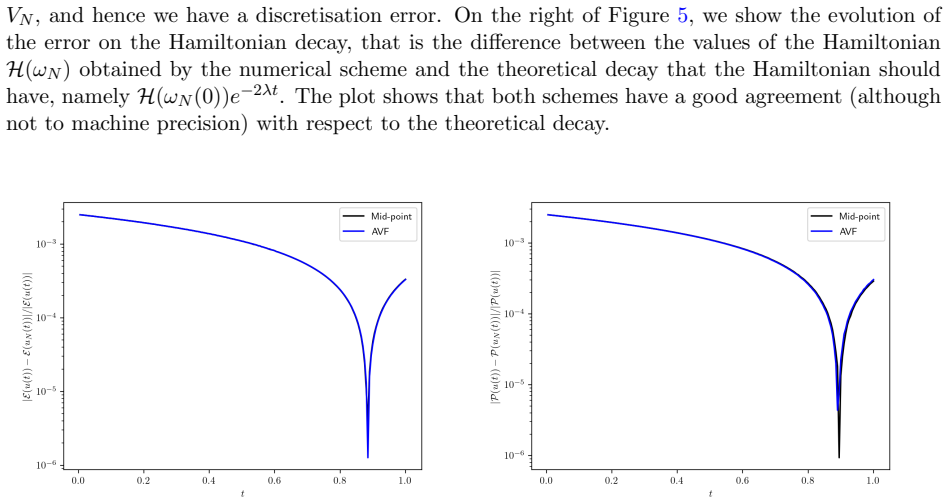
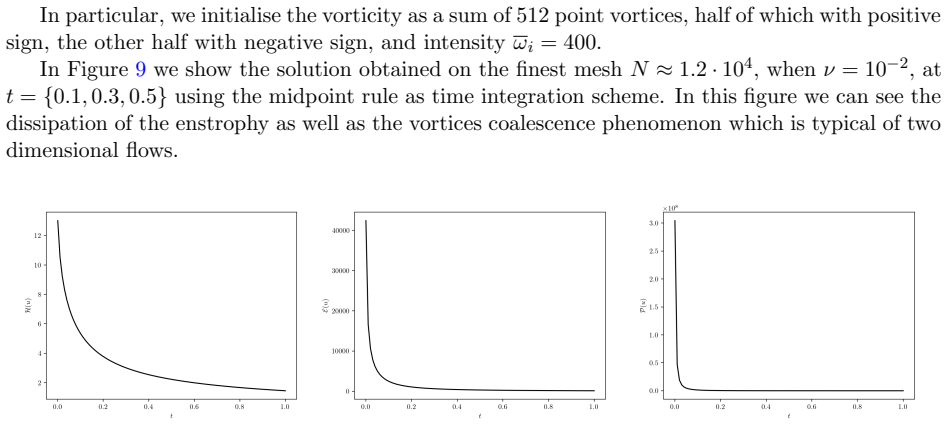
The central claim is that the infinite-dimensional split between a Hamiltonian part $J(u)\delta H(u)$ and a gradient-flow dissipation $G(u)\delta S(u)$ can be reproduced exactly by a finite-dimensional system, if one discretises a mixed variational formulation instead of the original weak form. Introducing auxiliary unknowns $z\approx\delta H$ and $y\approx\delta S$, then Galerkin-projecting onto a subspace $V_N\subset X_s$, gives semi-discrete equations (4.3); eliminating $z,y$ yields $d_t a = \hat J(a)\nabla H(a) + \hat G(a)\nabla S(a)$ with $\hat J(a)=M^{-1}J(a)M^{-1}$ and $\hat G(a)=M^{-1}G(a)M^{-1}$. The paper proves that $\hat J$ is a Poisson tensor, so the conservative part remains genuinely Hamiltonian, while $\hat G$ is symmetric positive or negative semi-definite, so the dissipative part remains a finite-dimensional gradient flow. It derives from this structure the conservation of discrete invariants, the preservation of the kernel of $J$ contained in $V_N$, the preservation of equilibria lying in $V_N$, the metriplectic character of the discretised GENERIC system under the discrete degeneracy conditions (4.6), and an $L^2$ convergence theorem (Proposition 4.9). The KdV and Navier-Stokes computations are offered as confirmation that mass conservation, Hamiltonian conservation or decay, and enstrophy decay survive discretisation.
Load-bearing premise
The load-bearing premise, used in the proof of Lemma 4.2 and hence in Propositions 4.3 and 4.8, is that the Frechet derivative $\delta F(u_N)$ of any $C^1$ functional lies in $V_N$ whenever $u_N\in V_N$; in general only its $L^2$ projection lies in $V_N$, and for the $P1$ Navier-Stokes test this is not verified.
Editorial extensions
If this is right
- Any invariant of the continuous problem whose restriction to $V_N$ is smooth becomes a discrete invariant of the semi-discrete flow; for KdV this gives exact mass conservation, and for inviscid flows exact Hamiltonian conservation.
- Equilibria of the continuous problem that lie in $V_N$ stay equilibria after discretisation, so spurious drift from a steady state is avoided when the steady state is resolved.
- For metriplectic/GENERIC systems, the mutual degeneracy conditions survive, so $H$ is conserved and $S$ monotone non-decreasing at semi-discrete level.
- Under Lipschitz hypotheses on $\delta H$, $\delta S$, $J$, and $G$, the semi-discrete solution converges to the continuous solution in $L^2$, so the structural preservation does not come at the price of losing accuracy.
- With constant $J$ and $G$, AVF time integration preserves the Hamiltonian exactly in the conservative case and the dissipation law in the dissipative case; with quadratic $H$ or $S$, the implicit midpoint rule gives the same exactness.
Reading between the lines
- The mixed formulation opens a route to adaptive or higher-order spaces, but only if refinement keeps $V_N$ nested and the invariance assumption used in Lemma 4.2 is maintained; the authors flag adaptive discretisation as future work.
- The discrete Jacobi identity is not a free consequence of the continuous one: it needs $\delta F(u_N)\in V_N$ for all $C^1$ functionals, which is not satisfied by $P1$ elements in the Navier-Stokes example, so exact Casimir preservation may require enriched spaces or special bases.
- The temporal exactness results assume either constant operators or quadratic $H/S$; for state-dependent Poisson or metric operators, analogous guarantees would likely need discrete-gradient or modified AVF integrators.
Signed reviews
Editorial analysis
A structured set of objections, weighed in public.
Referee Report
Summary. The manuscript proposes a conformal variational (mixed finite element) spatial discretization for evolution equations of the form ∂_t u = J(u)δH(u) + G(u)δS(u). The semi-discrete system is written as M da = J(a)b + G(a)c with M b = ∇H(a) and M c = ∇S(a), hence da = bJ(a)∇H(a) + bG(a)∇S(a), with bG symmetric and bJ claimed to be a Poisson tensor. The paper further claims preservation of invariants, kernels, equilibria, metriplectic structure, and L2 convergence, and it presents numerical tests for the KdV equation and for 2D Navier-Stokes equations on the torus and sphere.
Significance. If the structure-preservation claim were valid, the construction would be a valuable tool for low-order finite element discretization of noncanonical dissipative Hamiltonian PDEs. The mixed-formulation idea is attractive, the discrete algebra is presented transparently, and the numerical experiments are extensive and compared with analytical solutions. The constant-operator time-integration results in Section 5 are clean. However, the main structural claim rests on an unproven and generally invalid identification in Lemma 4.2, which affects the core theorems and the Navier-Stokes example.
major comments (3)
- [Section 4.2, Lemma 4.2] The proof asserts that δF(u_N) = Σ_{j=1}^N f_j v_j with f = M^{-1}∇F(a). Lemma 4.1 only establishes ⟨δF(u_N), v_i⟩ = ∂_{a_i}F(a), which means that f is the coefficient vector of the L2 projection P_NδF onto V_N, not the coefficient vector of δF itself. For a general C^1 functional on X_s, δF(u_N) has a component in V_N^⊥. Therefore the bracket {F,L}_N defined by (4.4) evaluates ⟨J(u_N)P_NδF, P_NδL⟩, and the equality with the continuous bracket {F,L}(u_N) is not established. Consequently the Jacobi identity of bJ(a) does not follow from the continuous Jacobi identity. This leaves unproven the structure-preservation statements in Propositions 4.3(2), 4.6, and 4.8, as well as the Jacobi claim in §6.2; only the constant-J case, such as KdV, is unaffected.
- [Section 6.2, Eqs. (6.4)-(6.5)] In the 2D Navier-Stokes example, the stream-function solve K b = M a produces the H^1 Riesz representative of -δH, not the L2 projection of δH onto V_N. The coefficient vector b entering the Hamiltonian part of (6.4) is therefore not the coefficient vector of δH(u_N), so the identification required by Lemma 4.2 fails exactly in the state-dependent, noncanonical example that motivates the paper. The assertion that bJ(a) satisfies the Jacobi identity in §6.2 is consequently unsupported.
- [Section 4.4, Proposition 4.9] The proof of convergence is not completed. After the estimates in the proof one obtains 1/2 d/dt∥e∥_0^2 ≤ C_N(u)∥e∥_s^2 + (∥Q_N∥_{-s} + ∥J∥∥P_N∥ + ∥G∥∥R_N∥)∥e∥_s, with no control of ∥e∥_s in terms of ∥e∥_0, with C_N depending on the discrete solution through ∥z_N∥ and ∥y_N∥, and with the residuals P_N, Q_N, R_N asserted to vanish from density alone rather than from a proven estimate. The final sentence that the equation is homogeneous in ∥e∥_s does not supply the missing Gronwall argument. Thus the claimed L2 convergence is not established.
minor comments (3)
- [Section 3.1.1] The remark after Proposition 3.2 states that density of X_s in X_{-s+d} and X_{-s+e} requires 2s ≤ d,e; the correct inequality is 2s ≥ d,e, as used in Section 4.
- [Section 6.2, Figure 7 text] The sentence describing Figure 7 uses 'On the left' twice; the second occurrence should read 'On the right'.
- [Example 2.2] The operator G = -J^2 is positive semi-definite, not necessarily positive definite, when J has a nontrivial kernel; the text says 'positive definite'.
Circularity Check
No circularity found: the semi-discrete structure-preservation claims are derived from the continuous bracket and the discretisation matrices, and the numerical benchmarks use analytical solutions rather than fitted quantities.
full rationale
I walked the derivation chain from the mixed formulation (3.2), through the Galerkin system (4.1), to the semi-discrete system (4.3). The central claim that the semi-discrete system has the form d_t a = M^{-1}J(a)M^{-1}∇H(a) + M^{-1}G(a)M^{-1}∇S(a) is derived by direct substitution of b = M^{-1}∇H(a) and c = M^{-1}∇S(a), not assumed. Lemma 4.2 proves that the discrete bracket is the restriction of the continuous Poisson bracket to V_N and therefore inherits skew-symmetry, Leibniz, and Jacobi via direct computation with the matrix representations in (4.2); this is not a self-citation or a fitted input. No parameter in the numerical tests is fitted to the target outputs: the KdV test compares against the known one-soliton solution (6.2), and the Navier-Stokes tests compare against analytical stream-function solutions with parameters set by the equations (e.g., λ = 25 and chosen ν). The references are external (Gardner, Morrison, Grmela-Öttinger, etc.), and I found no load-bearing self-citation by the authors. The one substantive caveat is a correctness gap, not circularity: Lemma 4.2 writes δF(u_N) = Σ_j f_j v_j, whereas Lemma 4.1 only establishes that f = M^{-1}∇F(a) gives the coefficients of the L2 projection of δF(u_N) onto V_N. For a general C^1 functional and P1 elements, δF(u_N) need not lie in V_N, and unless J(u_N) preserves V_N, the Jacobi identity of bJ(a) does not follow from the continuous Jacobi identity. This affects the support for Propositions 4.3(2) and 4.8 in the state-dependent Navier-Stokes case, but it is an unsupported inference from an auxiliary assumption, not a reduction of the conclusion to an input or to a fitted quantity. The paper is therefore self-contained against its external benchmarks, and the circularity score is 0.
Assumptions & free parameters
assumptions (4)
- domain assumption Regularity and density hypotheses: delta H in X_{-s+d}, delta S in X_{-s+e}, 2s >= d,e, and V_N dense in X_s as N tends to infinity
- domain assumption Lipschitz continuity of delta H, delta S, J and G (hypotheses H1 and H2)
- standard math Existence and uniqueness of solutions to the continuous problem (1.1) and to the semi-discrete ODE (4.3)
- ad hoc to paper For every C1 functional F, delta F(u_N) belongs to V_N, or equivalently the Poisson operator maps the finite element subspace to itself
Cite this review
Pith. "Pith review of Conformal variational discretisation of infinite dimensional Hamiltonian systems with gradient flow dissipation." pith.science (2026). https://pith.science/paper/5HIYLYSL
@misc{pith2026241206310,
  author       = {Pith},
  title        = {Pith review of: Conformal variational discretisation of infinite dimensional Hamiltonian systems with gradient flow dissipation},
  year         = {2026},
  howpublished = {\url{https://pith.science/paper/5HIYLYSL}},
  note         = {Machine review of arXiv:2412.06310}
}
read the original abstract
Nonconservative evolution problems describe irreversible processes and dissipative effects in a broad variety of phenomena. Such problems are often characterised by a conservative part, which can be modelled as a Hamiltonian term, and a nonconservative part, in the form of gradient flow dissipation. Traditional numerical approximations of this class of problem typically fail to retain the separation into conservative and nonconservative parts hence leading to unphysical solutions. In this work we propose a mixed variational method that gives a semi-discrete problem with the same geometric structure as the infinite-dimensional problem. As a consequence the conservation laws and the dissipative terms are retained. A priori convergence estimates on the solution are established. Numerical tests of the Korteweg-de Vries equation and of the two-dimensional Navier-Stokes equations on the torus and on the sphere are presented to corroborate the theoretical findings.
Figures


Figures from the paper (7 more)




Reference graph
Works this paper leans on
-
[1]
R. Abraham and J. E. Marsden. Foundations of mechanics. Second edition. Addison-Wesley Publishing Company, Inc., Redwood City, CA., 1987
work page 1987
-
[2]
B. D. Andrews and P. E. Farrell. High-order conservative and accurately dissipative numerical inte- grators via auxiliary variables . 2024. arXiv: 2407.11904. 34
arXiv 2024
-
[3]
Passing to the limit in a Wasserstein gradient flow: from diffusion to reaction
S. Arnrich, A. Mielke, M. A. Peletier, G. Savar´ e, and M. Veneroni. “Passing to the limit in a Wasserstein gradient flow: from diffusion to reaction”. In: Calculus of Variations and Partial Differential Equations 44.3 (2012), pp. 419–454
work page 2012
-
[4]
The Euler-Poincar´ e equations and double bracket dissipation
A. Bloch, P. Krishnaprasad, J. E. Marsden, and T. S. Ratiu. “The Euler-Poincar´ e equations and double bracket dissipation”. In: Communications in mathematical physics 175.1 (1996), pp. 1–42
work page 1996
-
[5]
Structure preserving approximation of dissipative evolution problems
H. Egger. “Structure preserving approximation of dissipative evolution problems”. In: Numer. Math. 143.1 (2019), pp. 85–106
work page 2019
-
[6]
C. Eldred and F. Gay-Balmaz. “Single and double generator bracket formulations of multicomponent fluids with irreversible processes”. In: Journal of Physics A: Mathematical and Theoretical 53.39 (Aug. 2020), p. 395701
work page 2020
-
[7]
C. S. Gardner. “Korteweg-de Vries equation and generalizations. IV. The Korteweg-de Vries equation as a Hamiltonian system”. In: Journal of Mathematical Physics 12.8 (Aug. 1971), pp. 1548–1551
work page 1971
-
[8]
Hamiltonian discretization of boundary control systems
G. Golo, V. Talasila, A. van der Schaft, and B. Maschke. “Hamiltonian discretization of boundary control systems”. In: Automatica 40.5 (2004), pp. 757–771
work page 2004
Show all 27 references
-
[9]
Dynamics and thermodynamics of complex fluids. I. Development of a general formalism
M. Grmela and H. C. ¨Ottinger. “Dynamics and thermodynamics of complex fluids. I. Development of a general formalism”. In: Phys. Rev. E 56 (6 1997), pp. 6620–6632
1997
-
[10]
The variational formulation of the Fokker–Planck equation
R. Jordan, D. Kinderlehrer, and F. Otto. “The variational formulation of the Fokker–Planck equation”. In: SIAM journal on mathematical analysis 29.1 (1998), pp. 1–17
1998
-
[11]
Dissipative Hamiltonian systems: A unifying principle
A. N. Kaufman. “Dissipative Hamiltonian systems: A unifying principle”. In: Physics Letters A 100.8 (1984), pp. 419–422
1984
-
[12]
S. B. Kuksin. Analysis of Hamiltonian PDEs . Vol. 19. Oxford Lecture Series in Mathematics and its Applications. Oxford University Press, Oxford, 2000, pp. xii+212
2000
-
[13]
Hamiltonian PDEs
B. Leimkuhler and S. Reich. “Hamiltonian PDEs”. In: Simulating Hamiltonian Dynamics . Cambridge Monographs on Applied and Computational Mathematics. Cambridge University Press, 2005, pp. 316– 356
2005
-
[14]
J.-L. Lions. Quelques m´ ethodes de r´ esolution des probl` emes aux limites non lin´ eaires. Dunod, Paris; Gauthier-Villars, Paris, 1969, pp. xx+554
1969
-
[15]
A. Mielke. An introduction to the analysis of gradients systems . 2023. arXiv: 2306.05026
2023 arXiv
-
[16]
Weighted energy-dissipation functionals for gradient flows
A. Mielke and U. Stefanelli. “Weighted energy-dissipation functionals for gradient flows”. In: ESAIM: Control, Optimisation and Calculus of Variations 17.1 (2011), pp. 52–85
2011
-
[17]
A paradigm for joined Hamiltonian and dissipative systems
P. J. Morrison. “A paradigm for joined Hamiltonian and dissipative systems”. In: Physica D: Nonlinear Phenomena 18.1 (1986), pp. 410–419
1986
-
[18]
Relativistic and nonrelativistic description of fluids with anisotropic heat conduction
H. C. ¨Ottinger. “Relativistic and nonrelativistic description of fluids with anisotropic heat conduction”. In: Phys. A 254.3 (1998), pp. 433–450
1998
-
[19]
Dynamics and thermodynamics of complex fluids. II. Illustrations of a general formalism
H. C. ¨Ottinger and M. Grmela. “Dynamics and thermodynamics of complex fluids. II. Illustrations of a general formalism”. In: Phys. Rev. E 56 (6 1997), pp. 6633–6655
1997
-
[20]
A new class of energy-preserving numerical integration meth- ods
G. R. W. Quispel and D. I. McLaren. “A new class of energy-preserving numerical integration meth- ods”. In: J. Phys. A 41.4 (2008), pp. 045206, 7
2008
-
[21]
An energy- and helicity-conserving finite element scheme for the Navier–Stokes equa- tions
L. G. Rebholz. “An energy- and helicity-conserving finite element scheme for the Navier–Stokes equa- tions”. In: SIAM Journal on Numerical Analysis 45.4 (2007), pp. 1622–1638
2007
-
[22]
{Euclidean, metric, and Wasserstein } gradient flows: an overview
F. Santambrogio. “ {Euclidean, metric, and Wasserstein } gradient flows: an overview”. In: Bulletin of Mathematical Sciences 7 (2017), pp. 87–154. 35
2017
-
[23]
A reduced ideal MHD system for nonlinear magnetic field turbulence in plasmas with approximate flux surfaces
N. Sato and M. Yamada. “A reduced ideal MHD system for nonlinear magnetic field turbulence in plasmas with approximate flux surfaces”. In: Journal of Mathematical Physics 65.9 (2024)
2024
-
[24]
Port-Hamiltonian systems: an introductory survey
A. van der Schaft. “Port-Hamiltonian systems: an introductory survey”. In: Proceedings of the Inter- national Congress of Mathematicians Vol. III . suppl 2. European Mathematical Society Publishing House, 2006, pp. 1339–1365
2006
-
[25]
Mechanics and thermodynamics of a new minimal model of the atmo- sphere
G. Vissio and V. Lucarini. “Mechanics and thermodynamics of a new minimal model of the atmo- sphere”. In: The European Physical Journal Plus 135.807 (2020)
2020
-
[26]
Eddy solutions of the Navier-Stokes equations
O. Walsh. “Eddy solutions of the Navier-Stokes equations”. In: The Navier-Stokes Equations II — The- ory and Numerical Methods . Ed. by J. G. Heywood, K. Masuda, R. Rautmann, and V. A. Solonnikov. Berlin, Heidelberg: Springer Berlin Heidelberg, 1992, pp. 306–309
1992
-
[27]
A MEEVC discretization for two-dimensional incom- pressible Navier-Stokes equations with general boundary conditions
Y. Zhang, A. Palha, M. Gerritsma, and Q. Yao. “A MEEVC discretization for two-dimensional incom- pressible Navier-Stokes equations with general boundary conditions”. In: Journal of Computational Physics 510 (2024), p. 113080. 36
2024
Reviewed August 11, 2026 · model on record in the stance chip above.
Discussion (0). Continue with ORCID to comment.