REVIEW 3 major objections 5 minor 65 references
LLaVA-SpaceSGG: Visual Instruct Tuning for Open-vocabulary Scene Graph Generation with Enhanced Spatial Relations
T0 review · 3 major / 5 minor · reviewed 2026-08-11 · deepseek-v4-flash
Pith's one-line read Depth-derived spatial instruction data raises open-vocabulary scene graph recall by 8.6% and mean recall by 28.4% over ASMv2.
desk verdict A useful new depth-informed SGG dataset, but the paper's signature spatial-reasoning claim leans on a small, partly circular validation set with unexplained ablation zeros; the PSG gain over ASMv2 is modest but external. read the letter →
The pith
A machine-rendered reading of the paper's core claim, the machinery that carries it, and where it could break.
The reading
What carries the argument
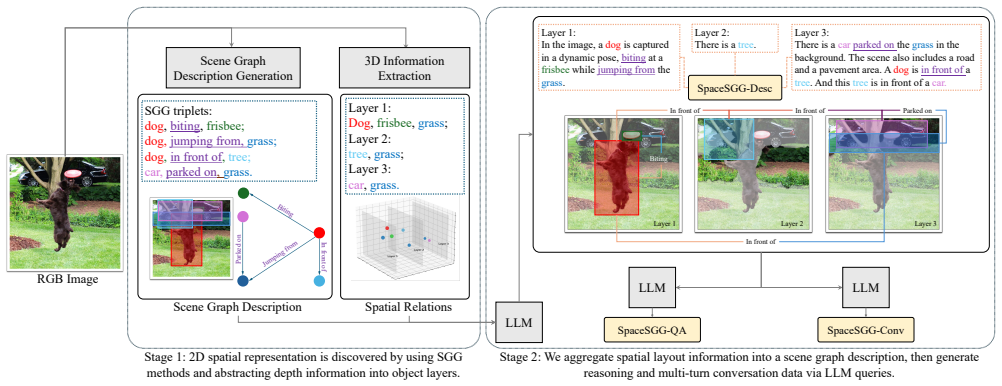
The load-bearing object is the depth-layered scene graph description produced by the SpaceSGG pipeline. A monocular depth estimator (Depth Anything) gives per-pixel depth; camera calibration converts it into a point cloud; Algorithm 1 computes each object's z-range and coverage relations; Algorithm 2 sorts objects into layers by distance and builds sub-layers for covered objects; and an LLM rewrites this structured layout into natural-language layer-by-layer descriptions. Those descriptions, paired with spatially focused QA and chain-of-thought multi-turn conversations, become instruction-tuning targets in the second stage. The mechanism works because spatial predicates are expressed not as abstract labels but as textual layer orderings, letting the MLLM reuse its language priors about 'in front of', 'behind', and 'attached to' while grounding them in geometry.
What would settle it
Re-train the identical model with the same SpaceSGG data but evaluate on an independent human-annotated spatial relation benchmark built from images the pipeline never processed; if accuracy falls to the 25% random-choice level, the depth-derived training data did not teach transferable spatial understanding.
Extended reading notes
Core claim
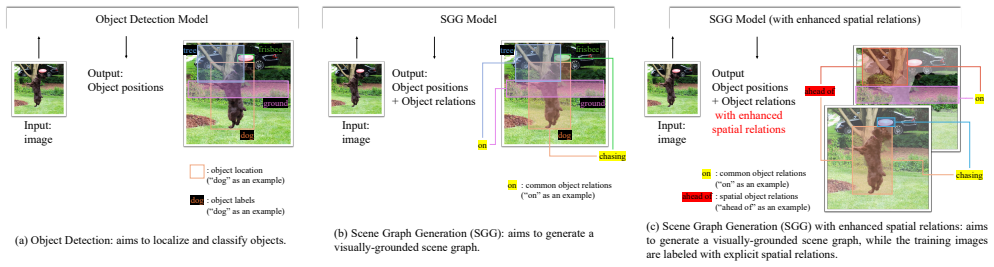
The central claim is that the reason existing open-vocabulary SGG models miss spatial relations is not a lack of model capacity but a lack of spatial signal in their training text: their instruction data is mostly 2D captions and common predicates. LLaVA-SpaceSGG demonstrates the fix by injecting depth-derived layering into the instruction stream. The depth map from a monocular estimator is calibrated into a point cloud, per-object depth ranges determine which objects cover or lie behind which, and objects are sorted into layers from near to far; this layered scene layout is then narrated by an LLM as SpaceSGG-Desc, SpaceSGG-QA, and SpaceSGG-Conv. On the external PSG benchmark the resulting model improves recall by 8.6% and mean recall by 28.4% over ASMv2, and on the authors' spatial benchmark it reaches 52.48%, outperforming LLaVA-1.5-13B at 45.13% and ASMv2-13B at 50.52%.
Load-bearing premise
The load-bearing premise is that the automatically generated and manually corrected spatial labels used for both training and evaluation faithfully describe true 3D layout.
Editorial extensions
If this is right
- Open-vocabulary SGG can be improved by changing the training text, not the label space: adding 40K spatial instruction samples raises PSG recall from 14.2 to 15.43.
- Monocular depth is sufficient to teach a model front-back and occlusion relations for SGG, avoiding the need for 3D sensors at inference time.
- The same two-stage training paradigm, stage-1 image-level alignment followed by stage-2 SGG instruction tuning, is the recipe that transfers MLLM priors to structured scene graphs.
- Because the SpaceSGG dataset and code are released, other models can be re-tuned on this data and compared under identical PSG evaluation.
- Spatial-only data formats each contribute: the paper's ablations show removing any one of Desc, QA, or Conv lowers either PSG recall or spatial accuracy.
Reading between the lines
- Since the spatial benchmark shares its construction pipeline with the training data, the 52.48% figure should be read as an upper bound on genuine spatial transfer; an independent human-annotated test set would give the sharper number.
- The same depth-layering-to-text pipeline could be used to synthesize spatial supervision for other structured outputs, such as referring expressions, layout-based VQA, or robot instruction data, with the same caveat that model and benchmark would share biases.
- The reported gain from depth-derived layers likely depends on the choice of monocular depth estimator, and scenes with ambiguous depth such as mirrors, transparent objects, or textureless regions are where the approach would most visibly fail.
- If the method generalizes, a practical outcome is that open-vocabulary scene graphs with reliable 'in front of' and 'behind' relations become cheap to produce from ordinary photographs, which would directly help image retrieval and captioning systems that consume scene graphs.
Editorial analysis
A structured set of objections, weighed in public.
Referee Report
Summary. The paper proposes LLaVA-SpaceSGG, a multimodal LLM for open-vocabulary scene graph generation with enhanced spatial relations. It introduces the SpaceSGG instruction-tuning dataset, built from public datasets plus a synthetic data pipeline that combines 2D object detection, monocular depth estimation (DepthAnything), camera calibration, point-cloud layering, and LLM-generated descriptions, QA, and conversations. The model is trained with a two-stage paradigm and evaluated on the PSG validation set and on a self-constructed spatial relation validation set. The main reported results are Recall 15.43 vs. ASMv2's 14.2 and mRecall 13.23 vs. 10.3 on PSG, and 52.48% accuracy on the spatial validation set.
Significance. If the PSG results are reproducible, the paper makes a useful contribution: it demonstrates that adding depth-derived spatial instruction data can improve open-vocabulary triplet recall and mean recall for an MLLM-based SGG method, and it releases code, data, and models. The PSG evaluation is externally benchmarked and not circular. The main weakness is that the distinctive spatial-relation claim rests entirely on a self-constructed validation set generated by the same pipeline as the training data, with no error bars, no stated image disjointness, and a very small performance margin. The paper's central PSG claim is credible, but the spatial-relation contribution needs stronger independent evidence before the broader claims can be accepted.
major comments (3)
- [§4.1, §3.1.4] The spatial relation validation set is built by randomly selecting 30 images from COCO-Val-2017 and generating QA with the same data generation pipeline (DepthAnything, camera calibration, LLM prompting) used for SpaceSGG training data. The manuscript does not state that the 30 validation images are disjoint from the SpaceSGG training images, nor does it quantify noise in the manual correction step. With only 271 questions, the reported 52.48% vs. 50.52% difference is approximately five questions, and no error bars or significance test are provided. Because this benchmark is the sole support for the spatial-relation contribution, the spatial claim is not yet independently established. Please evaluate on an external or independently human-annotated spatial benchmark, report confidence intervals or repeated runs, and state the image disjointness explicitly.
- [Table 3, ab-train-1] The ablation without the SpaceSGG dataset reports 1.47% accuracy on a four-choice spatial benchmark, which is far below the 25% random-choice baseline. This strongly suggests that the free-form answer evaluation or output parsing is not robust for that model configuration, or that the benchmark is not measuring spatial ability in a controlled way. Since the same evaluation protocol produces the headline 52.48% result, this discrepancy must be explained and the evaluation protocol must be fixed (for example, with constrained decoding or manual grading).
- [Table 6, ab-data-9 and ab-data-10] Rows ab-data-9 and ab-data-10 report Recall=0, mRecall=0, and Accuracy=0. These values are implausible as genuine model performance and are not discussed in the text. If these runs failed to converge or the evaluation failed, they cannot support the placebo-ablation conclusion; if the numbers are real, the cause must be explained with training details. As written, these rows undermine the supplementary ablation evidence.
minor comments (5)
- [Figure 4] The prompt text contains a typo: 'Qeustion' should be 'Question'. Please proofread the figure text.
- [Algorithm 2] The algorithm title says 'Devide objects into layers'; 'Devide' should be 'Divide'. The pseudo-code also uses the phrase 'covered by' without a precise definition in the algorithm; please clarify how coverage is determined from the depth ranges and bounding boxes.
- [Throughout] The model name is written inconsistently as 'LLaVA-SpaceSGG' and 'LLaV A-SpaceSGG', and the baseline is sometimes 'ASMv2' and sometimes 'AS-V2'. Please standardize the notation.
- [§4.3.3, Table 5] The text states that results 'vary minimally' across generative models, but Table 5 shows GPT-4o giving 53.725% spatial accuracy vs. 52.48% for Llama 3, and mRecall ranging from 9.53 to 13.23. Please either provide a statistical or practical significance argument or soften the claim.
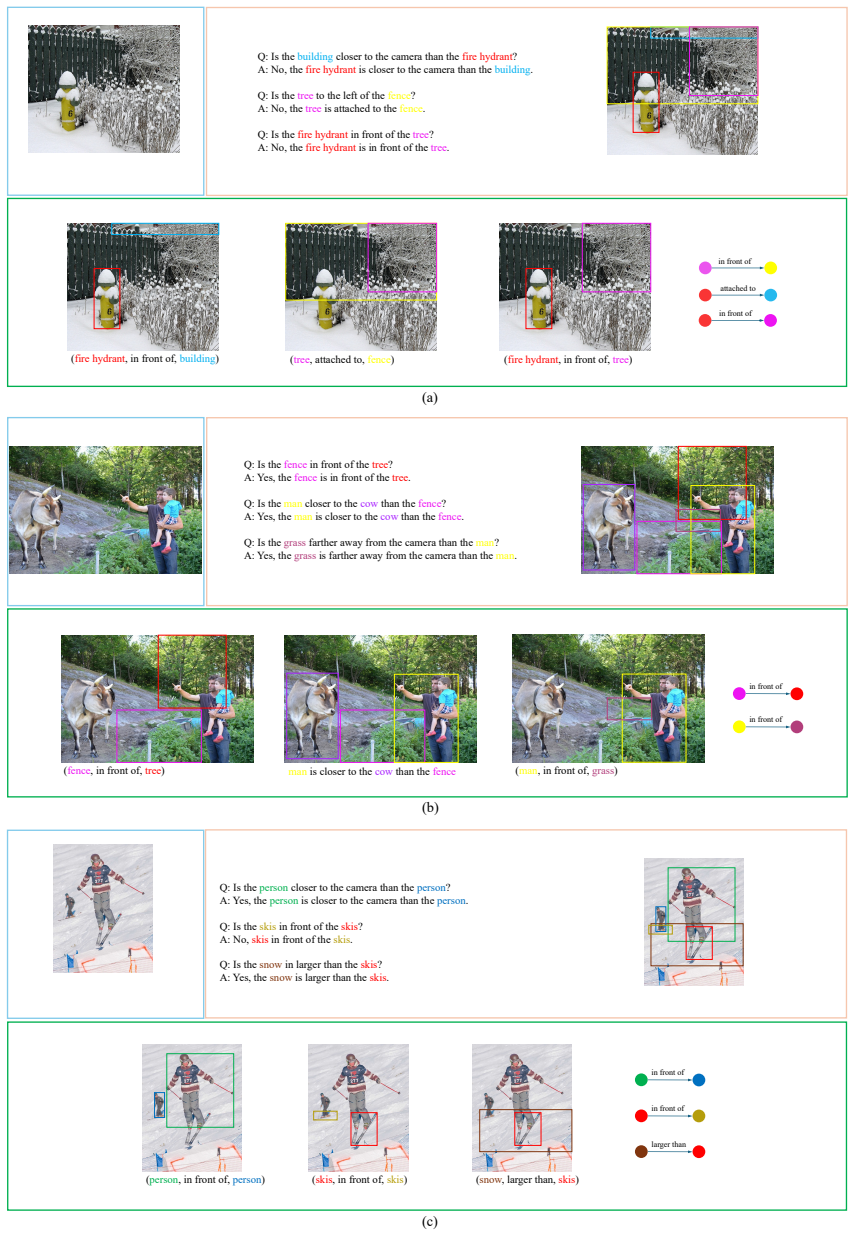
- [Figures 10 and 11] Some QA examples appear malformed, such as 'Is the snow in larger than the skis?' and answers that repeat the same entity names without disambiguation. If these are representative samples from the released dataset, they suggest the synthetic data may contain template errors; please clean the examples or note known artifacts.
Circularity Check
PSG gains are externally benchmarked and non-circular, but the distinctive spatial-relation accuracy claim is evaluated on a validation set generated by the same pipeline that produced the SpaceSGG training data, making that claim partially circular.
-
fitted input called prediction
[Section 4.1 (Spatial Relation Validation Set), cross-referencing Section 3.1.4]
"We randomly select 30 images from COCO-Val-2017 and generate two types of questions (QA and multi-turn conversations) using the data generation pipeline in Section 3.1.4. These are manually annotated as single-choice QA with factual corrections, resulting in 271 questions."
Section 3.1.4 is the same procedure that creates the SpaceSGG-QA and SpaceSGG-Conv training samples: it starts from scene graph descriptions, triplets, and object depth distributions, and uses LLM queries to produce front-back, up-down, occlusion, and multi-object sorting questions. The 271 validation questions are therefore not an independent spatial ground truth; they are outputs of the same depth-estimation, camera-calibration, layering, and LLM-prompting pipeline on which the model was trained. The paper says the questions are 'manually annotated as single-choice QA with factual corrections,' but this operates on pipeline-generated content and does not establish that the labels are independent of the pipeline's biases.
full rationale
The headline PSG comparison is not circular: LLaVA-SpaceSGG is evaluated on the external PSG validation set against ASMv2 and TextPSG using standard triplet recall and mean recall, so the reported 8.6% recall and 28.4% mRecall gains rest on independent annotations. No load-bearing self-citation chain is present; the cited prior works are external. However, the paper's novel spatial-relation contribution is supported by a self-constructed validation set that is generated with the exact data-generation pipeline used to create the SpaceSGG training data. Because the benchmark answers derive from DepthAnything-based depth extraction, camera calibration, layer assignment, and Llama-3 question generation, and because only 'factual corrections' are applied to those generated questions, the spatial accuracy claim is partly circular and does not yet independently establish genuine spatial reasoning. Additional warning signs, such as the below-random 1.47% accuracy for one ablation row and the absence of significance testing on a 271-question benchmark, reinforce that the spatial benchmark is not yet trustworthy; those are correctness concerns rather than circularity per se. Overall, the central open-vocabulary SGG claim remains externally grounded, so the paper is only partially circular.
Assumptions & free parameters
assumptions (4)
- domain assumption PSG ground-truth scene graphs and the triplet matching protocol (IoU>0.5) are accepted as correct evaluation basis.
- domain assumption Depth-Anything monocular depth estimates are accurate enough to determine relative object depths and layer ordering.
- domain assumption Camera calibration and 3D point cloud construction from a single RGB image preserve the true spatial layout of objects.
- domain assumption LLM-generated descriptions, QA pairs, and conversations contain correct spatial facts about the image.
Cite this review
Pith. "Pith review of LLaVA-SpaceSGG: Visual Instruct Tuning for Open-vocabulary Scene Graph Generation with Enhanced Spatial Relations." pith.science (2026). https://pith.science/paper/BUH2ZE5I
@misc{pith2026241206322,
  author       = {Pith},
  title        = {Pith review of: LLaVA-SpaceSGG: Visual Instruct Tuning for Open-vocabulary Scene Graph Generation with Enhanced Spatial Relations},
  year         = {2026},
  howpublished = {\url{https://pith.science/paper/BUH2ZE5I}},
  note         = {Machine review of arXiv:2412.06322}
}
read the original abstract
Scene Graph Generation (SGG) converts visual scenes into structured graph representations, providing deeper scene understanding for complex vision tasks. However, existing SGG models often overlook essential spatial relationships and struggle with generalization in open-vocabulary contexts. To address these limitations, we propose LLaVA-SpaceSGG, a multimodal large language model (MLLM) designed for open-vocabulary SGG with enhanced spatial relation modeling. To train it, we collect the SGG instruction-tuning dataset, named SpaceSGG. This dataset is constructed by combining publicly available datasets and synthesizing data using open-source models within our data construction pipeline. It combines object locations, object relations, and depth information, resulting in three data formats: spatial SGG description, question-answering, and conversation. To enhance the transfer of MLLMs' inherent capabilities to the SGG task, we introduce a two-stage training paradigm. Experiments show that LLaVA-SpaceSGG outperforms other open-vocabulary SGG methods, boosting recall by 8.6% and mean recall by 28.4% compared to the baseline. Our codebase, dataset, and trained models are publicly accessible on GitHub at the following URL: https://github.com/Endlinc/LLaVA-SpaceSGG.
Figures

Figures from the paper (9 more)




Reference graph
Works this paper leans on
-
[1]
Josh Achiam, Steven Adler, Sandhini Agarwal, Lama Ah- mad, Ilge Akkaya, Florencia Leoni Aleman, Diogo Almeida, Janko Altenschmidt, Sam Altman, Shyamal Anadkat, et al. Gpt-4 technical report. arXiv preprint arXiv:2303.08774 ,
- [2]
-
[3]
Vqa: Visual question answering
Stanislaw Antol, Aishwarya Agrawal, Jiasen Lu, Margaret Mitchell, Dhruv Batra, C Lawrence Zitnick, and Devi Parikh. Vqa: Visual question answering. In Proceedings of the IEEE international conference on computer vision , pages 2425– 2433, 2015. 1
2015
-
[4]
Adabins: Depth estimation using adaptive bins
Shariq Farooq Bhat, Ibraheem Alhashim, and Peter Wonka. Adabins: Depth estimation using adaptive bins. In Proceed- ings of the IEEE/CVF conference on computer vision and pattern recognition, pages 4009–4018, 2021. 3
work page 2021
-
[5]
Transformerfusion: Monocular rgb scene reconstruction using transformers
Aljaz Bozic, Pablo Palafox, Justus Thies, Angela Dai, and Matthias Nießner. Transformerfusion: Monocular rgb scene reconstruction using transformers. Advances in Neural In- formation Processing Systems, 34:1403–1414, 2021. 3
work page 2021
-
[6]
Language models are few-shot learners
Tom B Brown. Language models are few-shot learners. arXiv preprint arXiv:2005.14165, 2020. 3
arXiv 2005
-
[7]
Sift flow: Dense correspondence across different scenes
LIU Ce. Sift flow: Dense correspondence across different scenes. ECCV 2008, 2008. 3
work page 2008
-
[8]
Spatialvlm: Endowing vision-language mod- els with spatial reasoning capabilities
Boyuan Chen, Zhuo Xu, Sean Kirmani, Brian Ichter, Danny Driess, Pete Florence, Dorsa Sadigh, Leonidas Guibas, and Fei Xia. Spatialvlm: Endowing vision-language mod- els with spatial reasoning capabilities. arXiv preprint arXiv:2401.12168, 2024. 3
arXiv 2024
Show all 65 references
-
[9]
Sharegpt4v: Improving large multi-modal models with better captions
Lin Chen, Jisong Li, Xiaoyi Dong, Pan Zhang, Conghui He, Jiaqi Wang, Feng Zhao, and Dahua Lin. Sharegpt4v: Improving large multi-modal models with better captions. arXiv preprint arXiv:2311.12793, 2023. 1
2023 arXiv
-
[10]
Knowledge-embedded routing network for scene graph gen- eration
Tianshui Chen, Weihao Yu, Riquan Chen, and Liang Lin. Knowledge-embedded routing network for scene graph gen- eration. In Proceedings of the IEEE/CVF Conference on Computer Vision and Pattern Recognition , pages 6163– 6171, 2019. 3
2019
-
[11]
How far are we to gpt-4v? closing the gap to commercial multimodal models with open-source suites
Zhe Chen, Weiyun Wang, Hao Tian, Shenglong Ye, Zhang- wei Gao, Erfei Cui, Wenwen Tong, Kongzhi Hu, Jiapeng Luo, Zheng Ma, et al. How far are we to gpt-4v? closing the gap to commercial multimodal models with open-source suites. arXiv preprint arXiv:2404.16821, 2024. 3
2024 arXiv
-
[12]
Internvl: Scaling up vision foundation mod- els and aligning for generic visual-linguistic tasks
Zhe Chen, Jiannan Wu, Wenhai Wang, Weijie Su, Guo Chen, Sen Xing, Muyan Zhong, Qinglong Zhang, Xizhou Zhu, Lewei Lu, et al. Internvl: Scaling up vision foundation mod- els and aligning for generic visual-linguistic tasks. In Pro- ceedings of the IEEE/CVF Conference on Computer...
2024
-
[13]
Spatial- rgpt: Grounded spatial reasoning in vision language model
An-Chieh Cheng, Hongxu Yin, Yang Fu, Qiushan Guo, Rui- han Yang, Jan Kautz, Xiaolong Wang, and Sifei Liu. Spatial- rgpt: Grounded spatial reasoning in vision language model. arXiv preprint arXiv:2406.01584, 2024. 4
2024 arXiv
-
[14]
Deep- videomvs: Multi-view stereo on video with recurrent spatio- temporal fusion
Arda Duzceker, Silvano Galliani, Christoph V ogel, Pablo Speciale, Mihai Dusmanu, and Marc Pollefeys. Deep- videomvs: Multi-view stereo on video with recurrent spatio- temporal fusion. In Proceedings of the IEEE/CVF Confer- ence on Computer Vision and Pattern Recognition (CVPR...
2021
-
[15]
Depth map prediction from a single image using a multi-scale deep net- work
David Eigen, Christian Puhrsch, and Rob Fergus. Depth map prediction from a single image using a multi-scale deep net- work. Advances in neural information processing systems , 27, 2014. 3
2014
-
[16]
Making the v in vqa matter: Elevating the role of image understanding in visual question answer- ing
Yash Goyal, Tejas Khot, Douglas Summers-Stay, Dhruv Ba- tra, and Devi Parikh. Making the v in vqa matter: Elevating the role of image understanding in visual question answer- ing. In Proceedings of the IEEE conference on computer vision and pattern recognition, pages 6904–6913...
2017
-
[17]
Recov- ering surface layout from an image
Derek Hoiem, Alexei A Efros, and Martial Hebert. Recov- ering surface layout from an image. International Journal of Computer Vision, 75:151–172, 2007. 3
2007
-
[18]
Language is not all you need: Aligning perception with language mod- els
Shaohan Huang, Li Dong, Wenhui Wang, Yaru Hao, Saksham Singhal, Shuming Ma, Tengchao Lv, Lei Cui, Owais Khan Mohammed, Barun Patra, et al. Language is not all you need: Aligning perception with language mod- els. Advances in Neural Information Processing Systems , 36, 2024. 3
2024
-
[19]
Vi- sual prompt tuning
Menglin Jia, Luming Tang, Bor-Chun Chen, Claire Cardie, Serge Belongie, Bharath Hariharan, and Ser-Nam Lim. Vi- sual prompt tuning. In European Conference on Computer Vision, pages 709–727. Springer, 2022. 3
2022
-
[20]
Image retrieval using scene graphs
Justin Johnson, Ranjay Krishna, Michael Stark, Li-Jia Li, David Shamma, Michael Bernstein, and Li Fei-Fei. Image retrieval using scene graphs. InProceedings of the IEEE con- ference on computer vision and pattern recognition , pages 3668–3678, 2015. 1
2015
-
[21]
Poisson surface reconstruction
Michael Kazhdan, Matthew Bolitho, and Hugues Hoppe. Poisson surface reconstruction. In Proceedings of the fourth Eurographics symposium on Geometry processing , volume 7, 2006. 3
2006
-
[22]
Two algorithms for constructing a delaunay triangulation
Der-Tsai Lee and Bruce J Schachter. Two algorithms for constructing a delaunay triangulation. International Journal of Computer & Information Sciences, 9(3):219–242, 1980. 3
1980
-
[23]
Depth and surface normal estimation from monocular images using regression on deep features and hi- erarchical crfs
Bo Li, Chunhua Shen, Yuchao Dai, Anton Van Den Hengel, and Mingyi He. Depth and surface normal estimation from monocular images using regression on deep features and hi- erarchical crfs. In Proceedings of the IEEE conference on computer vision and pattern recognition , pages 1...
-
[24]
Blip-2: Bootstrapping language-image pre-training with frozen image encoders and large language models
Junnan Li, Dongxu Li, Silvio Savarese, and Steven Hoi. Blip-2: Bootstrapping language-image pre-training with frozen image encoders and large language models. In In- ternational conference on machine learning , pages 19730– 19742. PMLR, 2023. 3
2023
-
[25]
Align before fuse: Vision and language representation learn- ing with momentum distillation
Junnan Li, Ramprasaath Selvaraju, Akhilesh Gotmare, Shafiq Joty, Caiming Xiong, and Steven Chu Hong Hoi. Align before fuse: Vision and language representation learn- ing with momentum distillation. Advances in neural infor- mation processing systems, 34:9694–9705, 2021. 3
2021
-
[26]
Factorizable net: an efficient subgraph-based framework for scene graph generation
Yikang Li, Wanli Ouyang, Bolei Zhou, Jianping Shi, Chao Zhang, and Xiaogang Wang. Factorizable net: an efficient subgraph-based framework for scene graph generation. In Proceedings of the European Conference on Computer Vi- sion (ECCV), pages 335–351, 2018. 1
2018
-
[27]
Scene graph generation from objects, phrases and region captions
Yikang Li, Wanli Ouyang, Bolei Zhou, Kun Wang, and Xi- aogang Wang. Scene graph generation from objects, phrases and region captions. In Proceedings of the IEEE inter- national conference on computer vision , pages 1261–1270,
-
[28]
Stablellava: Enhanced visual instruction tun- ing with synthesized image-dialogue data
Yanda Li, Chi Zhang, Gang Yu, Zhibin Wang, Bin Fu, Guosheng Lin, Chunhua Shen, Ling Chen, and Yun- chao Wei. Stablellava: Enhanced visual instruction tun- ing with synthesized image-dialogue data. arXiv preprint arXiv:2308.10253, 2023. 1
2023 arXiv
-
[29]
Binsformer: Revisiting adaptive bins for monocular depth estimation
Zhenyu Li, Xuyang Wang, Xianming Liu, and Junjun Jiang. Binsformer: Revisiting adaptive bins for monocular depth estimation. IEEE Transactions on Image Processing , 2024. 3
2024
-
[30]
Microsoft coco: Common objects in context
Tsung-Yi Lin, Michael Maire, Serge Belongie, James Hays, Pietro Perona, Deva Ramanan, Piotr Doll´ar, and C Lawrence Zitnick. Microsoft coco: Common objects in context. In Computer Vision–ECCV 2014: 13th European Conference, Zurich, Switzerland, September 6-12, 2014, Proceeding...
2014
-
[31]
Gps-net: Graph property sensing network for scene graph generation
Xin Lin, Changxing Ding, Jinquan Zeng, and Dacheng Tao. Gps-net: Graph property sensing network for scene graph generation. In Proceedings of the IEEE/CVF Conference on Computer Vision and Pattern Recognition , pages 3746– 3753, 2020. 5, 6
2020
-
[32]
Visual spa- tial reasoning
Fangyu Liu, Guy Emerson, and Nigel Collier. Visual spa- tial reasoning. Transactions of the Association for Computa- tional Linguistics, 11:635–651, 2023. 1
2023
-
[33]
Improved baselines with visual instruction tuning
Haotian Liu, Chunyuan Li, Yuheng Li, and Yong Jae Lee. Improved baselines with visual instruction tuning. In Pro- ceedings of the IEEE/CVF Conference on Computer Vision and Pattern Recognition, pages 26296–26306, 2024. 1, 6
2024
-
[34]
Visual instruction tuning
Haotian Liu, Chunyuan Li, Qingyang Wu, and Yong Jae Lee. Visual instruction tuning. Advances in neural information processing systems, 36, 2024. 3, 5
2024
-
[35]
Visual relationship detection with language priors
Cewu Lu, Ranjay Krishna, Michael Bernstein, and Li Fei- Fei. Visual relationship detection with language priors. In Computer Vision–ECCV 2016: 14th European Conference, Amsterdam, The Netherlands, October 11–14, 2016, Pro- ceedings, Part I 14, pages 852–869. Springer, 2016. 1, 2
2016
-
[36]
Ocr-vqa: Visual question answering by reading text in images
Anand Mishra, Shashank Shekhar, Ajeet Kumar Singh, and Anirban Chakraborty. Ocr-vqa: Visual question answering by reading text in images. In ICDAR, 2019. 5
2019
-
[37]
Atlas: End- to-end 3d scene reconstruction from posed images
Zak Murez, Tarrence Van As, James Bartolozzi, Ayan Sinha, Vijay Badrinarayanan, and Andrew Rabinovich. Atlas: End- to-end 3d scene reconstruction from posed images. In Com- puter Vision–ECCV 2020: 16th European Conference, Glas- gow, UK, August 23–28, 2020, Proceedings, Part V...
2020
-
[38]
Gpt-4o system card, August 2024
OpenAI. Gpt-4o system card, August 2024. 8
2024
-
[39]
Kosmos-2: Ground- ing multimodal large language models to the world
Zhiliang Peng, Wenhui Wang, Li Dong, Yaru Hao, Shaohan Huang, Shuming Ma, and Furu Wei. Kosmos-2: Ground- ing multimodal large language models to the world. arXiv preprint arXiv:2306.14824, 2023. 5
2023 arXiv
-
[40]
Spatial-temporal knowledge-embedded transformer for video scene graph generation
Tao Pu, Tianshui Chen, Hefeng Wu, Yongyi Lu, and Liang Lin. Spatial-temporal knowledge-embedded transformer for video scene graph generation. IEEE Transactions on Image Processing, 2023. 1
2023
-
[41]
Qwen2.5: A party of foundation models, September 2024
Qwen Team. Qwen2.5: A party of foundation models, September 2024. 8
2024
-
[42]
Learning transferable visual models from natural language supervi- sion
Alec Radford, Jong Wook Kim, Chris Hallacy, Aditya Ramesh, Gabriel Goh, Sandhini Agarwal, Girish Sastry, Amanda Askell, Pamela Mishkin, Jack Clark, et al. Learning transferable visual models from natural language supervi- sion. In International conference on machine learning, ...
2021
-
[43]
Pixelwise view selection for unstructured multi-view stereo
Johannes L Sch ¨onberger, Enliang Zheng, Jan-Michael Frahm, and Marc Pollefeys. Pixelwise view selection for unstructured multi-view stereo. In Computer Vision–ECCV 2016: 14th European Conference, Amsterdam, The Nether- lands, October 11-14, 2016, Proceedings, Part III 14 , pa...
2016
-
[44]
Structured query- based image retrieval using scene graphs
Brigit Schroeder and Subarna Tripathi. Structured query- based image retrieval using scene graphs. In Proceedings of the IEEE/CVF conference on computer vision and pattern recognition workshops, pages 178–179, 2020. 1
2020
-
[45]
Nddepth: Normal-distance as- sisted monocular depth estimation
Shuwei Shao, Zhongcai Pei, Weihai Chen, Xingming Wu, and Zhengguo Li. Nddepth: Normal-distance as- sisted monocular depth estimation. In Proceedings of the IEEE/CVF International Conference on Computer Vision , pages 7931–7940, 2023. 3
2023
-
[46]
Conceptual captions: A cleaned, hypernymed, im- age alt-text dataset for automatic image captioning
Piyush Sharma, Nan Ding, Sebastian Goodman, and Radu Soricut. Conceptual captions: A cleaned, hypernymed, im- age alt-text dataset for automatic image captioning. In Pro- ceedings of the 56th Annual Meeting of the Association for Computational Linguistics (V olume 1: Long Pape...
2018
-
[47]
Towards vqa models that can read
Amanpreet Singh, Vivek Natarjan, Meet Shah, Yu Jiang, Xinlei Chen, Devi Parikh, and Marcus Rohrbach. Towards vqa models that can read. In Proceedings of the IEEE Con- ference on Computer Vision and Pattern Recognition , pages 8317–8326, 2019. 5
2019
-
[48]
Neuralrecon: Real-time coherent 3d re- construction from monocular video
Jiaming Sun, Yiming Xie, Linghao Chen, Xiaowei Zhou, and Hujun Bao. Neuralrecon: Real-time coherent 3d re- construction from monocular video. In Proceedings of the IEEE/CVF conference on computer vision and pattern recognition, pages 15598–15607, 2021. 3
2021
-
[49]
Learning to compose dynamic tree structures for visual contexts
Kaihua Tang, Hanwang Zhang, Baoyuan Wu, Wenhan Luo, and Wei Liu. Learning to compose dynamic tree structures for visual contexts. In Proceedings of the IEEE/CVF con- ference on computer vision and pattern recognition , pages 6619–6628, 2019. 5, 6
2019
-
[50]
Llama 2: Open foundation and fine-tuned chat models.arXiv preprint arXiv:2307.09288, 2023
Hugo Touvron, Louis Martin, Kevin Stone, Peter Albert, Amjad Almahairi, Yasmine Babaei, Nikolay Bashlykov, Soumya Batra, Prajjwal Bhargava, Shruti Bhosale, et al. Llama 2: Open foundation and fine-tuned chat models.arXiv preprint arXiv:2307.09288, 2023. 2
2023 arXiv
-
[51]
The all-seeing project v2: Towards general relation comprehension of the open world
Weiyun Wang, Yiming Ren, Haowen Luo, Tiantong Li, Chenxiang Yan, Zhe Chen, Wenhai Wang, Qingyun Li, Lewei Lu, Xizhou Zhu, et al. The all-seeing project v2: Towards general relation comprehension of the open world. arXiv preprint arXiv:2402.19474, 2024. 1, 2, 3, 4, 5, 6
2024 arXiv
-
[52]
The all-seeing project: Towards panop- tic visual recognition and understanding of the open world
Weiyun Wang, Min Shi, Qingyun Li, Wenhai Wang, Zhen- hang Huang, Linjie Xing, Zhe Chen, Hao Li, Xizhou Zhu, Zhiguo Cao, et al. The all-seeing project: Towards panop- tic visual recognition and understanding of the open world. arXiv preprint arXiv:2308.01907, 2023. 5, 6
2023 arXiv
-
[53]
Chain-of-thought prompting elicits reasoning in large lan- guage models
Jason Wei, Xuezhi Wang, Dale Schuurmans, Maarten Bosma, Fei Xia, Ed Chi, Quoc V Le, Denny Zhou, et al. Chain-of-thought prompting elicits reasoning in large lan- guage models. Advances in neural information processing systems, 35:24824–24837, 2022. 2, 3
2022
-
[54]
Scene graph generation by iterative message passing
Danfei Xu, Yuke Zhu, Christopher B Choy, and Li Fei-Fei. Scene graph generation by iterative message passing. InPro- ceedings of the IEEE conference on computer vision and pat- tern recognition, pages 5410–5419, 2017. 3, 5, 6
2017
-
[55]
Panoptic scene graph gen- eration
Jingkang Yang, Yi Zhe Ang, Zujin Guo, Kaiyang Zhou, Wayne Zhang, and Ziwei Liu. Panoptic scene graph gen- eration. In European Conference on Computer Vision, pages 178–196. Springer, 2022. 2, 3, 5, 6
2022
-
[56]
Graph r-cnn for scene graph generation
Jianwei Yang, Jiasen Lu, Stefan Lee, Dhruv Batra, and Devi Parikh. Graph r-cnn for scene graph generation. In Proceed- ings of the European conference on computer vision (ECCV), pages 670–685, 2018. 3
2018
-
[57]
Depth anything: Unleashing the power of large-scale unlabeled data
Lihe Yang, Bingyi Kang, Zilong Huang, Xiaogang Xu, Jiashi Feng, and Hengshuang Zhao. Depth anything: Unleashing the power of large-scale unlabeled data. In Proceedings of the IEEE/CVF Conference on Computer Vision and Pattern Recognition, pages 10371–10381, 2024. 2, 4
2024
-
[58]
Coca: Contrastive captioners are image-text foundation models
Jiahui Yu, Zirui Wang, Vijay Vasudevan, Legg Yeung, Mo- jtaba Seyedhosseini, and Yonghui Wu. Coca: Contrastive captioners are image-text foundation models. arXiv preprint arXiv:2205.01917, 2022. 1, 3
2022 arXiv
-
[59]
Neural motifs: Scene graph parsing with global con- text
Rowan Zellers, Mark Yatskar, Sam Thomson, and Yejin Choi. Neural motifs: Scene graph parsing with global con- text. In Proceedings of the IEEE conference on computer vision and pattern recognition, pages 5831–5840, 2018. 5, 6
2018
-
[60]
Conceptual and syntactical cross-modal alignment with cross-level consistency for image-text match- ing
Pengpeng Zeng, Lianli Gao, Xinyu Lyu, Shuaiqi Jing, and Jingkuan Song. Conceptual and syntactical cross-modal alignment with cross-level consistency for image-text match- ing. In Proceedings of the 29th ACM International Confer- ence on Multimedia, pages 2205–2213, 2021. 1
2021
-
[61]
Textpsg: Panoptic scene graph generation from textual descriptions
Chengyang Zhao, Yikang Shen, Zhenfang Chen, Mingyu Ding, and Chuang Gan. Textpsg: Panoptic scene graph generation from textual descriptions. In Proceedings of the IEEE/CVF International Conference on Computer Vision , pages 2839–2850, 2023. 5, 6
2023
-
[62]
Minigpt-4: Enhancing vision-language understanding with advanced large language models
Deyao Zhu, Jun Chen, Xiaoqian Shen, Xiang Li, and Mo- hamed Elhoseiny. Minigpt-4: Enhancing vision-language understanding with advanced large language models. arXiv preprint arXiv:2304.10592, 2023. 3 The supplementary material contains:
2023 arXiv
-
[63]
more ablation studies testing effectiveness of the pro- posed dataset
-
[64]
more examples about the SpaceSGG dataset includ- ing 3 components (SpaceSGG-Desc, SpaceSGG-QA and SpaceSGG-Conv)
-
[65]
house” as an example): object labels(“house
more visual examples about our proposed LLaV A- SpaceSGG prediction compare with other models (TextPSG, ASMv2). A. More Ablation Studies To further validate the effectiveness of the proposed dataset, we replaced each element with equivalent compo- nents from the LLaV A-Instruc...
Reviewed August 11, 2026 · model on record in the stance chip above.
Discussion (0). Continue with ORCID to comment.