REVIEW 4 major objections 5 minor 1 cited by
You See it, You Got it: Learning 3D Creation on Pose-Free Videos at Scale
T0 review · 4 major / 5 minor · reviewed 2026-08-11 · deepseek-v4-flash
Pith's one-line read See3D teaches a multi-view diffusion model to do pose-free 3D generation from web videos, reporting state-of-the-art single- and sparse-view reconstruction without camera annotations.
desk verdict Interesting pose-free conditioning idea and a large new dataset, but the headline PSNR gains are unreliable because the evaluation applies a test-time brightness alignment to ground truth that baselines don't get. read the letter →
The pith
A machine-rendered reading of the paper's core claim, the machinery that carries it, and where it could break.
The reading
What carries the argument
The load-bearing object is the visual-condition Vt = [Wt*Ct + (1−Wt)*Xt; M] (Eq. 3), a concatenation of a corrupted target view Ct, the diffusion latent Xt, and a mask M, mixed by a timestep-dependent weight Wt. Ct itself is the masked target image with time-dependent noise at a reduced schedule t' = βt (β = 0.2), which the paper uses to keep enough signal for camera control while preventing conditional-image leakage at small timesteps. This purely 2D signal replaces camera poses as the control channel. The paper couples it with a warping-based generation pipeline using monocular depth (MoGe), sparse keypoint matching (SuperPoint/LightGlue), independent per-keypoint scale-shift alignment, and locally weighted linear regression to recover dense metric depth, so that warped hints stay close enough to the training-time visual-condition distribution.
What would settle it
Run See3D on a pose-annotated test set where camera trajectories are known and measure the angular error of generated views relative to ground-truth poses: if the visual-condition genuinely encodes viewpoint, this error should be small and grow smoothly with viewpoint distance, whereas a model that only interpolates appearance would show near-chance angular errors for large viewpoint shifts. A second check: train the same architecture on the same data with the visual-condition replaced by plain masked frames; the reported PSNR gap between MV-UnPoseT and MV-UnPoseM should persist on held-out videos beyond the MVImageNet subset used in the ablation.
Extended reading notes
Core claim
The central claim is that a multi-view diffusion model conditioned solely on a visual signal derived from pixel-space video data – random masks, time-dependent noise with t' = βt, and a schedule-dependent mixture Wt*Ct + (1−Wt)*Xt – learns to control camera movement and synthesize geometrically consistent novel views. Trained on WebVi3D, the model See3D reports zero-shot single-view PSNRs of 23.76 on Tanks-and-Temples, 25.36 on RealEstate10K, and 24.28 on CO3D, each several dB above the warped-image baseline ViewCrafter*, and sparse-view results (23.23 PSNR on LLFF, 28.04 on DTU, 17.35 on Mip-NeRF 360) that exceed diffusion-based few-shot reconstructions like CAT3D and ReconFusion. The authors further show the same model, without fine-tuning, supports open-world 3D editing by masking and reconditioning regions of a reference view. The evidence is intended to show that scaling pose-free video data raises the upper bound of 3D generation beyond what 3D-annotated datasets allow.
Load-bearing premise
The approach assumes that the time-dependent mixture of masked, noised frames and noisy latents carries enough camera-motion information for a diffusion model to synthesize correct novel views without any pose annotation, and that warped test-time images fall within the distribution of this visual-condition; the paper's main numerical comparisons also rely on ground-truth brightness alignment that is not applied to baselines.
Editorial extensions
If this is right
- Scaling training data from pose-free video is enough to displace pose-conditional multi-view diffusion: See3D reports state-of-the-art results on single- and sparse-view benchmarks without any camera input.
- The visual-condition generalizes to warping-based pipelines and mask-based editing without fine-tuning, covering single-view-to-3D, sparse-view 3D, and open-world 3D editing.
- The data curation pipeline (static-scene filtering, dynamic-region rejection, viewpoint-radius filtering) can be reused to grow WebVi3D as more Internet video becomes available.
- The iterative depth alignment (per-keypoint scale-shift plus locally weighted linear regression) corrects monocular depth errors and enables long-sequence generation along complex camera trajectories.
Reading between the lines
- If the pose-free scaling result holds, 3D generation performance may come to track internet video volume rather than curated 3D asset production, a shift that would change the cost structure of training such systems.
- The time-dependent mixture is essentially a learned weighting between a content hint and a noise prior; similar schedules could be ported to other conditional diffusion tasks where pose or dense correspondences are unavailable, such as video editing or dense tracking.
- The test-time brightness alignment used in evaluation likely inflates PSNR-type metrics relative to baselines; a fairer comparison would re-run baselines with the same alignment or report perceptual metrics on unaligned images.
- Because the model shuffles frames and drops time embeddings, it discards temporal order; this suggests an implicit assumption that static-scene multi-view sets are interchangeable, which may limit extension to dynamic 4D content.
Editorial analysis
A structured set of objections, weighed in public.
Referee Report
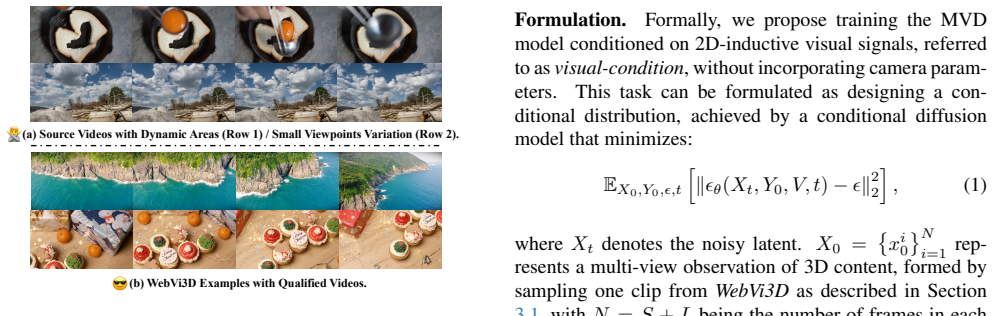
Summary. See3D proposes a pose-free multi-view diffusion model for 3D generation trained on Internet videos. The paper contributes (i) WebVi3D, a dataset of ~15.99M clips/320M frames curated from ~25.5M stock and drone videos via a four-step pipeline (dynamic-object detection, optical-flow motion filtering, and keypoint-trajectory viewpoint filtering); (ii) a visual condition V_t (Eqs. 2-3) that mixes masked, time-noised target views with the noisy latent, replacing camera-pose conditions; and (iii) a warping-based 3D generation pipeline with per-keypoint depth scale/shift alignment, locally weighted regression, and 3DGS reconstruction. The paper reports strong single-view and sparse-view numbers (e.g., 23.76 PSNR on Tanks-and-Temples vs 19.13 for the re-implemented ViewCrafter in Table 2) and claims zero-shot, open-world capability. A controlled ablation on MVImageNet (Table 3) shows near-parity between the proposed pose-free condition and a pose-conditioned warped-image model. The appendix discloses a test-time brightness-scaling protocol (Appendix C.2) that aligns the warped condition with ground truth, plus a training recipe that mixes RealEstate10K and CO3D clips and 0.5M pose-annotated samples into WebVi3D and initializes from MVDream.
Significance. If validated, the core idea is significant: replacing camera-pose conditioning with a pixel-space time-dependent signal would let 3D priors be learned from web-scale video, and WebVi3D's curation pipeline (with a human-validated 88.6% precision on the filtered set) is a useful community asset. The Table 3 ablation gives credible, controlled evidence that the time-dependent visual condition can approximate pose-conditioned warp inputs, and the paper is honest enough to disclose the disputed evaluation protocol in the appendix. At present, however, the headline quantitative claims are not supported: the test-time brightness scaling leaks ground-truth target statistics into the condition and is applied without a matched treatment for baselines; the training set overlaps two of the three single-view test benchmarks; and the pose-free recipe includes a pose-conditioned initialization and 0.5M annotated samples. These issues bear directly on the Abstract's central claim of markedly outperforming models trained on 3D datasets, so the evidence requires substantial rework before the paper's claims can be assessed.
major comments (4)
- [Appendix C.2 (Brightness Control); Sec. 4.1] Appendix C.2 states: 'In our evaluation experiments, brightness scaling is applied to the unmasked regions of warped images to align with ground truth, reducing the impact of brightness, and thus yielding a higher correlation between the generated content and pixel-level metrics.' The scaling factor is computed from the ground-truth target image, so at test time the visual condition (Eqs. 2-3) injected into the model carries the target's global brightness statistics, and PSNR/SSIM are then measured against that same target. This is an oracle leak: PSNR is highly sensitive to global brightness offsets (a uniform offset of 15-20 gray levels can cost several dB), so the reported margins in Table 2—e.g., 4.63 dB over the re-implemented ViewCrafter on Tanks-and-Temples—cannot be attributed to viewpoint-control accuracy. Section 4.1 does not disclose this protocol, the paper does not state that the warping-based baselines (ViewCrafter, LucidDreamer) received an equivalent adjustment, and no ablation quantifies performance without the scaling. Because the paper itself identifies PSNR as the metric that 'reflects the accuracy of viewpoint control,' this issue is load-bearing for the central quantitative claim and must be addressed with a GT-free evaluation or an identical normalization applied to all methods.
- [Appendix C.2 (Training Configuration); Abstract; Sec. 4.1] The training configuration mixes clips 'from datasets such as Objaverse, CO3D, RealEstate10k, MVImgNet, and DL3DV' into WebVi3D, and the model is initialized from MVDream, a pose-conditioned multi-view diffusion model. Two of the three single-view benchmarks in Table 2 (RealEstate10K and CO3D) are therefore inside the training distribution, which contradicts the 'zero-shot' characterization in the Abstract and Section 4.1 and makes the comparison to baselines that were not trained on those datasets uneven; only Tanks-and-Temples is a clean out-of-distribution benchmark among the three. In addition, the disclosed 0.5M pose-annotated supplement and the MVDream initialization mean the claim of learning 3D control 'solely' from pose-free video is stronger than the actual recipe. I request results for a WebVi3D-only variant (at least at the reduced scales used in the Section 4.3 data-proportion ablations), and a rewording of the zero-shot and pose-free claims to match what is trained.
- [Eqs. 2-3; Appendix C.1] The definition of the visual condition is incomplete. In Eq. 3, X_t is explicitly a noisy latent, while C_t in Eq. 2 is described as a corrupted image; their weighted sum is well-defined only if both are in the same space, but the paper never states whether C_t is VAE-encoded before the mixture, nor does it specify how many channels V_t and the mask M add to the model's first convolution. Because the entire method depends on V_t, this omitted specification blocks reproduction and should be clarified in a revision.
- [Sec. 4.3; Appendix C.3] The pose-free mechanism rests on three coupled components—random masking, the time-dependent noise schedule t' = f(t) = βt with β = 0.2, and the piecewise mixture W_t—but the only visual-condition ablation (Table 3) contrasts the full model against a masked-only condition (MV-UnPoseM vs MV-UnPoseT). No experiment isolates the contribution of the time-dependent noise (Eq. 2) or of the mixture (Eq. 3), and no sensitivity analysis is reported for β, t_decay_end, v_decay_end, or b, so the claimed robustness of the schedule (Section 3.2.2) is not established.
minor comments (5)
- [Sec. 3.1; Appendix B (User Study)] The reported '77% improvement' in Appendix B is arithmetically inconsistent: the pre-filter and post-filter 3D-aware ratios are 11.6% and 88.6%, a 77 percentage-point increase (or a ~7.6x relative increase), not a 77% improvement. Please correct the wording.
- [Sec. 4.1-4.2; Tables 2 and 5] The claims that the method 'outperforms all baseline methods across all metrics' (Sec. 4.1) and 'surpassed state-of-the-art reconstruction models' (Sec. 4.2) are too strong: on DTU 3-view, MuRF reports a higher SSIM (0.885 vs 0.884 in Table 2), and on LLFF 9-view, FSGS, BGGS, and CAT3D all report higher SSIM than See3D (Table 5). Please qualify the claims per dataset and per metric.
- [Sec. 3.2.3] The sentence 'we removed the time embedding' is ambiguous: Eq. 1 requires the diffusion timestep embedding, so the removal presumably refers to the temporal/positional embedding of the video backbone (frame ordering is shuffled anyway). Please rephrase to avoid implying the timestep embedding is dropped.
- [Sec. 1; Table 1] The abstract and Section 1 state that WebVi3D totals 4.41 years in duration, but Table 1's filtered hours (36.27K hours) correspond to roughly 4.14 years; please reconcile the numbers.
- [Appendix A (Limitations)] The limitations statement lists inference speed, lack of 4D modeling, and model scalability, but does not mention the evaluation-protocol issues (test-time ground-truth brightness alignment, benchmark overlap) that most affect the interpretation of the reported numbers; these should be acknowledged or refuted in the revision.
Circularity Check
Reported PSNR margins are inflated by a test-time ground-truth brightness alignment applied only to See3D; the central quantitative claim is partially circular.
-
fitted input called prediction
[Appendix C.2 (Training Details, Brightness Control) and Section 4.1 (Single View to 3D, metric statement)]
"In our evaluation experiments, brightness scaling is applied to the unmasked regions of warped images to align with ground truth, reducing the impact of brightness, and thus yielding a higher correlation between the generated content and pixel-level metrics. ... As such, PSNR reflects the accuracy of viewpoint control provided by our proposed visual-condition in multi-view generation."
The evaluation protocol computes a brightness scaling factor from the ground-truth target and applies it to the unmasked regions of the warped-image condition before feeding the condition into See3D. The reported PSNR and SSIM are then measured against that same ground-truth image. Because the paper itself identifies PSNR as the metric that "reflects the accuracy of viewpoint control," the score now partially measures how well the model copied the target's brightness from its own input, not how well it predicted the view. Baselines (LucidDreamer, ViewCrafter, ZeroNVS, MotionCtrl, CAT3D, etc.) receive no such ground-truth alignment, so the headline 4.63 dB gain over ViewCrafter on Tanks-and-Temples is not a controlled comparison.
full rationale
The core training formulation is not circular: Eq. 1 is a standard conditional denoising objective, and the visual-condition Vt in Eq. 3 is built from masked, noised versions of the target plus the noisy latent, which is a legitimate conditioning design rather than a tautology. The data curation pipeline and the depth-alignment warping pipeline are also self-contained. There is no load-bearing self-citation or imported uniqueness theorem; MVDream, SVD, and ViewCrafter are cited as prior architectural or baseline work, not as evidence that See3D's approach is forced. The significant circularity is confined to the evaluation protocol in Appendix C.2: a test-time brightness alignment injects ground-truth target brightness into the model's input before PSNR/SSIM are computed against that same ground truth, and this is done for See3D but not for the baselines. The paper explicitly states that this "yielding a higher correlation between the generated content and pixel-level metrics," which is an admission that the reported metric is partly manufactured. Additionally, the same appendix discloses that RealEstate10K and CO3D clips are mixed into the training set, undermining the "zero-shot" interpretation of those benchmarks; this is a data-contamination concern rather than circularity, but it compounds the reliability problem. Because the headline quantitative advantage rests on a metric whose input is aligned to the ground truth at test time, the central claim is partially circular, warranting a score of 6 rather than a lower score.
Assumptions & free parameters
free parameters (5)
- beta (noise-level scale in f(t)) =
0.2
- Wt piecewise schedule parameters =
t_decay_end=300, v_decay_end=0.8, b=0.075
- Data curation dynamic-score thresholds =
Theta_i=0.12, Theta_c=0.35 and 0.2 in Eq. 8
- Trajectory radius and count thresholds =
r<=20, count>40, mean_radius<5
- Keypoint count and LWLR bandwidth =
1024 keypoints; bandwidth b in Eq. 5 not specified
assumptions (4)
- domain assumption Static scenes with camera ego-motion provide valid multi-view supervision for learning 3D priors.
- ad hoc to paper The time-dependent visual-condition Vt embeds camera pose information implicitly through pixel-space hints.
- domain assumption Pretrained components (MVDream, SVD, MoGe, RAFT, CoTracker, SuperPoint, LightGlue, Mask R-CNN) perform as needed.
- domain assumption The diffusion training objective (Eq. 1) with classifier-free guidance and a linear noise schedule is sufficient to learn multi-view consistency from unposed frames.
Cite this review
Pith. "Pith review of You See it, You Got it: Learning 3D Creation on Pose-Free Videos at Scale." pith.science (2026). https://pith.science/paper/3E2LXBZB
@misc{pith2026241206699,
  author       = {Pith},
  title        = {Pith review of: You See it, You Got it: Learning 3D Creation on Pose-Free Videos at Scale},
  year         = {2026},
  howpublished = {\url{https://pith.science/paper/3E2LXBZB}},
  note         = {Machine review of arXiv:2412.06699}
}
read the original abstract
Recent 3D generation models typically rely on limited-scale 3D `gold-labels' or 2D diffusion priors for 3D content creation. However, their performance is upper-bounded by constrained 3D priors due to the lack of scalable learning paradigms. In this work, we present See3D, a visual-conditional multi-view diffusion model trained on large-scale Internet videos for open-world 3D creation. The model aims to Get 3D knowledge by solely Seeing the visual contents from the vast and rapidly growing video data -- You See it, You Got it. To achieve this, we first scale up the training data using a proposed data curation pipeline that automatically filters out multi-view inconsistencies and insufficient observations from source videos. This results in a high-quality, richly diverse, large-scale dataset of multi-view images, termed WebVi3D, containing 320M frames from 16M video clips. Nevertheless, learning generic 3D priors from videos without explicit 3D geometry or camera pose annotations is nontrivial, and annotating poses for web-scale videos is prohibitively expensive. To eliminate the need for pose conditions, we introduce an innovative visual-condition - a purely 2D-inductive visual signal generated by adding time-dependent noise to the masked video data. Finally, we introduce a novel visual-conditional 3D generation framework by integrating See3D into a warping-based pipeline for high-fidelity 3D generation. Our numerical and visual comparisons on single and sparse reconstruction benchmarks show that See3D, trained on cost-effective and scalable video data, achieves notable zero-shot and open-world generation capabilities, markedly outperforming models trained on costly and constrained 3D datasets. Please refer to our project page at: https://vision.baai.ac.cn/see3d
Figures


Figures from the paper (10 more)


Forward citations
Cited by 1 Pith paper
-
Context as Memory: Scene-Consistent Interactive Long Video Generation with Memory Retrieval
Context-as-Memory conditions video generation on selected historical frames chosen by camera FOV overlap, improving scene consistency in long generated videos.
Reference graph
Works this paper leans on
-
[1]
Polydiff: Generating 3d polyg- onal meshes with diffusion models
Antonio Alliegro, Yawar Siddiqui, Tatiana Tommasi, and Matthias Nießner. Polydiff: Generating 3d polyg- onal meshes with diffusion models. arXiv preprint arXiv:2312.11417, 2023. 3
arXiv 2023
-
[2]
Vd3d: Taming large video diffu- sion transformers for 3d camera control
Sherwin Bahmani, Ivan Skorokhodov, Aliaksandr Siarohin, Willi Menapace, Guocheng Qian, Michael Vasilkovsky, Hsin-Ying Lee, Chaoyang Wang, Jiaxu Zou, Andrea Tagliasacchi, et al. Vd3d: Taming large video diffu- sion transformers for 3d camera control. arXiv preprint arXiv:2407.12781, 2024. 2
arXiv 2024
-
[3]
Barron, Ben Mildenhall, Dor Verbin, Pratul P
Jonathan T. Barron, Ben Mildenhall, Dor Verbin, Pratul P. Srinivasan, and Peter Hedman. Mip-nerf 360: Unbounded anti-aliased neural radiance fields. CVPR, 2022. 3, 8, 9
2022
-
[4]
Zip-nerf: Anti-aliased grid-based neural radiance fields
Jonathan T Barron, Ben Mildenhall, Dor Verbin, Pratul P Srinivasan, and Peter Hedman. Zip-nerf: Anti-aliased grid-based neural radiance fields. In Proceedings of the IEEE/CVF International Conference on Computer Vision, pages 19697–19705, 2023. 9, 25
2023
-
[5]
Zoedepth: Zero-shot trans- fer by combining relative and metric depth
Shariq Farooq Bhat, Reiner Birkl, Diana Wofk, Peter Wonka, and Matthias M ¨uller. Zoedepth: Zero-shot trans- fer by combining relative and metric depth. arXiv preprint arXiv:2302.12288, 2023. 6
arXiv 2023
-
[6]
Stable video diffusion: Scaling latent video diffusion models to large datasets
Andreas Blattmann, Tim Dockhorn, Sumith Kulal, Daniel Mendelevitch, Maciej Kilian, Dominik Lorenz, Yam Levi, Zion English, Vikram V oleti, Adam Letts, et al. Stable video diffusion: Scaling latent video diffusion models to large datasets. arXiv preprint arXiv:2311.15127, 2023. 6
arXiv 2023
-
[7]
Pyscenedetect
Brandon Castellano. Pyscenedetect. https://github. com/Breakthrough/PySceneDetect/ . [Online; accessed 13-Oct-2024]. 4
2024
-
[8]
pixelsplat: 3d gaussian splats from im- age pairs for scalable generalizable 3d reconstruction
David Charatan, Sizhe Lester Li, Andrea Tagliasacchi, and Vincent Sitzmann. pixelsplat: 3d gaussian splats from im- age pairs for scalable generalizable 3d reconstruction. In Proceedings of the IEEE/CVF Conference on Computer Vision and Pattern Recognition, pages 19457–19467, 2024. 3
2024
Show all 135 references
-
[9]
Single-stage dif- fusion nerf: A unified approach to 3d generation and recon- struction
Hansheng Chen, Jiatao Gu, Anpei Chen, Wei Tian, Zhuowen Tu, Lingjie Liu, and Hao Su. Single-stage dif- fusion nerf: A unified approach to 3d generation and recon- struction. In Proceedings of the IEEE/CVF International Conference on Computer Vision, pages 2416–2425, 2023. 3
2023
-
[10]
Gaussianeditor: Swift and con- trollable 3d editing with gaussian splatting
Yiwen Chen, Zilong Chen, Chi Zhang, Feng Wang, Xi- aofeng Yang, Yikai Wang, Zhongang Cai, Lei Yang, Huap- ing Liu, and Guosheng Lin. Gaussianeditor: Swift and con- trollable 3d editing with gaussian splatting. In Proceedings of the IEEE/CVF Conference on Computer Vision and Pa...
2024
-
[11]
Mvsplat: Efficient 3d gaussian splatting from sparse multi-view images
Yuedong Chen, Haofei Xu, Chuanxia Zheng, Bohan Zhuang, Marc Pollefeys, Andreas Geiger, Tat-Jen Cham, and Jianfei Cai. Mvsplat: Efficient 3d gaussian splatting from sparse multi-view images. In European Conference on Computer Vision, pages 370–386. Springer, 2025. 3
2025
-
[12]
Luciddreamer: Domain-free generation of 3d gaussian splatting scenes
Jaeyoung Chung, Suyoung Lee, Hyeongjin Nam, Jaerin Lee, and Kyoung Mu Lee. Luciddreamer: Domain-free generation of 3d gaussian splatting scenes. arXiv preprint arXiv:2311.13384, 2023. 2, 3, 6, 8, 9, 20, 23, 24
2023 arXiv
-
[13]
Chang, Manolis Savva, Maciej Hal- ber, Thomas Funkhouser, and Matthias Nießner
Angela Dai, Angel X. Chang, Manolis Savva, Maciej Hal- ber, Thomas Funkhouser, and Matthias Nießner. Scannet: Richly-annotated 3d reconstructions of indoor scenes. In Proc. Computer Vision and Pattern Recognition (CVPR), IEEE, 2017. 3
2017
-
[14]
Flashattention: Fast and memory-efficient ex- act attention with io-awareness
Tri Dao, Dan Fu, Stefano Ermon, Atri Rudra, and Christo- pher R ´e. Flashattention: Fast and memory-efficient ex- act attention with io-awareness. Advances in Neural Information Processing Systems, 35:16344–16359, 2022. 22
2022
-
[15]
Objaverse: A universe of annotated 3d objects
Matt Deitke, Dustin Schwenk, Jordi Salvador, Luca Weihs, Oscar Michel, Eli VanderBilt, Ludwig Schmidt, Kiana Ehsani, Aniruddha Kembhavi, and Ali Farhadi. Objaverse: A universe of annotated 3d objects. In Proceedings of the IEEE/CVF Conference on Computer Vision and Pattern Rec...
2023
-
[16]
Superpoint: Self-supervised interest point detection and description
Daniel DeTone, Tomasz Malisiewicz, and Andrew Rabi- novich. Superpoint: Self-supervised interest point detection and description. In Proceedings of the IEEE conference on computer vision and pattern recognition workshops, pages 224–236, 2018. 7, 19
2018
-
[17]
Invisible stitch: Generating smooth 3d scenes with depth inpainting
Paul Engstler, Andrea Vedaldi, Iro Laina, and Christian Rupprecht. Invisible stitch: Generating smooth 3d scenes with depth inpainting. arXiv preprint arXiv:2404.19758,
-
[18]
Exploiting the signal-leak bias in diffusion mod- els
Martin Nicolas Everaert, Athanasios Fitsios, Marco Boc- chio, Sami Arpa, Sabine S ¨usstrunk, and Radhakrishna Achanta. Exploiting the signal-leak bias in diffusion mod- els. In Proceedings of the IEEE/CVF Winter Conference on Applications of Computer Vision, pages 4025–4034, 2024. 6
2024
-
[19]
A point set generation network for 3d object reconstruction from a single image
Haoqiang Fan, Hao Su, and Leonidas J Guibas. A point set generation network for 3d object reconstruction from a single image. In Proceedings of the IEEE conference on computer vision and pattern recognition, pages 605–613,
-
[20]
Instantsplat: Un- bounded sparse-view pose-free gaussian splatting in 40 sec- onds
Zhiwen Fan, Wenyan Cong, Kairun Wen, Kevin Wang, Jian Zhang, Xinghao Ding, Danfei Xu, Boris Ivanovic, Marco Pavone, Georgios Pavlakos, et al. Instantsplat: Un- bounded sparse-view pose-free gaussian splatting in 40 sec- onds. arXiv preprint arXiv:2403.20309, 2, 2024. 8
2024 arXiv
-
[21]
Random sam- ple consensus: a paradigm for model fitting with ap- plications to image analysis and automated cartography
Martin A Fischler and Robert C Bolles. Random sam- ple consensus: a paradigm for model fitting with ap- plications to image analysis and automated cartography. Communications of the ACM, 24(6):381–395, 1981. 19
1981
-
[22]
Scenescape: Text-driven consistent scene genera- tion
Rafail Fridman, Amit Abecasis, Yoni Kasten, and Tali Dekel. Scenescape: Text-driven consistent scene genera- tion. Advances in Neural Information Processing Systems, 36, 2024. 6
2024
-
[23]
Cat3d: Create anything in 3d with multi-view diffusion models
Ruiqi Gao, Aleksander Holynski, Philipp Henzler, Arthur Brussee, Ricardo Martin-Brualla, Pratul Srinivasan, Jonathan T Barron, and Ben Poole. Cat3d: Create anything in 3d with multi-view diffusion models. arXiv preprint arXiv:2405.10314, 2024. 2, 3, 9, 25
2024 arXiv
-
[24]
Nerfdiff: Single-image view synthesis with nerf-guided distillation from 3d-aware diffusion
Jiatao Gu, Alex Trevithick, Kai-En Lin, Joshua M Susskind, Christian Theobalt, Lingjie Liu, and Ravi Ra- mamoorthi. Nerfdiff: Single-image view synthesis with nerf-guided distillation from 3d-aware diffusion. In International Conference on Machine Learning, pages 11808–11826. ...
2023
-
[25]
3dgen: Triplane latent diffusion for textured mesh generation
Anchit Gupta, Wenhan Xiong, Yixin Nie, Ian Jones, and Barlas O ˘guz. 3dgen: Triplane latent diffusion for textured mesh generation. arXiv preprint arXiv:2303.05371, 2023. 3
2023 arXiv
-
[26]
Vfusion3d: Learning scalable 3d generative models from video diffu- sion models
Junlin Han, Filippos Kokkinos, and Philip Torr. Vfusion3d: Learning scalable 3d generative models from video diffu- sion models. In European Conference on Computer Vision, pages 333–350. Springer, 2025. 3
2025
-
[27]
Binocular-guided 3d gaussian splatting with view consistency for sparse view synthesis
Liang Han, Junsheng Zhou, Yu-Shen Liu, and Zhizhong Han. Binocular-guided 3d gaussian splatting with view consistency for sparse view synthesis. arXiv preprint arXiv:2410.18822, 2024. 8, 9, 25
2024 arXiv
-
[28]
Cameractrl: En- abling camera control for text-to-video generation
Hao He, Yinghao Xu, Yuwei Guo, Gordon Wetzstein, Bo Dai, Hongsheng Li, and Ceyuan Yang. Cameractrl: En- abling camera control for text-to-video generation. arXiv preprint arXiv:2404.02101, 2024. 2
2024 arXiv
-
[29]
Mask r-cnn
Kaiming He, Georgia Gkioxari, Piotr Doll ´ar, and Ross Gir- shick. Mask r-cnn. In Proceedings of the IEEE international conference on computer vision, pages 2961–2969, 2017. 4, 18
2017
-
[30]
Classifier-free diffusion guidance
Jonathan Ho and Tim Salimans. Classifier-free diffusion guidance. arXiv preprint arXiv:2207.12598, 2022. 22
2022 arXiv
-
[31]
Denois- ing diffusion probabilistic models
Jonathan Ho, Ajay Jain, and Pieter Abbeel. Denois- ing diffusion probabilistic models. Advances in neural information processing systems, 33:6840–6851, 2020. 3, 5
2020
-
[32]
Text2room: Extracting textured 3d meshes from 2d text-to-image models
Lukas H ¨ollein, Ang Cao, Andrew Owens, Justin Johnson, and Matthias Nießner. Text2room: Extracting textured 3d meshes from 2d text-to-image models. In Proceedings of the IEEE/CVF International Conference on Computer Vision, pages 7909–7920, 2023. 3
2023
-
[33]
Lrm: Large reconstruction model for single image to 3d
Yicong Hong, Kai Zhang, Jiuxiang Gu, Sai Bi, Yang Zhou, Difan Liu, Feng Liu, Kalyan Sunkavalli, Trung Bui, and Hao Tan. Lrm: Large reconstruction model for single image to 3d. arXiv preprint arXiv:2311.04400, 2023. 2, 3
2023 arXiv
-
[34]
Training-free camera control for video generation
Chen Hou, Guoqiang Wei, Yan Zeng, and Zhibo Chen. Training-free camera control for video generation. arXiv preprint arXiv:2406.10126, 2024. 6
2024 arXiv
-
[35]
2d gaussian splatting for geometri- cally accurate radiance fields
Binbin Huang, Zehao Yu, Anpei Chen, Andreas Geiger, and Shenghua Gao. 2d gaussian splatting for geometri- cally accurate radiance fields. In ACM SIGGRAPH 2024 Conference Papers, pages 1–11, 2024. 2
2024
-
[36]
https:// artlist.io/stock- footage/
Specializes in royalty-free digital content. https:// artlist.io/stock- footage/ . [Online; accessed 15-Aug-2024]. 4
2024
-
[37]
Large scale multi-view stereop- sis evaluation
Rasmus Jensen, Anders Dahl, George V ogiatzis, Engin Tola, and Henrik Aanæs. Large scale multi-view stereop- sis evaluation. In Proceedings of the IEEE conference on computer vision and pattern recognition, pages 406–413,
-
[38]
Shap-e: Generat- ing conditional 3d implicit functions
Heewoo Jun and Alex Nichol. Shap-e: Generat- ing conditional 3d implicit functions. arXiv preprint arXiv:2305.02463, 2023. 3
2023 arXiv
-
[39]
Learn- ing a multi-view stereo machine
Abhishek Kar, Christian H ¨ane, and Jitendra Malik. Learn- ing a multi-view stereo machine. Advances in neural information processing systems, 30, 2017. 2
2017
-
[40]
Co- tracker: It is better to track together
Nikita Karaev, Ignacio Rocco, Benjamin Graham, Natalia Neverova, Andrea Vedaldi, and Christian Rupprecht. Co- tracker: It is better to track together. In Proc. ECCV, 2024. 4, 19
2024
-
[41]
3d gaussian splatting for real-time radiance field rendering
Bernhard Kerbl, Georgios Kopanas, Thomas Leimk ¨uhler, and George Drettakis. 3d gaussian splatting for real-time radiance field rendering. ACM Trans. Graph., 42(4):139–1,
-
[42]
Collaborative score distillation for consistent visual editing
Subin Kim, Kyungmin Lee, June Suk Choi, Jongheon Jeong, Kihyuk Sohn, and Jinwoo Shin. Collaborative score distillation for consistent visual editing. Advances in Neural Information Processing Systems, 36:73232–73257,
-
[43]
Tanks and temples: Benchmarking large-scale scene reconstruction
Arno Knapitsch, Jaesik Park, Qian-Yi Zhou, and Vladlen Koltun. Tanks and temples: Benchmarking large-scale scene reconstruction. ACM Transactions on Graphics (ToG), 36(4):1–13, 2017. 3, 8, 9, 23, 24
2017
-
[44]
Rgbd2: Genera- tive scene synthesis via incremental view inpainting using rgbd diffusion models
Jiabao Lei, Jiapeng Tang, and Kui Jia. Rgbd2: Genera- tive scene synthesis via incremental view inpainting using rgbd diffusion models. In Proceedings of the IEEE/CVF Conference on Computer Vision and Pattern Recognition, pages 8422–8434, 2023. 6
2023
-
[45]
Vivid-zoo: 12 Multi-view video generation with diffusion model
Bing Li, Cheng Zheng, Wenxuan Zhu, Jinjie Mai, Biao Zhang, Peter Wonka, and Bernard Ghanem. Vivid-zoo: 12 Multi-view video generation with diffusion model. arXiv preprint arXiv:2406.08659, 2024. 2
2024 arXiv
-
[46]
Instant3d: Fast text-to-3d with sparse-view generation and large reconstruction model
Jiahao Li, Hao Tan, Kai Zhang, Zexiang Xu, Fujun Luan, Yinghao Xu, Yicong Hong, Kalyan Sunkavalli, Greg Shakhnarovich, and Sai Bi. Instant3d: Fast text-to-3d with sparse-view generation and large reconstruction model. arXiv preprint arXiv:2311.06214, 2023. 3
2023 arXiv
-
[47]
M-lrm: Multi-view large reconstruction model
Mengfei Li, Xiaoxiao Long, Yixun Liang, Weiyu Li, Yuan Liu, Peng Li, Xiaowei Chi, Xingqun Qi, Wei Xue, Wenhan Luo, et al. M-lrm: Multi-view large reconstruction model. arXiv preprint arXiv:2406.07648, 2024. 3
2024 arXiv
-
[48]
Magic3d: High- resolution text-to-3d content creation
Chen-Hsuan Lin, Jun Gao, Luming Tang, Towaki Takikawa, Xiaohui Zeng, Xun Huang, Karsten Kreis, Sanja Fidler, Ming-Yu Liu, and Tsung-Yi Lin. Magic3d: High- resolution text-to-3d content creation. In Proceedings of the IEEE/CVF Conference on Computer Vision and Pattern Recogniti...
2023
-
[49]
Lightglue: Local feature matching at light speed
Philipp Lindenberger, Paul-Edouard Sarlin, and Marc Pollefeys. Lightglue: Local feature matching at light speed. In Proceedings of the IEEE/CVF International Conference on Computer Vision, pages 17627–17638, 2023. 7
2023
-
[50]
Dl3dv-10k: A large-scale scene dataset for deep learning-based 3d vision
Lu Ling, Yichen Sheng, Zhi Tu, Wentian Zhao, Cheng Xin, Kun Wan, Lantao Yu, Qianyu Guo, Zixun Yu, Yawen Lu, et al. Dl3dv-10k: A large-scale scene dataset for deep learning-based 3d vision. In Proceedings of the IEEE/CVF Conference on Computer Vision and Pattern Recognition, pa...
2024
-
[51]
Re- conx: Reconstruct any scene from sparse views with video diffusion model
Fangfu Liu, Wenqiang Sun, Hanyang Wang, Yikai Wang, Haowen Sun, Junliang Ye, Jun Zhang, and Yueqi Duan. Re- conx: Reconstruct any scene from sparse views with video diffusion model. arXiv preprint arXiv:2408.16767, 2024. 2
2024 arXiv
-
[52]
One-2-3-45++: Fast single image to 3d objects with consistent multi-view generation and 3d diffusion
Minghua Liu, Ruoxi Shi, Linghao Chen, Zhuoyang Zhang, Chao Xu, Xinyue Wei, Hansheng Chen, Chong Zeng, Ji- ayuan Gu, and Hao Su. One-2-3-45++: Fast single image to 3d objects with consistent multi-view generation and 3d diffusion. arXiv preprint arXiv:2311.07885, 2023. 3
2023 arXiv
-
[53]
One-2-3-45: Any single image to 3d mesh in 45 seconds without per-shape optimization
Minghua Liu, Chao Xu, Haian Jin, Linghao Chen, Mukund Varma T, Zexiang Xu, and Hao Su. One-2-3-45: Any single image to 3d mesh in 45 seconds without per-shape optimization. Advances in Neural Information Processing Systems, 36, 2024. 3
2024
-
[54]
Zero-1-to-3: Zero-shot one image to 3d object
Ruoshi Liu, Rundi Wu, Basile Van Hoorick, Pavel Tok- makov, Sergey Zakharov, and Carl V ondrick. Zero-1-to-3: Zero-shot one image to 3d object. In Proceedings of the IEEE/CVF international conference on computer vision, pages 9298–9309, 2023. 2, 3
2023
-
[55]
Mvsgaussian: Fast generalizable gaussian splat- ting reconstruction from multi-view stereo
Tianqi Liu, Guangcong Wang, Shoukang Hu, Liao Shen, Xinyi Ye, Yuhang Zang, Zhiguo Cao, Wei Li, and Zi- wei Liu. Mvsgaussian: Fast generalizable gaussian splat- ting reconstruction from multi-view stereo. In European Conference on Computer Vision, pages 37–53. Springer,
-
[56]
Syncdreamer: Generating multiview-consistent images from a single-view image
Yuan Liu, Cheng Lin, Zijiao Zeng, Xiaoxiao Long, Lingjie Liu, Taku Komura, and Wenping Wang. Syncdreamer: Generating multiview-consistent images from a single-view image. arXiv preprint arXiv:2309.03453, 2023. 2, 3
2023 arXiv
-
[57]
Robust dynamic radi- ance fields
Yu-Lun Liu, Chen Gao, Andreas Meuleman, Hung-Yu Tseng, Ayush Saraf, Changil Kim, Yung-Yu Chuang, Jo- hannes Kopf, and Jia-Bin Huang. Robust dynamic radi- ance fields. In Proceedings of the IEEE/CVF Conference on Computer Vision and Pattern Recognition, pages 13–23,
-
[58]
Wonder3d: Single image to 3d using cross-domain diffusion
Xiaoxiao Long, Yuan-Chen Guo, Cheng Lin, Yuan Liu, Zhiyang Dou, Lingjie Liu, Yuexin Ma, Song-Hai Zhang, Marc Habermann, Christian Theobalt, et al. Wonder3d: Single image to 3d using cross-domain diffusion. In Proceedings of the IEEE/CVF Conference on Computer Vision and Patter...
2024
-
[59]
Marching cubes: A high resolution 3d surface construction algorithm
William E Lorensen and Harvey E Cline. Marching cubes: A high resolution 3d surface construction algorithm. In Seminal graphics: pioneering efforts that shaped the field, pages 347–353. 1998. 2
1998
-
[60]
Large point-to- gaussian model for image-to-3d generation
Longfei Lu, Huachen Gao, Tao Dai, Yaohua Zha, Zhi Hou, Junta Wu, and Shu-Tao Xia. Large point-to- gaussian model for image-to-3d generation. arXiv preprint arXiv:2408.10935, 2024. 3
2024 arXiv
-
[61]
Controllable mesh generation through sparse latent point diffusion models
Zhaoyang Lyu, Jinyi Wang, Yuwei An, Ya Zhang, Dahua Lin, and Bo Dai. Controllable mesh generation through sparse latent point diffusion models. In Proceedings of the IEEE/CVF conference on computer vision and pattern recognition, pages 271–280, 2023. 3
2023
-
[62]
Shapesplat: A large-scale dataset of gaussian splats and their self-supervised pretraining
Qi Ma, Yue Li, Bin Ren, Nicu Sebe, Ender Konukoglu, Theo Gevers, Luc Van Gool, and Danda Pani Paudel. Shapesplat: A large-scale dataset of gaussian splats and their self-supervised pretraining. arXiv preprint arXiv:2408.10906, 2024. 3
2024 arXiv
-
[63]
Latent-nerf for shape-guided gen- eration of 3d shapes and textures
Gal Metzer, Elad Richardson, Or Patashnik, Raja Giryes, and Daniel Cohen-Or. Latent-nerf for shape-guided gen- eration of 3d shapes and textures. In Proceedings of the IEEE/CVF Conference on Computer Vision and Pattern Recognition, pages 12663–12673, 2023. 3
2023
-
[64]
Local light field fusion: Practical view synthesis with prescriptive sampling guidelines
Ben Mildenhall, Pratul P Srinivasan, Rodrigo Ortiz-Cayon, Nima Khademi Kalantari, Ravi Ramamoorthi, Ren Ng, and Abhishek Kar. Local light field fusion: Practical view synthesis with prescriptive sampling guidelines. ACM Transactions on Graphics (ToG), 38(4):1–14, 2019. 8, 9
2019
-
[65]
Nerf: Representing scenes as neural radiance fields for view syn- thesis
Ben Mildenhall, Pratul P Srinivasan, Matthew Tancik, Jonathan T Barron, Ravi Ramamoorthi, and Ren Ng. Nerf: Representing scenes as neural radiance fields for view syn- thesis. Communications of the ACM, 65(1):99–106, 2021. 2
2021
-
[66]
Multidiff: Consistent novel view synthesis from a single image
Norman M ¨uller, Katja Schwarz, Barbara R ¨ossle, Lorenzo Porzi, Samuel Rota Bul `o, Matthias Nießner, and Peter Kontschieder. Multidiff: Consistent novel view synthesis from a single image. In Proceedings of the IEEE/CVF Conference on Computer Vision and Pattern Recognition, ...
2024
-
[67]
Point-e: A system for generat- ing 3d point clouds from complex prompts
Alex Nichol, Heewoo Jun, Prafulla Dhariwal, Pamela Mishkin, and Mark Chen. Point-e: A system for generat- ing 3d point clouds from complex prompts. arXiv preprint arXiv:2212.08751, 2022. 3
2022 arXiv
-
[68]
Regnerf: Regularizing neural radiance fields for view syn- thesis from sparse inputs
Michael Niemeyer, Jonathan T Barron, Ben Mildenhall, Mehdi SM Sajjadi, Andreas Geiger, and Noha Radwan. Regnerf: Regularizing neural radiance fields for view syn- thesis from sparse inputs. In Proceedings of the IEEE/CVF 13 Conference on Computer Vision and Pattern Recognition...
2022
-
[69]
https: //www.pexels.com/search/videos/videos/
Provider of stock photography and stock footage. https: //www.pexels.com/search/videos/videos/ . [Online; accessed 13-Oct-2024]. 4
2024
-
[70]
https: //www.airvuz.com/collections/
Premiere online destination for drone pilots. https: //www.airvuz.com/collections/ . [Online; ac- cessed 29-Sept-2024]. 4
2024
-
[71]
Sdxl: Improving latent diffusion mod- els for high-resolution image synthesis
Dustin Podell, Zion English, Kyle Lacey, Andreas Blattmann, Tim Dockhorn, Jonas M ¨uller, Joe Penna, and Robin Rombach. Sdxl: Improving latent diffusion mod- els for high-resolution image synthesis. arXiv preprint arXiv:2307.01952, 2023. 19
2023 arXiv
-
[72]
Dreamfusion: Text-to-3d using 2d diffusion
Ben Poole, Ajay Jain, Jonathan T Barron, and Ben Milden- hall. Dreamfusion: Text-to-3d using 2d diffusion. arXiv preprint arXiv:2209.14988, 2022. 3
2022 arXiv
-
[73]
Richdreamer: A gen- eralizable normal-depth diffusion model for detail richness in text-to-3d
Lingteng Qiu, Guanying Chen, Xiaodong Gu, Qi Zuo, Mutian Xu, Yushuang Wu, Weihao Yuan, Zilong Dong, Liefeng Bo, and Xiaoguang Han. Richdreamer: A gen- eralizable normal-depth diffusion model for detail richness in text-to-3d. In Proceedings of the IEEE/CVF Conference on Comput...
2024
-
[74]
Deepspeed: System optimizations enable training deep learning models with over 100 billion pa- rameters
Jeff Rasley, Samyam Rajbhandari, Olatunji Ruwase, and Yuxiong He. Deepspeed: System optimizations enable training deep learning models with over 100 billion pa- rameters. In Proceedings of the 26th ACM SIGKDD International Conference on Knowledge Discovery & Data Mining, pages...
2020
-
[75]
Com- mon objects in 3d: Large-scale learning and evaluation of real-life 3d category reconstruction
Jeremy Reizenstein, Roman Shapovalov, Philipp Henzler, Luca Sbordone, Patrick Labatut, and David Novotny. Com- mon objects in 3d: Large-scale learning and evaluation of real-life 3d category reconstruction. In Proceedings of the IEEE/CVF international conference on computer vi...
2021
-
[76]
High-resolution image synthesis with latent diffusion models
Robin Rombach, Andreas Blattmann, Dominik Lorenz, Patrick Esser, and Bj ¨orn Ommer. High-resolution image synthesis with latent diffusion models. In Proceedings of the IEEE/CVF conference on computer vision and pattern recognition, pages 10684–10695, 2022. 3
2022
-
[77]
Zeronvs: Zero-shot 360-degree view synthesis from a single real im- age
Kyle Sargent, Zizhang Li, Tanmay Shah, Charles Her- rmann, Hong-Xing Yu, Yunzhi Zhang, Eric Ryan Chan, Dmitry Lagun, Li Fei-Fei, Deqing Sun, et al. Zeronvs: Zero-shot 360-degree view synthesis from a single real im- age. arXiv preprint arXiv:2310.17994, 2023. 3, 8, 9, 24, 25
-
[78]
Gamba: Marry gaussian splatting with mamba for single view 3d recon- struction
Qiuhong Shen, Zike Wu, Xuanyu Yi, Pan Zhou, Hanwang Zhang, Shuicheng Yan, and Xinchao Wang. Gamba: Marry gaussian splatting with mamba for single view 3d recon- struction. arXiv preprint arXiv:2403.18795, 2024. 3
2024 arXiv
-
[79]
Zero123++: a single image to consis- tent multi-view diffusion base model
Ruoxi Shi, Hansheng Chen, Zhuoyang Zhang, Minghua Liu, Chao Xu, Xinyue Wei, Linghao Chen, Chong Zeng, and Hao Su. Zero123++: a single image to consis- tent multi-view diffusion base model. arXiv preprint arXiv:2310.15110, 2023. 3, 20
-
[80]
Mvdream: Multi-view diffusion for 3d generation
Yichun Shi, Peng Wang, Jianglong Ye, Mai Long, Kejie Li, and Xiao Yang. Mvdream: Multi-view diffusion for 3d generation. arXiv preprint arXiv:2308.16512, 2023. 2, 3, 19, 22
2023 arXiv
-
[81]
Realmdreamer: Text-driven 3d scene gener- ation with inpainting and depth diffusion
Jaidev Shriram, Alex Trevithick, Lingjie Liu, and Ravi Ra- mamoorthi. Realmdreamer: Text-driven 3d scene gener- ation with inpainting and depth diffusion. arXiv preprint arXiv:2404.07199, 2024. 2
2024 arXiv
-
[82]
Make-a-video: Text-to-video generation without text-video data
Uriel Singer, Adam Polyak, Thomas Hayes, Xi Yin, Jie An, Songyang Zhang, Qiyuan Hu, Harry Yang, Oron Ashual, Oran Gafni, et al. Make-a-video: Text-to-video generation without text-video data. arXiv preprint arXiv:2209.14792,
-
[83]
On conditioning the input noise for controlled image generation with diffusion models
Vedant Singh, Surgan Jandial, Ayush Chopra, Siddharth Ramesh, Balaji Krishnamurthy, and Vineeth N Balasub- ramanian. On conditioning the input noise for controlled image generation with diffusion models. arXiv preprint arXiv:2205.03859, 2022. 6
2022 arXiv
-
[84]
Deep unsupervised learning us- ing nonequilibrium thermodynamics
Jascha Sohl-Dickstein, Eric Weiss, Niru Maheswaranathan, and Surya Ganguli. Deep unsupervised learning us- ing nonequilibrium thermodynamics. In International conference on machine learning, pages 2256–2265. PMLR,
-
[85]
Denoising diffusion implicit models
Jiaming Song, Chenlin Meng, and Stefano Ermon. Denoising diffusion implicit models. arXiv preprint arXiv:2010.02502, 2020. 3, 5, 6, 22
2010 arXiv
-
[86]
Diffusion guided do- main adaptation of image generators
Kunpeng Song, Ligong Han, Bingchen Liu, Dimitris Metaxas, and Ahmed Elgammal. Diffusion guided do- main adaptation of image generators. arXiv preprint arXiv:2212.04473, 2022. 20
2022 arXiv
-
[87]
Dreamcraft3d: Hierarchi- cal 3d generation with bootstrapped diffusion prior
Jingxiang Sun, Bo Zhang, Ruizhi Shao, Lizhen Wang, Wen Liu, Zhenda Xie, and Yebin Liu. Dreamcraft3d: Hierarchi- cal 3d generation with bootstrapped diffusion prior. arXiv preprint arXiv:2310.16818, 2023. 3
2023 arXiv
-
[88]
Dimensionx: Create any 3d and 4d scenes from a single image with con- trollable video diffusion
Wenqiang Sun, Shuo Chen, Fangfu Liu, Zilong Chen, Yueqi Duan, Jun Zhang, and Yikai Wang. Dimensionx: Create any 3d and 4d scenes from a single image with con- trollable video diffusion. arXiv preprint arXiv:2411.04928,
-
[89]
Splatter image: Ultra-fast single-view 3d recon- struction
Stanislaw Szymanowicz, Christian Rupprecht, and Andrea Vedaldi. Splatter image: Ultra-fast single-view 3d recon- struction. arXiv preprint arXiv:2312.13150, 2023. 3
2023 arXiv
-
[90]
Dreamgaussian: Generative gaussian splat- ting for efficient 3d content creation
Jiaxiang Tang, Jiawei Ren, Hang Zhou, Ziwei Liu, and Gang Zeng. Dreamgaussian: Generative gaussian splat- ting for efficient 3d content creation. arXiv preprint arXiv:2309.16653, 2023. 3
2023 arXiv
-
[91]
Lgm: Large multi- view gaussian model for high-resolution 3d content cre- ation
Jiaxiang Tang, Zhaoxi Chen, Xiaokang Chen, Tengfei Wang, Gang Zeng, and Ziwei Liu. Lgm: Large multi- view gaussian model for high-resolution 3d content cre- ation. In European Conference on Computer Vision, pages 1–18. Springer, 2025. 3
2025
-
[92]
Paddle ocr
Paddle Team. Paddle ocr. https://github.com/ PaddlePaddle/PaddleOCR/. [Online; accessed 13- Oct-2024]. 4
2024
-
[93]
Raft: Recurrent all-pairs field transforms for optical flow
Zachary Teed and Jia Deng. Raft: Recurrent all-pairs field transforms for optical flow. In Computer Vision–ECCV 2020: 16th European Conference, Glasgow, UK, August 23–28, 2020, Proceedings, Part II 16, pages 402–419. Springer, 2020. 4, 18 14
2020
-
[94]
Triposr: Fast 3d object reconstruction from a single image
Dmitry Tochilkin, David Pankratz, Zexiang Liu, Zixuan Huang, Adam Letts, Yangguang Li, Ding Liang, Christian Laforte, Varun Jampani, and Yan-Pei Cao. Triposr: Fast 3d object reconstruction from a single image. arXiv preprint arXiv:2403.02151, 2024. 2, 3
2024 arXiv
-
[95]
Megascenes: Scene-level view synthesis at scale
Joseph Tung, Gene Chou, Ruojin Cai, Guandao Yang, Kai Zhang, Gordon Wetzstein, Bharath Hariharan, and Noah Snavely. Megascenes: Scene-level view synthesis at scale. arXiv preprint arXiv:2406.11819, 2024. 2, 4
2024 arXiv
-
[96]
https://www
Videos and photos shot by DJI devices. https://www. skypixel.com/. [Online; accessed 29-Aug-2024]. 4
2024
-
[97]
Vistadream: Sampling multi- view consistent images for single-view scene reconstruc- tion
Haiping Wang, Yuan Liu, Ziwei Liu, Wenping Wang, Zhen Dong, and Bisheng Yang. Vistadream: Sampling multi- view consistent images for single-view scene reconstruc- tion. arXiv preprint arXiv:2410.16892, 2024. 3
2024 arXiv
-
[98]
Pixel2mesh: Generating 3d mesh models from single rgb images
Nanyang Wang, Yinda Zhang, Zhuwen Li, Yanwei Fu, Wei Liu, and Yu-Gang Jiang. Pixel2mesh: Generating 3d mesh models from single rgb images. In Proceedings of the European conference on computer vision (ECCV), pages 52–67, 2018. 2
2018
-
[99]
Imagedream: Image-prompt multi-view diffusion for 3d generation
Peng Wang and Yichun Shi. Imagedream: Image-prompt multi-view diffusion for 3d generation. arXiv preprint arXiv:2312.02201, 2023. 3
2023 arXiv
-
[100]
Pf-lrm: Pose-free large reconstruction model for joint pose and shape prediction
Peng Wang, Hao Tan, Sai Bi, Yinghao Xu, Fujun Luan, Kalyan Sunkavalli, Wenping Wang, Zexiang Xu, and Kai Zhang. Pf-lrm: Pose-free large reconstruction model for joint pose and shape prediction. arXiv preprint arXiv:2311.12024, 2023. 3
2023 arXiv
-
[101]
Moge: Unlocking accurate monocular geometry estimation for open-domain images with optimal training supervision, 2024
Ruicheng Wang, Sicheng Xu, Cassie Dai, Jianfeng Xiang, Yu Deng, Xin Tong, and Jiaolong Yang. Moge: Unlocking accurate monocular geometry estimation for open-domain images with optimal training supervision, 2024. 7
2024
-
[102]
Emu3: Next-token prediction is all you need
Xinlong Wang, Xiaosong Zhang, Zhengxiong Luo, Quan Sun, Yufeng Cui, Jinsheng Wang, Fan Zhang, Yueze Wang, Zhen Li, Qiying Yu, et al. Emu3: Next-token prediction is all you need. arXiv preprint arXiv:2409.18869, 2024. 4
2024 arXiv
-
[103]
Prolificdreamer: High- fidelity and diverse text-to-3d generation with varia- tional score distillation
Zhengyi Wang, Cheng Lu, Yikai Wang, Fan Bao, Chongx- uan Li, Hang Su, and Jun Zhu. Prolificdreamer: High- fidelity and diverse text-to-3d generation with varia- tional score distillation. Advances in Neural Information Processing Systems, 36, 2024. 3
2024
-
[104]
Motionctrl: A unified and flexible motion controller for video generation
Zhouxia Wang, Ziyang Yuan, Xintao Wang, Yaowei Li, Tianshui Chen, Menghan Xia, Ping Luo, and Ying Shan. Motionctrl: A unified and flexible motion controller for video generation. In ACM SIGGRAPH 2024 Conference Papers, pages 1–11, 2024. 8, 9, 24
2024
-
[105]
Novel view synthesis with diffusion models
Daniel Watson, William Chan, Ricardo Martin-Brualla, Jonathan Ho, Andrea Tagliasacchi, and Mohammad Norouzi. Novel view synthesis with diffusion models. arXiv preprint arXiv:2210.04628, 2022. 3
2022 arXiv
-
[106]
Meshlrm: Large reconstruction model for high- quality mesh
Xinyue Wei, Kai Zhang, Sai Bi, Hao Tan, Fujun Luan, Valentin Deschaintre, Kalyan Sunkavalli, Hao Su, and Zex- iang Xu. Meshlrm: Large reconstruction model for high- quality mesh. arXiv preprint arXiv:2404.12385, 2024. 3
2024 arXiv
-
[107]
Reconfusion: 3d reconstruction with diffusion priors
Rundi Wu, Ben Mildenhall, Philipp Henzler, Keunhong Park, Ruiqi Gao, Daniel Watson, Pratul P Srinivasan, Dor Verbin, Jonathan T Barron, Ben Poole, et al. Reconfusion: 3d reconstruction with diffusion priors. In Proceedings of the IEEE/CVF Conference on Computer Vision and Patt...
2024
-
[108]
Direct3d: Scalable image-to-3d generation via 3d latent diffusion transformer
Shuang Wu, Youtian Lin, Feihu Zhang, Yifei Zeng, Jingxi Xu, Philip Torr, Xun Cao, and Yao Yao. Direct3d: Scalable image-to-3d generation via 3d latent diffusion transformer. arXiv preprint arXiv:2405.14832, 2024. 3
2024 arXiv
-
[109]
Omniobject3d: Large- vocabulary 3d object dataset for realistic perception, re- construction and generation
Tong Wu, Jiarui Zhang, Xiao Fu, Yuxin Wang, Liang Pan Jiawei Ren, Wayne Wu, Lei Yang, Jiaqi Wang, Chen Qian, Dahua Lin, and Ziwei Liu. Omniobject3d: Large- vocabulary 3d object dataset for realistic perception, re- construction and generation. In IEEE/CVF Conference on Compute...
2023
-
[110]
Cavia: Camera-controllable multi-view video diffusion with view-integrated attention
Dejia Xu, Yifan Jiang, Chen Huang, Liangchen Song, Thorsten Gernoth, Liangliang Cao, Zhangyang Wang, and Hao Tang. Cavia: Camera-controllable multi-view video diffusion with view-integrated attention. arXiv preprint arXiv:2410.10774, 2024. 2
-
[111]
Camco: Camera-controllable 3d-consistent image-to-video genera- tion
Dejia Xu, Weili Nie, Chao Liu, Sifei Liu, Jan Kautz, Zhangyang Wang, and Arash Vahdat. Camco: Camera-controllable 3d-consistent image-to-video genera- tion. arXiv preprint arXiv:2406.02509, 2024. 2, 3
2024 arXiv
-
[112]
Frozenrecon: Pose-free 3d scene reconstruction with frozen depth models
Guangkai Xu, Wei Yin, Hao Chen, Chunhua Shen, Kai Cheng, and Feng Zhao. Frozenrecon: Pose-free 3d scene reconstruction with frozen depth models. In 2023 IEEE/CVF International Conference on Computer Vision (ICCV), pages 9276–9286. IEEE, 2023. 7
2023
-
[113]
Murf: Multi-baseline radiance fields
Haofei Xu, Anpei Chen, Yuedong Chen, Christos Sakaridis, Yulun Zhang, Marc Pollefeys, Andreas Geiger, and Fisher Yu. Murf: Multi-baseline radiance fields. In Proceedings of the IEEE/CVF Conference on Computer Vision and Pattern Recognition, pages 20041–20050, 2024. 8, 9, 25
2024
-
[114]
Depthsplat: Connecting gaussian splatting and depth.arXiv preprint arXiv:2410.13862, 2024
Haofei Xu, Songyou Peng, Fangjinhua Wang, Hermann Blum, Daniel Barath, Andreas Geiger, and Marc Pollefeys. Depthsplat: Connecting gaussian splatting and depth.arXiv preprint arXiv:2410.13862, 2024. 9, 21, 25
2024 arXiv
-
[115]
Instantmesh: Efficient 3d mesh generation from a single image with sparse-view large reconstruction models
Jiale Xu, Weihao Cheng, Yiming Gao, Xintao Wang, Shenghua Gao, and Ying Shan. Instantmesh: Efficient 3d mesh generation from a single image with sparse-view large reconstruction models. arXiv preprint arXiv:2404.07191,
-
[116]
Grm: Large gaussian reconstruction model for ef- ficient 3d reconstruction and generation
Yinghao Xu, Zifan Shi, Wang Yifan, Hansheng Chen, Ceyuan Yang, Sida Peng, Yujun Shen, and Gordon Wet- zstein. Grm: Large gaussian reconstruction model for ef- ficient 3d reconstruction and generation. arXiv preprint arXiv:2403.14621, 2024. 3
2024 arXiv
-
[117]
Hunyuan3d-1.0: A uni- fied framework for text-to-3d and image-to-3d generation
Xianghui Yang, Huiwen Shi, Bowen Zhang, Fan Yang, Ji- acheng Wang, Hongxu Zhao, Xinhai Liu, Xinzhou Wang, Qingxiang Lin, Jiaao Yu, et al. Hunyuan3d-1.0: A uni- fied framework for text-to-3d and image-to-3d generation. arXiv preprint arXiv:2411.02293, 2024. 2
2024 arXiv
-
[118]
Gaussiandreamer: Fast generation from text to 3d gaus- sian splatting with point cloud priors
Taoran Yi, Jiemin Fang, Guanjun Wu, Lingxi Xie, Xi- aopeng Zhang, Wenyu Liu, Qi Tian, and Xinggang Wang. Gaussiandreamer: Fast generation from text to 3d gaus- sian splatting with point cloud priors. arXiv preprint arXiv:2310.08529, 2023. 3
-
[119]
Wonderworld: Interactive 3d 15 scene generation from a single image
Hong-Xing Yu, Haoyi Duan, Charles Herrmann, William T Freeman, and Jiajun Wu. Wonderworld: Interactive 3d 15 scene generation from a single image. arXiv preprint arXiv:2406.09394, 2024. 3
2024 arXiv
-
[120]
Wonderjour- ney: Going from anywhere to everywhere
Hong-Xing Yu, Haoyi Duan, Junhwa Hur, Kyle Sargent, Michael Rubinstein, William T Freeman, Forrester Cole, Deqing Sun, Noah Snavely, Jiajun Wu, et al. Wonderjour- ney: Going from anywhere to everywhere. In Proceedings of the IEEE/CVF Conference on Computer Vision and Pattern R...
2024
-
[121]
Viewcrafter: Taming video dif- fusion models for high-fidelity novel view synthesis
Wangbo Yu, Jinbo Xing, Li Yuan, Wenbo Hu, Xiaoyu Li, Zhipeng Huang, Xiangjun Gao, Tien-Tsin Wong, Ying Shan, and Yonghong Tian. Viewcrafter: Taming video dif- fusion models for high-fidelity novel view synthesis. arXiv preprint arXiv:2409.02048, 2024. 2, 3, 8, 9, 10, 20, 23
2024 arXiv
-
[122]
Mvimgnet: A large-scale dataset of multi-view images
Xianggang Yu, Mutian Xu, Yidan Zhang, Haolin Liu, Chongjie Ye, Yushuang Wu, Zizheng Yan, Chenming Zhu, Zhangyang Xiong, Tianyou Liang, et al. Mvimgnet: A large-scale dataset of multi-view images. In Proceedings of the IEEE/CVF conference on computer vision and pattern recognit...
2023
-
[123]
Lcm: Locally constrained compact point cloud model for masked point modeling
Yaohua Zha, Naiqi Li, Yanzi Wang, Tao Dai, Hang Guo, Bin Chen, Zhi Wang, Zhihao Ouyang, and Shu-Tao Xia. Lcm: Locally constrained compact point cloud model for masked point modeling. arXiv preprint arXiv:2405.17149,
-
[124]
Recapture: Generative video camera controls for user- provided videos using masked video fine-tuning
David Junhao Zhang, Roni Paiss, Shiran Zada, Nikhil Karnad, David E Jacobs, Yael Pritch, Inbar Mosseri, Mike Zheng Shou, Neal Wadhwa, and Nataniel Ruiz. Recapture: Generative video camera controls for user- provided videos using masked video fine-tuning. arXiv preprint arXiv:2...
2024 arXiv
-
[125]
Clay: A controllable large-scale generative model for creating high-quality 3d assets
Longwen Zhang, Ziyu Wang, Qixuan Zhang, Qiwei Qiu, Anqi Pang, Haoran Jiang, Wei Yang, Lan Xu, and Jingyi Yu. Clay: A controllable large-scale generative model for creating high-quality 3d assets. ACM Transactions on Graphics (TOG), 43(4):1–20, 2024. 2, 3
2024
-
[126]
The unreasonable effectiveness of deep features as a perceptual metric
Richard Zhang, Phillip Isola, Alexei A Efros, Eli Shecht- man, and Oliver Wang. The unreasonable effectiveness of deep features as a perceptual metric. In Proceedings of the IEEE conference on computer vision and pattern recognition, pages 586–595, 2018. 8, 9
2018
-
[127]
Identifying and solv- ing conditional image leakage in image-to-video diffusion model
Min Zhao, Hongzhou Zhu, Chendong Xiang, Kaiwen Zheng, Chongxuan Li, and Jun Zhu. Identifying and solv- ing conditional image leakage in image-to-video diffusion model. arXiv preprint arXiv:2406.15735, 2024. 6
2024 arXiv
-
[128]
Genxd: Generating any 3d and 4d scenes
Yuyang Zhao, Chung-Ching Lin, Kevin Lin, Zhiwen Yan, Linjie Li, Zhengyuan Yang, Jianfeng Wang, Gim Hee Lee, and Lijuan Wang. Genxd: Generating any 3d and 4d scenes. arXiv preprint arXiv:2411.02319, 2024. 2
2024 arXiv
-
[129]
Stereo magnification: Learning view synthesis using multiplane images
Tinghui Zhou, Richard Tucker, John Flynn, Graham Fyffe, and Noah Snavely. Stereo magnification: Learning view synthesis using multiplane images. ACM Trans. Graph. (Proc. SIGGRAPH), 37, 2018. 2, 8, 9, 22, 23, 24
2018
-
[130]
Fsgs: Real-time few-shot view synthesis using gaussian splatting
Zehao Zhu, Zhiwen Fan, Yifan Jiang, and Zhangyang Wang. Fsgs: Real-time few-shot view synthesis using gaussian splatting. In European Conference on Computer Vision, pages 145–163. Springer, 2025. 8, 9, 25
2025
-
[131]
Long-lrm: Long- sequence large reconstruction model for wide-coverage gaussian splats
Chen Ziwen, Hao Tan, Kai Zhang, Sai Bi, Fujun Luan, Yi- cong Hong, Li Fuxin, and Zexiang Xu. Long-lrm: Long- sequence large reconstruction model for wide-coverage gaussian splats. arXiv preprint arXiv:2410.12781, 2024. 3
2024 arXiv
-
[132]
Triplane meets gaussian splatting: Fast and generalizable single- view 3d reconstruction with transformers
Zi-Xin Zou, Zhipeng Yu, Yuan-Chen Guo, Yangguang Li, Ding Liang, Yan-Pei Cao, and Song-Hai Zhang. Triplane meets gaussian splatting: Fast and generalizable single- view 3d reconstruction with transformers. arXiv preprint arXiv:2312.09147, 2023. 3 16 Contents
2023 arXiv
-
[133]
Video Data Curation
Method 4 3.1. Video Data Curation . . . . . . . . . . . . . . . . . . . . . . . . . . . . . . . . . . . . . . . . . . . . . . . . 4 3.2. Visual Conditional Multi-View Diffusion Model . . . . . . . . . . . . . . . . . . . . . . . . . . . . . . . . . 5 3.2.1 Principle of Visual-...
-
[134]
Single View to 3D
Experiments 8 4.1. Single View to 3D . . . . . . . . . . . . . . . . . . . . . . . . . . . . . . . . . . . . . . . . . . . . . . . . . 8 4.2. Sparse Views to 3D . . . . . . . . . . . . . . . . . . . . . . . . . . . . . . . . . . . . . . . . . . . . . . . . . 8 4.3. Ablation St...
-
[135]
Broader Impact and Limitations 18 B
Conclusion 11 A . Broader Impact and Limitations 18 B . Video Data Curation 18 C . Technical Implementations 19 C.1. Model Architecture . . . . . . . . . . . . . . . . . . . . . . . . . . . . . . . . . . . . . . . . . . . . . . . . 19 C.2. Training Details . . . . . . . . . . ...
Reviewed August 11, 2026 · model on record in the stance chip above.
Discussion (0). Continue with ORCID to comment.