REVIEW 3 major objections 5 minor 2 cited by
Time to Sparkler. Accurate ages of lensed globular clusters at $z=1.4$ with JWST photometry
T0 review · 3 major / 5 minor · reviewed 2026-08-11 · deepseek-v4-flash
Pith's one-line read Five lensed globular clusters at z=1.4 have a mean age of 1.9 Gyr.
desk verdict A real proof-of-concept for lensed GCs as cosmic clocks, but the headline age precision is overstated and the GC identification is photometric, not spectroscopic. read the letter →
The pith
A machine-rendered reading of the paper's core claim, the machinery that carries it, and where it could break.
The reading
What carries the argument
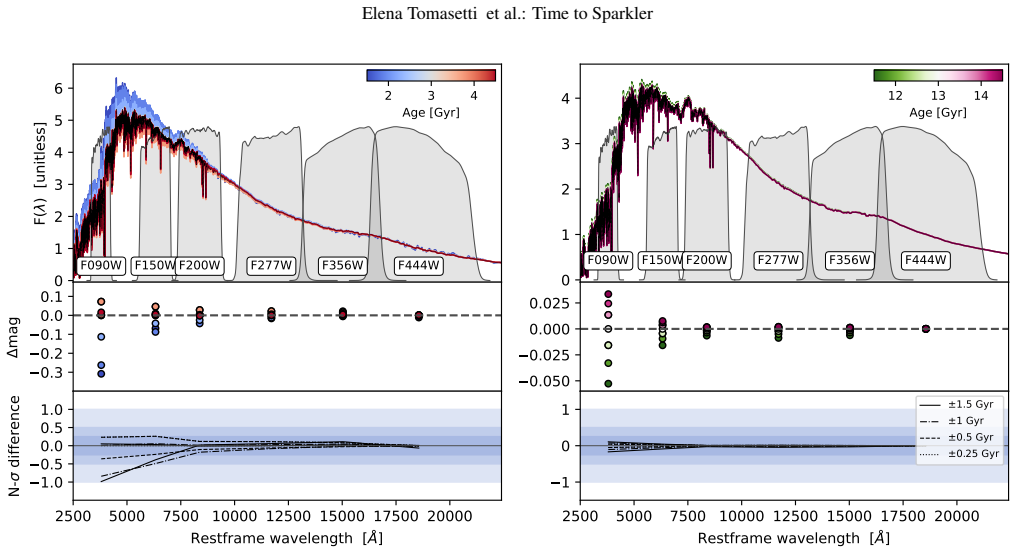
Three ingredients carry the argument: STARRED, a wavelet-based deconvolution photometry pipeline that separates unresolved point sources (the sparkles) from the complicated lensed arc of the host galaxy and delivers clean six-band fluxes; BAGPIPES, a Bayesian SED-fitting code using BC16 stellar population models, a delayed exponentially declining star formation history, a Kroupa initial mass function, and a Calzetti dust law; and broad uniform priors on age, metallicity, dust, and star-formation-history width that are deliberately independent of any cosmological model. The age prior spanning 0–15 Gyr lets the data choose the age without input from cosmology, and the six NIRCam bands (F090W through F444W) sample rest-frame wavelengths where populations around 1–3 Gyr are especially sensitive to age.
What would settle it
Take JWST/NIRSpec spectra of the five candidates: if they show strong nebular emission lines such as [OIII] or Balmer emission, or a young stellar signature inconsistent with a roughly 2 Gyr old population, the measured ages and the cosmic-clock interpretation would be falsified; conversely, spectra showing Balmer absorption typical of an intermediate-age population would support the result.
Extended reading notes
Core claim
The central discovery is that five globular cluster candidates in the strongly lensed Sparkler galaxy have a mean age of 1.9 ± 0.4 Gyr, derived solely from integrated six-band JWST/NIRCam photometry after isolating point-source light from the lensed arc using deconvolution photometry. Stellar population fits with very broad, deliberately cosmology-independent priors (a uniform age prior spanning 0–15 Gyr, along with broad metallicity, dust, and star-formation-history priors) give ages that are not prior-dominated and that agree with the Planck18 ΛCDM age of the Universe at that redshift. This is the first time globular clusters beyond z=0 are used as cosmic clocks, and the age precision is comparable to that of the first passively evolving galaxy clocks at similar redshift from the mid-1990s.
Load-bearing premise
The five compact sources are genuinely old globular clusters rather than young star clusters, background galaxies, or clumps in the lensed arc; the paper adopts this identification from their red colors and lack of [OIII] emission, with no independent confirmation yet.
Editorial extensions
If this is right
- Globular clusters at z>1 can serve as cosmic clocks, complementing passively evolving galaxies as cosmology-independent age anchors.
- The measured ages give a lower limit on the age of the Universe at z=1.378 that is consistent with Planck18 ΛCDM, so the method can be used to test cosmological models.
- The ages and metallicities of the five candidates enable an age-metallicity relation for the Sparkler's cluster system, relevant to galaxy formation and chemical enrichment.
- The upcoming JWST/NIRSpec IFU spectra of the Sparkler will provide a blind test of the photometry-only age method.
- A systematic multi-band survey of globular clusters in and behind galaxy clusters with JWST and Euclid could date clusters across a wide redshift range, extending cosmic clock measurements to many epochs.
Reading between the lines
- If confirmed by spectroscopy, this result would give globular clusters a role as independent probes of the Hubble tension, since their ages at high redshift constrain the expansion history without relying on distance ladders.
- The method's success depends on the identification of the five sources as old globular clusters; a plausible alternative is that some are young massive clusters or chance projections along the arc, which the planned spectra can test.
- A natural extension would be to apply the same deconvolution-plus-Bayesian pipeline to other strongly lensed systems with multiple candidate clusters, increasing sample sizes and pushing cosmic clock measurements to even higher redshifts.
- The systematic offset noted in the F150W filter during fitting suggests a possible calibration or model issue; if real, it may shift ages by roughly 0.2 Gyr, a small but worth monitoring systematic for future applications.
Editorial analysis
A structured set of objections, weighed in public.
Referee Report
Summary. This paper presents age measurements for five compact sources in the lensed Sparkler galaxy at z=1.378, previously identified as globular cluster (GC) candidates on the basis of their red colors and lack of [OIII] emission. Using six-band JWST/NIRCam photometry processed with the STARRED deconvolution pipeline and Bayesian SED fitting with BAGPIPES, the authors derive individual age posteriors and report a mean age of 1.9±0.4 Gyr, which they compare to the Planck18 ΛCDM age of the universe at that redshift (~4.5 Gyr). They argue that this result demonstrates the viability of using lensed GCs as cosmic clocks at z>1.
Significance. The paper introduces a novel technical path: combining high-resolution deconvolution photometry (STARRED) with redshift-independent priors in a Bayesian SED fit to measure ages of GC candidates at z~1.4 from integrated light. If the GC identification is confirmed and the age measurement refined, this approach could extend cosmic-clock studies beyond z=0, complementing passively evolving galaxies. The STARRED photometry and the explicit removal of cosmological assumptions from the priors are genuine strengths. However, the current precision is limited: the individual age posteriors are wide, the quoted average uncertainty is only the scatter of the posterior medians rather than a combined measurement error, and the GC nature of the sources remains unconfirmed. The result is therefore a promising proof of concept rather than a precise cosmic-clock measurement.
major comments (3)
- [Section 3, Table 1] The headline average age of 1.9±0.4 Gyr is reported as the mean of the five posterior medians, with the quoted error being the standard deviation of the medians. This does not represent the uncertainty of the combined age measurement: the individual 68% credible intervals are much wider (e.g., Source 1: 2.73+5.22−1.53 Gyr, i.e., [1.20, 7.95] Gyr; Source 4: 1.51+1.24−0.71 Gyr). The consistency with the Planck18 age of the universe at z=1.378 (~4.5 Gyr) is therefore much weaker than the quoted '1.9±0.4 Gyr' suggests. The authors should either combine the full posterior distributions (e.g., hierarchically or via a weighted mean that includes individual uncertainties) or clearly label the quoted value as the mean of medians with the scatter among sources, and temper the abstract and conclusions accordingly.
- [Section 1, Section 4] The cosmic-clock claim rests entirely on the assumption that the five compact sources are globular clusters. The paper states this explicitly: 'Hereafter we will assume these candidates are indeed GCs' (Section 1). The evidence for GC candidacy is indirect—absence of [OIII] and red urJ colors—and the objects are unresolved at 0.04'' FWHM, so compact young clusters, background galaxies, or reddened star-forming clumps cannot be excluded. The upcoming NIRSpec IFU observations are correctly described as a 'strong blind test,' but until they are available, the reported ages apply only under the GC hypothesis. The abstract and conclusions should state this conditionality explicitly rather than presenting the result as a definitive measurement of GC ages.
- [Section 2.2, Fig. 3] The deliberately redshift-independent age prior (uniform 0–15 Gyr) is a strength for avoiding cosmological bias, but it admits ages that are unphysical at z=1.378, where the age of the universe is ~4.5 Gyr. For Source 1, the 68% posterior extends to 7.95 Gyr, and the posterior has substantial support beyond the cosmic age. This indicates that the age constraint for that source is weak and that the posterior may be influenced by the prior at large ages. The authors should quantify how the quoted average age and the claimed consistency with ΛCDM change if the age is truncated at the cosmic age at that redshift, and discuss whether the posteriors are truly prior-independent in the high-age tail.
minor comments (5)
- [Abstract] The phrase 'yield a formation age of 1.9±0.4 Gyr on average' should be accompanied by a caveat that this is the average of the individual posterior medians and that the sources are assumed to be globular clusters.
- [Section 2.2] The delayed-τ star formation history with τ in [0,1] Gyr may not be the most appropriate description for globular clusters, which are typically considered single stellar populations. Since the fitted τ values are reported to be ~0.6 Gyr, the authors should comment on whether this affects the age interpretation.
- [Appendix] The systematic underestimate of the F150W flux, which shifts ages by ~0.2 Gyr and metallicities by ~0.2 dex when masked, is only mentioned in the appendix. Since it represents a potential systematic affecting the central result, it should be summarized in the main text.
- [Section 1] The sentence 'a typical GC with an effective radius of 50 pc subtends a few milliarcsec at z=1−1.5' could be clarified to explain that this is why the sources are unresolved in the 0.04''-resolution STARRED images.
- [Section 1] The notation 'urJ colours' is used without defining the filters; it would be helpful to specify the corresponding JWST/NIRCam bands.
Circularity Check
No significant circularity: the age measurement is self-contained, and the main caveat is an acknowledged external assumption about GC classification, not a circular derivation.
full rationale
The paper's derivation chain is self-contained and not circular. The measured ages come from BAGPIPES fits to six-band JWST/NIRCam photometry with broad, redshift-independent priors: "a key modification to BAGPIPES, already tested and validated in Jiao et al. (2023) and Tomasetti et al. (2023), is applied to allow T0, and consequently the age of the stellar population, to span the full range of 0-15 Gyr independently of redshift, thus removing the effects of cosmological assumptions in the age priors." The Planck18 comparison is made after the fit as a reference, not as an input: "For reference, the ΛCDM Planck18-model inferred age of the Universe at redshift z = 1.378 is ∼4.5 Gyr." No equation defines the measured age in terms of Planck18 or in terms of the GC candidate selection. The stellar population models (BC16), the fitting code (BAGPIPES), and the photometry pipeline (STARRED) are external products or prior methodological developments; self-citations to Tomasetti et al. (2023, 2024), Millon et al. (2024), and Jimenez/Verde works are contextual and not load-bearing for the central age result. The paper explicitly flags its main external assumption in Section 1: "Hereafter we will assume these candidates are indeed GCs." This is a classification caveat, not a circular reduction, and the paper itself notes that upcoming NIRSpec IFU observations (Cycle 2 GO#2969) "will represent a strong blind test and validation of our methodology." Therefore the central claim does not reduce to its inputs by construction; the score is low only because of the acknowledged but as-yet-unverified GC classification premise.
Assumptions & free parameters
free parameters (6)
- Stellar population age for each GC candidate =
1.66-2.73 Gyr (posterior medians for sources 1, 2, 4, 8, 10)
- SFH timescale tau =
about 0.6 Gyr (posterior medians, Fig. 4)
- Metallicity [Z/H] =
-0.18 to -0.96 dex
- Dust attenuation A_V =
0.25-0.46 mag for GC candidates
- Velocity dispersion sigma_v =
not reported
- Stellar mass =
not reported
assumptions (7)
- domain assumption The five compact sources are globular clusters
- domain assumption BC16 stellar population synthesis models accurately predict integrated SEDs of 1-3 Gyr old stellar populations
- domain assumption Delayed exponential SFH with tau in [0,1] Gyr describes the star formation history of these clusters
- domain assumption Calzetti dust attenuation law applies to these compact sources
- domain assumption STARRED photometry isolates point-source fluxes from the lensed arc without chromatic bias
- domain assumption Lensing magnification is achromatic over the Sparkler field
- standard math Bayesian nested sampling (Multinest) in BAGPIPES yields unbiased posteriors
Cite this review
Pith. "Pith review of Time to Sparkler. Accurate ages of lensed globular clusters at $z=1.4$ with JWST photometry." pith.science (2026). https://pith.science/paper/PGE3H763
@misc{pith2026241206903,
  author       = {Pith},
  title        = {Pith review of: Time to Sparkler. Accurate ages of lensed globular clusters at $z=1.4$ with JWST photometry},
  year         = {2026},
  howpublished = {\url{https://pith.science/paper/PGE3H763}},
  note         = {Machine review of arXiv:2412.06903}
}
abstract
Determining reliable ages for old stellar objects at different redshifts offers a powerful means to constrain cosmology without relying on a specific cosmological model: this is known as the cosmic clocks method. Globular clusters (GCs), long recognised as hosts of the Universe's oldest stars, have served as the archetypical cosmic clocks. However, their age estimates have traditionally been confined to redshift z=0, limiting their role to constraining the present-day age of the Universe. Here we explore how to measure reliable ages of GCs well beyond $z=0$, leveraging their potential to extend cosmic clock measurements to earlier epochs. Specifically, we use 6-band JWST/NIRCam high-precision photometry of candidate stellar clusters in the Sparkler galaxy, located at redshift $z$=1.378 and strongly lensed by the galaxy cluster SMACS J0723.3-7327. By employing stellar population models within a Bayesian inference framework, we constrain the GCs' ages, star formation histories, metallicities, and dust attenuation. The five compact sources previously identified as GCs, based on their red spectral energy distributions being consistent with the colours of old stellar systems, yield a formation age of $1.9\pm0.4$ Gyr on average. This result implies a total age of the Universe that aligns well with the $\Lambda$CDM model derived from Planck18 data. Recent space-based observations have uncovered a wealth of lensed GCs as well as globulars within the member galaxies of the clusters themselves. These findings suggest that the pool of objects available for cosmic clock studies is enormous. A systematic multi-band photometric survey of GCs in and behind galaxy clusters, using facilities like Euclid and JWST, would therefore be a powerful tool for estimating cluster ages across a large range of redshifts, allowing the Universe to be dated across an unprecedented range of epochs.
Figures


Figures from the paper (1 more)

Forward citations
Cited by 2 Pith papers
-
The dynamical evolution of the stellar clumps in the Sparkler galaxy
N-body simulations of the Sparkler clumps predict that survivors keep half-mass radii of 20-50 pc to z=0, making them too large to evolve into present-day globular clusters.
-
Cosmic CORALS: Timing the Universe with high-z star clusters
Star clusters at z=9.6 combined with local globular cluster ages give H0=70(+27,-16) km/s/Mpc and Omega_m=0.33(+0.37,-0.21), with a forecast that ~300 clusters could reach 4% precision.
Reference graph
Works this paper leans on
-
[1]
& Lardo, C
Bastian, N. & Lardo, C. 2018, ARA&A, 56, 83
2018
-
[2]
2020, PASA, 37, e046
Baumgardt, H., Sollima, A., & Hilker, M. 2020, PASA, 37, e046
2020
- [3]
- [4]
-
[5]
& Charlot, S
Bruzual, G. & Charlot, S. 2003, MNRAS, 344, 1000
2003
-
[6]
2016, Statistics and Computing, 26, 383
Buchner, J. 2016, Statistics and Computing, 26, 383
2016
- [7]
-
[8]
C., et al
Calzetti, D., Armus, L., Bohlin, R. C., et al. 2000, ApJ, 533, 682
2000
Show all 46 references
-
[9]
B., Suyu, S
Caminha, G. B., Suyu, S. H., Mercurio, A., et al. 2022, A&A, 666, L9
2022
-
[10]
C., McLure, R
Carnall, A. C., McLure, R. J., Dunlop, J. S., et al. 2019, MNRAS, 490, 417
2019
-
[11]
C., McLure, R
Carnall, A. C., McLure, R. J., Dunlop, J. S., & Davé, R. 2018, MNRAS, 480, 4379
2018
-
[12]
C., McLure, R
Carnall, A. C., McLure, R. J., Dunlop, J. S., et al. 2022, ApJ, 929, 131
2022
-
[13]
Cezario, E., Coelho, P. R. T., Alves-Brito, A., Forbes, D. A., & Brodie, J. P. 2013, A&A, 549, A60
2013
-
[14]
& Charlot, S
Chevallard, J. & Charlot, S. 2016, MNRAS, 462, 1415
2016
-
[15]
& Moresco, M
Cimatti, A. & Moresco, M. 2023, ApJ, 953, 149
2023
-
[16]
2023, MNRAS, 520, 2180
Claeyssens, A., Adamo, A., Richard, J., et al. 2023, MNRAS, 520, 2180
2023
-
[17]
C., Bolzonella, M., Boselli, A., et al
Cuillandre, J. C., Bolzonella, M., Boselli, A., et al. 2024, arXiv e-prints, arXiv:2405.13501
2024
-
[18]
1996, Nature, 381, 581
Dunlop, J., Peacock, J., Spinrad, H., et al. 1996, Nature, 381, 581
1996
-
[19]
2024 [Arxiv:2411.04177v1]
Dux, F., Millon, M., Lemon, C., et al. 2024 [Arxiv:2411.04177v1]
2024 arXiv
-
[20]
Forbes, D. A. & Romanowsky, A. J. 2023, MNRAS, 520, L58
2023
-
[21]
2005, ARA&A, 43, 387 Gonçalves, G., Coelho, P., Schiavon, R., & Usher, C
Gallart, C., Zoccali, M., & Aparicio, A. 2005, ARA&A, 43, 387 Gonçalves, G., Coelho, P., Schiavon, R., & Usher, C. 2020, MNRAS, 499, 2327
2005
-
[22]
2019, A&A Rev., 27, 8
Gratton, R., Bragaglia, A., Carretta, E., et al. 2019, A&A Rev., 27, 8
2019
-
[23]
2023, ApJS, 265, 48
Jiao, K., Borghi, N., Moresco, M., & Zhang, T.-J. 2023, ApJS, 265, 48
2023
-
[24]
2019, Journal of Cosmology and Astroparticle Physics, 2019, 043
Jimenez, R., Cimatti, A., Verde, L., Moresco, M., & Wandelt, B. 2019, Journal of Cosmology and Astroparticle Physics, 2019, 043
2019
-
[25]
& Loeb, A
Jimenez, R. & Loeb, A. 2002, ApJ, 573, 37
2002
-
[26]
Jimenez, R., Moresco, M., Verde, L., & Wandelt, B. D. 2023, J. Cosmology Astropart. Phys., 2023, 047
2023
-
[27]
2008, MN- RAS, 385, 1998
Koleva, M., Prugniel, P., Ocvirk, P., Le Borgne, D., & Soubiran, C. 2008, MN- RAS, 385, 1998
2008
-
[28]
2001, MNRAS, 322, 231
Kroupa, P. 2001, MNRAS, 322, 231
2001
-
[29]
M., Koekemoer, A., Coe, D., et al
Lotz, J. M., Koekemoer, A., Coe, D., et al. 2017, ApJ, 837, 97
2017
-
[30]
1998, ApJ, 494, 472
Magain, P., Courbin, F., & Sohy, S. 1998, ApJ, 494, 472
1998
-
[31]
2023, ApJ, 945, 49
Mahler, G., Jauzac, M., Richard, J., et al. 2023, ApJ, 945, 49
2023
-
[32]
2023, The Journal of Open Source Software, 8, 5340
Michalewicz, K., Millon, M., Dux, F., & Courbin, F. 2023, The Journal of Open Source Software, 8, 5340
2023
-
[33]
Millon, M., Michalewicz, K., Dux, F., Courbin, F., & Marshall, P. J. 2024, AJ, 168, 55
2024
-
[34]
Milone, A. P. & Marino, A. F. 2022, Universe, 8, 359
2022
-
[35]
2015, MNRAS, 450, L16
Moresco, M. 2015, MNRAS, 450, L16
2015
-
[36]
2022, Living Reviews in Relativity, 25, 6
Moresco, M., Amati, L., Amendola, L., et al. 2022, Living Reviews in Relativity, 25, 6
2022
-
[37]
Moresco, M., Cimatti, A., Jimenez, R., et al. 2012, J. Cosmology Astropart. Phys., 2012, 006
2012
-
[38]
Moresco, M., Pozzetti, L., Cimatti, A., et al. 2016, J. Cosmology Astropart. Phys., 2016, 014
2016
-
[39]
G., Desprez, G., et al
Mowla, L., Iyer, K. G., Desprez, G., et al. 2022, ApJ, 937, L35
2022
-
[40]
2023, MNRAS, 525, 1867
Noirot, G., Desprez, G., Asada, Y ., et al. 2023, MNRAS, 525, 1867
2023
-
[41]
M., Barrientes, J., Blome, C., et al
Pontoppidan, K. M., Barrientes, J., Blome, C., et al. 2022, ApJ, 936, L14
2022
-
[42]
L., Loubser, S
Ratsimbazafy, A. L., Loubser, S. I., Crawford, S. M., et al. 2017, MNRAS, 467, 3239
2017
-
[43]
2023, A&A, 679, A96
Tomasetti, E., Moresco, M., Borghi, N., et al. 2023, A&A, 679, A96
2023
-
[44]
2024, arXiv e-prints, arXiv:2410.22466
Tomasetti, E., Moresco, M., Lardo, C., Cimatti, A., & Jimenez, R. 2024, arXiv e-prints, arXiv:2410.22466
2024 arXiv
-
[45]
L., Jimenez, R., Verde, L., & Wandelt, B
Valcin, D., Bernal, J. L., Jimenez, R., Verde, L., & Wandelt, B. D. 2020, J. Cos- mology Astropart. Phys., 2020, 002
2020
-
[46]
A., Brogaard, K., Leaman, R., & Casagrande, L
VandenBerg, D. A., Brogaard, K., Leaman, R., & Casagrande, L. 2013, ApJ, 775, 134 Article number, page 5 of 6 A&A proofs: manuscript no. aanda Age = 2.78+5.21 1.62 0.3 0.6 0.9 1.2 Z/Z Z/Z = 0.13+0.48 0.10 0.2 0.4 0.6 0.8 [Gyr] = 0.59+0.28 0.35 3 6 9 12 Age [Gyr] 0.4 0.8 1.2 1....
2013
Reviewed August 11, 2026 · model on record in the stance chip above.
Discussion (0). Continue with ORCID to comment.