REVIEW 3 major objections 4 minor 2 cited by
Boundary anomaly detection in two-dimensional subsystem symmetry-protected topological phases
T0 review · 3 major / 4 minor · reviewed 2026-08-11 · deepseek-v4-flash
Pith's one-line read The paper establishes that the normalized subsystem-symmetry charge of a twisted sector state equals the mixed boundary anomaly of adjacent subsystem symmetries, giving a transfer-matrix detector for strong, weak, and intrinsic SSPT…
desk verdict A solid, genuinely new anomaly-indicator method for adjacent-subsystem SSPT phases; central claim holds within its stated scope, but the 'more complex cases' generalization is unproved. read the letter →
The pith
A machine-rendered reading of the paper's core claim, the machinery that carries it, and where it could break.
The reading
What carries the argument
The central object is the anomaly indicator $Q(g[y], f[y+1])$, a ratio of symmetry charges evaluated from the spectra of transfer matrices with an $f[y+1]$ symmetry defect. The load-bearing identity is that reordering the local virtual-space operators $V_{y+1}(g[y])$ and $V_{y+1}(f[y+1])$ on the shared virtual bond produces the phase $\phi(g[y], f[y+1])$, and this phase factors out of the transfer-matrix trace to give Eq. (16). The locality decomposition $W^{\mathrm{Right}}(g[y]) = V_y(g[y]) V_{y+1}(g[y])$ restricts the analysis to mixed anomalies between adjacent subsystems and is what makes the transfer-matrix proof work.
What would settle it
Take a symmetric tensor state whose boundary operator $W^{\mathrm{Right}}(g[y])$ is supported on rows $y$, $y+1$, and $y+2$, and compute $Q(g[y], f[y+2])$ from the transfer-matrix formula; the paper's assumptions force $\phi(g[y], f[y+2]) = 1$ and hence $Q = 1$, so observing any value other than $1$ would show the indicator misses non-adjacent mixed anomalies.
Extended reading notes
Core claim
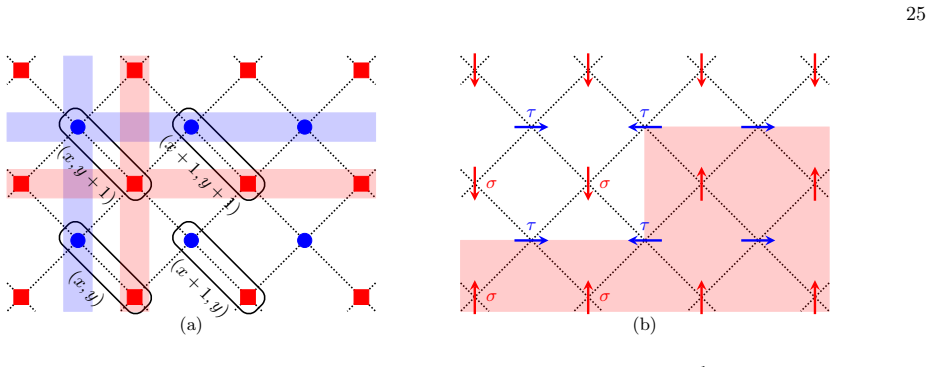
The central discovery is the relation $Q(g[y], f[y+1]) = \phi(g[y], f[y+1])$ for symmetric subsystem states (Eq. 16): inserting a zero-dimensional symmetry defect $V_{y+1}(f[y+1])$ on one virtual bond and measuring the charge of a horizontal subsystem symmetry $S_h(g[y])$ in the resulting twisted sector state reproduces the factor-system phase $\phi$ that labels the mixed anomaly between rows $y$ and $y+1$. The paper verifies this analytically for the 2D cluster state, where $Q = -1$ matches $\phi(g[y]^\tau, g[y+1]^\sigma) = -1$, and numerically for a tunable tensor $\Gamma(\gamma)$ that interpolates between strong ($\gamma = -1$) and weak ($\gamma = 1$) $Z_2^\tau \times Z_2^\sigma$ SSPT phases. It then constructs an intrinsic $Z_2$ SSPT phase with no weak counterpart, detected by $Q(g[1], g[2]) = -1$ and a fully degenerate entanglement spectrum, and extends the indicator to density matrices via $Q_{\mathrm{ave}}$ and $Q_{\mathrm{exa}}$, showing that the anomalies survive both uniform and alternating disorder.
Load-bearing premise
The whole scheme assumes that a boundary subsystem-symmetry operator acts only on two neighboring rows and factorizes as a product of two local operators; if a real phase has boundary anomalies spread across three or more rows, the indicator would fail to see them.
Editorial extensions
If this is right
- The same transfer-matrix routine separates strong from weak SSPT phases: in the weak $Z_2^\tau \times Z_2^\sigma$ phase, $Q(g[y]^\tau, g[y+1]^\sigma) = 1$ while the same-row indicator $Q(g[y]^\tau, g[y]^\sigma) = -1$ remains nontrivial.
- An intrinsic $Z_2$ SSPT phase exists whose only nontrivial invariant is the adjacent-row mixed anomaly; its entanglement spectrum is fully degenerate and the indicator stays at $-1$ under symmetric perturbations.
- When a subsystem symmetry is spontaneously broken, the anomaly indicator decays to zero in the thermodynamic limit, so the method simultaneously detects symmetry breaking as the loss of anomaly signal.
- In mixed states with average subsystem symmetries, the exact and average symmetry charges of the twisted density matrix reproduce the mixed anomaly, and the anomaly persists under both uniform and alternating disorders, connecting pure- and mixed-state boundary anomalies.
Reading between the lines
- The locality assumption suggests a natural generalization the authors do not construct: insert defects spanning $k$ adjacent rows and define $Q(g[y], f[y+k])$ to capture longer-range mixed anomalies between non-adjacent subsystems.
- Because the indicator is built from the topological response rather than from any specific Hamiltonian, it should transfer to foliated fracton and higher-order topological phases in 3D, where planar subsystem symmetries replace row symmetries.
- The mixed-state version could serve as a practical probe of strong-to-weak spontaneous symmetry breaking in disordered or decohered systems, since $Q_{\mathrm{ave}}$ jumps between $\pm 1$ exactly where the entanglement gap closes; this use goes beyond the paper's stated claims.
Signed reviews
Editorial analysis
A structured set of objections, weighed in public.
Referee Report
Summary. The paper proposes a tensor-network anomaly indicator Q(g[y], f[y+1]) for two-dimensional subsystem symmetry-protected topological (SSPT) phases. A twisted-sector state is formed by inserting a symmetry defect V_{y+1}(f[y+1]) on one virtual bond of a cylinder, and Q is defined as the expectation value of the horizontal subsystem symmetry S_h(g[y]) in that state. Under the assumption that boundary subsystem symmetry operators factorize into adjacent local operators, W^Right(g[y]) = V_y(g[y]) V_{y+1}(g[y]), the paper proves Q = φ(g[y], f[y+1]) (Eq. 16), i.e., the indicator equals the mixed anomaly of adjacent row symmetries. The identity is verified analytically for the 2D cluster state and numerically with transfer-matrix calculations on Ly=2 cylinders for a tunable tensor T(γ), which distinguishes strong (γ=-1) and weak (γ=1) Z2^τ x Z2^σ SSPT phases. The authors also introduce a fixed-point tensor T_Z2(φ) with Z2 subsystem symmetry, identify an intrinsic Z2 SSPT phase without a weak counterpart, and detect it through Q=-1 and a degenerate entanglement spectrum. The method is further extended to mixed-state density matrices with average and exact subsystem symmetries in uniform and alternating disorder ensembles, with numerical results for an interpolated density matrix ρ(t).
Significance. The central identity is a useful and nontrivial transfer-matrix characterization for the adjacent-subsystem class of SSPT boundary anomalies. The strengths of the paper are the analytic proof of Q=φ under the stated ansatz, the explicit cluster-state example, and the set of reproducible transfer-matrix numerics that separate strong, weak, and intrinsic phases. The mixed-state extension is a reasonable bridge between pure-state SSPT anomalies and average-symmetry anomalies, and the identification of an intrinsic Z2 SSPT phase is potentially interesting. The main caveat is that the established result is restricted to boundary operators of the adjacent-factorized form (Eq. B2); the broader generality statements in the title, Sec. II A, and the conclusion go beyond what is proven, and the stability claim for the intrinsic phase is asserted rather than demonstrated.
major comments (3)
- [Sec. II A, Eq. (B2); Appendix B, Eq. (B16); Eq. (16)] The central identity Q(g[y], f[y+1]) = φ(g[y], f[y+1]) (Eq. 16) is proven only for boundary subsystem symmetry operators satisfying W^Right(g[y]) = V_y(g[y]) V_{y+1}(g[y]) (Eq. B2). The proof passes through Eq. (B16), which reduces the mixed anomaly to a commutation relation of the single-bond operator V_{y+1}(g[y]) with V_{y+1}(f[y+1]); if a boundary representative instead has support on a wider window, for example W^Right(g[y]) = V_y(g[y]) V_{y+2}(g[y]), then the V_{y+2} factor commutes through the trace in Eq. (15) and Q need not equal the actual boundary anomaly φ(g[y], f[y+2]). The statement in Sec. II A that "by expanding the region of the investigation... the analysis is also applicable to more complex cases" is not supported by any proof, construction, or numerical example, and the Ly=2 numerics in Figs. 3, 5, and 9 cannot test non-adjacent boundary anomalies. The scope restriction should therefore be stated as a hard limitation, or an explicit proof and example for wider operator support should be supplied.
- [Sec. V, Appendix E, Eqs. (47), (49), (E10), (E11)] The mixed-state indicators Qexa and Qave are derived in Appendix E for a one-dimensional MPO with global symmetry; the application to 2D subsystem symmetries in Sec. V is not given the same level of proof. I ask the authors to state explicitly how the adjacent-factorization ansatz of Eq. (B2) is inherited by the boundary operators of the Choi-state representation of the PEPDO, and to show the transfer-matrix steps that lead to Qexa(k,~g)=φ and Qave(g,~g)=φ for the subsystem operators in Eqs. (83) and (86). In addition, Eq. (E10) as written has the right conjugation by V(k)⊗I, whereas Eq. (E9) and the trace evaluation in Eq. (E11) appear to require conjugation by V(g)⊗I; please clarify whether this is a typo or a step relying on the group-extension structure. Without this clarification, the numerical values in Fig. 9 do not by themselves establish the claimed mixed-state anomalies.
- [Sec. IV B, Eq. (40)] Section IV B states that the intrinsic Z2 SSPT phase is stable under the subsystem-symmetric perturbation U^v_y(η)=∏_x exp(η X_{x,y}), with φ(g[y],g[y+1]) remaining -1 and the entanglement spectrum remaining fully degenerate "throughout the nontrivial SSPT phase". No numerical data or analytic argument for this stability is provided. Because calling T_Z2(φ) at φ=(2m+1)π a phase rather than a fixed point requires a finite region of stability, please include the Q(g[1],g[2]) and entanglement-spectrum results as functions of η, or state that only the fixed-point behavior is established.
minor comments (4)
- [Sec. VI] The conclusion overstates the proven scope by presenting the method as "a numerical method to detect quantum anomalies of subsystem symmetries" without repeating the adjacent-subsystem restriction; I recommend qualifying this sentence.
- [Appendix C, Eq. (C4)] The thermodynamic-limit formula for Q involves the ratio (λ0(g[y],e)/λ0(e,e))^{Lx-1}; please specify how the phase of λ0 is treated when the transfer matrix is non-Hermitian, and state under what conditions Q is guaranteed to be real.
- [Secs. V A and V B, Eqs. (60), (63), (74), (76)] Several tensor-network equations are presented diagrammatically without explicit algebraic definitions of every tensor; providing explicit local tensor components or a short pseudocode would help readers verify the commutation relations that the boundary-anomaly graphs in Eqs. (66) and (80) rely on.
- [Figs. 4 and 10] The captions do not state the bond dimension (or truncation) used in the entanglement-spectrum calculations, nor the specific Lx values for the horizontal-cylinder geometry; these parameters are needed to assess the claims of full degeneracy and gap closing.
Circularity Check
No significant circularity: Eq. (16) is a derived identity, not a fitted input renamed as a prediction.
full rationale
The central result Q(g[y], f[y+1]) = phi(g[y], f[y+1]) is derived from the tensor equations, not assumed or fitted. The indicator is defined independently in Eq. (10) as the normalized subsystem-symmetry charge of a twisted sector state, while phi is defined separately from boundary-operator commutation in Eqs. (6)-(7). The equality follows from the transfer-matrix manipulations in Eqs. (12)-(15) and the bond-commutation relation Eq. (B16), which itself follows from the stated adjacent-factorization ansatz W^Right(g[y]) = V_y(g[y]) V_{y+1}(g[y]). This is a mathematical derivation rather than a self-referential definition. The numerical examples for the cluster state and the intrinsic Z2 phase compute Q from transfer-matrix spectra (Appendix C) and compare against analytically derived boundary commutators, so the numerical checks are not curve fits to the target quantity. The tunable-tensor calculations also detect symmetry breaking via Q approaching zero, which is additional, non-circular content. The paper includes some self-citations (e.g., Refs. [42,65,78,80]), but these concern mixed-state constructions and generalization remarks and are not load-bearing for the main anomaly-indicator identity. The main caveat is scope, not circularity: the proof assumes adjacent-subsystem factorization, and the statement in Sec. II A that 'by expanding the region of the investigation while using a similar approach, the analysis is also applicable to more complex cases' is an unproved assertion about wider-support boundary anomalies. That is a limitation in generality, not a circular step. No specific equation is shown to reduce to its own input, so the appropriate circularity score is 0.
Assumptions & free parameters
free parameters (4)
- gamma in tunable cluster tensor T(gamma) =
gamma = -1 (strong), gamma = 1 (weak), otherwise symmetry-broken
- phi in intrinsic Z2 tensor T_Z2(phi) =
phi = (2m+1)pi (nontrivial), phi = 2m pi (trivial)
- t in density matrix interpolation rho(t) =
t = 1 (nontrivial), t = 0 (trivial)
- eta in perturbation U^v_y(eta) =
eta in [0,1]
assumptions (4)
- ad hoc to paper Boundary subsystem symmetry operators decompose as W^Right(g[y]) = V_y(g[y]) V_{y+1}(g[y]) into adjacent local boundary spaces.
- domain assumption The bulk wave function is symmetric under the linear subsystem symmetries and admits the tensor equation Eq. (8).
- domain assumption The transfer matrix of an SRE state has a unique leading eigenvalue.
- standard math The group Gs is a finite Abelian group.
invented entities (2)
-
Intrinsic Z2 SSPT phase
-
Average subsystem symmetry anomaly indicators Qexa and Qave
Cite this review
Pith. "Pith review of Boundary anomaly detection in two-dimensional subsystem symmetry-protected topological phases." pith.science (2026). https://pith.science/paper/IYKGOXTW
@misc{pith2026241207563,
  author       = {Pith},
  title        = {Pith review of: Boundary anomaly detection in two-dimensional subsystem symmetry-protected topological phases},
  year         = {2026},
  howpublished = {\url{https://pith.science/paper/IYKGOXTW}},
  note         = {Machine review of arXiv:2412.07563}
}
abstract
We generalize the topological response theory to detect the boundary anomalies of linear subsystem symmetries. This approach allows us to distinguish different subsystem symmetry-protected topological (SSPT) phases and uncover new ones. We focus on the cases where the mixed anomaly exists within the adjacent subsystems. Using numerical simulations, we demonstrate the power of this method by identifying strong and weak $Z_2^\tau\times Z_2^\sigma$ SSPT phases in a tunable tensor network state. Our analysis reveals an intrinsic $Z_2$ SSPT phase characterized by its degenerate entanglement spectrum. Furthermore, we extend the anomaly indicator to mixed-state density matrices and show that quantum anomalies of subsystem symmetry can persist under both uniform and alternating disorders. This finding establishes a connection between boundary quantum anomalies in pure and mixed states. Our work provides a numerical method to detect quantum anomalies of subsystem symmetries, offering new insights into the study of topological quantum phases.
Figures


Figures from the paper (10 more)



Forward citations
Cited by 2 Pith papers
-
Entanglement Holography in Quantum Phases via Twisted R\'enyi-N Correlators
Twisted Rényi-N correlators of the reduced density matrix exhibit long-range order along an artificial replica direction for SPT phases, mirroring the bulk strange correlator.
-
Topological edge states in two-dimensional $\mathbb{Z}_4$ Potts paramagnet protected by the $\mathbb{Z}_4^{\times 3}$ symmetry
The nontrivial Z4^×3 SPT edge reduces to a constrained Z4 chain whose spectrum is gapless and consistent with a c≈11/5 CFT, tentatively SU(3)_3/SU(2)_3.
Reference graph
Works this paper leans on
-
[1]
Uniform average subsystem symmetry 9
-
[2]
Mixed-state anomaly detection 12 VI
Alternating average subsystem symmetry 11 C. Mixed-state anomaly detection 12 VI. Conclusion and Discussion 13 Acknowledgments 14 References 14 A. Topological response theory 17 B. Extract mixed anomaly from local boundary Hilbert space 21 ∗ shuoyang@tsinghua.edu.cn C. Numerical calculation of Q(g[y], f[y+1]) 24 D. Tensor network representation of 2D clus...
arXiv 2025
-
[3]
By expanding the region of the investi- gation while using a similar approach, the analysis is also applicable to more complex cases
In Appendix B, we discuss the specific forms of ϕ(g[y1], f[y2]) for the cases with |y1 −y2| > 1, |y1 −y2| = 0, and |y1 − y2| = 1. By expanding the region of the investi- gation while using a similar approach, the analysis is also applicable to more complex cases. Given the system is translationally invariant in both x and y directions, Eq. (2) can be expr...
-
[4]
The total horizontal subsys- tem symmetry of |ψSSPT⟩ is denoted by Gh = Q y ˜G[y] s
Uniform average subsystem symmetry In the first case, the subsystem symmetry ˜Gs of a pure state SSPT wave function |ψSSPT⟩ is considered as a product group Gs × Ks. The total horizontal subsys- tem symmetry of |ψSSPT⟩ is denoted by Gh = Q y ˜G[y] s . To prepare an ASSPT phase ρASSPT, local disorders are introduced uniformly in the SSPT state, leading to ...
-
[5]
Alternating average subsystem symmetry In the second case, we construct the ASSPT phase by breaking the subsystem symmetry in an alternating way shown in Fig. 8. Starting from a Gs SSPT wave Sh(k[2y+1]) Sh(g[2y+2]) Sh(g[2y]) FIG. 8. Gs ASSPT phase with alternating disorders. The blue and red squares denote the exact subsystem symmetry operators Sh(k[2y+1]...
-
[6]
Wen, Colloquium: Zoo of quantum-topological phases of matter, Rev
X.-G. Wen, Colloquium: Zoo of quantum-topological phases of matter, Rev. Mod. Phys. 89, 041004 (2017)
2017
-
[7]
Gu and X.-G
Z.-C. Gu and X.-G. Wen, Tensor-entanglement-filtering renormalization approach and symmetry-protected topo- logical order, Phys. Rev. B 80, 155131 (2009)
2009
-
[8]
Chen, Z.-C
X. Chen, Z.-C. Gu, Z.-X. Liu, and X.-G. Wen, Symmetry protected topological orders and the group cohomology of their symmetry group, Phys. Rev. B 87, 155114 (2013)
2013
Show all 94 references
-
[9]
Chen, Z.-C
X. Chen, Z.-C. Gu, Z.-X. Liu, and X.-G. Wen, Symmetry- Protected Topological Orders in Interacting Bosonic Sys- tems, Science 338, 1604 (2012)
2012
-
[10]
Chen, Y.-M
X. Chen, Y.-M. Lu, and A. Vishwanath, Symmetry- protected topological phases from decorated domain walls, Nature Communications 5, 3507 (2014)
2014
-
[11]
Chen, Z.-C
X. Chen, Z.-C. Gu, and X.-G. Wen, Classification of gapped symmetric phases in one-dimensional spin sys- tems, Phys. Rev. B 83, 035107 (2011)
2011
-
[12]
Schuch, D
N. Schuch, D. P´ erez-Garc ´ ıa, and I. Cirac, Classifying quantum phases using matrix product states and pro- jected entangled pair states, Phys. Rev. B 84, 165139 (2011)
2011
-
[13]
I.Affleck and E.H.Lieb, A proof of part of haldane’s con- jecture on spin chains, Letters in Mathematical Physics (1986)
1986
-
[14]
Qi and S.-C
X.-L. Qi and S.-C. Zhang, Topological insulators and su- perconductors, Rev. Mod. Phys. 83, 1057 (2011)
2011
-
[15]
Vishwanath and T
A. Vishwanath and T. Senthil, Physics of three- dimensional bosonic topological insulators: Surface- deconfined criticality and quantized magnetoelectric ef- fect, Phys. Rev. X 3, 011016 (2013)
2013
-
[16]
Chen, Z.-X
X. Chen, Z.-X. Liu, and X.-G. Wen, Two-dimensional symmetry-protected topological orders and their pro- tected gapless edge excitations, Phys. Rev. B 84, 235141 (2011)
2011
-
[17]
Levin and Z.-C
M. Levin and Z.-C. Gu, Braiding statistics approach to symmetry-protected topological phases, Phys. Rev. B86, 115109 (2012)
2012
-
[18]
Kawagoe and M
K. Kawagoe and M. Levin, Anomalies in bosonic symmetry-protected topological edge theories: Connec- tion to f symbols and a method of calculation, Phys. Rev. B 104, 115156 (2021)
2021
-
[19]
Garre-Rubio, L
J. Garre-Rubio, L. Lootens, and A. Moln´ ar, Classifying phases protected by matrix product operator symmetries using matrix product states, Quantum 7, 927 (2023)
2023
-
[20]
Li and F
H. Li and F. D. M. Haldane, Entanglement spectrum as a generalization of entanglement entropy: Identification of topological order in non-abelian fractional quantum hall effect states, Phys. Rev. Lett. 101, 010504 (2008)
2008
-
[21]
Pollmann, A
F. Pollmann, A. M. Turner, E. Berg, and M. Oshikawa, Entanglement spectrum of a topological phase in one di- mension, Phys. Rev. B 81, 064439 (2010)
2010
-
[22]
J. I. Cirac, D. Poilblanc, N. Schuch, and F. Verstraete, Entanglement spectrum and boundary theories with pro- jected entangled-pair states, Phys. Rev. B 83, 245134 (2011)
2011
-
[23]
Poilblanc, J
D. Poilblanc, J. I. Cirac, and N. Schuch, Chiral topo- logical spin liquids with projected entangled pair states, Phys. Rev. B 91, 224431 (2015)
2015
-
[24]
M. P. Zaletel, R. S. K. Mong, and F. Pollmann, Topolog- ical characterization of fractional quantum hall ground states from microscopic hamiltonians, Phys. Rev. Lett. 110, 236801 (2013). 15
2013
-
[25]
Schuch, D
N. Schuch, D. Poilblanc, J. I. Cirac, and D. P´ erez-Garc ´ ıa, Topological order in the projected entangled-pair states formalism: Transfer operator and boundary hamiltoni- ans, Phys. Rev. Lett. 111, 090501 (2013)
2013
-
[26]
S. Yang, L. Lehman, D. Poilblanc, K. Van Acoleyen, F. Verstraete, J. I. Cirac, and N. Schuch, Edge theories in projected entangled pair state models, Phys. Rev. Lett. 112, 036402 (2014)
2014
-
[27]
S. Yang, T. B. Wahl, H.-H. Tu, N. Schuch, and J. I. Cirac, Chiral projected entangled-pair state with topological or- der, Phys. Rev. Lett. 114, 106803 (2015)
2015
-
[28]
Jiang, Z
H.-C. Jiang, Z. Wang, and L. Balents, Identifying topo- logical order by entanglement entropy, Nature Physics 8, 902 (2012)
2012
-
[29]
Zou and J
L. Zou and J. Haah, Spurious long-range entanglement and replica correlation length, Phys. Rev. B 94, 075151 (2016)
2016
-
[30]
Van Acoleyen, N
K. Van Acoleyen, N. Bultinck, J. Haegeman, M. Marien, V. B. Scholz, and F. Verstraete, Entanglement of distil- lation for lattice gauge theories, Phys. Rev. Lett. 117, 131602 (2016)
2016
-
[31]
H. He, H. Moradi, and X.-G. Wen, Modular matrices as topological order parameter by a gauge-symmetry- preserved tensor renormalization approach, Phys. Rev. B 90, 205114 (2014)
2014
-
[32]
M. P. Zaletel, Detecting two-dimensional symmetry- protected topological order in a ground-state wave func- tion, Phys. Rev. B 90, 235113 (2014)
2014
-
[33]
Huang and T.-C
C.-Y. Huang and T.-C. Wei, Detecting and identi- fying two-dimensional symmetry-protected topological, symmetry-breaking, and intrinsic topological phases with modular matrices via tensor-network methods, Phys. Rev. B 93, 155163 (2016)
2016
-
[34]
Bultinck, R
N. Bultinck, R. Vanhove, J. Haegeman, and F. Ver- straete, Global anomaly detection in two-dimensional symmetry-protected topological phases, Phys. Rev. Lett. 120, 156601 (2018)
2018
-
[35]
Shiozaki and S
K. Shiozaki and S. Ryu, Matrix product states and equiv- ariant topological field theories for bosonic symmetry- protected topological phases in (1+1) dimensions, Jour- nal of High Energy Physics 2017, 100 (2017)
2017
-
[36]
Kapustin, A
A. Kapustin, A. Turzillo, and M. You, Topological field theory and matrix product states, Phys. Rev. B 96, 075125 (2017)
2017
-
[37]
W.-T. Xu, T. Rakovszky, M. Knap, and F. Pollmann, Entanglement properties of gauge theories from higher- form symmetries (2024), arXiv:2311.16235 [cond-mat.str- el]
2024 arXiv
-
[38]
Schuch, I
N. Schuch, I. Cirac, and D. P´ erez-Garc ´ ıa, PEPS as ground states: Degeneracy and topology, Annals of Physics 325, 2153 (2010)
2010
-
[39]
Pollmann and A
F. Pollmann and A. M. Turner, Detection of symmetry- protected topological phases in one dimension, Phys. Rev. B 86, 125441 (2012)
2012
-
[40]
D. J. Williamson, N. Bultinck, M. Mari¨ en, M. B. S ¸ahino˘ glu, J. Haegeman, and F. Verstraete, Matrix prod- uct operators for symmetry-protected topological phases: Gauging and edge theories, Phys. Rev. B 94, 205150 (2016)
2016
-
[41]
Bultinck, D
N. Bultinck, D. J. Williamson, J. Haegeman, and F. Verstraete, Fermionic matrix product states and one- dimensional topological phases, Phys. Rev. B 95, 075108 (2017)
2017
-
[42]
Jiang and Y
S. Jiang and Y. Ran, Anyon condensation and a generic tensor-network construction for symmetry-protected topological phases, Phys. Rev. B 95, 125107 (2017)
2017
-
[43]
Yang, Z.-C
S. Yang, Z.-C. Gu, and X.-G. Wen, Loop optimization for tensor network renormalization, Phys. Rev. Lett. 118, 110504 (2017)
2017
-
[44]
M. B. S ¸ahino˘ glu, D. Williamson, N. Bultinck, M. Mari¨ en, J. Haegeman, N. Schuch, and F. Verstraete, Character- izing Topological Order with Matrix Product Operators, Annales Henri Poincar´ e22, 563 (2021)
2021
-
[45]
Y. Ma, S. Jiang, and C. Xu, Variational tensor wave func- tions for the interacting quantum spin hall phase, Phys. Rev. Lett. 132, 126504 (2024)
2024
-
[46]
C. Xu, Y. Ma, and S. Jiang, Unveiling correlated two- dimensional topological insulators through fermionic ten- sor network states—classification, edge theories and vari- ational wavefunctions, Reports on Progress in Physics 87, 108001 (2024)
2024
-
[47]
Guo, J.-H
Y. Guo, J.-H. Zhang, S. Yang, and Z. Bi, Locally pu- rified density operators for symmetry-protected topo- logical phases in mixed states (2024), arXiv:2403.16978 [cond-mat.str-el]
2024 arXiv
-
[48]
Iqbal, K
M. Iqbal, K. Duivenvoorden, and N. Schuch, Study of anyon condensation and topological phase transitions from a z4 topological phase using the projected entangled pair states approach, Phys. Rev. B 97, 195124 (2018)
2018
-
[49]
Iqbal and N
M. Iqbal and N. Schuch, Entanglement order parameters and critical behavior for topological phase transitions and beyond, Phys. Rev. X 11, 041014 (2021)
2021
-
[50]
Pollmann, S
F. Pollmann, S. Mukerjee, A. M. Turner, and J. E. Moore, Theory of finite-entanglement scaling at one- dimensional quantum critical points, Phys. Rev. Lett. 102, 255701 (2009)
2009
-
[51]
Y.-C. He, S. Bhattacharjee, R. Moessner, and F. Poll- mann, Bosonic integer quantum hall effect in an interact- ing lattice model, Phys. Rev. Lett. 115, 116803 (2015)
2015
-
[52]
Vanderstraeten, M
L. Vanderstraeten, M. Mari¨ en, J. Haegeman, N. Schuch, J. Vidal, and F. Verstraete, Bridging perturbative expan- sions with tensor networks, Phys. Rev. Lett. 119, 070401 (2017)
2017
-
[53]
Huang, L
R.-Z. Huang, L. Zhang, A. M. L¨ auchli, J. Haegeman, F. Verstraete, and L. Vanderstraeten, Emergent confor- mal boundaries from finite-entanglement scaling in ma- trix product states, Phys. Rev. Lett. 132, 086503 (2024)
2024
-
[54]
Haller, W.-T
L. Haller, W.-T. Xu, Y.-J. Liu, and F. Pollmann, Quan- tum phase transition between symmetry enriched topo- logical phases in tensor-network states, Phys. Rev. Res. 5, 043078 (2023)
2023
-
[55]
Y. You, T. Devakul, F. J. Burnell, and S. L. Sondhi, Subsystem symmetry protected topological order, Phys. Rev. B 98, 035112 (2018)
2018
-
[56]
Devakul, D
T. Devakul, D. J. Williamson, and Y. You, Classification of subsystem symmetry-protected topological phases, Phys. Rev. B 98, 235121 (2018)
2018
-
[57]
Devakul, W
T. Devakul, W. Shirley, and J. Wang, Strong planar sub- system symmetry-protected topological phases and their dual fracton orders, Phys. Rev. Res. 2, 012059 (2020)
2020
-
[58]
F. J. Burnell, T. Devakul, P. Gorantla, H. T. Lam, and S.-H. Shao, Anomaly inflow for subsystem symmetries, Phys. Rev. B 106, 085113 (2022)
2022
-
[59]
Seiberg, Field theories with a vector global symmetry, SciPost Phys
N. Seiberg, Field theories with a vector global symmetry, SciPost Phys. 8, 050 (2020)
2020
-
[60]
Y. You, F. J. Burnell, and T. L. Hughes, Multipolar topo- logical field theories: Bridging higher order topological insulators and fractons, Phys. Rev. B103, 245128 (2021). 16
2021
-
[61]
Casasola, G
H. Casasola, G. Delfino, Y. You, P. F. Bienzobaz, and P. R. S. Gomes, Fractal subsystem symmetries, anomalies, boundaries, and effective field theory (2024), arXiv:2406.19275 [cond-mat.str-el]
2024 arXiv
-
[62]
Ebisu, M
H. Ebisu, M. Honda, and T. Nakanishi, Anomaly inflow for dipole symmetry and higher form foliated field theo- ries, Journal of High Energy Physics 2024, 61 (2024)
2024
-
[63]
D. T. Stephen, H. Dreyer, M. Iqbal, and N. Schuch, Detecting subsystem symmetry protected topological or- der via entanglement entropy, Phys. Rev. B 100, 115112 (2019)
2019
-
[64]
D. T. Stephen, A. Dua, J. Garre-Rubio, D. J. Williamson, and M. Hermele, Fractionalization of subsystem symme- tries in two dimensions, Phys. Rev. B106, 085104 (2022)
2022
-
[65]
D. T. Stephen, J. Garre-Rubio, A. Dua, and D. J. Williamson, Subsystem symmetry enriched topological order in three dimensions, Phys. Rev. Res. 2, 033331 (2020)
2020
-
[66]
J. F. San Miguel, A. Dua, and D. J. Williamson, Bifurcat- ing subsystem symmetric entanglement renormalization in two dimensions, Phys. Rev. B 103, 035148 (2021)
2021
-
[67]
Y. You, T. Devakul, F. J. Burnell, and T. Neupert, Higher-order symmetry-protected topological states for interacting bosons and fermions, Phys. Rev. B98, 235102 (2018)
2018
-
[68]
May-Mann, Y
J. May-Mann, Y. You, T. L. Hughes, and Z. Bi, Interaction-enabled fractonic higher-order topological phases, Phys. Rev. B 105, 245122 (2022)
2022
-
[69]
Zhang, M
J.-H. Zhang, M. Cheng, and Z. Bi, Classification and con- struction of interacting fractonic higher-order topological phases, Phys. Rev. B 108, 045133 (2023)
2023
-
[70]
Zhang, K
J.-H. Zhang, K. Ding, S. Yang, and Z. Bi, Fractonic higher-order topological phases in open quantum sys- tems, Phys. Rev. B 108, 155123 (2023)
2023
-
[71]
Raussendorf and H
R. Raussendorf and H. J. Briegel, A one-way quantum computer, Phys. Rev. Lett. 86, 5188 (2001)
2001
-
[72]
H. J. Briegel, D. E. Browne, W. D¨ ur, R. Raussendorf, and M. V. den Nest, Measurement-based quantum com- putation, Nature Physics 5, 19 (2009)
2009
-
[73]
Raussendorf, C
R. Raussendorf, C. Okay, D.-S. Wang, D. T. Stephen, and H. P. Nautrup, Computationally universal phase of quantum matter, Phys. Rev. Lett. 122, 090501 (2019)
2019
-
[74]
D. T. Stephen, H. P. Nautrup, J. Bermejo-Vega, J. Eisert, and R. Raussendorf, Subsystem symmetries, quantum cellular automata, and computational phases of quantum matter, Quantum 3, 142 (2019)
2019
-
[75]
Devakul and D
T. Devakul and D. J. Williamson, Universal quantum computation using fractal symmetry-protected cluster phases, Phys. Rev. A 98, 022332 (2018)
2018
-
[76]
D. J. Williamson, A. Dua, and M. Cheng, Spurious topo- logical entanglement entropy from subsystem symme- tries, Phys. Rev. Lett. 122, 140506 (2019)
2019
-
[77]
de Groot, A
C. de Groot, A. Turzillo, and N. Schuch, Symmetry Pro- tected Topological Order in Open Quantum Systems, Quantum 6, 856 (2022)
2022
-
[78]
Ma and C
R. Ma and C. Wang, Average symmetry-protected topo- logical phases, Phys. Rev. X 13, 031016 (2023)
2023
-
[79]
Ma, J.-H
R. Ma, J.-H. Zhang, Z. Bi, M. Cheng, and C. Wang, Topological phases with average symmetries: the de- cohered, the disordered, and the intrinsic (2023), arXiv:2305.16399 [cond-mat.str-el]
2023 arXiv
-
[80]
Y. Zang, Y. Gu, and S. Jiang, Detecting quantum anoma- lies in open systems, Phys. Rev. Lett.133, 106503 (2024)
2024
-
[81]
L. A. Lessa, R. Ma, J.-H. Zhang, Z. Bi, M. Cheng, and C. Wang, Strong-to-weak spontaneous symmetry break- ing in mixed quantum states (2024), arXiv:2405.03639 [quant-ph]
2024 arXiv
-
[82]
Zhang, Y
C. Zhang, Y. Xu, J.-H. Zhang, C. Xu, Z. Bi, and Z.-X. Luo, Strong-to-weak spontaneous breaking of 1- form symmetry and intrinsically mixed topological order (2024), arXiv:2409.17530 [quant-ph]
2024
-
[83]
Y. Guo, K. Ding, and S. Yang, A new frame- work for quantum phases in open systems: Steady state of imaginary-time lindbladian evolution (2024), arXiv:2408.03239 [quant-ph]
2024
-
[84]
You and M
Y. You and M. Oshikawa, Intrinsic symmetry-protected topological mixed state from modulated symmetries and hierarchical structure of boundary anomaly, Phys. Rev. B 110, 165160 (2024)
2024
-
[85]
Guo and S
Y. Guo and S. Yang, Strong-to-weak spontaneous sym- metry breaking meets average symmetry-protected topo- logical order, Phys. Rev. B 111, L201108 (2025)
2025
-
[86]
Xu and C.-M
Y. Xu and C.-M. Jian, Average-exact mixed anomalies and compatible phases (2024), arXiv:2406.07417 [cond- mat.str-el]
2024 arXiv
-
[87]
Sun, J.-H
S. Sun, J.-H. Zhang, Z. Bi, and Y. You, Holographic view of mixed-state symmetry-protected topological phases in open quantum systems (2024), arXiv:2410.08205 [quant- ph]
2024 arXiv
-
[88]
Shirley, K
W. Shirley, K. Slagle, and X. Chen, Foliated fracton or- der from gauging subsystem symmetries, SciPost Phys. 6, 041 (2019)
2019
-
[89]
Pretko, X
M. Pretko, X. Chen, and Y. You, Fracton phases of matter, International Journal of Modern Physics A 35, 2030003 (2020)
2020
-
[90]
Shirley, K
W. Shirley, K. Slagle, and X. Chen, Fractional excitations in foliated fracton phases, Annals of Physics 410, 167922 (2019)
2019
-
[91]
Shirley, K
W. Shirley, K. Slagle, Z. Wang, and X. Chen, Fracton models on general three-dimensional manifolds, Phys. Rev. X 8, 031051 (2018)
2018
-
[92]
Cheng and N
M. Cheng and N. Seiberg, Lieb-Schultz-Mattis, Lut- tinger, and ’t Hooft - anomaly matching in lattice sys- tems, SciPost Phys. 15, 051 (2023)
2023
-
[93]
Kapustin and R
A. Kapustin and R. Thorngren, Anomalies of discrete symmetries in various dimensions and group cohomology (2014), arXiv:1404.3230 [hep-th]. 17 Appendix A: T opological response theory In this appendix, we discuss the relationship between the topological response theory and the...
2014 arXiv
-
[94]
⊙” and red “ ⊡
= ( |+⟩, σ z 1σz 2σz 3σz 4 = 1 |−⟩, σ z 1σz 2σz 3σz 4 = −1 . (D3) 26 Therefore, the nonzero elements of Tτ are given by Tτ = + + + + + + + + + + + + + + + , where the solid and dotted legs represent the virtual degrees of freedom | ↑⟩and | ↓⟩. The solid and hollow blue balls d...
Reviewed August 11, 2026 · model on record in the stance chip above.
Discussion (0). Continue with ORCID to comment.