REVIEW 3 major objections 6 minor 1 cited by
Hyperband-based Bayesian Optimization for Black-box Prompt Selection
T0 review · 3 major / 6 minor · reviewed 2026-08-11 · deepseek-v4-flash
Pith's one-line read A new method, HbBoPs, selects better LLM prompts with fewer API calls by combining a structural-aware Gaussian Process with Hyperband scheduling.
desk verdict A solid, well-tested engineering contribution to black-box prompt selection, with an honest but load-bearing efficiency claim that needs a small fix before the abstract can stand. read the letter →
The pith
A machine-rendered reading of the paper's core claim, the machinery that carries it, and where it could break.
The reading
What carries the argument
The central machinery is the structural-aware deep kernel Gaussian Process: a GP whose kernel is a learned feature extractor that processes instruction embeddings and exemplar embeddings through separate feed-forward networks, concatenates them, and projects to a low-dimensional latent space aligned with downstream performance. This surrogate is trained online and used with Expected Improvement to propose candidate prompts within Hyperband brackets, where the number of validation instances serves as the fidelity parameter.
What would settle it
Re-run the HbBoPs experiments with high sampling temperature (e.g., temperature=1.0) or with seed-dependent variability in LLM outputs, and compare the number of true LLM calls needed to reach the same test error as reported; if the cached lower-fidelity evaluations produce inconsistent rankings, HbBoPs's edge over TRIPLE-SH would shrink or vanish.
Extended reading notes
Core claim
The paper claims that combining a structural-aware deep kernel Gaussian Process (which learns a low-dimensional latent representation from separate embeddings of instructions and few-shot exemplars) with Hyperband (which adaptively allocates validation instances across fidelity levels) yields a prompt selection method that is both sample-efficient and query-efficient. In experiments, HbBoPs achieves the lowest average normalized test error at full budget (0.150) compared to all baselines and competitors, and shows the largest improvements in the low-budget regime, e.g., roughly 35% lower error than the best full-fidelity method (HDBO) and 24% lower than the best multi-fidelity method (TRIPLE-SH) at 0.25 budget. The paper also demonstrates through ablation that each component (deep kernel, structural-awareness, Hyperband, and BO proposal) contributes significantly to the overall performance.
Load-bearing premise
The method's query-efficiency gains assume that LLM outputs are reasonably deterministic, so that cached lower-fidelity evaluations remain valid at higher fidelities; the paper uses temperature=0.5, making this assumption fragile.
Editorial extensions
If this is right
- HbBoPs can identify well-performing prompts with substantially fewer LLM calls than full-fidelity Bayesian optimization or bandit methods, making black-box prompt selection more practical under API budget constraints.
- In the low-budget regime (e.g., 0.25 of total calls), the method's gains are largest, suggesting it is especially effective when evaluation budgets are severely limited.
- The structural-aware deep kernel generalizes across encoder models, indicating the approach is robust to the choice of embedding backbone.
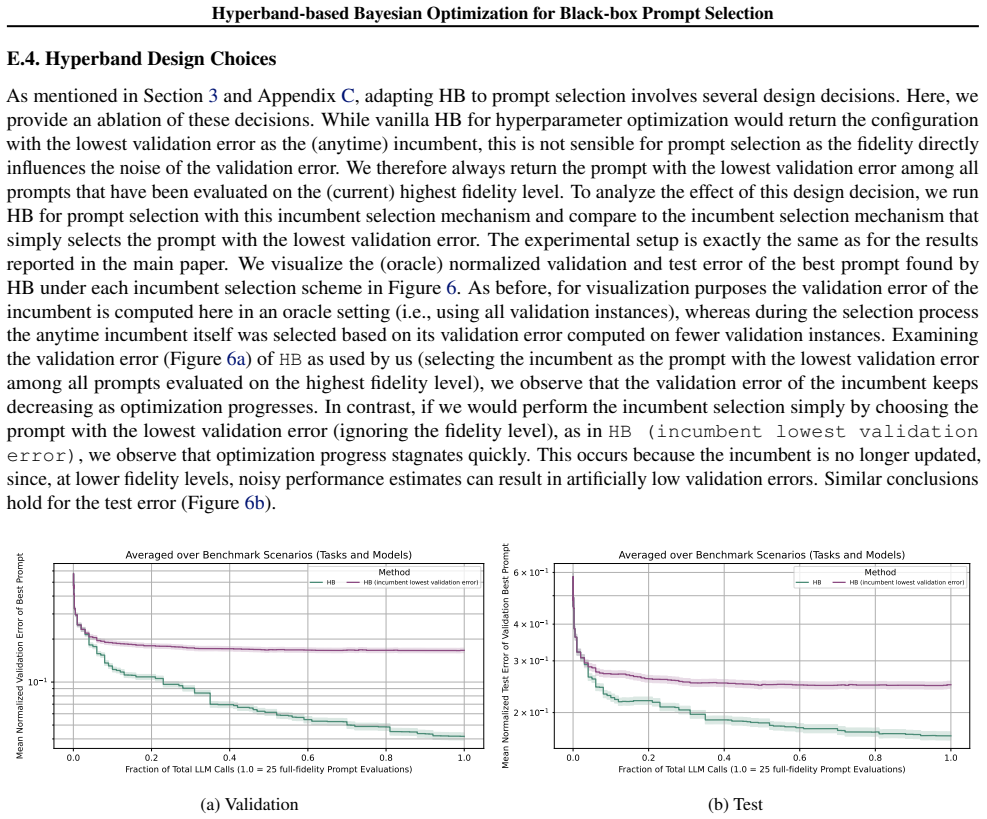
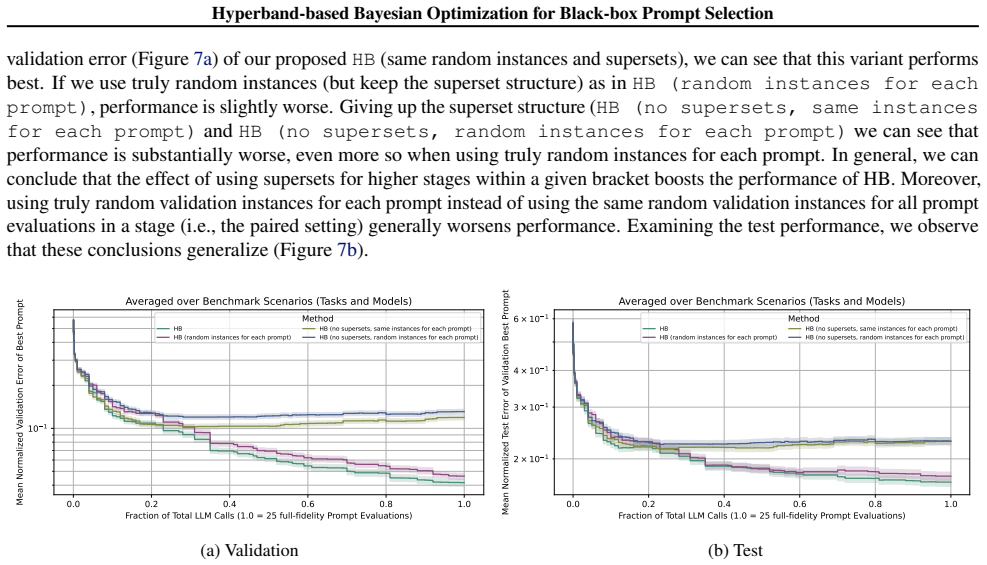
- The paper's design choices—caching lower-fidelity evaluations, using supersets for higher stages, and selecting the incumbent from full-fidelity evaluations—make Hyperband viable for prompt selection.
- The method can be extended to evolving candidate pools, enabling integration with mutation-based or iterative prompt optimizers.
Reading between the lines
- The efficiency gains reported are partially contingent on caching lower-fidelity LLM outputs and assuming near-deterministic outputs; with temperature=0.5, stochasticity could undermine this assumption, potentially inflating the reported query-efficiency advantage over methods that do not cache.
- The paper's focus on exact-match loss on ten benchmarks may not capture settings with more nuanced or open-ended outputs, where the surrogate's learned embeddings may transfer differently.
- A direct extension would be to test HbBoPs on larger candidate pools (e.g., hundreds or thousands of prompts) to see whether the deep kernel's capacity and Hyperband's bracket structure scale gracefully.
- The multi-objective extension mentioned in the paper (balancing prompt performance against inference latency) is a natural next step, but is not explored here.
Signed reviews
Editorial analysis
A structured set of objections, weighed in public.
Referee Report
Summary. The paper proposes HbBoPs, a black-box prompt selection method that combines a structural-aware deep kernel Gaussian Process (GP) with Hyperband multi-fidelity scheduling. Prompts are composed of an instruction and a few-shot exemplar; the GP is trained on separate BERT embeddings of the two components and proposes candidates via expected improvement, while Hyperband controls the number of validation instances per evaluation. The authors evaluate HbBoPs against random search, four full-fidelity baselines (vanilla BO, HDBO, BOPCA, EASE, MIPROv2) and two multi-fidelity state-of-the-art methods (TRIPLE-SH, TRIPLE-GSE) on ten tasks and three LLMs, with 30 repeats per scenario, reporting normalized validation/test errors versus total LLM-call budget. They report that HbBoPs achieves lower average errors than all competitors, especially in the anytime regime, and they support this with mixed-effects models, Tukey post-hoc tests, component ablations, and an encoder robustness study.
Significance. The contribution is potentially valuable: to my knowledge it is the first method in static black-box prompt selection to combine a surrogate model with a multi-fidelity scheduler, and the empirical design is unusually thorough (10 tasks x 3 LLMs x 30 runs, with linear mixed-effects models and corrected post-hoc tests, plus ablations of the deep kernel, structural-awareness, and Hyperband design choices). The statistical analysis is a strength: the authors report exact test statistics and p-values rather than only mean curves. However, the headline claim of 'outperforms state-of-the-art methods in both performance and efficiency' is only partially supported: at full budget, the advantage over TRIPLE-SH and TRIPLE-GSE is not statistically significant, and the efficiency claim relies on a caching assumption that is not validated under temperature=0.5. The anytime improvements and component ablations are credible and are the paper's main contribution.
major comments (3)
- [Section 5.1; Appendix E.1] The claim that HbBoPs outperforms all methods at full budget is not supported by the paper's own statistical tests. In Appendix E.1, the Tukey post-hoc tests at fraction 1.00 report non-significant differences versus TRIPLE-SH for validation (z=1.87, p=0.236) and test error (z=1.49, p=1.000), and versus TRIPLE-GSE for test error (z=1.34, p=1.000). Table 2 also shows median test improvements over TRIPLE-SH at full budget of -0.006 (Claude 3 Haiku), 0.000 (LLAMA3 8B), and -0.001 (Mistral 7B). The abstract and Section 5.1 should either restrict the 'outperforms' claim to the anytime regime or provide additional evidence (e.g., more repetitions, a different aggregation, or a focused analysis) that HbBoPs also improves final test performance.
- [Appendix C; Section 3.3; Section D.2] The query-efficiency advantage is partly built on caching lower-fidelity outputs and reusing them in higher stages. Appendix C justifies this by assuming 'reasonably deterministic outcomes,' but the experimental protocol sets temperature=0.5 for all three LLMs (Section D.2), and Section 2 states that the validation error is observed with noise. Under stochastic sampling, a cached output is one realization; reusing it at higher fidelity biases the paired halving comparisons and understates the number of LLM calls that would be needed to obtain an unbiased estimate at the higher fidelity. The paper should either validate the determinism assumption (e.g., with temperature=0 or fixed seeds) or quantify the sensitivity of the anytime performance curves and the claimed factor-of-eta call reduction to stochasticity, for example by comparing the cached implementation with an implementation that re-queries at each fidelity.
- [Section 5.2; Table 2] The text states that 'HbBoPs consistently outperforms TRIPLE-SH in terms of both anytime validation and test error,' but Table 2 shows the opposite at full budget for test error: the median relative improvements are negative or zero for all three LLMs. This overstatement should be corrected, e.g., by limiting the consistency claim to the anytime fractions (0.25 and 0.50) and noting that the full-budget test differences are within noise.
minor comments (6)
- [Figure 1 caption] The legend entry 'TRIPLE-SH (Shi et al. 2014)' should read '(Shi et al., 2024)' to match the reference list.
- [Appendix C] The passage 'roughly by a factor of eta), In HbBoPs we cache the output...' contains a stray closing parenthesis and a missing sentence break; please revise for clarity.
- [Section 4.2] The threshold 'at least four observations' used for training the deep-kernel GP is defined only in the experimental setup; it would be helpful to state it in the method description in Section 3.4 alongside the definition of 'enough' observations.
- [Algorithm 1] The expression for n in the for-loop header is typeset with an ambiguous 'l' and 'm'; please use explicit floor/ceiling notation so that the bracket schedule is unambiguous.
- [Section 5] The normalization of errors 'by the performance of the worst and best prompt' should specify whether the 'best prompt' is the global optimum over the candidate set P or the best prompt found by any method; otherwise the normalized errors are not uniquely defined.
- [Section 6 / Reproducibility] No link to the code is provided; given the complexity of the method and the many design choices, releasing the implementation would substantially aid reproducibility.
Circularity Check
No significant circularity; HbBoPs is a standard surrogate-based multi-fidelity selection method evaluated on held-out test sets.
full rationale
The paper's derivation chain is self-contained and non-circular. The surrogate is a structural-aware deep kernel GP trained on observed prompt validation errors (Eq. 6) and used to propose the next prompt via Expected Improvement (Eq. 7); this is standard BO, and the GP's predictions are not presented as first-principles results but as an acquisition mechanism. Reported test errors come from held-out test sets that are not used during prompt selection, so the headline empirical claim does not reduce to fitted inputs. Hyperband is adopted from Li et al. (2018) as an external, independently established algorithm, and the only self-citation is the BOHB-style combination of BO with Hyperband (Falkner et al., 2018), which is a published method with independent content and is not used to justify the paper's central claims. The stochastic-caching concern in Appendix C is a correctness or validity issue about cost accounting under temperature = 0.5, not a circularity: an optimistic query-efficiency estimate would weaken the efficiency claim but does not make any prediction equivalent to its inputs by construction. No self-definitional quantities, renamed known results, or imported uniqueness theorems were found.
Assumptions & free parameters
free parameters (5)
- bmin =
10
- eta =
2.0
- rho =
0.1
- feature_extractor_widths =
64-32-10
- min_observations_gp =
4
assumptions (6)
- domain assumption Validation error is a black-box function with homoscedastic Gaussian noise
- domain assumption Cached LLM outputs remain valid across fidelity levels
- domain assumption Exact match loss on validation set is a sufficient objective for prompt selection
- standard math Gaussian process posterior and Expected Improvement formulas
- standard math Hyperband and Successive Halving guarantees from bandit literature
- ad hoc to paper The structural split into instruction and exemplar embeddings with the chosen MLP helps learning
Cite this review
Pith. "Pith review of Hyperband-based Bayesian Optimization for Black-box Prompt Selection." pith.science (2026). https://pith.science/paper/TVU3IKBD
@misc{pith2026241207820,
  author       = {Pith},
  title        = {Pith review of: Hyperband-based Bayesian Optimization for Black-box Prompt Selection},
  year         = {2026},
  howpublished = {\url{https://pith.science/paper/TVU3IKBD}},
  note         = {Machine review of arXiv:2412.07820}
}
read the original abstract
Optimal prompt selection is crucial for maximizing large language model (LLM) performance on downstream tasks, especially in black-box settings where models are only accessible via APIs. Black-box prompt selection is challenging due to potentially large, combinatorial search spaces, absence of gradient information, and high evaluation cost of prompts on a validation set. We propose HbBoPs, a novel method that combines a structural-aware deep kernel Gaussian Process with Hyperband as a multi-fidelity scheduler to efficiently select prompts. HbBoPs uses embeddings of instructions and few-shot exemplars, treating them as modular components within prompts. This enhances the surrogate model's ability to predict which prompt to evaluate next in a sample-efficient manner. Hyperband improves query-efficiency by adaptively allocating resources across different fidelity levels, reducing the number of validation instances required for evaluating prompts. Extensive experiments across ten diverse benchmarks and three LLMs demonstrate that HbBoPs outperforms state-of-the-art methods in both performance and efficiency.
Figures


Figures from the paper (4 more)


Forward citations
Cited by 1 Pith paper
-
Meta-Prompt Optimization for LLM-Based Sequential Decision Making
EXPO uses adversarial bandit weighting over LLM-generated prompt variations to optimize the meta-prompt of LLM-based sequential decision-making agents, improving performance on optimization and bandit tasks.
Reference graph
Works this paper leans on
-
[3]
Left: Raw, unprocessed features
Visualization of the 768 dimensional BERT [CLS] token embeddings of prompts via a two component t-SNE. Left: Raw, unprocessed features. Middle: Features of a 10 component PCA solution. Right: Latent features ( 10 dimensional) from the feature extractor of our structural-aware DK-GP. Top row: Train split. Bottom row: Test split. Color indicates the perform...
work page 2024
-
[4]
Honovich, O., Shaham, U., Bowman, S. R., and Levy, O. Instruction induction: From few examples to natural lan- guage task descriptions. In61st Annual Meeting of the Association for Computational Linguistics, ACL 2023, pp. 1935–1952,
work page 2023
-
[5]
Box plots of the bootstrapped variance estimates of the mean validation error of 250 prompts evaluated with LLAMA3 8B Instruct onGSM8Kvarying the number of validation instances used to estimate the mean validation error. The empirical results we have presented here further provide justification for using a multi-fidelity scheduler over the validation inst...
work page 2024
-
[8]
Plum: Prompt learn- ing using metaheuristics
Pan, R., Xing, S., Diao, S., Sun, W., Liu, X., Shum, K., Zhang, J., Pi, R., and Zhang, T. Plum: Prompt learn- ing using metaheuristics. In Ku, L.-W.and Martins, A. and Srikumar, V . (eds.),Findings of the Association for Computational Linguistics: ACL 2024, pp. 2177–2197,
work page 2024
-
[9]
Pryzant, R., Iter, D., Li, J., Lee, Y ., Zhu, C., and Zeng, M. Automatic prompt optimization with “gradient de- scent” and beam search. In Bouamor, H., Pino, J., and Bali, K. (eds.),Proceedings of the 2023 Conference on Empirical Methods in Natural Language Processing, pp. 7957–7968,
work page 2023
-
[10]
Learning to retrieve prompts for in-context learning
Rubin, O., Herzig, J., and Berant, J. Learning to retrieve prompts for in-context learning. In Carpuat, M., de Marn- effe, M.-C., and Meza Ruiz, I. V . (eds.),Proceedings of the 2022 Conference of the North American Chapter of the Association for Computational Linguistics: Human Language Technologies (NAACL-HLT), pp. 2655–2671,
work page 2022
-
[12]
Reliable gradient-free and likelihood-free prompt tuning
Shen, M., Ghosh, S., Sattigeri, P., Das, S., Bu, Y ., and Wor- nell, G. Reliable gradient-free and likelihood-free prompt tuning. In Vlachos, A. and Augenstein, I. (eds.),Findings of the Association for Computational Linguistics: EACL 2023, pp. 2416–2429,
work page 2023
-
[13]
Shin, T., Razeghi, Y ., Logan IV , R. L., Wallace, E., and Singh, S. AutoPrompt: Eliciting knowledge from lan- guage models with automatically generated prompts. In Webber, B., Cohn, T., He, Y ., and Liu, Y . (eds.),Proceed- ings of the 2020 Conference on Empirical Methods in Natural Language Processing (EMNLP), pp. 4222–4235,
work page 2020
Show all 24 references
-
[14]
BBTv2: Towards a gradient-free future with large language models
Sun, T., He, Z., Qian, H., Zhou, Y ., Huang, X., and Qiu, X. BBTv2: Towards a gradient-free future with large language models. In Goldberg, Y ., Kozareva, Z., and Zhang, Y . (eds.),Proceedings of the 2022 Conference on Empirical Methods in Natural Language Processing, pp. 3916...
2022
-
[15]
GPS: Genetic prompt search for efficient few-shot learning
Xu, H., Chen, Y ., Du, Y ., Shao, N., Yanggang, W., Li, H., and Yang, Z. GPS: Genetic prompt search for efficient few-shot learning. In Goldberg, Y ., Kozareva, Z., and Zhang, Y . (eds.),Proceedings of the 2022 Conference on Empirical Methods in Natural Language Processing (EM...
2022
-
[16]
Zhang, T., Wang, X., Zhou, D., Schuurmans, D., and Gon- zalez, J
URLhttps://arxiv.org/abs/2404.08164. Zhang, T., Wang, X., Zhou, D., Schuurmans, D., and Gon- zalez, J. E. TEMPERA: Test-time prompt editing via reinforcement learning. InThe Eleventh International Conference on Learning Representations,
-
[20]
1”, “2”, “3
Exemplary HB schedule for black-box prompt selection assuming a minimum budget of bmin = 10 validation instances, a maximum number ofn valid = 80validation instances being available in total, and a halving parameter ofη= 2.0. Bracket(s)Stage(i)#Instances(b)#Prompts(n) 3 0 10 8...
2024
-
[21]
forward mode and to select instances for few-shot exemplars. Instructions are generated using APE’s forward mode, where Claude 3 Sonnet (Anthropic, 2024), configured with a temperature of 1.0 and default settings otherwise (as in the main paper for Claude 3 Haiku), produces 10...
2024
-
[22]
We include HDBO (Hvarfner et al.,
All full-fidelity BO methods are implemented within BoTorch (Balandat et al., 2020). We include HDBO (Hvarfner et al.,
2020
-
[23]
high-dimensional
to have a simple yet well-performing “high-dimensional” BO baseline. Hvarfner et al. (2024) recently challenged the general belief that vanilla BO does not perform well for high-dimensional functions by training a GP via MAP with priors over kernel and likelihood parameters ad...
2024
-
[24]
(2018) for each proposal with a probability of ρ= 0.1
Moreover, to hedge against poor model-based proposals, we perform random interleaving as described in Falkner et al. (2018) for each proposal with a probability of ρ= 0.1 . Since a single SH or HB schedule may require less budget than the total pre-defined LLM call budget per ...
2018
-
[1978]
J., Purtell, J., Broman, D., Potts, C., Zaharia, M., and Khattab, O
11 Hyperband-based Bayesian Optimization for Black-box Prompt Selection Opsahl-Ong, K., Ryan, M. J., Purtell, J., Broman, D., Potts, C., Zaharia, M., and Khattab, O. Optimizing instruc- tions and demonstrations for multi-stage language model programs. In Al-Onaizan, Y ., Bansa...
2024
-
[2011]
Brown, T., Mann, B., Ryder, N., Subbiah, M., Kaplan, J. D., Dhariwal, P., Neelakantan, A., Shyam, P., Sastry, G., Askell, A., Agarwal, S., Herbert-V oss, A., Krueger, G., Henighan, T., Child, R., Ramesh, A., Ziegler, D., Wu, J., Winter, C., Hesse, C., Chen, M., Sigler, E., Lit...
1901
-
[2013]
samples from a probability distribution
is formally characterized by the following: (1) Losses are i.i.d. samples from a probability distribution. (2) Each arm has a fixed expected lossµ p. (3) The goal is to identify the arm with the lowest expected loss. 17 Hyperband-based Bayesian Optimization for Black-box Promp...
2016
-
[2018]
org/abs/1810.09305
URL https://arxiv. org/abs/1810.09305. Kushner, H. J. A new method of locating the maximum point of an arbitrary multipeak curve in the presence of noise.Journal of Basic Engineering, 86(1):97–106,
-
[2021]
org/abs/2110.14168
URL https://arxiv. org/abs/2110.14168. Devlin, J., Chang, M.-W., Lee, K., and Toutanova, K. BERT: Pre-training of deep bidirectional transformers for lan- guage understanding. In Burstein, J., Doran, C., and Solorio, T. (eds.),Proceedings of the 2019 Conference of the North Am...
-
[2022]
and Neville, J
Schnabel, T. and Neville, J. Symbolic prompt program search: A structure-aware approach to efficient compile- time prompt optimization. In Al-Onaizan, Y ., Bansal, M., and Chen, Y .-N. (eds.),Findings of the Association for Computational Linguistics: EMNLP 2024, pp. 670–686,
2024
-
[2023]
Jones, D
URL https: //arxiv.org/abs/2310.06825. Jones, D. R., Schonlau, M., and Welch, W. J. Efficient global optimization of expensive black-box functions.Journal of Global Optimization, 13:455–492,
-
[2024]
Eriksson, D
URL https://arxiv.org/abs/2404.02717. Eriksson, D. and Jankowiak, M. High-dimensional Bayesian optimization with sparse axis-aligned subspaces. In de Campos, C. and Maathuis, M. H. (eds.),Proceed- ings of the Thirty-Seventh Conference on Uncertainty in Artificial Intelligence,...
Reviewed August 11, 2026 · model on record in the stance chip above.
Discussion (0). Continue with ORCID to comment.