REVIEW 3 major objections 4 minor 88 references
The SARAO MeerKAT Galactic Plane Survey filamentary source catalogue
T0 review · 3 major / 4 minor · reviewed 2026-08-11 · deepseek-v4-flash
Pith's one-line read The paper claims that 77 of 130 isolated radio filaments in the MeerKAT Galactic Plane Survey are likely non-thermal, making them the first such filaments found outside the Galactic Centre.
desk verdict Useful catalogue, but the 'first NRFs outside the GC' claim rests on an uncalibrated by-eye MIR proxy and needs spectral-index confirmation. read the letter →
The pith
A machine-rendered reading of the paper's core claim, the machinery that carries it, and where it could break.
The reading
What carries the argument
The central mechanism is a semi-automated filament extraction pipeline applied to the SMGPS moment-zero tiles: a median-filter high-pass step removes emission on scales larger than 2 arcminutes, then 3-sigma thresholding creates source masks, which are filtered by the J2 < 0 elongation-moment criterion and a mask aspect ratio of at least 4, with final manual artefact removal. The surviving masks are skeletonised into one-pixel spines, from which length, width, position angle and flux are measured. Non-thermal classification then uses the proxy that absence of spatially coincident 8.3-micron mid-infrared emission indicates synchrotron emission, while thermal radio filaments are bright in the mid-infrared. The same pipeline is applied to the Galactic Centre mosaic to obtain a consistent comparison sample.
What would settle it
A multi-frequency radio observation of a sample of the 77 candidate non-thermal filaments that measures flat or positive spectral indices (indicating thermal free-free emission), or the detection of bright, spatially coincident mid-infrared emission at higher resolution than 20 arcseconds, would falsify the non-thermal classification for those filaments.
Extended reading notes
Core claim
The paper's central claim is that 77 of the 130 isolated filaments are excellent candidates for non-thermal radio filaments, the first such population identified outside the Galactic Centre. The claim rests on a by-eye classification using 8.3-micron mid-infrared images: filaments with no bright coincident infrared emission are judged likely non-thermal, while those with such emission are likely thermal. Since spectral indices could not be measured from the survey data, the classification is explicitly provisional. The paper further shows that the candidate plane filaments are angularly longer and wider than the Galactic Centre filaments, but have comparable flux densities, and that their position angles on the sky are consistent with a uniform distribution, unlike the perpendicular-to-plane alignment of the longest Galactic Centre filaments. These morphological differences are interpreted as possibly due to distance, or to the more extreme environment of the Galactic Centre.
Load-bearing premise
The load-bearing premise is that the absence of spatially coincident 8.3-micron mid-infrared emission reliably identifies non-thermal radio emission, even though the paper cannot measure spectral indices and line-of-sight infrared contamination could misclassify filaments.
Editorial extensions
If this is right
- If the 77 candidate non-thermal filaments are confirmed by spectral-index measurements, they would constitute the first population of non-thermal radio filaments in the Galactic Plane, showing that filament formation does not require the Galactic Centre's unique environment.
- The uniformly distributed position angles of the plane filaments imply that the local magnetic field orientation they trace does not follow the large-scale spiral Galactic field, adding a new constraint on disc magnetic-field structure.
- If the plane filaments are closer than the Galactic Centre population, the similar flux densities imply the Galactic Centre filaments are intrinsically more luminous and host a more energetic cosmic-ray electron population.
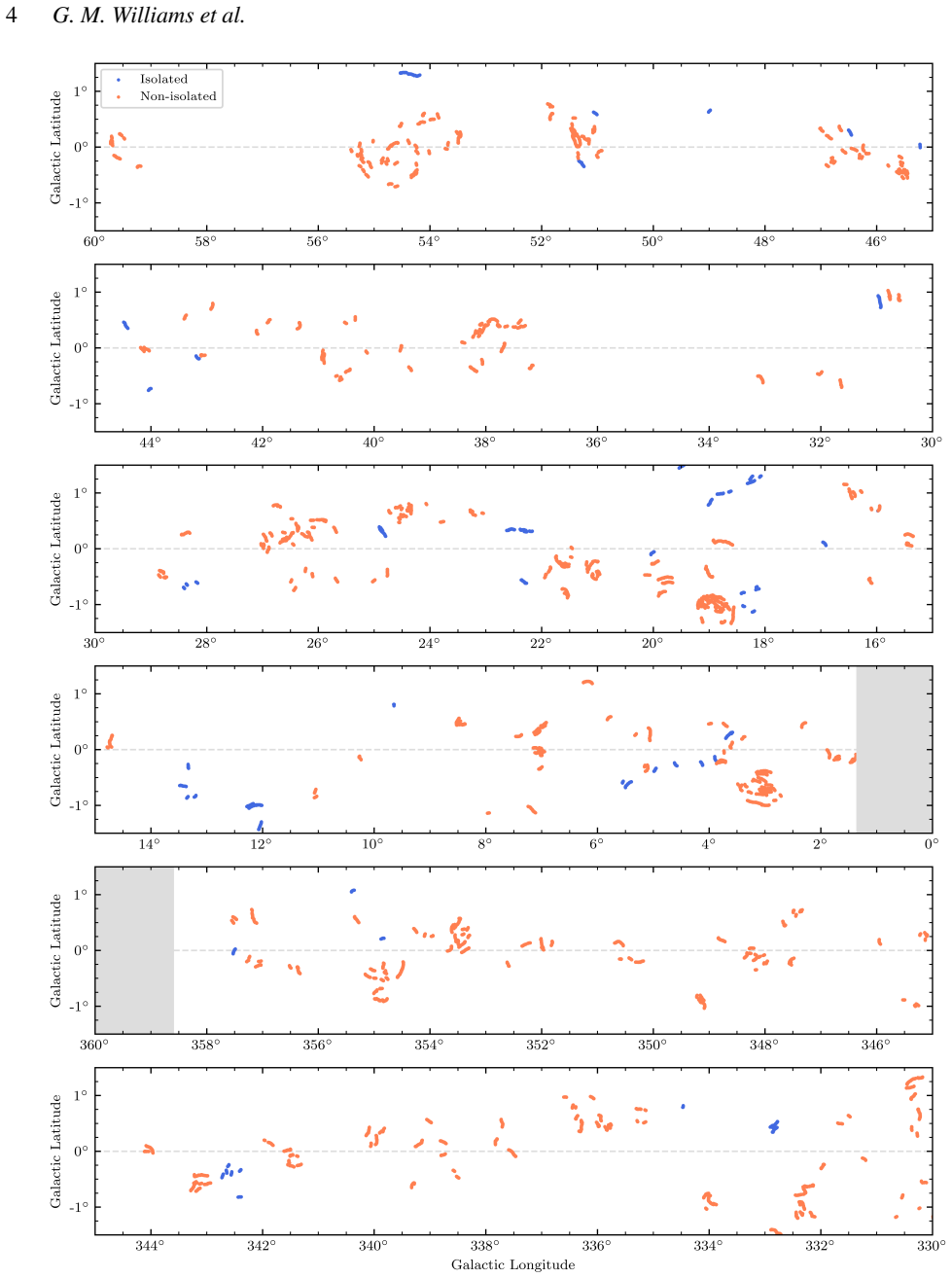
- The catalogue of 933 filaments, split into 803 non-isolated and 130 isolated sources with measured positions, lengths, widths and fluxes, provides a homogeneous sample for targeted follow-up of individual filaments and their possible cosmic-ray sources.
Reading between the lines
- A direct test of the classification would be to measure radio spectral indices by combining the SMGPS 1.3 GHz data with higher-frequency images (e.g., 3 or 5 GHz); synchrotron emission typically shows a negative spectral index, whereas the tentative thermal sources would show flat or positive indices.
- If higher-resolution 8-micron imaging reveals faint mid-infrared counterparts along the lines of sight of the 77 candidates, the true non-thermal fraction among the isolated filaments could be lower than the paper's 59 percent, since line-of-sight confusion would have hidden some thermal sources.
- The uniform position-angle distribution, if it persists in a larger sample, suggests that synchrotron filaments in the disc may be shaped by local turbulence or shock compression rather than by the global spiral magnetic field; polarimetric observations could test whether the field is disordered at filament scales.
- Without distance measurements, the morphological comparison between plane and Galactic Centre filaments remains ambiguous; future parallax or association studies that place the plane filaments at known distances would determine whether the differences are intrinsic or purely geometric.
Signed reviews
Editorial analysis
A structured set of objections, weighed in public.
Referee Report
Summary. This paper presents a catalogue of 933 filamentary structures extracted from the SARAO MeerKAT 1.3 GHz Galactic Plane Survey (SMGPS), of which 130 are classified as isolated from extended radio structures. Using by-eye coincidence with MSX 8.3 μm mid-infrared emission, the authors classify 77 of the 130 isolated filaments as candidate non-thermal radio filaments (NRFs) and claim these are the first such objects found outside the Galactic Centre. The paper also applies the same extraction pipeline to the MeerKAT Galactic Centre mosaic and compares the two populations, finding that GC filaments are shorter and narrower, have a brighter tail in mean spine brightness, and show a more anisotropic position-angle distribution. The catalogue itself, including spine masks, is made publicly available.
Significance. If the classification is reliable, the catalogue would provide the first evidence for an isolated NRF population outside the Galactic Centre, directly challenging models that require the unique GC environment for NRF formation. The catalogue and the morphological comparison are valuable resources for follow-up spectral-index and polarisation studies, and the paper is transparent about its main limitations, including a robustness check in Section 5.2.5 that repeats the GC comparison without relying on the MIR classification. The data availability statement provides public access to the catalogues and spine masks, which supports reproducibility. However, the headline claim depends on a proxy that is not quantitatively calibrated, and the GC comparison is affected by several methodological asymmetries.
major comments (3)
- [§5.1] The classification of 77/130 isolated filaments as 'likely to be non-thermal' rests entirely on the by-eye absence of spatially coincident MSX 8.3 μm emission, with no quantitative threshold for 'bright' MIR emission, no repeatability test, and no validation against objects with known spectral indices. The manuscript itself states in §5.1 that 'without distance information in the MIR nor the radio we can only speculate on the coincidence of the MIR emission', and in §5.2.5 that 'widespread MIR emission ... may result in a large number of filaments being misidentified as candidate thermal filaments due to line-of-sight confusion'. Because the headline claim that these are the first NRFs outside the GC depends on this proxy, the abstract's 'likely to be non-thermal' overstates the evidence. I request either a quantitative MIR analysis (e.g., measured 8.3 μm brightness at the spines compared with a control sample, or cross-validation with known HII regions and SNRs) or a softening of the language to 'IR-dark candidates', plus a discussion of why the MSX 20″ resolution, comparable to the median filament FWHM, does not compromise the classification.
- [§5.2, Fig. 11] The GC comparison is made with a different synthesised beam (4″ versus 8″), a different physical area cutoff (20 beams corresponds to a factor-four smaller physical area for the GC), a different median-filter scale in units of beam (30 versus 15 beams), and a different detection threshold (3σ of a 40 μJy/beam rms, i.e., ~120 μJy/beam, versus the fixed 20 μJy/beam used for SMGPS). These asymmetries are not quantified, so the conclusions that GC filaments are shorter and narrower, and that the GC flux distribution has a brighter tail, may be biased by resolution and selection effects. The authors mention the beam difference but do not test its impact. I recommend convolving the GC mosaic to the SMGPS 8″ beam and re-running the extraction, and/or applying a matching physical size threshold, to demonstrate the robustness of the morphological comparison.
- [Abstract; §5.2.2] The statement 'The SMGPS filaments have flux densities similar to those of the GC' is not supported by the analysis, which compares the mean flux along the spine in units of mJy/beam (a surface-brightness measure), not integrated flux densities. The catalogue does not include integrated flux densities, and the conclusion about a more energetic cosmic-ray population in the GC (Section 5.2.2) depends on the luminosity interpretation. Please either compute integrated flux densities for the filaments (e.g., by summing over the source masks or the spine neighbourhood) or revise the abstract and interpretation to refer to mean spine brightness, not flux density.
minor comments (4)
- [§3.1] The description of the intensity threshold is internally inconsistent: the text first states that a mask is created 'above 3× the rms background brightness', then reports an rms of 10–15 μJy/beam, but the adopted threshold is given as σ = 20 μJy/beam, which is not 3σ for the stated rms range. Please clarify the actual threshold used for the SMGPS extraction.
- [Abstract; §4.2.2] The abstract states that the filament position angles are 'uniformly distributed', but the K-S analysis in Section 4.2.2 only shows that the isolated-filament PA distribution is consistent with uniform (the p-value distribution peaks near 0.22 and extends below 0.05), while the non-isolated sample is inconclusive. Please phrase the claim as 'consistent with a uniform distribution' rather than asserting uniformity.
- [Throughout] There are numerous typographical and formatting issues, including the character '□' appearing in place of expected symbols (e.g., in Figure 1 axis labels and elsewhere), the axis label 'pos.galactic.lon' in Figure 1, the header 'MNRAS000, 1–17 (2023)' not updated to the current year, and inconsistent citation formatting for companion papers (e.g., 'Mutale et al., in preparation' versus 'to be submitted'). A careful proofreading pass is needed.
- [§5.2.3] The interpretation that the uniform PA distribution implies the local magnetic field traced by SMGPS filaments does not follow the large-scale Galactic field assumes that radio filaments are aligned with the magnetic field. This assumption is not established for the SMGPS sample and should be stated explicitly as a working hypothesis rather than an inference.
Circularity Check
No significant circularity: the catalogue construction and thermal/non-thermal classification rest on external data and an explicitly stated proxy, not on fitting or predicting the paper's own inputs.
full rationale
The central derivation chain is: extract filaments from SMGPS moment-zero tiles via high-pass filtering, thresholding, and morphological cuts; separate isolated vs. non-isolated filaments by cross-matching to the SMGPS extended source catalogue; classify isolated filaments as candidate thermal or non-thermal by by-eye coincidence with MSX 8.3 micron emission; and compare the candidate NRFs to Galactic Centre filaments extracted with the same pipeline. None of these steps fits a parameter to a subset and then predicts a closely related quantity. The 77/130 split is an observational classification, not a fitted prediction. The MIR proxy is an external assumption whose limitations are explicitly acknowledged in Sections 5.1 and 5.2.5, e.g. 'without distance information in the MIR nor the radio we can only speculate on the coincidence of the MIR emission to the filaments' and 'the classification of these filaments as thermal or non-thermal may be affected by line-of-sight confusion'. Acknowledging that the proxy can misclassify objects is a correctness risk, not circularity. The GC comparison sample is extracted from an independent published mosaic (Heywood et al. 2022) using the same code, so the reported morphological differences are not imposed by construction. The only same-team dependencies (Bordiu et al., under review; Mutale et al., in prep) are companion data products used as inputs, not as validations of this paper's claims; they are independently falsifiable and are not derived from the filament catalogue itself. No circular step is exhibited, so the score is 0.
Assumptions & free parameters
free parameters (6)
- Median filter window size =
15 beam widths (2 arcmin)
- Intensity threshold (SMGPS) =
3 sigma = 20 uJy/beam
- Minimum mask area =
20 synthesised beam areas
- Mask aspect ratio cut =
>= 4
- Straightening polynomial order =
n = 10
- Intensity threshold (GC mosaic) =
3 sigma = 40 uJy/beam
assumptions (4)
- domain assumption Absence of bright 8.3 micron MSX emission is a reliable signpost of non-thermal radio emission.
- domain assumption Hand-chosen extraction thresholds and manual refinement do not bias the comparison between SMGPS and GC filament populations.
- domain assumption Filament position angles trace the local magnetic field direction.
- domain assumption Mean spine flux densities are not systematically biased by the negative bowl artifacts from high-pass filtering.
Cite this review
Pith. "Pith review of The SARAO MeerKAT Galactic Plane Survey filamentary source catalogue." pith.science (2026). https://pith.science/paper/LCJEBXAK
@misc{pith2026241207852,
  author       = {Pith},
  title        = {Pith review of: The SARAO MeerKAT Galactic Plane Survey filamentary source catalogue},
  year         = {2026},
  howpublished = {\url{https://pith.science/paper/LCJEBXAK}},
  note         = {Machine review of arXiv:2412.07852}
}
read the original abstract
We present a catalogue of filamentary structures identified in the SARAO (South African Radio Astronomy Observatory) MeerKAT 1.3 GHz Galactic Plane Survey (SMGPS). We extract 933 filaments across the survey area, 803 of which (~86%) are associated with extended radio structures (e.g. supernova remnants and HII regions), whilst 130 (~14%) are largely isolated. We classify filaments as thermal or non-thermal via their associated mid-infrared emission and find 77/130 (~59%) of the isolated sources are likely to be non-thermal, and are therefore excellent candidates for the first isolated, non-thermal radio filaments observed outside of the Galactic Centre (GC). Comparing the morphological properties of these non-thermal candidates to the non-thermal filaments observed towards the GC we find the GC filaments are on the whole angularly narrower and shorter than those across the SMGPS, potentially an effect of distance. The SMGPS filaments have flux densities similar to those of the GC, however the distribution of the latter extends to higher flux densities. If the SMGPS filaments were closer than the GC population, it would imply a more energetic population of cosmic ray electrons in the GC. We find the filament position angles in the SMGPS are uniformly distributed, implying that the local magnetic field traced by the filaments does not follow the large-scale Galactic field. Finally, although we have clearly shown that filaments are not unique to the GC, the GC nevertheless has the highest density of filaments in the Milky Way.
Figures


Figures from the paper (13 more)


Reference graph
Works this paper leans on
-
[1]
write newline
" write newline "" before.all 'output.state := FUNCTION fin.entry write newline FUNCTION new.block output.state before.all = 'skip after.block 'output.state := if FUNCTION new.sentence output.state after.block = 'skip output.state before.all = 'skip after.sentence 'output.state := if if FUNCTION not #0 #1 if FUNCTION and 'skip pop #0 if FUNCTION or pop #1...
-
[2]
Anderson L. D., et al., 2017, @doi [ ] 10.1051/0004-6361/201731019 , https://ui.adsabs.harvard.edu/abs/2017A&A...605A..58A 605, A58
-
[3]
Anderson L. D., et al., 2024, @doi [arXiv e-prints] 10.48550/arXiv.2409.16607 , https://ui.adsabs.harvard.edu/abs/2024arXiv240916607A p. arXiv:2409.16607
-
[4]
Andr \'e P., Di Francesco J., Ward-Thompson D., Inutsuka S. I., Pudritz R. E., Pineda J. E., 2014, in Beuther H., Klessen R. S., Dullemond C. P., Henning T., eds, Protostars and Planets VI. p. 27 ( @eprint arXiv 1312.6232 ), @doi 10.2458/azu\_uapress\_9780816531240-ch002
arXiv 2014
-
[5]
Arzoumanian D., et al., 2019, @doi [ ] 10.1051/0004-6361/201832725 , https://ui.adsabs.harvard.edu/abs/2019A&A...621A..42A 621, A42
-
[6]
Astropy Collaboration et al., 2013, @doi [ ] 10.1051/0004-6361/201322068 , https://ui.adsabs.harvard.edu/abs/2013A&A...558A..33A 558, A33
-
[7]
Barkov M. V., Lyutikov M., 2019, @doi [ ] 10.1093/mnrasl/slz124 , https://ui.adsabs.harvard.edu/abs/2019MNRAS.489L..28B 489, L28
-
[8]
Bianchi S., et al., 2017, @doi [ ] 10.1051/0004-6361/201629013 , https://ui.adsabs.harvard.edu/abs/2017A&A...597A.130B 597, A130
Show all 88 references
-
[9]
O., et al., 2024, @doi [ ] 10.3847/1538-4357/ad12b9 , https://ui.adsabs.harvard.edu/abs/2024ApJ...963..130B 963, 130
Butterfield N. O., et al., 2024, @doi [ ] 10.3847/1538-4357/ad12b9 , https://ui.adsabs.harvard.edu/abs/2024ApJ...963..130B 963, 130
2024 doi
-
[10]
M., Amato E., Petrov A
Bykov A. M., Amato E., Petrov A. E., Krassilchtchikov A. M., Levenfish K. P., 2017, @doi [ ] 10.1007/s11214-017-0371-7 , https://ui.adsabs.harvard.edu/abs/2017SSRv..207..235B 207, 235
2017 doi
-
[11]
T., Davidson J
Chuss D. T., Davidson J. A., Dotson J. L., Dowell C. D., Hildebrand R. H., Novak G., Vaillancourt J. E., 2003, @doi [ ] 10.1086/379538 , https://ui.adsabs.harvard.edu/abs/2003ApJ...599.1116C 599, 1116
2003 doi
-
[12]
E., Hensley B
Clark S. E., Hensley B. S., 2019, @doi [ ] 10.3847/1538-4357/ab5803 , https://ui.adsabs.harvard.edu/abs/2019ApJ...887..136C 887, 136
2019 doi
-
[13]
D., Williams G
Clarke S. D., Williams G. M., Ib \'a \ n ez-Mej \' a J. C., Walch S., 2019, @doi [ ] 10.1093/mnras/stz248 , https://ui.adsabs.harvard.edu/abs/2019MNRAS.484.4024C 484, 4024
2019 doi
-
[14]
D., Williams G
Clarke S. D., Williams G. M., Walch S., 2020, @doi [ ] 10.1093/mnras/staa2298 , https://ui.adsabs.harvard.edu/abs/2020MNRAS.497.4390C 497, 4390
2020 doi
-
[15]
J., 2001, @doi [ ] 10.1046/j.1365-8711.2001.04421.x , https://ui.adsabs.harvard.edu/abs/2001MNRAS.325..531C 325, 531
Cohen M., Green A. J., 2001, @doi [ ] 10.1046/j.1365-8711.2001.04421.x , https://ui.adsabs.harvard.edu/abs/2001MNRAS.325..531C 325, 531
2001
-
[16]
R., Nixon C
Coughlin E. R., Nixon C. J., Ginsburg A., 2021, @doi [ ] 10.1093/mnras/staa3771 , https://ui.adsabs.harvard.edu/abs/2021MNRAS.501.1868C 501, 1868
2021 doi
-
[17]
M., Jones D
Crocker R. M., Jones D. I., Melia F., Ott J., Protheroe R. J., 2010, @doi [ ] 10.1038/nature08635 , https://ui.adsabs.harvard.edu/abs/2010Natur.463...65C 463, 65
2010 doi
-
[18]
M., Hartmann D., Thaddeus P., 2001, @doi [ ] 10.1086/318388 , https://ui.adsabs.harvard.edu/abs/2001ApJ...547..792D 547, 792
Dame T. M., Hartmann D., Thaddeus P., 2001, @doi [ ] 10.1086/318388 , https://ui.adsabs.harvard.edu/abs/2001ApJ...547..792D 547, 792
2001 doi
-
[19]
Ferri \`e re K., 2009, @doi [ ] 10.1051/0004-6361/200912617 , https://ui.adsabs.harvard.edu/abs/2009A&A...505.1183F 505, 1183
2009 doi
-
[20]
Goedhart S., et al., 2024, @doi [ ] 10.1093/mnras/stae1166 , https://ui.adsabs.harvard.edu/abs/2024MNRAS.531..649G 531, 649
2024 doi
-
[21]
Gravity Collaboration et al., 2019, @doi [ ] 10.1051/0004-6361/201935656 , https://ui.adsabs.harvard.edu/abs/2019A&A...625L..10G 625, L10
2019 doi
-
[22]
D., Cram L
Gray A. D., Cram L. E., Ekers R. D., Goss W. M., 1991, @doi [ ] 10.1038/353237a0 , https://ui.adsabs.harvard.edu/abs/1991Natur.353..237G 353, 237
1991 doi
-
[23]
A., 2014, @doi [Bulletin of the Astronomical Society of India] 10.48550/arXiv.1409.0637 , https://ui.adsabs.harvard.edu/abs/2014BASI...42...47G 42, 47
Green D. A., 2014, @doi [Bulletin of the Astronomical Society of India] 10.48550/arXiv.1409.0637 , https://ui.adsabs.harvard.edu/abs/2014BASI...42...47G 42, 47
-
[24]
Guan Y., et al., 2021, @doi [ ] 10.3847/1538-4357/ac133f , https://ui.adsabs.harvard.edu/abs/2021ApJ...920....6G 920, 6
2021 doi
-
[25]
Han J.-L., Wielebinski R., 2002, @doi [ ] 10.1088/1009-9271/2/4/293 , https://ui.adsabs.harvard.edu/abs/2002ChJAA...2..293H 2, 293
2002 doi
-
[26]
R., et al., 2020, @doi [ ] 10.1038/s41586-020-2649-2 , https://ui.adsabs.harvard.edu/abs/2020Natur.585..357H 585, 357
Harris C. R., et al., 2020, @doi [ ] 10.1038/s41586-020-2649-2 , https://ui.adsabs.harvard.edu/abs/2020Natur.585..357H 585, 357
2020 doi
-
[27]
Heywood I., et al., 2019, @doi [ ] 10.1038/s41586-019-1532-5 , https://ui.adsabs.harvard.edu/abs/2019Natur.573..235H 573, 235
2019 doi
-
[28]
Heywood I., et al., 2022, @doi [ ] 10.3847/1538-4357/ac449a , https://ui.adsabs.harvard.edu/abs/2022ApJ...925..165H 925, 165
2022 doi
-
[29]
G., Han J
Hou L. G., Han J. L., 2014, @doi [ ] 10.1051/0004-6361/201424039 , https://ui.adsabs.harvard.edu/abs/2014A&A...569A.125H 569, A125
2014 doi
-
[30]
D., 2007, @doi [Computing in Science and Engineering] 10.1109/MCSE.2007.55 , https://ui.adsabs.harvard.edu/abs/2007CSE.....9...90H 9, 90
Hunter J. D., 2007, @doi [Computing in Science and Engineering] 10.1109/MCSE.2007.55 , https://ui.adsabs.harvard.edu/abs/2007CSE.....9...90H 9, 90
2007 doi
-
[31]
Hurley-Walker N., et al., 2019, @doi [ ] 10.1017/pasa.2019.33 , https://ui.adsabs.harvard.edu/abs/2019PASA...36...48H 36, e048
2019 doi
-
[32]
Indriolo N., et al., 2015, @doi [ ] 10.1088/0004-637X/800/1/40 , https://ui.adsabs.harvard.edu/abs/2015ApJ...800...40I 800, 40
2015 doi
-
[33]
Jackson T., Werner M., Gautier T. N. I., 2003, @doi [ ] 10.1086/378671 , https://ui.adsabs.harvard.edu/abs/2003ApJS..149..365J 149, 365
2003 doi
-
[34]
E., Whitworth A
Jaffa S. E., Whitworth A. P., Clarke S. D., Howard A. D. P., 2018, @doi [ ] 10.1093/mnras/sty696 , https://ui.adsabs.harvard.edu/abs/2018MNRAS.477.1940J 477, 1940
2018 doi
-
[35]
Kalberla P. M. W., Kerp J., Haud U., Winkel B., Ben Bekhti N., Fl \"o er L., Lenz D., 2016, @doi [ ] 10.3847/0004-637X/821/2/117 , https://ui.adsabs.harvard.edu/abs/2016ApJ...821..117K 821, 117
2016 doi
-
[36]
Kalberla P. M. W., Kerp J., Haud U., 2020, @doi [ ] 10.1051/0004-6361/202037602 , https://ui.adsabs.harvard.edu/abs/2020A&A...639A..26K 639, A26
2020 doi
-
[37]
Kansabanik D., et al., 2024, @doi [ ] 10.3847/1538-4357/ad0b7f , https://ui.adsabs.harvard.edu/abs/2024ApJ...961...96K 961, 96
2024 doi
-
[38]
Knowles K., et al., 2022, @doi [ ] 10.1051/0004-6361/202141488 , https://ui.adsabs.harvard.edu/abs/2022A&A...657A..56K 657, A56
2022 doi
-
[39]
W., Rosolowsky E
Koch E. W., Rosolowsky E. W., 2015, @doi [ ] 10.1093/mnras/stv1521 , http://adsabs.harvard.edu/abs/2015MNRAS.452.3435K 452, 3435
2015 doi
-
[40]
C., Anantharamaiah K
Lang C. C., Anantharamaiah K. R., Kassim N. E., Lazio T. J. W., 1999a, @doi [ ] 10.1086/312180 , https://ui.adsabs.harvard.edu/abs/1999ApJ...521L..41L 521, L41
-
[41]
C., Morris M., Echevarria L., 1999b, @doi [ ] 10.1086/308012 , https://ui.adsabs.harvard.edu/abs/1999ApJ...526..727L 526, 727
Lang C. C., Morris M., Echevarria L., 1999b, @doi [ ] 10.1086/308012 , https://ui.adsabs.harvard.edu/abs/1999ApJ...526..727L 526, 727
-
[42]
J., Yusef-Zadeh F., Cotton W
Law C. J., Yusef-Zadeh F., Cotton W. D., 2008, @doi [ ] 10.1086/588218 , https://ui.adsabs.harvard.edu/abs/2008ApJS..177..515L 177, 515
2008 doi
-
[43]
Lee T., Kashyap R., Chu C., 1994, @doi [CVGIP: Graphical Models and Image Processing] https://doi.org/10.1006/cgip.1994.1042 , 56, 462
1994
-
[44]
S., Leurini S., Csengeri T., Wyrowski F., Menten K
Li G.-X., Urquhart J. S., Leurini S., Csengeri T., Wyrowski F., Menten K. M., Schuller F., 2016, @doi [ ] 10.1051/0004-6361/201527468 , https://ui.adsabs.harvard.edu/abs/2016A&A...591A...5L 591, A5
2016 doi
-
[45]
J., et al., 1984, @doi [ ] 10.1086/184213 , https://ui.adsabs.harvard.edu/abs/1984ApJ...278L..19L 278, L19
Low F. J., et al., 1984, @doi [ ] 10.1086/184213 , https://ui.adsabs.harvard.edu/abs/1984ApJ...278L..19L 278, L19
1984 doi
-
[46]
Mangilli A., et al., 2019, @doi [ ] 10.1051/0004-6361/201935072 , https://ui.adsabs.harvard.edu/abs/2019A&A...630A..74M 630, A74
2019 doi
-
[47]
Mattern M., et al., 2018, @doi [ ] 10.1051/0004-6361/201833406 , https://ui.adsabs.harvard.edu/abs/2018A&A...619A.166M 619, A166
2018 doi
-
[48]
pp 56 -- 61, @doi 10.25080/Majora-92bf1922-00a
McKinney W., 2010, in S t\'efan van der W alt & J arrod M illman ed., P roceedings of the 9th P ython in S cience C onference. pp 56 -- 61, @doi 10.25080/Majora-92bf1922-00a
2010 doi
-
[49]
MeerKAT Collaboration 2018, Monthly Notes of the Astronomical Society of South Africa, https://ui.adsabs.harvard.edu/abs/2018MNSSA..77..102. 77, 102
2018
-
[50]
A., et al., 2010, @doi [ ] 10.1051/0004-6361/201014678 , https://ui.adsabs.harvard.edu/abs/2010A&A...518L.104M 518, L104
Miville-Desch \^e nes M. A., et al., 2010, @doi [ ] 10.1051/0004-6361/201014678 , https://ui.adsabs.harvard.edu/abs/2010A&A...518L.104M 518, L104
2010 doi
-
[51]
Molinari S., et al., 2016, @doi [ ] 10.1051/0004-6361/201526380 , https://ui.adsabs.harvard.edu/abs/2016A&A...591A.149M 591, A149
2016 doi
-
[52]
C., Muno M
Morris M., 2006, in Sch \"o del R., Bower G. C., Muno M. P., Nayakshin S., Ott T., eds, Journal of Physics Conference Series Vol. 54, Journal of Physics Conference Series. IOP, pp 1--9, @doi 10.1088/1742-6596/54/1/001
2006 doi
-
[53]
Morris M., Serabyn E., 1996, @doi [ ] 10.1146/annurev.astro.34.1.645 , https://ui.adsabs.harvard.edu/abs/1996ARA&A..34..645M 34, 645
1996 doi
-
[54]
R., Zhao J.-H., Goss W
Morris M. R., Zhao J.-H., Goss W. M., 2017, @doi [ ] 10.3847/2041-8213/aa9985 , https://ui.adsabs.harvard.edu/abs/2017ApJ...850L..23M 850, L23
2017 doi
-
[55]
Nishiyama S., et al., 2010, @doi [ ] 10.1088/2041-8205/722/1/L23 , https://ui.adsabs.harvard.edu/abs/2010ApJ...722L..23N 722, L23
2010 doi
-
[56]
M., Lang C
Par \'e D. M., Lang C. C., Morris M. R., 2022, @doi [ ] 10.3847/1538-4357/aca40a , https://ui.adsabs.harvard.edu/abs/2022ApJ...941..123P 941, 123
2022 doi
-
[57]
O., Chuss D
Par \'e D., Butterfield N. O., Chuss D. T., Guerra J. A., Iuliano J. I., Karpovich K., Morris M. R., Wollack E. J., 2024, @doi [ ] 10.3847/1538-4357/ad4462 , https://ui.adsabs.harvard.edu/abs/2024ApJ...969..150P 969, 150
2024 doi
-
[58]
D., Egan M
Price S. D., Egan M. P., Carey S. J., Mizuno D. R., Kuchar T. A., 2001, @doi [ ] 10.1086/320404 , https://ui.adsabs.harvard.edu/abs/2001AJ....121.2819P 121, 2819
2001 doi
-
[59]
E., Henning T., Tackenberg J., Beuther H., Johnston K
Ragan S. E., Henning T., Tackenberg J., Beuther H., Johnston K. G., Kainulainen J., Linz H., 2014, @doi [ ] 10.1051/0004-6361/201423401 , https://ui.adsabs.harvard.edu/abs/2014A&A...568A..73R 568, A73
2014 doi
-
[60]
Ramatsoku M., et al., 2020, @doi [ ] 10.1051/0004-6361/202037800 , https://ui.adsabs.harvard.edu/abs/2020A&A...636L...1R 636, L1
2020 doi
-
[61]
J., et al., 2019, @doi [ ] 10.3847/1538-4357/ab4a11 , https://ui.adsabs.harvard.edu/abs/2019ApJ...885..131R 885, 131
Reid M. J., et al., 2019, @doi [ ] 10.3847/1538-4357/ab4a11 , https://ui.adsabs.harvard.edu/abs/2019ApJ...885..131R 885, 131
2019 doi
-
[62]
J., et al., 2019, @doi [ ] 10.1051/0004-6361/201935236 , https://ui.adsabs.harvard.edu/abs/2019A&A...632A..58R 632, A58
Rigby A. J., et al., 2019, @doi [ ] 10.1051/0004-6361/201935236 , https://ui.adsabs.harvard.edu/abs/2019A&A...632A..58R 632, A58
2019 doi
-
[63]
M., Heyer M., Johnson A., Rathborne J., Shah R., Simon R., 2009, @doi [ ] 10.1088/0004-637X/699/2/1153 , https://ui.adsabs.harvard.edu/abs/2009ApJ...699.1153R 699, 1153
Roman-Duval J., Jackson J. M., Heyer M., Johnson A., Rathborne J., Shah R., Simon R., 2009, @doi [ ] 10.1088/0004-637X/699/2/1153 , https://ui.adsabs.harvard.edu/abs/2009ApJ...699.1153R 699, 1153
2009 doi
-
[64]
M., Heyer M., Rathborne J., Simon R., 2010, @doi [ ] 10.1088/0004-637X/723/1/492 , https://ui.adsabs.harvard.edu/abs/2010ApJ...723..492R 723, 492
Roman-Duval J., Jackson J. M., Heyer M., Rathborne J., Simon R., 2010, @doi [ ] 10.1088/0004-637X/723/1/492 , https://ui.adsabs.harvard.edu/abs/2010ApJ...723..492R 723, 492
2010 doi
-
[65]
Rosner R., Bodo G., 1996, @doi [ ] 10.1086/310286 , https://ui.adsabs.harvard.edu/abs/1996ApJ...470L..49R 470, L49
1996 doi
-
[66]
Schisano E., et al., 2020, @doi [ ] 10.1093/mnras/stz3466 , https://ui.adsabs.harvard.edu/abs/2020MNRAS.492.5420S 492, 5420
2020 doi
-
[67]
G., 1979, @doi [ ] 10.1086/190609 , https://ui.adsabs.harvard.edu/abs/1979ApJS...41...87S 41, 87
Schneider S., Elmegreen B. G., 1979, @doi [ ] 10.1086/190609 , https://ui.adsabs.harvard.edu/abs/1979ApJS...41...87S 41, 87
1979 doi
-
[68]
D., et al., 2020, @doi [ ] 10.1051/0004-6361/202038882 , https://ui.adsabs.harvard.edu/abs/2020A&A...642A.163S 642, A163
Soler J. D., et al., 2020, @doi [ ] 10.1051/0004-6361/202038882 , https://ui.adsabs.harvard.edu/abs/2020A&A...642A.163S 642, A163
2020 doi
-
[69]
Thomas T., Pfrommer C., En lin T., 2020, @doi [ ] 10.3847/2041-8213/ab7237 , https://ui.adsabs.harvard.edu/abs/2020ApJ...890L..18T 890, L18
2020 doi
-
[70]
M., Greene C
Thyng K. M., Greene C. A., Hetland R. D., Zimmerle H. M., DiMarco S. F., 2016, @doi [Oceanography] 10.5670/oceanog.2016.66 , 29, 3
2016 doi
-
[71]
Tsuboi M., Inoue M., Handa T., Tabara H., Kato T., Sofue Y., Kaifu N., 1986, @doi [ ] 10.1086/114215 , https://ui.adsabs.harvard.edu/abs/1986AJ.....92..818T 92, 818
1986 doi
-
[72]
der Tak van van der Tak F. F. S., Belloche A., Schilke P., G \"u sten R., Philipp S., Comito C., Bergman P., Nyman L. A ., 2006, @doi [ ] 10.1051/0004-6361:20065289 , https://ui.adsabs.harvard.edu/abs/2006A&A...454L..99V 454, L99
2006 doi
-
[73]
der Walt Van van der Walt S., et al., 2014, @doi [PeerJ] 10.7717/peerj.453 , https://ui.adsabs.harvard.edu/abs/2014PeerJ...2..453V 2, e453
2014 doi
-
[74]
L., Schmelz J
Verschuur G. L., Schmelz J. T., Asgari-Targhi M., 2018, @doi [ ] 10.3847/1538-4357/aae4df , https://ui.adsabs.harvard.edu/abs/2018ApJ...867..139V 867, 139
2018 doi
-
[75]
Virtanen P., et al., 2020, @doi [Nature Methods] https://doi.org/10.1038/s41592-019-0686-2 , https://rdcu.be/b08Wh 17, 261
2020 doi
-
[76]
Whiteoak J. B. Z., Green A. J., 1996, , https://ui.adsabs.harvard.edu/abs/1996A&AS..118..329W 118, 329
1996
-
[77]
Yusef-Zadeh F., Wardle M., 2019, @doi [ ] 10.1093/mnrasl/slz134 , https://ui.adsabs.harvard.edu/abs/2019MNRAS.490L...1Y 490, L1
2019 doi
-
[78]
Yusef-Zadeh F., Morris M., Chance D., 1984, @doi [ ] 10.1038/310557a0 , https://ui.adsabs.harvard.edu/abs/1984Natur.310..557Y 310, 557
1984 doi
-
[79]
Yusef-Zadeh F., Wardle M., Parastaran P., 1997, @doi [ ] 10.1086/310484 , https://ui.adsabs.harvard.edu/abs/1997ApJ...475L.119Y 475, L119
1997 doi
-
[80]
W., Cotton W., 2004, @doi [ ] 10.1086/425257 , https://ui.adsabs.harvard.edu/abs/2004ApJS..155..421Y 155, 421
Yusef-Zadeh F., Hewitt J. W., Cotton W., 2004, @doi [ ] 10.1086/425257 , https://ui.adsabs.harvard.edu/abs/2004ApJS..155..421Y 155, 421
2004 doi
-
[81]
G., Wardle M., Boldyrev S., Heywood I., Cotton W., Camilo F., 2022a, @doi [ ] 10.1093/mnras/stac1696 , https://ui.adsabs.harvard.edu/abs/2022MNRAS.515.3059Y 515, 3059
Yusef-Zadeh F., Arendt R. G., Wardle M., Boldyrev S., Heywood I., Cotton W., Camilo F., 2022a, @doi [ ] 10.1093/mnras/stac1696 , https://ui.adsabs.harvard.edu/abs/2022MNRAS.515.3059Y 515, 3059
-
[82]
G., Wardle M., Heywood I., Cotton W., 2022b, @doi [ ] 10.1093/mnras/stac2415 , https://ui.adsabs.harvard.edu/abs/2022MNRAS.517..294Y 517, 294
Yusef-Zadeh F., Arendt R. G., Wardle M., Heywood I., Cotton W., 2022b, @doi [ ] 10.1093/mnras/stac2415 , https://ui.adsabs.harvard.edu/abs/2022MNRAS.517..294Y 517, 294
-
[83]
G., Wardle M., Heywood I., Cotton W., Camilo F., 2022c, @doi [ ] 10.3847/2041-8213/ac4802 , https://ui.adsabs.harvard.edu/abs/2022ApJ...925L..18Y 925, L18
Yusef-Zadeh F., Arendt R. G., Wardle M., Heywood I., Cotton W., Camilo F., 2022c, @doi [ ] 10.3847/2041-8213/ac4802 , https://ui.adsabs.harvard.edu/abs/2022ApJ...925L..18Y 925, L18
-
[84]
G., Wardle M., 2022d, @doi [ ] 10.3847/2041-8213/ac982a , https://ui.adsabs.harvard.edu/abs/2022ApJ...939L..21Y 939, L21
Yusef-Zadeh F., Arendt R. G., Wardle M., 2022d, @doi [ ] 10.3847/2041-8213/ac982a , https://ui.adsabs.harvard.edu/abs/2022ApJ...939L..21Y 939, L21
-
[85]
G., Wardle M., Heywood I., 2023, @doi [ ] 10.3847/2041-8213/acd54b , https://ui.adsabs.harvard.edu/abs/2023ApJ...949L..31Y 949, L31
Yusef-Zadeh F., Arendt R. G., Wardle M., Heywood I., 2023, @doi [ ] 10.3847/2041-8213/acd54b , https://ui.adsabs.harvard.edu/abs/2023ApJ...949L..31Y 949, L31
2023 doi
-
[86]
H.-H., 2018, @doi [ ] 10.3847/1538-4357/aad3b5 , https://ui.adsabs.harvard.edu/abs/2018ApJ...864..152Z 864, 152
Zucker C., Chen H. H.-H., 2018, @doi [ ] 10.3847/1538-4357/aad3b5 , https://ui.adsabs.harvard.edu/abs/2018ApJ...864..152Z 864, 152
2018 doi
-
[87]
Zucker C., Battersby C., Goodman A., 2018, @doi [ ] 10.3847/1538-4357/aacc66 , https://ui.adsabs.harvard.edu/abs/2018ApJ...864..153Z 864, 153
2018 doi
-
[88]
G., 2017, @doi [Physics of Plasmas] 10.1063/1.4984017 , https://ui.adsabs.harvard.edu/abs/2017PhPl...24e5402Z 24, 055402
Zweibel E. G., 2017, @doi [Physics of Plasmas] 10.1063/1.4984017 , https://ui.adsabs.harvard.edu/abs/2017PhPl...24e5402Z 24, 055402
2017 doi
Reviewed August 11, 2026 · model on record in the stance chip above.
Discussion (0). Continue with ORCID to comment.