REVIEW 4 major objections 4 minor 1 cited by
Isolated Black Holes as Potential PeVatrons and Ultrahigh-energy Gamma-ray Sources
T0 review · 4 major / 4 minor · reviewed 2026-08-11 · deepseek-v4-flash
Pith's one-line read Stellar-mass isolated black holes in molecular clouds can accelerate protons to PeV energies and power LHAASO dark gamma-ray sources, potentially supplying a large share of the PeV cosmic rays observed on Earth.
desk verdict A genuinely new IBH-in-molecular-cloud scenario for LHAASO dark sources and PeV CRs, but the dark-source match is hand-picked and the 'no GeV-TeV gamma-rays' claim is untested against upper limits. read the letter →
The pith
A machine-rendered reading of the paper's core claim, the machinery that carries it, and where it could break.
The reading
What carries the argument
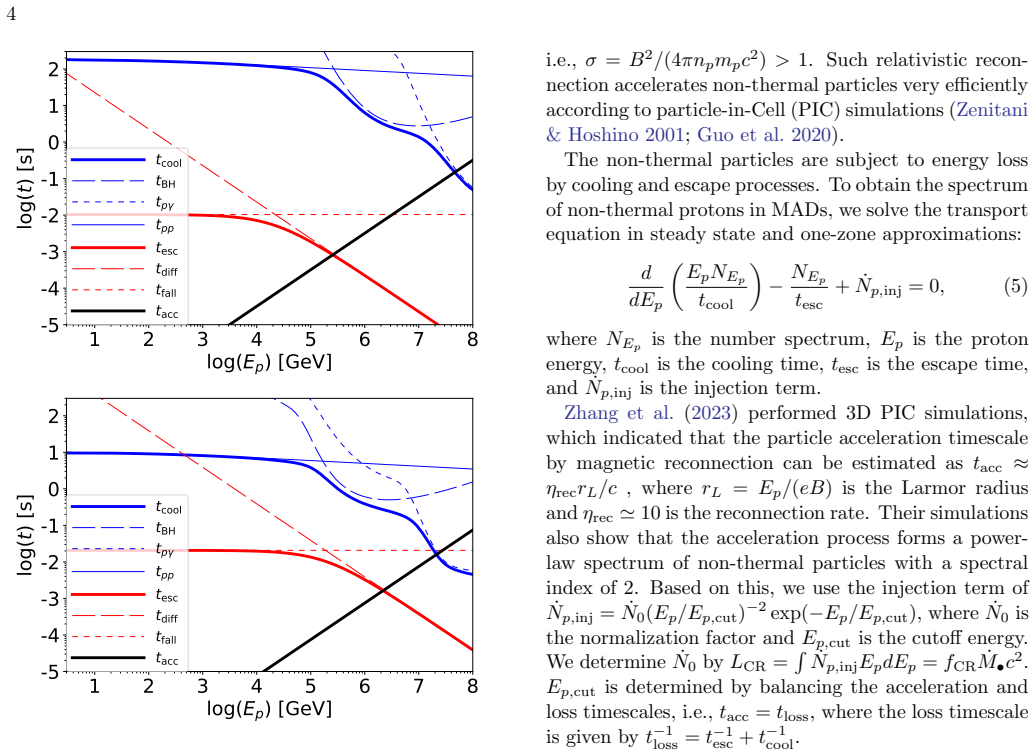
The central object is the magnetically arrested disk (MAD) that forms around a slowly moving IBH accreting from a molecular cloud. Magnetic reconnection, parameterized by an acceleration timescale $t_{\rm acc}\approx \eta_{\rm rec} r_L/c$ with $\eta_{\rm rec}=10$, produces a power-law proton spectrum with index 2. The escape energy $E_{p,\rm esc}$ is set by balancing Bohm-like diffusive escape against infall into the black hole; this energy filter is what removes the GeV-TeV gamma-ray counterpart, because only protons above $E_{p,\rm esc}$ reach the cloud and produce hadronic gamma rays. The proton cutoff energy $E_{p,\rm cut}\sim 0.48$ PeV for typical parameters scales as $M n_{MC}^{1/2} V_k^{-3/2}$, showing that low velocity, high black-hole mass, or high gas density pushes protons to PeV energies.
What would settle it
Measure the space velocities of a sample of isolated stellar-mass black holes via astrometric microlensing follow-up; if a large fraction move faster than roughly 100 km/s relative to ambient molecular gas, the predicted PeV cosmic-ray contribution collapses because the accretion rate scales as $V_{\rm eff}^{-3}$. A second decisive test is a sensitive molecular-line search toward LHAASO J0007+5659u: if no dense cloud of the required column is found, the proposed source class is ruled out.
Extended reading notes
Core claim
The central claim is that an IBH embedded in a molecular cloud forms a magnetically arrested disk (MAD), and magnetic reconnection in that disk accelerates cosmic-ray protons up to PeV energies. Because diffusive escape dominates over cooling, protons above the escape energy $E_{p,\rm esc}\sim 41$ TeV (scaling as $M_1 n_{MC,2}^{1/2}\lambda_{w,-1}^{1/2}V_{\rm eff,6.3}^{-3/2}$) escape from the MAD and are injected into the surrounding cloud. These sub-PeV protons undergo proton-proton collisions with cloud gas, producing gamma rays in the TeV-PeV band while GeV-TeV gamma rays are absent, because the lower-energy protons never escape the disk. The paper applies this to LHAASO dark sources such as J0007+5659u, and demonstrates with a Galactic population model that IBHs in molecular clouds can provide a significant contribution to the PeV cosmic-ray intensity observed on Earth, with the reference model yielding about 30% of the knee flux.
Load-bearing premise
The scenario's output hinges on most isolated black holes moving slowly relative to molecular gas (velocity dispersion about 20 km/s), because the accretion luminosity falls as the third power of relative speed; a population with a sizable fraction of natal kicks above 100 km/s would suppress the predicted cosmic-ray and gamma-ray fluxes by orders of magnitude.
Editorial extensions
If this is right
- LHAASO dark sources with hard spectra above 100 TeV and no GeV-TeV counterparts can be understood as molecular clouds hosting a single IBH, with only sub-PeV protons leaking out to produce gamma rays.
- The summed population of IBHs in molecular clouds can supply a sizable fraction of the PeV cosmic rays observed at Earth, with the reference model giving about 30% of the knee proton intensity, and higher values if the accretion efficiency is larger or the velocity dispersion is lower.
- Future gamma-ray detectors in the southern sky (such as ALPACA and SWGO) should find additional dark sources, because molecular clouds and IBHs concentrate toward the inner Galaxy.
- The scenario predicts hadronic neutrino emission accompanying the gamma rays, with a flux about an order of magnitude below current IceCube sensitivity but potentially reachable through stacking analyses or next-generation detectors.
- Hard X-ray and mid-infrared follow-up of dark sources could reveal the accreting IBH, since soft X-rays and optical light are heavily absorbed by the molecular cloud.
Reading between the lines
- I infer that the escape-energy filter is a generic spectral signature: any source class where acceleration happens in a compact region embedded in a thick target will produce gamma-ray spectra peaking above the escape energy, so future detections of a cutoff in dark-source spectra near tens of TeV would support this mechanism.
- I infer that the same IBH+MAD mechanism could naturally explain the PeVatron activity in the Galactic center region, where both molecular gas and black holes are most concentrated, as the authors note in passing.
- I infer that the ratio of neutrino to gamma-ray flux from a resolved dark source could distinguish this hadronic scenario from leptonic alternatives, and stacking many dark sources in the southern sky may yield a detection even if individual sources are weak.
- I infer that the velocity distribution of isolated black holes is the single most informative observable to test the scenario: microlensing surveys with astrometric follow-up can measure the transverse speeds of IBHs, and if a large fraction exceed roughly 100 km/s, the predicted cosmic-ray and gamma-ray outputs would drop by orders of magnitude.
Editorial analysis
A structured set of objections, weighed in public.
Referee Report
Summary. This Letter proposes that isolated stellar-mass black holes (IBHs) accreting from dense molecular gas enter a magnetically arrested disk (MAD) state in which magnetic reconnection accelerates protons to PeV energies. Protons above a characteristic escape energy E_p,esc ≈ 41 TeV (Eq. 6) leave the MAD and diffuse into the surrounding cloud, where pp collisions produce TeV–PeV gamma rays and neutrinos, while lower-energy protons are swallowed by the black hole. The model is applied to the LHAASO 'dark' source J0007+5659u and used with Galactic distributions of IBHs and molecular clouds to estimate the PeV cosmic-ray intensity at Earth, finding a 30% contribution at the knee in a reference model.
Significance. If correct, the scenario would identify a new class of Galactic PeVatrons and provide a natural explanation for the newly discovered LHAASO dark sources, with concrete predictions for southern-sky gamma-ray detectors and neutrino telescopes. Strengths include the internally consistent transport calculation, the anchoring of the acceleration rate and spectral index to PIC simulations (Zhang et al. 2023), the use of GRMHD-motivated MAD plasma parameters, and the explicit comparison of the model SED with LHAASO data in the >100 TeV band. However, the population-level predictions depend on several poorly constrained parameters (natal kick distribution, accretion reduction factor, total IBH number), and the dark-source match in the lower panel of Figure 3 uses parameters chosen after the fact, so the central claims require further validation and a quantitative GeV–TeV upper-limit comparison.
major comments (4)
- [Section 4, Figure 3] The claim in Section 4 that 'we do not expect GeV-TeV gamma-rays from the molecular cloud' is not supported by a quantitative comparison with the observed non-detection in the 0.1–2000 GeV band. Since the escaping proton spectrum extends continuously from E_p,esc ≈ 41 TeV (Eq. 6) to PeV energies, hadronic pp collisions produce a broad photon spectrum that reaches well below 0.1 E_p; the numerical SEDs in Figure 3 are only displayed for E > 100 GeV. The paper should show the full 0.1 GeV to 1 PeV SED for the J0007 model and overlay the Fermi-LAT and LHAASO-WCDA upper limits for J0007+5659u. If the predicted E^2 flux in the GeV–TeV band exceeds those limits, the source would not be dark and the central explanation would be inconsistent with the definition of a dark source; if it does not, the paper should state this explicitly as a test.
- [Table 1 and Section 4] The 'J0007' model in Table 1 is evidently constructed to reproduce the observed spectrum of J0007+5659u, making the bottom panel of Figure 3 a post-hoc fit rather than an a priori prediction. This circularity weakens the statement in the abstract that the scenario 'can explain' dark sources. I request that the authors either (i) treat the LHAASO measurement as an upper limit and propagate the observational uncertainties into the model parameters, or (ii) perform a forward calculation using the Galactic IBH and molecular-cloud distributions to predict the number of detectable dark sources and compare with the observed population (two sources satisfying the selection). Without one of these steps, the match to J0007+5659u is an existence proof, not an explanation.
- [Section 5, Eq. (1), Figure 4] The estimate that IBHs contribute ≈30% of the PeV cosmic-ray flux at the knee hinges on the assumed weak natal-kick distribution (σ_v ≈ 20 km/s). Because the accretion luminosity scales as V_eff^{-3} (Eq. 1), a population containing a significant fraction of black holes with V_k > 100 km/s would be suppressed by orders of magnitude, and such high-kick BHs are inferred from X-ray binary studies and from the Galactic BH mass distribution. The paper explores only two velocity dispersions and two values of λ_w in Figure 4. I request a population calculation that adopts a realistic kick-velocity distribution (e.g., a Maxwellian with a high-velocity tail or the distribution inferred from BH X-ray binary kinematics) and reports the resulting CR intensity and its uncertainty. This is necessary to substantiate the abstract's claim of a 'significant contribution' to PeV CRs.
- [Section 3, Eq. (7)] The maximum proton energy E_p,cut depends on the reconnection-acceleration coefficient η_rec and the diffusion enhancement factor η_diff, which are assigned fiducial values (η_rec = η_diff = 10) based on PIC simulations for η_rec and a Bohm-diffusion assumption for η_diff. These quantities are not directly measured for IBH MADs, and E_p,cut scales as η_rec^{1/2} η_diff^{1/2}; a factor of ~3 uncertainty in either parameter changes the peak gamma-ray energy by a similar factor, potentially moving the predicted >100 TeV signal below the LHAASO threshold. The paper should provide a sensitivity study over the plausible ranges of η_rec and η_diff and state the fraction of the IBH population that would still reach PeV energies under conservative choices.
minor comments (4)
- [Figure 2 caption] The caption contains a typo: 'J0007+05659u' should be 'J0007+5659u'.
- [Section 6] There is a typo in 'hihg-sensitivity radio surveys'; it should read 'high-sensitivity'.
- [Equation (8)] Please verify the numerical coefficient in the expression for E_coh = e B_MC λ_coh. With λ_coh = R_MC/5, R_MC = 20 pc, and B_MC = 10 μG, the product e B λ gives approximately 0.036 EeV in Gaussian units, not 0.18 EeV; the discrepancy may indicate a different convention or a typo that could affect the diffusion timescale in Eq. (9).
- [Section 5] The assumption that dN/dM, dN/dV_k, and dξ/dn_MC are independent of Galactocentric radius is a strong simplification, and the paper should state whether this assumption biases the predicted CR intensity high or low.
Circularity Check
The J0007 dark-source match is a postdiction: the Table 1 parameters are chosen to reproduce J0007+5659u, and the resulting curve is labeled 'prediction'; the PeV CR population calculation is largely independent.
-
fitted input called prediction
[Section 4 (text after Eq. 11), Figure 3 caption, Table 1 'J0007' row]
"Top and bottom panels are for a typical case in a typical molecular cloud and for an optimistic case that matches a LHAASO dark source (J0007+5659u), respectively. ... The black-solid and blue dashed curves are our prediction on gamma-ray and neutrinos, respectively. ... if we take an optimistic parameter set (see J0007 on Table 1), the resulting gamma-ray emission can be luminous enough to be detected by LHAASO, as shown in the bottom panel."
The J0007 model parameters (M=20 Msun, n=1000 cm^-3, Vk=20 km/s, RMC=5 pc, BMC=30 uG, d=2 kpc) are not independently measured for this source; they are chosen after the fact so that the predicted flux matches J0007+5659u. The gamma-ray normalization is set by LCR in Eq. (3) and the distance d, so any desired flux can be accommodated by picking these values. Thus the bottom panel of Fig. 3 is an exercise in matching, not a prediction; the neutrino curve, being derived from the same tuned proton luminosity, inherits that accommodation. The PeV CR contribution in Section 5 uses independent population inputs and is not circular.
full rationale
The core MAD acceleration calculation (Eqs. 5-7) is a forward transport model with inputs from PIC and GRMHD simulations, and the escape/cutoff energies are derived rather than assumed. The PeV CR contribution integrates literature-based IBH and molecular-cloud distributions, so it is parameter-dependent but not circular. Self-citations to Kimura et al. (2021b) for plasma parameters are supported by external fits to quiescent X-ray binaries, so they are not counted as load-bearing circularity. The main circular element is the J0007 dark-source panel: the model parameters are selected to reproduce that LHAASO source, and the resulting curve is then called 'our prediction.' The claim that no GeV-TeV gamma rays are produced is physically under-supported because sub-PeV protons also generate lower-energy pionic photons, but that is a correctness/falsifiability concern rather than a circularity of the derivation. Overall, one central demonstration reduces to parameter accommodation, giving partial circularity.
Assumptions & free parameters
free parameters (14)
- lambda_w (accretion reduction factor) =
0.1 (reference; 0.3 in one variant)
- f_CR (CR proton production efficiency) =
0.035 (epsilon_diss=0.15, epsilon_NT=0.33, f_e=0.3)
- alpha (viscous parameter) =
0.3
- beta (plasma beta in MAD) =
0.1
- R (emission radius in gravitational radii) =
10
- eta_rec (reconnection acceleration coefficient) =
10
- eta_diff (diffusion coefficient multiplier) =
10
- s_inj (injection spectral index) =
2.0
- J0007 source model parameters (M, n_MC, V_k, R_MC, B_MC, d) =
M=20 M_sun, n_MC=1000 cm^-3, V_k=20 km/s, R_MC=5 pc, B_MC=30 muG, d=2 kpc
- N_IBH,tot (total Galactic IBH number) =
6e8
- sigma_v (IBH velocity dispersion) =
20 km/s
- H_IBH (IBH disk scale height) =
0.3 kpc
- BH mass distribution index =
dN/dM proportional to M^-3.5 for 10-50 M_sun
- MC gas density distribution slope =
d_xi/d_nMC proportional to n_MC^-2.8
assumptions (7)
- domain assumption A Galactic population of 10^8 to 10^9 stellar-mass isolated black holes exists, and N_IBH,tot = 6e8 is adopted.
- domain assumption Magnetic flux advected from the Bondi radius is sufficient to form a magnetically arrested disk around an IBH.
- domain assumption Relativistic magnetic reconnection accelerates protons with t_acc = eta_rec r_L/c and produces a power-law spectrum with index 2.
- domain assumption The escape threshold E_p,esc separates protons that fall into the BH (GeV-TeV) from those that escape (sub-PeV), creating the dark-source spectral gap.
- domain assumption CR transport in molecular clouds follows Kolmogorov-style diffusion with coherence length R_MC/5 and weak streaming instability.
- standard math Galactic CR confinement is modeled with a leaky box and grammage X_esc around 2.0 (E_p/250 GeV)^-delta.
- ad hoc to paper The IBH mass distribution, velocity distribution, and molecular-cloud density distribution are independent of Galactic radius.
Cite this review
Pith. "Pith review of Isolated Black Holes as Potential PeVatrons and Ultrahigh-energy Gamma-ray Sources." pith.science (2026). https://pith.science/paper/7WS3X5JH
@misc{pith2026241208136,
  author       = {Pith},
  title        = {Pith review of: Isolated Black Holes as Potential PeVatrons and Ultrahigh-energy Gamma-ray Sources},
  year         = {2026},
  howpublished = {\url{https://pith.science/paper/7WS3X5JH}},
  note         = {Machine review of arXiv:2412.08136}
}
read the original abstract
The origin of PeV cosmic rays is a long-standing mystery, and ultrahigh-energy gamma-ray observations would play a crucial role in identifying it. Recently, LHAASO reported the discovery of ``dark'' gamma-ray sources that were detected above 100 TeV without any GeV--TeV gamma-ray counterparts. The origins of these dark gamma-ray sources are unknown. We propose isolated black holes (IBHs) wandering in molecular clouds as the origins of PeV cosmic rays and LHAASO dark sources. An IBH accretes surrounding dense gas, which forms a magnetically arrested disk (MAD) around the IBH. Magnetic reconnection in the MAD can accelerate cosmic-ray protons up to PeV energies. Cosmic-ray protons of GeV-TeV energies fall to the IBH, whereas cosmic-ray protons at sub-PeV energies can escape from the MAD, providing PeV CRs into the interstellar medium. The sub-PeV cosmic-ray protons interact with the surrounding molecular clouds, producing TeV-PeV gamma rays without emitting GeV-TeV gamma rays. This scenario can explain the dark sources detected by LHAASO. Taking into account the IBH and molecular cloud distributions in our Galaxy, we demonstrate that IBHs can provide a significant contribution to the PeV cosmic rays observed on Earth. Future gamma-ray detectors in the southern sky and neutrino detectors would provide a concrete test to our scenario.
Figures


Figures from the paper (1 more)

Forward citations
Cited by 1 Pith paper
-
Galactic Isolated Stellar-Mass Black Holes with the Magnetospheric Spark Gap as Possible GeV-TeV Gamma-ray Unidentified Sources
Isolated stellar-mass black holes accreting from the interstellar medium may shine as GeV-TeV gamma-ray sources through magnetospheric spark gaps, potentially explaining some unidentified Fermi and H.E.S.S. sources.
Reference graph
Works this paper leans on
-
[1]
, " * write output.state after.block = add.period write newline
ENTRY address archivePrefix author booktitle chapter doi edition editor eprint howpublished institution journal key month number organization pages publisher school series title misctitle type volume year version url label extra.label sort.label short.list INTEGERS output.state before.all mid.sentence after.sentence after.block FUNCTION init.state.consts ...
-
[2]
write newline
" write newline "" before.all 'output.state := FUNCTION format.url url empty "" new.block "" url * "" * if FUNCTION format.eprint eprint empty "" archivePrefix empty "" archivePrefix "arXiv" = new.block " " eprint * " " * new.block " " eprint * " " * if if if FUNCTION format.doi doi empty "" " " doi * " " * if FUNCTION format.pid doi empty eprint empty ur...
-
[3]
4j6*H5ab5FC Rk uu0* U!R 4JU j? 8v!R kXcI- *3 7ԭE kadZ Be&Nƺhj ?EtòtM Űl
thebibliography [1] 20pt to REFERENCES 6pt =0pt -12pt 10pt plus 3pt =0pt =0pt =1pt plus 1pt =0pt =0pt -12pt =13pt plus 1pt =20pt =13pt plus 1pt \@M =10000 =-1.0em =0pt =0pt 0pt =0pt =1.0em @enumiv\@empty 10000 10000 `\.\@m \@noitemerr \@latex@warning Empty `thebibliography' environment \@ifnextchar \@reference \@latexerr Missing key on reference command E...
2021
-
[4]
Aartsen, M., et al. 2020 a . 2008.04323
arXiv 2020
-
[5]
G., Ackermann , M., Adams , J., et al
Aartsen , M. G., Ackermann , M., Adams , J., et al. 2019, , 100, 082002, 10.1103/PhysRevD.100.082002
-
[6]
Aartsen, M. G., et al. 2020 b , Phys. Rev. Lett., 124, 051103, 10.1103/PhysRevLett.124.051103
-
[7]
U., Abe , M., Abu-Zayyad , T., et al
Abbasi , R. U., Abe , M., Abu-Zayyad , T., et al. 2018, , 865, 74, 10.3847/1538-4357/aada05
-
[8]
Abbott, R., et al. 2023, Phys. Rev. X, 13, 011048, 10.1103/PhysRevX.13.011048
Show all 95 references
- [9]
-
[10]
Abreu, P., et al. 2019. 1907.07737
2019 arXiv
-
[11]
2013, Science, 339, 807, 10.1126/science.1231160
Ackermann, M., et al. 2013, Science, 339, 807, 10.1126/science.1231160
2013 doi
-
[12]
2016, Journal of Physics G Nuclear Physics, 43, 084001, 10.1088/0954-3899/43/8/084001
Adri \'a n-Mart \' nez , S., Ageron , M., Aharonian , F., et al. 2016, Journal of Physics G Nuclear Physics, 43, 084001, 10.1088/0954-3899/43/8/084001
2016 doi
-
[13]
C., Bazilevskaya , G
Adriani , O., Barbarino , G. C., Bazilevskaya , G. A., et al. 2014, , 791, 93, 10.1088/0004-637X/791/2/93
2014 doi
-
[14]
2020, Nature Astron., 4, 913, 10.1038/s41550-020-1182-4
Agostini, M., et al. 2020, Nature Astron., 4, 913, 10.1038/s41550-020-1182-4
2020 doi
-
[15]
2016, Physical Review Letters, 117, 231102, 10.1103/PhysRevLett.117.231102
Aguilar , M., Ali Cavasonza , L., Ambrosi , G., et al. 2016, Physical Review Letters, 117, 231102, 10.1103/PhysRevLett.117.231102
2016 doi
-
[16]
2017, Progress of Theoretical and Experimental Physics, 2017, 12A105, 10.1093/ptep/ptx021
Ahlers , M., & Halzen , F. 2017, Progress of Theoretical and Experimental Physics, 2017, 12A105, 10.1093/ptep/ptx021
2017 doi
-
[17]
L., et al
Ahnen, M. L., et al. 2017, Mon. Not. Roy. Astron. Soc., 472, 2956, 10.1093/mnras/sty382, 10.1093/mnras/stx2079
2017 doi
-
[18]
C., et al
Alfaro , R., Alvarez , C., Arteaga-Vel \'a zquez , J. C., et al. 2024, , 634, 557, 10.1038/s41586-024-07995-9
2024 doi
- [19]
-
[20]
W., Bi , X
Amenomori , M., Bao , Y. W., Bi , X. J., et al. 2021, , 126, 141101, 10.1103/PhysRevLett.126.141101
2021 doi
-
[21]
2010, , 518, L102, 10.1051/0004-6361/201014666
Andr \'e , P., Men'shchikov , A., Bontemps , S., et al. 2010, , 518, L102, 10.1051/0004-6361/201014666
2010 doi
-
[22]
2024, arXiv e-prints, arXiv:2412.14550, 10.48550/arXiv.2412.14550
Anzorena , M., de la Fuente , E., Fujita , K., et al. 2024, arXiv e-prints, arXiv:2412.14550, 10.48550/arXiv.2412.14550
2024 doi
-
[23]
D., Arteaga-Vel \'a zquez , J
Apel , W. D., Arteaga-Vel \'a zquez , J. C., Bekk , K., et al. 2013, Astroparticle Physics, 47, 54, 10.1016/j.astropartphys.2013.06.004
2013 doi
-
[24]
T., Padovani , M., & Marcowith , A
Araudo , A. T., Padovani , M., & Marcowith , A. 2021, , 504, 2405, 10.1093/mnras/stab635
2021 doi
-
[25]
Y., Bi , X
Bai , X., Bi , B. Y., Bi , X. J., et al. 2019, arXiv e-prints, arXiv:1905.02773. 1905.02773
2019
-
[26]
2018, , 853, 184, 10.3847/1538-4357/aaa42f
Ball , D., \"O zel , F., Psaltis , D., Chan , C.-K., & Sironi , L. 2018, , 853, 184, 10.3847/1538-4357/aaa42f
2018 doi
-
[28]
Bell , A. R. 2004, , 353, 550, 10.1111/j.1365-2966.2004.08097.x
2004
-
[29]
2000, Gas in Galaxies , ed
Bland-Hawthorn , J., & Reynolds , R. 2000, Gas in Galaxies , ed. P. Murdin , 2636, 10.1888/0333750888/2636
2000 doi
-
[30]
D., & Begelman , M
Blandford , R. D., & Begelman , M. C. 1999, , 303, L1, 10.1046/j.1365-8711.1999.02358.x
1999
-
[31]
2011, , 737, 94, 10.1088/0004-637X/737/2/94
Cao , X. 2011, , 737, 94, 10.1088/0004-637X/737/2/94
2011 doi
-
[32]
2023, , 131, 151001, 10.1103/PhysRevLett.131.151001
Cao , Z., Aharonian , F., An , Q., et al. 2023, , 131, 151001, 10.1103/PhysRevLett.131.151001
2023 doi
- [33]
-
[34]
2024, Phys
Cao, Z., et al. 2024, Phys. Rev. Lett., 132, 131002, 10.1103/PhysRevLett.132.131002
2024 doi
-
[35]
A., Clayton , G
Cardelli , J. A., Clayton , G. C., & Mathis , J. S. 1989, , 345, 245, 10.1086/167900
1989 doi
-
[36]
J., Gaggero , D., Markoff , S., & Zhang , S
Cooper , A. J., Gaggero , D., Markoff , S., & Zhang , S. 2020, , 493, 3212, 10.1093/mnras/staa373
2020 doi
-
[37]
Crutcher , R. M. 2012, , 50, 29, 10.1146/annurev-astro-081811-125514
2012 doi
-
[38]
M., Hartmann , D., & Thaddeus , P
Dame , T. M., Hartmann , D., & Thaddeus , P. 2001, , 547, 792, 10.1086/318388
2001 doi
-
[39]
Dhang , P., Bai , X.-N., & White , C. J. 2023, , 944, 182, 10.3847/1538-4357/acb534
2023 doi
-
[40]
Fujita , Y., Murase , K., & Kimura , S. S. 2017, , 4, 037, 10.1088/1475-7516/2017/04/037
2017 doi
- [41]
-
[42]
2024, Universe, 10, 203, 10.3390/universe10050203
Giuliani, A., & Cardillo, M. 2024, Universe, 10, 203, 10.3390/universe10050203
2024 doi
-
[43]
2020, Physics of Plasmas, 27, 080501, 10.1063/5.0012094
Guo , F., Liu , Y.-H., Li , X., et al. 2020, Physics of Plasmas, 27, 080501, 10.1063/5.0012094
2020 doi
-
[44]
u ver , T., & \
G \"u ver , T., & \"O zel , F. 2009, , 400, 2050, 10.1111/j.1365-2966.2009.15598.x
2009
-
[45]
2014, , 89, 123001, 10.1103/PhysRevD.89.123001
Harari , D., Mollerach , S., & Roulet , E. 2014, , 89, 123001, 10.1103/PhysRevD.89.123001
2014 doi
-
[46]
2016, , 531, 476, 10.1038/nature17147
HESS Collaboration , Abramowski , A., Aharonian , F., et al. 2016, , 531, 476, 10.1038/nature17147
2016 doi
-
[47]
C.-C., et al
Hirotani , K., Pu , H.-Y., Lin , L. C.-C., et al. 2016, , 833, 142, 10.3847/1538-4357/833/2/142
2016 doi
-
[48]
2023, PoS, ICRC2023, 1080, 10.22323/1.444.1080
Huang, T.-Q., Cao, Z., Chen, M., et al. 2023, PoS, ICRC2023, 1080, 10.22323/1.444.1080
2023 doi
-
[49]
2023, Science, 380, 1338, 10.1126/science.adc9818
Icecube Collaboration , Abbasi , R., Ackermann , M., et al. 2023, Science, 380, 1338, 10.1126/science.adc9818
2023 doi
-
[50]
2017, , 470, 3332, 10.1093/mnras/stx1337
Ioka , K., Matsumoto , T., Teraki , Y., Kashiyama , K., & Murase , K. 2017, , 470, 3332, 10.1093/mnras/stx1337
2017 doi
-
[51]
M., & Vila , G
Kafexhiu , E., Aharonian , F., Taylor , A. M., & Vila , G. S. 2014, , 90, 123014, 10.1103/PhysRevD.90.123014
2014 doi
-
[52]
R., Aharonian , F
Kelner , S. R., Aharonian , F. A., & Bugayov , V. V. 2006, , 74, 034018, 10.1103/PhysRevD.74.034018
2006 doi
- [53]
-
[54]
S., Kashiyama , K., & Hotokezaka , K
Kimura , S. S., Kashiyama , K., & Hotokezaka , K. 2021 a , , 922, L15, 10.3847/2041-8213/ac35dc
2021 doi
-
[55]
S., Murase , K., & M \'e sz \'a ros , P
Kimura , S. S., Murase , K., & M \'e sz \'a ros , P. 2018, , 866, 51, 10.3847/1538-4357/aadc0a
2018 doi
-
[56]
S., Sudoh , T., Kashiyama , K., & Kawanaka , N
Kimura , S. S., Sudoh , T., Kashiyama , K., & Kawanaka , N. 2021 b , , 915, 31, 10.3847/1538-4357/abff58
2021 doi
- [57]
-
[58]
S., & Levinson , A
Kin , K., Kisaka , S., Toma , K., Kimura , S. S., & Levinson , A. 2024, , 964, 78, 10.3847/1538-4357/ad20cd
2024 doi
- [59]
-
[60]
Kobayashi , M. I. N., Inutsuka , S.-i., Kobayashi , H., & Hasegawa , K. 2017, , 836, 175, 10.3847/1538-4357/836/2/175
2017 doi
-
[61]
Kobayashi , M. I. N., Kobayashi , H., Inutsuka , S.-i., & Fukui , Y. 2018, , 70, S59, 10.1093/pasj/psy018
2018 doi
-
[62]
2024, , 973, 5, 10.3847/1538-4357/ad5feb
Koshimoto , N., Kawanaka , N., & Tsuna , D. 2024, , 973, 5, 10.3847/1538-4357/ad5feb
2024 doi
- [63]
-
[64]
S., & Toma , K
Kuze , R., Kimura , S. S., & Toma , K. 2022, , 935, 159, 10.3847/1538-4357/ac7ec1
2022 doi
-
[65]
2024, arXiv e-prints, arXiv:2410.08988, 10.48550/arXiv.2410.08988
LHAASO Collaboration . 2024, arXiv e-prints, arXiv:2410.08988, 10.48550/arXiv.2410.08988
2024 doi
-
[66]
C., & Newman , J
Licquia , T. C., & Newman , J. A. 2015, , 806, 96, 10.1088/0004-637X/806/1/96
2015 doi
-
[67]
2020, , 494, 3656, 10.1093/mnras/staa955
Liska , M., Tchekhovskoy , A., & Quataert , E. 2020, , 494, 3656, 10.1093/mnras/staa955
2020 doi
-
[68]
H., Papaloizou , J
Lubow , S. H., Papaloizou , J. C. B., & Pringle , J. E. 1994, , 267, 235, 10.1093/mnras/267.2.235
1994 doi
-
[70]
Murase , K., Ahlers , M., & Lacki , B. C. 2013, , 88, 121301, 10.1103/PhysRevD.88.121301
2013 doi
-
[71]
2019, , 99, 063012, 10.1103/PhysRevD.99.063012
Murase , K., & Fukugita , M. 2019, , 99, 063012, 10.1103/PhysRevD.99.063012
2019 doi
- [72]
-
[73]
2016, , 68, 5, 10.1093/pasj/psv108
Nakanishi , H., & Sofue , Y. 2016, , 68, 5, 10.1093/pasj/psv108
2016 doi
-
[74]
2024, , 528, 2588, 10.1093/mnras/stae195
Ogata , E., Ohsuga , K., Fukushima , H., & Yajima , H. 2024, , 528, 2588, 10.1093/mnras/stae195
2024 doi
-
[75]
2000, , 539, 809, 10.1086/309267
Quataert , E., & Gruzinov , A. 2000, , 539, 809, 10.1086/309267
2000 doi
-
[76]
P., & Nelemans , G
Repetto , S., Igoshev , A. P., & Nelemans , G. 2017, , 467, 298, 10.1093/mnras/stx027
2017 doi
-
[77]
G., Duffy , P., & O'Sullivan , S
Reville , B., Kirk , J. G., Duffy , P., & O'Sullivan , S. 2007, , 475, 435, 10.1051/0004-6361:20078336
2007 doi
-
[78]
2022, , 924, L32, 10.3847/2041-8213/ac46a1
Ripperda , B., Liska , M., Chatterjee , K., et al. 2022, , 924, L32, 10.3847/2041-8213/ac46a1
2022 doi
-
[79]
C., Anderson , J., Casertano , S., et al
Sahu , K. C., Anderson , J., Casertano , S., et al. 2022, , 933, 83, 10.3847/1538-4357/ac739e
2022 doi
-
[80]
2021, , 366, 58, 10.1007/s10509-021-03960-4
Sano , H., & Fukui , Y. 2021, , 366, 58, 10.1007/s10509-021-03960-4
2021 doi
-
[81]
2022, , 666, A165, 10.1051/0004-6361/202039610
Schneider , N., Ossenkopf-Okada , V., Clarke , S., et al. 2022, , 666, A165, 10.1051/0004-6361/202039610
2022 doi
-
[82]
1975, , 172, 557, 10.1093/mnras/172.3.557
Skilling , J. 1975, , 172, 557, 10.1093/mnras/172.3.557
1975 doi
- [83]
-
[84]
Sudoh , T., & Beacom , J. F. 2023, , 107, 043002, 10.1103/PhysRevD.107.043002
2023 doi
-
[85]
2017, , 469, 62, 10.1093/mnras/stx769
Sugimura , K., Hosokawa , T., Yajima , H., & Omukai , K. 2017, , 469, 62, 10.1093/mnras/stx769
2017 doi
-
[86]
Tchekhovskoy , A., Narayan , R., & McKinney , J. C. 2011, , 418, L79, 10.1111/j.1745-3933.2011.01147.x
2011
-
[87]
2018, , 477, 791, 10.1093/mnras/sty699
Tsuna , D., Kawanaka , N., & Totani , T. 2018, , 477, 791, 10.1093/mnras/sty699
2018 doi
-
[88]
2017, , 69, 78, 10.1093/pasj/psx061
Umemoto , T., Minamidani , T., Kuno , N., et al. 2017, , 69, 78, 10.1093/pasj/psx061
2017 doi
-
[89]
J., Stone , J
White , C. J., Stone , J. M., & Quataert , E. 2019, , 874, 168, 10.3847/1538-4357/ab0c0c
2019 doi
-
[90]
2000, , 542, 914, 10.1086/317016
Wilms , J., Allen , A., & McCray , R. 2000, , 542, 914, 10.1086/317016
2000 doi
-
[91]
Xie, C., Liu, Y., Shao, C., Cui, Y., & Yang, L. 2024. 2408.02070
2024 arXiv
-
[92]
2012, , 427, 1580, 10.1111/j.1365-2966.2012.22030.x
Xie , F.-G., & Yuan , F. 2012, , 427, 1580, 10.1111/j.1365-2966.2012.22030.x
2012
-
[93]
2019, , 624, A6, 10.1051/0004-6361/201834337
Yan , Q.-Z., Zhang , B., Xu , Y., et al. 2019, , 624, A6, 10.1051/0004-6361/201834337
2019 doi
-
[94]
P., Hu , F., Tian , W., et al
Ye , Z. P., Hu , F., Tian , W., et al. 2023, Nature Astronomy, 7, 1497, 10.1038/s41550-023-02087-6
2023 doi
-
[95]
2014, , 52, 529, 10.1146/annurev-astro-082812-141003
Yuan , F., & Narayan , R. 2014, , 52, 529, 10.1146/annurev-astro-082812-141003
2014 doi
-
[96]
2001, , 562, L63, 10.1086/337972
Zenitani , S., & Hoshino , M. 2001, , 562, L63, 10.1086/337972
2001 doi
-
[97]
2023, , 956, L36, 10.3847/2041-8213/acfe7c
Zhang , H., Sironi , L., Giannios , D., & Petropoulou , M. 2023, , 956, L36, 10.3847/2041-8213/acfe7c
2023 doi
Reviewed August 11, 2026 · model on record in the stance chip above.
Discussion (0). Continue with ORCID to comment.