REVIEW 3 major objections 5 minor 1 cited by
AGMixup: Adaptive Graph Mixup for Semi-supervised Node Classification
T0 review · 3 major / 5 minor · reviewed 2026-08-11 · deepseek-v4-flash
Pith's one-line read Mixing local subgraphs with per-pair mixing ratios improves semi-supervised node classification for GNNs.
desk verdict AGMixup is a solid, well-tested extension of graph mixup — subgraph-centric virtual node with adaptive λ — but the SOTA claim rests on comparison fairness that the paper doesn't fully document. read the letter →
The pith
A machine-rendered reading of the paper's core claim, the machinery that carries it, and where it could break.
The reading
What carries the argument
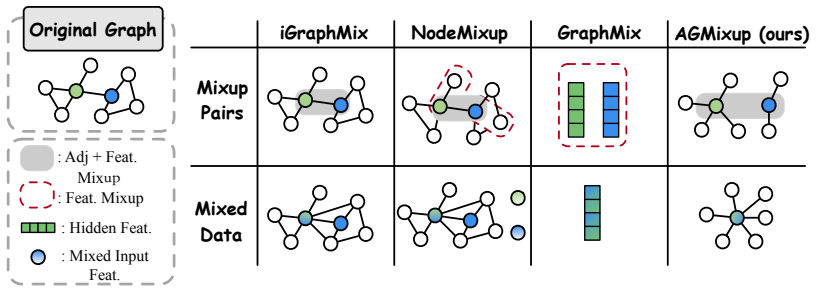
The load-bearing object is the $r$-ego subgraph $G_i^{(r)}$, the set of nodes and edges within $r$ hops of node $i$, treated like an image patch. Mixup happens between two such subgraphs: the mixed graph $\tilde{G}_{ij}$ is the union of both subgraphs with a virtual node $\tilde{x}_{ij}$ in place of the two centers, connected to the union of their neighborhoods, and labeled by the interpolation $\lambda y_i + (1-\lambda)y_j$. The adaptive $\lambda$ carries the argument: its initialization uses the Euclidean distance between mean subgraph embeddings, so $\lambda$ is near $0.5$ only for contextually similar subgraphs, and its adjustment biases mixing toward the subgraph with higher entropy uncertainty. The virtual node is what lets a graph structure be interpolated without rewiring the original topology, which the paper argues avoids the edge pollution and over-smoothing seen in node-centric graph mixup.
What would settle it
Run AGMixup against a control with the same extra forward passes and the same adaptive $\lambda$, but where the virtual node's features are not a convex combination (for instance, the concatenation of $x_i$ and $x_j$, or the average of the two subgraphs' mean features). If accuracy stays at the AGMixup level, the interpolated central node is not the active ingredient; if accuracy drops to baseline, interpolation is essential.
Extended reading notes
Core claim
The paper's central claim is that a subgraph-centric mixup with an adaptive mixing coefficient improves GNN generalization in semi-supervised node classification. The standard mixup recipe is applied to $r$-ego subgraphs: for nodes $i$ and $j$, the mixed graph keeps every node from both subgraphs except the centers, and replaces those centers with a virtual node $\tilde{x}_{ij} = \lambda x_i + (1-\lambda)x_j$ whose edges connect to all neighbors of $i$ and $j$. The loss on the mixed graph, $\lambda \ell(g_\theta(\tilde{G}_{ij}), y_i) + (1-\lambda)\ell(g_\theta(\tilde{G}_{ij}), y_j)$, is added with weight $\mu$ to the standard classification loss. $\lambda$ is set per pair by $\lambda_{ij}^{(0)} = 0.5\exp(-\gamma\|\bar{h}_i^{(r)}-\bar{h}_j^{(r)}\|_2)$ and then adjusted by an uncertainty term, so that similar subgraphs mix more evenly and uncertain subgraphs pull $\lambda$ toward the higher-uncertainty label. Comparisons with GraphMix, NodeMixup, and iGraphMix, plus ablations of subgraph-centric versus node-centric mixing and adaptive versus fixed $\lambda$, are used to argue that both design choices are necessary for the reported gains.
Load-bearing premise
The paper assumes, without a proof, that training on synthetic virtual subgraphs—a virtual node joined to the union of two $r$-hop neighborhoods with interpolated labels—regularizes a GNN so that it classifies better on the original graph; all support for this is empirical.
Editorial extensions
If this is right
- Across GCN, GAT, JKNet, and GraphSAGE on six medium and large datasets, AGMixup reports average gains of +2.71%, +2.78%, +2.70%, and +3.00% over the plain backbones, with improvements on each dataset.
- On the two large-scale graphs, ogbn-arxiv and ogbn-products, the gains persist; ogbn-products test accuracy rises by +2.46 points for GCN and +2.93 for GraphSAGE.
- With only 1 to 10 labels per class, AGMixup improves accuracy over GraphMix and iGraphMix, indicating usefulness under extreme label scarcity.
- Subgraph-centric mixing dominates its node-centric counterpart with $r=0$, and adaptive $\lambda$ beats both random Beta-sampled $\lambda$ and fixed $\lambda=0.5$ in the paper's ablations.
- The method lowers the generalization gap and the miss rate on interpolated samples, and increases average prediction confidence on test nodes.
Reading between the lines
- If the structural mechanism is the real driver, AGMixup should also help edge-level tasks such as link prediction and inductive node classification, since the mixed subgraphs are local and extracted independently; the paper does not test those settings.
- Because the similarity initialization uses the GNN's own mean embeddings, AGMixup's advantage may shrink when those embeddings are weak or untrained; an ablation using random or frozen embeddings would quantify this dependence.
- The adaptive $\lambda$ rule is one hand-designed instance; a learned or uncertainty-scaled schedule would likely give similar or better results and deserves a direct comparison.
- The reported gains combine structural mixing with the effect of additional forward passes, so a matched-compute control that runs the same number of forward passes on unmixed subgraphs would isolate the mixup contribution.
Signed reviews
Editorial analysis
A structured set of objections, weighed in public.
Referee Report
Summary. The paper proposes AGMixup, a data-augmentation regularizer for semi-supervised node classification. Instead of mixing individual node features or connections, AGMixup constructs virtual disjoint subgraphs: for each labeled pair, it takes the union of the two r-hop neighborhoods, replaces the two central nodes with one interpolated virtual node, and connects that node to the union of the neighborhoods; the mixed-label loss is added to the base classification loss with weight µ. The mixing coefficient λ is initialized by a contextual-similarity formula (Eq. 3) and then adjusted by an uncertainty term based on the model's own predicted probabilities (Eq. 4). The paper reports experiments on six benchmark datasets in Table 1 plus ogbn-products in the appendix, across four backbone GNNs, with consistent accuracy gains over the backbone and over GraphMix, NodeMixup, and iGraphMix. The appendix adds paired t-tests, label-scarcity experiments, results on four advanced GNNs, and comparisons with DropEdge and PairNorm.
Significance. If the comparisons are fair, this is a useful and reasonably broad empirical contribution: subgraph-centric mixup is a natural extension of image mixup to graphs, the method is simple and scalable via the shrink ratio ϵ, and the experimental scope is wide, covering seven datasets, four standard backbones, four advanced backbones, large OGB graphs, and low-label regimes. The release of source code, the paired t-tests in the appendix, and the explicit ablations of the adaptive-λ components are strengths. The main caveats are that the central superiority claim over state-of-the-art graph mixup methods rests on a comparison whose tuning budgets may be asymmetric, and that the adaptive-λ formulas are heuristics with no theoretical grounding, a limitation the authors themselves acknowledge in the conclusion.
major comments (3)
- [Appendix, 'Hyperparameters Searching'; Table 1] The headline comparison is not yet controlled for tuning budget. The paper reports a per-dataset/backbone search for AGMixup's own hyperparameters (r fixed at 2; γ, β ∈ {0.5, 1, 1.5, 2, 2.5, 3}; µ ∈ {0.1, 0.3, 0.5, 0.7, 0.9}) with validation-based selection, but it does not report an analogous search for GraphMix, NodeMixup, or iGraphMix, nor their method-specific settings (e.g., GraphMix's interpolation layer and α, NodeMixup's loss weight, iGraphMix's mixing and edge ratios). Because the abstract's central claim is superiority over state-of-the-art graph mixup methods, the gains in Table 1 (e.g., +2.71% on GCN and +3.00% on GraphSAGE) could in part reflect the extra search budget rather than the subgraph-centric or adaptive-λ design. Please tune the baselines under the same validation protocol, or justify a fixed configuration with sensitivity evidence, and list the selected AGMixup hyperparameters for every dataset/backbone combination.
- [§Ablation Study, Figs. 7–8] The within-method ablations isolate the subgraph construction and the adaptive λ mechanism from random/fixed-λ variants of AGMixup, and Fig. 8 is the right control for the λ module because it holds the virtual-subgraph forward pass fixed. However, these ablations do not provide an equally controlled comparison against the external baselines in Table 1; they compare only AGMixup variants. The claim of superiority over SOTA graph mixup methods therefore rests entirely on Table 1, which currently mixes the method change with the tuning-budget asymmetry described in the previous comment. Please add a like-for-like comparison with the same search budget and validation protocol for all baselines, or clearly state that the reported gains are relative to the baseline configurations as implemented.
- [§Methodology, Eq. (4)] The uncertainty-aware adjustment uses the current model's own mean predicted probabilities to set λ for the same model's subsequent training steps. This is a legitimate training heuristic rather than a mathematical circularity, but it makes the training dynamics self-referential and the manuscript provides no analysis of stability or of how often the clipping operation in Eq. (4) is active. Since the paper's claimed contribution includes the adaptive mechanism, please add an empirical check, such as the distribution of λ over training, the fraction of clipped values, and a sensitivity analysis of the initialization choice (r and γ), so that the adaptive mechanism rather than the extra subgraph-regularizer alone can be identified as the source of the reported gains.
minor comments (5)
- [Appendix, Implementation Details] 'PyTorch 3.7.1' is not a valid PyTorch version; if Python 3.7.1 is meant, please state the Python and PyTorch versions separately.
- [Table 2] The caption reads 'Datasets Statics'; it should read 'Dataset Statistics'.
- [Algorithm 1] The input/parameter list omits the shrink ratio ϵ and the mixup-loss weight µ, although both appear in the complexity analysis and in Eq. (7); please update the pseudocode and indicate where ϵ is applied to the sampled pairs.
- [Figures 3, 4, 6–15] Most figures show single curves or bars without error bars or seed information. Since Table 1 reports standard deviations over ten runs, adding error bands or stating explicitly that the curves are from a representative run would improve interpretability; in particular, the text's claim in Fig. 3 of '0.20% vs >10%' miss rates cannot be read from the axis labels.
- [Figure 11] The paired t-test figure is reproduced at too small a resolution to distinguish the red/green cells and the dataset/backbone labels; a table of p-values or a higher-resolution figure would be much clearer.
Circularity Check
No significant circularity: AGMixup is an empirical augmentation method; its self-referential adaptive-lambda training loop and minor self-citations do not reduce the claimed gains to the method's inputs.
full rationale
The paper does not contain a derivation chain in which a predicted quantity is equivalent, by construction, to a fitted input. AGMixup is an augmentation regularizer: the mixup loss in Eq. (6) is added to the classification loss in Eq. (7), and the headline claim (Table 1) is evaluated on held-out test nodes, not on the training objective itself. The adaptive mixing coefficient in Eqs. (3)-(4) is computed from the model's current embeddings and predictive uncertainties, so training does involve a self-referential feedback loop: the model's own confidence influences the regularization applied to itself. This is a standard-style self-training/curriculum mechanism and is not a mathematical circularity; the claimed accuracy gains are external to the loop and measured on unseen labels. The paper's self-citations, chiefly NodeMixup (Lu et al. 2024) and SkipNode (Lu et al. 2021), are used for related-work context and as comparison baselines, not as load-bearing justification for AGMixup's design, so they do not constitute imported uniqueness or smuggled ansatz. The reviewer concern about asymmetric hyperparameter tuning (AGMixup's r, gamma, beta, mu, epsilon are searched while baselines are not equivalently tuned) is a comparison-fairness and reproducibility risk, not a circularity: it does not make the reported accuracy improvements true by definition. Consequently, no specific circular reduction can be quoted, and the appropriate finding is no significant circularity, with a low score reflecting only the self-referential training loop and minor self-citation presence.
Assumptions & free parameters
free parameters (5)
- γ (similarity sensitivity) =
Not reported for main results; search space {0.5, 1, 1.5, 2, 2.5, 3}
- β (uncertainty adjustment scaling) =
Not reported for main results; search space {0.5, 1, 1.5, 2, 2.5, 3}
- µ (mixup loss weight) =
Not reported for main results; tuned from {0.1, 0.3, 0.5, 0.7, 0.9}
- r (subgraph radius) =
Set to 2 for main results; ablation recommends 2 to 5
- ϵ (shrink ratio) =
Not reported for main results; varied from 0 to 1 in efficacy analysis
assumptions (3)
- standard math Linear interpolation of features and labels is a valid data augmentation for classification (Zhang et al. 2017).
- domain assumption Training a GNN on synthetic disjoint virtual subgraphs with mixed labels transfers to improved classification on the original graph.
- ad hoc to paper The functional forms of λ_init (Eq. 3) and the uncertainty adjustment (Eq. 4) are appropriate heuristics for adaptive mixing.
invented entities (2)
-
Virtual node x̃ij in the mixed subgraph
-
Set of virtual disjoint subgraphs G̃
Cite this review
Pith. "Pith review of AGMixup: Adaptive Graph Mixup for Semi-supervised Node Classification." pith.science (2026). https://pith.science/paper/5EYXTP4F
@misc{pith2026241208144,
  author       = {Pith},
  title        = {Pith review of: AGMixup: Adaptive Graph Mixup for Semi-supervised Node Classification},
  year         = {2026},
  howpublished = {\url{https://pith.science/paper/5EYXTP4F}},
  note         = {Machine review of arXiv:2412.08144}
}
abstract
Mixup is a data augmentation technique that enhances model generalization by interpolating between data points using a mixing ratio $\lambda$ in the image domain. Recently, the concept of mixup has been adapted to the graph domain through node-centric interpolations. However, these approaches often fail to address the complexity of interconnected relationships, potentially damaging the graph's natural topology and undermining node interactions. Furthermore, current graph mixup methods employ a one-size-fits-all strategy with a randomly sampled $\lambda$ for all mixup pairs, ignoring the diverse needs of different pairs. This paper proposes an Adaptive Graph Mixup (AGMixup) framework for semi-supervised node classification. AGMixup introduces a subgraph-centric approach, which treats each subgraph similarly to how images are handled in Euclidean domains, thus facilitating a more natural integration of mixup into graph-based learning. We also propose an adaptive mechanism to tune the mixing ratio $\lambda$ for diverse mixup pairs, guided by the contextual similarity and uncertainty of the involved subgraphs. Extensive experiments across seven datasets on semi-supervised node classification benchmarks demonstrate AGMixup's superiority over state-of-the-art graph mixup methods. Source codes are available at \url{https://github.com/WeigangLu/AGMixup}.
Figures


Figures from the paper (10 more)


Forward citations
Cited by 1 Pith paper
-
Conf-GNNRec: Quantifying and Calibrating the Prediction Confidence for GNN-based Recommendation Methods
A post-hoc rating compression plus a high-confidence negative-sample loss reduces overconfidence and slightly improves recommendation accuracy in GNN-based recommender systems.
Reference graph
Works this paper leans on
-
[1]
, " * write output.state after.block = add.period write newline
ENTRY address archivePrefix author booktitle chapter edition editor eid eprint howpublished institution isbn journal key month note number organization pages publisher school series title type volume year label extra.label sort.label short.list INTEGERS output.state before.all mid.sentence after.sentence after.block FUNCTION init.state.consts #0 'before.a...
-
[2]
write newline
" write newline "" before.all 'output.state := FUNCTION n.dashify 't := "" t empty not t #1 #1 substring "-" = t #1 #2 substring "--" = not "--" * t #2 global.max substring 't := t #1 #1 substring "-" = "-" * t #2 global.max substring 't := while if t #1 #1 substring * t #2 global.max substring 't := if while FUNCTION word.in bbl.in capitalize " " * FUNCT...
-
[3]
Chen, M.; Wei, Z.; Huang, Z.; Ding, B.; and Li, Y. 2020. Simple and deep graph convolutional networks. In International Conference on Machine Learning, 1725--1735. PMLR
work page 2020
-
[4]
Chien, E.; Peng, J.; Li, P.; and Milenkovic, O. 2021. Adaptive Universal Generalized PageRank Graph Neural Network. ICLR
work page 2021
-
[5]
Crisostomi, D.; Antonelli, S.; Maiorca, V.; Moschella, L.; Marin, R.; and Rodol \`a , E. 2022 a . Metric based few-shot graph classification. In Learning on Graphs Conference, 33--1. PMLR
work page 2022
-
[6]
Crisostomi, D.; Antonelli, S.; Maiorca, V.; Moschella, L.; Marin, R.; and Rodol \`a , E. 2022 b . Metric Based Few-Shot Graph Classification. arXiv preprint arXiv:2206.03695
work page Pith review arXiv 2022
-
[7]
Dabouei, A.; Soleymani, S.; Taherkhani, F.; and Nasrabadi, N. M. 2021. Supermix: Supervising the mixing data augmentation. In Proceedings of the IEEE/CVF conference on computer vision and pattern recognition, 13794--13803
work page 2021
-
[8]
Faramarzi, M.; Amini, M.; Badrinaaraayanan, A.; Verma, V.; and Chandar, S. 2022. Patchup: A feature-space block-level regularization technique for convolutional neural networks. In Proceedings of the AAAI Conference on Artificial Intelligence, volume 36, 589--597
work page 2022
Show all 43 references
-
[9]
Feng, W.; Zhang, J.; Dong, Y.; Han, Y.; Luan, H.; Xu, Q.; Yang, Q.; Kharlamov, E.; and Tang, J. 2020. Graph random neural networks for semi-supervised learning on graphs. Advances in neural information processing systems, 33: 22092--22103
2020
-
[10]
Fey, M.; and Lenssen, J. E. 2019. Fast Graph Representation Learning with PyTorch Geometric . In ICLR Workshop on Representation Learning on Graphs and Manifolds
2019
-
[11]
Guo, H.; and Mao, Y. 2021. ifMixup: Interpolating Graph Pair to Regularize Graph Classification. arXiv e-prints, arXiv--2110
2021
-
[12]
Hamilton, W.; Ying, Z.; and Leskovec, J. 2017. Inductive representation learning on large graphs. Advances in neural information processing systems, 30
2017
-
[13]
Han, X.; Jiang, Z.; Liu, N.; and Hu, X. 2022. G-mixup: Graph data augmentation for graph classification. In International Conference on Machine Learning, 8230--8248. PMLR
2022
-
[14]
Hu, W.; Fey, M.; Zitnik, M.; Dong, Y.; Ren, H.; Liu, B.; Catasta, M.; and Leskovec, J. 2020. Open graph benchmark: Datasets for machine learning on graphs. Advances in neural information processing systems, 33: 22118--22133
2020
-
[15]
G.; Lee, B.; Heo, J.; Kim, G.; and Seon, K
Jeong, J.; Lee, H.; Yoon, H. G.; Lee, B.; Heo, J.; Kim, G.; and Seon, K. J. 2024. iGraphMix: Input Graph Mixup Method for Node Classification. In The Twelfth International Conference on Learning Representations
2024
-
[16]
Kim, J.-H.; Choo, W.; and Song, H. O. 2020. Puzzle Mix: Exploiting Saliency and Local Statistics for Optimal Mixup. In III, H. D.; and Singh, A., eds., Proceedings of the 37th International Conference on Machine Learning, volume 119 of Proceedings of Machine Learning Research,...
2020
-
[17]
T.; and Welling, M
Kipf, N. T.; and Welling, M. 2017. Semi-Supervised Classification with Graph Convolutional Networks. international conference on learning representations
2017
-
[18]
Klicpera, J.; Bojchevski, A.; and Günnemann, S. 2019. Predict then Propagate: Graph Neural Networks meet Personalized PageRank. ICLR
2019
-
[19]
Liu, Z.; Li, S.; Wang, G.; Wu, L.; Tan, C.; and Li, S. Z. 2024. Harnessing hard mixed samples with decoupled regularizer. Advances in Neural Information Processing Systems, 36
2024
-
[20]
Liu, Z.; Li, S.; Wu, D.; Liu, Z.; Chen, Z.; Wu, L.; and Li, S. Z. 2022. Automix: Unveiling the power of mixup for stronger classifiers. In European Conference on Computer Vision, 441--458. Springer
2022
-
[21]
Lu, W.; Guan, Z.; Zhao, W.; Yang, Y.; and Jin, L. 2024. Nodemixup: Tackling under-reaching for graph neural networks. In Proceedings of the AAAI Conference on Artificial Intelligence, volume 38, 14175--14183
2024
-
[22]
Lu, W.; Zhan, Y.; Guan, Z.; Liu, L.; Yu, B.; Zhao, W.; Yang, Y.; and Tao, D. 2021. SkipNode: On Alleviating Over-smoothing for Deep Graph Convolutional Networks. arXiv preprint arXiv:2112.11628
2021 arXiv
-
[23]
Ma, X.; Chu, X.; Wang, Y.; Lin, Y.; Zhao, J.; Ma, L.; and Zhu, W. 2024. Fused Gromov-Wasserstein Graph Mixup for Graph-level Classifications. Advances in Neural Information Processing Systems, 36
2024
-
[24]
Navarro, M.; and Segarra, S. 2022. GraphMAD: Graph Mixup for Data Augmentation using Data-Driven Convex Clustering. arXiv preprint arXiv:2210.15721
2022 arXiv
-
[25]
Oono, K.; and Suzuki, T. 2020. Graph Neural Networks Exponentially Lose Expressive Power for Node Classification. ICLR
2020
-
[26]
Park, J.; Shim, H.; and Yang, E. 2022. Graph transplant: Node saliency-guided graph mixup with local structure preservation. In Proceedings of the AAAI Conference on Artificial Intelligence, volume 36, 7966--7974
2022
-
[27]
Rong, Y.; Huang, W.; Xu, T.; and Huang, J. 2019. Dropedge: Towards deep graph convolutional networks on node classification. arXiv preprint arXiv:1907.10903
2019 arXiv
-
[28]
Shchur, O.; Mumme, M.; Bojchevski, A.; and G \"u nnemann, S. 2018. Pitfalls of graph neural network evaluation. arXiv preprint arXiv:1811.05868
2018 arXiv
-
[29]
S.; Monira, M
Uddin, A. S.; Monira, M. S.; Shin, W.; Chung, T. C.; and Bae, S. H. 2021. SALIENCYMIX: A SALIENCY GUIDED DATA AUGMENTATION STRATEGY FOR BETTER REGULARIZATION. In 9th International Conference on Learning Representations, ICLR 2021
2021
-
[30]
Velickovic, P.; Cucurull, G.; Casanova, A.; Romero, A.; Liò, P.; and Bengio, Y. 2018. Graph Attention Networks. ICLR
2018
-
[31]
Verma, V.; Lamb, A.; Beckham, C.; Najafi, A.; Mitliagkas, I.; Lopez-Paz, D.; and Bengio, Y. 2019. Manifold mixup: Better representations by interpolating hidden states. In International conference on machine learning, 6438--6447. PMLR
2019
-
[32]
Verma, V.; Qu, M.; Kawaguchi, K.; Lamb, A.; Bengio, Y.; Kannala, J.; and Tang, J. 2021. Graphmix: Improved training of gnns for semi-supervised learning. In Proceedings of the AAAI conference on artificial intelligence, volume 35, 10024--10032
2021
-
[33]
Wang, Y.; Wang, W.; Liang, Y.; Cai, Y.; and Hooi, B. 2021. Mixup for node and graph classification. In Proceedings of the Web Conference 2021, 3663--3674
2021
-
[34]
Wu, F.; Souza, A.; Zhang, T.; Fifty, C.; Yu, T.; and Weinberger, K. 2019. Simplifying graph convolutional networks. In International conference on machine learning, 6861--6871. PMLR
2019
-
[35]
Wu, L.; Lin, H.; Gao, Z.; Tan, C.; Li, S.; et al. 2021. Graphmixup: Improving class-imbalanced node classification on graphs by self-supervised context prediction. arXiv preprint arXiv:2106.11133
2021 arXiv
-
[36]
Xu, K.; Li, C.; Tian, Y.; Sonobe, T.; Kawarabayashi, K.-i.; and Jegelka, S. 2018. Representation learning on graphs with jumping knowledge networks. In International Conference on Machine Learning, 5453--5462. PMLR
2018
-
[37]
Yang, Y.; Guan, Z.; Zhao, W.; Lu, W.; and Zong, B. 2022. Graph substructure assembling network with soft sequence and context attention. IEEE Transactions on Knowledge and Data Engineering, 35(5): 4894--4907
2022
-
[38]
Yang, Z.; Cohen, W.; and Salakhudinov, R. 2016. Revisiting semi-supervised learning with graph embeddings. In International conference on machine learning, 40--48. PMLR
2016
-
[39]
N.; and Lopez-Paz, D
Zhang, H.; Cisse, M.; Dauphin, Y. N.; and Lopez-Paz, D. 2017. mixup: Beyond empirical risk minimization. arXiv preprint arXiv:1710.09412
2017 arXiv
-
[40]
Zhang, L.; Deng, Z.; Kawaguchi, K.; Ghorbani, A.; and Zou, J. 2021. HOW DOES MIXUP HELP WITH ROBUSTNESS AND GENERALIZATION? In 9th International Conference on Learning Representations, ICLR 2021
2021
-
[41]
Zhang, L.; Deng, Z.; Kawaguchi, K.; and Zou, J. 2022. When and how mixup improves calibration. In International Conference on Machine Learning, 26135--26160. PMLR
2022
-
[42]
Zhang, M.; and Chen, Y. 2018. Link prediction based on graph neural networks. Advances in neural information processing systems, 31
2018
-
[43]
Zhao, L.; and Akoglu, L. 2019. Pairnorm: Tackling oversmoothing in gnns. arXiv preprint arXiv:1909.12223
2019 arXiv
Reviewed August 11, 2026 · model on record in the stance chip above.
Discussion (0). Continue with ORCID to comment.