REVIEW 5 major objections 6 minor 39 references
AsyncDSB: Schedule-Asynchronous Diffusion Schr\"odinger Bridge for Image Inpainting
T0 review · 5 major / 6 minor · reviewed 2026-08-11 · deepseek-v4-flash
Pith's one-line read Existing diffusion Schrödinger bridge inpainting applies one noise schedule to all pixels, but AsyncDSB assigns each pixel its own shifted schedule based on gradient magnitude, improving FID by about 3% to 14% over I2SB.
desk verdict Novel per-pixel asynchronous schedule idea that works empirically, but the bridge validity is not proven and the evaluation needs error bars. read the letter →
The pith
A machine-rendered reading of the paper's core claim, the machinery that carries it, and where it could break.
The reading
What carries the argument
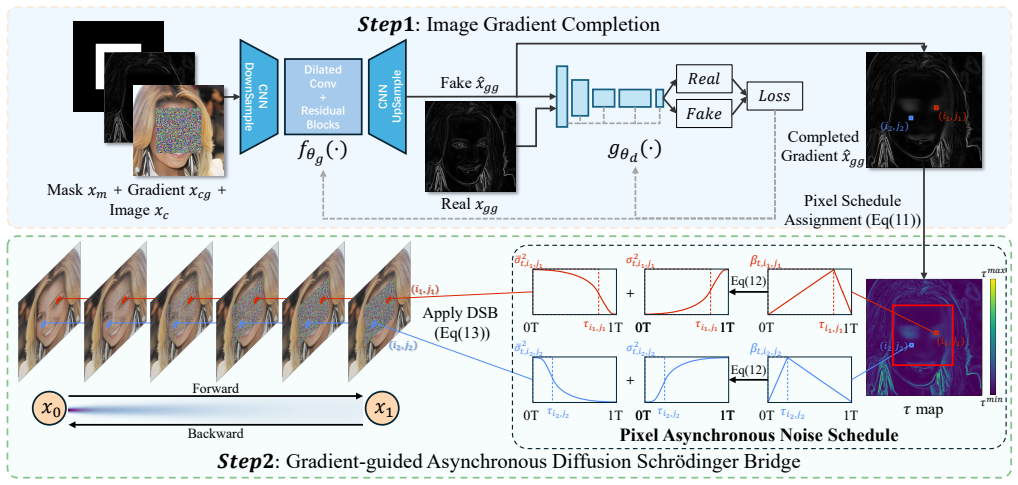
The central object is the pixel-asynchronous noise schedule $\beta_{t,i,j}$, built by shifting a global schedule per pixel through a predicted-gradient time shift $\tau_{i,j}$ (Eq. 11). The shift map comes from a gradient completion network $f_{\theta_g}$ trained adversarially with feature matching, following the edge-prediction approach of EdgeConnect. Each pixel then has its own accumulated variances $\bar{\sigma}_{t,i,j}^2$ and $\sigma_{t,i,j}^2$ (Eq. 12), and inference uses the pixel-wise posterior sampling recursion of Eq. (13). The mechanism works by allocating early steps to high-gradient pixels and later steps to low-gradient pixels, explicitly modeling the temporal ordering observed in real restoration.
What would settle it
Train the same AsyncDSB pipeline but replace the gradient-derived $\tau$ map with a random or shuffled per-pixel shift that has the same distribution and no correlation with image structure. If FID remains at the same level, the improvement comes from adding per-pixel variation rather than from restoring high-frequency pixels first. Alternatively, directly measure per-pixel restoration times in AsyncDSB trajectories; the mechanism is refuted if high-frequency pixels are not restored earlier than low-frequency pixels on average.
Extended reading notes
Core claim
The paper's central discovery is a schedule-restoration mismatch in I2SB. Using the analytic Gaussian posterior of the Schrödinger bridge, it derives that the restoration speed of a pixel is $\partial x_t/\partial t = -\beta_t (x_0 \odot x_m)/(\bar{\sigma}_t^2 + \sigma_t^2)$, so $\beta_t$ sets the global pace while the pixel value sets the amplitude. Measuring the derivative of SSIM across denoising time on CelebA-HQ shows the practical restoration curve lags the theoretical one, and the lag is concentrated in mid- and low-frequency pixels, meaning pixels are not restored synchronously. The paper's fix is to give each pixel its own time shift $\tau_{i,j}$, computed by normalizing a Gaussian-filtered predicted gradient map to $[\tau_{\min}, \tau_{\max}]$, and to run posterior sampling with a per-pixel schedule. This re-aligns practical and theoretical restoration speeds and improves FID.
Load-bearing premise
All of the reported gains rest on the assumption that a score network trained with the global, synchronous schedule still gives correct per-pixel denoising predictions when each pixel is advanced at its own shifted time; the paper does not prove this, it only demonstrates the empirical improvement.
Editorial extensions
If this is right
- AsyncDSB improves FID by roughly 3% to 14% over I2SB on CelebA-HQ and Places2 across center, half, wide, and narrow masks, with larger gains on masks that remove structure.
- The asynchronous schedule visibly narrows the gap between theoretical and practical restoration-speed curves, particularly for mid- and low-frequency pixels.
- The framework is not limited to gradient guidance; the authors state that any $\beta_{t,i,j}$ strategy matching the pixel-asynchronous generation process can be plugged in.
- For higher mask ratios, the optimal schedule shifts earlier (larger $\tau_{\min}$ and $\tau_{\max}$), indicating that mask-aware schedule selection is a promising extension the paper leaves for future work.
Reading between the lines
- The same per-pixel schedule idea could transfer to other bridge-based image translation tasks, such as super-resolution or deblurring, where restoration order is also spatially non-uniform.
- A cheaper proxy for the gradient map — e.g., distance to the mask boundary or local variance — might capture most of the gain, which would separate the benefit of asynchrony from the specific gradient predictor.
- The paper does not prove that per-pixel shifted schedules preserve the Schrödinger bridge coupling or that the score network stays calibrated for pixels at different effective times; if that proof fails, the empirical gains would still stand but the theoretical explanation would need revision.
Signed reviews
Editorial analysis
A structured set of objections, weighed in public.
Referee Report
Summary. The paper analyzes the noise schedule of I2SB and argues that a single global schedule beta_t is mismatched to the asynchronous way image pixels are restored. It proposes AsyncDSB, which (i) completes the gradient map of the corrupted region with an adversarially trained module, (ii) converts gradient magnitudes into per-pixel shift parameters tau_{i,j} via Eq. (11), and (iii) applies per-pixel posterior sampling with pixel-dependent variances sigma_{t,i,j}. Experiments on CelebA-HQ and Places2 report FID improvements over I2SB, with relative gains of roughly 3% to 14% depending on mask type.
Significance. If correct, the idea that per-pixel asynchronous schedules can better align the theoretical and practical restoration processes in diffusion Schrodinger bridges is a useful and non-obvious contribution to image inpainting. The paper identifies a real phenomenon: the empirical restoration speed of I2SB lags the theoretical schedule, and this lag differs across frequency bands. The proposed fix is simple, practical, and testable, and the authors include a useful control (I2SB plus gradient condition) to separate the effect of the asynchronous schedule from the effect of the extra gradient input. The main strength is the clean diagnosis of restoration asynchrony and the straightforward gradient-prior schedule. However, the paper does not yet establish that the per-pixel shifted schedule is a valid Schrodinger bridge, and the reported gains are not accompanied by measures of statistical uncertainty.
major comments (5)
- [Step 2, Eqs. (11)-(13)] The per-pixel noise schedule beta_{t,i,j} is never explicitly defined as a function of t and tau_{i,j}. The text says that tau_{i,j} transforms the traditional noise schedule into a pixel-wise form, but no equation gives beta_{t,i,j} in terms of beta_t and tau_{i,j}. This is needed both for reproducibility and for checking the validity of the bridge. More importantly, Eq. (13) evaluates the score as s_theta(x_{t,i,j}, t)/sigma_t using the global sigma_t, while the variances in Eq. (12) are per-pixel sigma_{t,i,j}. For the posterior update to be a valid discretization of a Schrodinger bridge, the score must correspond to the per-pixel marginal q(x_{t,i,j} | x0, x1) at the per-pixel noise level Sigma_{t,i,j}; using a score trained on the global schedule on a mixture of pixels at different effective noise levels is not justified. The authors need to either prove that the per-pixel time shifts preserve the score calibration, retrain or condition the score on per-pixel noise levels, or restrict the theoretical claims to the empirical heuristic they actually implement.
- [Theoretical Analysis, Eq. (7)] The derivation of restoration speed drops the stochastic Term3 with the statement that its expectation is zero. For individual trajectories, the noise term contributes to the per-pixel restoration order, and Eq. (11) assigns schedules to individual pixels based on gradient magnitude alone. An expectation-based argument therefore does not establish that high-gradient pixels restore earlier along a typical sample path. If the intended claim is about the expected restoration speed, the paper should say so explicitly and relate the measured SSIM derivative in Figure 2 to the expectation rather than to individual pixel behavior.
- [Experiments, Table 1 and Reproducibility Checklist] The headline FID improvements are reported without error bars, seeds, or statistical tests; the reproducibility checklist explicitly answers 'no' to the use of statistical tests. Many absolute FID differences are small (e.g., 2.2 to 1.9 on CelebA-HQ center, 8.6 to 8.3 on Places2 center) and could lie within run-to-run variation. Additionally, tau_min and tau_max are tuned per mask type and dataset (Figure 6, Table 2), with no validation split described. The authors should provide multiple seeds with means and variances, and a significance test for the I2SB comparison, especially because the 3%-14% relative improvement is the central empirical claim.
- [Ablation Study, Table 3] The I2SB+gradient baseline in Table 3 is not described in sufficient detail: it is unclear how the gradient map is injected into the UNet, whether the same gradient completion network is used, and whether the baseline is trained with the same objective as AsyncDSB. Without these details, Table 3 cannot cleanly attribute the improvement to the asynchronous schedule rather than to the way the gradient conditioning is implemented.
- [Figure 7 and Section 'Can AsyncDSB solve the schedule-restoration mismatch issue?'] The claim that AsyncDSB alleviates the schedule-restoration mismatch is, in part, enforced by design: Eq. (11) assigns earlier schedules to pixels with larger gradients, so observing in Figure 7 that high-frequency pixels restore earlier than low-frequency ones is not an independent confirmation of the mechanism. The FID improvements in Table 1 are the relevant empirical evidence; the text should not present Figure 7 as a verification of the scheduling hypothesis without acknowledging that the schedule directly encodes that hypothesis.
minor comments (6)
- [Preliminaries, Eq. (2)] The notation in Eq. (2) is ambiguous because both variances are rendered as sigma^2_t; based on Eq. (6), the first should be sigma-bar^2_t and the second sigma^2_t. Please use distinct symbols consistently.
- [Theoretical Analysis and Abstract] Several cross-references are missing or blank, such as 'Section' and 'our insight of Section' in the Introduction and Methodology sections. Please fill in the appropriate section numbers.
- [Table 1] The abstract and text state a '3% - 14% improvement' over I2SB, but some entries in Table 1 report gains in the ‰ range (e.g., IS 6.71 to 6.74) while others are in the % range. The reporting should use a consistent relative measure and avoid mixing percentages with permille.
- [Figure 6] The figure would be easier to interpret with explicit axis labels for tau_min and tau_max, a colorbar with units, and a legend or note explaining that blank cells are invalid because tau_min must not exceed tau_max.
- [Reproducibility Checklist] The checklist states that all source code is included in an appendix and will be made public, but no code appendix appears in the manuscript. Either include the code or remove these claims.
- [Eq. (13)] The integral in Eq. (13) is typeset incorrectly; it should be written as an integral from t - 1/T to t, not as 'Z t/(t-1/T)'. Please fix the notation.
Circularity Check
The schedule-restoration alignment claim is partially enforced by construction, but the headline FID gains are externally benchmarked.
-
self definitional
[Methodology, Step 2, Eq. (11); Experiments, 'Can AsyncDSB solve the schedule-restoration mismatch issue?' (Fig. 7)]
"Intuitively, the pixel with high frequency should assign larger τi,j than pixel with low frequency since the pixel with high frequency are priority restored. ... τi,j = gauss(ˆxgg i,j)−min(gauss(ˆxgg)) / max(gauss(ˆxgg))−min(gauss(ˆxgg)) (τmax−τmin) +τmin ... From results, we can see that the schedule-restoration mismatch issue can be significantly alleviated after applying our AsyncDSB."
Eq. (11) constructs τ_{i,j} directly from the gradient/frequency map, with the stated rationale that high-frequency pixels should restore earlier. Because β_{t,i,j} and hence σ²_{t,i,j}, σ̄²_{t,i,j} are per-pixel functions of τ (Eq. 12), and posterior sampling (Eq. 13) uses those per-pixel schedules, the ordering of effective restoration times across pixels is imposed by construction. Therefore Fig. 7's finding that after applying AsyncDSB the practical restoration process matches the theoretical schedule and that high-frequency pixels restore earlier is not an independent empirical confirmation of the asynchronous-restoration hypothesis; it reads back the τ assignment.
full rationale
The paper's central quantitative claim—roughly 3%–14% FID improvement over I2SB—is an external benchmark comparison and is not derived from the schedule equations, so it does not reduce by construction. No load-bearing self-citation chain or imported uniqueness theorem is present. The circular component is narrower but real: the asynchronous schedule is defined from the same gradient/frequency ordering that Fig. 7 then 'verifies.' Eq. (11) assigns each pixel a shifted schedule τ_{i,j} from the predicted gradient map, Eq. (12) computes per-pixel variances from that schedule, and Eq. (13) samples with those per-pixel schedules; consequently, high-frequency pixels restoring earlier is a designed property, not a learned or predicted outcome. The mismatch-alleviation evidence in Fig. 7 therefore loops back to the construction. The appended reproducibility checklist also states that no statistical significance tests were used ('The significance of any improvement ... is judged using appropriate statistical tests. (no)'), and Fig. 6 shows τ_min/τ_max selected per mask on the evaluated benchmark; these are robustness/overfitting concerns rather than definitional circularity, but they reinforce caution about the strength of the headline improvements. Overall, partial circularity in the mechanistic claim, independent external grounding for the main FID result, and no problematic self-citation yield a score of 4.
Assumptions & free parameters
free parameters (4)
- tau_min =
0.2T for center masks; 0.001T for wide/narrow; 0.001T to 0.7T by mask ratio in Table 2
- tau_max =
0.5T for center masks; 0.4T for wide masks; 0.9T in mask-ratio table
- Gaussian filter parameters in gauss() =
not reported
- lambda_adv and lambda_FM =
not specified in main text
assumptions (5)
- standard math I2SB analytic Gaussian posterior and score matching objective
- domain assumption Mask corruption model x1 = (1 - xm) * x0
- ad hoc to paper High-frequency-first restoration priority
- ad hoc to paper Per-pixel shifted schedule remains a valid Schrödinger bridge
- domain assumption Accuracy of the predicted gradient map
Cite this review
Pith. "Pith review of AsyncDSB: Schedule-Asynchronous Diffusion Schr\"odinger Bridge for Image Inpainting." pith.science (2026). https://pith.science/paper/TVBDZJVK
@misc{pith2026241208149,
  author       = {Pith},
  title        = {Pith review of: AsyncDSB: Schedule-Asynchronous Diffusion Schr\"odinger Bridge for Image Inpainting},
  year         = {2026},
  howpublished = {\url{https://pith.science/paper/TVBDZJVK}},
  note         = {Machine review of arXiv:2412.08149}
}
read the original abstract
Image inpainting is an important image generation task, which aims to restore corrupted image from partial visible area. Recently, diffusion Schr\"odinger bridge methods effectively tackle this task by modeling the translation between corrupted and target images as a diffusion Schr\"odinger bridge process along a noising schedule path. Although these methods have shown superior performance, in this paper, we find that 1) existing methods suffer from a schedule-restoration mismatching issue, i.e., the theoretical schedule and practical restoration processes usually exist a large discrepancy, which theoretically results in the schedule not fully leveraged for restoring images; and 2) the key reason causing such issue is that the restoration process of all pixels are actually asynchronous but existing methods set a synchronous noise schedule to them, i.e., all pixels shares the same noise schedule. To this end, we propose a schedule-Asynchronous Diffusion Schr\"odinger Bridge (AsyncDSB) for image inpainting. Our insight is preferentially scheduling pixels with high frequency (i.e., large gradients) and then low frequency (i.e., small gradients). Based on this insight, given a corrupted image, we first train a network to predict its gradient map in corrupted area. Then, we regard the predicted image gradient as prior and design a simple yet effective pixel-asynchronous noise schedule strategy to enhance the diffusion Schr\"odinger bridge. Thanks to the asynchronous schedule at pixels, the temporal interdependence of restoration process between pixels can be fully characterized for high-quality image inpainting. Experiments on real-world datasets show that our AsyncDSB achieves superior performance, especially on FID with around 3% - 14% improvement over state-of-the-art baseline methods.
Figures


Figures from the paper (4 more)


Reference graph
Works this paper leans on
-
[1]
, " * write output.state after.block = add.period write newline
ENTRY address archivePrefix author booktitle chapter edition editor eid eprint howpublished institution isbn journal key month note number organization pages publisher school series title type volume year label extra.label sort.label short.list INTEGERS output.state before.all mid.sentence after.sentence after.block FUNCTION init.state.consts #0 'before.a...
-
[2]
write newline
" write newline "" before.all 'output.state := FUNCTION n.dashify 't := "" t empty not t #1 #1 substring "-" = t #1 #2 substring "--" = not "--" * t #2 global.max substring 't := t #1 #1 substring "-" = "-" * t #2 global.max substring 't := while if t #1 #1 substring * t #2 global.max substring 't := if while FUNCTION word.in bbl.in capitalize " " * FUNCT...
-
[3]
Ballester, C.; Bertalmio, M.; Caselles, V.; Sapiro, G.; and Verdera, J. 2001. Filling-in by joint interpolation of vector fields and gray levels. IEEE transactions on image processing, 10(8): 1200--1211
work page 2001
-
[4]
Barnes, C.; Shechtman, E.; Finkelstein, A.; and Goldman, D. B. 2009. PatchMatch: A randomized correspondence algorithm for structural image editing. ACM Trans. Graph., 28(3): 24
2009
-
[5]
Bendel, M.; Ahmad, R.; and Schniter, P. 2023. A Regularized Conditional GAN for Posterior Sampling in Image Recovery Problems. Advances in Neural Information Processing Systems, 36
work page 2023
-
[6]
Bertalmio, M.; Sapiro, G.; Caselles, V.; and Ballester, C. 2000. Image inpainting. In Proceedings of the 27th annual conference on Computer graphics and interactive techniques, 417--424
2000
-
[7]
Bertalmio, M.; Vese, L.; Sapiro, G.; and Osher, S. 2003. Simultaneous structure and texture image inpainting. IEEE transactions on image processing, 12(8): 882--889
work page 2003
-
[8]
Chen, T. 2023. On the importance of noise scheduling for diffusion models. arXiv preprint arXiv:2301.10972
arXiv 2023
Show all 39 references
-
[9]
T.; and Pavon, M
Chen, Y.; Georgiou, T. T.; and Pavon, M. 2016. On the relation between optimal transport and Schr \"o dinger bridges: A stochastic control viewpoint. Journal of Optimization Theory and Applications, 169: 671--691
2016
-
[10]
Chu, T.; Chen, J.; Sun, J.; Lian, S.; Wang, Z.; Zuo, Z.; Zhao, L.; Xing, W.; and Lu, D. 2023. Rethinking fast fourier convolution in image inpainting. In Proceedings of the IEEE/CVF International Conference on Computer Vision, 23195--23205
2023
-
[11]
Criminisi, A.; Perez, P.; and Toyama, K. 2003. Object removal by exemplar-based inpainting. In 2003 IEEE Computer Society Conference on Computer Vision and Pattern Recognition, 2003. Proceedings., volume 2, II--II. IEEE
2003
-
[12]
Criminisi, A.; P \'e rez, P.; and Toyama, K. 2004. Region filling and object removal by exemplar-based image inpainting. IEEE Transactions on image processing, 13(9): 1200--1212
2004
-
[13]
De Bortoli, V.; Thornton, J.; Heng, J.; and Doucet, A. 2021. Diffusion schr \"o dinger bridge with applications to score-based generative modeling. Advances in Neural Information Processing Systems, 34: 17695--17709
2021
-
[14]
Dong, Q.; Cao, C.; and Fu, Y. 2022. Incremental transformer structure enhanced image inpainting with masking positional encoding. In Proceedings of the IEEE/CVF Conference on Computer Vision and Pattern Recognition, 11358--11368
2022
-
[15]
Feng, T.; Feng, W.; Li, W.; and Lin, D. 2022. Cross-image context for single image inpainting. Advances in Neural Information Processing Systems, 35: 1474--1487
2022
-
[16]
Guo, Q.; Liu, S.; Yu, Y.; and Luo, P. 2023. Rethinking the Noise Schedule of Diffusion-Based Generative Models
2023
-
[17]
Ho, J.; Jain, A.; and Abbeel, P. 2020. Denoising diffusion probabilistic models. Advances in neural information processing systems, 33: 6840--6851
2020
-
[18]
Li, B.; Xue, K.; Liu, B.; and Lai, Y.-K. 2023. Bbdm: Image-to-image translation with brownian bridge diffusion models. In Proceedings of the IEEE/CVF conference on computer vision and pattern Recognition, 1952--1961
2023
-
[19]
Li, W.; Lin, Z.; Zhou, K.; Qi, L.; Wang, Y.; and Jia, J. 2022 a . Mat: Mask-aware transformer for large hole image inpainting. In Proceedings of the IEEE/CVF conference on computer vision and pattern recognition, 10758--10768
2022
-
[20]
Li, X.; Guo, Q.; Lin, D.; Li, P.; Feng, W.; and Wang, S. 2022 b . Misf: Multi-level interactive siamese filtering for high-fidelity image inpainting. In Proceedings of the IEEE/CVF Conference on Computer Vision and Pattern Recognition, 1869--1878
2022
-
[21]
Lin, S.; Liu, B.; Li, J.; and Yang, X. 2024. Common diffusion noise schedules and sample steps are flawed. In Proceedings of the IEEE/CVF Winter Conference on Applications of Computer Vision, 5404--5411
2024
-
[22]
A.; Nie, W.; and Anandkumar, A
Liu, G.-H.; Vahdat, A.; Huang, D.-A.; Theodorou, E. A.; Nie, W.; and Anandkumar, A. 2023. I2SB: image-to-image Schr \"o dinger bridge. In Proceedings of the 40th International Conference on Machine Learning, 22042--22062
2023
-
[23]
Liu, H.; Wang, Y.; Qian, B.; Wang, M.; and Rui, Y. 2024. Structure Matters: Tackling the Semantic Discrepancy in Diffusion Models for Image Inpainting. arXiv preprint arXiv:2403.19898
2024 arXiv
-
[24]
Liu, X.; and Wu, L. 2023. Learning diffusion bridges on constrained domains. In international conference on learning representations (ICLR)
2023
-
[25]
Liu, Z.; Luo, P.; Wang, X.; and Tang, X. 2015. Deep Learning Face Attributes in the Wild. In Proceedings of International Conference on Computer Vision (ICCV)
2015
-
[26]
Lugmayr, A.; Danelljan, M.; Romero, A.; Yu, F.; Timofte, R.; and Van Gool, L. 2022. Repaint: Inpainting using denoising diffusion probabilistic models. In Proceedings of the IEEE/CVF conference on computer vision and pattern recognition, 11461--11471
2022
-
[27]
Z.; and Ebrahimi, M
Nazeri, K.; Ng, E.; Joseph, T.; Qureshi, F. Z.; and Ebrahimi, M. 2019. Edgeconnect: Generative image inpainting with adversarial edge learning. arXiv preprint arXiv:1901.00212
2019 arXiv
-
[28]
Q.; and Dhariwal, P
Nichol, A. Q.; and Dhariwal, P. 2021. Improved denoising diffusion probabilistic models. In International conference on machine learning, 8162--8171. PMLR
2021
-
[29]
Pavon, M. 2002. Quantum Schr \"o dinger bridges. In Directions in mathematical systems theory and optimization, 227--238. Springer
2002
-
[30]
Peluchetti, S. 2023. Diffusion bridge mixture transports, Schr \"o dinger bridge problems and generative modeling. Journal of Machine Learning Research, 24(374): 1--51
2023
-
[31]
Sargsyan, A.; Navasardyan, S.; Xu, X.; and Shi, H. 2023. Mi-gan: A simple baseline for image inpainting on mobile devices. In Proceedings of the IEEE/CVF International Conference on Computer Vision, 7335--7345
2023
-
[32]
Shi, Y.; De Bortoli, V.; Campbell, A.; and Doucet, A. 2023. Diffusion Schr \"o dinger bridge matching. Advances in Neural Information Processing Systems, 36
2023
-
[33]
L.; and Lemaire, V
Strasman, S.; Ocello, A.; Boyer, C.; Corff, S. L.; and Lemaire, V. 2024. An analysis of the noise schedule for score-based generative models. arXiv preprint arXiv:2402.04650
2024 arXiv
-
[34]
Su, X.; Song, J.; Meng, C.; and Ermon, S. 2022. Dual Diffusion Implicit Bridges for Image-to-Image Translation. In The Eleventh International Conference on Learning Representations
2022
-
[35]
Wang, W.; Niu, L.; Zhang, J.; Yang, X.; and Zhang, L. 2022. Dual-path image inpainting with auxiliary gan inversion. In Proceedings of the IEEE/CVF conference on computer vision and pattern recognition, 11421--11430
2022
-
[36]
Xia, B.; Zhang, Y.; Wang, S.; Wang, Y.; Wu, X.; Tian, Y.; Yang, W.; and Van Gool, L. 2023. Diffir: Efficient diffusion model for image restoration. In Proceedings of the IEEE/CVF International Conference on Computer Vision, 13095--13105
2023
-
[37]
Zeng, Y.; Lin, Z.; Lu, H.; and Patel, V. M. 2021. Cr-fill: Generative image inpainting with auxiliary contextual reconstruction. In Proceedings of the IEEE/CVF international conference on computer vision, 14164--14173
2021
-
[38]
S.; and Chang, S
Zhang, G.; Ji, J.; Zhang, Y.; Yu, M.; Jaakkola, T. S.; and Chang, S. 2023. Towards coherent image inpainting using denoising diffusion implicit models
2023
-
[39]
Zomet. 2003. Learning how to inpaint from global image statistics. In Proceedings Ninth IEEE international conference on computer vision, 305--312. IEEE
2003
Reviewed August 11, 2026 · model on record in the stance chip above.
Discussion (0). Continue with ORCID to comment.