REVIEW 5 major objections 4 minor 37 references
ProGDF: Progressive Gaussian Differential Field for Controllable and Flexible 3D Editing
T0 review · 5 major / 4 minor · reviewed 2026-08-11 · deepseek-v4-flash
Pith's one-line read ProGDF turns 3D editing into a learned offset field, so one offline training pass yields real-time control.
desk verdict Real idea (out-of-loop training) with an unvalidated continuous-slider claim and an unfair comparison protocol; send to review but ask for the missing evidence. read the letter →
The pith
A machine-rendered reading of the paper's core claim, the machinery that carries it, and where it could break.
The reading
What carries the argument
The load-bearing object is the Progressive Gaussian Differential Field, consisting of Progressive Gaussian Splatting (PGS) plus a lightweight neural network called GDF. PGS makes the editing trajectory visible and well-behaved: a progressive constraint $\alpha \beta^{t/s} \sum_i \Delta \Theta_i^t$ keeps early Gaussian updates from rushing, and the Laplacian rendering-quality term $-\nabla^2_{\text{Laplacian}} R(\Theta_t, v)$ preserves sharp texture in intermediate frames. GDF is the interactive machinery: it receives a 3D location and the scalar control signal $H(t/T)$, discretized into $k=10$ bins, and emits the per-Gaussian deltas $(\Delta \mu_i, \Delta \Sigma_i, \Delta \sigma_i, \Delta c_i)$, which are added to the original scene. Trajectory resampling from a memory bank prevents the neural network from forgetting earlier editing states while it is trained in parallel with the Gaussians.
What would settle it
Render GDF outputs at several control values that fall strictly between the ten discretized bins, such as 0.23, 0.47, and 0.81, in a scene used for training, and independently run a fresh PGS optimization that records the true intermediate Gaussians at those same progress fractions; if the rendered interpolation images differ materially in semantic content or texture quality from the true intermediates, the central generalization assumption is refuted.
Extended reading notes
Core claim
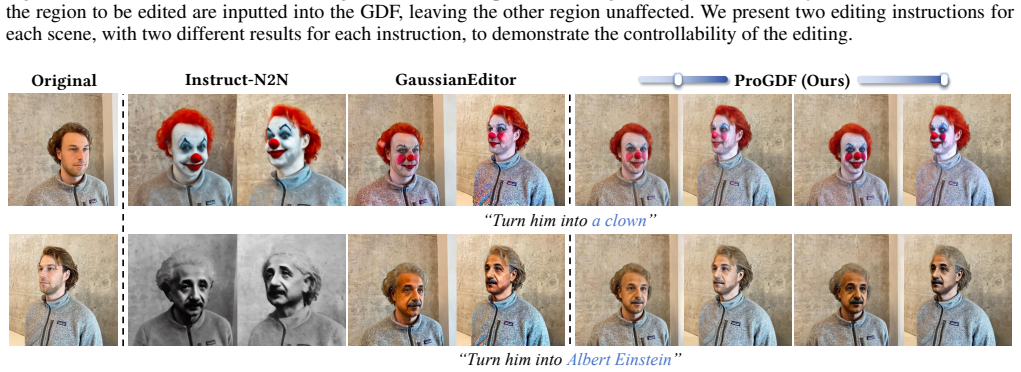
The central discovery is that controllability in 3D editing can be modeled out-of-loop as a continuous offset field rather than by re-optimizing 3D Gaussians for each user request. Given an instruction, PGS optimizes 3D Gaussians from the original scene toward the edited scene while a progressive constraint dams early large updates and a Laplacian-based rendering-quality regularizer keeps intermediate frames sharp; those frames are stored in a memory bank. GDF, a roughly six-million-parameter neural network, takes any spatial coordinate and a normalized control signal H(t/T), discretized into ten bins, and predicts the offsets in position, scale, rotation, opacity, and color for the Gaussian at that point. The predicted offsets are added to the original Gaussians, rendered, and supervised by the same editing loss used for the target. After training, a user moves a slider and the GDF evaluates all affected Gaussians in 0.02 seconds, producing continuously variable edits, and separate GDFs trained on different masked regions can be composed for fine-grained manipulations.
Load-bearing premise
The load-bearing premise is that the small neural network inside GDF generalizes across the slider, rather than merely recalling the discrete intermediate frames it was trained on; if slider values between those sampled frames produce broken or non-semantic edits, the real-time controllability claim collapses.
Editorial extensions
If this is right
- After one training session for an instruction, a user can generate a range of edit strengths from the same model, with each slider adjustment rendering in 0.02 seconds.
- The same trained GDF can be reused for controllable editing without retraining, including in a session where the user decides a different amount of the edit is better.
- By assigning different 3D masks to different GDFs, edits such as Batman shirt with yellow pants can be produced by composing region-specific trained fields.
- If the progressive constraint is removed, the intermediate frames collapse toward the final result, so slider positions produce nearly identical outputs; if the Laplacian regularizer is removed, intermediate edits blur.
- The out-of-loop design means training GDF in parallel with Gaussian optimization adds only modest compute, making the one-time training cost acceptable.
Reading between the lines
- The same offset-field idea could be carried beyond a scalar slider: replacing H(t/T) with a low-dimensional control vector, for example separate sliders for texture and color, is a natural extension the paper does not demonstrate.
- If the GDF truly interpolates between stored frames, the representation implies edit reversibility: subtracting the predicted offset should return the scene toward the original, which the paper does not test.
- A direct stress test of the generalization claim would compare GDF predictions at slider values that fall between the ten training bins against independently optimized intermediate states, separating true interpolation from memorization of sampled frames.
- The composition of multiple GDFs suggests a library of reusable partial edits: training an edit once and combining regions later could make asset editing more modular than current end-to-end pipelines.
Signed reviews
Editorial analysis
A structured set of objections, weighed in public.
Referee Report
Summary. ProGDF proposes to replace iterative in-the-loop training for 3D Gaussian Splatting (3DGS) editing with a single out-of-loop training session. The method first runs a Progressive Gaussian Splatting (PGS) stage that optimizes 3D Gaussians from the original scene toward a target scene under a progressive constraint and a Laplacian-based rendering-quality regularizer, while recording intermediate states along the optimization trajectory. A lightweight Gaussian Differential Field (GDF), an MLP with about 6M parameters, is then trained in parallel to map a spatial position and a discretized control signal to attribute offsets, with supervision from resampled trajectory frames. At inference, a user moves a slider to select a control signal, and the edited Gaussians are produced in 0.02 seconds. The paper also demonstrates fine-grained 3D manipulation by composing multiple region-specific GDFs. Experiments compare ProGDF with Instruct-N2N and GaussianEditor on user study scores and CLIP directional similarity, and ablations study the progressive constraint and rendering-quality regularization.
Significance. The central idea of process-oriented modeling for 3D editing is timely and potentially valuable. If validated, the out-of-loop training paradigm would be a practical step beyond per-edit optimization, and the claimed 0.02-second slider-based control would substantially improve the user experience of 3DGS editing. The paper has clear strengths: the GDF is lightweight, training is parallel with the PGS stage, inference is fast, and the two applications (controllable editing and fine-grained manipulation) are novel and well motivated. However, the current evidence is weakened by an evaluation protocol that gives ProGDF an advantage over baselines, by the absence of quantitative validation of the central slider-interpolation claim, and by an underspecified control-signal transformation. These issues are localized and fixable, so the contribution is worth pursuing after substantial revision.
major comments (5)
- [Quantitative Results, Table 1] The quantitative comparison is not apples-to-apples. The text states that for ProGDF the authors 'randomly adjust its slider for three inference runs and take the best results', while Instruct-N2N and GaussianEditor are evaluated with a single deterministic run. Taking the best of three runs introduces a selection bias that can inflate both the user study score and the CLIP Sdir value. To support the claimed superiority, report results for a fixed protocol, such as one predefined slider position (e.g., mid-range), or report the mean and standard deviation over multiple slider positions for all methods, with appropriate significance tests.
- [Gaussian Differential Field, Eq. (8)] The central controllability claim requires that the GDF generalizes between the discrete control signals used in training. The control signal is discretized into k=10 bins and supervised by trajectory frames sampled every 100 steps, yet the user slider is continuous. The paper provides no direct evidence that slider positions between bins produce valid, artifact-free, semantically meaningful, or monotonic intermediate edits; the user study and CLIP scores evaluate only final results, not the coherence of the slider trajectory. I recommend adding a quantitative interpolation experiment, for example rendering a fixed view across many slider values and reporting per-slider CLIP directional similarity, rendering-quality metrics, or a dedicated user study on trajectory coherence.
- [Gaussian Differential Field, Controllable 3D Editing] The 'learnable transformation H' in Eq. (8) is never defined. The paper says that the goal is to construct a learnable transformation H to map the optimization trajectory to a slider, but it does not specify the parameterization of H, its input and output dimensions, how it is trained, or whether it is the identity map on t/T. Without this information, the mapping from slider position to control signal is underspecified and the experiments cannot be reproduced. Please define H explicitly and include its implementation details, or state that H is fixed and describe its form.
- [Gaussian Differential Field, Trajectory Resampling and Eq. (10)] The GDF is trained on, and evaluated against, the same PGS trajectory frames that it is designed to reproduce. This does not by itself invalidate the method, but it means the reported variable editing results are essentially reconstructions of training samples. There is no evidence that the GDF generalizes to control values not seen during training or to trajectories generated under different conditions. I recommend a held-out evaluation, such as training the GDF on a subset of trajectory frames and testing on the remaining frames, or comparing a slider path used during training with an unseen slider path, to demonstrate that the GDF learns a continuous process rather than memorizing a discrete set.
- [Progressive Gaussian Splatting, Eq. (3)] Equation (3) is ambiguous. The term ΔΘ_t_i is described as the 'variation' of the i-th Gaussian at time step t, but no norm is specified; as written, the sum over signed updates could cancel and would not penalize the magnitude of parameter changes. Please define ΔΘ_t_i explicitly, e.g., as the L2 norm of the per-step parameter update, and clarify how the constants α, β, and s are chosen so that the progressive constraint has the intended dampening effect on the trajectory.
minor comments (4)
- [Eq. (4) and Eq. (11)] The notation L_render = -∇²_Laplacian R(Θ_t, v) is confusing because the Laplacian is already a second-derivative operator. Please state precisely what ∇²_Laplacian means, for example that L_render is the negative mean Laplacian of the rendered image, and define the averaging over pixels.
- [Appendix, User Study] The user study reports a 95% confidence interval but does not describe the participant pool, the number of scenes and instructions per participant, the order of presentation, or whether any statistical test was performed between methods. Including these details would strengthen the comparison, especially given the best-of-three protocol.
- [Appendix, Implementation Details] With T between 1500 and 2000 steps and a trajectory resampling interval of 100, only about 15 to 20 discrete time stamps are actually used for supervision, and these are further collapsed into k=10 bins. The paper should discuss how this limited number of distinct control values is reconciled with the claim of continuous slider control.
- [Figure 2 and Figure 6] For the flexible fine-grained manipulation results, the caption notes that some instructions are 'not real inputs' but are used only to indicate which editing results are combined. It would be clearer to describe the actual user interaction for composition, including how multiple GDFs are blended when their masks overlap.
Circularity Check
The variable editing results demonstrated for slider positions are supervised reconstructions of the PGS trajectory, not independent predictions; the GDF's outputs at the discrete training controls are forced by its own loss.
-
fitted input called prediction
[Section 'Gaussian Differential Field', 'Controllable 3D Editing' (Eq. 8) and 'Loss Function' (Eq. 10)]
"We sum the offsets predicted by GDF with the original 3D Gaussians to get the rendered images, and calculate the loss with the corresponding edited images. I^t_pred = R(ˆΘ^t_edit,v), 1 ≤ t ≤ T, L_pred = L1(I^t_pred, I^t_r) + Llpips(I^t_pred, I^t_r)."
The GDF is trained to minimize L_pred between its rendered output I^t_pred and I^t_r, where I^t_r is the render of the PGS trajectory state at time t. At inference, the user slider supplies the control signal H(t/T) from Eq. (8), and the GDF produces offsets rendered as I^t_pred. For every control signal used in training (k=10 discretized bins over trajectory frames sampled every 100 steps), the output is therefore statistically forced to match the very trajectory frame that was used as supervision. The paper presents these as 'variable editing results' demonstrating controllability, but they are fitted reconstructions of the training trajectory, not predictions of unseen edits.
full rationale
ProGDF is an engineering system in which PGS produces an optimization trajectory and the GDF is a lightweight MLP trained to reproduce the rendered images of that trajectory for each control signal. The central concern is that the demonstrated controllable variable results are not independent: Eq. (10) supervises the GDF with I^t_r, the rendered trajectory states, so the model's outputs at the training controls are the training targets by construction. The continuous-slider generalization between the 10 discretized bins is the only genuinely predictive part, but it is unvalidated, and the learnable transformation H in Eq. (8) is never specified or trained. The out-of-loop single-session training, 0.02-second inference, and region-wise composition remain independent contributions, and the one self-citation (Zhao et al. 2024 for k=10 bins) is a minor implementation detail that is not load-bearing. Overall, the 'variable editing results' claim partially reduces to replaying the fitted trajectory, giving a score of 6.
Assumptions & free parameters
free parameters (8)
- alpha initial weight =
0.05
- beta decay coefficient =
1.1
- s scaling factor =
50
- lambda1, lambda2, lambda3 =
1, 5, 1
- k bins =
10
- epsilon mask threshold =
0.8
- total time steps T =
1500-2000
- trajectory resampling interval =
100
assumptions (4)
- standard math 3D Gaussian splatting representation and differentiable rendering (Kerbl et al. 2023)
- domain assumption InstructPix2Pix produces consistent multi-view image edits for a given instruction
- domain assumption SAM/LangSAM segmentation and unprojection yield accurate 3D masks
- ad hoc to paper The progressive constraint (Eq. 3) makes the optimization trajectory a smooth continuum suitable for GDF regression
Cite this review
Pith. "Pith review of ProGDF: Progressive Gaussian Differential Field for Controllable and Flexible 3D Editing." pith.science (2026). https://pith.science/paper/76XHAOFZ
@misc{pith2026241208152,
  author       = {Pith},
  title        = {Pith review of: ProGDF: Progressive Gaussian Differential Field for Controllable and Flexible 3D Editing},
  year         = {2026},
  howpublished = {\url{https://pith.science/paper/76XHAOFZ}},
  note         = {Machine review of arXiv:2412.08152}
}
read the original abstract
3D editing plays a crucial role in editing and reusing existing 3D assets, thereby enhancing productivity. Recently, 3DGS-based methods have gained increasing attention due to their efficient rendering and flexibility. However, achieving desired 3D editing results often requires multiple adjustments in an iterative loop, resulting in tens of minutes of training time cost for each attempt and a cumbersome trial-and-error cycle for users. This in-the-loop training paradigm results in a poor user experience. To address this issue, we introduce the concept of process-oriented modelling for 3D editing and propose the Progressive Gaussian Differential Field (ProGDF), an out-of-loop training approach that requires only a single training session to provide users with controllable editing capability and variable editing results through a user-friendly interface in real-time. ProGDF consists of two key components: Progressive Gaussian Splatting (PGS) and Gaussian Differential Field (GDF). PGS introduces the progressive constraint to extract the diverse intermediate results of the editing process and employs rendering quality regularization to improve the quality of these results. Based on these intermediate results, GDF leverages a lightweight neural network to model the editing process. Extensive results on two novel applications, namely controllable 3D editing and flexible fine-grained 3D manipulation, demonstrate the effectiveness, practicality and flexibility of the proposed ProGDF.
Figures


Figures from the paper (6 more)




Reference graph
Works this paper leans on
-
[1]
, " * write output.state after.block = add.period write newline
ENTRY address archivePrefix author booktitle chapter edition editor eid eprint howpublished institution isbn journal key month note number organization pages publisher school series title type volume year label extra.label sort.label short.list INTEGERS output.state before.all mid.sentence after.sentence after.block FUNCTION init.state.consts #0 'before.a...
-
[2]
write newline
" write newline "" before.all 'output.state := FUNCTION n.dashify 't := "" t empty not t #1 #1 substring "-" = t #1 #2 substring "--" = not "--" * t #2 global.max substring 't := t #1 #1 substring "-" = "-" * t #2 global.max substring 't := while if t #1 #1 substring * t #2 global.max substring 't := if while FUNCTION word.in bbl.in capitalize " " * FUNCT...
-
[3]
Brooks, T.; Holynski, A.; and Efros, A. A. 2023. Instructpix2pix: Learning to follow image editing instructions. In Proceedings of the IEEE/CVF Conference on Computer Vision and Pattern Recognition, 18392--18402
2023
-
[4]
Cao, M.; Wang, X.; Qi, Z.; Shan, Y.; Qie, X.; and Zheng, Y. 2023. Masactrl: Tuning-free mutual self-attention control for consistent image synthesis and editing. In Proceedings of the IEEE/CVF International Conference on Computer Vision, 22560--22570
2023
-
[5]
Chen, Y.; Chen, Z.; Zhang, C.; Wang, F.; Yang, X.; Wang, Y.; Cai, Z.; Yang, L.; Liu, H.; and Lin, G. 2024. Gaussianeditor: Swift and controllable 3d editing with gaussian splatting. In Proceedings of the IEEE/CVF Conference on Computer Vision and Pattern Recognition, 21476--21485
2024
-
[6]
Gao, W.; Aigerman, N.; Groueix, T.; Kim, V.; and Hanocka, R. 2023. Textdeformer: Geometry manipulation using text guidance. In ACM SIGGRAPH 2023 Conference Proceedings, 1--11
work page 2023
-
[7]
A.; Holynski, A.; and Kanazawa, A
Haque, A.; Tancik, M.; Efros, A. A.; Holynski, A.; and Kanazawa, A. 2023. Instruct-nerf2nerf: Editing 3d scenes with instructions. In Proceedings of the IEEE/CVF International Conference on Computer Vision, 19740--19750
work page 2023
-
[8]
Hertz, A.; Mokady, R.; Tenenbaum, J.; Aberman, K.; Pritch, Y.; and Cohen-Or, D. 2022. Prompt-to-prompt image editing with cross attention control. arXiv preprint arXiv:2208.01626
arXiv 2022
Show all 37 references
-
[9]
Kawar, B.; Zada, S.; Lang, O.; Tov, O.; Chang, H.; Dekel, T.; Mosseri, I.; and Irani, M. 2023. Imagic: Text-based real image editing with diffusion models. In Proceedings of the IEEE/CVF Conference on Computer Vision and Pattern Recognition, 6007--6017
2023
-
[10]
Kerbl, B.; Kopanas, G.; Leimk \"u hler, T.; and Drettakis, G. 2023. 3D Gaussian Splatting for Real-Time Radiance Field Rendering. ACM Trans. Graph., 42(4): 139--1
2023
-
[11]
C.; Lo, W.-Y.; et al
Kirillov, A.; Mintun, E.; Ravi, N.; Mao, H.; Rolland, C.; Gustafson, L.; Xiao, T.; Whitehead, S.; Berg, A. C.; Lo, W.-Y.; et al. 2023. Segment anything. In Proceedings of the IEEE/CVF International Conference on Computer Vision, 4015--4026
2023
-
[12]
Liu, K.; Zhan, F.; Xu, M.; Theobalt, C.; Shao, L.; and Lu, S. 2024 a . StyleGaussian: Instant 3D Style Transfer with Gaussian Splatting. arXiv preprint arXiv:2403.07807
2024 arXiv
-
[13]
Liu, S.; Zhang, X.; Zhang, Z.; Zhang, R.; Zhu, J.-Y.; and Russell, B. 2021. Editing conditional radiance fields. In Proceedings of the IEEE/CVF international conference on computer vision, 5773--5783
2021
-
[14]
Liu, X.; Xue, H.; Luo, K.; Tan, P.; and Yi, L. 2024 b . GenN2N: Generative NeRF2NeRF Translation. In Proceedings of the IEEE/CVF Conference on Computer Vision and Pattern Recognition, 5105--5114
2024
-
[15]
Meng, C.; He, Y.; Song, Y.; Song, J.; Wu, J.; Zhu, J.-Y.; and Ermon, S. 2021. Sdedit: Guided image synthesis and editing with stochastic differential equations. arXiv preprint arXiv:2108.01073
2021 arXiv
-
[16]
P.; Tancik, M.; Barron, J
Mildenhall, B.; Srinivasan, P. P.; Tancik, M.; Barron, J. T.; Ramamoorthi, R.; and Ng, R. 2021. Nerf: Representing scenes as neural radiance fields for view synthesis. Communications of the ACM, 65(1): 99--106
2021
-
[17]
Mishra, S.; Khashabi, D.; Baral, C.; and Hajishirzi, H. 2021. Cross-task generalization via natural language crowdsourcing instructions. arXiv preprint arXiv:2104.08773
2021 arXiv
-
[18]
Mou, C.; Wang, X.; Xie, L.; Wu, Y.; Zhang, J.; Qi, Z.; and Shan, Y. 2024. T2i-adapter: Learning adapters to dig out more controllable ability for text-to-image diffusion models. In Proceedings of the AAAI Conference on Artificial Intelligence, volume 38, 4296--4304
2024
-
[19]
Ouyang, L.; Wu, J.; Jiang, X.; Almeida, D.; Wainwright, C.; Mishkin, P.; Zhang, C.; Agarwal, S.; Slama, K.; Ray, A.; et al. 2022. Training language models to follow instructions with human feedback. Advances in neural information processing systems, 35: 27730--27744
2022
-
[20]
Palandra, F.; Sanchietti, A.; Baieri, D.; and Rodol \`a , E. 2024. GSEdit: Efficient Text-Guided Editing of 3D Objects via Gaussian Splatting. arXiv preprint arXiv:2403.05154
2024 arXiv
-
[21]
T.; and Mildenhall, B
Poole, B.; Jain, A.; Barron, J. T.; and Mildenhall, B. 2022. Dreamfusion: Text-to-3d using 2d diffusion. arXiv preprint arXiv:2209.14988
2022 arXiv
-
[22]
W.; Hallacy, C.; Ramesh, A.; Goh, G.; Agarwal, S.; Sastry, G.; Askell, A.; Mishkin, P.; Clark, J.; et al
Radford, A.; Kim, J. W.; Hallacy, C.; Ramesh, A.; Goh, G.; Agarwal, S.; Sastry, G.; Askell, A.; Mishkin, P.; Clark, J.; et al. 2021. Learning transferable visual models from natural language supervision. In International conference on machine learning, 8748--8763. PMLR
2021
-
[23]
Ramesh, A.; Dhariwal, P.; Nichol, A.; Chu, C.; and Chen, M. 2022. Hierarchical text-conditional image generation with clip latents. arXiv preprint arXiv:2204.06125, 1(2): 3
2022 arXiv
-
[24]
Rombach, R.; Blattmann, A.; Lorenz, D.; Esser, P.; and Ommer, B. 2022. High-resolution image synthesis with latent diffusion models. In Proceedings of the IEEE/CVF conference on computer vision and pattern recognition, 10684--10695
2022
-
[25]
Ruiz, N.; Li, Y.; Jampani, V.; Pritch, Y.; Rubinstein, M.; and Aberman, K. 2023. Dreambooth: Fine tuning text-to-image diffusion models for subject-driven generation. In Proceedings of the IEEE/CVF conference on computer vision and pattern recognition, 22500--22510
2023
-
[26]
L.; Ghasemipour, K.; Gontijo Lopes, R.; Karagol Ayan, B.; Salimans, T.; et al
Saharia, C.; Chan, W.; Saxena, S.; Li, L.; Whang, J.; Denton, E. L.; Ghasemipour, K.; Gontijo Lopes, R.; Karagol Ayan, B.; Salimans, T.; et al. 2022. Photorealistic text-to-image diffusion models with deep language understanding. Advances in neural information processing syste...
2022
-
[27]
Wang, C.; Chai, M.; He, M.; Chen, D.; and Liao, J. 2022. Clip-nerf: Text-and-image driven manipulation of neural radiance fields. In Proceedings of the IEEE/CVF Conference on Computer Vision and Pattern Recognition, 3835--3844
2022
-
[28]
A.; and Shakhnarovich, G
Wang, H.; Du, X.; Li, J.; Yeh, R. A.; and Shakhnarovich, G. 2023. Score jacobian chaining: Lifting pretrained 2d diffusion models for 3d generation. In Proceedings of the IEEE/CVF Conference on Computer Vision and Pattern Recognition, 12619--12629
2023
-
[29]
Wang, J.; Fang, J.; Zhang, X.; Xie, L.; and Tian, Q. 2024. Gaussianeditor: Editing 3d gaussians delicately with text instructions. In Proceedings of the IEEE/CVF Conference on Computer Vision and Pattern Recognition, 20902--20911
2024
-
[30]
Wang, X. 2007. Laplacian operator-based edge detectors. IEEE transactions on pattern analysis and machine intelligence, 29(5): 886--890
2007
-
[31]
Y.; Guu, K.; Yu, A
Wei, J.; Bosma, M.; Zhao, V. Y.; Guu, K.; Yu, A. W.; Lester, B.; Du, N.; Dai, A. M.; and Le, Q. V. 2021. Finetuned language models are zero-shot learners. arXiv preprint arXiv:2109.01652
2021 arXiv
-
[32]
Xu, T.; and Harada, T. 2022. Deforming radiance fields with cages. In European Conference on Computer Vision, 159--175. Springer
2022
-
[33]
Yang, B.; Bao, C.; Zeng, J.; Bao, H.; Zhang, Y.; Cui, Z.; and Zhang, G. 2022. Neumesh: Learning disentangled neural mesh-based implicit field for geometry and texture editing. In European Conference on Computer Vision, 597--614. Springer
2022
-
[34]
Yuan, Y.-J.; Sun, Y.-T.; Lai, Y.-K.; Ma, Y.; Jia, R.; and Gao, L. 2022. Nerf-editing: geometry editing of neural radiance fields. In Proceedings of the IEEE/CVF Conference on Computer Vision and Pattern Recognition, 18353--18364
2022
-
[35]
Zhang, L.; Rao, A.; and Agrawala, M. 2023. Adding conditional control to text-to-image diffusion models. In Proceedings of the IEEE/CVF International Conference on Computer Vision, 3836--3847
2023
-
[36]
Zhao, Y.; Li, K.; Cheng, Z.; Qiao, P.; Zheng, X.; Ji, R.; Liu, C.; Yuan, L.; and Chen, J. 2024. GraCo: Granularity-Controllable Interactive Segmentation. In Proceedings of the IEEE/CVF Conference on Computer Vision and Pattern Recognition, 3501--3510
2024
-
[37]
Zhuang, J.; Wang, C.; Lin, L.; Liu, L.; and Li, G. 2023. Dreameditor: Text-driven 3d scene editing with neural fields. In SIGGRAPH Asia 2023 Conference Papers, 1--10
2023
Reviewed August 11, 2026 · model on record in the stance chip above.
Discussion (0). Continue with ORCID to comment.