Thermodynamic Behavior of a 4D Nonminimal Maxwell-AdS Black Hole
Pith reviewed 2026-05-25 08:13 UTC · model grok-4.3
The pith
A perturbative nonminimal Ricci-Maxwell coupling produces black hole solutions whose thermodynamics follows a van der Waals equation of state in both canonical and grand canonical ensembles.
A machine-rendered reading of the paper's core claim, the machinery that carries it, and where it could break.
Core claim
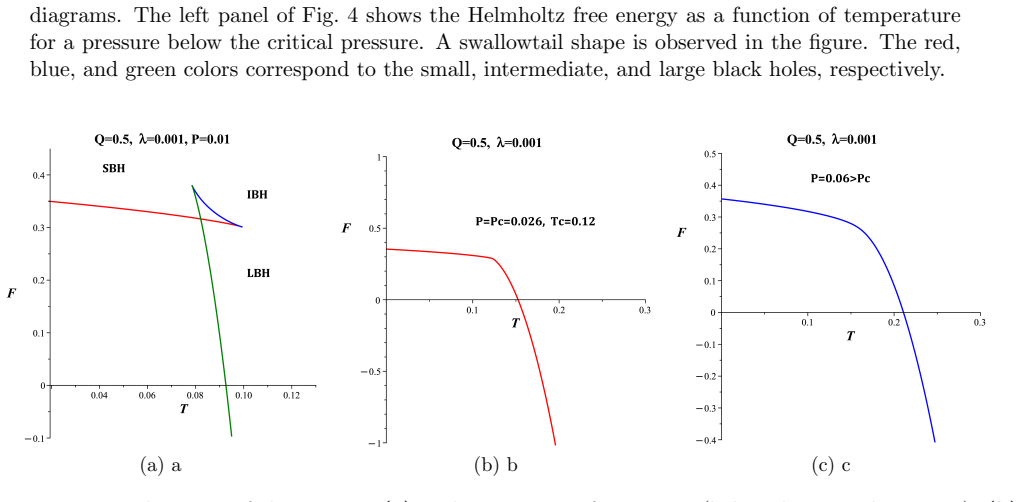
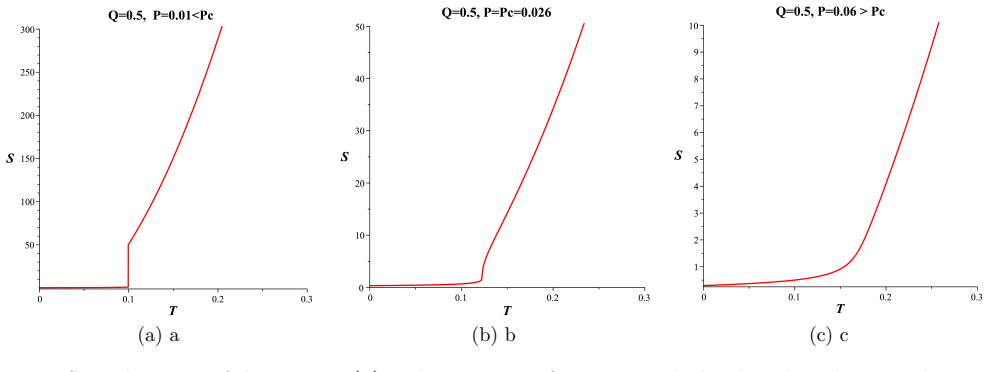
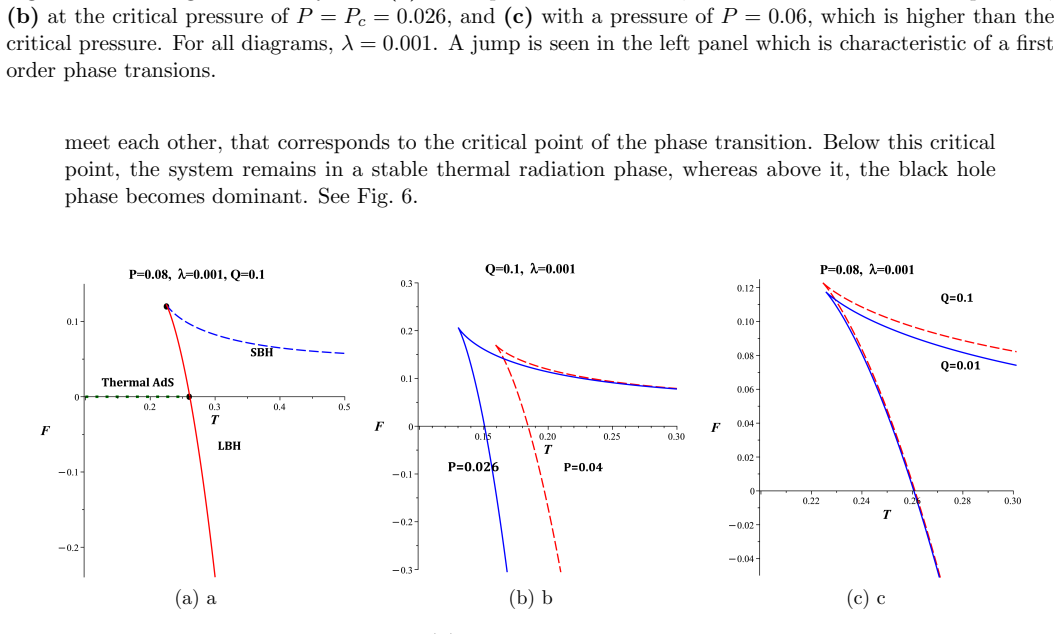
Using a perturbative expansion, the authors obtain a consistent 4D black hole metric satisfying the modified Einstein-Maxwell equations with nonminimal coupling. In the extended phase space, the thermodynamic quantities satisfy an equation of state that exhibits van der Waals-like behavior, including a first-order phase transition between small and large black holes, in both the canonical ensemble (fixed charge) and the grand canonical ensemble (fixed potential). When the charge or potential is sufficiently small, the system undergoes a Hawking-Page phase transition between thermal AdS and the black hole phase.
What carries the argument
The perturbative black hole metric obtained from the nonminimal Ricci-Maxwell coupling term, which alters the field equations and produces the observed thermodynamic equation of state in extended phase space.
If this is right
- The black hole equation of state mimics a van der Waals fluid, so the system possesses critical points and regions of phase coexistence.
- The same qualitative phase structure appears in both ensembles, indicating the behavior is not an artifact of ensemble choice.
- For sufficiently small charge or potential the Hawking-Page transition replaces the van der Waals transition as the dominant feature.
- Treating the cosmological constant as thermodynamic pressure reveals the extended phase space structure of the nonminimal theory.
Where Pith is reading between the lines
- If the perturbative metric approximates the exact solution, nonminimal couplings of this type may produce fluid-like thermodynamics in higher dimensions or with additional matter fields.
- The result suggests that the dual holographic fluid in the AdS/CFT correspondence would also exhibit van der Waals behavior when the bulk coupling is nonminimal.
- Checking the thermodynamic stability and quasinormal modes of the perturbative solution beyond the working order would delimit the regime where the reported transitions remain valid.
Load-bearing premise
The perturbative expansion around the background solution yields a consistent black hole metric that satisfies the modified field equations to the working order.
What would settle it
Deriving an exact non-perturbative solution and verifying whether its pressure-volume relation still contains a van der Waals loop and critical point would directly test the claim.
Figures




read the original abstract
In this paper, we derive a black hole solution within the Einstein Maxwell framework incorporating a nonminimal coupling between the Ricci tensor and the Maxwell field strength tensor, using a perturbative approach. We subsequently explore the thermodynamic phase transitions of the black hole in an extended phase space, analyzing both canonical and grand canonical ensembles. Our findings reveal that the system exhibits Van der Waals like behavior in both ensembles. Moreover, for sufficiently small values of electric charge and Maxwell potential, the thermodynamics is dominated by a Hawking Page phase transition.
Editorial analysis
A structured set of objections, weighed in public.
Referee Report
Summary. The paper derives a perturbative black hole solution in 4D Einstein-Maxwell theory with nonminimal coupling between the Ricci tensor and Maxwell field strength tensor. It then studies the thermodynamics in extended phase space, reporting Van der Waals-like behavior in both the canonical and grand canonical ensembles, and dominance of the Hawking-Page phase transition for sufficiently small electric charge and Maxwell potential.
Significance. If the perturbative metric is shown to satisfy the modified field equations, the work would extend known thermodynamic phase structures to nonminimal couplings and demonstrate ensemble-independent Van der Waals behavior plus parameter-controlled Hawking-Page dominance, adding to the literature on black hole thermodynamics in modified gravity.
major comments (1)
- [metric derivation section] The section deriving the perturbative metric: no explicit verification is supplied that the obtained metric satisfies the nonminimal Einstein-Maxwell field equations to the working perturbative order (e.g., via residual computation of the modified Einstein tensor or on-shell action evaluation). This is load-bearing, as all thermodynamic potentials, temperatures, entropies, and the subsequent phase diagrams are constructed from this metric.
minor comments (1)
- [Abstract] Abstract: the claim of a 'perturbative approach' would benefit from specifying the expansion order and any truncation error estimate to allow readers to assess the regime of validity for the reported phase behaviors.
Simulated Author's Rebuttal
We thank the referee for their careful reading of our manuscript and for identifying an important point regarding the verification of the perturbative solution. We address the major comment below and will revise the manuscript accordingly.
read point-by-point responses
-
Referee: [metric derivation section] The section deriving the perturbative metric: no explicit verification is supplied that the obtained metric satisfies the nonminimal Einstein-Maxwell field equations to the working perturbative order (e.g., via residual computation of the modified Einstein tensor or on-shell action evaluation). This is load-bearing, as all thermodynamic potentials, temperatures, entropies, and the subsequent phase diagrams are constructed from this metric.
Authors: We agree that an explicit verification of the field equations strengthens the manuscript. The perturbative metric was derived by substituting the ansatz into the modified Einstein-Maxwell equations and solving order by order in the nonminimal coupling parameter, but the original text omitted a direct residual computation. In the revised version we will add this check (either in the metric section or an appendix) by explicitly evaluating the modified Einstein tensor components and confirming that all residuals vanish to the working perturbative order. This will directly support the subsequent thermodynamic quantities and phase diagrams. revision: yes
Circularity Check
No significant circularity in derivation chain.
full rationale
The paper derives a perturbative black hole metric from the nonminimal Einstein-Maxwell-AdS field equations and then computes thermodynamic potentials and phase structure directly from that metric in both ensembles. No quoted step shows a self-definitional loop, a fitted parameter renamed as a prediction, or a load-bearing result justified only by self-citation. The Van der Waals-like behavior and Hawking-Page dominance are computed outputs, not inputs imposed by construction, so the chain remains independent of its target results.
Axiom & Free-Parameter Ledger
free parameters (1)
- nonminimal coupling constant
axioms (1)
- domain assumption Einstein-Maxwell theory extended by a nonminimal Ricci-Maxwell coupling term
Reference graph
Works this paper leans on
-
[1]
Q. Huang, P. Wu, and H. Yu, “Stability of Einstein Static Universe in Gravity Theory with a Non-Minimal Derivative Coupling,” Eur. Phys. J. C76, 128 (2016). doi:10.1140/epjc/s10052- 016-3929-y
-
[2]
A. B. Balakin, V. V. Bochkarev, and J. P. S. Lemos, “Non-minimal Coupling for the Gravita- tional and Electromagnetic Fields: Black Hole Solutions and Solitons,” Phys. Rev. D77, 084013 (2008). doi:10.1103/PhysRevD.77.084013
-
[3]
R. P. L. Azevedo and P. P. Avelino, “Big-Bang Nucleosynthesis and Cosmic Microwave Back- ground Constraints on Nonminimally Coupled Theories of Gravity,” Phys. Rev. D98, 064045 (2018). doi:10.1103/PhysRevD.98.064045
-
[4]
Mach’s Principle and a Relativistic Theory of Gravitation. II,
C. H. Brans, “Mach’s Principle and a Relativistic Theory of Gravitation. II,” Phys. Rev.125, 2194–2201 (1962). doi:10.1103/PhysRev.125.2194
-
[5]
Non-minimal coupling for the gravitational and electromagnetic fields: A general system of equations
A. B. Balakin and J. P. S. Lemos, “Non-minimal coupling for the gravitational and electro- magnetic fields: A General system of equations,” Class. Quant. Grav.22, 1867–1880 (2005). doi:10.1088/0264-9381/22/9/024, arXiv:gr-qc/0503076
work page internal anchor Pith review Pith/arXiv arXiv doi:10.1088/0264-9381/22/9/024 2005
-
[6]
Regular nonminimal magnetic black holes in spacetimes with a cosmological constant
A. B. Balakin, J. P. S. Lemos, and A. E. Zayats, “Regular nonminimal magnetic black holes in spacetimes with a cosmological constant,” Phys. Rev. D93, 024008 (2016). doi:10.1103/PhysRevD.93.024008, arXiv:1512.02653 [gr-qc]
work page internal anchor Pith review Pith/arXiv arXiv doi:10.1103/physrevd.93.024008 2016
-
[7]
K. Bamba and S. D. Odintsov, “Inflation and late-time cosmic acceleration in non-minimal Maxwell-F(R) gravity and the generation of large-scale magnetic fields,” JCAP04, 024 (2008). doi:10.1088/1475-7516/2008/04/024, arXiv:0801.0954 [astro-ph]
work page internal anchor Pith review Pith/arXiv arXiv doi:10.1088/1475-7516/2008/04/024 2008
-
[8]
Static Spherically Symmetric Solutions to a System of Generalized Einstein- Maxwell Field Equations,
G. W. Horndeski, “Static Spherically Symmetric Solutions to a System of Generalized Einstein- Maxwell Field Equations,” Phys. Rev. D17, 391–395 (1978). doi:10.1103/PhysRevD.17.391. 26
-
[9]
Spherically Symmetric Solutions of the Nonminimally Cou- pled Einstein-Maxwell Equations,
F. Mueller-Hoissen and R. Sippel, “Spherically Symmetric Solutions of the Nonminimally Cou- pled Einstein-Maxwell Equations,” Class. Quant. Grav.5, 1473 (1988)
work page 1988
-
[10]
Nonminimal coupling for the gravitational and electromagnetic fields: Traversable electric wormholes
A. B. Balakin, J. P. S. Lemos, and A. E. Zayats, “Nonminimal coupling for the gravitational and electromagnetic fields: Traversable electric wormholes,” Phys. Rev. D81, 084015 (2010). doi:10.1103/PhysRevD.81.084015, arXiv:1003.4584 [gr-qc]
work page internal anchor Pith review Pith/arXiv arXiv doi:10.1103/physrevd.81.084015 2010
-
[11]
Non-Commutative Yang-Mills and the AdS/CFT Correspon- dence,
A. Hashimoto and N. Itzhaki, “Non-Commutative Yang-Mills and the AdS/CFT Correspon- dence,” Phys. Lett. B465, 142–147 (1999). doi:10.1016/S0370-2693(99)01025-8
-
[12]
Classical Yang-Mills Black Hole Hair in Anti-de Sitter Space,
J. Bjoraker and Y. Hosotani, “Classical Yang-Mills Black Hole Hair in Anti-de Sitter Space,” Phys. Rev. Lett.84, 1853–1856 (2000). doi:10.1103/PhysRevLett.84.1853
-
[13]
The phase transition of nonminimal Yang–Mills AdS black brane,
M. Sadeghi and F. Rahmani, “The phase transition of nonminimal Yang–Mills AdS black brane,” Int. J. Mod. Phys. A39, 2450010 (2024). doi:10.1142/S0217751X24500106, arXiv:2306.05231 [hep-th]
-
[14]
The phase transition of 4D Yang–Mills charged GB AdS black hole with cloud of strings,
F. Rahmani and M. Sadeghi, “The phase transition of 4D Yang–Mills charged GB AdS black hole with cloud of strings,” Mod. Phys. Lett. A39, 2450164 (2024). doi:10.1142/S0217732324501645, arXiv:2402.07856 [hep-th]
-
[15]
Holographic aspects of non-minimalRF (a) µα F (a)µα black brane,
M. Sadeghi, “Holographic aspects of non-minimalRF (a) µα F (a)µα black brane,” Mod. Phys. Lett. A38, 2350098 (2023). doi:10.1142/S0217732323500980, arXiv:2302.07247 [hep-th]
-
[16]
Holographic aspects of non-minimalRF FAdS black brane,
M. Sadeghi, “Holographic aspects of non-minimalRF FAdS black brane,” Class. Quant. Grav.40, 195002 (2023). doi:10.1088/1361-6382/acf020, arXiv:2210.06584 [hep-th]
-
[17]
A. B. Balakin, H. Dehnen, and A. E. Zayats, “Non-minimal Einstein-Yang-Mills-Higgs theory: Associated, color and color-acoustic metrics for the Wu-Yang monopole model,” Phys. Rev. D 76, 124011 (2007). doi:10.1103/PhysRevD.76.124011, arXiv:0710.5070 [gr-qc]
work page internal anchor Pith review Pith/arXiv arXiv doi:10.1103/physrevd.76.124011 2007
-
[18]
Einstein-Yang-Mills-Higgs Dark Energy Revisited,
M. Alvarez, J. B. Orjuela-Quintana, Y. Rodriguez, and C. A. Valenzuela-Toledo, “Einstein-Yang-Mills-Higgs Dark Energy Revisited,” Class. Quant. Grav.36, 195004 (2019). doi:10.1088/1361-6382/ab3775
-
[19]
Non-minimal coupling of photons and axions
A. B. Balakin and W. T. Ni, “Non-minimal coupling of photons and axions,” Class. Quant. Grav.27, 055003 (2010). doi:10.1088/0264-9381/27/5/055003, arXiv:0911.2946 [gr-qc]
work page internal anchor Pith review Pith/arXiv arXiv doi:10.1088/0264-9381/27/5/055003 2010
-
[20]
Implications of Einstein-Maxwell Dilaton-Axion Gravity from the Black Hole Continuum Spectrum,
I. Banerjee, B. Mandal, and S. SenGupta, “Implications of Einstein-Maxwell Dilaton-Axion Gravity from the Black Hole Continuum Spectrum,” Class. Quant. Grav.35, 195002 (2018). doi:10.1088/1361-6382/aad7b9
-
[21]
Thermodynamics of Black Holes in Anti-de Sitter Space,
S. W. Hawking and D. N. Page, “Thermodynamics of Black Holes in Anti-de Sitter Space,” Commun. Math. Phys.87, 577–588 (1983). doi:10.1007/BF01208266
-
[22]
Thermodynamics of AdS Black Holes in Einstein-Gauss-Bonnet Gravity,
R. G. Cai, “Thermodynamics of AdS Black Holes in Einstein-Gauss-Bonnet Gravity,” Phys. Rev. D65, 084014 (2002). doi:10.1103/PhysRevD.65.084014
-
[23]
Building a Holographic Superconductor,
S. A. Hartnoll, C. P. Herzog, and G. T. Horowitz, “Building a Holographic Superconductor,” Phys. Rev. Lett.101, 031601 (2008). doi:10.1103/PhysRevLett.101.031601. 27
-
[25]
Black Hole Entropy and the Renormalization Group,
A. L. Larsen and F. Larsen, “Black Hole Entropy and the Renormalization Group,” Nucl. Phys. B500, 37–54 (1996). doi:10.1016/0550-3213(96)00339-3
-
[26]
Geometry of AdS Black Hole Ther- modynamics in Extended Phase Space,
J. D. Bairagya, K. Pal, K. Pal, and T. Sarkar, “Geometry of AdS Black Hole Ther- modynamics in Extended Phase Space,” Int. J. Mod. Phys. D30, 2150041 (2021). doi:10.1142/S0218271821500414
-
[27]
S. H. Hendi and A. Dehghani, “Criticality and Extended Phase Space Thermodynamics of AdS Black Holes in Higher Curvature Massive Gravity,” Phys. Rev. D98, 084006 (2018). doi:10.1103/PhysRevD.98.084006
-
[28]
Extended Phase Space Thermodynamics of Regular- AdS Black Hole,
M. Rehan, S. U. Islam, and S. G. Ghosh, “Extended Phase Space Thermodynamics of Regular- AdS Black Hole,” Annals Phys.409, 167921 (2019). doi:10.1016/j.aop.2019.167921
-
[29]
The Cosmological Constant and the Black Hole Equation of State,
B. P. Dolan, “The Cosmological Constant and the Black Hole Equation of State,” Class. Quant. Grav.28, 125020 (2011). doi:10.1088/0264-9381/28/12/125020
-
[30]
Holographic black hole chemistry,
A. Karch and B. Robinson, “Holographic black hole chemistry,” JHEP12, 073 (2015). doi:10.1007/JHEP12(2015)073
-
[31]
M. Robinson, “Generalized Euler Equation from Effective Action: Implications for the Smarr Formula in AdS Black Holes,” arXiv:2410.06605 [hep-th] (2024)
-
[32]
Stability and Hawking-Page-like phase transition of phantom AdS black holes,
H. Abdusattar, “Stability and Hawking-Page-like phase transition of phantom AdS black holes,” Eur. Phys. J. C83, 614 (2023). doi:10.1140/epjc/s10052-023-11766-7
-
[33]
Anti-de Sitter Space, Thermal Phase Transition, and Confinement in Gauge Theories,
E. Witten, “Anti-de Sitter Space, Thermal Phase Transition, and Confinement in Gauge Theories,” Adv. Theor. Math. Phys.2, 505–532 (1998). doi:10.4310/ATMP.1998.v2.n3.a3
-
[34]
Critical Phenomena and Thermodynamic Geome- try of Charged Gauss-Bonnet AdS Black Holes,
S. W. Wei and Y. X. Liu, “Critical Phenomena and Thermodynamic Geome- try of Charged Gauss-Bonnet AdS Black Holes,” Phys. Rev. D85, 044012 (2012). doi:10.1103/PhysRevD.85.044012
-
[35]
Thermodynamics of Kerr-Newman-AdS Black Holes and Conformal Field Theories,
M. M. Caldarelli, G. Cognola, and D. Klemm, “Thermodynamics of Kerr-Newman-AdS Black Holes and Conformal Field Theories,” Class. Quant. Grav.17, 399–420 (2000). doi:10.1088/0264- 9381/17/2/310
-
[36]
P-Vcriticality of charged AdS black holes,
D. Kubiznak and R. B. Mann, “P-Vcriticality of charged AdS black holes,” JHEP07, 033 (2012). doi:10.1007/JHEP07(2012)033
-
[37]
The Large N Limit of Superconformal Field Theories and Supergravity
J. M. Maldacena, “The LargeNlimit of superconformal field theories and supergravity,” Int. J. Theor. Phys.38, 1113–1133 (1999). doi:10.1023/A:1026654312961, arXiv:hep-th/9711200
work page internal anchor Pith review Pith/arXiv arXiv doi:10.1023/a:1026654312961 1999
-
[38]
Large N Field Theories, String Theory and Gravity
O. Aharony, S. S. Gubser, J. M. Maldacena, H. Ooguri, and Y. Oz, “LargeNfield theories, string theory and gravity,” Phys. Rept.323, 183–386 (2000). doi:10.1016/S0370-1573(99)00083- 6, arXiv:hep-th/9905111. 28
work page internal anchor Pith review Pith/arXiv arXiv doi:10.1016/s0370-1573(99)00083- 2000
-
[39]
Van der Waals phase transition in the framework of holography
X. X. Zeng and L. F. Li, “Van der Waals phase transition in the framework of holography,” Phys. Lett. B764, 100–108 (2017). doi:10.1016/j.physletb.2016.11.017, arXiv:1512.08855 [hep- th]
work page internal anchor Pith review Pith/arXiv arXiv doi:10.1016/j.physletb.2016.11.017 2017
-
[40]
Phase transition of holographic entanglement entropy in massive gravity
X. X. Zeng, H. Zhang, and L. F. Li, “Phase transition of holographic entanglement entropy in massive gravity,” Phys. Lett. B756, 170–179 (2016). doi:10.1016/j.physletb.2016.03.013, arXiv:1511.00383 [gr-qc]
work page internal anchor Pith review Pith/arXiv arXiv doi:10.1016/j.physletb.2016.03.013 2016
-
[41]
Holographic Van der Waals-like phase transition in the Gauss-Bonnet gravity
S. He, L. F. Li, and X. X. Zeng, “Holographic Van der Waals-like phase transition in the Gauss- Bonnet gravity,” Nucl. Phys. B915, 243–261 (2017). doi:10.1016/j.nuclphysb.2016.12.005, arXiv:1608.04208 [hep-th]
work page internal anchor Pith review Pith/arXiv arXiv doi:10.1016/j.nuclphysb.2016.12.005 2017
-
[42]
S. W. Hawking, “Black hole explosions,” Nature248, 30–31 (1974). doi:10.1038/248030a0
-
[43]
Black Hole Entropy is Noether Charge
R. M. Wald, “Black hole entropy is the Noether charge,” Phys. Rev. D48, R3427–R3431 (1993). doi:10.1103/PhysRevD.48.R3427, arXiv:gr-qc/9307038
work page internal anchor Pith review Pith/arXiv arXiv doi:10.1103/physrevd.48.r3427 1993
-
[44]
Phase Transitions and Critical Phenomena,
C. Domb and M. S. Green, eds., “Phase Transitions and Critical Phenomena,” Vols. 1–20 (Academic Press, 1972–2001)
work page 1972
-
[45]
Renormalization Group Analysis of Phase Transitions in the Two-Dimensional Majorana-Hubbard Model,
K. Wamer and I. Affleck, “Renormalization Group Analysis of Phase Transitions in the Two-Dimensional Majorana-Hubbard Model,” Phys. Rev. B98, 165137 (2018). doi:10.1103/PhysRevB.98.165137
-
[46]
Thermodynamically stable phases of asymptotically flat Lovelock black holes,
J. Wu and R. B. Mann, “Thermodynamically stable phases of asymptotically flat Lovelock black holes,” Class. Quant. Grav.40, 145009 (2023). doi:10.1088/1361-6382/acdd41
-
[47]
C. Promsiri, E. Hirunsirisawat, and W. Liewrian, “Thermodynamics and Van der Waals phase transition of charged black holes in flat spacetime via R´ enyi statistics,” Phys. Rev. D102, 064014 (2020). doi:10.1103/PhysRevD.102.064014. 29
discussion (0)
Sign in with ORCID, Apple, or X to comment. Anyone can read and Pith papers without signing in.