REVIEW 4 major objections 5 minor 45 references
Video Summarization using Denoising Diffusion Probabilistic Model
T0 review · 4 major / 5 minor · reviewed 2026-08-11 · deepseek-v4-flash
Pith's one-line read The paper proposes a denoising diffusion probabilistic model for video summarization that, trained on raw per-annotator importance scores and seeded by an unsupervised model's output, achieves state-of-the-art F-scores on TVSum, SumMe…
desk verdict Solid conditional-DDPM application with strong reported numbers, but the noise-robustness claim is unablated and the novelty claim is overstated. read the letter →
The pith
A machine-rendered reading of the paper's core claim, the machinery that carries it, and where it could break.
The reading
What carries the argument
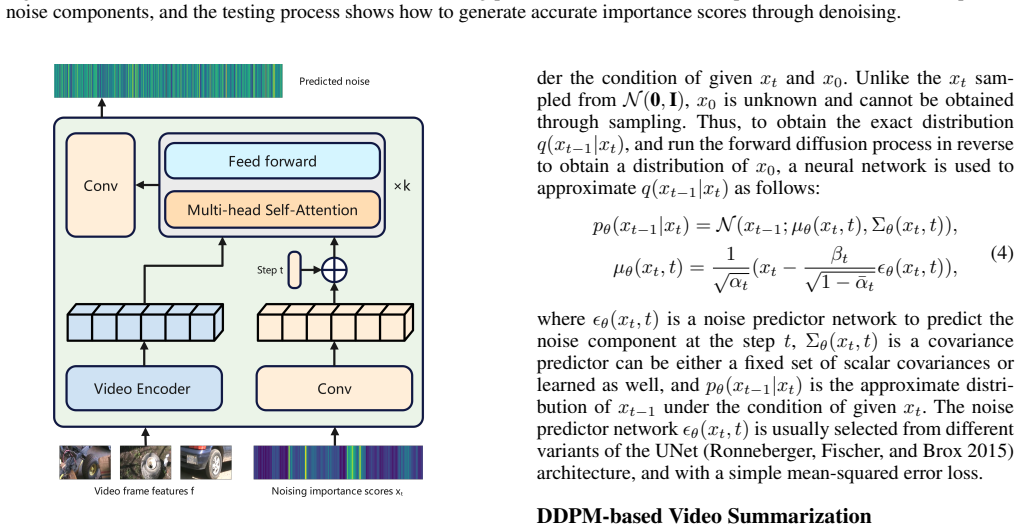
The key mechanism is the DDPM reverse process applied to frame importance scores, with video features as conditioning. The forward process defines $x_t = \sqrt{\bar\alpha_t} x_0 + \sqrt{1-\bar\alpha_t}\epsilon$, and the noise predictor $\epsilon_\theta(x_t, f, t)$ uses Transformer attention, treating the noised importance scores as queries and video features as keys and values, to predict the noise component at step $t$. The design choice that makes the method work under data scarcity is to initialize the reverse process with the scaled output of an unsupervised video summarization model instead of Gaussian noise, so the model only needs to perform $T=200$ denoising steps. The training objective is $\|\epsilon - \hat\epsilon\|^2$ over all annotators' raw scores, which lets the network learn the distribution of importance scores rather than a single averaged target.
What would settle it
Compare the empirical distribution of the scaled unsupervised-model outputs against the theoretical $q(x_T|x_0)$ for $T=200$ with the paper's variance schedule; if the two distributions differ substantially, the 'denoising' is not a valid reverse diffusion process, and the reported gains would need a different explanation.
Extended reading notes
Core claim
The paper's central claim is that modeling the distribution of per-annotator importance scores with a DDPM yields summaries that are more robust to subjective annotation noise and less prone to overfitting than discriminative score predictors. In training, ground-truth importance scores are linearly scaled to [-1,1] and noised for up to 200 steps; a Transformer-based noise predictor, with the noised scores as queries and video features as keys and values, is trained to estimate the added noise using a simple mean-squared error loss on each annotator's scores separately. At test time, the scaled output of an unsupervised video summarization model is treated as the starting state $x_T$ and is iteratively denoised for 200 steps to produce the final importance scores. The authors report the highest F-scores on all three datasets in all evaluated settings, along with the best Kendall's tau and Spearman's rho correlations, and interpret this as support for the generative formulation.
Load-bearing premise
The method assumes that the unsupervised model's scaled importance scores are distributed like ground-truth scores that have been corrupted by 200 steps of Gaussian noise, so that the reverse diffusion process starts on the manifold the model was trained on.
Editorial extensions
If this is right
- If the central claim is correct, generative score modeling replaces direct discriminative prediction as a robust formulation, achieving top F-scores on TVSum, SumMe, and FPVSum.
- Training on raw per-annotator scores, rather than averaged scores, is what provides resistance to subjective annotation noise.
- Starting the reverse process from an unsupervised model's output makes DDPM practical for small video summarization datasets, outperforming both pure DDPM and the unsupervised model alone in ablations.
- The larger gains in the transfer settings indicate that the method overfits less to training data and generalizes across domains.
Reading between the lines
- A testable extension is to apply the same recipe to other dense prediction tasks with noisy per-annotator labels, such as saliency or highlight detection, where learning the full label distribution may outperform learning the mean.
- The optimal choice of $T=200$ is likely tied to the distribution of the chosen unsupervised model's output; the method may require retuning $T$ if a different unsupervised model is used.
- The paper does not isolate how much of the improvement comes from the diffusion process itself versus from a learned refinement of the unsupervised scores; comparing against a lightweight residual correction head on top of the unsupervised output would separate those contributions.
- If the distributional assumption is relaxed, the framework could be interpreted as a learned post-processing of the unsupervised model's scores, which would make the 'denoising' framing a useful but not strictly necessary description.
Signed reviews
Editorial analysis
A structured set of objections, weighed in public.
Referee Report
Summary. The paper proposes a diffusion-based generative method for video summarization. A Transformer-based noise predictor is trained to denoise importance-score trajectories, conditioned on video features, with raw per-annotator importance scores scaled to [-1,1] as training targets. At test time the method scales the output of an unsupervised summarizer (DR-DSN) to [-1,1], treats it as a T-step noised score x_T, and performs T=200 denoising steps to obtain final importance scores. Experiments on TVSum, SumMe, and FPVSum report state-of-the-art F-scores, correlation coefficients, ablations, a hyperparameter study, and a user study.
Significance. If the core claims hold, the paper would establish that generative modeling of importance-score distributions is more robust to annotation subjectivity than direct discriminative prediction, and that coupling DDPM with an unsupervised initializer is a practical answer to limited training data. The manuscript has strengths: the method is described in enough detail to be reimplemented, ablations show that both the DDPM component and the unsupervised initialization contribute, and the evaluation covers several datasets, three standard settings, and rank-correlation metrics. The paper also makes a falsifiable prediction about transfer performance. However, the distinctive claim regarding raw per-annotator targets is not experimentally isolated, the test-time assumption that the unsupervised output is a valid DDPM noisy state is unsupported, and key hyperparameters are selected on the test benchmarks. The current evidence supports a promising method but not the strong robustness and generalization interpretation stated in the Abstract.
major comments (4)
- [Abstract/Introduction; Algorithm 1; Table 4] The central novelty claim is that training on raw per-annotator importance scores, rather than averaged scores, makes the method 'more resistant to subjective annotation noise' and 'less prone to overfitting'. This claim is never directly tested. Algorithm 1 always uses raw annotations, and the ablations in Table 4 vary only the DDPM component and the unsupervised initialization; no variant replaces raw targets with averaged ground-truth scores. As a result, the gains over discriminative baselines are confounded: they could be due to the DDPM architecture, the video-feature guidance, the DR-DSN starting point, or the 200-step schedule. Please add an ablation in which the only change is raw versus averaged annotation targets, and report train/test gap or training-curve evidence for the overfitting claim; the Abstract should be calibrated to the outcome of that experiment.
- [Eq. (7); Algorithm 2; Figure 4] The testing process assumes that the scaled output of the unsupervised model, x_T = Scale(x_u), is a valid noisy state under q(x_T|x_0) with the chosen T=200. No distributional evidence is provided for this equivalence. If DR-DSN scores are not distributed like a 200-step noised ground-truth score, the reverse process starts off-manifold and the method is not a valid DDPM denoising. Please provide diagnostics, such as comparing the empirical distribution of scaled DR-DSN outputs with that of training-time x_T samples from Eq. (5), or an experiment that replaces the DR-DSN starting point with an actual 200-step noised ground-truth score during evaluation.
- [Analysis of Hyper-parameter; Table 5; Figure 4] Important configuration choices are made using the test benchmarks. Table 5 selects DR-DSN as the unsupervised model because it gives the 'best overall performance' on TVSum and SumMe, and Figure 4 selects T=200 on the same datasets. Since the final method uses these choices, the reported test F-scores are not fully independent and the state-of-the-art claim is weakened. Use validation splits or nested cross-validation to select T and the unsupervised model, then report test performance only after those choices are fixed.
- [Quantitative Evaluation; Tables 1-3] The experiments average over five random splits, but no standard deviations, per-split results, or significance tests are reported. Several headline differences are moderate in magnitude (for example, SumMe canonical: 58.7 vs. 56.0 for CFT-GIB; TVSum transfer: 60.9 vs. 59.7 for RR-STG) and may be within split-to-split variation. Reporting variance is necessary before concluding that the proposed method is state of the art under all settings.
minor comments (5)
- [Related Work] The statement 'We make the first attempt to introduce DDPM into the field of video summarization' is contradicted by the cited baseline DMFF (Yu et al. 2024), which is a diffusion-based video summarization method; please qualify the novelty claim.
- [Ablation Study; Table 4] The column header 'FVPSum' is a typo for 'FPVSum'.
- [Experiment] The text refers to an appendix containing dataset details and additional visualization cases, but no appendix is present in the submitted version.
- [Analysis of Hyper-parameter; Figure 4] Figure 4 labels the hyperparameter as 't', while the method defines the maximum noise addition steps as T; please make the notation consistent throughout.
- [Eq. (6)] The loss is written as L = ||epsilon - hat-epsilon||^2 with no normalization or expectation; please clarify whether this is the per-sample simplified DDPM objective and how the loop over annotations and steps is aggregated.
Circularity Check
No significant circularity: the DDPM is trained on external labels and initialized from an independent unsupervised model, so the central result is not forced by construction.
full rationale
Walking the derivation chain, no load-bearing step reduces to its own input. The DDPM is trained with the standard objective (Eq. 6) on external per-annotator importance scores (Algorithm 1), and the test-time starting point is the output of an independent unsupervised model DR-DSN (Eq. 7, Zhou et al. 2018), not a quantity constructed from the fitted targets. The claimed noise robustness and generalization are empirical interpretations of Tables 1-4, not definitions equating the prediction with the training target. No uniqueness theorem, ansatz, or central premise is imported from a self-citation by the present authors; citations to Ho et al. and Zhou et al. are external and non-circular. The skeptic's concerns — no ablation replacing raw annotations with averaged targets, and selection of T and of the unsupervised model on the reported test sets — are experimental-confounding and evaluation-independence issues, not definitional circularity, and per the rubric they do not warrant a nonzero circularity score.
Assumptions & free parameters
free parameters (2)
- Maximum noise addition steps T =
200
- Unsupervised initialization model =
DR-DSN
assumptions (4)
- domain assumption Scaled ground-truth importance scores in [-1,1] are valid diffusion targets; Gaussian corruption in Eq. 5 is an appropriate forward process.
- ad hoc to paper The unsupervised model output x_u, after scaling, can be used as the noisy state x_T in Eq. 7, i.e., it approximates a T-step noised ground-truth score.
- ad hoc to paper Training on each raw annotation separately learns the true score distribution and therefore reduces annotation inconsistency.
- standard math Standard DDPM equations from Ho et al. 2020 (Eqs. 1-4, 8) are correct and applicable to sequence-valued importance scores.
Cite this review
Pith. "Pith review of Video Summarization using Denoising Diffusion Probabilistic Model." pith.science (2026). https://pith.science/paper/3SYWITXQ
@misc{pith2026241208357,
  author       = {Pith},
  title        = {Pith review of: Video Summarization using Denoising Diffusion Probabilistic Model},
  year         = {2026},
  howpublished = {\url{https://pith.science/paper/3SYWITXQ}},
  note         = {Machine review of arXiv:2412.08357}
}
read the original abstract
Video summarization aims to eliminate visual redundancy while retaining key parts of video to construct concise and comprehensive synopses. Most existing methods use discriminative models to predict the importance scores of video frames. However, these methods are susceptible to annotation inconsistency caused by the inherent subjectivity of different annotators when annotating the same video. In this paper, we introduce a generative framework for video summarization that learns how to generate summaries from a probability distribution perspective, effectively reducing the interference of subjective annotation noise. Specifically, we propose a novel diffusion summarization method based on the Denoising Diffusion Probabilistic Model (DDPM), which learns the probability distribution of training data through noise prediction, and generates summaries by iterative denoising. Our method is more resistant to subjective annotation noise, and is less prone to overfitting the training data than discriminative methods, with strong generalization ability. Moreover, to facilitate training DDPM with limited data, we employ an unsupervised video summarization model to implement the earlier denoising process. Extensive experiments on various datasets (TVSum, SumMe, and FPVSum) demonstrate the effectiveness of our method.
Figures


Figures from the paper (3 more)


Reference graph
Works this paper leans on
-
[1]
I.; Mezaris, V.; and Patras, I
Apostolidis, E.; Adamantidou, E.; Metsai, A. I.; Mezaris, V.; and Patras, I. 2020 a . AC-SUM-GAN: Connecting actor-critic and generative adversarial networks for unsupervised video summarization. IEEE Transactions on Circuits and Systems for Video Technology, 31(8): 3278--3292
work page 2020
-
[2]
I.; Mezaris, V.; and Patras, I
Apostolidis, E.; Adamantidou, E.; Metsai, A. I.; Mezaris, V.; and Patras, I. 2020 b . Unsupervised video summarization via attention-driven adversarial learning. In Proceedings of the International Conference on MultiMedia Modeling, 492--504. Springer
work page 2020
-
[3]
Bousmalis, K.; Trigeorgis, G.; Silberman, N.; Krishnan, D.; and Erhan, D. 2016. Domain separation networks. Advances in Neural Information Processing Systems, 29
work page 2016
-
[4]
Carrillo, H.; Cl \'e ment, M.; Bugeau, A.; and Simo-Serra, E. 2023. Diffusart: Enhancing line art colorization with conditional diffusion models. In Proceedings of the IEEE/CVF Conference on Computer Vision and Pattern Recognition, 3486--3490
work page 2023
-
[5]
De Avila, S. E. F.; Lopes, A. P. B.; da Luz Jr, A.; and de Albuquerque Ara \'u jo, A. 2011. VSUMM: A mechanism designed to produce static video summaries and a novel evaluation method. Pattern Recognition Letters, 32(1): 56--68
work page 2011
-
[6]
S.; Argyriou, V.; Monekosso, D.; and Remagnino, P
Fajtl, J.; Sokeh, H. S.; Argyriou, V.; Monekosso, D.; and Remagnino, P. 2019. Summarizing videos with attention. In Proceedings of the Asian Conference on Computer Vision, 39--54. Springer
work page 2019
-
[7]
Gao, S.; Liu, X.; Zeng, B.; Xu, S.; Li, Y.; Luo, X.; Liu, J.; Zhen, X.; and Zhang, B. 2023. Implicit diffusion models for continuous super-resolution. In Proceedings of the IEEE/CVF Conference on Computer Vision and Pattern Recognition, 10021--10030
2023
-
[8]
Gong, B.; Chao, W.-L.; Grauman, K.; and Sha, F. 2014. Diverse sequential subset selection for supervised video summarization. Advances in Neural Information Processing Systems, 27
work page 2014
Show all 45 references
-
[9]
He, X.; Hua, Y.; Song, T.; Zhang, Z.; Xue, Z.; Ma, R.; Robertson, N.; and Guan, H. 2019. Unsupervised video summarization with attentive conditional generative adversarial networks. In Proceedings of the 27th ACM International Conference on Multimedia, 2296--2304
2019
-
[10]
Ho, H.-I.; Chiu, W.-C.; and Wang, Y.-C. F. 2018. Summarizing first-person videos from third persons' points of view. In Proceedings of the European Conference on Computer Vision, 70--85
2018
-
[11]
Ho, J.; Jain, A.; and Abbeel, P. 2020. Denoising diffusion probabilistic models. Advances in Neural Information Processing Systems, 33: 6840--6851
2020
-
[12]
Hsu, T.-C.; Liao, Y.-S.; and Huang, C.-R. 2023. Video summarization with spatiotemporal vision transformer. IEEE Transactions on Image Processing, 32: 3013--3026
2023
-
[13]
Ji, Z.; Xiong, K.; Pang, Y.; and Li, X. 2019. Video summarization with attention-based encoder--decoder networks. IEEE Transactions on Circuits and Systems for Video Technology, 30(6): 1709--1717
2019
-
[14]
U.; Khan, Z
Khan, H.; Hussain, T.; Khan, S. U.; Khan, Z. A.; and Baik, S. W. 2024. Deep multi-scale pyramidal features network for supervised video summarization. Expert Systems with Applications, 237: 121288
2024
-
[15]
Lagani \`e re, R.; Bacco, R.; Hocevar, A.; Lambert, P.; Pa \" s, G.; and Ionescu, B. E. 2008. Video summarization from spatio-temporal features. In Proceedings of the 2nd ACM TRECVid Video Summarization Workshop, 144--148
2008
-
[16]
Li, H.; Ke, Q.; Gong, M.; and Drummond, T. 2023. Progressive video summarization via multimodal self-supervised learning. In Proceedings of the IEEE/CVF Winter Conference on Applications of Computer Vision, 5584--5593
2023
-
[17]
Li, H.; Yang, Y.; Chang, M.; Chen, S.; Feng, H.; Xu, Z.; Li, Q.; and Chen, Y. 2022. Srdiff: Single image super-resolution with diffusion probabilistic models. Neurocomputing, 479: 47--59
2022
-
[18]
Liang, G.; Lv, Y.; Li, S.; Zhang, S.; and Zhang, Y. 2022. Video summarization with a convolutional attentive adversarial network. Pattern Recognition, 131: 108840
2022
-
[19]
Liu, T.; Meng, Q.; Huang, J.-J.; Vlontzos, A.; Rueckert, D.; and Kainz, B. 2022. Video summarization through reinforcement learning with a 3D spatio-temporal u-net. IEEE Transactions on Image Processing, 31: 1573--1586
2022
-
[20]
Mahasseni, B.; Lam, M.; and Todorovic, S. 2017. Unsupervised video summarization with adversarial lstm networks. In Proceedings of the IEEE conference on Computer Vision and Pattern Recognition, 202--211
2017
-
[21]
Nam, Y.; Lehavi, A.; Yang, D.; Bose, D.; Swayamdipta, S.; and Narayanan, S. 2024. Does Video Summarization Require Videos? Quantifying the Effectiveness of Language in Video Summarization. In Proceedings of the International Conference on Acoustics, Speech and Signal Processin...
2024
-
[22]
Q.; and Dhariwal, P
Nichol, A. Q.; and Dhariwal, P. 2021. Improved denoising diffusion probabilistic models. In Proceedings of the International Conference on Machine Learning, 8162--8171. PMLR
2021
-
[23]
Otani, M.; Nakashima, Y.; Rahtu, E.; and Heikkila, J. 2019. Rethinking the evaluation of video summaries. In Proceedings of the IEEE/CVF Conference on Computer Vision and Pattern Recognition, 7596--7604
2019
-
[24]
Ren, Z.; Yan, J.; Ni, B.; Liu, B.; Yang, X.; and Zha, H. 2017. Unsupervised deep learning for optical flow estimation. In Proceedings of the AAAI Conference on Artificial Intelligence, volume 31
2017
-
[25]
Rochan, M.; Ye, L.; and Wang, Y. 2018. Video summarization using fully convolutional sequence networks. In Proceedings of the European Conference on Computer Vision, 347--363
2018
-
[26]
Ronneberger, O.; Fischer, P.; and Brox, T. 2015. U-net: Convolutional networks for biomedical image segmentation. In Proceedings of the International Conference on Medical Image Computing and Computer-Assisted Intervention, 234--241. Springer
2015
-
[27]
Singh, A.; and Kumar, M. 2024. Bayesian fuzzy clustering and deep CNN-based automatic video summarization. Multimedia Tools and Applications, 83(1): 963--1000
2024
-
[28]
Song, Y.; Vallmitjana, J.; Stent, A.; and Jaimes, A. 2015. Tvsum: Summarizing web videos using titles. In Proceedings of the IEEE/CVF Conference on Computer Vision and Pattern Recognition, 5179--5187
2015
-
[29]
Terbouche, H.; Morel, M.; Rodriguez, M.; and Othmani, A. 2023. Multi-annotation attention model for video summarization. In Proceedings of the IEEE/CVF Conference on Computer Vision and Pattern Recognition, 3143--3152
2023
-
[30]
Wang, G.; Wu, X.; and Yan, J. 2024. Progressive reinforcement learning for video summarization. Information Sciences, 655: 119888
2024
-
[31]
H.; and De la Torre, F
Wu, C. H.; and De la Torre, F. 2023. A latent space of stochastic diffusion models for zero-shot image editing and guidance. In Proceedings of the IEEE/CVF International Conference on Computer Vision, 7378--7387
2023
-
[32]
Yao, T.; Mei, T.; and Rui, Y. 2016. Highlight detection with pairwise deep ranking for first-person video summarization. In Proceedings of the IEEE/CVF Conference on Computer Vision and Pattern Recognition, 982--990
2016
-
[33]
Yu, Q.; Yu, H.; Sun, Y.; Ding, D.; and Jian, M. 2024. Unsupervised Video Summarization Based on the Diffusion Model of Feature Fusion. IEEE Transactions on Computational Social Systems
2024
-
[34]
Zhang, K.; Chao, W.-L.; Sha, F.; and Grauman, K. 2016. Video summarization with long short-term memory. In Proceedings of the European Conference on Computer Vision, 766--782. Springer
2016
-
[35]
Zhang, Y.; Liu, Y.; Kang, W.; and Tao, R. 2023. VSS-Net: visual semantic self-mining network for video summarization. IEEE Transactions on Circuits and Systems for Video Technology
2023
-
[36]
Zhang, Y.; Liu, Y.; and Wu, C. 2024. Attention-guided multi-granularity fusion model for video summarization. Expert Systems with Applications, 249: 123568
2024
-
[37]
Zhao, B.; Li, H.; Lu, X.; and Li, X. 2021. Reconstructive sequence-graph network for video summarization. IEEE Transactions on Pattern Analysis and Machine Intelligence, 44(5): 2793--2801
2021
-
[38]
Zhao, B.; Li, X.; and Lu, X. 2017. Hierarchical recurrent neural network for video summarization. In Proceedings of the 25th ACM international conference on Multimedia, 863--871
2017
-
[39]
Zhao, B.; Li, X.; and Lu, X. 2018. Hsa-rnn: Hierarchical structure-adaptive rnn for video summarization. In Proceedings of the IEEE/CVF Conference on Computer Vision and Pattern Recognition, 7405--7414
2018
-
[40]
Zhong, R.; Wang, R.; Yao, W.; Hu, M.; Dong, S.; and Munteanu, A. 2023. Semantic representation and attention alignment for Graph Information Bottleneck in video summarization. IEEE Transactions on Image Processing
2023
-
[41]
Zhou, K.; Qiao, Y.; and Xiang, T. 2018. Deep reinforcement learning for unsupervised video summarization with diversity-representativeness reward. In Proceedings of the AAAI Conference on Artificial Intelligence (AAAI), volume 32
2018
-
[42]
Zhu, W.; Han, Y.; Lu, J.; and Zhou, J. 2022. Relational reasoning over spatial-temporal graphs for video summarization. IEEE Transactions on Image Processing, 31: 3017--3031
2022
-
[43]
Zhu, W.; Lu, J.; Li, J.; and Zhou, J. 2020. Dsnet: A flexible detect-to-summarize network for video summarization. IEEE Transactions on Image Processing, 30: 948--962
2020
-
[44]
, " * write output.state after.block = add.period write newline
ENTRY address archivePrefix author booktitle chapter edition editor eid eprint howpublished institution isbn journal key month note number organization pages publisher school series title type volume year label extra.label sort.label short.list INTEGERS output.state before.all...
-
[45]
write newline
" write newline "" before.all 'output.state := FUNCTION n.dashify 't := "" t empty not t #1 #1 substring "-" = t #1 #2 substring "--" = not "--" * t #2 global.max substring 't := t #1 #1 substring "-" = "-" * t #2 global.max substring 't := while if t #1 #1 substring * t #2 gl...
Reviewed August 11, 2026 · model on record in the stance chip above.
Discussion (0). Continue with ORCID to comment.