REVIEW 3 major objections 5 minor 32 references
Strategies and Challenges of Efficient White-Box Training for Human Activity Recognition
T0 review · 3 major / 5 minor · reviewed 2026-08-11 · deepseek-v4-flash
Pith's one-line read This paper proposes a white-box training framework for Human Activity Recognition that visualizes latent-space dynamics, enables human-in-the-loop adjustments, and uses an LLM assistant to make training more transparent, trustworthy, and…
desk verdict A coherent but purely conceptual white-box training framework for HAR, honestly labeled as future work; the abstract overclaims and there is no experimental validation to accept or reject. read the letter →
The pith
A machine-rendered reading of the paper's core claim, the machinery that carries it, and where it could break.
The reading
What carries the argument
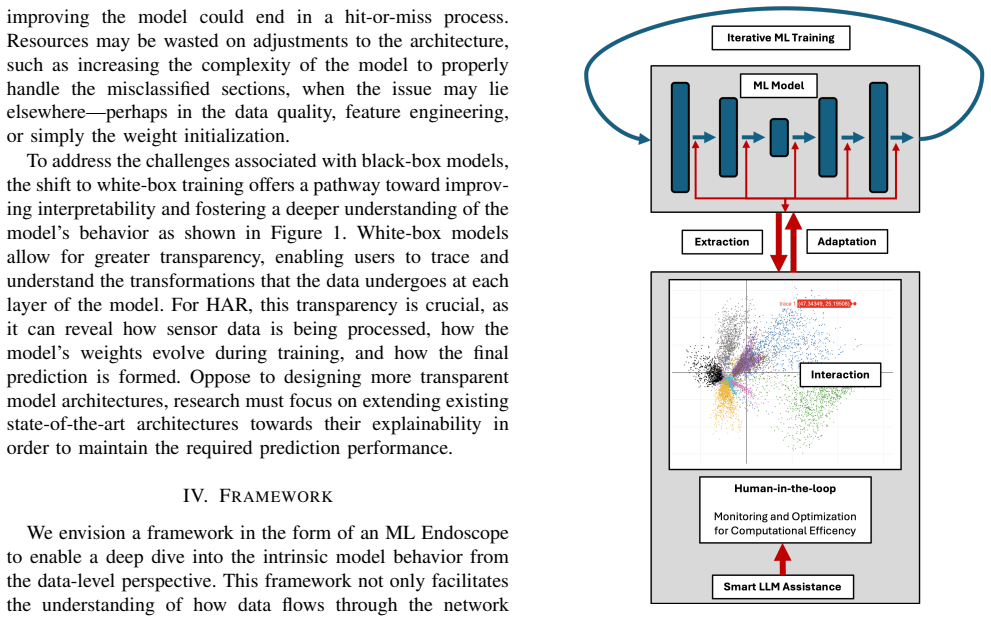
The central object is the ML Endoscope, a human-in-the-loop training interface that reveals latent-space dynamics from intermediate layer outputs of a HAR network. Its working parts are three complementary visualization strategies: scatter plots (with PCA, t-SNE, or UMAP projections) for judging class separability and spotting outliers, parallel-coordinate plots for ranking the relevance of individual latent dimensions, and radar plots for comparing feature profiles across activity classes. The feedback mechanism is the human (or the LLM) acting on these views: users manually adjust latent projections or tweak model parameters when they see misclassifications or poor separation, and the LLM agent interprets the visualizations in natural language and proposes corrective measures. This combination is what carries the argument that white-box training can be efficient: instead of blind trial-and-error architecture changes, the framework lets the source of error be located visually and corrected immediately.
What would settle it
A controlled PAMAP2 experiment would falsify the central claim if expert users or LLM-assisted users applying the proposed adjustments fail to reduce training time or improve F1-score compared with an identical black-box baseline, or if LLM suggestions based on 2D projections systematically lead to changes that worsen performance.
Extended reading notes
Core claim
The central claim of the paper is that transparency can be added to existing black-box HAR architectures without replacing them, by making their internal representations inspectable during training. The framework keeps the predictive architecture untouched and instead instruments it as an endoscope: latent activations are projected into human-perceptible views, and the resulting visual structure (cluster separability, outliers, dimension relevance) becomes a diagnostic target. The paper argues that well-structured latent spaces support overall model performance, so when the visualizations expose poorly separated classes or noisy outliers, the user can intervene directly, either by adjusting the latent-space geometry or by changing model parameters, and observe the effect in real time. An LLM agent, optionally paired with a vision model, is proposed as a co-pilot that reads the plots and recommends corrective steps, with a caveat that the LLM's compute cost must be balanced against the efficiency gains. The discovery, as stated, is the framework itself: a concrete strategy for combining visualization, human intuition, and language-model guidance to turn black-box training into an interpretable, human-steerable process.
Load-bearing premise
The framework depends on the assumption that users, with or without LLM help, can correctly interpret the latent-space visualizations and that their manual or suggested tweaks will actually improve model accuracy and training efficiency rather than degrade them.
Editorial extensions
If this is right
- HAR practitioners could trace misclassifications to their root cause (sensor noise, feature overlap, or initialization) rather than guess at architecture changes.
- Training runs could converge in fewer epochs because human or LLM feedback corrects errors as they appear, saving compute and energy.
- In healthcare and other trust-critical settings, model decisions would come with visual and natural-language justifications that non-experts can check.
- The same black-box architecture can remain in production, meaning white-box training is a drop-in addition rather than a replacement of state-of-the-art models.
- Efficiency claims hinge on using LLM guidance sparingly: periodic or hybrid queries keep the assistant's compute cost from canceling the training savings.
Reading between the lines
- A concrete test the paper leaves implicit: on PAMAP2, compare black-box training, visualization-only monitoring, human-in-the-loop adjustment, and LLM-assisted adjustment on accuracy, convergence time, and energy per epoch; the framework predicts the two interactive conditions beat the passive ones.
- The viability of the LLM assistant likely depends on how well a vision-language model can read lossy 2D projections, so a sensible safeguard is to validate LLM suggestions against the original high-dimensional latent space before applying them.
- The same white-box training recipe should transfer to other wearable and time-series domains, such as gesture recognition or predictive maintenance, where class overlap and sensor artifacts create the same diagnostic blind spots.
Signed reviews
Editorial analysis
A structured set of objections, weighed in public.
Referee Report
Summary. The paper proposes a framework called the ML Endoscope for making black-box HAR models more interpretable and efficient. The core idea is to visualize latent space dynamics during training, let human users interact with the model (Human-in-the-Loop) to correct misclassifications or adjust parameters, and optionally use LLMs to help users interpret the visualizations. The paper describes challenges of black-box HAR models, related work on interactive visualization and explainability, and outlines a set of visualization strategies, a HITL training loop, and an LLM agent support concept. It then presents an evaluation plan using datasets such as PAMAP2 with metrics like accuracy, silhouette score, and expert feedback. However, the paper contains no experiments, no implementation, and no quantitative or qualitative results; Section V describes only planned evaluations and Section VI explicitly states that future work will conduct in-depth evaluations and move 'beyond conceptual proposals.'
Significance. The framework addresses a real need: HAR models for wearable sensor data are often opaque, and providing human-understandable views of the training process could help practitioners diagnose misclassifications and reduce training cost. The paper also builds on a plausible prior result in the image domain [17], extending the idea to time-series HAR, which is a meaningful direction. Its explicit discussion of the trade-off between LLM assistance and efficiency (Section IV.C) shows intellectual honesty. If the framework were implemented and validated, it could be a useful contribution to interactive machine learning for HAR. As it stands, however, the paper is a well-organized position statement, not a completed research contribution: every claimed benefit (improved explainability, trust, efficiency, performance) is asserted without supporting evidence, and no artifact, code, or dataset is provided.
major comments (3)
- [Abstract, Section V, Section VI] The central claims that the framework 'improves explainability, fosters trust, and promotes transparent HAR systems' are not supported by any experimental data. Section V only describes metrics that 'can be calculated' and evaluations that are 'designed' but not executed, while Section VI states that 'Future work will focus on conducting in-depth evaluations ... moving beyond conceptual proposals and discussion to practical implementation and validation.' There is no implementation, no user study, no accuracy or efficiency result, and no code or dataset. For a journal submission, the abstract's assertions are load-bearing and need at least a proof-of-concept evaluation: a concrete HAR experiment (e.g., PAMAP2) comparing the proposed HITL approach against a baseline, with quantitative results for classification performance, convergence time or energy, and a user study or simulated intervention analysis.
- [Section IV.B] The HITL mechanism is under-specified. The paper states that users 'can manually adjust the latent space projections or tweak model parameters when they observe misclassifications or issues with feature separability,' but it does not describe how such adjustments are fed back into the network—e.g., whether the user modifies gradients, constrains activations, adds a regularization term, or directly adjusts weights. Reference [17] provides a concrete mechanism for images, but HAR's temporal dependencies and the proposed LLM integration introduce new challenges that are not addressed. Without a specific, reproducible algorithm for the intervention step, the framework cannot be evaluated, reimplemented, or compared with baselines.
- [Section IV.C] The efficiency claim is internally weakened. The paper acknowledges that 'the efficiency gains in training need to be significant enough to justify the computational costs of frequent LLM interactions' and that 'training efficiency enhancements may become irrelevant due to the excessive use of the LLM.' Yet the abstract and introduction claim that the framework is 'scalable and efficient' and can 'shrink its required resources.' No quantitative energy or latency model is provided, and no analysis of when the HITL/LLM overhead would outweigh the benefits. This tension needs to be resolved either by measured efficiency results or by a clearly scoped cost-benefit analysis.
minor comments (5)
- [Index Terms] The word 'Efficency' is misspelled; it should be 'Efficiency.'
- [Section II.A] The sentence 'These tools help open up the black-box nature of ML models [11]' is missing a period at the end.
- [Section III] The phrase 'Oppose to designing more transparent model architectures' should read 'Opposed to designing' or 'In contrast to designing.'
- [Section IV.C] The word 'targetted' is misspelled; it should be 'targeted.'
- [Section IV.A] The text says 'The overall concept can be found on Figure 2,' but the figure is not described in enough detail in the body; please add a few sentences explaining the endoscope's components and data flow, since the figure currently carries most of the framework's structural information.
Circularity Check
No significant circularity: the paper proposes a white-box HAR training framework without any derivation, equations, or fitted predictions to reduce to its own inputs.
full rationale
The paper is a conceptual position piece. It introduces an 'ML Endoscope' framework and argues that visualizing latent spaces plus Human-in-the-Loop and LLM assistance can improve interpretability, trust, and training efficiency, but it presents no experimental results, formal model, or quantitative derivation. Because there is no derivation chain, there is nothing that reduces by construction to an input. The abstract's claims about improving explainability and fostering trust are unsupported by evidence, and Section IV.B's assertion that users 'can manually adjust the latent space projections or tweak model parameters' is an unvalidated assumption; Section V describes the evaluation only as a plan and Section VI explicitly defers implementation and validation to future work. These are evidence gaps and correctness risks, not circularity. The paper self-cites references [9] and [12] for energy demand and latent activation probing, but the framework's core proposal does not rest on those cited tools: the argument would stand or fall identically if those citations were removed, and no cited 'uniqueness theorem' or fitted parameter is invoked to force the proposal. No equation in the paper sets a defined quantity equal to a predicted quantity, and no empirical benchmark is used to define the framework's claimed benefits. Accordingly, the appropriate finding is no significant circularity (score 0), with the caveat that the absence of a derivation also means the central claims are not yet established.
Assumptions & free parameters
assumptions (3)
- domain assumption Well-structured latent spaces from intermediate model layers support overall model performance.
- domain assumption Human-in-the-loop feedback improves model performance and training efficiency.
- domain assumption LLMs can accurately interpret latent space visualizations and provide actionable optimization guidance.
Cite this review
Pith. "Pith review of Strategies and Challenges of Efficient White-Box Training for Human Activity Recognition." pith.science (2026). https://pith.science/paper/KEEALGEY
@misc{pith2026241208507,
  author       = {Pith},
  title        = {Pith review of: Strategies and Challenges of Efficient White-Box Training for Human Activity Recognition},
  year         = {2026},
  howpublished = {\url{https://pith.science/paper/KEEALGEY}},
  note         = {Machine review of arXiv:2412.08507}
}
read the original abstract
Human Activity Recognition using time-series data from wearable sensors poses unique challenges due to complex temporal dependencies, sensor noise, placement variability, and diverse human behaviors. These factors, combined with the nontransparent nature of black-box Machine Learning models impede interpretability and hinder human comprehension of model behavior. This paper addresses these challenges by exploring strategies to enhance interpretability through white-box approaches, which provide actionable insights into latent space dynamics and model behavior during training. By leveraging human intuition and expertise, the proposed framework improves explainability, fosters trust, and promotes transparent Human Activity Recognition systems. A key contribution is the proposal of a Human-in-the-Loop framework that enables dynamic user interaction with models, facilitating iterative refinements to enhance performance and efficiency. Additionally, we investigate the usefulness of Large Language Model as an assistance to provide users with guidance for interpreting visualizations, diagnosing issues, and optimizing workflows. Together, these contributions present a scalable and efficient framework for developing interpretable and accessible Human Activity Recognition systems.
Figures


Reference graph
Works this paper leans on
-
[17]
Fine-tuning deep neural networks by interactively refining the 2d latent space of ambiguous images
J. Wei, H. Xie, C.-M. Chang, and X. Yang, “Fine-tuning deep neural networks by interactively refining the 2d latent space of ambiguous images.” in IJCAI, 2022, pp. 5948–5951
work page 2022
-
[12]
D. Geißler, B. Zhou, P. Lukowicz, and R. Kaiserslautern-Landau, “Latent inspector: an interactive tool for probing neural network behaviors through arbitrary latent activation,” in Proceedings of the Thirty-Second International Joint Conference on Artificial Intelligence, 2023, pp. 7127– 7130
work page 2023
-
[1]
A survey on human activity recognition using wearable sensors,
O. D. Lara and M. A. Labrador, “A survey on human activity recognition using wearable sensors,” IEEE communications surveys & tutorials , vol. 15, no. 3, pp. 1192–1209, 2012
2012
-
[2]
Deep learning for sensor-based activity recognition: A survey,
J. Wang, Y . Chen, S. Hao, X. Peng, and L. Hu, “Deep learning for sensor-based activity recognition: A survey,” Pattern recognition letters, vol. 119, pp. 3–11, 2019
2019
-
[3]
Activity recognition us- ing cell phone accelerometers,
J. R. Kwapisz, G. M. Weiss, and S. A. Moore, “Activity recognition us- ing cell phone accelerometers,” ACM SigKDD Explorations Newsletter , vol. 12, no. 2, pp. 74–82, 2011
work page 2011
-
[4]
imove: Exploring bio-impedance sensing for fitness activity recogni- tion,
M. Liu, V . F. Rey, Y . Zhang, L. S. S. Ray, B. Zhou, and P. Lukowicz, “imove: Exploring bio-impedance sensing for fitness activity recogni- tion,” in 2024 IEEE International Conference on Pervasive Computing and Communications (PerCom). IEEE, 2024, pp. 194–205
2024
-
[5]
D. Geißler, B. Zhou, H. Bello, J. Sorysz, L. Ray, H. Javaheri, M. R ¨ub, J. Herbst, E. Zahn, E. Woop et al., “Embedding textile capacitive sensing into smart wearables as a versatile solution for human motion capturing,” Scientific Reports, vol. 14, no. 1, p. 15797, 2024
work page 2024
-
[6]
The mythos of model interpretability: In machine learning, the concept of interpretability is both important and slippery
Z. C. Lipton, “The mythos of model interpretability: In machine learning, the concept of interpretability is both important and slippery.” Queue, vol. 16, no. 3, pp. 31–57, 2018
2018
Show all 32 references
-
[7]
A survey of methods for explaining black box models,
R. Guidotti, A. Monreale, S. Ruggieri, F. Turini, F. Giannotti, and D. Pedreschi, “A survey of methods for explaining black box models,” ACM computing surveys (CSUR) , vol. 51, no. 5, pp. 1–42, 2018
2018
-
[8]
” why should i trust you?
M. T. Ribeiro, S. Singh, and C. Guestrin, “” why should i trust you?” explaining the predictions of any classifier,” in Proceedings of the 22nd ACM SIGKDD international conference on knowledge discovery and data mining, 2016, pp. 1135–1144
2016
-
[9]
The power of training: How different neural network setups influence the energy demand,
D. Geißler, B. Zhou, M. Liu, S. Suh, and P. Lukowicz, “The power of training: How different neural network setups influence the energy demand,” arXiv preprint arXiv:2401.01851 , 2024
2024 arXiv
-
[10]
Towards a rigorous science of interpretable machine learning,
F. Doshi-Velez and B. Kim, “Towards a rigorous science of interpretable machine learning,” arXiv preprint arXiv:1702.08608 , 2017
2017 arXiv
-
[11]
Interactive slice visualiza- tion for exploring machine learning models,
C. Hurley, M. O’Connell, and K. Domijan, “Interactive slice visualiza- tion for exploring machine learning models,” Journal of Computational and Graphical Statistics , vol. 31, pp. 1 – 13, 2021
2021
-
[13]
Visualizing dataflow graphs of deep learning models in tensorflow,
K. Wongsuphasawat, D. Smilkov, J. Wexler, J. Wilson, D. Man ´e, D. Fritz, D. Krishnan, F. Vi ´egas, and M. Wattenberg, “Visualizing dataflow graphs of deep learning models in tensorflow,” IEEE Trans- actions on Visualization and Computer Graphics , vol. 24, pp. 1–12, 2018
2018
-
[14]
Visualizing the hidden activity of artificial neural networks,
P. E. Rauber, S. G. Fadel, A. Falc ˜ao, and A. Telea, “Visualizing the hidden activity of artificial neural networks,” IEEE Transactions on Visualization and Computer Graphics , vol. 23, pp. 101–110, 2017
2017
-
[15]
Visual human+machine learn- ing,
R. Fuchs, J. Waser, and M. E. Gr ¨oller, “Visual human+machine learn- ing,” IEEE Transactions on Visualization and Computer Graphics , vol. 15, 2009
2009
-
[16]
What you see is what you can change: Human- centered machine learning by interactive visualization,
D. Sacha, M. Sedlmair, L. Zhang, J. Lee, J. Peltonen, D. Weiskopf, S. North, and D. Keim, “What you see is what you can change: Human- centered machine learning by interactive visualization,” Neurocomput- ing, vol. 268, pp. 164–175, 2017
2017
-
[18]
Infogan: Interpretable representation learning by information maximizing generative adversarial nets,
X. Chen, Y . Duan, R. Houthooft, J. Schulman, I. Sutskever, and P. Abbeel, “Infogan: Interpretable representation learning by information maximizing generative adversarial nets,” Advances in neural information processing systems, vol. 29, 2016
2016
-
[19]
Ib-gan: Disentangled rep- resentation learning with information bottleneck generative adversarial networks,
I. Jeon, W. Lee, M. Pyeon, and G. Kim, “Ib-gan: Disentangled rep- resentation learning with information bottleneck generative adversarial networks,” in Proceedings of the AAAI conference on artificial intelli- gence, vol. 35, no. 9, 2021, pp. 7926–7934
2021
-
[20]
Understanding disentangling in β-vae,
C. P. Burgess, I. Higgins, A. Pal, L. Matthey, N. Watters, G. Desjardins, and A. Lerchner, “Understanding disentangling in β-vae,” arXiv preprint arXiv:1804.03599, 2018
2018 arXiv
-
[21]
Disen- tanglement via latent quantization,
K. Hsu, W. Dorrell, J. Whittington, J. Wu, and C. Finn, “Disen- tanglement via latent quantization,” Advances in Neural Information Processing Systems, vol. 36, 2024
2024
-
[22]
Human- interpretable model explainability on high-dimensional data,
D. de Mijolla, C. Frye, M. Kunesch, J. Mansir, and I. Feige, “Human- interpretable model explainability on high-dimensional data,” arXiv preprint arXiv:2010.07384, 2020
2010 arXiv
-
[23]
A disentangling invertible interpretation network for explaining latent representations,
P. Esser, R. Rombach, and B. Ommer, “A disentangling invertible interpretation network for explaining latent representations,” in Pro- ceedings of the IEEE/CVF Conference on Computer Vision and Pattern Recognition, 2020, pp. 9223–9232
2020
-
[24]
This looks like that... does it? shortcomings of latent space prototype interpretability in deep networks,
A. Hoffmann, C. Fanconi, R. Rade, and J. Kohler, “This looks like that... does it? shortcomings of latent space prototype interpretability in deep networks,” arXiv preprint arXiv:2105.02968 , 2021
2021 arXiv
-
[25]
A survey on neural network interpretability,
Y . Zhang, P. Ti ˇno, A. Leonardis, and K. Tang, “A survey on neural network interpretability,” IEEE Transactions on Emerging Topics in Computational Intelligence, vol. 5, no. 5, pp. 726–742, 2021
2021
-
[26]
Explaining deep neural networks and beyond: A review of methods and applications,
W. Samek, G. Montavon, S. Lapuschkin, C. J. Anders, and K.-R. M ¨uller, “Explaining deep neural networks and beyond: A review of methods and applications,” Proceedings of the IEEE , vol. 109, no. 3, pp. 247–278, 2021
2021
-
[27]
Interpretable deep learning: Interpretation, interpretability, trustworthi- ness, and beyond,
X. Li, H. Xiong, X. Li, X. Wu, X. Zhang, J. Liu, J. Bian, and D. Dou, “Interpretable deep learning: Interpretation, interpretability, trustworthi- ness, and beyond,” Knowledge and Information Systems, vol. 64, no. 12, pp. 3197–3234, 2022
2022
-
[28]
Liii. on lines and planes of closest fit to systems of points in space,
K. P. F.R.S., “Liii. on lines and planes of closest fit to systems of points in space,” The London, Edinburgh, and Dublin Philosophical Magazine and Journal of Science , vol. 2, no. 11, pp. 559–572, 1901
1901
-
[29]
Visualizing data using t-sne
L. Van der Maaten and G. Hinton, “Visualizing data using t-sne.” Journal of machine learning research , vol. 9, no. 11, 2008
2008
-
[30]
Umap: Uniform manifold approximation and projection for dimension reduction,
L. McInnes, J. Healy, and J. Melville, “Umap: Uniform manifold approximation and projection for dimension reduction,” arXiv preprint arXiv:1802.03426, 2018
2018 arXiv
-
[31]
Learning transferable visual models from natural language supervision,
A. Radford, J. W. Kim, C. Hallacy, A. Ramesh, G. Goh, S. Agarwal, G. Sastry, A. Askell, P. Mishkin, J. Clark et al., “Learning transferable visual models from natural language supervision,” in International conference on machine learning . PMLR, 2021, pp. 8748–8763
2021
-
[32]
Introducing a new benchmarked dataset for activity monitoring,
A. Reiss and D. Stricker, “Introducing a new benchmarked dataset for activity monitoring,” in 2012 16th international symposium on wearable computers. IEEE, 2012, pp. 108–109
2012
Reviewed August 11, 2026 · model on record in the stance chip above.
Discussion (0). Continue with ORCID to comment.