REVIEW 4 major objections 5 minor 119 references
Beyond the Goldilocks Zone: Identifying Critical Features in Massive Black Hole Formation
T0 review · 4 major / 5 minor · reviewed 2026-08-11 · deepseek-v4-flash
Pith's one-line read This paper claims that whether an early atomic-cooling halo can host a direct-collapse black hole depends mainly on its central gas density and radial mass influx, not on Lyman-Werner radiation or proximity to neighboring galaxies.
desk verdict Density and inflow ranking is real but may just trace the starless selection; needs a starless-control test to separate selection from physics. read the letter →
The pith
A machine-rendered reading of the paper's core claim, the machinery that carries it, and where it could break.
The reading
What carries the argument
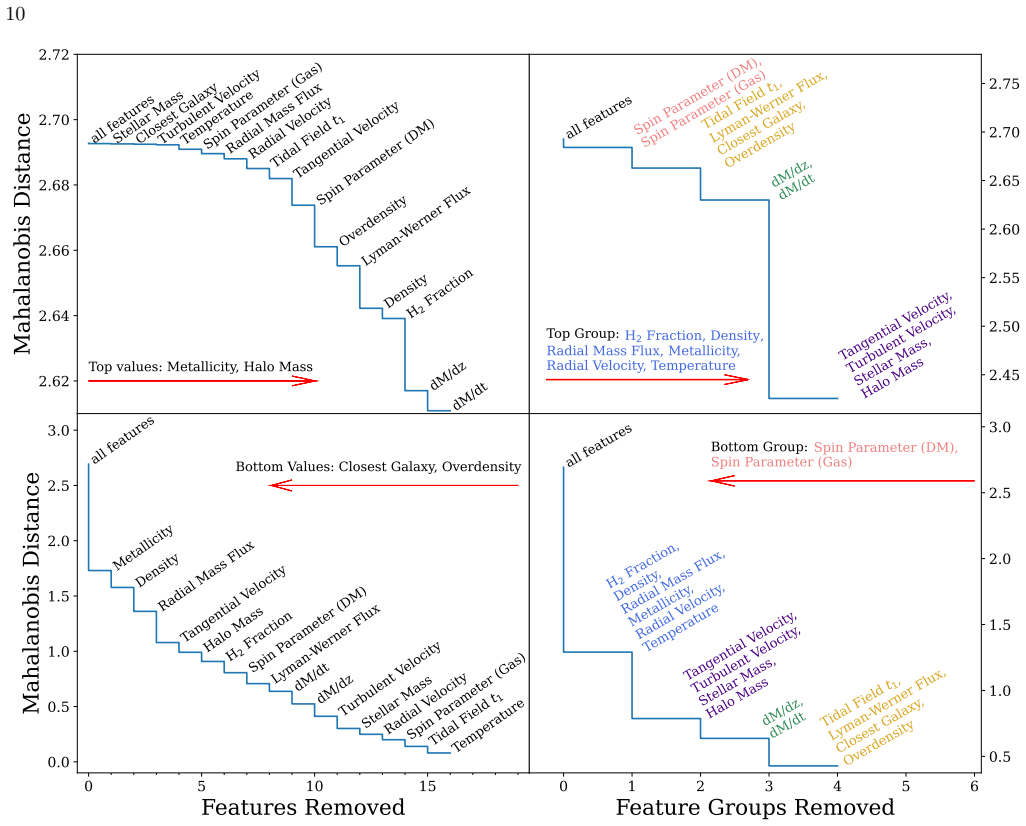
The load-bearing quantity is the spherically averaged radial gas mass influx into a 50 pc sphere around the halo center, defined as $\dot{m} = -4\pi r^2 \rho v_r$, together with the central gas density. These two core quantities, computed as mass-weighted 50 pc averages, carry the argument: they appear at or near the top of every feature ranking once the selection variables (metallicity, halo mass) are removed, and they are physically tied to whether a starless, atomic-cooling halo can concentrate enough gas to collapse directly. The statistical machinery, including Mahalanobis-distance recursive elimination, recursive logistic regression, and random-forest permutation importance with correlation-grouped features, is used to show that the separation is not an artifact of one ranking method.
What would settle it
Re-simulate a large fraction of the 35 candidate halos at sub-parsec resolution and track fragmentation: if a substantial fraction produce ordinary star clusters instead of supermassive stars or a massive seed, then central density and radial inflow are features of candidacy selection, not of DCBH formation.
Extended reading notes
Core claim
The paper's central claim is that DCBH candidacy is primarily a story of the halo's core: candidate halos are statistically separable from non-candidates mainly through central gas density and radial mass influx, plus rapid recent mass growth, rather than through external Lyman-Werner flux, distance to neighbors, overdensity, or tidal field. Across four ranking schemes, including Z-score distributions, recursive Mahalanobis-distance elimination, recursive logistic regression, and random-forest permutation importance, central density and radial mass influx appear among the top features once the selection-defining variables (metallicity and halo mass) are set aside. The case study of a matched pair of halos shows the candidate with an isothermal ($\rho \propto r^{-2}$) envelope, a collapsing core with inflow rising to 5 solar masses per year, and no prior star formation, whereas the non-candidate has a relic H II region, low central density, and inflows orders of magnitude smaller. Candidate halos also grow dramatically faster: over the final 130 Myr they increase in mass by a factor of about 12 versus about 2 for non-candidates, suggesting rapid halo growth suppresses H2 and sustains infall. The paper therefore argues that the needed cooling suppression comes from dynamical core processes, not from a Goldilocks Lyman-Werner environment.
Load-bearing premise
The 35 candidates are stand-ins for real black hole formation: the simulation cannot resolve the final collapse, so a halo only has to be starless, nearly metal-free, and near the atomic cooling limit to count as a candidate; if many of these halos would actually fragment into ordinary stars, the feature ranking describes the selection criteria rather than the formation of massive black hole seeds.
Editorial extensions
If this is right
- DCBH subgrid seeding models should be triggered by central density and radial mass influx instead of halo mass or environmental Lyman-Werner flux alone.
- The absence of a Goldilocks zone means the cosmic number density of DCBHs is not set by the abundance of nearby Lyman-Werner sources, so environments are weak regulators of the heavy-seed channel.
- Rapid halo growth can supply the hydrogen-suppression mechanism that Lyman-Werner radiation was previously invoked to provide.
- Because candidates and non-candidates are statistically separable populations with a Mahalanobis distance above 1, a probabilistic formation model built from these features is well posed.
- The H2 fraction does not need to be a separate input to seeding models, since the starless condition already selects halos with negligible molecular hydrogen.
Reading between the lines
- An extension the paper leaves implicit is that the same dense-core, high-infall signature is the common fuel condition for both direct-collapse seeds and rapid growth of light seeds, so the ranking may transfer beyond DCBH sites to early black hole accretion generally.
- A testable prediction from this view is that JWST-identified overmassive black hole hosts at z > 6 should preferentially live in rapidly growing halos with dense, inflowing cores and no nearby Lyman-Werner partner, compared with ordinary star-forming galaxies.
- The feature ranking could be turned into a probabilistic seeding trigger and checked against larger-volume simulations that resolve atomic-cooling halos; if the resulting seed mass function matches future gravitational-wave merger rates, that would support the mechanism as the main heavy-seed channel.
Editorial analysis
A structured set of objections, weighed in public.
Referee Report
Summary. This paper uses the Rarepeak region of the Renaissance simulations to compare 35 DCBH candidate halos with roughly 4,000 non-candidates at z = 15--24. The authors compute 18 halo, central, and environmental features and rank them with Z-scores, Mahalanobis-distance-based recursive elimination, logistic-regression recursive feature ranking, and random-forest permutation importance, after grouping correlated features. The central claim is that, apart from the candidacy-selection variables (metallicity and halo mass), central density and radial mass influx are the most important discriminators, while Lyman-Werner flux and large-scale environment are not, in tension with the 'Goldilocks zone' picture of DCBH formation.
Significance. If the central claim survives a matched starless control, the result is valuable: it would redirect DCBH formation criteria toward core gas dynamics rather than external radiation and would give concrete feature guidance for subgrid seeding models. The paper has real strengths: it uses multiple complementary ranking methods, groups correlated features, provides a robustness test that relaxes the metallicity criterion (Sec. 4.3), includes an illuminating case study with radial profiles (Sec. 3.3), and states its caveats unusually candidly (Sec. 4.2). The principal weakness is that the two promoted features may be imprints of the starless selection criterion itself, so the quantitative ranking needs a matched control before the main conclusion is supported.
major comments (4)
- [§2.2, §3.3, Conclusion item 2] The central conclusion that central density and radial mass influx are the most important features is not controlled against the starless selection criterion. Candidates are starless by construction (Sec. 2.1), while non-candidates are only required to lack metal-enriched stars younger than 20 Myr and therefore may contain older stellar populations. Prior star formation evacuates and heats the central gas, mechanically lowering both central density and radial mass influx; the Sec. 3.3 case study demonstrates this directly, attributing the non-candidate's diffuse core to a star-formation event 41 Myr earlier (Table 1, Fig. 8). The feature ranking may thus be measuring 'remained starless while crossing the atomic cooling limit' rather than 'has the physics to form a DCBH.' The robustness test in Sec. 4.3 relaxes only the metallicity criterion and leaves the starless cut in place, so it cannot resolve this confound. I request a matched analysis using non-candidate halos that are starless, or at minimum a control for time since last star formation, before this conclusion is supported.
- [§3.1, Fig. 1, Eq. (6)] The Z-scores quoted in Fig. 1 are not defined as sample-mean distances, carry no uncertainties, and are computed after ad hoc outlier trimming (20--50 halos for most features, up to 300--500 for H2 fraction and temperature). The text interprets values such as 1.1σ and 1.0σ as meaningful separations, but without standard errors, bootstrap confidence intervals, or a significance test, these numbers are not quantitative evidence. Please report the sample-mean version of Eq. (6) with uncertainties, and state whether the trimming affects the reported Z-scores or perform the calculation on the full samples.
- [§2.2, §2.1] The construction of the non-candidate sample is incompletely specified: the text says all atomic cooling halos from all 40 outputs are analyzed, but only the candidates are described as deduplicated by formation lineage. If a given halo appears at multiple snapshots, the ~4,000 non-candidates are not independent, which will bias both the statistical comparisons and the machine-learning feature importances. Please state how non-candidates were deduplicated and report the number of unique halos. Relatedly, the paper should reconcile the 35 candidates with the 76 Rarepeak candidates reported in Regan et al. (2020b), since the selection criteria appear similar.
- [§2.4.1, §2.4.3, Figs. 3--4] Two methodological issues weaken the quantitative feature-ranking claims. First, the recursive Mahalanobis procedure compares distances after removing features, but the dimension of the distance changes with each removal, and 'distance > 1' is not a statistical significance criterion; the resulting rankings therefore need normalization or a statistical test. Second, the Random Forest permutation ranking is trained on 35 candidates versus ~4,000 non-candidates without apparent class weighting, and the reported 'decrease in accuracy score' is a poor metric under strong class imbalance; the paper notes large error bars but not this imbalance. Please address both points or qualify the affected rankings accordingly.
minor comments (5)
- [§2.1] The text states a maximum spatial resolution of 19 comoving pc and then calls this 'parsec-scale resolution'; this is off by an order of magnitude and should be reworded, e.g., to 'tens of parsec scale.'
- [§4] The phrase 'observational research research cited above' contains a duplicated word and should be corrected.
- [§2.4.1] The statement that 'Mahalanobis distances with a value > 1 are generally considered to show a low similarity' is vague; please replace it with a formal criterion such as a chi-square quantile or a permutation-based p-value.
- [Fig. 3] The labels 'Top values' and 'Bottom values' in the stair plots are easy to misread; please clarify in the caption which row corresponds to least-to-most versus most-to-least elimination and what 'top' and 'bottom' mean in each panel.
- [§2.2.3] The overdensity definition says ρ̄ is the critical density at the halo redshift, but the surrounding text suggests it should be the mean density in the 15 kpc region; please reconcile the notation.
Circularity Check
Starless selection criterion is never controlled for, so top-ranked density and inflow features partially restate the candidate definition.
-
fitted input called prediction
[Sec. 2.1-2.2 (candidate selection), Sec. 3.3 (case study), Sec. 4.3 (robustness), Sec. 5 Conclusion item 2]
"the candidates are chosen from atomic cooling halos to be starless and metal-free ... a cut was made on non-candidate halos to remove those containing metal enriched stars younger than 20 Myr ... as being starless is one of our requirements for direct collapse. ... stellar feedback from the prior star formation event in the non-candidate halo evacuated its dense core. ... Excepting properties used for candidacy selection, we identify the central density and radial mass influx ... as the features of most importance in determining capability of hosting a DCBH."
The candidate set is defined by the starless criterion; the non-candidate pool only removes stars younger than 20 Myr, so it retains halos with older stellar populations. Older star formation injects feedback that evacuates and heats the central gas, and the paper's own case study attributes the non-candidate's diffuse core to a star-formation event 41 Myr earlier. Density and radial mass influx are therefore downstream physical manifestations of the starless part of the selection rule, not independent predictors. The Sec. 4.3 robustness test relaxes only the metallicity cut ('specifically removing the metal-poor requirement'), leaving the starless cut in place, so the top-ranked non-selection features remain statistically forced by the selection.
full rationale
The paper is unusually transparent about two of its explicit selection criteria: metallicity and halo mass are both acknowledged to be top-ranked features, and the authors rerank without the metallicity cut in Sec. 4.3. The partial circularity lies with the third criterion, starless, which is never entered as a feature and never relaxed. Because candidates are starless by construction while non-candidates may contain older stars, and because older star formation is shown in Sec. 3.3 to evacuate the core and suppress both density and radial mass influx, the headline result that these two central quantities are the most important 'non-candidacy' features is substantially forced by the selection rule. This is partial, not total, circularity: density and inflow are not themselves selection variables, and the paper's environmental conclusions (e.g., low importance of Lyman-Werner flux and distance) are not artifacts of the selection. The self-citations to Wise et al. 2019 and Regan et al. 2020c for validating three candidates are empirical follow-up simulations, so they do not by themselves make the argument circular. The missing matched starless-control analysis is the key reason the central claim cannot yet be read as an independent physical discovery.
Assumptions & free parameters
free parameters (4)
- Central property aperture =
50 pc
- Overdensity aperture =
15 kpc
- Non-candidate young-star exclusion age =
20 Myr
- Candidate metallicity threshold =
Z < 10^-4 Zsun
assumptions (4)
- domain assumption The Renaissance Rarepeak simulation faithfully models the gas, radiation transport, H2 chemistry, star formation, and feedback relevant to atomic cooling halos.
- ad hoc to paper Atomic cooling halos that are starless, metal-poor (Z < 10^-4 Zsun), and near the atomic cooling mass are valid DCBH candidates.
- domain assumption ROCKSTAR halo catalogs and consistent-trees merger trees correctly identify halos, their centers, masses, and progenitors.
- domain assumption The virial mass-temperature relation of Eq. (1) from Fernandez et al. (2014) holds for halos at z=15 to 24.
Cite this review
Pith. "Pith review of Beyond the Goldilocks Zone: Identifying Critical Features in Massive Black Hole Formation." pith.science (2026). https://pith.science/paper/HPQK6LVG
@misc{pith2026241208829,
  author       = {Pith},
  title        = {Pith review of: Beyond the Goldilocks Zone: Identifying Critical Features in Massive Black Hole Formation},
  year         = {2026},
  howpublished = {\url{https://pith.science/paper/HPQK6LVG}},
  note         = {Machine review of arXiv:2412.08829}
}
read the original abstract
Most galaxies, including the Milky Way, host a supermassive black hole (SMBH) at the center. These SMBHs can be observed out to high redshifts (z>=6) if the accretion rate is sufficiently large. However, we do not fully understand the mechanism through which these black holes form at early times. The heavy (or direct collapse) seeding mechanism has emerged as a probable contender in which the core of an atomic cooling halo directly collapses into a dense stellar cluster that could host supermassive stars that proceed to form a BH seed of mass ~10^5 M_sun. We use the Renaissance simulations to investigate the properties of 35 DCBH candidate host halos at z=15-24 and compare them to non-candidate halos. We aim to understand what features differentiate halos capable of hosting a DCBH from the general halo population with the use of statistical analysis and machine learning methods. We examine 18 halo, central, and environmental properties. We find that DCBH candidacy is more dependent on a halo's core internal properties than on exterior factors such as Lyman-Werner flux and distance to closest galaxy; our analysis selects density and radial mass influx as the most important features (outside candidacy establishing features). Our results concur with the recent suggestion that DCBH host halos neither need to lie within a "Goldilocks zone" nor have a significant amount of Lyman-Werner flux to suppress cooling. This paper presents insight to the dynamics possibly occurring in potential DCBH host halos and seeks to provide guidance to DCBH subgrid formation models.
Figures


Figures from the paper (5 more)


Reference graph
Works this paper leans on
-
[1]
2024, , 627, 281, 10.1038/s41586-024-07053-4
Abuter, R., Allouche, F., Amorim, A., et al. 2024, , 627, 281, 10.1038/s41586-024-07053-4
-
[2]
Agarwal, B., Johnson, J. L., Zackrisson, E., et al. 2016 a , , 460, 4003, 10.1093/mnras/stw1173
-
[3]
2016 b , , 459, 4209, 10.1093/mnras/stw929
Agarwal, B., Smith, B., Glover, S., Natarajan, P., & Khochfar, S. 2016 b , , 459, 4209, 10.1093/mnras/stw929
-
[5]
Begelman, M. C., Volonteri, M., & Rees, M. J. 2006, , 370, 289, 10.1111/j.1365-2966.2006.10467.x
arXiv 2006
-
[6]
Behroozi, P. S., Wechsler, R. H., & Wu, H.-Y. 2013, , 762, 109, 10.1088/0004-637x/762/2/109
-
[7]
K., Blecha, L., Torrey, P., et al
Bhowmick, A. K., Blecha, L., Torrey, P., et al. 2022, , 510, 177, 10.1093/mnras/stab3439
-
[8]
2024 a , , 531, 4311, 10.1093/mnras/stae1386
---. 2024 a , , 531, 4311, 10.1093/mnras/stae1386
-
[9]
2024 b , , 533, 1907, 10.1093/mnras/stae1819
---. 2024 b , , 533, 1907, 10.1093/mnras/stae1819
Show all 119 references
-
[10]
A., & Parker, R
Blaylock-Squibbs, G. A., & Parker, R. J. 2023, , 519, 3643, 10.1093/mnras/stac3683
2023 doi
-
[11]
D., Natarajan, P., et al
Bogd \'a n, \'A ., Goulding, A. D., Natarajan, P., et al. 2024, NatAs, 8, 126, 10.1038/s41550-023-02111-9
2024 doi
-
[12]
Bosman, S. E. I., \'A lvarez-M \'a rquez, J., Colina, L., et al. 2024, NatAs, 8, 1054, 10.1038/s41550-024-02273-0
2024 doi
-
[13]
2024, Aeos : Star-by-Star Cosmological Simulations of Early Chemical Enrichment and Galaxy Formation, 10.48550/arXiv.2410.16366
Brauer, K., Emerick, A., Mead, J., et al. 2024, Aeos : Star-by-Star Cosmological Simulations of Early Chemical Enrichment and Galaxy Formation, 10.48550/arXiv.2410.16366
-
[14]
2001, ML, 45, 5, 10.1023/a:1010933404324
Breiman, L. 2001, ML, 45, 5, 10.1023/a:1010933404324
2001 doi
-
[15]
H., Olshen, R
Breiman, L., Friedman, J. H., Olshen, R. A., & Stone, C. J. 1984, Classification And Regression Trees, 1st edn. (Routledge), 10.1201/9781315139470
1984 doi
- [16]
-
[17]
2019, JOSS, 4, 1636, 10.21105/joss.01636
Brummel-Smith, C., Bryan, G., Butsky, I., et al. 2019, JOSS, 4, 1636, 10.21105/joss.01636
2019 doi
-
[18]
L., Norman, M
Bryan, G. L., Norman, M. L., O'Shea, B. W., et al. 2014, , 211, 19, 10.1088/0067-0049/211/2/19
2014 doi
-
[19]
S., Dekel, A., Kolatt, T
Bullock, J. S., Dekel, A., Kolatt, T. S., et al. 2001, , 555, 240, 10.1086/321477
2001 doi
-
[20]
J., Saxena, A., Cameron, A
Bunker, A. J., Saxena, A., Cameron, A. J., et al. 2023, , 677, A88, 10.1051/0004-6361/202346159
2023 doi
-
[21]
J., Katz, H., Rey, M
Cameron, A. J., Katz, H., Rey, M. P., & Saxena, A. 2023, , 523, 3516, 10.1093/mnras/stad1579
2023 doi
-
[22]
Chen, R.-C., Dwei, C., Huang, S.-W., & Caraka, R. E. 2020, JBD, 7, 10.1186/s40537-020-00327-4
2020 doi
-
[23]
2021, , 502, 700, 10.1093/mnras/stab061
Chon, S., Hosokawa, T., & Omukai, K. 2021, , 502, 700, 10.1093/mnras/stab061
2021 doi
-
[24]
2024, , 530, 2453, 10.1093/mnras/stae1027
Chon, S., Hosokawa, T., Omukai, K., & Schneider, R. 2024, , 530, 2453, 10.1093/mnras/stae1027
2024 doi
-
[25]
2020, , 494, 2851, 10.1093/mnras/staa863
Chon, S., & Omukai, K. 2020, , 494, 2851, 10.1093/mnras/staa863
2020 doi
-
[26]
R., & Shirokov, A
Dalal, N., White, M., Bond, J. R., & Shirokov, A. 2008, , 687, 12, 10.1086/591512
2008 doi
- [27]
-
[28]
2019, , 486, 2827, 10.1093/mnras/stz937
Dav \'e , R., Angl \'e s-Alc \'a zar, D., Narayanan, D., et al. 2019, , 486, 2827, 10.1093/mnras/stz937
2019 doi
-
[29]
De Maesschalck, R., Jouan-Rimbaud, D., & Massart, D. L. 2000, Chemom. Intell. Lab. Syst., 50, 1, 10.1016/s0169-7439(99)00047-7
2000 doi
-
[30]
2018, MPLB, 32, 1850385, 10.1142/s0217984918503852
Dhiman, G., & Kumar, V. 2018, MPLB, 32, 1850385, 10.1142/s0217984918503852
2018 doi
-
[31]
Di Matteo, T., Croft, R. A. C., Feng, Y., Waters, D., & Wilkins, S. 2017, , 467, 4243, 10.1093/mnras/stx319
2017 doi
-
[32]
Dijkstra, M., Haiman, Z., Mesinger, A., & Wyithe, J. S. B. 2008, , 391, 1961, 10.1111/j.1365-2966.2008.14031.x
2008
-
[33]
G., Mahabal, A
Donalek, C., Djorgovski, S. G., Mahabal, A. A., et al. 2013, in 2013 IEEE International Conference on Big Data (IEEE), 35--41, 10.1109/BigData.2013.6691731
2013
-
[34]
2024, What is the origin of the JWST SMBHs?, 10.48550/arXiv.2410.24224
Ellis, J., Fairbairn, M., Urrutia, J., & Vaskonen, V. 2024, What is the origin of the JWST SMBHs?, 10.48550/arXiv.2410.24224
2024 doi
-
[35]
L., Haiman, Z., & Li, M
Fernandez, R., Bryan, G. L., Haiman, Z., & Li, M. 2014, , 439, 3798, 10.1093/mnras/stu230
2014 doi
-
[36]
J., Labb \'e , I., Zitrin, A., et al
Furtak, L. J., Labb \'e , I., Zitrin, A., et al. 2024, , 628, 57, 10.1038/s41586-024-07184-8
2024 doi
-
[37]
2000, Commun
Geun Kim, M. 2000, Commun. Stat. - Theory Methods, 29, 1511, 10.1080/03610920008832559
2000 doi
-
[38]
C., Fragione, G., Kremer, K., & Rasio, F
Gonz \'a lez Prieto, E., Weatherford, N. C., Fragione, G., Kremer, K., & Rasio, F. A. 2024, , 969, 29, 10.3847/1538-4357/ad43d6
2024 doi
-
[39]
D., Greene, J
Goulding, A. D., Greene, J. E., Setton, D. J., et al. 2023, , 955, L24, 10.3847/2041-8213/acf7c5
2023 doi
-
[40]
W., & Wise, J
Grace, J., O'Shea, B. W., & Wise, J. H. 2020, RNAAS, 4, 93, 10.3847/2515-5172/ab9e78
2020 doi
- [41]
-
[42]
2002, ML, 46, 389, 10.1023/a:1012487302797
Guyon, I., Weston, J., Barnhill, S., & Vapnik, V. 2002, ML, 46, 389, 10.1023/a:1012487302797
2002 doi
-
[43]
2016, , 463, 529, 10.1093/mnras/stw1924
Habouzit, M., Volonteri, M., Latif, M., Dubois, Y., & Peirani, S. 2016, , 463, 529, 10.1093/mnras/stw1924
2016 doi
- [44]
- [45]
-
[46]
N., & Basu, S
Hirano, S., Machida, M. N., & Basu, S. 2023, , 952, 56, 10.3847/1538-4357/acda94
2023 doi
-
[48]
M., Zitlau, R., Seitz, S., & Weller, J
Hoyle, B., Rau, M. M., Zitlau, R., Seitz, S., & Weller, J. 2015, , 449, 1275, 10.1093/mnras/stv373
2015 doi
-
[49]
Hunter, J. D. 2007, CSE, 9, 90, 10.1109/mcse.2007.55
2007 doi
-
[50]
2020, , 58, 27, 10.1146/annurev-astro-120419-014455
Inayoshi, K., Visbal, E., & Haiman, Z. 2020, , 58, 27, 10.1146/annurev-astro-120419-014455
2020 doi
-
[51]
M., et al
Juod z balis, I., Maiolino, R., Baker, W. M., et al. 2024, , 636, 594, 10.1038/s41586-024-08210-5
2024 doi
-
[52]
2020, , 494, 2200, 10.1093/mnras/staa639
Katz, H., Ramsoy, M., Rosdahl, J., et al. 2020, , 494, 2200, 10.1093/mnras/staa639
2020 doi
-
[53]
2017, , 467, 4739, 10.1093/mnras/stx126
Kaviraj, S., Laigle, C., Kimm, T., et al. 2017, , 467, 4739, 10.1093/mnras/stx126
2017 doi
-
[54]
2014, in 2014 Science and Information Conference (The Science and Information Organization), 372--378, 10.1109/SAI.2014.6918213
Khalid, S., Khalil, T., & Nasreen, S. 2014, in 2014 Science and Information Conference (The Science and Information Organization), 372--378, 10.1109/SAI.2014.6918213
2014
-
[55]
2017, , 466, 4826, 10.1093/mnras/stx052
Kimm, T., Katz, H., Haehnelt, M., et al. 2017, , 466, 4826, 10.1093/mnras/stx052
2017 doi
-
[56]
2024, , 534, 3916, 10.1093/mnras/stae2380
Kiyuna, M., Hosokawa, T., & Chon, S. 2024, , 534, 3916, 10.1093/mnras/stae2380
2024 doi
-
[57]
S., & Glover, S
Klessen, R. S., & Glover, S. C. O. 2023, , 61, 65, 10.1146/annurev-astro-071221-053453
2023 doi
-
[58]
2021, in 25th International Conference on Pattern Recognition (IEEE), 9318--9325, 10.1109/icpr48806.2021.9413090
K \"o nig, G., Molnar, C., Bischl, B., & Grosse-Wentrup, M. 2021, in 25th International Conference on Pattern Recognition (IEEE), 9318--9325, 10.1109/icpr48806.2021.9413090
2021
-
[59]
E., Bogd \'a n, \'A ., Natarajan, P., et al
Kov \'a cs, O. E., Bogd \'a n, \'A ., Natarajan, P., et al. 2024, , 965, L21, 10.3847/2041-8213/ad391f
2024 doi
-
[60]
2020, , 498, 5652, 10.1093/mnras/staa2276
Kroupa, P., Subr, L., Jerabkova, T., & Wang, L. 2020, , 498, 5652, 10.1093/mnras/staa2276
2020 doi
-
[61]
L., Finkelstein, S
Larson, R. L., Finkelstein, S. L., Kocevski, D. D., et al. 2023, , 953, L29, 10.3847/2041-8213/ace619
2023 doi
-
[62]
A., Schleicher, D
Latif, M. A., Schleicher, D. R. G., Schmidt, W., & Niemeyer, J. C. 2013, , 436, 2989, 10.1093/mnras/stt1786
2013 doi
-
[63]
C., Vijayan, A
Lovell, C. C., Vijayan, A. P., Thomas, P. A., et al. 2021, , 500, 2127, 10.1093/mnras/staa3360
2021 doi
-
[64]
Lupi, A., Quadri, G., Volonteri, M., Colpi, M., & Regan, J. A. 2024 a , , 686, A256, 10.1051/0004-6361/202348788
2024 doi
-
[65]
2024 b , , 689, A128, 10.1051/0004-6361/202451249
Lupi, A., Trinca, A., Volonteri, M., Dotti, M., & Mazzucchelli, C. 2024 b , , 689, A128, 10.1051/0004-6361/202451249
2024 doi
-
[66]
2024 a , , 627, 59, 10.1038/s41586-024-07052-5
Maiolino, R., Scholtz, J., Witstok, J., et al. 2024 a , , 627, 59, 10.1038/s41586-024-07052-5
2024 doi
-
[67]
2024 b , , 630, E2, 10.1038/s41586-024-07494-x
---. 2024 b , , 630, E2, 10.1038/s41586-024-07494-x
2024 doi
-
[68]
2024 c , , 691, A145, 10.1051/0004-6361/202347640
Maiolino, R., Scholtz, J., Curtis-Lake, E., et al. 2024 c , , 691, A145, 10.1051/0004-6361/202347640
2024 doi
-
[69]
A., Yue, M., Eilers, A.-C., et al
Marshall, M. A., Yue, M., Eilers, A.-C., et al. 2024, GA-NIFS & EIGER: A merging quasar host at z = 7 with an overmassive black hole, 10.48550/arXiv.2410.11035
2024 doi
-
[70]
R., Zwick, L., & Di Matteo, T
Mayer, L., Capelo, P. R., Zwick, L., & Di Matteo, T. 2024, , 961, 76, 10.3847/1538-4357/ad11cf
2024 doi
- [71]
- [72]
-
[73]
\'A ., Ru \'i z, R., Garc \'i a-Torres, M., & Sarro, L
Montero, M. \'A ., Ru \'i z, R., Garc \'i a-Torres, M., & Sarro, L. M. 2010, Feature Selection Applied to Data from the Sloan Digital Sky Survey, Lecture Notes in Artificial Intelligence (Springer Berlin Heidelberg), 611--620, 10.1007/978-3-642-13022-9_61
2010 doi
-
[74]
Musa, A. B. 2013, IJMLC, 4, 13, 10.1007/s13042-012-0068-x
2013 doi
-
[75]
2024, , 683, A58, 10.1051/0004-6361/202347724
Nabizadeh, A., Zackrisson, E., Pacucci, F., et al. 2024, , 683, A58, 10.1051/0004-6361/202347724
2024 doi
-
[76]
2024, , 960, L1, 10.3847/2041-8213/ad0e76
Natarajan, P., Pacucci, F., Ricarte, A., et al. 2024, , 960, L1, 10.3847/2041-8213/ad0e76
2024 doi
-
[77]
R., & Wright, M
Nembrini, S., K \"o nig, I. R., & Wright, M. N. 2018, Bioinform., 34, 3711, 10.1093/bioinformatics/bty373
2018 doi
-
[78]
2016, , 459, 1432, 10.1093/mnras/stw725
Pacucci, F., Ferrara, A., Grazian, A., et al. 2016, , 459, 1432, 10.1093/mnras/stw725
2016 doi
-
[79]
2024, , 964, 154, 10.3847/1538-4357/ad3044
Pacucci, F., & Loeb, A. 2024, , 964, 154, 10.3847/1538-4357/ad3044
2024 doi
-
[80]
J., Whalen, D
Patrick, S. J., Whalen, D. J., Latif, M. A., & Elford, J. S. 2023, , 522, 3795, 10.1093/mnras/stad1179
2023 doi
-
[81]
2011, JMLR, 12, 2825
Pedregosa, F., Varoquaux, G., Gramfort, A., et al. 2011, JMLR, 12, 2825. 1201.0490
2011 arXiv
-
[82]
2022, Supporting AI-Explainability by Analyzing Feature Subsets in a Machine Learning Model, Studies in Health Technology and Informatics (IOS Press), 109--113, 10.3233/shti220406
Plagwitz, L., Brenner, A., Fujarski, M., & Varghese, J. 2022, Supporting AI-Explainability by Analyzing Feature Subsets in a Machine Learning Model, Studies in Health Technology and Informatics (IOS Press), 109--113, 10.3233/shti220406
2022 doi
-
[83]
F., Baumgardt, H., Hut, P., Makino, J., & McMillan, S
Portegies Zwart, S. F., Baumgardt, H., Hut, P., Makino, J., & McMillan, S. L. W. 2004, , 428, 724, 10.1038/nature02448
2004 doi
-
[84]
R., Regan, J
Prole, L. R., Regan, J. A., Glover, S. C. O., et al. 2024, , 685, A31, 10.1051/0004-6361/202348903
2024 doi
-
[85]
A., Haiman, Z., Wise, J
Regan, J. A., Haiman, Z., Wise, J. H., O'Shea, B. W., & Norman, M. L. 2020 a , OJAp, 3, 10.21105/astro.2006.14625
2020 arXiv
-
[86]
A., Visbal, E., Wise, J
Regan, J. A., Visbal, E., Wise, J. H., et al. 2017, NatAs, 1, 0075, 10.1038/s41550-017-0075
2017 doi
- [87]
-
[88]
A., Wise, J
Regan, J. A., Wise, J. H., O'Shea, B. W., & Norman, M. L. 2020 b , , 492, 3021, 10.1093/mnras/staa035
2020 doi
-
[89]
A., Wise, J
Regan, J. A., Wise, J. H., Woods, T. E., et al. 2020 c , OJAp, 3, 10.21105/astro.2008.08090
2020
-
[90]
Reinoso, B., Schleicher, D. R. G., Fellhauer, M., Klessen, R. S., & Boekholt, T. C. N. 2018, , 614, A14, 10.1051/0004-6361/201732224
2018 doi
-
[91]
Sakurai, Y., Yoshida, N., & Fujii, M. S. 2019, , 484, 4665, 10.1093/mnras/stz315
2019 doi
-
[92]
S., & Hirano, S
Sakurai, Y., Yoshida, N., Fujii, M. S., & Hirano, S. 2017, , 472, 1677, 10.1093/mnras/stx2044
2017 doi
-
[93]
2021, , 506, 613, 10.1093/mnras/stab1737
Sassano, F., Schneider, R., Valiante, R., et al. 2021, , 506, 613, 10.1093/mnras/stab1737
2021 doi
-
[94]
A., Bower, R
Schaye, J., Crain, R. A., Bower, R. G., et al. 2015, , 446, 521, 10.1093/mnras/stu2058
2015 doi
-
[95]
2024, , 687, A283, 10.1051/0004-6361/202347187
Scholtz, J., Witten, C., Laporte, N., et al. 2024, , 687, A283, 10.1051/0004-6361/202347187
2024 doi
-
[96]
T., Haiman, Z., & Wise, J
Scoggins, M. T., Haiman, Z., & Wise, J. H. 2023, , 519, 2155, 10.1093/mnras/stac3715
2023 doi
-
[97]
2024, , 531, 851, 10.1093/mnras/stae1226
Shimizu, T., Oogi, T., Okamoto, T., Nagashima, M., & Enoki, M. 2024, , 531, 851, 10.1093/mnras/stae1226
2024 doi
-
[98]
2015, , 452, 575, 10.1093/mnras/stv1340
Sijacki, D., Vogelsberger, M., Genel, S., et al. 2015, , 452, 575, 10.1093/mnras/stv1340
2015 doi
- [99]
-
[100]
D., Wise, J
Smith, B. D., Wise, J. H., O'Shea, B. W., Norman, M. L., & Khochfar, S. 2015, , 452, 2822, 10.1093/mnras/stv1509
2015 doi
-
[101]
Suazo, M., Prieto, J., Escala, A., & Schleicher, D. R. G. 2019, , 885, 127, 10.3847/1538-4357/ab45eb
2019 doi
- [102]
-
[103]
2021, , 653, A154, 10.1051/0004-6361/202037698
Trebitsch, M., Dubois, Y., Volonteri, M., et al. 2021, , 653, A154, 10.1051/0004-6361/202037698
2021 doi
-
[104]
2017, , 470, 1121, 10.1093/mnras/stx1160
Tremmel, M., Karcher, M., Governato, F., et al. 2017, , 470, 1121, 10.1093/mnras/stx1160
2017 doi
-
[105]
J., Smith, B
Turk, M. J., Smith, B. D., Oishi, J. S., et al. 2011, , 192, 9, 10.1088/0067-0049/192/1/9
2011 doi
-
[106]
C., Schleicher, D
Vergara, M. C., Schleicher, D. R. G., Escala, A., et al. 2024, , 689, A34, 10.1051/0004-6361/202449967
2024 doi
-
[107]
P., Lovell, C
Vijayan, A. P., Lovell, C. C., Wilkins, S. M., et al. 2021, , 501, 3289, 10.1093/mnras/staa3715
2021 doi
-
[108]
E., et al
Virtanen, P., Gommers, R., Oliphant, T. E., et al. 2020, NatMeth, 17, 261, 10.1038/s41592-019-0686-2
2020 doi
-
[109]
2010, , 18, 279, 10.1007/s00159-010-0029-x
Volonteri, M. 2010, , 18, 279, 10.1007/s00159-010-0029-x
2010 doi
-
[110]
2012, Science, 337, 544, 10.1126/science.1220843
---. 2012, Science, 337, 544, 10.1126/science.1220843
2012 doi
-
[112]
2021, NatRP, 3, 732, 10.1038/s42254-021-00364-9
Volonteri, M., Habouzit, M., & Colpi, M. 2021, NatRP, 3, 732, 10.1038/s42254-021-00364-9
2021 doi
-
[113]
H., & Abel, T
Wise, J. H., & Abel, T. 2011, , 414, 3458, 10.1111/j.1365-2966.2011.18646.x
2011
-
[114]
H., Regan, J
Wise, J. H., Regan, J. A., O'Shea, B. W., et al. 2019, , 566, 85, 10.1038/s41586-019-0873-4
2019 doi
-
[115]
H., Turk, M
Wise, J. H., Turk, M. J., Norman, M. L., & Abel, T. 2012, , 745, 50, 10.1088/0004-637x/745/1/50
2012 doi
-
[116]
2011, , 412, 2603, 10.1111/j.1365-2966.2010.18080.x
Wolcott-Green, J., & Haiman, Z. 2011, , 412, 2603, 10.1111/j.1365-2966.2010.18080.x
2011
-
[117]
E., Patrick, S., Whalen, D
Woods, T. E., Patrick, S., Whalen, D. J., & Heger, A. 2024, , 960, 59, 10.3847/1538-4357/ad054a
2024 doi
-
[118]
H., Norman, M
Xu, H., Wise, J. H., Norman, M. L., Ahn, K., & O'Shea, B. W. 2016, , 833, 84, 10.3847/1538-4357/833/1/84
2016 doi
-
[119]
2003, , 592, 645, 10.1086/375810
Yoshida, N., Abel, T., Hernquist, L., & Sugiyama, N. 2003, , 592, 645, 10.1086/375810
2003 doi
-
[120]
Yu, H., & Hutson, A. D. 2024, Commun. Stat. - Theory Methods, 53, 2141, 10.1080/03610926.2022.2121144
2024
-
[121]
a mer, N., Sonnenburg, S., & R \
Zien, A., Kr \"a mer, N., Sonnenburg, S., & R \"a tsch, G. 2009, in Machine Learning and Knowledge Discovery in Databases, Vol. 2, Joint European Conference on Machine Learning and Knowledge Discovery in Databases (Springer Berlin Heidelberg), 694--709, 10.1007/978-3-642-04174-7_45
2009 doi
-
[122]
Zwick, L., Mayer, L., Haemmerl \'e , L., & Klessen, R. S. 2023, , 518, 2076, 10.1093/mnras/stac3204
2023 doi
Reviewed August 11, 2026 · model on record in the stance chip above.
Discussion (0). Continue with ORCID to comment.