REVIEW 4 major objections 4 minor 56 references
SMMF: Square-Matricized Momentum Factorization for Memory-Efficient Optimization
T0 review · 4 major / 4 minor · reviewed 2026-08-11 · deepseek-v4-flash
Pith's one-line read SMMF claims that square-matricizing any rank-d momentum tensor and factorizing it into two vectors cuts optimizer memory by up to 96% while retaining AdamNC-comparable regret.
desk verdict The empirical optimizer is practical and the experimental campaign is serious, but the regret analysis in Theorem 4.1 does not go through as stated; the paper deserves review, not rejection out of hand. read the letter →
The pith
A machine-rendered reading of the paper's core claim, the machinery that carries it, and where it could break.
The reading
What carries the argument
Square-matricization is the central mechanism: given a rank-$d$ tensor with $N$ elements, SMMF chooses $\hat{n}, \hat{m}$ with $\hat{n}\hat{m} = N$ that minimize $|\hat{n} - \hat{m}|$, reshapes the tensor into $\mathbb{R}^{\hat{n} \times \hat{m}}$, and applies one-time rank-1 NNMF to obtain row and column vectors whose outer product approximates the matrix. A decompression-to-compression loop reconstructs the momentum, updates it with the current gradient, and factorizes again; a binary sign matrix restores sign information for the first momentum. Theorems 3.1 and 3.2 establish that minimizing $|n-m|$ also minimizes $n+m$, which is what makes the square shape memory-optimal.
What would settle it
Run SMMF on a convex problem and record the compression errors $e_{m,t}$ and $e_{v,t}$ from Lemma E.3. If the substitution $\tilde{g}_{m,t}^2 \le \zeta_1^2 \tilde{g}_{v,t}$ used in Lemma E.5 fails at any step, or the error sum for the sign-restored first momentum is not zero, Theorem 4.1's derivation breaks; one can also check directly whether the empirical regret stays below the bound in Equation (2).
Extended reading notes
Core claim
On its own terms, SMMF claims that the memory cost of adaptive optimization can be reduced from $O(n_1 \cdots n_d)$ to $O(\hat{n} + \hat{m})$ per momentum for tensors of any rank, by reshaping each momentum into the closest-to-square matrix $\mathbb{R}^{\hat{n} \times \hat{m}}$ and factorizing it into two vectors via non-negative matrix factorization. The first momentum's signs are kept in a 1-bit binary matrix, and the second momentum is non-negative and factorized directly. Theorem 4.1 states that, under the two scheduling conditions (a) and (b) imported from AdamNC, the regret satisfies the same upper bound as AdamNC, namely $O(\sqrt{T})$ for convex objectives, with the explicit bound given in Equation (2). The paper takes this bound, together with experiments on CNNs and Transformers, as evidence that the factorization does not sacrifice convergence while saving up to 96% of optimizer memory.
Load-bearing premise
The regret proof assumes that the errors introduced by compressing and decompressing the momentums are small enough that the AdamNC convergence argument still applies, but the proof never bounds those errors.
Editorial extensions
If this is right
- Optimizer memory becomes $O(\hat{n} + \hat{m})$ per momentum, so high-rank tensors such as CNN kernels no longer force memory to grow with the product of all tensor dimensions.
- Under the two AdamNC scheduling conditions, SMMF inherits an $O(\sqrt{T})$ regret bound in the convex setting, matching Adam-family optimizers.
- Transformer-base, which needs about 1.4 GiB with Adam, trains with roughly 0.8 GiB end-to-end under SMMF, bringing it closer to memory-constrained devices.
- SMMF applies to vectors, matrices, and rank-$d$ tensors alike, unlike Adafactor and CAME which target matrix-shaped momentums.
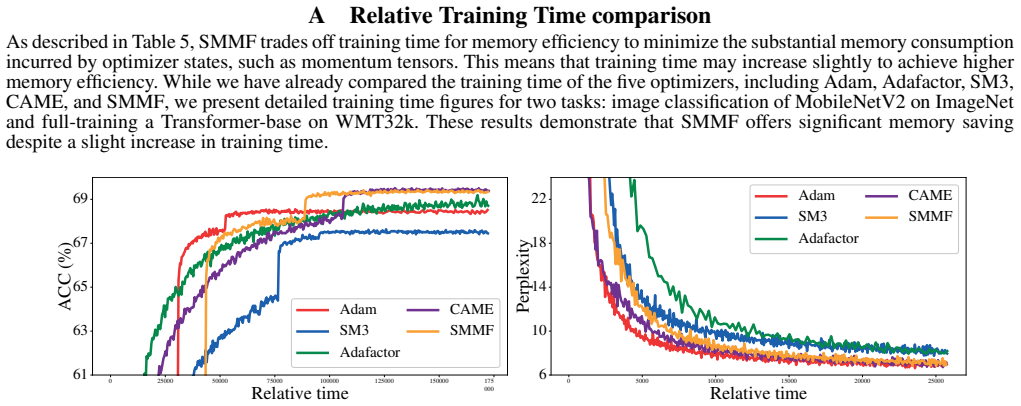
- Training time rises modestly, about 1.2 to 1.6 times Adam, while optimizer memory drops by up to 96%.
Reading between the lines
- If the compression-error gap in the proof is closed, the same square-matricization trick could likely combine with 8-bit quantization of the factor vectors to push memory even lower.
- Because square reshaping deliberately discards the original coordinate layout, a stress test comparing SMMF against reshaping into a non-square shape would reveal whether the memory benefit is purely from factorization or from the square geometry itself.
- SMMF's decompression-first scheme keeps the full current gradient before compression, so it may be particularly suited to fine-tuning tasks where small precise updates matter, such as instruction tuning of large language models.
- The 1-bit sign matrix dominates memory for small tensors like biases; the paper itself notes that binary matrix factorization could reduce that overhead further.
Editorial analysis
A structured set of objections, weighed in public.
Referee Report
Summary. The paper proposes SMMF, an optimizer that square-matricizes arbitrary-rank momentum tensors and compresses the first and second moments into row and column vectors by one NNMF step, storing a binary sign matrix for the first moment. It claims up to 96% memory reduction relative to Adafactor/CAME/SM3, comparable empirical performance across CNN and Transformer tasks, and a regret bound over convex objectives, Theorem 4.1, matching AdamNC's O(sqrt(T)) rate. The theoretical analysis is centered on bounding regret terms after absorbing NNMF decompression-compression errors e_m,t and e_v,t. The empirical section reports extensive experiments with optimizer memory, end-to-end memory, and task metrics.
Significance. If the claims were established, SMMF would fill a useful niche: a factorization-based optimizer that works for any tensor rank and comes with a regret analysis, something Adafactor and CAME lack. The square-matricization idea in Section 3.1 is simple and Theorems 3.1 and 3.2 appear correct. The empirical study is broad, includes many models and tasks, and code is provided. However, the central theoretical guarantee is not supported by the proof as written, and the formal memory-complexity statement ignores the sign matrix. The paper's significance is therefore currently limited to a practical memory-saving proposal with strong empirical results but unsupported asymptotic claims.
major comments (4)
- [Appendix E, Lemma E.5, Eq. (70)] Equation (70) replaces sum_j beta^{T-j} tilde{g}_{m,j,i}^2 with zeta_1^2 sum_j beta^{T-j} tilde{g}_{v,j,i} on the justification 'since tilde{g}_{m,j,i}^2 and tilde{g}_{v,j,i} are positive.' Positivity alone does not imply an elementwise inequality of the form tilde{g}_{m,j,i}^2 <= zeta_1^2 tilde{g}_{v,j,i} for a fixed zeta_1. No bound on the compression-error terms e_{m,t} and e_{v,t} is given, and Lemma E.7's zero-sum property cannot be used for the first momentum because SMMF applies NNMF to |M| and restores signs, so the reconstruction error of M is not the error of NNMF on a non-negative matrix. Consequently the chain (69)-(75) does not prove Lemma E.5, and Theorem 4.1's O(sqrt(T)) regret bound is unsupported.
- [Appendix E, Lemma E.5, Eqs. (70)-(71)] Independently of the zeta_1 issue, the proof drops the accumulated sum: Eq. (70) has sum_{t=1}^{T-1} eta_t m_{t,i}^2/sqrt(v_{t,i}) on the right-hand side, but Eq. (71) only keeps the newly bounded term. Unless an induction over T with a dominating inequality is supplied, the displayed inequalities do not imply the claimed bound for S_T = sum_{t=1}^T eta_t m_{t,i}^2/sqrt(v_{t,i}).
- [Section 3 and Algorithm 4] The formal memory complexity O_M(hat n + hat m) and O_V(hat n + hat m) in Section 3 ignores the sign matrix S in {0,1}^{hat n x hat m} stored by Algorithm 4. For a square-matricized tensor with hat n approximately hat m approximately sqrt(N), the sign matrix alone is N bits, so the asymptotic optimizer-state size is Theta(N) bits, not O(sqrt(N)) as implied. Including the sign matrix may still give a constant-factor saving over the original 32-bit momentum, and Table 1 does count S in the measured memory, but the formal claim as stated is false and should be revised.
- [Section 4, Theorem 4.1] The theorem assumes the Reddi et al. conditions (a)-(b) 'can be satisfied by properly scheduling beta_{2,t}', but the paper never proves that the default schedule used in Algorithm 8, beta_{2,t}=1-t^gamma, satisfies them. In addition, condition (b) as printed has the factor (1 - beta_{2,j} tilde{g}_{v,j,i}), which is structurally different from the Reddi et al. condition (1 - beta_{2,j}) tilde{g}_{v,j,i}, and zeta_1 is not connected to any inequality in the conditions. Thus even if Lemma E.5 were repaired, the theorem would not be linked to the algorithm as implemented.
minor comments (4)
- [Appendix E, Lemma E.3, Eq. (40)] The recurrence for hat v_t writes hat g_{m,j}; it should presumably be hat g_{v,j}.
- [Table 3] The table reports NaN for GPT-2 with Adafactor; this is an unusual result and the caption or text should explain the configuration or the reason this cell is excluded.
- [Algorithm 4] The notation 1_d is defined but never used; the algorithm actually uses 1_{hat n} and 1_{hat m}, which should be defined.
- [General presentation] There are typos such as 'full-trining' in Section 5 and 'SCMF' in Appendix L tables, and a duplicated citation in Appendix J ('Il-Post (Landro et al. 2022a) (Landro et al. 2022a)').
Circularity Check
No significant circularity: Theorem 4.1 is an attempted external regret proof with a gap, not a construction that reduces to its own inputs.
full rationale
SMMF's regret analysis follows the AdamNC proof template and imports conditions (a) and (b) from Reddi, Kale, and Kumar (2019); this is external support rather than a self-citation chain. The compression error terms e_m,t and e_v,t are introduced as defined quantities, not fitted parameters, and the final regret bound is not obtained by renaming a fitted quantity as a prediction. Lemma E.7's zero-sum property is a real algebraic fact for the nonnegative second momentum and is applied there; it is not used to force the conclusion for the sign-restored first momentum. The genuine weaknesses identified by the reader are proof gaps, not circularity: Lemma E.5 replaces \tilde g_m^2 with \zeta_1^2 \tilde g_v solely because both quantities are positive, and no proof is given that such a finite \zeta_1 exists uniformly; likewise the satisfiability of conditions (a) and (b) for SMMF's actual \beta_2 schedule is asserted, not verified. These are correctness concerns about an incomplete derivation, but they do not exhibit a step where the claimed result is equivalent to its own input by definition, by fitted construction, or by a load-bearing self-citation. Therefore the circularity score is 0.
Assumptions & free parameters
free parameters (3)
- decay_rate gamma =
-0.5 (CNN), -0.8 (Transformer)
- weight_decay multiplier =
1/1000 to 1/2000 of AdamW value
- growth_rate lambda =
0.999
assumptions (4)
- standard math Convexity and standard inequalities used in the regret proof (Lemmas E.1, E.2, E.8, Cauchy-Schwarz, Young's inequality).
- domain assumption The decompression error matrix from NNMF preserves the total sum of the 2nd momentum (Lemma E.7).
- ad hoc to paper Compression errors can be absorbed into constants zeta1 and zeta2 so that the AdamNC regret chain remains valid (Theorem 4.1, Lemma E.5).
- ad hoc to paper The beta2 schedule (beta2_t = 1 - t^gamma) satisfies Reddi et al. conditions (a) and (b).
Cite this review
Pith. "Pith review of SMMF: Square-Matricized Momentum Factorization for Memory-Efficient Optimization." pith.science (2026). https://pith.science/paper/YCEYYEPP
@misc{pith2026241208894,
  author       = {Pith},
  title        = {Pith review of: SMMF: Square-Matricized Momentum Factorization for Memory-Efficient Optimization},
  year         = {2026},
  howpublished = {\url{https://pith.science/paper/YCEYYEPP}},
  note         = {Machine review of arXiv:2412.08894}
}
read the original abstract
We propose SMMF (Square-Matricized Momentum Factorization), a memory-efficient optimizer that reduces the memory requirement of the widely used adaptive learning rate optimizers, such as Adam, by up to 96%. SMMF enables flexible and efficient factorization of an arbitrary rank (shape) of the first and second momentum tensors during optimization, based on the proposed square-matricization and one-time single matrix factorization. From this, it becomes effectively applicable to any rank (shape) of momentum tensors, i.e., bias, matrix, and any rank-d tensors, prevalent in various deep model architectures, such as CNNs (high rank) and Transformers (low rank), in contrast to existing memory-efficient optimizers that applies only to a particular (rank-2) momentum tensor, e.g., linear layers. We conduct a regret bound analysis of SMMF, which shows that it converges similarly to non-memory-efficient adaptive learning rate optimizers, such as AdamNC, providing a theoretical basis for its competitive optimization capability. In our experiment, SMMF takes up to 96% less memory compared to state-of-the-art memory efficient optimizers, e.g., Adafactor, CAME, and SM3, while achieving comparable model performance on various CNN and Transformer tasks.
Figures


Figures from the paper (1 more)

Reference graph
Works this paper leans on
-
[1]
Abdulkadirov, R.; Lyakhov, P.; and Nagornov, N. 2023. Survey of Optimization Algorithms in Modern Neural Networks. Mathematics, 11(11): 2466
work page 2023
-
[2]
Aghajanyan, A.; Zettlemoyer, L.; and Gupta, S. 2020. Intrinsic Dimensionality Explains the Effectiveness of Language Model Fine-Tuning. arXiv:2012.13255
arXiv 2020
-
[3]
Amari, S.-i. 2010. Information geometry in optimization, machine learning and statistical inference. Frontiers of Electrical and Electronic Engineering in China, 5: 241--260
work page 2010
-
[4]
Anil, R.; Gupta, V.; Koren, T.; and Singer, Y. 2019. Memory Efficient Adaptive Optimization. In Wallach, H.; Larochelle, H.; Beygelzimer, A.; d Alch\' e -Buc, F.; Fox, E.; and Garnett, R., eds., Advances in Neural Information Processing Systems, volume 32. Curran Associates, Inc
work page 2019
-
[5]
Bojar, O.; Buck, C.; Federmann, C.; Haddow, B.; Koehn, P.; Leveling, J.; Monz, C.; Pecina, P.; Post, M.; Saint-Amand, H.; et al. 2014. Findings of the 2014 workshop on statistical machine translation. In Proceedings of the ninth workshop on statistical machine translation, 12--58
work page 2014
-
[6]
Bojar, O. r.; Chatterjee, R.; Federmann, C.; Graham, Y.; Haddow, B.; Huck, M.; Jimeno Yepes, A.; Koehn, P.; Logacheva, V.; Monz, C.; Negri, M.; Neveol, A.; Neves, M.; Popel, M.; Post, M.; Rubino, R.; Scarton, C.; Specia, L.; Turchi, M.; Verspoor, K.; and Zampieri, M. 2016. Findings of the 2016 Conference on Machine Translation. In Proceedings of the First...
work page 2016
-
[7]
Chen, T.; Xu, B.; Zhang, C.; and Guestrin, C. 2016. Training deep nets with sublinear memory cost. arXiv preprint arXiv:1604.06174
arXiv 2016
-
[8]
Devlin, J.; Chang, M.-W.; Lee, K.; and Toutanova, K. 2018. Bert: Pre-training of deep bidirectional transformers for language understanding. arXiv preprint arXiv:1810.04805
arXiv 2018
Show all 56 references
-
[9]
Dong, K.; Zhou, C.; Ruan, Y.; and Li, Y. 2020. MobileNetV2 Model for Image Classification. In 2020 2nd International Conference on Information Technology and Computer Application (ITCA), 476--480
2020
-
[10]
Finesso, L.; and Spreij, P. 2006. Nonnegative matrix factorization and I-divergence alternating minimization. Linear Algebra and its Applications, 416(2): 270--287
2006
-
[11]
Google. 2022. Coral Dev Board Micro. Https://coral.ai/products/dev-board-micro/
2022
-
[12]
R.; Millman, K
Harris, C. R.; Millman, K. J.; van der Walt, S. J.; Gommers, R.; Virtanen, P.; Cournapeau, D.; Wieser, E.; Taylor, J.; Berg, S.; Smith, N. J.; Kern, R.; Picus, M.; Hoyer, S.; van Kerkwijk, M. H.; Brett, M.; Haldane, A.; del R \' i o, J. F.; Wiebe, M.; Peterson, P.; G \' e rard...
2020
-
[13]
He, K.; Zhang, X.; Ren, S.; and Sun, J. 2016. Deep Residual Learning for Image Recognition. In 2016 IEEE Conference on Computer Vision and Pattern Recognition (CVPR), 770--778
2016
-
[14]
Hinton, G.; Srivastava, N.; and Swersky, K. 2012. Neural networks for machine learning lecture 6a overview of mini-batch gradient descent. Cited on, 14(8): 2
2012
-
[15]
J.; Shen, Y.; Wallis, P.; Allen-Zhu, Z.; Li, Y.; Wang, S.; Wang, L.; and Chen, W
Hu, E. J.; Shen, Y.; Wallis, P.; Allen-Zhu, Z.; Li, Y.; Wang, S.; Wang, L.; and Chen, W. 2021. LoRA: Low-Rank Adaptation of Large Language Models. arXiv:2106.09685
2021 arXiv
-
[16]
P.; and Ba, J
Kingma, D. P.; and Ba, J. 2014. Adam: A method for stochastic optimization. arXiv preprint arXiv:1412.6980
2014 arXiv
-
[17]
Krizhevsky, A.; Hinton, G.; et al. 2009. Learning multiple layers of features from tiny images
2009
-
[18]
Kumar, R.; Panigrahy, R.; Rahimi, A.; and Woodruff, D. 2019. Faster Algorithms for Binary Matrix Factorization. In Chaudhuri, K.; and Salakhutdinov, R., eds., Proceedings of the 36th International Conference on Machine Learning, volume 97 of Proceedings of Machine Learning Res...
2019
-
[19]
Lan, Z.; Chen, M.; Goodman, S.; Gimpel, K.; Sharma, P.; and Soricut, R. 2020. ALBERT: A Lite BERT for Self-supervised Learning of Language Representations. arXiv:1909.11942
2020 arXiv
-
[20]
Landro, N.; Gallo, I.; La Grassa, R.; and Federici, E. 2022 a . Two New Datasets for Italian-Language Abstractive Text Summarization. Information, 13(5)
2022
-
[21]
Landro, N.; Gallo, I.; La Grassa, R.; and Federici, E. 2022 b . Two New Datasets for Italian-Language Abstractive Text Summarization. Information, 13(5)
2022
-
[22]
D.; and Seung, H
Lee, D. D.; and Seung, H. S. 1999. Learning the parts of objects by non-negative matrix factorization. Nature, 401(6755): 788--791
1999
-
[23]
Lewis, M.; Liu, Y.; Goyal, N.; Ghazvininejad, M.; Mohamed, A.; Levy, O.; Stoyanov, V.; and Zettlemoyer, L. 2019. BART: Denoising Sequence-to-Sequence Pre-training for Natural Language Generation, Translation, and Comprehension. arXiv:1910.13461
2019 arXiv
-
[24]
Li, C.; Farkhoor, H.; Liu, R.; and Yosinski, J. 2018. Measuring the Intrinsic Dimension of Objective Landscapes. arXiv:1804.08838
2018 arXiv
-
[25]
L.; and Dollár, P
Lin, T.-Y.; Maire, M.; Belongie, S.; Bourdev, L.; Girshick, R.; Hays, J.; Perona, P.; Ramanan, D.; Zitnick, C. L.; and Dollár, P. 2015. Microsoft COCO: Common Objects in Context. arXiv:1405.0312
2015 arXiv
-
[26]
C.; and Nocedal, J
Liu, D. C.; and Nocedal, J. 1989. On the limited memory BFGS method for large scale optimization. Mathematical programming, 45(1-3): 503--528
1989
-
[27]
Liu, Y.; Gu, J.; Goyal, N.; Li, X.; Edunov, S.; Ghazvininejad, M.; Lewis, M.; and Zettlemoyer, L. 2020. Multilingual Denoising Pre-training for Neural Machine Translation. arXiv:2001.08210
2020 arXiv
-
[28]
Liu, Y.; Ott, M.; Goyal, N.; Du, J.; Joshi, M.; Chen, D.; Levy, O.; Lewis, M.; Zettlemoyer, L.; and Stoyanov, V. 2019. RoBERTa: A Robustly Optimized BERT Pretraining Approach. arXiv:1907.11692
2019 arXiv
-
[29]
Loshchilov, I.; and Hutter, F. 2019. Decoupled Weight Decay Regularization. arXiv:1711.05101
2019 arXiv
-
[30]
Luo, Y.; Ren, X.; Zheng, Z.; Jiang, Z.; Jiang, X.; and You, Y. 2023. CAME : Confidence-guided Adaptive Memory Efficient Optimization. In Rogers, A.; Boyd-Graber, J.; and Okazaki, N., eds., Proceedings of the 61st Annual Meeting of the Association for Computational Linguistics ...
2023
-
[31]
Martens, J. 2016. Second-order optimization for neural networks. University of Toronto (Canada)
2016
-
[32]
N.; Gulcehre, C.; and Xiang, B
Nallapati, R.; Zhou, B.; dos santos, C. N.; Gulcehre, C.; and Xiang, B. 2016. Abstractive Text Summarization Using Sequence-to-Sequence RNNs and Beyond. arXiv:1602.06023
2016 arXiv
-
[33]
B.; and Lapata, M
Narayan, S.; Cohen, S. B.; and Lapata, M. 2018. Don't Give Me the Details, Just the Summary! Topic-Aware Convolutional Neural Networks for Extreme Summarization. ArXiv, abs/1808.08745
2018 arXiv
-
[34]
OpenAI; Achiam, J.; Adler, S.; Agarwal, S.; Ahmad, L.; Akkaya, I.; Aleman, F. L.; Almeida, D.; Altenschmidt, J.; Altman, S.; Anadkat, S.; Avila, R.; Babuschkin, I.; Balaji, S.; Balcom, V.; Baltescu, P.; Bao, H.; Bavarian, M.; Belgum, J.; Bello, I.; Berdine, J.; Bernadett-Shapi...
2024 arXiv
-
[35]
Paszke, A.; Gross, S.; Chintala, S.; Chanan, G.; Yang, E.; DeVito, Z.; Lin, Z.; Desmaison, A.; Antiga, L.; and Lerer, A. 2017. Automatic Differentiation in PyTorch. In NIPS 2017 Workshop on Autodiff
2017
-
[36]
Radford, A.; Wu, J.; Child, R.; Luan, D.; Amodei, D.; Sutskever, I.; et al. 2019. Language models are unsupervised multitask learners. OpenAI blog, 1(8): 9
2019
-
[37]
Raffel, C.; Shazeer, N.; Roberts, A.; Lee, K.; Narang, S.; Matena, M.; Zhou, Y.; Li, W.; and Liu, P. J. 2020. Exploring the limits of transfer learning with a unified text-to-text transformer. The Journal of Machine Learning Research, 21(1): 5485--5551
2020
-
[38]
Rajpurkar, P.; Jia, R.; and Liang, P. 2018. Know What You Don't Know: Unanswerable Questions for SQuAD. arXiv:1806.03822
2018 arXiv
-
[39]
Rajpurkar, P.; Zhang, J.; Lopyrev, K.; and Liang, P. 2016. SQuAD: 100,000+ Questions for Machine Comprehension of Text. arXiv:1606.05250
2016 arXiv
-
[40]
J.; Kale, S.; and Kumar, S
Reddi, S. J.; Kale, S.; and Kumar, S. 2019. On the convergence of adam and beyond. arXiv preprint arXiv:1904.09237
2019 arXiv
-
[41]
Rombach, R.; Blattmann, A.; Lorenz, D.; Esser, P.; and Ommer, B. 2022. High-Resolution Image Synthesis with Latent Diffusion Models. arXiv:2112.10752
2022 arXiv
-
[42]
Ruder, S. 2016. An overview of gradient descent optimization algorithms. arXiv preprint arXiv:1609.04747
2016 arXiv
-
[43]
C.; and Fei-Fei, L
Russakovsky, O.; Deng, J.; Su, H.; Krause, J.; Satheesh, S.; Ma, S.; Huang, Z.; Karpathy, A.; Khosla, A.; Bernstein, M.; Berg, A. C.; and Fei-Fei, L. 2015. ImageNet Large Scale Visual Recognition Challenge . International Journal of Computer Vision (IJCV), 115(3): 211--252
2015
-
[44]
Shazeer, N.; and Stern, M. 2018. Adafactor: Adaptive Learning Rates with Sublinear Memory Cost. In Dy, J.; and Krause, A., eds., Proceedings of the 35th International Conference on Machine Learning, volume 80 of Proceedings of Machine Learning Research, 4596--4604. PMLR
2018
-
[45]
Shi, Z.; Wang, L.; and Shi, L. 2014. Approximation method to rank-one binary matrix factorization. In 2014 IEEE International Conference on Automation Science and Engineering (CASE), 800--805
2014
-
[46]
Takase, S.; Kiyono, S.; Kobayashi, S.; and Suzuki, J. 2024. Spike No More: Stabilizing the Pre-training of Large Language Models. arXiv:2312.16903
2024 arXiv
-
[47]
Taori, R.; Gulrajani, I.; Zhang, T.; Dubois, Y.; Li, X.; Guestrin, C.; Liang, P.; and Hashimoto, T. B. 2023. Stanford Alpaca: An Instruction-following LLaMA model. https://github.com/tatsu-lab/stanford_alpaca
2023
-
[48]
Touvron, H.; Lavril, T.; Izacard, G.; Martinet, X.; Lachaux, M.-A.; Lacroix, T.; Rozière, B.; Goyal, N.; Hambro, E.; Azhar, F.; Rodriguez, A.; Joulin, A.; Grave, E.; and Lample, G. 2023 a . LLaMA: Open and Efficient Foundation Language Models. arXiv:2302.13971
2023 arXiv
-
[49]
Touvron, H.; Martin, L.; Stone, K.; Albert, P.; Almahairi, A.; Babaei, Y.; Bashlykov, N.; Batra, S.; Bhargava, P.; Bhosale, S.; Bikel, D.; Blecher, L.; Ferrer, C. C.; Chen, M.; Cucurull, G.; Esiobu, D.; Fernandes, J.; Fu, J.; Fu, W.; Fuller, B.; Gao, C.; Goswami, V.; Goyal, N....
2023 arXiv
-
[50]
Ultralytics. 2021. YOLOv5 : A state-of-the-art real-time object detection system. https://docs.ultralytics.com
2021
-
[51]
N.; Kaiser, .; and Polosukhin, I
Vaswani, A.; Shazeer, N.; Parmar, N.; Uszkoreit, J.; Jones, L.; Gomez, A. N.; Kaiser, .; and Polosukhin, I. 2017. Attention is all you need. Advances in neural information processing systems, 30
2017
-
[52]
Wang, A.; Singh, A.; Michael, J.; Hill, F.; Levy, O.; and Bowman, S. R. 2018. GLUE: A multi-task benchmark and analysis platform for natural language understanding. arXiv preprint arXiv:1804.07461
2018 arXiv
-
[53]
Zhang, Z.; and Xu, Z.-Q. J. 2023. Loss Spike in Training Neural Networks. arXiv:2305.12133
2023 arXiv
-
[54]
Zhu, Y.; Kiros, R.; Zemel, R.; Salakhutdinov, R.; Urtasun, R.; Torralba, A.; and Fidler, S. 2015. Aligning Books and Movies: Towards Story-Like Visual Explanations by Watching Movies and Reading Books. In The IEEE International Conference on Computer Vision (ICCV)
2015
-
[55]
, " * write output.state after.block = add.period write newline
ENTRY address archivePrefix author booktitle chapter edition editor eid eprint howpublished institution isbn journal key month note number organization pages publisher school series title type volume year label extra.label sort.label short.list INTEGERS output.state before.all...
-
[56]
write newline
" write newline "" before.all 'output.state := FUNCTION n.dashify 't := "" t empty not t #1 #1 substring "-" = t #1 #2 substring "--" = not "--" * t #2 global.max substring 't := t #1 #1 substring "-" = "-" * t #2 global.max substring 't := while if t #1 #1 substring * t #2 gl...
Reviewed August 11, 2026 · model on record in the stance chip above.
Discussion (0). Continue with ORCID to comment.