REVIEW 2 major objections 5 minor 58 references
Versatile Volumetric Medical Image Coding for Human-Machine Vision
T0 review · 2 major / 5 minor · reviewed 2026-08-11 · deepseek-v4-flash
Pith's one-line read A single compressed bitstream can support both human viewing of volumetric medical images and direct machine segmentation from latent features, without decoding to pixels.
desk verdict A genuine first for volumetric medical human-machine coding, but the segmentation evidence is confounded and the reconstruction comparison skips the volumetric neural baselines. read the letter →
The pith
A machine-rendered reading of the paper's core claim, the machinery that carries it, and where it could break.
The reading
What carries the argument
The load-bearing component is the Versatile Volumetric Autoencoder (VVAE), a recurrent module that reads a buffer of auxiliary features $F_{t-1}$ from previous slices, extracts multi-scale inter-slice contexts $E_1, E_2, E_3$ and an inter-slice latent prior $L_F$, and injects them into the current slice's analysis and synthesis transforms. The same auxiliary path produces intermediate decoding features $M_x$ (current-slice) and $M_F$ (inter-slice), which are fused into $F_t$ for the next slice and also handed to the downstream networks. This design is paired with a multi-dimensional context model that combines checkerboard spatial context, channel-wise context, the inter-slice prior $L_F$, and hierarchical hyperparameters $\Psi$ to estimate the entropy parameters of the quantized latents, which is what makes the rate savings possible.
What would settle it
Run a single, fixed segmentation model (no per-codec retraining) on either VVMIC latent features or decoded pixels from VVMIC, JPEG2000, and a third codec at matched bitrates on the CHAOS, ACDC, and Synapse datasets; if DICE and HD95 for the latent input are not consistently better than for the pixel inputs, the claim that the coded representation directly supports accurate analytics is not established.
Extended reading notes
Core claim
The paper's central discovery is that the same volumetric autoencoder that produces high-quality reconstructions also yields partially decoded intermediate features that are themselves suitable for organ segmentation, eliminating the need to decode to pixels for the machine task. The recurrent VVAE module carries inter-slice context forward slice by slice, producing current-slice latent decoding features $M_x$; these features are fed directly into a TransUNet segmentation network, and this 'Our Latents' scheme beats both decoded-pixel input from the same codec and JPEG2000-compressed pixel input in DICE and HD95 across the CHAOS, ACDC, and Synapse datasets. The authors interpret this as evidence that the coded representation preserves the structural information the segmenter needs, even at low bitrates where the reconstruction network cannot produce a clear image.
Load-bearing premise
The machine-vision comparison assumes that retraining the segmentation network on each codec's latent features is a fair measure of the codec's information preservation; if the segmenter merely adapts to the VVMIC feature format, the reported DICE and HD95 advantages over JPEG2000 may not hold for a fixed, deployment-time model.
Editorial extensions
If this is right
- Medical cloud pipelines could run segmentation on the latent features directly, skipping full pixel decoding and cutting the compute and latency of analytics.
- Hospitals could store one bitstream per volume that serves both archival/review and automated triage, instead of maintaining separate compressed copies.
- Because the inter-slice prior $L_F$ is not coded as side information, the framework shows a way to exploit inter-slice redundancy at negligible bitrate cost in learned volumetric codecs.
- The reported BD-Rate gains over VVC on MRNet suggest learned volumetric codecs are now competitive with advanced video codecs on medical data.
- The authors state the framework can be extended to other machine-vision tasks such as classification and detection, since the latent features are claimed to carry expressive intra- and inter-slice information.
Reading between the lines
- The machine-vision comparison uses JP2K as the only anchor and retrains the segmentation network to each input format; a fairer test of whether the codec's representation genuinely supports analytics would freeze one segmentation model and feed it either latent features or decoded pixels from several codecs at matched bitrates.
- The 16-slice update stride implies the inter-slice benefit comes from short-range correlation; volumes with longer-range repetition might benefit from an adaptive stride or hierarchical grouping, which the paper does not test.
- If latent features prove to be lossy but task-sufficient, the same approach could apply to other 3D medical analytics like detection or classification, but the paper only demonstrates segmentation, leaving this an open extension rather than an established claim.
- The ablation showing every context component contributes suggests the multi-dimensional context model is doing real work; one could test whether a learned transformer-based context model replaces or surpasses this hand-designed aggregation.
Editorial analysis
A structured set of objections, weighed in public.
Referee Report
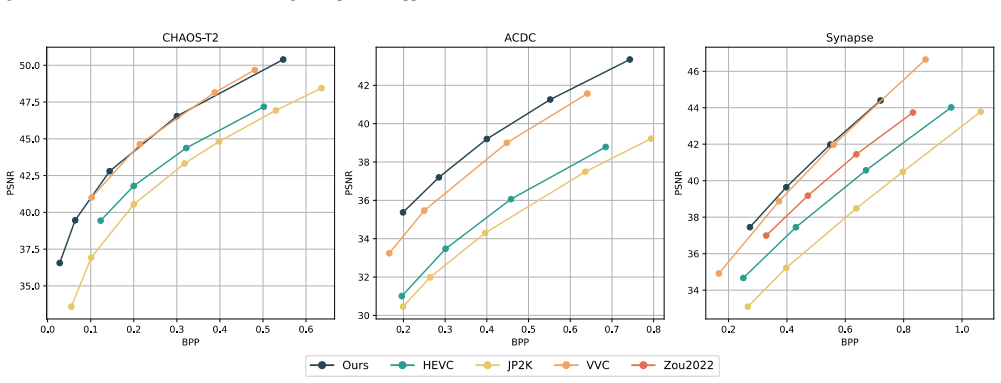
Summary. The paper proposes VVMIC, a recurrent volumetric medical image compression framework that produces a single bitstream intended to support both human-oriented reconstruction and machine-oriented segmentation. The model augments a learned autoencoder with an inter-slice auxiliary feature buffer, multi-scale inter-slice analysis/synthesis transforms, and a multi-dimensional context model combining spatial, channel-wise, hyperprior, and inter-slice contexts. The authors report BD-Rate savings of 7.67%, 17.23%, and 8.84% against VVC on the MRNet axial, coronal, and sagittal views, and higher DICE/lower HD95 than JP2K on CHAOS, ACDC, and Synapse when segmentation is performed on the intermediate latent feature Mx rather than on decoded pixels. Ablations on MRNet-Axial attribute the reconstruction gains to the checkerboard context, channel-wise context, and auxiliary inter-slice modules.
Significance. If the claims are borne out, VVMIC would be a useful contribution to JPEG-AI-style coding for medical volumes: the idea of decoding only the intermediate features needed by a segmentation network, rather than full pixels, and the recurrent inter-slice latent context are both natural and potentially impactful for medical cloud storage and transmission. The reconstruction part is internally consistent: the ablation study in Table II shows each suggested module improves BD-Rate, and the rate-distortion curves in Figs. 5-6 are plausible. However, the machine-vision half of the paper is currently not established by a controlled experiment, and the reconstruction comparison lacks relevant volumetric neural baselines and any measure of variability. The paper does not ship code, weights, or error bars, so the empirical claims cannot be independently checked from the manuscript alone. The authors do, to their credit, include a limitations paragraph in Section IV-E4 that acknowledges the fixed update stride and the difficulty of per-volume optimization.
major comments (2)
- [§IV-D and §IV-E2] The machine-vision comparison is confounded in two ways. First, the 'Our Latents' input is the multi-channel (192-channel) intermediate feature Mx, whereas the JP2K branch receives a single-channel reconstructed image; Section IV-D states that the input channel number is modified 'to fit the latent decoding feature.' Second, Section IV-E2 states that TransUNet is retrained for each feature type ('we retrain the TransUnet network with different decoding features as input'). Consequently, the reported DICE/HD95 advantage of 'Our Latents' over JP2K can be explained by higher input dimensionality and by per-codec adaptation of the segmenter, rather than by the bitstream preserving more task-relevant information. This is load-bearing because the abstract's machine-vision claim and the JPEG-AI-style 'single bitstream without full pixel decoding' contribution rest on this comparison. I request a controlled evaluation: a fixed segmentation model trained once on original images and then applied to all coded inputs, or a dimensionality-matched comparison (e.g., projecting Mx to one channel, or applying a comparable feature extraction to JP2K reconstructions), plus bitrate-matched operating points and multiple random seeds.
- [§IV-C and §II-A] The reconstruction comparison is missing the volumetric neural codecs that the paper itself cites as related work. Section II-A discusses aiWave, aiWave-lite, and DBVC as 3D medical image compression methods, but Tables I and Figs. 5-6 compare only 2D image codecs (Minnen2018, Cheng2020, Zou2022) applied to slices, plus traditional codecs. The conclusion's statement that VVMIC 'outperforms existing learning-based networks' is therefore not supported for volumetric learned codecs. In addition, all BD-Rate, DICE, and HD95 numbers are single-run point estimates with no error bars, significance tests, or seeds, so it is impossible to tell whether the reported margins (e.g., 2.19% vs. -7.67% in Table I) are stable. Please add the volumetric baselines or explicitly restrict the claim to 2D slice-wise learned codecs, and report variability across at least three runs.
minor comments (5)
- [§IV-D] The qualitative comparison in Fig. 7 is not at matched rates: the VVC point carries BPP 0.209 while the 'Ours' point carries BPP 0.747, so the visual edge-preservation claim is uninterpretable as a compression advantage. The paper should compare at the same or similar BPP, or show rate-distortion curves with markers for each method at all four λ values.
- [§III-B2 and §IV-D] There are several typos and notation inconsistencies: 'Multi-Dimention' in the Section III-B2 header, 'Segmentatioon' in the Section IV-D header, 'V olumetric' in the running header, and the text in Section IV-E1 refers to 'spatial context priors Ψsp' while Eq. (15) uses Φk_sp for spatial context and Ψ for hyperparameters.
- [Table I] The caption of Table I does not state the sign convention; since negative BD-Rate values denote bitrate savings relative to the VVC anchor, the caption should explicitly say 'negative is better' to avoid ambiguity.
- [§IV-B3] The transfer-learning protocol is described only briefly. The paper should state explicitly which patient/volume split is used for fine-tuning VVMIC and for training the segmentation network on each dataset, so that the reader can rule out any overlap between training and test volumes.
- [Reproducibility] No code, trained weights, or evaluation protocol details are provided. Since the paper reports a new end-to-end framework with many learned components, an anonymous code/weights release would substantially support verification of the reported numbers.
Circularity Check
No circular derivation; the machine-vision comparison has a per-codec retraining confound but is not circular.
full rationale
The paper's derivation chain is self-contained at the equation level. The rate-distortion objective (Eq. 1) and the autoencoder transforms (Eqs. 9-15) define a standard learned transform-coding system; the inter-slice contexts E1-E3, LF, D1-D2 and the fused feature Ft are produced by learned transforms from previously decoded slices, not by definition from the reconstruction or segmentation targets. The BD-Rate results (Table I) compare the trained codec against VVC, HEVC, JPEG-XL, and learned baselines on MRNet, so no fitted constant is renamed as a prediction. The segmentation experiments (Section IV-D and Fig. 8) report DICE/HD95 when feeding latent decoding features Mx or JP2K-decoded pixels into TransUNet. The paper explicitly states that the input channel number is modified 'to fit the latent decoding feature' and that 'we retrain the TransUnet network with different decoding features as input' (Section IV-E2). This makes the machine-vision comparison non-like-for-like: the latent branch has 192 input channels and a per-codec retrained head, while the JP2K branch has one input channel and its own retrained head. That is a genuine evaluation-fairness and generalization concern, but it is not circularity: the bitstream does not contain the segmentation masks, the JP2K baseline is also retrained, and higher DICE or lower HD95 is not forced by construction. The paper also states its own limitations in Section IV-E4 (inter-slice update stride, dataset-level optimization, and downstream tasks beyond segmentation). No load-bearing self-citation, imported uniqueness theorem, or ansatz-smuggling is present. Score 1 reflects only the minor self-referentiality of the segmentation evaluation protocol, not any equation-level circularity.
Assumptions & free parameters
free parameters (4)
- Rate-distortion weight lambda per dataset =
axial 2048/4096/8192/16384; coronal 4096/8192/16384/32768; sagittal 2048/4096/8192/12288
- Inter-slice auxiliary feature channel depth =
16
- Latent and hyper-latent channel count =
192 latent, 192 hyper-latent
- BPTT update stride =
16 slices
assumptions (4)
- domain assumption The estimated bit rate from the learned entropy model is achievable by a real entropy coder.
- domain assumption The inter-slice auxiliary features Ft can be reproduced at the decoder without additional bits.
- domain assumption Transfer learning from MRNet knee MRI to CHAOS, ACDC, and Synapse abdominal or cardiac data is valid for both reconstruction and segmentation.
- domain assumption A TransUNet whose input channels are changed to accept latent features Mx remains a valid comparator to pixel-input segmentation.
invented entities (2)
-
Inter-slice auxiliary feature buffer Ft
-
Inter-slice latent context LF and multi-scale contexts E1-E3, D1-D2
Cite this review
Pith. "Pith review of Versatile Volumetric Medical Image Coding for Human-Machine Vision." pith.science (2026). https://pith.science/paper/FA2VRMPU
@misc{pith2026241209231,
  author       = {Pith},
  title        = {Pith review of: Versatile Volumetric Medical Image Coding for Human-Machine Vision},
  year         = {2026},
  howpublished = {\url{https://pith.science/paper/FA2VRMPU}},
  note         = {Machine review of arXiv:2412.09231}
}
read the original abstract
Neural image compression (NIC) has received considerable attention due to its significant advantages in feature representation and data optimization. However, most existing NIC methods for volumetric medical images focus solely on improving human-oriented perception. For these methods, data need to be decoded back to pixels for downstream machine learning analytics, which is a process that lowers the efficiency of diagnosis and treatment in modern digital healthcare scenarios. In this paper, we propose a Versatile Volumetric Medical Image Coding (VVMIC) framework for both human and machine vision, enabling various analytics of coded representations directly without decoding them into pixels. Considering the specific three-dimensional structure distinguished from natural frame images, a Versatile Volumetric Autoencoder (VVAE) module is crafted to learn the inter-slice latent representations to enhance the expressiveness of the current-slice latent representations, and to produce intermediate decoding features for downstream reconstruction and segmentation tasks. To further improve coding performance, a multi-dimensional context model is assembled by aggregating the inter-slice latent context with the spatial-channel context and the hierarchical hypercontext. Experimental results show that our VVMIC framework maintains high-quality image reconstruction for human vision while achieving accurate segmentation results for machine-vision tasks compared to a number of reported traditional and neural methods.
Figures


Figures from the paper (7 more)




Reference graph
Works this paper leans on
-
[1]
Hybrid masked image modeling for 3d medical image segmentation,
Z. Xing, L. Zhu, L. Yu, Z. Xing, and L. Wan, “Hybrid masked image modeling for 3d medical image segmentation,” IEEE Journal of Biomedical and Health Informatics , 2024
work page 2024
-
[2]
L. Xie, W. Cai, and Y . Gao, “Dmcgnet: A novel network for medical image segmentation with dense self-mimic and channel grouping mech- anism,” IEEE Journal of Biomedical and Health Informatics , vol. 26, no. 10, pp. 5013–5024, 2022
work page 2022
-
[3]
A multi-scale context aware attention model for medical image segmentation,
M. S. Alam, D. Wang, Q. Liao, and A. Sowmya, “A multi-scale context aware attention model for medical image segmentation,” IEEE Journal of Biomedical and Health Informatics , vol. 27, no. 8, pp. 3731–3739, 2022
work page 2022
-
[4]
Ai in medical imaging informatics: current challenges and future directions,
A. S. Panayides, A. Amini, N. D. Filipovic, A. Sharma, S. A. Tsaftaris, A. Young, D. Foran, N. Do, S. Golemati, T. Kurc, et al., “Ai in medical imaging informatics: current challenges and future directions,” IEEE journal of biomedical and health informatics , vol. 24, no. 7, pp. 1837– 1857, 2020
work page 2020
-
[5]
Brain mr image classifi- cation using superpixel-based deep transfer learning,
T. K. Behera, M. A. Khan, and S. Bakshi, “Brain mr image classifi- cation using superpixel-based deep transfer learning,” IEEE Journal of Biomedical and Health Informatics, vol. 28, no. 3, pp. 1218–1227, 2022. JOURNAL OF LATEX CLASS FILES, VOL. 14, NO. 8, AUGUST 2021 11
work page 2022
-
[6]
H. Lao and X. Zhang, “Regression and classification of alzheimer’s disease diagnosis using nmf-tdnet features from 3d brain mr image,” IEEE Journal of Biomedical and Health Informatics , vol. 26, no. 3, pp. 1103–1115, 2021
work page 2021
-
[7]
Icmh-net: Neural image compres- sion towards both machine vision and human vision,
L. Liu, Z. Hu, Z. Chen, and D. Xu, “Icmh-net: Neural image compres- sion towards both machine vision and human vision,” in Proceedings of the 31st ACM International Conference on Multimedia , pp. 8047–8056, 2023
work page 2023
-
[8]
The jpeg ai standard: Providing efficient human and machine visual data consumption,
J. Ascenso, E. Alshina, and T. Ebrahimi, “The jpeg ai standard: Providing efficient human and machine visual data consumption,” Ieee Multimedia, vol. 30, no. 1, pp. 100–111, 2023
work page 2023
Show all 58 references
-
[9]
Roelofs, PNG: the definitive guide
G. Roelofs, PNG: the definitive guide . O’Reilly & Associates, Inc., 1999
1999
-
[10]
Jpeg2000: Standard for interactive imaging,
D. S. Taubman and M. W. Marcellin, “Jpeg2000: Standard for interactive imaging,” Proceedings of the IEEE, vol. 90, no. 8, pp. 1336–1357, 2002
2002
-
[11]
Jpeg2000. part 10. volumetric data encoding,
P. Schelkens, A. Munteanu, A. Tzannes, and C. Brislawn, “Jpeg2000. part 10. volumetric data encoding,” in 2006 IEEE International Sympo- sium on Circuits and Systems , pp. 4–pp, IEEE, 2006
2006
-
[12]
Flif: Free lossless image format based on maniac compression,
J. Sneyers and P. Wuille, “Flif: Free lossless image format based on maniac compression,” in 2016 IEEE international conference on image processing (ICIP), pp. 66–70, IEEE, 2016
2016
-
[13]
Jpeg xl next-generation image compression architecture and cod- ing tools,
J. Alakuijala, R. Van Asseldonk, S. Boukortt, M. Bruse, I.-M. Coms ,a, M. Firsching, T. Fischbacher, E. Kliuchnikov, S. Gomez, R. Obryk, et al., “Jpeg xl next-generation image compression architecture and cod- ing tools,” in Applications of digital image processing XLII , vol....
2019
-
[14]
Overview of the high efficiency video coding (hevc) standard,
G. J. Sullivan, J.-R. Ohm, W.-J. Han, and T. Wiegand, “Overview of the high efficiency video coding (hevc) standard,” IEEE Transactions on circuits and systems for video technology , vol. 22, no. 12, pp. 1649– 1668, 2012
2012
-
[15]
Overview of the versatile video coding (vvc) standard and its applications,
B. Bross, Y .-K. Wang, Y . Ye, S. Liu, J. Chen, G. J. Sullivan, and J.- R. Ohm, “Overview of the versatile video coding (vvc) standard and its applications,” IEEE Transactions on Circuits and Systems for Video Technology, vol. 31, no. 10, pp. 3736–3764, 2021
2021
-
[16]
End-to-end optimized image compression,
J. Ball ´e, V . Laparra, and E. P. Simoncelli, “End-to-end optimized image compression,” arXiv preprint arXiv:1611.01704 , 2016
2016 arXiv
-
[17]
Vari- ational image compression with a scale hyperprior,
J. Ball ´e, D. Minnen, S. Singh, S. J. Hwang, and N. Johnston, “Vari- ational image compression with a scale hyperprior,” arXiv preprint arXiv:1802.01436, 2018
2018 arXiv
-
[18]
Joint autoregressive and hierarchical priors for learned image compression,
D. Minnen, J. Ball ´e, and G. D. Toderici, “Joint autoregressive and hierarchical priors for learned image compression,” Advances in neural information processing systems , vol. 31, 2018
2018
-
[19]
Learned image com- pression with discretized gaussian mixture likelihoods and attention modules,
Z. Cheng, H. Sun, M. Takeuchi, and J. Katto, “Learned image com- pression with discretized gaussian mixture likelihoods and attention modules,” in Proceedings of the IEEE/CVF conference on computer vision and pattern recognition , pp. 7939–7948, 2020
2020
-
[20]
Elic: Efficient learned image compression with unevenly grouped space- channel contextual adaptive coding,
D. He, Z. Yang, W. Peng, R. Ma, H. Qin, and Y . Wang, “Elic: Efficient learned image compression with unevenly grouped space- channel contextual adaptive coding,” in Proceedings of the IEEE/CVF Conference on Computer Vision and Pattern Recognition , pp. 5718– 5727, 2022
2022
-
[21]
Contextformer: A transformer with spatio-channel attention for context modeling in learned image compression,
A. B. Koyuncu, H. Gao, A. Boev, G. Gaikov, E. Alshina, and E. Stein- bach, “Contextformer: A transformer with spatio-channel attention for context modeling in learned image compression,” in European Confer- ence on Computer Vision , pp. 447–463, Springer, 2022
2022
-
[22]
Entroformer: A transformer-based entropy model for learned image compression,
Y . Qian, M. Lin, X. Sun, Z. Tan, and R. Jin, “Entroformer: A transformer-based entropy model for learned image compression,” arXiv preprint arXiv:2202.05492, 2022
2022 arXiv
-
[23]
The devil is in the details: Window- based attention for image compression,
R. Zou, C. Song, and Z. Zhang, “The devil is in the details: Window- based attention for image compression,” inProceedings of the IEEE/CVF conference on computer vision and pattern recognition , pp. 17492– 17501, 2022
2022
-
[24]
Mlic: Multi- reference entropy model for learned image compression,
W. Jiang, J. Yang, Y . Zhai, P. Ning, F. Gao, and R. Wang, “Mlic: Multi- reference entropy model for learned image compression,” in Proceedings of the 31st ACM International Conference on Multimedia , pp. 7618– 7627, 2023
2023
-
[25]
Learned image compression with mixed transformer-cnn architectures,
J. Liu, H. Sun, and J. Katto, “Learned image compression with mixed transformer-cnn architectures,” in Proceedings of the IEEE/CVF con- ference on computer vision and pattern recognition , pp. 14388–14397, 2023
2023
-
[26]
Attention is all you need,
A. Vaswani, “Attention is all you need,” Advances in Neural Information Processing Systems, 2017
2017
-
[27]
Towards image understanding from deep compression without decoding,
R. Torfason, F. Mentzer, E. Agustsson, M. Tschannen, R. Timofte, and L. Van Gool, “Towards image understanding from deep compression without decoding,” arXiv preprint arXiv:1803.06131 , 2018
2018 arXiv
-
[28]
Variable-rate deep image compression through spatially-adaptive feature transform,
M. Song, J. Choi, and B. Han, “Variable-rate deep image compression through spatially-adaptive feature transform,” in Proceedings of the IEEE/CVF international conference on computer vision, pp. 2380–2389, 2021
2021
-
[29]
Semantics-to-signal scalable image compression with learned revertible representations,
K. Liu, D. Liu, L. Li, N. Yan, and H. Li, “Semantics-to-signal scalable image compression with learned revertible representations,” Interna- tional Journal of Computer Vision, vol. 129, no. 9, pp. 2605–2621, 2021
2021
-
[30]
Image coding for machines: an end-to-end learned approach,
N. Le, H. Zhang, F. Cricri, R. Ghaznavi-Youvalari, and E. Rahtu, “Image coding for machines: an end-to-end learned approach,” in ICASSP 2021- 2021 IEEE International Conference on Acoustics, Speech and Signal Processing (ICASSP), pp. 1590–1594, IEEE, 2021
2021
-
[31]
Machine vision guided 3d medical image compression for efficient transmission and accurate segmentation in the clouds,
Z. Liu, X. Xu, T. Liu, Q. Liu, Y . Wang, Y . Shi, W. Wen, M. Huang, H. Yuan, and J. Zhuang, “Machine vision guided 3d medical image compression for efficient transmission and accurate segmentation in the clouds,” in Proceedings of the IEEE/CVF conference on computer vision and...
2019
-
[32]
Auto-encoding variational bayes,
D. P. Kingma, “Auto-encoding variational bayes,” arXiv preprint arXiv:1312.6114, 2013
2013 arXiv
-
[33]
Theoretical foundations of transform coding,
V . K. Goyal, “Theoretical foundations of transform coding,”IEEE Signal Processing Magazine, vol. 18, no. 5, pp. 9–21, 2001
2001
-
[34]
End-to-end optimized versatile image compression with wavelet-like transform,
H. Ma, D. Liu, N. Yan, H. Li, and F. Wu, “End-to-end optimized versatile image compression with wavelet-like transform,” IEEE Transactions on Pattern Analysis and Machine Intelligence , vol. 44, no. 3, pp. 1247– 1263, 2020
2020
-
[35]
Transformer-based transform coding,
Y . Zhu, Y . Yang, and T. Cohen, “Transformer-based transform coding,” in International Conference on Learning Representations , 2022
2022
-
[36]
Checkerboard context model for efficient learned image compression,
D. He, Y . Zheng, B. Sun, Y . Wang, and H. Qin, “Checkerboard context model for efficient learned image compression,” in Proceedings of the IEEE/CVF Conference on Computer Vision and Pattern Recognition , pp. 14771–14780, 2021
2021
-
[37]
Channel-wise autoregressive entropy models for learned image compression,
D. Minnen and S. Singh, “Channel-wise autoregressive entropy models for learned image compression,” in 2020 IEEE International Conference on Image Processing (ICIP) , pp. 3339–3343, IEEE, 2020
2020
-
[38]
V olumetric end-to-end optimized compression for brain images,
S. Gao, Y . Zhang, D. Liu, and Z. Xiong, “V olumetric end-to-end optimized compression for brain images,” in 2020 IEEE International Conference on Visual Communications and Image Processing (VCIP) , pp. 503–506, IEEE, 2020
2020
-
[39]
aiwave: V olumetric image compression with 3-d trained affine wavelet-like transform,
D. Xue, H. Ma, L. Li, D. Liu, and Z. Xiong, “aiwave: V olumetric image compression with 3-d trained affine wavelet-like transform,”IEEE Transactions on Medical Imaging , vol. 42, no. 3, pp. 606–618, 2022
2022
-
[40]
Lightweight context model equipped aiwave in response to the avs call for evidence on volumetric medical image coding,
D. Xue, L. Li, D. Liu, and H. Li, “Lightweight context model equipped aiwave in response to the avs call for evidence on volumetric medical image coding,” IEEE Transactions on Circuits and Systems for Video Technology, 2024
2024
-
[41]
Dbvc: An end-to- end 3-d deep biomedical video coding framework,
D. Xue, H. Ma, L. Li, D. Liu, Z. Xiong, and H. Li, “Dbvc: An end-to- end 3-d deep biomedical video coding framework,” IEEE Transactions on Circuits and Systems for Video Technology , 2023
2023
-
[42]
Video coding for machines: Compact visual representation compression for intelligent collaborative analytics,
W. Yang, H. Huang, Y . Hu, L.-Y . Duan, and J. Liu, “Video coding for machines: Compact visual representation compression for intelligent collaborative analytics,” IEEE Transactions on Pattern Analysis and Machine Intelligence, 2024
2024
-
[43]
Towards coding for human and machine vision: A scalable image coding approach,
Y . Hu, S. Yang, W. Yang, L.-Y . Duan, and J. Liu, “Towards coding for human and machine vision: A scalable image coding approach,” in 2020 IEEE International Conference on Multimedia and Expo (ICME) , pp. 1–6, IEEE, 2020
2020
-
[44]
Scalable image coding for humans and machines,
H. Choi and I. V . Baji ´c, “Scalable image coding for humans and machines,” IEEE Transactions on Image Processing , vol. 31, pp. 2739– 2754, 2022
2022
-
[45]
Human–machine interaction- oriented image coding for resource-constrained visual monitoring in iot,
Z. Wang, F. Li, J. Xu, and P. C. Cosman, “Human–machine interaction- oriented image coding for resource-constrained visual monitoring in iot,” IEEE Internet of Things Journal, vol. 9, no. 17, pp. 16181–16195, 2022
2022
-
[46]
Vnvc: A versatile neural video cod- ing framework for efficient human-machine vision,
X. Sheng, L. Li, D. Liu, and H. Li, “Vnvc: A versatile neural video cod- ing framework for efficient human-machine vision,” IEEE Transactions on Pattern Analysis and Machine Intelligence , 2024
2024
-
[47]
Pixel recurrent neural networks,
A. Van Den Oord, N. Kalchbrenner, and K. Kavukcuoglu, “Pixel recurrent neural networks,” in International conference on machine learning, pp. 1747–1756, PMLR, 2016
2016
-
[48]
Gaussian error linear units (gelus),
D. Hendrycks and K. Gimpel, “Gaussian error linear units (gelus),” arXiv preprint arXiv:1606.08415, 2016
2016 arXiv
-
[49]
Deep residual learning for image recognition,
K. He, X. Zhang, S. Ren, and J. Sun, “Deep residual learning for image recognition,” in Proceedings of the IEEE conference on computer vision and pattern recognition , pp. 770–778, 2016
2016
-
[50]
Density modeling of images using a generalized normalization transformation,
J. Ball ´e, V . Laparra, and E. P. Simoncelli, “Density modeling of images using a generalized normalization transformation,”arXiv preprint arXiv:1511.06281, 2015
2015 arXiv
-
[51]
Transunet: Transformers make strong encoders for medical image segmentation,
J. Chen, Y . Lu, Q. Yu, X. Luo, E. Adeli, Y . Wang, L. Lu, A. L. Yuille, and Y . Zhou, “Transunet: Transformers make strong encoders for medical image segmentation,” arXiv preprint arXiv:2102.04306 , 2021. JOURNAL OF LATEX CLASS FILES, VOL. 14, NO. 8, AUGUST 2021 12
2021 arXiv
-
[52]
An image is worth 16x16 words: Transformers for image recognition at scale,
A. Dosovitskiy, “An image is worth 16x16 words: Transformers for image recognition at scale,” arXiv preprint arXiv:2010.11929 , 2020
2010 arXiv
-
[53]
Deep-learning- assisted diagnosis for knee magnetic resonance imaging: development and retrospective validation of mrnet,
N. Bien, P. Rajpurkar, R. L. Ball, J. Irvin, A. Park, E. Jones, M. Bereket, B. N. Patel, K. W. Yeom, K. Shpanskaya, et al. , “Deep-learning- assisted diagnosis for knee magnetic resonance imaging: development and retrospective validation of mrnet,” PLoS medicine, vol. 15, no. ...
2018
-
[54]
Chaos challenge- combined (ct-mr) healthy abdominal organ segmentation,
A. E. Kavur, N. S. Gezer, M. Barıs ¸, S. Aslan, P.-H. Conze, V . Groza, D. D. Pham, S. Chatterjee, P. Ernst, S. ¨Ozkan, et al., “Chaos challenge- combined (ct-mr) healthy abdominal organ segmentation,” Medical Image Analysis, vol. 69, p. 101950, 2021
2021
-
[55]
Deep learning techniques for automatic mri cardiac multi-structures segmentation and diagnosis: is the problem solved?,
O. Bernard, A. Lalande, C. Zotti, F. Cervenansky, X. Yang, P.-A. Heng, I. Cetin, K. Lekadir, O. Camara, M. A. G. Ballester, et al. , “Deep learning techniques for automatic mri cardiac multi-structures segmentation and diagnosis: is the problem solved?,” IEEE transactions on m...
2018
-
[56]
Multi-scale hierarchical vision transformer with cascaded attention decoding for medical image seg- mentation,
M. M. Rahman and R. Marculescu, “Multi-scale hierarchical vision transformer with cascaded attention decoding for medical image seg- mentation,” in Medical Imaging with Deep Learning , pp. 1526–1544, PMLR, 2024
2024
-
[57]
Backpropagation through time: what it does and how to do it,
P. J. Werbos, “Backpropagation through time: what it does and how to do it,” Proceedings of the IEEE , vol. 78, no. 10, pp. 1550–1560, 1990
1990
-
[58]
Long short-term memory,
S. Hochreiter and J. Schmidhuber, “Long short-term memory,” Neural computation, vol. 9, no. 8, pp. 1735–1780, 1997
1997
Reviewed August 11, 2026 · model on record in the stance chip above.
Discussion (0). Continue with ORCID to comment.