REVIEW 4 major objections 6 minor 37 references
Text-Video Multi-Grained Integration for Video Moment Montage
T0 review · 4 major / 6 minor · reviewed 2026-08-11 · deepseek-v4-flash
Pith's one-line read This paper introduces Video Moment Montage and claims its TV-MGI model, which fuses script text with shot- and frame-level video features, localizes and assembles segments better than all tested baselines on the new MSSD benchmark.
desk verdict New task and dataset are real contributions, but the test set may let the model cheat with positional order; worth reviewing with that question asked. read the letter →
The pith
A machine-rendered reading of the paper's core claim, the machinery that carries it, and where it could break.
The reading
What carries the argument
The load-bearing object is the multi-grained fusion encoder. In each of its layers, frame features are mean-pooled into shot features; then three X-MHA cross-modal attention steps fuse shot-text, frame-shot, and frame-text representations; the outputs feed a prediction head that scores each shot for each sentence, applies a rank-aware contrastive loss for shot ordering, and predicts frame-level start and end positions within matched shots via softmax. This is what carries the claim that global and fine-grained alignment can be learned jointly.
What would settle it
Take a set of videos actually assembled by human editors, with raw footage that contains the source shots plus unrelated distractors; if TV-MGI fails to recover the editors' segment choices at comparable recall to the MSSD numbers, the central claim of superiority for real montage workloads would be contradicted. More directly, rerunning the main comparison with ground-truth segments drawn from true editor timestamps instead of the clustered two-video proxy would settle it.
Extended reading notes
Core claim
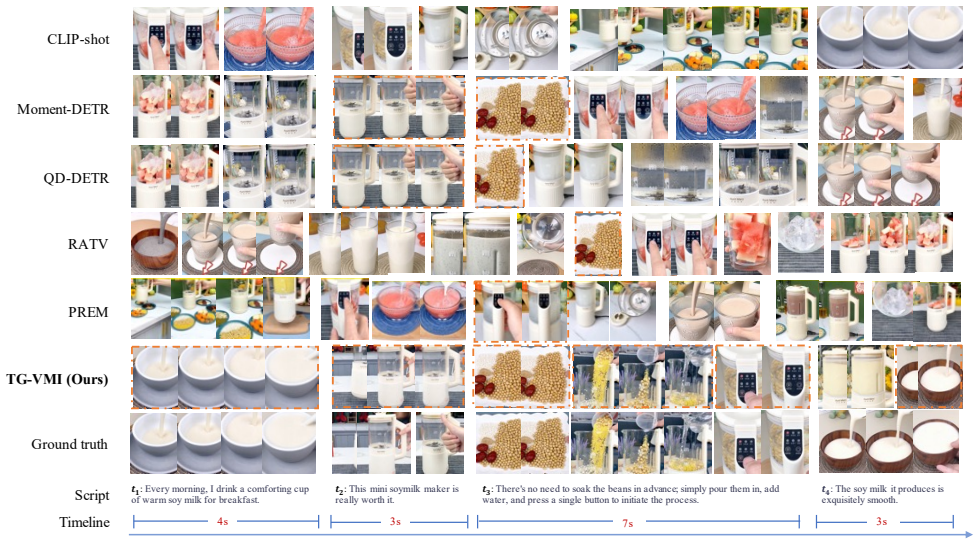
On the paper's own terms, the discovery is that multi-grained text-video fusion works for montage: per encoder layer, shot-level pooling and three cross-modal attention steps (shot-text, frame-shot, frame-text) let a model both choose which shots belong to each sentence and decide where within those shots the segment begins and ends. With a rank-aware contrastive loss ordering matched shots, TV-MGI reports R1@0.5 of 30.91 versus 21.65 for the strongest baseline and higher mAP and NDCG at both sentence and script levels; ablations show each component contributes. The paper also claims that synthetic augmentation, which shuffles shots and injects shots from related videos, is what lets the model handle redundant raw footage.
Load-bearing premise
The evaluation assumes the synthetic test set, built by pairing videos and using one video's own aligned shots as ground truth, faithfully represents how editors really montage raw footage; if that proxy is too easy or artificial, the reported gains may not carry over.
Editorial extensions
If this is right
- An editor could supply only raw footage and a narration script; the model returns a montage with each sentence matched to one or more trimmed video segments.
- Multi-sentence context is necessary, not optional: treating script sentences independently drops performance substantially, so montage systems should model inter-sentence relations.
- Shot-level representations plus a ranking objective give both recall and correct ordering, which standard moment retrieval lacks.
- Synthetic training data with shuffled and injected shots can bridge the gap between aligned training clips and messy real footage.
- Existing VMG, VMR, and VCMR methods are insufficient for script-level montage, which is why a purpose-built dataset is needed.
Reading between the lines
- If the approach generalizes beyond the synthetic test setup, it could be the core of an assistive editing tool that drafts a rough cut from a script, with a human refining the result.
- The rank-aware loss on shot order might transfer to other composition tasks where output order matters, such as slideshow generation or story visualization.
- Because the test set is built from clusters of two videos, the benchmark rewards discrimination between related footage; real editing often draws from many more sources, so gains may differ with larger material pools.
- A natural next test is cross-domain evaluation with scripts and footage from a different platform or language to see whether the learned alignment and ranking transfer.
Signed reviews
Editorial analysis
A structured set of objections, weighed in public.
Referee Report
Summary. The paper introduces Video Moment Montage (VMM), a task in which a model must localize and assemble video shots from a set of raw footage videos to match a multi-sentence narration script. The authors propose TV-MGI, which fuses CLIP text and frame features with shot-level and frame-level cross-attention, adds a rank-aware contrastive loss, and uses synthetic data augmentation with shot shuffling and injection. They also build a new large-scale dataset, MSSD, with 187k videos and ASR/OCR-derived scripts and sentence-shot alignments. On a synthetic test set of 2,921 paired-video instances, they report that TV-MGI outperforms five baselines across all metrics, with ablations and a user study.
Significance. If the results are robust, the paper makes a solid contribution by proposing a practically motivated task and a large dataset. The MSSD dataset itself is a substantial resource (187k videos, 808k sentences). The TV-MGI model is a sensible combination of multi-grained fusion and ranking losses, and the ablations show each component contributes. However, the evaluation is vulnerable to a positional-order shortcut in the test construction and to under-specified baseline adaptation; both need to be addressed before the superiority claim is established.
major comments (4)
- [Dataset Construction and Multi-grained Fusion Encoder] The test set description in the Dataset Construction section does not state whether the candidate shots are shuffled before being presented as materials. Because the fusion encoder adds positional encodings to both text and video features, and because the training augmentation explicitly uses Shuffling to mimic unordered footage, the model could learn to rely on the chronological correspondence between the script sentence order and the shot order of the ground-truth video rather than semantic alignment. Since the test set is built by pairing two videos and using one video's aligned shots as ground truth, if the candidate list preserves the original shot order, the reported margins (e.g., R1@0.5 30.91 vs. PREM 17.35) may be inflated. Please clarify the test-set construction and, if shuffling is not applied, re-evaluate on a shuffled candidate set to verify that gains persist.
- [Experimental Settings: Baselines] The description of baseline adaptation is too brief to establish a fair comparison. It is unclear whether Moment-DETR, QD-DETR, RATV, and PREM were trained on the MSSD training set with the same optimization budget, or were used with default or pretrained weights and only inference. For a fair claim of 'outperforms all baseline methods across all metrics' (Table 1), the paper should specify fine-tuning procedures, hyperparameter selection, and any adaptation efforts (e.g., how RATV's video-level retrieval was converted to the sentence-shot setting). Without this, the baseline results may be undertuned, which would bias the comparison.
- [User Study] The user study excludes RATV and PREM because their outputs 'exhibit a chaotic nature.' This selection means the user study does not compare against all six methods, and the conclusion about perceptual superiority is limited to the four retained methods. Please either include all methods in the study or explicitly phrase the claim as applying to the four-method comparison. Additionally, the study uses 13 volunteers with 10 sets each and only two rankings per set; the small sample should be acknowledged when claiming significance.
- [Quantitative Analysis and Table 1] No error bars or significance tests are reported. Given that the test set has 2,921 instances, repeating the evaluation with different seeds or reporting confidence intervals would strengthen the claim that the margins are not due to noise, particularly for smaller gaps such as QD-DETR vs. Moment-DETR.
minor comments (6)
- [Prediction and Loss (Eq. 4)] The text mentions trainable projection weights 'W t_m and W c_m', but the equation uses 'W v_m'; please correct the notation.
- [Table 1] The caption contains the typo 'evlautaion'; it should read 'evaluation'.
- [Multi-grained Fusion Encoder] The notation 'LvLf' for the total number of frames is ambiguous; write it as L_v·L_f or N_frames_total.
- [Method: Formal Definition] The statement that 'A higher rank indicates an earlier appearance of the shot in time' is counterintuitive and conflicts with the usual understanding of rank; please clarify with an example, since the rank-aware loss depends on this definition.
- [Figure 1] The notation such as '(Videos_5; Start1_1, End 1_1)' in the figure is hard to parse; consider simplifying to make the example clearer.
- [General] The paper does not mention whether code or data will be released; an availability statement would aid reproducibility.
Circularity Check
No significant circularity: the method is an empirical pipeline with openly cited components; only a minor non-load-bearing self-citation appears in related work.
full rationale
Walking the derivation chain, TV-MGI is an empirical system: CLIP features are fed into a multi-grained cross-attention fusion module, followed by shot-text matching, a rank-aware contrastive loss, and segment prediction losses (Eqs. 4-8). Each component is either proposed openly in this paper or drawn from cited groundwork (CLIP, X-MHA, ranking info noise contrastive estimation, TransNet v2). No parameter is fitted to evaluation data and then reported as a prediction; no quantity is defined in terms of the target outcome; and no uniqueness theorem from the authors is invoked to make a choice forced. The central claim, superiority over baselines on the MSSD test split, is an empirical comparison on a purpose-built benchmark. The test set is indeed constructed by the authors through clustering and pairing videos, with one video's aligned shots serving as ground truth. That raises a legitimate dataset-validity concern: if candidate shots are presented in original chronological order, a model with positional encodings could exploit order correlation with script sentences, and the reported margins might partly reflect that shortcut. However, this is a benchmark design and external-validity risk, not a circular derivation; it does not make the method's outputs equivalent to its inputs by construction. The only author-overlap citation is Chen et al. 2024 (IEEE TMM), which shares co-author Bo Wang with the present work; it appears in Related Work merely as an example of a two-stage VCMR method and is not load-bearing for any claimed result. Accordingly, the circularity score is 2, reflecting only that minor non-load-bearing self-citation.
Assumptions & free parameters
free parameters (7)
- temperature tau in rank-aware contrastive loss =
0.5
- number of fusion encoder layers N =
3
- hidden size =
512
- attention heads =
8
- frame sampling rate =
2 FPS
- batch size =
72
- learning rates =
1e-5 (text encoder), 1e-4 (rest)
assumptions (5)
- domain assumption ChineseCLIP provides semantically aligned vision and language features.
- domain assumption TransNet v2 shot boundaries are accurate on short-video content.
- domain assumption ASR/OCR transcripts and their timestamps correctly align sentences to video shots.
- ad hoc to paper The synthetic test set (clustered video pairs, one video as ground truth) is a valid benchmark for VMM.
- ad hoc to paper The reproduced baselines are fairly implemented and tuned.
Cite this review
Pith. "Pith review of Text-Video Multi-Grained Integration for Video Moment Montage." pith.science (2026). https://pith.science/paper/74OPJVVZ
@misc{pith2026241209276,
  author       = {Pith},
  title        = {Pith review of: Text-Video Multi-Grained Integration for Video Moment Montage},
  year         = {2026},
  howpublished = {\url{https://pith.science/paper/74OPJVVZ}},
  note         = {Machine review of arXiv:2412.09276}
}
read the original abstract
The proliferation of online short video platforms has driven a surge in user demand for short video editing. However, manually selecting, cropping, and assembling raw footage into a coherent, high-quality video remains laborious and time-consuming. To accelerate this process, we focus on a user-friendly new task called Video Moment Montage (VMM), which aims to accurately locate the corresponding video segments based on a pre-provided narration text and then arrange these video clips to create a complete video that aligns with the corresponding descriptions. The challenge lies in extracting precise temporal segments while ensuring intra-sentence and inter-sentence context consistency, as a single script sentence may require trimming and assembling multiple video clips. To address this problem, we present a novel \textit{Text-Video Multi-Grained Integration} method (TV-MGI) that efficiently fuses text features from the script with both shot-level and frame-level video features, which enables the global and fine-grained alignment between the video content and the corresponding textual descriptions in the script. To facilitate further research in this area, we introduce the Multiple Sentences with Shots Dataset (MSSD), a large-scale dataset designed explicitly for the VMM task. We conduct extensive experiments on the MSSD dataset to demonstrate the effectiveness of our framework compared to baseline methods.
Figures


Figures from the paper (2 more)

Reference graph
Works this paper leans on
-
[1]
Ahanger, G.; and Little, T. D. 1998. Automatic composition techniques for video production. IEEE TKDE, 10(6): 967--987
work page 1998
-
[2]
Anne Hendricks, L.; Wang, O.; Shechtman, E.; Sivic, J.; Darrell, T.; and Russell, B. 2017. Localizing moments in video with natural language. In ICCV, 5803--5812
work page 2017
-
[3]
Bao, P.; Zheng, Q.; and Mu, Y. 2021. Dense events grounding in video. In AAAI, volume 35, 920--928
work page 2021
-
[4]
Cao, M.; Chen, L.; Shou, M. Z.; Zhang, C.; and Zou, Y. 2021. On Pursuit of Designing Multi-modal Transformer for Video Grounding. In EMNLP, 9810--9823
work page 2021
-
[5]
Chen, T.; Wang, W.; Jiang, Z.; Li, R.; and Wang, B. 2024. Cross-Modality Knowledge Calibration Network for Video Corpus Moment Retrieval. IEEE TMM, 26: 3799--3813
work page 2024
-
[6]
Chua, T.-S.; and Ruan, L.-Q. 1995. A video retrieval and sequencing system. ACM TOIS, 13(4): 373--407
work page 1995
-
[7]
Gao, J.; Sun, C.; Yang, Z.; and Nevatia, R. 2017. Tall: Temporal activity localization via language query. In ICCV, 5267--5275
work page 2017
-
[8]
T.; Behrmann, N.; Gall, J.; Brox, T.; and Noroozi, M
Hoffmann, D. T.; Behrmann, N.; Gall, J.; Brox, T.; and Noroozi, M. 2022. Ranking info noise contrastive estimation: Boosting contrastive learning via ranked positives. In AAAI, volume 36, 897--905
work page 2022
Show all 37 references
-
[9]
Hou, D.; Pang, L.; Shen, H.; and Cheng, X. 2024. Improving Video Corpus Moment Retrieval with Partial Relevance Enhancement. In ICMR, 394--403
2024
-
[10]
Hou, Z.; Ngo, C.; and Chan, W. K. 2021. Conquer: Contextual query-aware ranking for video corpus moment retrieval. In ACM MM, 3900--3908
2021
-
[11]
Jiang, X.; Xu, X.; Zhang, J.; Shen, F.; Cao, Z.; and Shen, H. T. 2022. Semi-supervised video paragraph grounding with contrastive encoder. In CVPR, 2466--2475
2022
-
[12]
Leake, M.; Davis, A.; Truong, A.; and Agrawala, M. 2017. Computational video editing for dialogue-driven scenes. ACM TOG, 36(4): 130--1
2017
-
[13]
L.; and Bansal, M
Lei, J.; Berg, T. L.; and Bansal, M. 2021. Detecting moments and highlights in videos via natural language queries. NeurIPS, 34: 11846--11858
2021
-
[14]
L.; and Bansal, M
Lei, J.; Yu, L.; Berg, T. L.; and Bansal, M. 2020. Tvr: A large-scale dataset for video-subtitle moment retrieval. In ECCV, 447--463
2020
-
[15]
Li, L.; Chen, Y.-C.; Cheng, Y.; Gan, Z.; Yu, L.; and Liu, J. 2020. HERO : Hierarchical Encoder for V ideo+ L anguage Omni-representation Pre-training. In EMNLP, 2046--2065
2020
-
[16]
H.; Zhang, P.; Zhang, H.; Yang, J.; Li, C.; Zhong, Y.; Wang, L.; Yuan, L.; Zhang, L.; Hwang, J.-N.; et al
Li, L. H.; Zhang, P.; Zhang, H.; Yang, J.; Li, C.; Zhong, Y.; Wang, L.; Yuan, L.; Zhang, L.; Hwang, J.-N.; et al. 2022. Grounded language-image pre-training. In CVPR, 10965--10975
2022
-
[17]
Li, P.; Xie, C.-W.; Xie, H.; Zhao, L.; Zhang, L.; Zheng, Y.; Zhao, D.; and Zhang, Y. 2024. Momentdiff: Generative video moment retrieval from random to real. NeurIPS, 36
2024
-
[18]
Liu, Y.; Li, S.; Wu, Y.; Chen, C.-W.; Shan, Y.; and Qie, X. 2022. Umt: Unified multi-modal transformers for joint video moment retrieval and highlight detection. In CVPR, 3042--3051
2022
-
[19]
Loshchilov, I.; and Hutter, F. 2017. Decoupled weight decay regularization. arXiv preprint arXiv:1711.05101
2017 arXiv
-
[20]
Moon, W.; Hyun, S.; Park, S.; Park, D.; and Heo, J.-P. 2023. Query-dependent video representation for moment retrieval and highlight detection. In CVPR, 23023--23033
2023
-
[21]
W.; Hallacy, C.; Ramesh, A.; Goh, G.; Agarwal, S.; Sastry, G.; Askell, A.; Mishkin, P.; Clark, J.; et al
Radford, A.; Kim, J. W.; Hallacy, C.; Ramesh, A.; Goh, G.; Agarwal, S.; Sastry, G.; Askell, A.; Mishkin, P.; Clark, J.; et al. 2021. Learning transferable visual models from natural language supervision. In ICML, 8748--8763. PMLR
2021
-
[22]
Sou c ek, T.; and Loko c , J. 2020. Transnet v2: An effective deep network architecture for fast shot transition detection. arXiv preprint arXiv:2008.04838
2020 arXiv
-
[23]
Tan, C.; Lin, Z.; Hu, J.-F.; Zheng, W.-S.; and Lai, J. 2023. Hierarchical Semantic Correspondence Networks for Video Paragraph Grounding. In CVPR, 18973--18982
2023
-
[24]
Truong, A.; Berthouzoz, F.; Li, W.; and Agrawala, M. 2016. Quickcut: An interactive tool for editing narrated video. In ACM UIST, 497--507
2016
-
[25]
Victor, E.; Mattia, S.; Josef, S.; Bernard, G.; and Bryan, R. 2019. Temporal localization of moments in video collections with natural language. arXiv preprint arXiv:1907.12763
2019 arXiv
-
[26]
Wang, M.; Yang, G.-W.; Hu, S.-M.; Yau, S.-T.; Shamir, A.; et al. 2019. Write-a-video: computational video montage from themed text. ACM TOG, 38(6): 177--1
2019
-
[27]
C.; and Lin, D
Xiong, Y.; Heilbron, F. C.; and Lin, D. 2022. Transcript to video: Efficient clip sequencing from texts. In ACM MM, 5407--5416
2022
-
[28]
Yang, A.; Pan, J.; Lin, J.; Men, R.; Zhang, Y.; Zhou, J.; and Zhou, C. 2022. Chinese CLIP: Contrastive Vision-Language Pretraining in Chinese. arXiv preprint arXiv:2211.01335
2022 arXiv
-
[29]
Yang, G.; Lu, H.; Sun, Z.; and Lu, Z. 2023. Shot Retrieval and Assembly with Text Script for Video Montage Generation. In ICMR, 298--306
2023
-
[30]
W.; Yoon, E.; Kim, D.; Kim, J.; Yoon, H
Yoon, S.; Hong, J. W.; Yoon, E.; Kim, D.; Kim, J.; Yoon, H. S.; and Yoo, C. D. 2022 a . Selective Query-Guided Debiasing for Video Corpus Moment Retrieval. In ECCV, volume 13696, 185--200
2022
-
[31]
W.; Yoon, E.; Kim, D.; Kim, J.; Yoon, H
Yoon, S.; Hong, J. W.; Yoon, E.; Kim, D.; Kim, J.; Yoon, H. S.; and Yoo, C. D. 2022 b . Selective query-guided debiasing for video corpus moment retrieval. In ECCV, 185--200
2022
-
[32]
T.; and Goh, R
Zhang, H.; Sun, A.; Jing, W.; Nan, G.; Zhen, L.; Zhou, J. T.; and Goh, R. S. M. 2021. Video corpus moment retrieval with contrastive learning. In ACM SIGIR, 685--695
2021
-
[33]
Zhang, H.; Sun, A.; Jing, W.; and Zhou, J. T. 2020 a . Span-based Localizing Network for Natural Language Video Localization. In ACL, 6543--6554
2020
-
[34]
Zhang, S.; Peng, H.; Fu, J.; and Luo, J. 2020 b . Learning 2d temporal adjacent networks for moment localization with natural language. In AAAI, volume 34, 12870--12877
2020
-
[35]
Zhang, X.; Zhao, P.; Ji, J.; Lu, X.; and Yin, Y. 2023. Video corpus moment retrieval via deformable multigranularity feature fusion and adversarial training. IEEE TCSVT, 1--1
2023
-
[36]
, " * write output.state after.block = add.period write newline
ENTRY address archivePrefix author booktitle chapter edition editor eid eprint howpublished institution isbn journal key month note number organization pages publisher school series title type volume year label extra.label sort.label short.list INTEGERS output.state before.all...
-
[37]
write newline
" write newline "" before.all 'output.state := FUNCTION n.dashify 't := "" t empty not t #1 #1 substring "-" = t #1 #2 substring "--" = not "--" * t #2 global.max substring 't := t #1 #1 substring "-" = "-" * t #2 global.max substring 't := while if t #1 #1 substring * t #2 gl...
Reviewed August 11, 2026 · model on record in the stance chip above.
Discussion (0). Continue with ORCID to comment.