REVIEW 3 major objections 5 minor 2 cited by
FLAMINGO: Galaxy formation and feedback effects on the gas density and velocity fields
T0 review · 3 major / 5 minor · reviewed 2026-08-11 · deepseek-v4-flash
Pith's one-line read Gas underclusters dark matter by up to 8 percent, even on gigaparsec scales.
desk verdict Solid and useful quantification of the large-scale gas anti-bias in FLAMINGO, but the headline 8% peak at z≈1 and the jet-versus-thermal comparison need more work before they are trusted. read the letter →
The pith
A machine-rendered reading of the paper's core claim, the machinery that carries it, and where it could break.
The reading
What carries the argument
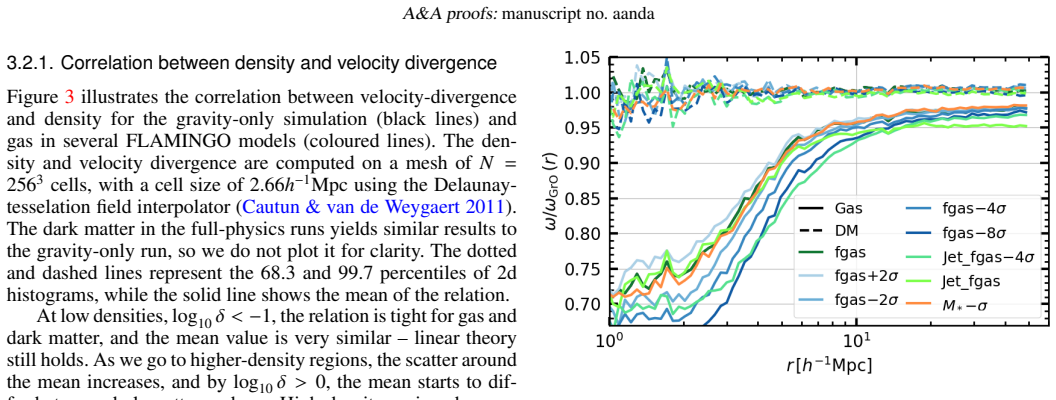
The argument runs on ratio power spectra Sδδ(k)=Pδδ/Pδδ,GrO and Sθθ(k) for gas versus gravity-only runs, evaluated at k=0.01 h/Mpc for the large-scale bias and across k for scale-dependent suppression. To study haloes, the paper stacks spherically averaged density, enclosed-mass, and radial-velocity profiles of cross-matched, isolated haloes, and defines outflow regions kinematically as grid cells where gas has positive radial velocity while dark matter has negative radial velocity. A linear-theory decomposition of pairwise velocities, ω(r)∝∫ k√(Pδδ Pθθ) j1(kr) dk with measured suppression factors inserted, separates density-field effects from velocity-field effects and identifies the density weighting as the source of the large-scale pairwise-velocity bias.
What would settle it
Measure the gas momentum field around stacked group-scale haloes with kinetic Sunyaev-Zeldovich observations at separations above about 10 $h^{-1}$ Mpc: if no 5–8% gas power suppression peaking near z≈1 appears, or if a higher-resolution resimulation removes the suppression at k=0.01 h/Mpc, the star-formation-depletion explanation for the large-scale gas bias would be falsified.
Extended reading notes
Core claim
The paper's central claim is that cosmic gas does not trace the dark matter field even in the linear, gigaparsec regime: the gas mass power spectrum falls short of the gravity-only matter power spectrum by a constant 4–8%, with the deficit peaking near z≈1. The mechanism is that star formation removes mass from the most biased, highest-density sites of the gas field, transforming it into a stellar component that is clustered more strongly than matter and leaving the remaining gas anti-biased. The same simulations show no corresponding large-scale velocity bias: gas velocities agree with dark matter velocities, and the apparent 2–3% suppression of large-scale pairwise velocities is a density-weighting artifact rather than slower infall. On scales k>0.1 h/Mpc, both density and velocity power are suppressed in a way that scales with AGN feedback strength, and the paper attributes this to outflows—gas bubbles with positive radial velocity that reach several to ten virial radii and reshape the gas around group-size haloes.
Load-bearing premise
The comparison between thermal and jet AGN feedback assumes the two implementations are numerically converged and differ only in how energy is injected, an assumption the paper itself weakens by admitting that the jet runs' large-scale power spectra do not converge.
Editorial extensions
If this is right
- Large-scale gas clustering is biased low by roughly 5% at z=0 and up to 8% at z≈1, independent of AGN feedback strength but dependent on the stellar mass function, while total baryons still trace matter.
- Gas velocities are unbiased relative to dark matter on large scales, so the large-scale pairwise-velocity suppression seen in gas is a weighting effect of the biased density field rather than slower infall.
- On scales k>0.1 h/Mpc, AGN feedback suppresses both gas density and velocity power, with stronger feedback producing stronger suppression.
- Outflows, defined as gas with positive radial velocity against infalling dark matter, reach up to roughly ten virial radii, show a biconical structure, and carry more mass and higher velocity as feedback strength increases.
- Thermal and jet AGN implementations calibrated to the same observables differ in their outflow footprint: jets redistribute gas to larger radii but are less efficient at lowering central baryon fractions in lower-mass haloes.
Reading between the lines
- If the large-scale gas bias is as generic as FLAMINGO suggests, kinetic Sunyaev-Zeldovich power-spectrum analyses should include a gas bias parameter on top of the halo bias; the paper notes that pairwise kSZ measurements scale with the square root of the suppression, reducing but not removing the effect.
- A direct observational test could search for the predicted peak in gas anti-bias near z≈1 using kSZ or line-intensity maps; a monotonic trend with redshift would challenge the star-formation-depletion mechanism.
- The explanation implies that gas bias should track the evolution of the stellar mass function rather than AGN feedback, so future parameter variations that change only star formation or supernova feedback could sharpen the prediction.
- The outflow definition used here could be applied to reconstructed velocity maps around groups once kSZ imaging reaches sufficient resolution, turning outflow bubbles into an observable proxy for AGN feedback strength and implementation.
Editorial analysis
A structured set of objections, weighed in public.
Referee Report
Summary. Using the FLAMINGO simulation suite, the paper compares gas density and velocity statistics in full-physics runs against gravity-only runs, quantifying how galaxy formation and AGN feedback modify the cosmic gas field. The central claims are that on large scales (k ≲ 0.01 h/Mpc) gas is anti-biased relative to dark matter — a roughly 5% power-spectrum suppression at z=0, rising to about 8% near z≈1 — while gas velocities are unbiased on those scales; the bias is interpreted as a consequence of star formation removing gas from the densest, most clustered regions. On smaller scales, feedback suppresses gas clustering, potential flows, and pairwise velocities, and the paper associates these effects with AGN-driven outflows around group and cluster haloes, highlighting differences between thermal and jet AGN feedback implementations. The paper closes with observational implications for tSZ, kSZ, and weak-lensing analyses.
Significance. If the main results hold, this is a valuable quantitative mapping of gas density and velocity bias in a large, observationally calibrated hydrodynamical suite, directly relevant to kSZ/tSZ and lensing analyses. The use of the non-radiative control run, the z=0 large-box convergence check, the decomposition of pairwise velocities into density and velocity contributions, and the cross-comparison with BAHAMAS are clear strengths, and the quantities studied are not calibration targets of the FLAMINGO suite, so the conclusions have independent content. However, the headline 8% peak at z≈1 is not yet secured by error estimates or a large-volume check, and the thermal-versus-jet comparison is weakened by the admitted non-convergence of the jet simulations.
major comments (3)
- [Sec. 3.1.1 / Fig. 1 (right panel); abstract] The abstract and Sec. 3.1.1 report a maximum gas bias of about 8% at z≈1, measured at k=0.01 h/Mpc. In the L=681 h^-1 Mpc box this wavenumber is essentially the fundamental mode (k_f≈0.0092 h/Mpc), so the z≈1 point is estimated from a handful of modes in a single realization, and no error bar is provided. The z=0 value is checked with the L=2800 Mpc run, but no analogous check is shown at z≈1. Because this peak is a headline quantitative claim, please add mode-count or jackknife error bars, or better, a large-volume or multi-realization estimate at z≈1, and adjust the abstract and summary statements if the peak is not robust.
- [Sec. 4.2 / Fig. 9; Footnote 1] Footnote 1 states that the two jet runs have large-scale power spectra that do not converge and attributes this to an unexplained behaviour, yet raw jet data are displayed in Figs. 2, 4, and 5 and are used in the thermal-versus-jet outflow comparison of Fig. 9. The Section 4.2 conclusion that the outflow radial profile and halo-mass scaling depend on the AGN feedback implementation rests on these runs. The admitted artifact therefore needs to be corrected, shown not to affect the outflow statistics, or the jet-related conclusions must be explicitly qualified as provisional.
- [Sec. 3.3 / Figs. 4 and 5] The pairwise-velocity ratio R_omega is quoted as converging to a constant 2–3% bias on large scales, and Fig. 5 uses this to conclude that the density field, not the velocity field, produces the bias. No uncertainties are reported for R_omega or for S_delta_delta and S_theta_theta in Figs. 1–2, so it is not possible to tell whether the large-scale velocity contribution is consistent with zero or with a few-percent velocity bias. Please report errors, for example jackknife over subvolumes, at least for the representative models shown in Fig. 4.
minor comments (5)
- [Abstract and Sec. 3.1.1] Writing the power-spectrum suppression as 'b2≈5%' is potentially confusing because the plotted quantity is P_gas/P_DM = b^2; a 5% suppression corresponds to a linear bias b≈0.975. Please define the notation explicitly.
- [Sec. 2 and Fig. 1 caption] The L=2800 Mpc run used in the middle panel of Fig. 1 is mentioned only in the caption; please specify its box size, resolution, calibration model, and the corresponding run name in Sec. 2.
- [Fig. 9] The error bars in Fig. 9 are standard deviations over 100 haloes; for comparing model differences, the uncertainty in the mean would be more appropriate, since the standard deviation is dominated by halo-to-halo scatter.
- [Appendix A] The notation 'm_gas^2/m_b^2' in Fig. A.1 is confusing: the dotted curves appear to show (M_gas/M_bar)^2 as a function of redshift, while the text says 'total gas mass relative to the total baryon mass squared'. Please make the normalization explicit and consistent in the caption and text.
- [Sec. 3.2 and Fig. 2] The text states that the velocity-divergence power spectrum is converged only for k < 0.6 h/Mpc, but Fig. 2 appears to extend to larger k; please indicate in the caption which parts of the curves should be regarded as converged.
Circularity Check
No significant circularity: the paper's claims are simulation measurements with independent calibration targets; the one reconstructed statistic (pairwise velocity from S(k)) is explicitly an ad-hoc consistency check, not a fitted prediction.
full rationale
This paper reports measurements from hydrodynamical simulations rather than derivations from fitted parameters. The central claims – large-scale gas anti-bias b^2≈5% at z=0 and ≈8% at z≈1, unbiased large-scale gas velocities, and feedback-dependent outflow properties – are not calibration targets of the FLAMINGO suite; the suite is calibrated to cluster gas fractions and stellar mass functions (Kugel et al. 2023), and the paper's statistics are separately measured from the simulation outputs. The interpretation that star formation removes gas from dense, clustered regions is supported by an independent control run (the non-radiative run, which forms no stars and shows no gas bias) and by a model with a reduced stellar mass function, not by circular definition. Equation 8 defines S(k)=sqrt(S_delta S_vv) using measured power-spectrum ratios, and Eq. 9 reconstructs pairwise velocities; the paper explicitly calls this an 'ad-hoc term' and uses it as a decomposition/consistency check to show which field drives the pairwise-velocity bias. This is not a fitted input renamed as a prediction, because no parameter is adjusted to match the pairwise velocities. Self-citations to Schaye et al. (2023), Kugel et al. (2023) and related FLAMINGO papers are descriptions of the simulation and calibration infrastructure, not unverified theorems that force the results; the jet-run convergence caveat in footnote 1 is an admitted limitation, not circular reasoning. One could question sample variance at k=0.01 h/Mpc in the L=681 h^-1 Mpc box for the z≈1 8% peak, but that is a statistical robustness concern, not circularity.
Assumptions & free parameters
free parameters (3)
- Thermal AGN feedback temperature increment DeltaT_AGN =
Not given in this paper; calibrated in Kugel et al. 2023
- Jet velocity v_jet =
Not given in this paper; calibrated in Kugel et al. 2023
- Stellar feedback parameters (two) =
Not given in this paper; calibrated in Kugel et al. 2023
assumptions (6)
- standard math Linear theory relations theta = -delta a f H and P_vv = P_theta_theta / k^2 = P_delta_delta (a f H)^2 hold for the large-scale velocity field (Eqs 1, 5, 6).
- domain assumption Subgrid prescriptions for star formation, cooling, and AGN feedback in FLAMINGO adequately represent galaxy formation physics.
- domain assumption Gravity-only FLAMINGO run is a valid reference: dark matter velocities respond negligibly to baryonic processes on the studied scales.
- ad hoc to paper The outflow identification criterion (Vgas>0 and Vdm<0 on a DTFE grid, Eq. 10) selects genuine AGN-driven outflows rather than virialized or infalling material.
- ad hoc to paper The linear-theory pairwise velocity formula, modified by the ad-hoc suppression factor S(k)=sqrt(S_delta_delta S_vv) (Eq. 8), remains applicable for gas on large scales.
- ad hoc to paper Isolated haloes (no more massive neighbour within 20 r200) are representative for studying feedback effects on gas profiles.
Cite this review
Pith. "Pith review of FLAMINGO: Galaxy formation and feedback effects on the gas density and velocity fields." pith.science (2026). https://pith.science/paper/D33OQCS2
@misc{pith2026241209526,
  author       = {Pith},
  title        = {Pith review of: FLAMINGO: Galaxy formation and feedback effects on the gas density and velocity fields},
  year         = {2026},
  howpublished = {\url{https://pith.science/paper/D33OQCS2}},
  note         = {Machine review of arXiv:2412.09526}
}
abstract
Most of the visible matter in the Universe is in a gaseous state, subject to hydrodynamic forces and galaxy formation processes that are much more complex to model than gravity. These baryonic effects can potentially bias the analyses of several cosmological probes, such as weak gravitational lensing. In this work, we study the gas density and velocity fields of the FLAMINGO simulations and compare them with their gravity-only predictions. We find that, while the gas velocities do not differ from those of dark matter on large scales, the gas mass power spectrum is suppressed by up to $\approx 8\%$ relative to matter, even on gigaparsec scales. This is a consequence of star formation depleting gas in the densest and most clustered regions of the universe. On smaller scales, $k>0.1 \, h / \rm Mpc$, the power suppression for both gas densities and velocities is more significant and correlates with the strength of the active galactic nucleus (AGN) feedback. The impact of feedback can be understood in terms of outflows, identified as gas bubbles with positive radial velocities ejected from the central galaxy. With increasing feedback strength, the outflowing gas has higher velocities, and it reaches scales as large as $10$ times the virial radius of the halo, redistributing the gas and slowing its average infall velocity. Interestingly, different implementations of AGN feedback leave distinct features in these outflows in terms of their radial and angular profiles and their dependence on halo mass. In the future, such differences could be measured in observations using, for example, the kinetic Sunyaev-Zeldovich effect.
Figures


Figures from the paper (5 more)


Forward citations
Cited by 2 Pith papers
-
Shear-kSZ: A New Estimator for the Matter-Electron Power Spectrum from kSZ Tomography and Weak Lensing
Shear–kSZ correlates kSZ, tomographic line-of-sight velocity, and lensing convergence to measure P_me(k) and thereby the baryonic matter-power suppression S(k) at high forecast significance.
-
Interpreting the stacked kinetic SZ effect I: velocity reconstruction and non-linear velocity effects
Non-linear velocity terms cancel in real-space linear reconstruction, but redshift-space distortions reintroduce a 10–20% small-scale suppression of the stacked kSZ signal.
Reference graph
Works this paper leans on
-
[1]
, " * write output.state after.block = add.period write newline
ENTRY address archiveprefix author booktitle chapter edition editor howpublished institution eprint journal key month note number organization pages publisher school series title type volume year label extra.label sort.label short.list INTEGERS output.state before.all mid.sentence after.sentence after.block FUNCTION init.state.consts #0 'before.all := #1 ...
-
[2]
write newline
" write newline "" before.all 'output.state := FUNCTION n.dashify 't := "" t empty not t #1 #1 substring "-" = t #1 #2 substring "--" = not "--" * t #2 global.max substring 't := t #1 #1 substring "-" = "-" * t #2 global.max substring 't := while if t #1 #1 substring * t #2 global.max substring 't := if while FUNCTION word.in bbl.in " " * FUNCTION format....
-
[3]
Ade, P. A. R., Aghanim, N., Arnaud, M., et al. 2016, , 594, A24
2016
-
[4]
2021, , 923, 37
Adhikari , S., Shin , T.-h., Jain , B., et al. 2021, , 923, 37
2021
-
[5]
P., Alexandroff , R., Allende Prieto , C., et al
Ahn , C. P., Alexandroff , R., Allende Prieto , C., et al. 2014, , 211, 17
2014
-
[6]
2017, Publications of the Astronomical Society of Japan, 70
Aihara, H., Arimoto, N., Armstrong, R., et al. 2017, Publications of the Astronomical Society of Japan, 70
2017
-
[7]
2022, , 514, 1645
Anbajagane , D., Chang , C., Jain , B., et al. 2022, , 514, 1645
2022
-
[8]
2022, , 663, L6
Angelinelli , M., Ettori , S., Dolag , K., Vazza , F., & Ragagnin , A. 2022, , 663, L6
2022
Show all 132 references
-
[9]
Angulo , R. E. & Hahn , O. 2022, Living Reviews in Computational Astrophysics, 8, 1
2022
-
[10]
E., Hahn , O., & Abel , T
Angulo , R. E., Hahn , O., & Abel , T. 2013, , 434, 1756
2013
-
[11]
E., Hern \'a ndez-Monteagudo , C., Contreras , S., & Zennaro , M
Aric \`o , G., Angulo , R. E., Hern \'a ndez-Monteagudo , C., Contreras , S., & Zennaro , M. 2021, , 503, 3596
2021
-
[12]
E., Hern \'a ndez-Monteagudo , C., et al
Aric \`o , G., Angulo , R. E., Hern \'a ndez-Monteagudo , C., et al. 2020, , 495, 4800
2020
-
[13]
2023 a , , 524, 5391
Ayromlou , M., Nelson , D., & Pillepich , A. 2023 a , , 524, 5391
2023
-
[14]
2023 b , arXiv e-prints, arXiv:2311.06339
Ayromlou , M., Nelson , D., Pillepich , A., et al. 2023 b , arXiv e-prints, arXiv:2311.06339
2023 arXiv
-
[15]
R., Pfrommer , C., & Sievers , J
Battaglia , N., Bond , J. R., Pfrommer , C., & Sievers , J. L. 2012 a , , 758, 74
2012
-
[16]
R., Pfrommer , C., & Sievers , J
Battaglia , N., Bond , J. R., Pfrommer , C., & Sievers , J. L. 2012 b , , 758, 75
2012
-
[17]
J., Adhikari , S., Vega-Ferrero , J., et al
Baxter , E. J., Adhikari , S., Vega-Ferrero , J., et al. 2021, , 508, 1777
2021
-
[18]
& Kosowsky, A
Bhattacharya, S. & Kosowsky, A. 2008, Physical Review D, 77
2008
-
[19]
& Silvestri, A
Bianchini, F. & Silvestri, A. 2016, Physical Review D, 93
2016
-
[20]
2022, Monthly Notices of the Royal Astronomical Society, 512, 3703–3716
Bird, S., Ni, Y., Di Matteo, T., et al. 2022, Monthly Notices of the Royal Astronomical Society, 512, 3703–3716
2022
-
[21]
E., et al
Bocquet, S., Grandis, S., Bleem, L. E., et al. 2024, SPT Clusters with DES and HST Weak Lensing. II. Cosmological Constraints from the Abundance of Massive Halos
2024
-
[22]
Bolliet , B., Comis , B., Komatsu , E., & Mac \' as-P \'e rez , J. F. 2018, , 477, 4957
2018
-
[23]
Booth , C. M. & Schaye , J. 2009, , 398, 53
2009
-
[24]
A., Vavagiakis , E
Calafut , V., Gallardo , P. A., Vavagiakis , E. M., et al. 2021, , 104, 043502
2021
-
[25]
Cautun , M. C. & van de Weygaert , R. 2011, arXiv e-prints, arXiv:1105.0370
2011 arXiv
-
[26]
2024, , 109, 063513
Chen , Z., Jamieson , D., Komatsu , E., et al. 2024, , 109, 063513
2024
-
[27]
2023, , 953, 188
Chen , Z., Zhang , P., & Yang , X. 2023, , 953, 188
2023
-
[28]
2022, , 510, 5916
Chen , Z., Zhang , P., Yang , X., & Zheng , Y. 2022, , 510, 5916
2022
-
[29]
2021, , 910, 32
Chiang , Y.-K., Makiya , R., Komatsu , E., & M \'e nard , B. 2021, , 910, 32
2021
-
[30]
2020, , 902, 56
Chiang , Y.-K., Makiya , R., M \'e nard , B., & Komatsu , E. 2020, , 902, 56
2020
-
[31]
E., Richardson , M
Chisari , N. E., Richardson , M. L. A., Devriendt , J., et al. 2018, , 480, 3962
2018
-
[32]
J., Crain , R
Davies , J. J., Crain , R. A., McCarthy , I. G., et al. 2019, , 485, 3783
2019
-
[33]
S., & White , S
Davis , M., Efstathiou , G., Frenk , C. S., & White , S. D. M. 1985, , 292, 371
1985
-
[34]
2019, Monthly Notices of the Royal Astronomical Society, 486, 2827–2849
Davé, R., Anglés-Alcázar, D., Narayanan, D., et al. 2019, Monthly Notices of the Royal Astronomical Society, 486, 2827–2849
2019
-
[35]
de Jong, J. T. A., Verdoes Kleijn, G. A., Kuijken, K. H., & Valentijn, E. A. 2012, Experimental Astronomy, 35, 25–44
2012
-
[36]
Debackere , S. N. B., Schaye , J., & Hoekstra , H. 2020, , 492, 2285
2020
-
[37]
2022, in European Physical Journal Web of Conferences, Vol
Douspis , M., Salvati , L., Gorce , A., & Aghanim , N. 2022, in European Physical Journal Web of Conferences, Vol. 257, mm Universe @ NIKA2 - Observing the mm Universe with the NIKA2 Camera, 00014
2022
-
[38]
A., Saar , E., & Shandarin , S
Einasto , J., Klypin , A. A., Saar , E., & Shandarin , S. F. 1984, , 206, 529
1984
-
[39]
J., Ca \ n as , R., Poulton , R
Elahi , P. J., Ca \ n as , R., Poulton , R. J. J., et al. 2019, , 36, e021
2019
-
[40]
Fry , J. N. 1996, , 461, L65
1996
-
[41]
2024, , 689, A298
Ghirardini , V., Bulbul , E., Artis , E., et al. 2024, , 689, A298
2024
-
[42]
A., et al
Gong , Y., Bean , R., Gallardo , P. A., et al. 2024, , 109, 023513
2024
-
[43]
E., & Abel , T
Hahn , O., Angulo , R. E., & Abel , T. 2015, , 454, 3920
2015
-
[44]
E., Aubourg , E., et al
Hand , N., Addison , G. E., Aubourg , E., et al. 2012, , 109, 041101
2012
-
[45]
P., Campbell , D., Tollerud , E., et al
Hearin , A. P., Campbell , D., Tollerud , E., et al. 2017, The Astronomical Journal, 154, 190
2017
-
[46]
A., Schaller , M., Frenk , C
Hellwing , W. A., Schaller , M., Frenk , C. S., et al. 2016, , 461, L11
2016
-
[47]
2023, , 524, 2556
Hern \'a ndez-Aguayo , C., Springel , V., Pakmor , R., et al. 2023, , 524, 2556
2023
-
[48]
Hernandez‐Monteagudo, C., Verde, L., Jimenez, R., & Spergel, D. N. 2006, The Astrophysical Journal, 643, 598–615
2006
-
[49]
G., Schaye , J., Nobels , F
Hu s ko , F., Lacey , C. G., Schaye , J., Nobels , F. S. J., & Schaller , M. 2024, , 527, 5988
2024
-
[50]
G., Schaye , J., Schaller , M., & Nobels , F
Hu s ko , F., Lacey , C. G., Schaye , J., Schaller , M., & Nobels , F. S. J. 2022, , 516, 3750
2022
-
[51]
Karp , J. S. M., Lange , J. U., & Wechsler , R. H. 2023, , 949, L13
2023
-
[52]
2009, , 698, 266
Knebe , A., Wagner , C., Knollmann , S., Diekershoff , T., & Krause , F. 2009, , 698, 266
2009
-
[53]
2023, , 526, 6103
Kugel , R., Schaye , J., Schaller , M., et al. 2023, , 526, 6103
2023
-
[54]
Kuruvilla , J., Aghanim , N., & McCarthy , I. G. 2020, , 644, A170
2020
-
[55]
G., & Salcido , J
Kwan , J., McCarthy , I. G., & Salcido , J. 2024, , 533, 3570
2024
-
[56]
T., Nagai , D., Avestruz , C., Nelson , K., & Vikhlinin , A
Lau , E. T., Nagai , D., Avestruz , C., Nelson , K., & Vikhlinin , A. 2015, , 806, 68
2015
-
[57]
2024, , 271, 30
Li , S., Zheng , Y., Chen , Z., Xu , H., & Yang , X. 2024, , 271, 30
2024
-
[58]
D., Schaye , J., & Bower , R
Ludlow , A. D., Schaye , J., & Bower , R. 2019, , 488, 3663
2019
-
[59]
2021, , 594, 187
Mart \' n-Navarro , I., Pillepich , A., Nelson , D., et al. 2021, , 594, 187
2021
-
[60]
G., Amon , A., Schaye , J., et al
McCarthy , I. G., Amon , A., Schaye , J., et al. 2024, arXiv e-prints, arXiv:2410.19905
2024 arXiv
-
[61]
G., Le Brun , A
McCarthy , I. G., Le Brun , A. M. C., Schaye , J., & Holder , G. P. 2014, , 440, 3645
2014
-
[62]
G., Schaye, J., Bird, S., & Le Brun, A
McCarthy, I. G., Schaye, J., Bird, S., & Le Brun, A. M. C. 2017, Monthly Notices of the Royal Astronomical Society, 465, 2936–2965
2017
-
[63]
R., Hernquist, L., Zahn, O., & Zaldarriaga, M
McQuinn, M., Furlanetto, S. R., Hernquist, L., Zahn, O., & Zaldarriaga, M. 2005, The Astrophysical Journal, 630, 643
2005
-
[64]
J., Brieden , S., Tr \"o ster , T., & Heymans , C
Mead , A. J., Brieden , S., Tr \"o ster , T., & Heymans , C. 2021, , 502, 1401
2021
-
[65]
J., Tr \"o ster , T., Heymans , C., Van Waerbeke , L., & McCarthy , I
Mead , A. J., Tr \"o ster , T., Heymans , C., Van Waerbeke , L., & McCarthy , I. G. 2020, , 641, A130
2020
-
[66]
Mitchell , P. D. & Schaye , J. 2022, , 511, 2600
2022
-
[67]
Mueller, E.-M., de Bernardis, F., Bean, R., & Niemack, M. D. 2015, Physical Review D, 92
2015
-
[68]
O., McCarthy , I
Mummery , B. O., McCarthy , I. G., Bird , S., & Schaye , J. 2017, , 471, 227
2017
-
[69]
S., Ferraro , S., Johnson , M
M \"u nchmeyer , M., Madhavacheril , M. S., Ferraro , S., Johnson , M. C., & Smith , K. M. 2019, , 100, 083508
2019
-
[70]
2015, Astronomy and Computing, 13, 12–37
Nelson, D., Pillepich, A., Genel, S., et al. 2015, Astronomy and Computing, 13, 12–37
2015
-
[71]
2023, , 959, 136
Ni , Y., Genel , S., Angl \'e s-Alc \'a zar , D., et al. 2023, , 959, 136
2023
-
[72]
Nobels , F. S. J., Schaye , J., Schaller , M., Bah \'e , Y. M., & Chaikin , E. 2022, , 515, 4838
2022
-
[73]
A., & Bond, J
Park, H., Alvarez, M. A., & Bond, J. R. 2018, The Astrophysical Journal, 853, 121
2018
-
[74]
2020, , 499, 2462
P \'e roux , C., Nelson , D., van de Voort , F., et al. 2020, , 499, 2462
2020
-
[75]
2018, , 473, 4077
Pillepich , A., Springel , V., Nelson , D., et al. 2018, , 473, 4077
2018
-
[76]
& Knebe , A
Power , C. & Knebe , A. 2006, , 370, 691
2006
-
[77]
F., Jenkins , A., et al
Power , C., Navarro , J. F., Jenkins , A., et al. 2003, , 338, 14
2003
-
[78]
Press , W. H. & Davis , M. 1982, , 259, 449
1982
-
[79]
& Scoccimarro , R
Pueblas , S. & Scoccimarro , R. 2009, , 80, 043504
2009
-
[80]
Rodriguez , F., Merch \'a n , M., & Artale , M. C. 2022, , 514, 1077
2022
-
[81]
C., & Andrews , M
Rodriguez , F., Merch \'a n , M., Artale , M. C., & Andrews , M. 2023, , 521, 5483
2023
-
[82]
2018, Monthly Notices of the Royal Astronomical Society, 481, 2497–2506
Roncarelli, M., Baldi, M., & Villaescusa-Navarro, F. 2018, Monthly Notices of the Royal Astronomical Society, 481, 2497–2506
2018
-
[83]
2017, Monthly Notices of the Royal Astronomical Society, stx170
Roncarelli, M., Villaescusa-Navarro, F., & Baldi, M. 2017, Monthly Notices of the Royal Astronomical Society, stx170
2017
-
[84]
G., Kwan , J., Upadhye , A., & Font , A
Salcido , J., McCarthy , I. G., Kwan , J., Upadhye , A., & Font , A. S. 2023, , 523, 2247
2023
-
[85]
2018, , 614, A13
Salvati , L., Douspis , M., & Aghanim , N. 2018, , 614, A13
2018
-
[86]
Schaap , W. E. & van de Weygaert , R. 2000, , 363, L29
2000
-
[87]
C., & van Daalen , M
Schaller , M., Schaye , J., Kugel , R., Broxterman , J. C., & van Daalen , M. P. 2024, arXiv e-prints, arXiv:2410.17109
2024 arXiv
-
[88]
A., Bower , R
Schaye , J., Crain , R. A., Bower , R. G., et al. 2015, , 446, 521
2015
-
[89]
2023, , 526, 4978
Schaye , J., Kugel , R., Schaller , M., et al. 2023, , 526, 4978
2023
-
[90]
2024, arXiv e-prints, arXiv:2409.18368
Schiappucci , E., Raghunathan , S., To , C., et al. 2024, arXiv e-prints, arXiv:2409.18368
2024 arXiv
-
[91]
& Teyssier , R
Schneider , A. & Teyssier , R. 2015, , 2015, 049
2015
-
[92]
2016, , 2016, 047
Schneider , A., Teyssier , R., Potter , D., et al. 2016, , 2016, 047
2016
-
[93]
2019, , 2019, 020
Schneider , A., Teyssier , R., Stadel , J., et al. 2019, , 2019, 020
2019
-
[94]
2013, , 434, 148
Semboloni , E., Hoekstra , H., & Schaye , J. 2013, , 434, 148
2013
-
[95]
P., & McCarthy , I
Semboloni , E., Hoekstra , H., Schaye , J., van Daalen , M. P., & McCarthy , I. G. 2011, , 417, 2020
2011
-
[96]
D., Rudd , D
Shaw , L. D., Rudd , D. H., & Nagai , D. 2012, , 756, 15
2012
-
[97]
M., Markovic , K., & Rhodes , J
Shirasaki , M., Huff , E. M., Markovic , K., & Rhodes , J. D. 2021, , 907, 38
2021
-
[98]
2024, arXiv e-prints, arXiv:2409.05815
Sorini , D., Bose , S., Dav \'e , R., & Angl \'e s-Alc \'a zar , D. 2024, arXiv e-prints, arXiv:2409.05815
2024 arXiv
-
[99]
2022, , 516, 883
Sorini , D., Dav \'e , R., Cui , W., & Appleby , S. 2022, , 516, 883
2022
-
[100]
2018, , 475, 676
Springel , V., Pakmor , R., Pillepich , A., et al. 2018, , 475, 676
2018
-
[101]
Sunyaev , R. A. & Zeldovich , Y. B. 1972, Comments on Astrophysics and Space Physics, 4, 173
1972
-
[102]
Sunyaev , R. A. & Zeldovich , Y. B. 1980, , 190, 413
1980
-
[103]
& Peebles , P
Tegmark , M. & Peebles , P. J. E. 1998, , 500, L79
1998
-
[104]
2005, arXiv e-prints, astro
The Dark Energy Survey Collaboration . 2005, arXiv e-prints, astro
2005
-
[105]
Tinker , J. L. 2007, , 374, 477
2007
-
[106]
V., Dutton , A
Tollet , \'E ., Cattaneo , A., Macci \`o , A. V., Dutton , A. A., & Kang , X. 2019, , 485, 2511
2019
-
[107]
T., Schaye , J., et al
Towler , I., Kay , S. T., Schaye , J., et al. 2024, , 529, 2017
2024
-
[108]
R., Ricarte , A., et al
Tremmel , M., Quinn , T. R., Ricarte , A., et al. 2019, , 483, 3336
2019
-
[109]
2023, , 525, 1976
Truong , N., Pillepich , A., Nelson , D., et al. 2023, , 525, 1976
2023
-
[110]
2021 a , , 508, 1563
Truong , N., Pillepich , A., Nelson , D., Werner , N., & Hernquist , L. 2021 a , , 508, 1563
2021
-
[111]
2021 b , , 501, 2210
Truong , N., Pillepich , A., & Werner , N. 2021 b , , 501, 2210
2021
-
[112]
P., McCarthy , I
van Daalen , M. P., McCarthy , I. G., & Schaye , J. 2020, , 491, 2424
2020
-
[113]
P., Schaye , J., Booth , C
van Daalen , M. P., Schaye , J., Booth , C. M., & Dalla Vecchia , C. 2011, , 415, 3649
2011
-
[114]
P., Schaye, J., McCarthy, I
van Daalen, M. P., Schaye, J., McCarthy, I. G., Booth, C. M., & Vecchia, C. D. 2014, Monthly Notices of the Royal Astronomical Society, 440, 2997–3010
2014
-
[115]
P., Schaye, J., et al
Velliscig, M., van Daalen, M. P., Schaye, J., et al. 2014, Monthly Notices of the Royal Astronomical Society, 442, 2641–2658
2014
-
[116]
2013, Monthly Notices of the Royal Astronomical Society, 436, 3031–3067
Vogelsberger, M., Genel, S., Sijacki, D., et al. 2013, Monthly Notices of the Royal Astronomical Society, 436, 3031–3067
2013
-
[117]
2020, Nature Reviews Physics, 2, 42
Vogelsberger , M., Marinacci , F., Torrey , P., & Puchwein , E. 2020, Nature Reviews Physics, 2, 42
2020
-
[118]
2017, , 465, 3291
Weinberger , R., Springel , V., Hernquist , L., et al. 2017, , 465, 3291
2017
-
[119]
2024, , 527, 1612
Yang , T., Dav \'e , R., Cui , W., et al. 2024, , 527, 1612
2024
-
[120]
2005, The Astrophysical Journal, 630, 657–666
Zahn, O., Zaldarriaga, M., Hernquist, L., & McQuinn, M. 2005, The Astrophysical Journal, 630, 657–666
2005
-
[121]
2013, , 87, 063526
Zhang , P., Pan , J., & Zheng , Y. 2013, , 87, 063526
2013
-
[122]
2013, , 88, 103510
Zheng , Y., Zhang , P., Jing , Y., Lin , W., & Pan , J. 2013, , 88, 103510
2013
-
[123]
1966, in Stellar Evolution, ed.\ R
Baker, N. 1966, in Stellar Evolution, ed.\ R. F. Stein,& A. G. W. Cameron (Plenum, New York) 333
1966
-
[124]
1988, A&A, 200, 58
Balluch, M. 1988, A&A, 200, 58
1988
-
[125]
Cox, J. P. 1980, Theory of Stellar Pulsation (Princeton University Press, Princeton) 165
1980
-
[126]
N.,& Stewart, J
Cox, A. N.,& Stewart, J. N. 1969, Academia Nauk, Scientific Information 15, 1
1969
-
[127]
1980, Prog
Mizuno H. 1980, Prog. Theor. Phys., 64, 544
1980
-
[128]
Tscharnuter W. M. 1987, A&A, 188, 55
1987
-
[129]
1992, in ASP Conf
Terlevich, R. 1992, in ASP Conf. Ser. 31, Relationships between Active Galactic Nuclei and Starburst Galaxies, ed. A. V. Filippenko, 13
1992
-
[130]
Yorke, H. W. 1980a, A&A, 86, 286
-
[131]
F., Tytler, D
Zheng, W., Davidsen, A. F., Tytler, D. & Kriss, G. A. 1997, preprint
1997
-
[132]
write newline
" write newline "" before.all 'output.state := FUNCTION fin.entry write newline FUNCTION new.block output.state before.all = 'skip after.block 'output.state := if FUNCTION new.sentence output.state after.block = 'skip output.state before.all = 'skip after.sentence 'output.stat...
Reviewed August 11, 2026 · model on record in the stance chip above.
Discussion (0). Continue with ORCID to comment.