REVIEW 5 minor 87 references
Dissipative Dynamical Phase Transition as a Complex Ising Model
T0 review · 0 major / 5 minor · reviewed 2026-08-11 · deepseek-v4-flash
Pith's one-line read The paper claims that the relaxation of a dephasing qubit chain is governed by a complex transverse-field Ising model, with a phase transition at $g=1$ that is first-order from one side and second-order from the other.
desk verdict The 1D result is the real thing: an exact free-fermion solution with a genuinely new two-sided transition, honestly labeled where the evidence is weaker; this deserves a serious referee. read the letter →
The pith
A machine-rendered reading of the paper's core claim, the machinery that carries it, and where it could break.
The reading
What carries the argument
The central object is the cTFIM, defined by Eq. (22): $H_{\mathrm{1d}}(g)= -\sum_{\langle i,j\rangle} \tau^z_i \tau^z_j - i g \sum_i \tau^x_i$, where the $\tau$ operators live in the doubled-Hilbert-space representation of the density matrix and $g=\theta/p$ is the ratio of coherent rotation rate to dephasing rate. Its role is to generate the open-system observable: $\langle \prod_i \sigma^z_i\rangle$ equals a return amplitude of imaginary-time evolution under $H_{\mathrm{1d}}(g)$, normalized by the $g=0$ denominator. The exact solution proceeds by Jordan-Wigner mapping to free fermions with complex single-particle energies $\epsilon^\pm_k = \pm 2\sqrt{1-g^2-2ig\cos k}$; the late-time behavior is dominated by the many-body "ground state" with smallest real part of its energy, so the real part of the energy sum gives the decay rate $\Gamma$ and the imaginary part gives the oscillation frequency $\omega$. Non-analyticity localizes at momentum $k=\pi/2$ and $g=1$, the exceptional point, and a Hubbard-Stratonovich field theory is used to extend the ferromagnetic-side picture to higher dimensions.
What would settle it
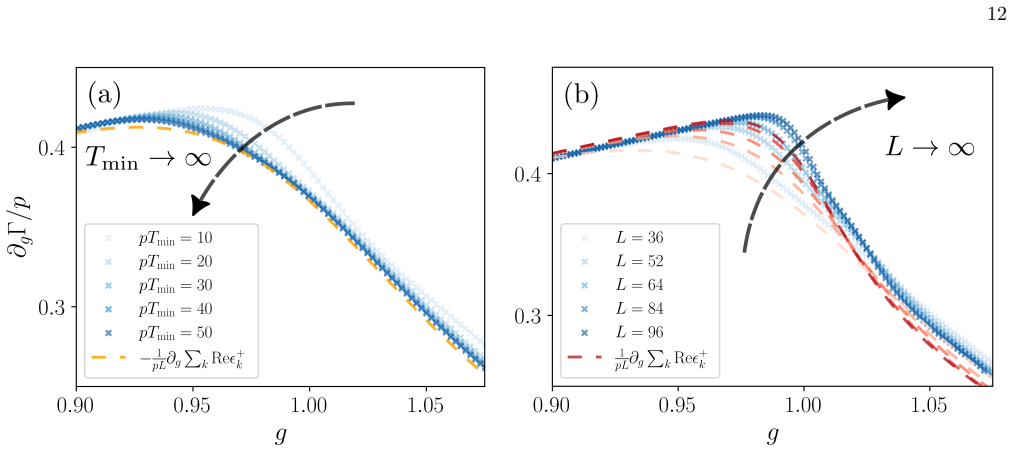
Compute $\partial^2_g \Gamma$ from the exact free-fermion expression on finite chains with $L$ up to a few hundred, taking $T$ very large at fixed $L$; the singularity $(g-1)^{-1/2}$ should appear only after $L\to\infty$, so a finite-$L$ peak that moves away from $g=1$ or fails to sharpen would falsify the ordered-limit claim.
Extended reading notes
Core claim
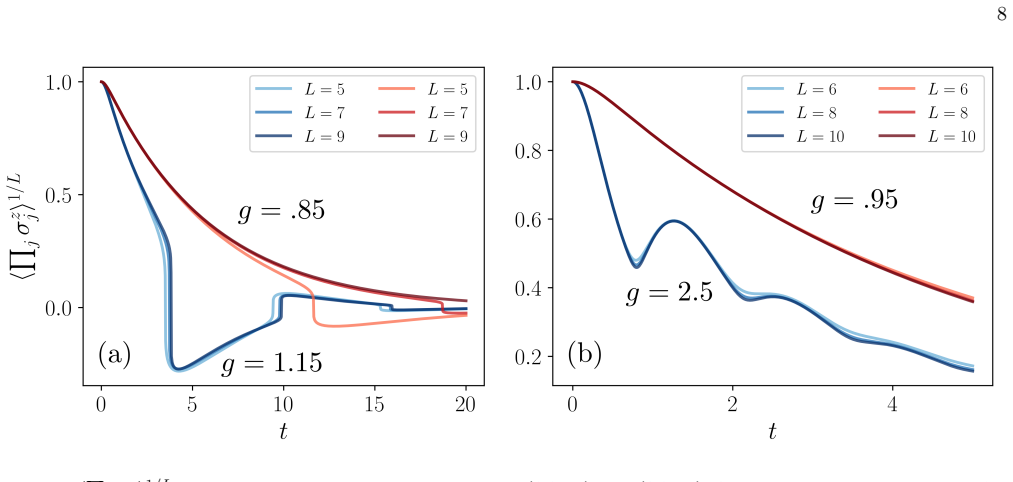
On the paper's own terms, the central discovery is that the observable $\langle \prod_i \sigma^z_i\rangle^{1/L}$ at late times takes the form of an exponential envelope $e^{-\Gamma T}$ multiplied by an oscillatory factor: underdamped oscillations for $g>1$ and pure exponential decay for $g<1$, with $\omega \sim \sqrt{g-1}$ and $\partial^2_g \Gamma \sim (g-1)^{-1/2}$ approaching the transition from above. The same non-Hermitian Hamiltonian's ground state (right eigenstate with smallest real energy) is gapped and ferromagnetic for $g<1$ and gapless with power-law correlations for $g>1$. The magnetization, defined from long-distance static correlations, tends to a nonzero constant as $g\to 1^-$ and then disappears discontinuously, while the correlation length does not diverge, giving the first-order appearance from below.
Load-bearing premise
The predictions rely on the late-time signal being dominated by the non-Hermitian "ground state" once the chain is infinitely long, and on taking the chain length to infinity before the time goes to infinity; if other modes take over near the critical point, the transition's order could look different.
Editorial extensions
If this is right
- For $g<1$, the global string decays purely exponentially in the thermodynamic limit; for $g>1$ it oscillates with frequency $\omega=\theta\sqrt{1-1/g^2}$, so the oscillation frequency vanishes with a square-root singularity at the transition.
- The late-time decay rate $\Gamma$ has a well-defined thermodynamic limit independent of the parity of the chain length, and its second derivative diverges as $g\to 1^+$, a many-body effect absent in the single-qubit problem.
- The cTFIM phases are physical: the ferromagnetic phase has long-range order with a correlation length that stays finite at the transition, while the gapless phase has quasi-long-range order with a continuously varying power-law exponent, measurable via the modified time-evolution protocol for spin-spin correlations.
- The purity, a nonlinear observable, maps to a cTFIM with annealed disorder in the transverse field, shifting the expected transition to $g_c=2$, consistent with exact numerics at small system sizes.
- In higher dimensions the field theory yields a stable time-independent saddlepoint only on the ferromagnetic side, predicting a first-order transition with no diverging length scale when approached from that side.
Reading between the lines
- The paper leaves open the connection to the $1+1$-d repetition code with coherent errors and weak measurements; if the same two-sided transition governs the logical error rate, the first-order side would imply a sharp threshold without a diverging correlation length.
- A testable extension is to measure the ratio of the two exceptional-point probing operators $O_1,O_2$ on an even-length chain; their long-lived oscillations should persist only at $g>1$ and would directly expose the $k=\pi/2$ mode.
- In higher dimensions the underdamped phase lacks a stable time-independent saddlepoint; if the one-dimensional gapless phase generalizes, it would likely require a time-dependent or complex saddle, and the paper leaves the nature of that phase open.
- Because the weak symmetry is a feature only of the unconditional channel, the conditional dynamics with recorded measurement outcomes may not show the same transition; determining what survives there is a natural next step the authors flag explicitly.
Editorial analysis
A structured set of objections, weighed in public.
Referee Report
Summary. The paper studies a qubit chain with on-site σx rotations and nearest-neighbor σzσz dephasing, whose unconditional dynamics drives any state to the maximally mixed state. The authors show that the late-time expectation value of the global σz string is exactly the return amplitude of the complex transverse-field Ising model H1d(g) = -Σ τ^z_iτ^z_j - ig Σ τ^x_i (Eq. 22), with g=θ/p. Using a Jordan-Wigner transformation, they diagonalize H1d and obtain closed forms for the return amplitude in the large-T limit. They identify a transition at g=1: for g<1 the decay rate's second derivative is regular as g→1⁻, while for g>1 ∂²_gΓ diverges as (g-1)^{-1/2}. The oscillation frequency vanishes as sqrt(g-1) from the paramagnetic side. The ferromagnetic side is associated with a magnetization that appears to jump discontinuously based on finite-size Pfaffian calculations. A Hubbard-Stratonovich field theory for higher dimensions is presented, suggesting a first-order transition from the ferromagnetic side, with an acknowledged incomplete treatment of the paramagnetic side.
Significance. If the claims hold, this is a valuable exact example of a dynamical phase transition in an open quantum system that does not require post-selection or non-local couplings. The derivation is self-contained and parameter-free: the transition point is g=1, arising from the free-fermion spectrum rather than fitted. The analytic result for ∂²_gΓ divergence from the paramagnetic side, with explicit scaling collapse, is a strong concrete prediction. The numerical corroboration via exact diagonalization of the discrete-time channel and finite-size scaling of the analytic formula supports the central claim. The higher-dimensional field theory is clearly exploratory and flagged as such. The main limitation is that the first-order-side characterization rests on finite-size numerics, which the authors label 'consistent with' rather than prove.
minor comments (5)
- [Appendix C.2] The statement before Eq. (SC.14) that ⟨GHZ±| e^{−pT H(0)} |GHZ±⟩ = e^{−2pT L} is inconsistent with the sign convention of Eq. (22); for H(0)=−Σ τ^z_iτ^z_j acting on the all-aligned states the matrix element is e^{+pTL}. The final normalized expression (SC.14) appears correct, but this intermediate sentence should be corrected or clarified.
- [Abstract and Section IV.D] The phrase 'an analytic result' in the abstract overstates the status of the ferromagnetic-side first-order characterization; Section IV.D and Fig. S3 support it only as 'consistent with' a discontinuous magnetization from finite-L Pfaffian extrapolations. Please revise the wording to distinguish the analytic two-sided derivative behavior from the numerically inferred first-order interpretation.
- [Section IV.B, Eq. (35)] For odd L the definition of Γ via log⟨∏σ^z⟩ requires first dividing out cos(ω_odd T), which is undefined at zero crossings; please state that Γ is defined through the envelope or equivalently through the ground-state energy in Eq. (36), and that the ordered limit is taken after removing the oscillatory factor.
- [Section V.B] The conclusion that the class A saddlepoint dominates for g<2d is conditional on the explicitly stated assumption that no other time- or space-dependent saddlepoints exist; please mark this as an unproven assumption in the conclusion as well as in Section V.B, since it is load-bearing for the higher-dimensional claims.
- [Typos] In Section II.B 'SW AP' should be 'SWAP'; in Eq. (37) 'eigpT' and 'eiθT' should be 'e^{igpT}' and 'e^{iθT}'; in Section III.C 'R´ enyi' should be 'Rényi'.
Circularity Check
No circularity: the central 1D result is an exact free-fermion derivation from the Lindbladian, with no fitted parameter renamed as a prediction.
full rationale
I walked the derivation chain and found no step in which an output is equivalent to its input by construction. The central object, the global sigma-z string expectation value, is first reduced to a return amplitude of the complex transverse-field Ising model (Eq. 21 and Eq. 22) via the weak-symmetry structure of the Lindbladian. That return amplitude is then evaluated exactly by Jordan-Wigner transformation (Eq. 28, Eq. SC.2), with single-particle energies epsilon_k^± = ±2 sqrt(1 - g^2 - 2 i g cos k) (Eq. 29). The late-time decay rate Gamma in Eq. 36 is a sum over the real parts of these exact energies, and the claimed two-sided non-analyticity is obtained by evaluating the same derivative integral in the two regimes g < 1 and g > 1 (Appendix D.3, Eqs. SD.13-SD.16). The critical point g = 1 is not assumed; it emerges from the branch structure of the exact spectrum at k = pi/2, and the paper explicitly states the ordered limit L -> infinity before T -> infinity (Section IV.B) on which the late-time projection rests. No parameter is fitted to a subset of data and then presented as a prediction: g = theta/p is a physical ratio of the prescribed unitary and dephasing rates. The softer claim of a discontinuous magnetization on the ferromagnetic side is explicitly labeled as 'consistent with' a first-order transition and supported by finite-L Pfaffian numerics, not as an analytically proven consequence, and it is not the load-bearing part of the central claim. The self-citations appearing in the reference list are background and contextual, such as earlier work on entanglement dynamics and error correction, and none is invoked to justify the existence or nature of the transition. The manuscript also explicitly identifies its own open questions and limitations, including the higher-dimensional underdamped phase and conditional dynamics, which further indicates that no circular closure is being asserted. I therefore find no significant circularity and assign score 0.
Assumptions & free parameters
assumptions (5)
- standard math Jordan-Wigner transformation maps the 1D cTFIM to free fermions with boundary conditions set by Ising parity.
- domain assumption The unconditioned quantum channel is obtained by discarding weak-measurement outcomes, giving the Z-dephasing Lindbladian (3), (18).
- domain assumption The weak symmetry µ^x_j is conserved, fragmenting the doubled Hilbert space; the global σz-string insertion selects the sector where every site has µ^x = -1.
- domain assumption Late-time dynamics is dominated by the right eigenstate with smallest real eigenvalue; limits are taken L → ∞ before T → ∞.
- ad hoc to paper In higher dimensions, the Hubbard-Stratonovich saddlepoint analysis is complete; no other saddlepoints with non-trivial time or space dependence dominate.
Cite this review
Pith. "Pith review of Dissipative Dynamical Phase Transition as a Complex Ising Model." pith.science (2026). https://pith.science/paper/QJQFZSWL
@misc{pith2026241209591,
  author       = {Pith},
  title        = {Pith review of: Dissipative Dynamical Phase Transition as a Complex Ising Model},
  year         = {2026},
  howpublished = {\url{https://pith.science/paper/QJQFZSWL}},
  note         = {Machine review of arXiv:2412.09591}
}
abstract
We investigate a quantum dynamical phase transition induced by the competition between local unitary evolution and dissipation in a qubit chain with a strong, on-site $\mathbb{Z}_2$ symmetry. While the steady-state of this evolution is always maximally-mixed, we show that the dynamical behavior of certain non-local observables on the approach to this steady-state is dictated by a quantum Ising model with a $\textit{complex}$ transverse-field (cTFIM). We investigate these observables analytically, uncovering a dynamical phase transition as the relative rate of unitary evolution and dissipation is tuned. We show that the weak-dissipation limit corresponds to a cTFIM with a large magnitude of the imaginary transverse-field, for which the many-body "ground-state" (with smallest real eigenvalue) is gapless, exhibiting quasi-long-range correlations of the local magnetization with a continuously-varying exponent. Correspondingly, the dynamics of the non-local observables show oscillatory behavior with an amplitude decaying exponentially in time. The strong-dissipation limit corresponds to a gapped ferromagnetic phase of the cTFIM, and non-local observables show exponential decay on the approach to equilibrium. This transition in (1+1)-dimensions has a peculiar, "two-sided" nature appearing as either first- or second-order depending on the phase from which the transition is approached, an analytic result which is corroborated by numerical studies. In higher dimensions, we present a field-theoretic understanding of the first-order nature of this transition, when approaching from the ferromagnetic phase of the cTFIM, though the nature of the phase with large imaginary transverse-field remains to be understood.
Figures


Figures from the paper (2 more)

Reference graph
Works this paper leans on
-
[61]
Dynamical signatures of the Yang-Lee edge singularity in non-Hermitian systems
Ming-Chu Lu, Shun-Hui Shi, and Gaoyong Sun, “Dynamical signatures of the yang-lee edge sin- gularity in non-hermitian systems,” arXiv preprint arXiv:2407.20106 (2024)
work page Pith review arXiv 2024
-
[1]
two-sided
is a T -independent constant. This saddlepoint is exponentially suppressed in the T → ∞ limit, for any value of g. We also find that q fluctuations are massive, but there is an instability for ω fluctuations with frequency p g2 − ϕ2 0/π. B. Approaching the T ransition Assuming that there are no other saddlepoints with smaller action, but non-trivial tempo...
-
[2]
Quantum computing in the nisq era and beyond,
John Preskill, “Quantum computing in the nisq era and beyond,” Quantum 2, 79 (2018)
2018
-
[3]
Quantum simulators: Architectures and opportunities,
Ehud Altman, Kenneth R Brown, Giuseppe Carleo, Lin- 14 coln D Carr, Eugene Demler, Cheng Chin, Brian De- Marco, Sophia E Economou, Mark A Eriksson, Kai- Mei C Fu, et al., “Quantum simulators: Architectures and opportunities,” PRX quantum 2, 017003 (2021)
2021
-
[4]
Measurement-induced phase transitions in the dynamics of entanglement,
Brian Skinner, Jonathan Ruhman, and Adam Nahum, “Measurement-induced phase transitions in the dynamics of entanglement,” Phys. Rev. X 9, 031009 (2019)
2019
-
[5]
Quantum zeno effect and the many-body entanglement transition,
Yaodong Li, Xiao Chen, and Matthew P. A. Fisher, “Quantum zeno effect and the many-body entanglement transition,” Phys. Rev. B 98, 205136 (2018)
2018
-
[6]
Unitary-projective entanglement dynamics,
Amos Chan, Rahul M. Nandkishore, Michael Pretko, and Graeme Smith, “Unitary-projective entanglement dynamics,” Phys. Rev. B 99, 224307 (2019)
2019
-
[7]
En- tanglement domain walls in monitored quantum circuits and the directed polymer in a random environment,
Yaodong Li, Sagar Vijay, and Matthew PA Fisher, “En- tanglement domain walls in monitored quantum circuits and the directed polymer in a random environment,” PRX Quantum 4, 010331 (2023)
2023
Show all 87 references
-
[8]
Dynamical pu- rification phase transition induced by quantum measure- ments,
Michael J Gullans and David A Huse, “Dynamical pu- rification phase transition induced by quantum measure- ments,” Physical Review X 10, 041020 (2020)
2020
-
[9]
Symmetry-enforced many-body separability transitions,
Yu-Hsueh Chen and Tarun Grover, “Symmetry-enforced many-body separability transitions,” PRX Quantum 5, 030310 (2024)
2024
-
[10]
Anomaly in open quan- tum systems and its implications on mixed-state quan- tum phases,
Zijian Wang and Linhao Li, “Anomaly in open quan- tum systems and its implications on mixed-state quan- tum phases,” arXiv preprint arXiv:2403.14533 (2024)
2024 arXiv
-
[11]
Quantum communication and mixed-state order in de- cohered symmetry-protected topological states,
Zhehao Zhang, Utkarsh Agrawal, and Sagar Vijay, “Quantum communication and mixed-state order in de- cohered symmetry-protected topological states,” arXiv preprint arXiv:2405.05965 (2024)
2024 arXiv
-
[12]
Persis- tent topological negativity in a high-temperature mixed- state,
Yonna Kim, Ali Lavasani, and Sagar Vijay, “Persis- tent topological negativity in a high-temperature mixed- state,” arXiv preprint arXiv:2408.00066 (2024)
2024 arXiv
-
[13]
Stability of mixed- state quantum phases via finite markov length,
Shengqi Sang and Timothy H Hsieh, “Stability of mixed- state quantum phases via finite markov length,” arXiv preprint arXiv:2404.07251 (2024)
2024
-
[14]
Average symmetry- protected topological phases,
Ruochen Ma and Chong Wang, “Average symmetry- protected topological phases,” Physical Review X 13 (2023), 10.1103/physrevx.13.031016
2023 doi
-
[15]
Classification of phases for mixed states via fast dissipative evolution,
Andrea Coser and David P´ erez-Garc ´ ıa, “Classification of phases for mixed states via fast dissipative evolution,” Quantum 3, 174 (2019)
2019
-
[16]
Mixed-state quantum phases: Renormalization and quantum error correction,
Shengqi Sang, Yijian Zou, and Timothy H Hsieh, “Mixed-state quantum phases: Renormalization and quantum error correction,” Physical Review X 14, 031044 (2024)
2024
-
[17]
Symmetry protected topological order in open quantum systems,
Caroline de Groot, Alex Turzillo, and Norbert Schuch, “Symmetry protected topological order in open quantum systems,” Quantum 6, 856 (2022)
2022
-
[18]
The stability of gapped quantum matter and error-correction with adiabatic noise,
Ali Lavasani and Sagar Vijay, “The stability of gapped quantum matter and error-correction with adiabatic noise,” arXiv preprint arXiv:2402.14906 (2024)
2024 arXiv
-
[19]
Defining stable phases of open quantum systems,
Tibor Rakovszky, Sarang Gopalakrishnan, and Curt von Keyserlingk, “Defining stable phases of open quantum systems,” Physical Review X 14, 041031 (2024)
2024
-
[20]
Towards a classifica- tion of mixed-state topological orders in two dimensions,
Tyler Ellison and Meng Cheng, “Towards a classifica- tion of mixed-state topological orders in two dimensions,” arXiv preprint arXiv:2405.02390 (2024)
2024 arXiv
-
[21]
Intrin- sic mixed-state topological order without quantum mem- ory,
Zijian Wang, Zhengzhi Wu, and Zhong Wang, “Intrin- sic mixed-state topological order without quantum mem- ory,” arXiv preprint arXiv:2307.13758 (2023)
2023 arXiv
-
[22]
Strong-to-weak spontaneous breaking of 1-form symmetry and intrinsically mixed topological order,
Carolyn Zhang, Yichen Xu, Jian-Hao Zhang, Cenke Xu, Zhen Bi, and Zhu-Xi Luo, “Strong-to-weak spontaneous breaking of 1-form symmetry and intrinsically mixed topological order,” arXiv preprint arXiv:2409.17530 (2024)
2024
-
[23]
Mixed-state topological order and the errorfield double formulation of decoherence-induced transitions,
Yimu Bao, Ruihua Fan, Ashvin Vishwanath, and Ehud Altman, “Mixed-state topological order and the errorfield double formulation of decoherence-induced transitions,” arXiv preprint arXiv:2301.05687 (2023)
2023 arXiv
-
[24]
Topological phases with average sym- metries: the decohered, the disordered, and the intrin- sic,
Ruochen Ma, Jian-Hao Zhang, Zhen Bi, Meng Cheng, and Chong Wang, “Topological phases with average sym- metries: the decohered, the disordered, and the intrin- sic,” arXiv preprint arXiv:2305.16399 (2023)
2023 arXiv
-
[25]
Hierarchy of topological order from finite-depth unitaries, measurement, and feedforward,
Nathanan Tantivasadakarn, Ashvin Vishwanath, and Ruben Verresen, “Hierarchy of topological order from finite-depth unitaries, measurement, and feedforward,” PRX Quantum 4, 020339 (2023)
2023
-
[26]
Long-range entan- glement from measuring symmetry-protected topological phases,
Nathanan Tantivasadakarn, Ryan Thorngren, Ashvin Vishwanath, and Ruben Verresen, “Long-range entan- glement from measuring symmetry-protected topological phases,” Physical Review X 14, 021040 (2024)
2024
-
[27]
Mixed-state long-range order and criti- cality from measurement and feedback,
Tsung-Cheng Lu, Zhehao Zhang, Sagar Vijay, and Tim- othy H Hsieh, “Mixed-state long-range order and criti- cality from measurement and feedback,” PRX Quantum 4, 030318 (2023)
2023
-
[28]
Dynamically generated logical qubits,
Matthew B Hastings and Jeongwan Haah, “Dynamically generated logical qubits,” Quantum 5, 564 (2021)
2021
-
[29]
Quantum criticality under imperfect teleporta- tion,
Pablo Sala, Sara Murciano, Yue Liu, and Jason Al- icea, “Quantum criticality under imperfect teleporta- tion,” PRX Quantum 5, 030307 (2024)
2024
-
[30]
Quan- tum criticality under decoherence or weak measurement,
Jong Yeon Lee, Chao-Ming Jian, and Cenke Xu, “Quan- tum criticality under decoherence or weak measurement,” PRX quantum 4, 030317 (2023)
2023
-
[31]
Nishi- mori’s cat: stable long-range entanglement from finite- depth unitaries and weak measurements,
Guo-Yi Zhu, Nathanan Tantivasadakarn, Ashvin Vish- wanath, Simon Trebst, and Ruben Verresen, “Nishi- mori’s cat: stable long-range entanglement from finite- depth unitaries and weak measurements,” Physical Re- view Letters 131, 200201 (2023)
2023
-
[32]
Measurements conspire nonlocally to restructure critical quantum states,
Samuel J Garratt, Zack Weinstein, and Ehud Altman, “Measurements conspire nonlocally to restructure critical quantum states,” Physical Review X 13, 021026 (2023)
2023
-
[33]
Embedding the yang-lee quantum criticality in open quantum systems,
Norifumi Matsumoto, Masaya Nakagawa, and Masahito Ueda, “Embedding the yang-lee quantum criticality in open quantum systems,” Phys. Rev. Res. 4, 033250 (2022)
2022
-
[34]
Heralded magnetism in non-hermitian atomic systems,
Tony E. Lee and Ching-Kit Chan, “Heralded magnetism in non-hermitian atomic systems,” Physical Review X 4 (2014), 10.1103/physrevx.4.041001
2014 doi
-
[35]
Experimental observation of the yang-lee quantum criticality in open quantum systems,
Huixia Gao, Kunkun Wang, Lei Xiao, Masaya Nakagawa, Norifumi Matsumoto, Dengke Qu, Haiqing Lin, Masahito Ueda, and Peng Xue, “Experimental observation of the yang-lee quantum criticality in open quantum systems,” Phys. Rev. Lett. 132, 176601 (2024)
2024
-
[36]
Quantum state tomography across the excep- tional point in a single dissipative qubit,
M. Naghiloo, M. Abbasi, Yogesh N. Joglekar, and K. W. Murch, “Quantum state tomography across the excep- tional point in a single dissipative qubit,” Nature Physics 15, 1232–1236 (2019)
2019
-
[37]
Integrability of one-dimensional lindbladians from operator-space frag- mentation,
Fabian HL Essler and Lorenzo Piroli, “Integrability of one-dimensional lindbladians from operator-space frag- mentation,” Physical Review E 102, 062210 (2020)
2020
-
[38]
Hilbert space fragmentation in open quantum systems,
Yahui Li, Pablo Sala, and Frank Pollmann, “Hilbert space fragmentation in open quantum systems,” Phys. Rev. Res. 5, 043239 (2023)
2023
-
[39]
Hidden quasilocal charges and gibbs en- semble in a lindblad system,
Marius de Leeuw, Chiara Paletta, Bal´ azs Pozsgay, and Eric Vernier, “Hidden quasilocal charges and gibbs en- semble in a lindblad system,” Phys. Rev. B 109, 054311 (2024). 15
2024
-
[40]
Dynamical quantum phase transitions: a review,
Markus Heyl, “Dynamical quantum phase transitions: a review,” Reports on Progress in Physics 81, 054001 (2018)
2018
-
[41]
Dynamical quantum phase transitions in the transverse-field ising model,
M. Heyl, A. Polkovnikov, and S. Kehrein, “Dynamical quantum phase transitions in the transverse-field ising model,” Phys. Rev. Lett. 110, 135704 (2013)
2013
-
[42]
Direct observation of dynamical quan- tum phase transitions in an interacting many-body sys- tem,
P. Jurcevic, H. Shen, P. Hauke, C. Maier, T. Bry- dges, C. Hempel, B. P. Lanyon, M. Heyl, R. Blatt, and C. F. Roos, “Direct observation of dynamical quan- tum phase transitions in an interacting many-body sys- tem,” Physical Review Letters119 (2017), 10.1103/phys- revlett.119.080501
2017 doi
-
[43]
Observation of dynamical vortices after quenches in a system with topology,
N. Fl¨ aschner, D. Vogel, M. Tarnowski, B. S. Rem, D.-S. L¨ uhmann, M. Heyl, J. C. Budich, L. Mathey, K. Sen- gstock, and C. Weitenberg, “Observation of dynamical vortices after quenches in a system with topology,” Na- ture Physics 14, 265–268 (2017)
2017
-
[44]
Dynamical topo- logical order parameters far from equilibrium,
Jan Carl Budich and Markus Heyl, “Dynamical topo- logical order parameters far from equilibrium,” Physical Review B 93 (2016), 10.1103/physrevb.93.085416
2016 doi
-
[45]
Slow quenches in a quantum ising chain: Dynamical phase transitions and topology,
Shraddha Sharma, Uma Divakaran, Anatoli Polkovnikov, and Amit Dutta, “Slow quenches in a quantum ising chain: Dynamical phase transitions and topology,” Phys- ical Review B 93 (2016), 10.1103/physrevb.93.144306
2016 doi
-
[46]
Tosio Kato, Perturbation Theory for Linear Operators, eigenvalues, hilbert spaces (Springer Berlin Heidelberg,
-
[47]
The physics of exceptional points,
W. D. Heiss, “The physics of exceptional points,” J. Phys. A 45, 444016 (2012), arXiv:1210.7536 [quant-ph]
2012 arXiv
-
[48]
Avoided level crossing and exceptional points,
W D Heiss and A L Sannino, “Avoided level crossing and exceptional points,” Journal of Physics A: Mathematical and General 23, 1167 (1990)
1990
-
[49]
Phases of wave functions and level re- pulsion,
W. D. Heiss, “Phases of wave functions and level re- pulsion,” Eur. Phys. J. D 7, 1 (1999), arXiv:quant- ph/9901023
1999
-
[50]
Moiseyev, Non-Hermitian Quantum Mechanics(Cam- bridge University Press, 2011)
N. Moiseyev, Non-Hermitian Quantum Mechanics(Cam- bridge University Press, 2011)
2011
-
[51]
Passive parity-time-symmetry-breaking transitions without ex- ceptional points in dissipative photonic systems,
Yogesh N. Joglekar and Andrew K. Harter, “Passive parity-time-symmetry-breaking transitions without ex- ceptional points in dissipative photonic systems,” Pho- tonics Research 6, A51–A57 (2018)
2018
-
[52]
A note on symmetry reductions of the lindblad equation: transport in con- strained open spin chains,
Berislav Buˇ ca and Tomaˇ z Prosen, “A note on symmetry reductions of the lindblad equation: transport in con- strained open spin chains,” New Journal of Physics 14, 073007 (2012)
2012
-
[53]
Symmetries and con- served quantities in lindblad master equations,
Victor V. Albert and Liang Jiang, “Symmetries and con- served quantities in lindblad master equations,” Physical Review A 89 (2014), 10.1103/physreva.89.022118
2014 doi
-
[54]
Quantum exceptional points of non-hermitian hamiltonians and liouvillians: The effects of quantum jumps,
Fabrizio Minganti, Adam Miranowicz, Ravindra W. Chhajlany, and Franco Nori, “Quantum exceptional points of non-hermitian hamiltonians and liouvillians: The effects of quantum jumps,” Physical Review A 100 (2019), 10.1103/physreva.100.062131
2019 doi
-
[55]
Real spectra in non-hermitian hamiltonians having PT symmetry,
Carl M. Bender and Stefan Boettcher, “Real spectra in non-hermitian hamiltonians having PT symmetry,” Phys. Rev. Lett. 80, 5243–5246 (1998)
1998
-
[56]
Pseudo-hermitian representation of quantum mechanics,
Ali Mostafazadeh, “Pseudo-hermitian representation of quantum mechanics,” International Journal of Geometric Methods in Modern Physics 07, 1191–1306 (2010)
2010
-
[57]
Ising chain with topological degeneracy induced by dissipation,
K. L. Zhang and Z. Song, “Ising chain with topological degeneracy induced by dissipation,” Phys. Rev. B 101, 245152 (2020)
2020
-
[58]
Biorthogonal quantum criticality in non-hermitian many-body systems,
Gaoyong Sun, Jia-Chen Tang, and Su-Peng Kou, “Biorthogonal quantum criticality in non-hermitian many-body systems,” Frontiers of Physics 17, 33502 (2021)
2021
-
[59]
Hidden continuous quantum phase transition without gap closing in non-hermitian transverse ising model,
Fei Yang, Heng Wang, Meng-Lei Yang, Cui-Xian Guo, Xiao-Ran Wang, Gao-Yong Sun, and Su-Peng Kou, “Hidden continuous quantum phase transition without gap closing in non-hermitian transverse ising model,” New Journal of Physics 24, 043046 (2022)
2022
-
[60]
Dy- namical scaling of loschmidt echo in non-hermitian sys- tems,
Jia-Chen Tang, Su-Peng Kou, and Gaoyong Sun, “Dy- namical scaling of loschmidt echo in non-hermitian sys- tems,” Europhysics Letters 137, 40001 (2022)
2022
-
[62]
Unconventional many-body phase transi- tions in a non-hermitian ising chain,
Chao-Ze Lu, Xiaolong Deng, Su-Peng Kou, and Gaoy- ong Sun, “Unconventional many-body phase transi- tions in a non-hermitian ising chain,” arXiv preprint arXiv:2311.11251 (2023)
2023 arXiv
-
[63]
¨Uber das Paulische ¨Aquiv- alenzverbot,
P. Jordan and E. Wigner, “ ¨Uber das Paulische ¨Aquiv- alenzverbot,” Zeitschrift fur Physik 47, 631–651 (1928)
1928
-
[64]
Theory of first-order phase transitions,
K Binder, “Theory of first-order phase transitions,” Re- ports on Progress in Physics 50, 783 (1987)
1987
-
[65]
Scaling for first- order phase transitions in thermodynamic and finite sys- tems,
Michael E. Fisher and A. Nihat Berker, “Scaling for first- order phase transitions in thermodynamic and finite sys- tems,” Phys. Rev. B 26, 2507–2513 (1982)
1982
-
[66]
Lee-yang zeros and critical times in decoherence of a probe spin coupled to a bath,
Bo-Bo Wei and Ren-Bao Liu, “Lee-yang zeros and critical times in decoherence of a probe spin coupled to a bath,” Phys. Rev. Lett. 109, 185701 (2012)
2012
-
[67]
Many-body thermody- namics on quantum computers via partition func- tion zeros,
Akhil Francis, Daiwei Zhu, Cinthia Huerta Alderete, Sonika Johri, Xiao Xiao, James K. Freericks, Christopher Monroe, Norbert M. Linke, and Alexander F. Kemper, “Many-body thermody- namics on quantum computers via partition func- tion zeros,” Science Advances 7, eabf2447 (2021)...
2021 doi
-
[68]
Diagnostics of mixed-state topological order and breakdown of quantum memory,
Ruihua Fan, Yimu Bao, Ehud Altman, and Ashvin Vish- wanath, “Diagnostics of mixed-state topological order and breakdown of quantum memory,” PRX Quantum 5, 020343 (2024)
2024
-
[69]
Infor- mation dynamics in decohered quantum memory with repeated syndrome measurements: a dual approach,
Jacob Hauser, Yimu Bao, Shengqi Sang, Ali Lavasani, Utkarsh Agrawal, and Matthew P. A. Fisher, “Infor- mation dynamics in decohered quantum memory with repeated syndrome measurements: a dual approach,” arXiv preprint arXiv:2407.07882 (2024)
2024 arXiv
-
[70]
Topological quantum memory,
Eric Dennis, Alexei Kitaev, Andrew Landahl, and John Preskill, “Topological quantum memory,” Journal of Mathematical Physics 43, 4452–4505 (2002)
2002
-
[71]
Statistical me- chanics of the xy model. ii. spin-correlation functions,
Eytan Barouch and Barry M. McCoy, “Statistical me- chanics of the xy model. ii. spin-correlation functions,” Phys. Rev. A 3, 786–804 (1971). 16 Supplementary Material Appendix A: Additional Observables of Non-Hermitian Hamiltonian As shown in the main text, the unconditional d...
1971
-
[72]
In the doubled Hilbert space, the unitary at space-time point ( r, t) takes the form D(r, t) = e−i π 2 σz r ⊗ ei π 2 σz r = σz r ⊗ σz r = τ z r
Spin Correlation Probes Spin correlation functions of the family of effective NHHs (26) can be probed through the application of single-site unitary rotations about σz. In the doubled Hilbert space, the unitary at space-time point ( r, t) takes the form D(r, t) = e−i π 2 σz r ...
-
[73]
The ratio of two expectation values is required to cancel out the exponentially decaying contributions from k ̸= π 2 that are common to both
Exceptional Point Probes As mentioned in the main text, when L is even, it is possible to find O1 and O2 such that TrO1ρ(T ) | TrO2ρ(T )| ∼ cosh pϵk=π/2T , (SA.5) which directly probes the non-analyticity of the exceptional point at g = 1. The ratio of two expectation values i...
-
[74]
Purity We also compute the purity of the final density matrix Trρ2(T ) (Trρ(T ))2 = ⟨⟨ρ0|e−T L† e−T L|ρ0⟩⟩ ⟨⟨I|e−T L|ρ0⟩⟩2 . (SA.17) To evaluate the above, we insert the following resolution of the identity I = X µx,τ z=±1 |τ z⟩ |µx⟩ ⟨τ z| ⟨µx| !L , (SA.18) which has the effec...
-
[75]
This implies that there is a set of left- and right-eigenvectors of H that completely span the Hilbert space
No Exceptional Point Away from the exceptional point, the algebraic rank of (SB.1) is equal to the geometric rank, such thatP −1HP = Λ for some invertible, but not necessarily unitary matrix P and diagonal Λ. This implies that there is a set of left- and right-eigenvectors of ...
-
[76]
In the model of interest, we encounter an exceptional point of degree 2
At the Exceptional Point At the exceptional point, the algebraic rank of (SB.1) is larger than the geometric rank. In the model of interest, we encounter an exceptional point of degree 2. This implies the existence of a unitary U such that U †HU = λ 1 0 λ , (SB.4) is a 2 x 2 J...
-
[77]
We must occupy the a† EP mode because aEPbEP = 0
Generalized Bogoliubov V acuum Up to normalization, the vacuum |0⟩H with respect to H is defined as the state annihilated by all ak’s away from the exceptional point, but annhilated by a† EP and bEP at the exceptional point. We must occupy the a† EP mode because aEPbEP = 0. |0...
-
[78]
Intro- ducing a pair of γi, ηi Majorana modes at each lattice site, the transformation is defined by iσz → γη, σx → W γand σy = W η, with string operator Wi = Q j<i iηjγj
Diagonalizing the F ree F ermion Hamiltonian The Hamiltonian H1d(g) in (22) can be solved using the standard Jordan-Wigner mapping to free fermions. Intro- ducing a pair of γi, ηi Majorana modes at each lattice site, the transformation is defined by iσz → γη, σx → W γand σy = ...
-
[79]
(SC.9) The two states in (SC.9) differ in the sum over momenta, with APBC for |GHZ+⟩, and PBC momenta for |GHZ−⟩
Computing the Linear Observable We are interested in the quantity ⟨0|L e−pT H(g) |0⟩L = 1 2 ⟨GHZ+| e−pT H(g) |GHZ+⟩ + 1 2 ⟨GHZ−| e−pT H(g) |GHZ−⟩ , (SC.8) where |GHZ±⟩ = 1√ 2 |0⟩L ± |1⟩L are the Bogoliubov vacua of the H(g = 0) Hamiltonian in the even/odd sector |GHZ±⟩ = c† 0 ...
-
[80]
Under the transformation k → π − k = π(L−n) L , when L is odd, L − n is of opposite parity so a momentum corresponding to APBC is taken to a PBC momentum and vice versa
Dependence on the Parity of L Recall that momenta in the Brillouin zone take the form nπ L , where n ∈ 2Z + 1 is odd for APBC and even n ∈ 2Z for PBC. Under the transformation k → π − k = π(L−n) L , when L is odd, L − n is of opposite parity so a momentum corresponding to APBC...
-
[81]
Case of Even L Recall that for even L, the observable ⟨Q i σz i ⟩ is given by the average of two products (SC.19). The form of f (k) at large T (SD.1) tells us that Y π>k>0 |f (k)| →e−pT P k(2−R(k)) Y π>k>0 1 + 2(1 − ig cos k) R + iI , (SD.2) and Y π>k′>0 |f (k′)| →e−pT P k′ (...
-
[82]
Case of Odd L In the case of odd L, the observable ⟨Q i σz i ⟩ behaves as an underdamped oscillator and can be written as ⟨ Y i σz i ρ(T )⟩ ∼e−pT P k 2−R(k) cos Θ, (SD.6) where we’ve substituted the large- T limit of f (k) (SD.1) into (SC.17). Here Θ is given by Θ = arg eiθT Y...
-
[83]
We claim that in the thermodynamic limit, the second derivative ∂2 g Γ diverges at the critical point
Singularity in the Decay Rate The decay rate for L both odd and even is given by the finite sum Γ = p L X π>k>0 2 − R(k) , (SD.12) where the sum over k avoids the symmetric point k = π 2 and therefore is an analytic function at the transition point gc = 1 for any finite L. We ...
-
[84]
bicorrelator
Spin Correlation F unctions The mapping to free fermions allows us to study equal-time spin correlation functions. Of particular interest are σz correlation functions within the ground state of the cTFIM, which in the fermionic language take the form C(i, j) = ⟨σz i σz j ⟩ = (...
-
[85]
Derivation of Effective Action Expanding the action (40) for small fluctuations φ(τ ) = ϕ0 + ϕ(τ ) around the saddlepoint, we have the effective action to quadratic order Seff [ϕ] = S[ϕ0] + 1 2 Z dτ dτ′ X ij δ2S δφi(τ )δφj(τ ′) φ=ϕ0 ϕi(τ )ϕj(τ ′) + O δ3 , (SE.1) using the sadd...
-
[86]
Correlators in Local Mean-Field Hamiltonian It will be useful to compute correlation functions of τ z(t) with respect to the mean-field Hamiltonian −h[ϕ0] = ϕ0τ z + igτ x . (SE.4) Away from the exceptional point g = ϕ0, the non-Hermitian Hamiltonian has two independent right-e...
-
[87]
• Class A–We solve the saddlepoint condition (42) under the assumption thatϕ0 > g
Solving for Saddlepoints and Stability As discussed in the main text, there are three types of saddlepoints. • Class A–We solve the saddlepoint condition (42) under the assumption thatϕ0 > g. In this case, the saddlepoint condition 1 2d q ϕ2 0 − g2 = tanh T q ϕ2 0 − g2 , (SE.1...
Reviewed August 11, 2026 · model on record in the stance chip above.
Discussion (0). Continue with ORCID to comment.