REVIEW 3 major objections 5 minor 4 cited by
SnapGen: Taming High-Resolution Text-to-Image Models for Mobile Devices with Efficient Architectures and Training
T0 review · 3 major / 5 minor · reviewed 2026-08-11 · deepseek-v4-flash
Pith's one-line read SnapGen is a 379M-parameter text-to-image model that, for the first time, generates 1024x1024 images on a mobile phone in about 1.4 seconds while matching or beating billion-parameter models on standard benchmarks.
desk verdict Genuinely new mobile 1K T2I result, but the headline 1.4s latency does not survive contact with the paper's own per-component numbers; worth refereeing after the measurement protocol is clarified. read the letter →
The pith
A machine-rendered reading of the paper's core claim, the machinery that carries it, and where it could break.
The reading
What carries the argument
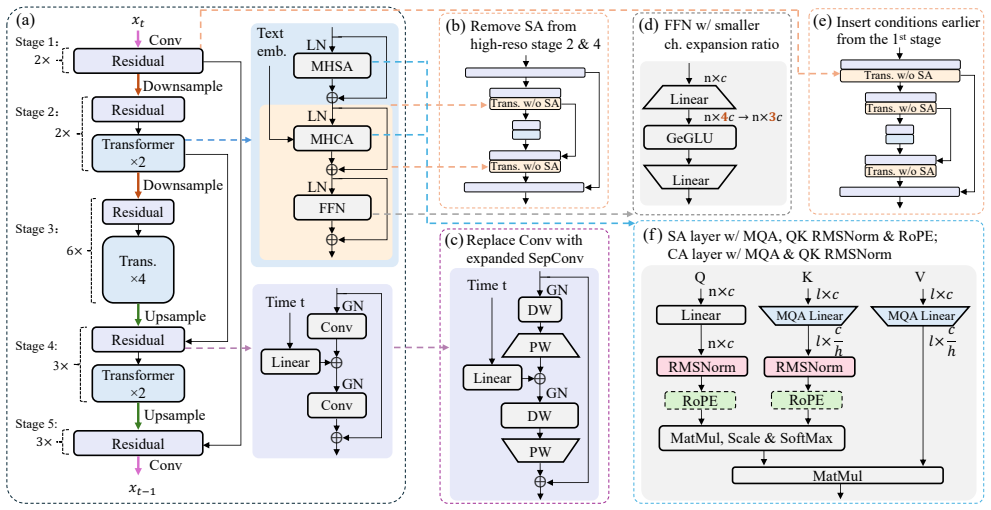
The argument is carried by three coupled components. The efficient UNet keeps self-attention only in the lowest-resolution stage, replaces convolutions with expanded separable convolutions, trims feed-forward expansion, uses multi-query attention, injects text conditions from the first stage, and adds QK-RMSNorm and 2D rotary position embeddings; each change is ablated on ImageNet FID, latency, and FLOPs. The decoder removes attention entirely, keeps minimal GroupNorm, and uses separable convolutions to reach 1.38M parameters. Training combines flow matching with multi-level knowledge distillation that matches both the teacher's velocity output and its last-layer features, reweighted by a timestep-aware scaling function, and then applies adversarial step distillation to reach 4-8 steps.
What would settle it
Run the released model on an iPhone 16 Pro-Max and time a 1024x1024 generation: a median above the reported 1.2-2.3 second range would falsify the deployment claim. Independently, training the same architecture and recipe from scratch should reproduce GenEval near 0.66 and DPG-Bench near 81.1; a large miss would show the public numbers depend on undisclosed data or evaluation details.
Extended reading notes
Core claim
The central claim is that a small UNet, deliberately thinned and shortened, can be the backbone of mobile-runnable text-to-image generation without sacrificing quality. On ImageNet-1K, the 372M-parameter model reaches an FID of 2.06 at 256x256, matching SiT-XL while using 45% fewer parameters and 68% fewer FLOPs. For open-domain text-to-image, the 379M-parameter model scores 0.66 on GenEval and 81.1 on DPG-Bench, exceeding SDXL, Playground, and IF-XL, and its step-distilled 4- and 8-step variants keep most of that quality. The tiny 1.38M-parameter decoder reconstructs images with PSNR close to SD3's decoder while being 36x smaller and 54x faster, and the full 1024x1024 pipeline runs on-device in 1.2-2.3 seconds.
Load-bearing premise
The whole recipe assumes that a much larger teacher's output and internal features, compared in the shared latent space, can push a much smaller student to the same quality, and that if this cross-architecture transfer breaks at high resolution, the claimed quality would not appear.
Editorial extensions
If this is right
- A text-to-image model under 400M parameters can outperform billion-parameter models on prompt-following benchmarks, so model scale is not the only path to quality.
- On-device 1024x1024 generation in about 1.4 seconds makes private, offline image generation practical on consumer phones.
- Step-distilled 4- and 8-step inference retains most of the 28-step quality (GenEval 0.61-0.63 vs 0.66), so mobile latency and quality do not have to trade off sharply.
- The architectural ablations show that removing self-attention from high-resolution stages and using separable convolutions can lower FLOPs and latency while improving FID.
- Distilling from a large DiT teacher into a compact UNet student, in a shared latent space, transfers capability across heterogeneous architectures.
Reading between the lines
- Beyond the paper's claims, the recipe suggests that a compact UNet distilled from a large DiT teacher in a shared latent space could generalize to other flow-matching generators (video, 3D, audio), where such teachers exist.
- The paper fixes the teacher feature layer to the last transformer layer; ablating earlier or later teacher layers would test whether that choice is optimal for heterogeneous distillation.
- The latency figures are for a single generation; repeated-run energy and thermal measurements would complete the mobile-deployment picture.
Editorial analysis
A structured set of objections, weighed in public.
Referee Report
Summary. The paper presents SnapGen, a compact text-to-image diffusion model comprising a 379M-parameter efficient UNet, a 1.38M-parameter decoder, multi-level knowledge distillation from SD3.5-Large, and adversarial step distillation. The authors report an ImageNet-1K FID of 2.06 at 256x256 with 372M parameters, GenEval 0.66 and DPG-Bench 81.1 at 1024x1024, human evaluation results competitive with SD3.5-Large, and claim on-device 1024x1024 generation on an iPhone 16 Pro-Max in approximately 1.4 seconds.
Significance. If the claims hold, this is a significant step for on-device text-to-image generation: a carefully ablated efficient architecture, a tiny high-quality decoder, and a training recipe that transfers knowledge from a much larger DiT teacher are all useful contributions. The ablations in Fig. 3 and Supp. Tab. 3 are clear and internally consistent, and the ImageNet FID result at 372M parameters is strong. The main caveats are that the headline mobile latency claim is not backed by a complete measurement protocol and that the 379M-parameter number refers only to the UNet backbone while the deployed system also carries large text encoders. These issues are fixable in revision but currently prevent the central mobile-feasibility claim from being verified.
major comments (3)
- [Abstract, Sec. 1, Sec. 3.2 (Discussion of Total On-Device Latency), Sec. 4.1 (Hyper-parameters)] The headline claim that SnapGen generates 1024x1024 images on a mobile device in ~1.4 s is not supported by the timing data given in the paper. Sec. 3.2 reports a 119 ms decoder and a 274 ms per-step UNet latency, which gives 4x274 + 119 = 1,215 ms for a 4-step run before any VAE encoding, text-encoder inference, or scheduling overhead. The training recipe uses classifier-free guidance with 46.4% text-encoder dropout (Sec. 4.1), but the paper never states whether CFG is applied in the timed mobile demo; with standard CFG the UNet cost doubles and a 4-step run becomes approximately 2.3 s. In addition, Fig. 3 lists a final per-step UNet latency of 397 ms on an iPhone 15 Pro while Sec. 3.2 uses 274 ms on an iPhone 16 Pro-Max, and the paper does not explain whether this difference is due to hardware, quantization, step count, or other settings. No measurement protocol (device state, warm-up, model loading, text-encoder inclusion, CFG on/off) is provided for the 'around 1.4 seconds' figure, so the central mobile-feasibility contribution cannot be independently verified or reproduced.
- [Sec. 4.1 (Model Details) and Table 3] The repeated claim that SnapGen has 'merely 379M parameters' refers only to the UNet backbone, as the Table 3 caption states, but the deployed pipeline described in Sec. 4.1 also requires CLIP-L, CLIP-G, and Gemma-2-2b text encoders, adding more than 2.5B parameters to the full system. Since the paper motivates the work by on-device deployment and by size comparisons with SDXL (2.6B) and IF-XL (5.5B), the authors should report the total on-device model size and memory footprint for the configurations they actually deploy, and state which text-encoder configuration was used for the benchmark results versus the mobile demo. Without this, the '7x smaller than SDXL' comparison conflates backbone size with full-system size.
- [Sec. 3.3, Eq. (7)] The timestep-aware weighting in Eq. (7) uses the ratio |L_task^t| / |L_kd^t|, but the paper does not specify how these magnitudes are computed in practice: per-batch estimates, running averages, or a fixed schedule estimated from a reference run. Since loss magnitudes change over the course of training, a fixed ratio could become stale, and because lambda(t) is described as a logit-normal density rather than a normalized probability, it is not clear that the weights on the two loss terms remain nonnegative. Please specify the exact computation and how it is updated during training.
minor comments (5)
- [Fig. 3] The three vertical bars for each design choice are not labeled with a legend indicating which bar corresponds to latency, FLOPs, and parameter count; please add clear labels or a legend.
- [Table 3] The table does not include the SD3.5-Large teacher model even though the human evaluation in Fig. 8 compares against it; adding the teacher's GenEval, DPG-Bench, CLIP, and ImageReward scores would make the comparison complete.
- [Sec. 3.2 and Fig. 4] The decoder latency is reported on both ANE and GPU in Table 2, but it is not stated which hardware path the 119 ms decoder time in Sec. 3.2 refers to; please clarify.
- [Supplementary Sec. G] The training-data description says the collection and filtering pipeline 'follows the approach described by Kag et al. [32]' but does not report dataset size, filtering thresholds, or deduplication details; please provide a self-contained summary for reproducibility.
- [Sec. 3.3, Eq. (5)] The feature-distillation loss is defined over layer pairs (l_T, l), but the text says only that the last layer is used in both models; please specify the exact layer indices and the output dimensions before and after the projector.
Circularity Check
No significant circularity: central claims rest on external benchmarks and measured latencies; self-citations are contextual, not load-bearing.
full rationale
The paper's derivation chain is not circular. The efficient-UNet and decoder claims are supported by measured ImageNet FID, PSNR, FLOPs, and on-device latency tables (Tabs. 1-2, Figs. 3-4); the training method (Eqs. 1-9) is a set of objectives, not a fit to the reported GenEval/DPG scores; timestep-aware scaling (Eq. 7) normalizes loss magnitudes by construction but is an optimization weighting scheme, and the paper separately ablates it (Tab. 3) on held-out benchmarks. The T2I quality claims (GenEval 0.66, DPG-Bench 81.1, ImageReward 1.32, human study) are measured against external benchmarks and external baselines (SDXL, Sana, IF-XL), not derived from the teacher SD3.5-Large by an equation that collapses into the input. Self-citations (SnapFusion [43], MobileDiffusion [88], BitsFusion [69], ASCAN [32]) supply prior baselines, architectural inspiration, and data-pipeline details; none is invoked as a uniqueness theorem or as the sole justification of a predicted quantity. The abstract's "around 1.4 seconds" versus Sec. 3.2's "1.2 ∼ 2.3s" is a potential reporting/protocol inconsistency about text-encoder and CFG inclusion, but it is not a circular reduction of a prediction to a fitted input. Therefore no circular step is identified.
Assumptions & free parameters
free parameters (6)
- UNet width and depth [256,512,896] channels, [0,2,4] transformer blocks =
chosen via ablations in Fig. 3
- SepConv expansion ratio =
2
- FFN expansion ratio =
3 (down from 4x with gated units)
- Timestep shift for flow matching =
3
- Text-encoder dropout probability =
46.4% per encoder
- Logit-normal timestep sampling location and scale =
(0,1)
assumptions (4)
- domain assumption The SD3.5-Large and SD3.5-Large-Turbo teachers provide effective supervision in the shared SD3 autoencoder latent space.
- domain assumption The internal training dataset built following ASCAN [32] is sufficient to train a T2I model from scratch at 256 to 1024 resolution.
- domain assumption Rectified flow matching (Eqs. 1-2) is a valid generative training objective for a UNet backbone.
- domain assumption The fixed 8-channel SD3 autoencoder encoder is a suitable latent space, and the decoder can be trained independently with the encoder fixed.
Cite this review
Pith. "Pith review of SnapGen: Taming High-Resolution Text-to-Image Models for Mobile Devices with Efficient Architectures and Training." pith.science (2026). https://pith.science/paper/D7I7HD7X
@misc{pith2026241209619,
  author       = {Pith},
  title        = {Pith review of: SnapGen: Taming High-Resolution Text-to-Image Models for Mobile Devices with Efficient Architectures and Training},
  year         = {2026},
  howpublished = {\url{https://pith.science/paper/D7I7HD7X}},
  note         = {Machine review of arXiv:2412.09619}
}
read the original abstract
Existing text-to-image (T2I) diffusion models face several limitations, including large model sizes, slow runtime, and low-quality generation on mobile devices. This paper aims to address all of these challenges by developing an extremely small and fast T2I model that generates high-resolution and high-quality images on mobile platforms. We propose several techniques to achieve this goal. First, we systematically examine the design choices of the network architecture to reduce model parameters and latency, while ensuring high-quality generation. Second, to further improve generation quality, we employ cross-architecture knowledge distillation from a much larger model, using a multi-level approach to guide the training of our model from scratch. Third, we enable a few-step generation by integrating adversarial guidance with knowledge distillation. For the first time, our model SnapGen, demonstrates the generation of 1024x1024 px images on a mobile device around 1.4 seconds. On ImageNet-1K, our model, with only 372M parameters, achieves an FID of 2.06 for 256x256 px generation. On T2I benchmarks (i.e., GenEval and DPG-Bench), our model with merely 379M parameters, surpasses large-scale models with billions of parameters at a significantly smaller size (e.g., 7x smaller than SDXL, 14x smaller than IF-XL).
Figures


Figures from the paper (11 more)


Forward citations
Cited by 4 Pith papers
-
SnapGen++: Unleashing Diffusion Transformers for Efficient High-Fidelity Image Generation on Edge Devices
A compact elastic diffusion transformer with adaptive sparse attention and knowledge-guided distribution-matching distillation achieves 4-step 1K image generation on a phone in roughly 1.8 seconds.
-
TurboVSR: Fantastic Video Upscalers and Where to Find Them
TurboVSR uses a high-compression video autoencoder with factorized conditioning and non-uniform shortcut sampling to achieve near-state-of-the-art perceptual video super-resolution at roughly 100x lower compute cost.
-
JuZhou 1.0 Technical Report: The First Edge-Native Text-to-Image Foundation Model Trained Entirely on China-Developed AI Accelerators
JuZhou 1.0 is a 0.387B-parameter T2I diffusion model with 4-step inference achieving 0.69 GenEval, trained on 9M Chinese pairs using Sugon K100 accelerators and deployable on Android/iOS devices.
-
SANA 1.5: Efficient Scaling of Training-Time and Inference-Time Compute in Linear Diffusion Transformer
SANA-1.5 combines layer growth, depth pruning, and VLM-judged best-of-N sampling to push GenEval text-to-image alignment from 0.81 to 0.96.
Reference graph
Works this paper leans on
-
[1]
Stable diffusion 1.5
Stability AI. Stable diffusion 1.5. https://huggingface.co/stable-diffusion-v1-5/stable- diffusion-v1-5, 2022. 8, 14
2022
-
[2]
Stable diffusion 2.1
Stability AI. Stable diffusion 2.1. https://huggingface.co/stabilityai/stable-diffusion-2-1,
-
[3]
Stable diffusion 3.5
Stability AI. Stable diffusion 3.5. https://github.com/Stability-AI/sd3.5, 2024. 2
2024
-
[4]
Stable diffusion 3.5 large
Stability AI. Stable diffusion 3.5 large. https://huggingface.co/stabilityai/stable-diffusion-3.5-large,
-
[5]
Stable diffusion 3.5 large turbo
Stability AI. Stable diffusion 3.5 large turbo. https://huggingface.co/stabilityai/stable-diffusion-3.5- large-turbo, 2024. 2, 7
2024
-
[6]
Kandinsky 3: Text-to-image synthe- sis for multifunctional generative framework
Vladimir Arkhipkin, Viacheslav Vasilev, Andrei Filatov, Igor Pavlov, Julia Agafonova, Nikolai Gerasimenko, Anna Averchenkova, Evelina Mironova, Anton Bukashkin, Kon- stantin Kulikov, et al. Kandinsky 3: Text-to-image synthe- sis for multifunctional generative framework. arXiv preprint arXiv:2410.21061, 2024. 3
-
[7]
Kandinsky 2.1, 2023
Shakhmatov Arseni, Razzhigaev Anton, Nikolich Aleksandr, Arkhipkin Vladimir, Pavlov Igor, Kuznetsov Andrey, and Denis Dimitrov. Kandinsky 2.1, 2023. 3
2023
-
[8]
All are worth words: A vit backbone for diffusion models
Fan Bao, Shen Nie, Kaiwen Xue, Yue Cao, Chongxuan Li, Hang Su, and Jun Zhu. All are worth words: A vit backbone for diffusion models. In Proceedings of the IEEE/CVF con- ference on computer vision and pattern recognition , pages 22669–22679, 2023. 5
2023
Show all 88 references
-
[9]
Efficientvit: Lightweight multi-scale attention for high- resolution dense prediction
Han Cai, Junyan Li, Muyan Hu, Chuang Gan, and Song Han. Efficientvit: Lightweight multi-scale attention for high- resolution dense prediction. InProceedings of the IEEE/CVF International Conference on Computer Vision, pages 17302– 17313, 2023. 3
2023
-
[10]
LD-Pruner: Efficient Pruning of Latent Dif- fusion Models using Task-Agnostic Insights
Thibault Castells, Hyoung-Kyu Song, Bo-Kyeong Kim, and Shinkook Choi. LD-Pruner: Efficient Pruning of Latent Dif- fusion Models using Task-Agnostic Insights. InProceedings of the IEEE/CVF Conference on Computer Vision and Pat- tern Recognition, pages 821–830, 2024. 2
2024
-
[11]
EdgeFusion: On-Device Text-to-Image Generation
Thibault Castells, Hyoung-Kyu Song, Tairen Piao, Shinkook Choi, Bo-Kyeong Kim, Hanyoung Yim, Changgwun Lee, Jae Gon Kim, and Tae-Ho Kim. EdgeFusion: On-Device Text-to-Image Generation. arXiv preprint arXiv:2404.11925, 2024. 3
2024 arXiv
-
[12]
Muse: Text-to-image generation via masked generative transform- ers
Huiwen Chang, Han Zhang, Jarred Barber, AJ Maschinot, Jose Lezama, Lu Jiang, Ming-Hsuan Yang, Kevin Mur- phy, William T Freeman, Michael Rubinstein, et al. Muse: Text-to-image generation via masked generative transform- ers. arXiv preprint arXiv:2301.00704, 2023. 15
2023 arXiv
-
[13]
Pixart- α: Fast training of diffusion transformer for photorealistic text-to-image synthesis
Junsong Chen, Jincheng Yu, Chongjian Ge, Lewei Yao, Enze Xie, Yue Wu, Zhongdao Wang, James Kwok, Ping Luo, Huchuan Lu, et al. Pixart- α: Fast training of diffusion transformer for photorealistic text-to-image synthesis. arXiv preprint arXiv:2310.00426, 2023. 2, 3, 7, 8, 14, 16
-
[14]
Pixart- \sigma: Weak-to-strong training of diffusion transformer for 4k text-to-image generation
Junsong Chen, Chongjian Ge, Enze Xie, Yue Wu, Lewei Yao, Xiaozhe Ren, Zhongdao Wang, Ping Luo, Huchuan Lu, and Zhenguo Li. Pixart- \sigma: Weak-to-strong training of diffusion transformer for 4k text-to-image generation. arXiv preprint arXiv:2403.04692, 2024. 2, 3, 8, 14
2024 arXiv
-
[15]
Transformers are ssms: General- ized models and efficient algorithms through structured state space duality
Tri Dao and Albert Gu. Transformers are ssms: General- ized models and efficient algorithms through structured state space duality. arXiv preprint arXiv:2405.21060, 2024. 3
2024 arXiv
-
[16]
Deepfloyd
DeepFloyd. Deepfloyd. https://github.com/deep-floyd/IF,
-
[17]
Imagenet: A large-scale hierarchical image database
Jia Deng, Wei Dong, Richard Socher, Li-Jia Li, Kai Li, and Li Fei-Fei. Imagenet: A large-scale hierarchical image database. In 2009 IEEE conference on computer vision and pattern recognition, pages 248–255. Ieee, 2009. 2, 3, 7
2009
-
[18]
Adam: A method for stochastic opti- mization
P Kingma Diederik. Adam: A method for stochastic opti- mization. (No Title), 2014. 7
2014
-
[19]
Scaling recti- fied flow transformers for high-resolution image synthesis
Patrick Esser, Sumith Kulal, Andreas Blattmann, Rahim Entezari, Jonas M ¨uller, Harry Saini, Yam Levi, Dominik Lorenz, Axel Sauer, Frederic Boesel, et al. Scaling recti- fied flow transformers for high-resolution image synthesis. In Forty-first International Conference on Mach...
2024
-
[20]
Institutionum calculi integralis
Leonhard Euler. Institutionum calculi integralis. imp. Acad. imp. Sa‘ent., 1768. 6
-
[21]
Lumina-T2X: Transforming Text into Any Modality, Resolution, and Duration via Flow-based Large Diffusion Transformers
Peng Gao, Le Zhuo, Ziyi Lin, Chris Liu, Junsong Chen, Ruoyi Du, Enze Xie, Xu Luo, Longtian Qiu, Yuhang Zhang, et al. Lumina-T2X: Transforming Text into Any Modality, Resolution, and Duration via Flow-based Large Diffusion Transformers. arXiv preprint arXiv:2405.05945, 2024. 3
2024 arXiv
-
[22]
Geneval: An object-focused framework for evaluating text- to-image alignment
Dhruba Ghosh, Hannaneh Hajishirzi, and Ludwig Schmidt. Geneval: An object-focused framework for evaluating text- to-image alignment. Advances in Neural Information Pro- cessing Systems, 36, 2024. 7, 15
2024
-
[23]
Generative adversarial nets
Ian Goodfellow, Jean Pouget-Abadie, Mehdi Mirza, Bing Xu, David Warde-Farley, Sherjil Ozair, Aaron Courville, and Yoshua Bengio. Generative adversarial nets. Advances in neural information processing systems, 27, 2014. 3, 5
2014
-
[24]
Deep residual learning for image recognition
Kaiming He, Xiangyu Zhang, Shaoqing Ren, and Jian Sun. Deep residual learning for image recognition. In Proceed- ings of the IEEE conference on computer vision and pattern recognition, pages 770–778, 2016. 3
2016
-
[25]
Query-key normalization for transformers
Alex Henry, Prudhvi Raj Dachapally, Shubham Pawar, and Yuxuan Chen. Query-key normalization for transformers. arXiv preprint arXiv:2010.04245, 2020. 5
2010 arXiv
-
[26]
Gans trained by a two time-scale update rule converge to a local nash equilib- rium
Martin Heusel, Hubert Ramsauer, Thomas Unterthiner, Bernhard Nessler, and Sepp Hochreiter. Gans trained by a two time-scale update rule converge to a local nash equilib- rium. Advances in neural information processing systems , 30, 2017. 3
2017
-
[28]
Classifier-free diffusion guidance
Jonathan Ho and Tim Salimans. Classifier-free diffusion guidance. arXiv preprint arXiv:2207.12598, 2022. 7
2022 arXiv
-
[29]
Denoising dif- fusion probabilistic models
Jonathan Ho, Ajay Jain, and Pieter Abbeel. Denoising dif- fusion probabilistic models. Advances in neural information processing systems, 33:6840–6851, 2020. 14
2020
-
[30]
Mobilenets: Efficient convolutional neu- ral networks for mobile vision applications
Andrew G Howard. Mobilenets: Efficient convolutional neu- ral networks for mobile vision applications. arXiv preprint arXiv:1704.04861, 2017. 3
2017 arXiv
-
[31]
Ella: Equip diffusion models with llm for enhanced semantic alignment
Xiwei Hu, Rui Wang, Yixiao Fang, Bin Fu, Pei Cheng, and Gang Yu. Ella: Equip diffusion models with llm for enhanced semantic alignment. arXiv preprint arXiv:2403.05135, 2024. 7, 15
2024 arXiv
-
[32]
Ascan: Asymmetric convolution-attention networks for efficient recognition and generation
Anil Kag, Huseyin Coskun, Jierun Chen, Junli Cao, Willi Menapace, Aliaksandr Siarohin, Sergey Tulyakov, and Jian Ren. Ascan: Asymmetric convolution-attention networks for efficient recognition and generation. arXiv preprint arXiv:2411.04967, 2024. 3, 7, 14
2024 arXiv
-
[33]
Elucidating the design space of diffusion-based generative models
Tero Karras, Miika Aittala, Timo Aila, and Samuli Laine. Elucidating the design space of diffusion-based generative models. Advances in neural information processing systems, 35:26565–26577, 2022. 15
2022
-
[34]
Transformers are rnns: Fast autoregressive transformers with linear attention
Angelos Katharopoulos, Apoorv Vyas, Nikolaos Pappas, and Franc ¸ois Fleuret. Transformers are rnns: Fast autoregressive transformers with linear attention. In International confer- ence on machine learning, pages 5156–5165. PMLR, 2020. 3
2020
-
[35]
Bk-sdm: Architecturally Compressed Sta- ble Diffusion for Efficient Text-to-Image Generation
Bo-Kyeong Kim, Hyoung-Kyu Song, Thibault Castells, and Shinkook Choi. Bk-sdm: Architecturally Compressed Sta- ble Diffusion for Efficient Text-to-Image Generation. In Workshop on Efficient Systems for Foundation Models@ ICML2023, 2023. 2, 3, 6
2023
-
[36]
Auto-encoding variational bayes
Diederik P Kingma. Auto-encoding variational bayes. 2nd International Conference on Learning Representations ,
-
[37]
Applying guidance in a limited interval improves sample and distribution quality in diffusion models
Tuomas Kynk ¨a¨anniemi, Miika Aittala, Tero Karras, Samuli Laine, Timo Aila, and Jaakko Lehtinen. Applying guidance in a limited interval improves sample and distribution quality in diffusion models. arXiv preprint arXiv:2404.07724, 2024. 5, 15
2024 arXiv
-
[38]
mplug: Effective and efficient vision-language learning by cross-modal skip-connections
Chenliang Li, Haiyang Xu, Junfeng Tian, Wei Wang, Ming Yan, Bin Bi, Jiabo Ye, He Chen, Guohai Xu, Zheng Cao, et al. mplug: Effective and efficient vision-language learning by cross-modal skip-connections. InProceedings of the 2022 Conference on Empirical Methods in Natural Lan...
2022
-
[39]
Playground v1,
Daiqing Li, Aleks Kamko, Ali Sabet, Ehsan Akhgari, Lin- miao Xu, and Suhail Doshi. Playground v1, . 3
-
[40]
Playground v2,
Daiqing Li, Aleks Kamko, Ali Sabet, Ehsan Akhgari, Lin- miao Xu, and Suhail Doshi. Playground v2, . 8
-
[41]
Playground V2
Daiqing Li, Aleks Kamko, Ehsan Akhgari, Ali Sabet, Lin- miao Xu, and Suhail Doshi. Playground V2. 5: Three Insights towards Enhancing Aesthetic Quality in Text-to- Image Generation. arXiv preprint arXiv:2402.17245, 2024. 3, 8, 14
2024 arXiv
-
[42]
On the scalability of diffusion-based text-to-image generation
Hao Li, Yang Zou, Ying Wang, Orchid Majumder, Yusheng Xie, R Manmatha, Ashwin Swaminathan, Zhuowen Tu, Ste- fano Ermon, and Stefano Soatto. On the scalability of diffusion-based text-to-image generation. In Proceedings of the IEEE/CVF Conference on Computer Vision and Pattern ...
2024
-
[43]
Snap- fusion: Text-to-Image Diffusion Model on Mobile Devices within Two Seconds
Yanyu Li, Huan Wang, Qing Jin, Ju Hu, Pavlo Chemerys, Yun Fu, Yanzhi Wang, Sergey Tulyakov, and Jian Ren. Snap- fusion: Text-to-Image Diffusion Model on Mobile Devices within Two Seconds. Advances in Neural Information Pro- cessing Systems, 36, 2024. 2, 3, 5
2024
-
[44]
Hunyuan- DiT: A Powerful Multi-Resolution Diffusion Transformer with Fine-Grained Chinese Understanding
Zhimin Li, Jianwei Zhang, Qin Lin, Jiangfeng Xiong, Yanxin Long, Xinchi Deng, Yingfang Zhang, Xingchao Liu, Minbin Huang, Zedong Xiao, et al. Hunyuan- DiT: A Powerful Multi-Resolution Diffusion Transformer with Fine-Grained Chinese Understanding. arXiv preprint arXiv:2405.0874...
2024 arXiv
-
[45]
SDXL- Lightning: Progressive Adversarial Diffusion Distillation,
Shanchuan Lin, Anran Wang, and Xiao Yang. SDXL- Lightning: Progressive Adversarial Diffusion Distillation,
-
[46]
Microsoft coco: Common objects in context
Tsung-Yi Lin, Michael Maire, Serge Belongie, James Hays, Pietro Perona, Deva Ramanan, Piotr Doll´ar, and C Lawrence Zitnick. Microsoft coco: Common objects in context. In Computer Vision–ECCV 2014: 13th European Conference, Zurich, Switzerland, September 6-12, 2014, Proceeding...
2014
-
[47]
Flow matching for generative mod- eling
Yaron Lipman, Ricky TQ Chen, Heli Ben-Hamu, Maximil- ian Nickel, and Matt Le. Flow matching for generative mod- eling. arXiv preprint arXiv:2210.02747, 2022. 2, 6
2022 arXiv
-
[48]
Playground v3: Improving text-to- image alignment with deep-fusion large language models
Bingchen Liu, Ehsan Akhgari, Alexander Visheratin, Aleks Kamko, Linmiao Xu, Shivam Shrirao, Joao Souza, Suhail Doshi, and Daiqing Li. Playground v3: Improving text-to- image alignment with deep-fusion large language models. arXiv preprint arXiv:2409.10695, 2024. 3
2024 arXiv
-
[49]
Linfusion: 1 gpu, 1 minute, 16k image.arXiv preprint arXiv:2409.02097, 2024
Songhua Liu, Weihao Yu, Zhenxiong Tan, and Xinchao Wang. Linfusion: 1 gpu, 1 minute, 16k image.arXiv preprint arXiv:2409.02097, 2024. 2, 3, 6
2024 arXiv
-
[50]
Flow straight and fast: Learning to generate and transfer data with rectified flow
Xingchao Liu, Chengyue Gong, and Qiang Liu. Flow straight and fast: Learning to generate and transfer data with rectified flow. arXiv preprint arXiv:2209.03003, 2022. 2, 6
2022 arXiv
-
[51]
Hyperhuman: Hyper-realistic human gener- ation with latent structural diffusion
Xian Liu, Jian Ren, Aliaksandr Siarohin, Ivan Skorokhodov, Yanyu Li, Dahua Lin, Xihui Liu, Ziwei Liu, and Sergey Tulyakov. Hyperhuman: Hyper-realistic human gener- ation with latent structural diffusion. arXiv preprint arXiv:2310.08579, 2023. 2, 3
-
[52]
Sit: Explor- ing flow and diffusion-based generative models with scalable interpolant transformers
Nanye Ma, Mark Goldstein, Michael S Albergo, Nicholas M Boffi, Eric Vanden-Eijnden, and Saining Xie. Sit: Explor- ing flow and diffusion-based generative models with scalable interpolant transformers. arXiv preprint arXiv:2401.08740,
-
[53]
Snap video: Scaled spatiotemporal transformers for text-to-video synthesis
Willi Menapace, Aliaksandr Siarohin, Ivan Skorokhodov, Ekaterina Deyneka, Tsai-Shien Chen, Anil Kag, Yuwei Fang, Aleksei Stoliar, Elisa Ricci, Jian Ren, et al. Snap video: Scaled spatiotemporal transformers for text-to-video synthesis. In Proceedings of the IEEE/CVF Conference...
2024
-
[55]
Scalable diffusion models with transformers
William Peebles and Saining Xie. Scalable diffusion models with transformers. In Proceedings of the IEEE/CVF Inter- national Conference on Computer Vision, pages 4195–4205,
-
[56]
Sdxl: Improving latent diffusion mod- els for high-resolution image synthesis
Dustin Podell, Zion English, Kyle Lacey, Andreas Blattmann, Tim Dockhorn, Jonas M ¨uller, Joe Penna, and Robin Rombach. Sdxl: Improving latent diffusion mod- els for high-resolution image synthesis. arXiv preprint arXiv:2307.01952, 2023. 2, 3, 5, 8, 14
2023 arXiv
-
[57]
Movie gen: A cast of media foundation models
Adam Polyak, Amit Zohar, Andrew Brown, Andros Tjandra, Animesh Sinha, Ann Lee, Apoorv Vyas, Bowen Shi, Chih- Yao Ma, Ching-Yao Chuang, et al. Movie gen: A cast of media foundation models. arXiv preprint arXiv:2410.13720,
-
[58]
Mobilenetv4- universal models for the mobile ecosystem
Danfeng Qin, Chas Leichner, Manolis Delakis, Marco Fornoni, Shixin Luo, Fan Yang, Weijun Wang, Colby Ban- bury, Chengxi Ye, Berkin Akin, et al. Mobilenetv4- universal models for the mobile ecosystem. arXiv preprint arXiv:2404.10518, 2024. 3
2024 arXiv
-
[59]
Learning transferable visual models from natural language supervi- sion
Alec Radford, Jong Wook Kim, Chris Hallacy, Aditya Ramesh, Gabriel Goh, Sandhini Agarwal, Girish Sastry, Amanda Askell, Pamela Mishkin, Jack Clark, et al. Learning transferable visual models from natural language supervi- sion. In International conference on machine learning, ...
2021
-
[60]
Zero-shot text-to-image generation
Aditya Ramesh, Mikhail Pavlov, Gabriel Goh, Scott Gray, Chelsea V oss, Alec Radford, Mark Chen, and Ilya Sutskever. Zero-shot text-to-image generation. In Proceedings of the 38th International Conference on Machine Learning , pages 8821–8831. PMLR, 2021. 2
2021
-
[61]
High-resolution image synthesis with latent diffusion models
Robin Rombach, Andreas Blattmann, Dominik Lorenz, Patrick Esser, and Bj ¨orn Ommer. High-resolution image synthesis with latent diffusion models. In Proceedings of the IEEE/CVF conference on computer vision and pattern recognition, pages 10684–10695, 2022. 3, 5
2022
-
[62]
Sara Mahdavi, Rapha Gontijo Lopes, Tim Salimans, Jonathan Ho, David J Fleet, and Mohammad Norouzi
Chitwan Saharia, William Chan, Saurabh Saxena, Lala Li, Jay Whang, Emily Denton, Seyed Kamyar Seyed Ghasemipour, Burcu Karagol Ayan, S. Sara Mahdavi, Rapha Gontijo Lopes, Tim Salimans, Jonathan Ho, David J Fleet, and Mohammad Norouzi. Photorealistic text-to-image diffusion mod...
2022
-
[63]
Fast high- resolution image synthesis with latent adversarial diffusion distillation
Axel Sauer, Frederic Boesel, Tim Dockhorn, Andreas Blattmann, Patrick Esser, and Robin Rombach. Fast high- resolution image synthesis with latent adversarial diffusion distillation. arXiv preprint arXiv:2403.12015, 2024. 3, 7
2024 arXiv
-
[64]
Adversarial diffusion distillation
Axel Sauer, Dominik Lorenz, Andreas Blattmann, and Robin Rombach. Adversarial diffusion distillation. In European Conference on Computer Vision , pages 87–103. Springer,
-
[65]
Fast transformer decoding: One write-head is all you need
Noam Shazeer. Fast transformer decoding: One write-head is all you need. arXiv preprint arXiv:1911.02150, 2019. 4
1911 arXiv
-
[66]
Emu edit: Precise image editing via recognition and gen- eration tasks
Shelly Sheynin, Adam Polyak, Uriel Singer, Yuval Kirstain, Amit Zohar, Oron Ashual, Devi Parikh, and Yaniv Taigman. Emu edit: Precise image editing via recognition and gen- eration tasks. In Proceedings of the IEEE/CVF Conference on Computer Vision and Pattern Recognition , pa...
2024
-
[67]
Sdxs: Real- time one-step latent diffusion models with image conditions
Yuda Song, Zehao Sun, and Xuanwu Yin. Sdxs: Real- time one-step latent diffusion models with image conditions. arXiv preprint arXiv:2403.16627, 2024. 2
2024 arXiv
-
[68]
Roformer: Enhanced transformer with rotary position embedding
Jianlin Su, Murtadha Ahmed, Yu Lu, Shengfeng Pan, Wen Bo, and Yunfeng Liu. Roformer: Enhanced transformer with rotary position embedding. Neurocomputing, 568:127063,
-
[69]
Bitsfusion: 1.99 bits weight quantization of diffusion model
Yang Sui, Yanyu Li, Anil Kag, Yerlan Idelbayev, Junli Cao, Ju Hu, Dhritiman Sagar, Bo Yuan, Sergey Tulyakov, and Jian Ren. Bitsfusion: 1.99 bits weight quantization of diffusion model. arXiv preprint arXiv:2406.04333, 2024. 2, 3, 6
2024 arXiv
-
[70]
Gemma 2: Improving open language models at a practical size
Gemma Team, Morgane Riviere, Shreya Pathak, Pier Giuseppe Sessa, Cassidy Hardin, Surya Bhupati- raju, L´eonard Hussenot, Thomas Mesnard, Bobak Shahriari, Alexandre Ram´e, et al. Gemma 2: Improving open language models at a practical size. arXiv preprint arXiv:2408.00118,
-
[71]
Kolors: Effective Training of Diffusion Model for Photorealistic Text-to-Image Synthesis
Kolors Team. Kolors: Effective Training of Diffusion Model for Photorealistic Text-to-Image Synthesis. arXiv preprint,
-
[72]
Attention is all you need
A Vaswani. Attention is all you need. Advances in Neural Information Processing Systems, 2017. 3
2017
-
[73]
Diffusion-gan: Training gans with diffusion
Zhendong Wang, Huangjie Zheng, Pengcheng He, Weizhu Chen, and Mingyuan Zhou. Diffusion-gan: Training gans with diffusion. arXiv preprint arXiv:2206.02262, 2022. 3
2022 arXiv
-
[74]
Omnigen: Unified image generation
Shitao Xiao, Yueze Wang, Junjie Zhou, Huaying Yuan, Xin- grun Xing, Ruiran Yan, Shuting Wang, Tiejun Huang, and Zheng Liu. Omnigen: Unified image generation. arXiv preprint arXiv:2409.11340, 2024. 2
2024 arXiv
-
[75]
Tack- ling the generative learning trilemma with denoising diffu- sion gans
Zhisheng Xiao, Karsten Kreis, and Arash Vahdat. Tack- ling the generative learning trilemma with denoising diffu- sion gans. arXiv preprint arXiv:2112.07804, 2021. 3
2021 arXiv
-
[76]
Sana: Ef- ficient high-resolution image synthesis with linear diffusion transformers
Enze Xie, Junsong Chen, Junyu Chen, Han Cai, Yujun Lin, Zhekai Zhang, Muyang Li, Yao Lu, and Song Han. Sana: Ef- ficient high-resolution image synthesis with linear diffusion transformers. arXiv preprint arXiv:2410.10629, 2024. 2, 3, 8, 14
-
[77]
Imagere- ward: Learning and evaluating human preferences for text- to-image generation
Jiazheng Xu, Xiao Liu, Yuchen Wu, Yuxuan Tong, Qinkai Li, Ming Ding, Jie Tang, and Yuxiao Dong. Imagere- ward: Learning and evaluating human preferences for text- to-image generation. Advances in Neural Information Pro- cessing Systems, 36, 2024. 7, 15
2024
-
[78]
Semi-implicit denoising diffusion models (siddms)
Yanwu Xu, Mingming Gong, Shaoan Xie, Wei Wei, Matthias Grundmann, Kayhan Batmanghelich, and Tingbo Hou. Semi-implicit denoising diffusion models (siddms). Ad- vances in neural information processing systems, 36:17383,
-
[79]
Ufogen: You forward once large scale text-to-image gener- ation via diffusion gans
Yanwu Xu, Yang Zhao, Zhisheng Xiao, and Tingbo Hou. Ufogen: You forward once large scale text-to-image gener- ation via diffusion gans. In Proceedings of the IEEE/CVF Conference on Computer Vision and Pattern Recognition , pages 8196–8206, 2024. 2, 3
2024
-
[80]
Cogvideox: Text-to-video diffusion models with an expert transformer
Zhuoyi Yang, Jiayan Teng, Wendi Zheng, Ming Ding, Shiyu Huang, Jiazheng Xu, Yuanming Yang, Wenyi Hong, Xiao- han Zhang, Guanyu Feng, et al. Cogvideox: Text-to-video diffusion models with an expert transformer. arXiv preprint arXiv:2408.06072, 2024. 2
2024 arXiv
-
[81]
Im- proved distribution matching distillation for fast image syn- thesis
Tianwei Yin, Micha ¨el Gharbi, Taesung Park, Richard Zhang, Eli Shechtman, Fredo Durand, and William T Freeman. Im- proved distribution matching distillation for fast image syn- thesis. arXiv preprint arXiv:2405.14867, 2024. 3
2024 arXiv
-
[82]
One-step diffusion with distribution matching distillation
Tianwei Yin, Micha ¨el Gharbi, Richard Zhang, Eli Shecht- man, Fredo Durand, William T Freeman, and Taesung Park. One-step diffusion with distribution matching distillation. In Proceedings of the IEEE/CVF Conference on Computer Vi- sion and Pattern Recognition, pages 6613–6623...
2024
-
[83]
Scaling autoregressive models for content-rich text-to-image generation
Jiahui Yu, Yuanzhong Xu, Jing Yu Koh, Thang Luong, Gun- jan Baid, Zirui Wang, Vijay Vasudevan, Alexander Ku, Yin- fei Yang, Burcu Karagol Ayan, et al. Scaling autoregressive models for content-rich text-to-image generation. Transac- tions on Machine Learning Research. 8
-
[84]
Root mean square layer nor- malization
Biao Zhang and Rico Sennrich. Root mean square layer nor- malization. Advances in Neural Information Processing Sys- tems, 32, 2019. 5
2019
-
[85]
Laptop-Diff: Layer Pruning and Normal- ized Distillation for Compressing Diffusion Models
Dingkun Zhang, Sijia Li, Chen Chen, Qingsong Xie, and Haonan Lu. Laptop-Diff: Layer Pruning and Normal- ized Distillation for Compressing Diffusion Models. arXiv preprint arXiv:2404.11098, 2024. 2
2024 arXiv
-
[86]
The unreasonable effectiveness of deep features as a perceptual metric
Richard Zhang, Phillip Isola, Alexei A Efros, Eli Shechtman, and Oliver Wang. The unreasonable effectiveness of deep features as a perceptual metric. In CVPR, 2018. 5
2018
-
[87]
Sine: Single image editing with text- to-image diffusion models
Zhixing Zhang, Ligong Han, Arnab Ghosh, Dimitris N Metaxas, and Jian Ren. Sine: Single image editing with text- to-image diffusion models. In Proceedings of the IEEE/CVF Conference on Computer Vision and Pattern Recognition , pages 6027–6037, 2023. 2
2023
-
[88]
Mobilediffusion: Subsecond text-to-image generation on mobile devices
Yang Zhao, Yanwu Xu, Zhisheng Xiao, and Tingbo Hou. Mobilediffusion: Subsecond text-to-image generation on mobile devices. arXiv preprint arXiv:2311.16567, 2023. 2, 3, 4, 5
2023 arXiv
-
[89]
Lumina-next: Making lumina-t2x stronger and faster with next-dit
Le Zhuo, Ruoyi Du, Han Xiao, Yangguang Li, Dongyang Liu, Rongjie Huang, Wenze Liu, Lirui Zhao, Fu-Yun Wang, Zhanyu Ma, et al. Lumina-next: Making lumina-t2x stronger and faster with next-dit. arXiv preprint arXiv:2406.18583 ,
-
[2024]
Generate
2, 8, 14 12 SnapGen: Taming High-Resolution Text-to-Image Models for Mobile Devices with Efficient Architectures and Training Supplementary Material A. Demo on Mobile Devices We present an on-device demo showcasing the capabili- ties of our efficient text-to-image model in gen...
Reviewed August 11, 2026 · model on record in the stance chip above.
Discussion (0). Continue with ORCID to comment.