REVIEW 3 major objections 4 minor 140 references
ALMA/SCUBA-2 COSMOS Survey: Properties of X-ray- and SED-selected AGNs in Bright Submillimeter Galaxies
T0 review · 3 major / 4 minor · reviewed 2026-08-11 · deepseek-v4-flash
Pith's one-line read Bright submillimeter galaxies that host active galactic nuclei are about twice as likely as non-AGN ones to be major mergers, implying mergers trigger black hole growth rather than the intense star formation itself.
desk verdict Careful, honest paper whose merger-fraction headline is a ~1.8 sigma trend the abstract overstates; the new AGN catalog and merger classifications still deserve peer review. read the letter →
The pith
A machine-rendered reading of the paper's core claim, the machinery that carries it, and where it could break.
The reading
What carries the argument
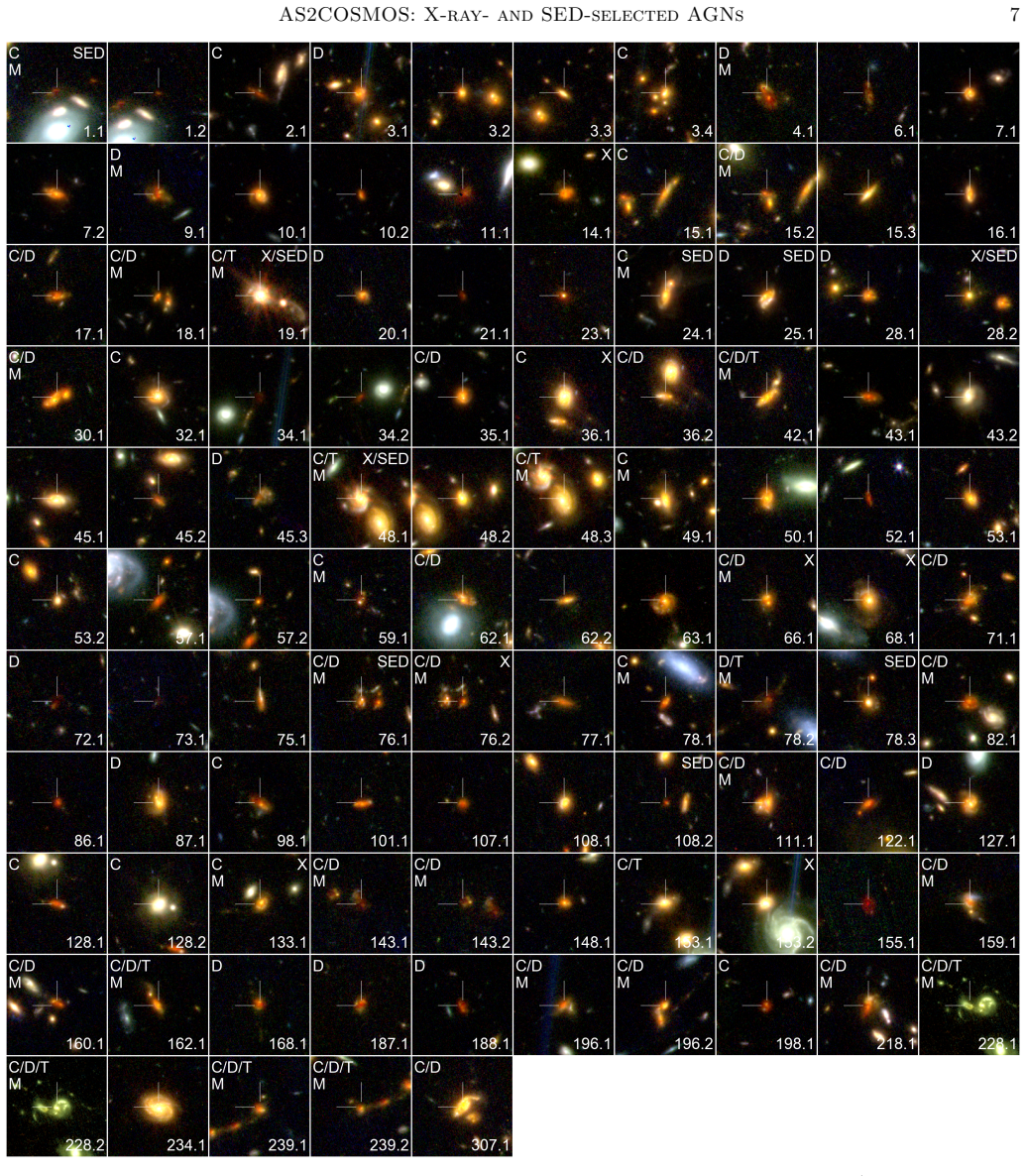
The core method is multi-component SED fitting with CIGALE, using an extended dust-emission model (ethemis) and clumpy torus AGN templates (skirtor). AGN identification is done by comparing the Bayesian Information Criterion of fits with and without an AGN component (DeltaBIC > 10), supplemented by 23 X-ray-detected AGNs from Chandra and X-ray spectral decomposition. The merger classification uses visual inspection of JWST/NIRCam color-composite images, following the approach of Gillman et al. (2024), classifying sources into major/minor/non-mergers based on tidal features, disturbed morphology, and potential companions. The paper combines these results to compare merger fractions between AGN hosts and non-AGN SMGs.
What would settle it
Deep hard X-ray observations above rest-frame 10 keV of the 17 X-ray-undetected SED AGNs: if these sources turn out to be Compton-thin and intrinsically X-ray-weak, the hidden-AGN interpretation and the inferred high obscuration would be disproven, weakening the merger-fraction comparison by removing these sources from the AGN sample.
Extended reading notes
Core claim
The central claim is that the dichotomy in merger fraction between AGN hosts and non-AGN SMGs points to a specific evolutionary role for mergers. In a sample of 40 AGN-host galaxies drawn from 260 AS2COSMOS SMGs (24 SED-selected, 23 X-ray-selected, with seven overlap), the major-merger fraction is 47+16/-15%, about twice the 25+6/-5% seen in the 65 non-AGN SMGs with JWST coverage. Because the non-AGN fraction matches the general z~2 galaxy population, the paper concludes that major mergers are not the dominant driver of the intense star formation in SMGs, but that they preferentially trigger black hole growth. The authors further argue that the X-ray-undetected SED AGNs, which dominate the AGN sample at high redshift, are likely obscured (nearly Compton-thick) or unusually X-ray-weak, based on X-ray stacking and bolometric correction analysis.
Load-bearing premise
The load-bearing premise is that the SED-based AGN selection reliably identifies true AGNs, particularly the 17 X-ray-undetected SED AGNs, even though the paper itself cautions that five of these candidates show only limited evidence and that high-redshift indicators (24-micron excess or flat FIR SEDs) can be mimicked by starburst PAH or hot dust emission.
Editorial extensions
If this is right
- If AGN activity in bright SMGs is preferentially triggered by major mergers, then the bright SMG population is not a single homogeneous phase but a mix of merger-driven and secularly star-forming galaxies.
- The lack of enhancement in the non-AGN merger fraction indicates that intense star formation in SMGs can be sustained without major mergers, aligning with simulations like EAGLE.
- The X-ray-undetected SED AGNs being near Compton-thick implies that X-ray surveys miss a substantial fraction of AGN activity in the most luminous dusty starbursts, biasing census studies.
- The AGN number fraction of 16+3/-2% in this bright sample is a lower limit, implying an even higher true AGN fraction once obscured and X-ray-weak sources are included.
Reading between the lines
- If the merger-AGN connection holds, AGN hosts in SMGs may be caught in a post-coalescence transition phase before feedback quenches star formation; a testable expectation is that their central black hole growth is elevated relative to host galaxy growth compared to X-ray-selected AGNs.
- The 24 SED AGNs have fAGN > 0.3, sitting above the derived detection limit; a direct corollary is that deeper far-IR or mid-IR data at z > 3 should reveal more low-fAGN obscured AGNs, potentially shifting the merger fraction comparison.
- The visual merger classification relies on apparent companions without redshift confirmation; spectroscopic follow-up of these companions will be decisive, as some may be foreground or background galaxies rather than true merging systems.
Editorial analysis
A structured set of objections, weighed in public.
Referee Report
Summary. The paper studies the 260 bright submillimeter galaxies of the AS2COSMOS survey, combining optical-to-millimeter SED fitting with X-ray spectral analysis to identify AGNs. The authors identify 24 SED-selected AGNs, add 23 X-ray-detected AGNs, and form an overall sample of 40 AGN hosts, of which seven are common to both selections. They then use JWST/NIRCam images to visually classify major-merger candidates and compare the merger fractions of AGN hosts and non-AGN SMGs. The headline result is that about 47% of AGN hosts are major-merger candidates versus about 25% of non-AGN SMGs, which the authors interpret as evidence that major mergers play a key role in triggering AGN activity but are not necessarily required for the enhanced star formation in SMGs.
Significance. If the hidden AGN population and the merger excess are both real, this would be one of the first statistical demonstrations in bright SMGs that mergers preferentially trigger SMBH growth rather than the starburst itself. The paper has real strengths: a well-defined 870-um-selected sample, careful reanalysis of the Chandra data, an X-ray stacking analysis of X-ray-undetected sources, explicit checks against the Donley mid-IR AGN selection and the radio-IR correlation, and a mock-based check of the CIGALE host-galaxy parameters. The authors are also unusually candid about the model dependence of their SED AGN selection. However, the central merger-fraction claim is not currently supported at the quoted significance, and the SED-selected AGN sample is admitted to contain sources with only limited evidence. These issues make the main astrophysical conclusion fragile as it stands.
major comments (3)
- [Section 4.6.2, abstract, and Section 5] The quoted major-merger fractions are internally inconsistent and the headline difference is not shown to be statistically significant. Section 4.6.2 reports 50 +/- 15% for AGN hosts and 28 +6/-5% for non-AGN hosts, while the abstract and Section 5 report 47 +16/-15% and 25 +6/-5%. No explanation is given for the difference, and either pair of numbers has 68% confidence intervals that overlap: the AGN lower bound is roughly 32-35% and the non-AGN upper bound is roughly 31-34%. No significance test (Fisher exact test, two-proportion z-test, or bootstrap) is reported anywhere in Section 4.6.2. Given the sample sizes implied by the binomial uncertainties, the 47% versus 25% difference corresponds to p of order 0.05 or larger. I therefore do not think the data establish that major mergers are more common in AGN hosts than in non-AGN SMGs. The authors should either provide a formal significance test with one internally consistent set of numbers, or explicitly downgrade the abstract and summary claims to 'tentative' or 'potentially' throughout.
- [Sections 3.1.3, 3.1.5, and 4.6.2] The central merger comparison depends on the reliability of the SED-selected AGN sample, but the paper itself states that the selection is model-dependent and that five SED AGNs (AS2COS0025.1, AS2COS0084.1, AS2COS0099.1, AS2COS0108.2, AS2COS0330.3) have 'fairly limited' evidence. At z >= 3 the AGN indicators can be only a 24-um excess or a flat far-infrared SED, which the authors note can be confused with PAH or hot-dust emission from a starburst. Because the 17 X-ray-undetected SED AGNs are the main hidden-AGN population, contamination by starburst-dominated galaxies would directly change the AGN-host merger fraction and the stated factor-of-two excess. I request a quantitative robustness test: recompute the major-merger fraction after (i) removing the five low-confidence SED AGNs and (ii) using only the X-ray-confirmed AGNs, and state how many of the claimed major-merger hosts belong to each of these subsamples. The Donley-based cross-check in Section 4.6.2 gives 43 +13/-12%, which is reassuring but relies on the same mid-infrared features that are degenerate at z >= 3.
- [Section 3.3 and Section 4.6.2] The morphological classification is purely visual, and the paper does not report inter-rater reliability, quantitative morphology metrics, or a stability test with respect to the definition of a major merger. Section 3.3 shows that the full-sample merger fraction changes from 33/105 (31 +/- 5%) to 28/99 (28 +/- 5%) when close pairs are counted once, indicating sensitivity to a small number of objects. In addition, the possible companions are not spectroscopically confirmed, as the paper acknowledges. Since the central claim rests on the difference between the AGN-host and non-AGN-host major-merger fractions, the authors should state how many of the AGN and non-AGN major-merger candidates are in the six close-pair systems, and should show that the AGN/non-AGN difference is stable under alternative definitions (for example, excluding unconfirmed companions or requiring tidal features rather than brightness ratios).
minor comments (4)
- [Section 3.1.3] The definition of BIC states that k is the number of degrees of freedom, but in the standard Bayesian Information Criterion k is the number of free parameters in the model. This affects the sentence claiming that the DeltaBIC > 10 threshold corresponds to an improvement in reduced chi-squared of about 1, and should be corrected.
- [Sections 3.2.1, 3.2.2, 4.1, and 4.6.1] Several X-ray luminosities are quoted with units of erg s^-1 cm^-2, for example 'L2-10 keV = 2.6 x 10^44 erg s^-1 cm^-2' in Section 3.2.1 and '16 +3/-2 per cent' in Section 4.6.1. Luminosities should be in erg s^-1, while erg s^-1 cm^-2 is the unit of flux; the extraneous cm^-2 appears to be a typo that should be removed throughout.
- [Appendix C.2] The text refers to 'AS2COS00159.1' in the discussion of the misidentified counterpart of AS2COS0159.1; the source ID has one extra digit and should read AS2COS0159.1 for consistency with the rest of the paper.
- [Section 2.5 and Section 3.3] The paper states that 107/260 AS2COSMOS sources fall within the NIRCam coverage, but Section 3.3 analyzes 105/258 sources after excluding the lensed system AS2COS0005.1/0005.2. The relationship between these numbers is clear, but it would help to state explicitly in Section 3.3 that the sample is 105 sources rather than 107 because two strongly lensed components are excluded, and that the denominator for the merger fractions is therefore 105 (or 99 when pairs are counted once).
Circularity Check
No circular derivation: the central merger-fraction claim compares independently measured observables (SED/X-ray AGN selection versus JWST visual morphology), so no prediction reduces to its own input by construction.
full rationale
No circular derivation is present. The paper is an observational analysis: AGN selection is made from X-ray spectral fitting and from optical-to-millimeter SED modeling with a BIC threshold, while merger morphology is visually classified from JWST images. These are independent data products, so the merger-fraction comparison does not reduce by construction to the AGN-selection inputs. The SED-derived quantities (fAGN and LSED_AGN,bol) are outputs of one CIGALE fit, but the paper does not use them to predict one another; the X-ray-to-bolometric comparison uses the external empirical relation of Duras et al. (2020), and the X-ray spectral analysis uses the independent xclumpy torus model. The dust-emission model EThemis is cited from the authors' prior work, but it is a model component used for fitting, not an unverified theorem invoked to forbid alternatives; the paper explicitly cautions about model degeneracies and identifies five SED AGNs with limited evidence. The possible overlap of the 68% confidence intervals for the 47% versus 25% major-merger fractions is a statistical-significance concern, not a circularity concern. Under the stated rules, no step can be quoted in which a prediction equals an input by construction, so the circularity score is 0.
Assumptions & free parameters
free parameters (6)
- fAGN (AGN IR luminosity fraction) =
per-source, 0.10-0.90 in Table 1
- L_SED_AGN,bol (bolometric AGN luminosity) =
per-source, log10 = 45.22-47.31 erg/s in Table 1
- photometric redshift (photo-z) =
per-source, range 0.1-6.0, Table 1
- log M* (stellar mass) =
per-source, Table 1
- log SFR (star formation rate) =
per-source, Table 1
- N_LOS_H,X (line-of-sight hydrogen column density) =
per-source, 21.9-23.9 log cm^-2 in Table 1
assumptions (6)
- domain assumption CIGALE SED templates (BC03 stellar, EThemis dust, SKIRTOR AGN) and the chosen parameter grid represent SMG emission adequately.
- ad hoc to paper DeltaBIC > 10 indicates a real AGN; the number of photometric points and degrees of freedom make this equivalent to a reduced chi2 improvement of about 1.
- domain assumption The Duras et al. (2020) empirical LX-to-bolometric relation applies to these bright SMG AGNs, and X-ray undetected SED AGNs have typical AGN spectra with photon index 1.9.
- domain assumption Visual classification of JWST NIRCam/F444W images identifies major mergers, with bright companions (within factor of four) being physically associated.
- domain assumption The AS2COSMOS sample, despite 50% completeness at S850~7.2 mJy and partial NIRCam coverage, yields merger fractions comparable across AGN and non-AGN subsets.
- standard math Flat LCDM cosmology with H0=70.4 km/s/Mpc and Omega_M=0.272.
Cite this review
Pith. "Pith review of ALMA/SCUBA-2 COSMOS Survey: Properties of X-ray- and SED-selected AGNs in Bright Submillimeter Galaxies." pith.science (2026). https://pith.science/paper/PUCDI7G2
@misc{pith2026241209737,
  author       = {Pith},
  title        = {Pith review of: ALMA/SCUBA-2 COSMOS Survey: Properties of X-ray- and SED-selected AGNs in Bright Submillimeter Galaxies},
  year         = {2026},
  howpublished = {\url{https://pith.science/paper/PUCDI7G2}},
  note         = {Machine review of arXiv:2412.09737}
}
abstract
We investigate the properties of active galactic nuclei (AGNs) in the brightest submillimeter galaxies (SMGs) in the COSMOS field. We utilize the bright sample of ALMA/SCUBA-2 COSMOS Survey (AS2COSMOS), which consists of 260 SMGs with $S_{\mathrm{870}\, \mu \mathrm{m}}=0.7\text{--}19.2\,\mathrm{mJy}$ at $z=0\text{--}6$. We perform optical to millimeter spectral energy distribution (SED) modeling for the whole sample. We identify 24 AGN-host galaxies from the SEDs. Supplemented by 23 X-ray detected AGNs (X-ray AGNs), we construct an overall sample of 40 AGN-host galaxies. The X-ray luminosity upper bounds indicate that the X-ray undetected SED-identified AGNs are likely to be nearly Compton thick or have unusually suppressed X-ray emission. From visual classification, we identify $25^{+6}_{-5}$\% of the SMGs without AGNs as major merger candidates. This fraction is almost consistent with the general galaxy population at $z\sim2$, suggesting that major mergers are not necessarily required for the enhanced star formation in SMGs. We also identify $47^{+16}_{-15}$\% of the AGN hosts as major merger candidates, which is about twice as high as that in the SMGs without AGNs. This suggests that major mergers play a key role in triggering AGN activity in bright SMGs.
Figures


Figures from the paper (18 more)


Reference graph
Works this paper leans on
-
[1]
, " * write output.state after.block = add.period write newline
ENTRY address archivePrefix author booktitle chapter doi edition editor eprint howpublished institution journal key month number organization pages publisher school series title misctitle type volume year version url label extra.label sort.label short.list INTEGERS output.state before.all mid.sentence after.sentence after.block FUNCTION init.state.consts ...
-
[2]
write newline
" write newline "" before.all 'output.state := FUNCTION format.url url empty "" new.block "" url * "" * if FUNCTION format.eprint eprint empty "" archivePrefix empty "" archivePrefix "arXiv" = new.block " " eprint * " " * new.block " " eprint * " " * if if if FUNCTION format.doi doi empty "" " " doi * " " * if FUNCTION format.pid doi empty eprint empty ur...
-
[3]
/* <q6w]r>`Uː v;+7L FDB !_n 1Jɐ+QC^ B Al q(
thebibliography [1] 20pt to REFERENCES 6pt =0pt -12pt 10pt plus 3pt =0pt =0pt =1pt plus 1pt =0pt =0pt -12pt =13pt plus 1pt =20pt =13pt plus 1pt \@M =10000 =-1.0em =0pt =0pt 0pt =0pt =1.0em @enumiv\@empty 10000 10000 `\.\@m \@noitemerr \@latex@warning Empty `thebibliography' environment \@ifnextchar \@reference \@latexerr Missing key on reference command E...
2021
-
[4]
2020, , 249, 3, 10.3847/1538-4365/ab929e
Ahumada , R., Allende Prieto , C., Almeida , A., et al. 2020, , 249, 3, 10.3847/1538-4365/ab929e
-
[5]
2019, , 71, 114, 10.1093/pasj/psz103
Aihara , H., AlSayyad , Y., Ando , M., et al. 2019, , 71, 114, 10.1093/pasj/psz103
-
[6]
2022, , 74, 247, 10.1093/pasj/psab122
---. 2022, , 74, 247, 10.1093/pasj/psab122
-
[7]
Alexander , D. M., Bauer , F. E., Chapman , S. C., et al. 2005, , 632, 736, 10.1086/444342
doi:10.1086/444342 2005
-
[8]
Alexander , D. M., & Hickox , R. C. 2012, , 56, 93, 10.1016/j.newar.2011.11.003
Show all 140 references
-
[9]
Algera , H. S. B., Smail , I., Dudzevi c i \= u t \. e , U., et al. 2020, , 903, 138, 10.3847/1538-4357/abb77b
2020 doi
-
[10]
M., Rosario , D., et al
Andonie , C., Alexander , D. M., Rosario , D., et al. 2022, , 517, 2577, 10.1093/mnras/stac2800
2022 doi
-
[11]
M., Greenwell , C., et al
Andonie , C., Alexander , D. M., Greenwell , C., et al. 2024, , 527, L144, 10.1093/mnrasl/slad144
2024 doi
-
[12]
Arnaud , K. A. 1996, in Astronomical Society of the Pacific Conference Series, Vol. 101, Astronomical Data Analysis Software and Systems V, ed. G. H. Jacoby & J. Barnes , 17
1996
-
[13]
P., Tollerud , E
Astropy Collaboration , Robitaille , T. P., Tollerud , E. J., et al. 2013, , 558, A33, 10.1051/0004-6361/201322068
2013 doi
-
[14]
M., Sip o cz , B
Astropy Collaboration , Price-Whelan , A. M., Sip o cz , B. M., et al. 2018, , 156, 123, 10.3847/1538-3881/aabc4f
2018 doi
-
[15]
J., Cowie , L
Barger , A. J., Cowie , L. L., Bauer , F. E., & Gonz \'a lez-L \'o pez , J. 2019, , 887, 23, 10.3847/1538-4357/ab5116
2019 doi
-
[16]
J., Cowie , L
Barger , A. J., Cowie , L. L., Blair , A. H., & Jones , L. H. 2022, , 934, 56, 10.3847/1538-4357/ac67e7
2022 doi
-
[17]
E., Weiss , A., Wardlow , J
Birkin , J. E., Weiss , A., Wardlow , J. L., et al. 2021, , 501, 3926, 10.1093/mnras/staa3862
2021 doi
-
[18]
2019, , 622, A103, 10.1051/0004-6361/201834156
Boquien , M., Burgarella , D., Roehlly , Y., et al. 2019, , 622, A103, 10.1051/0004-6361/201834156
2019 doi
-
[19]
G., Benson , A
Bower , R. G., Benson , A. J., Malbon , R., et al. 2006, , 370, 645, 10.1111/j.1365-2966.2006.10519.x
2006
-
[20]
2003, , 344, 1000, 10.1046/j.1365-8711.2003.06897.x
Bruzual , G., & Charlot , S. 2003, , 344, 1000, 10.1046/j.1365-8711.2003.06897.x
2003
-
[21]
C., et al
Calzetti , D., Armus , L., Bohlin , R. C., et al. 2000, , 533, 682, 10.1086/308692
2000 doi
-
[22]
M., Kartaltepe , J
Casey , C. M., Kartaltepe , J. S., Drakos , N. E., et al. 2023, , 954, 31, 10.3847/1538-4357/acc2bc
2023 doi
- [23]
- [24]
-
[25]
C., Blain , A
Chapman , S. C., Blain , A. W., Smail , I., & Ivison , R. J. 2005, , 622, 772, 10.1086/428082
2005 doi
-
[26]
2022, , 929, 159, 10.3847/1538-4357/ac61df
Chen , C.-C., Liao , C.-L., Smail , I., et al. 2022, , 929, 159, 10.3847/1538-4357/ac61df
2022 doi
-
[27]
Chien , T. C. C., Ling , C.-T., Goto , T., et al. 2024, , 532, 719, 10.1093/mnras/stae1550
2024 doi
-
[28]
2016, , 819, 62, 10.3847/0004-637X/819/1/62
Civano , F., Marchesi , S., Comastri , A., et al. 2016, , 819, 62, 10.3847/0004-637X/819/1/62
2016 doi
-
[29]
L., Blanton , M
Coil , A. L., Blanton , M. R., Burles , S. M., et al. 2011, , 741, 8, 10.1088/0004-637X/741/1/8
2011 doi
-
[30]
Condon , J. J. 1992, , 30, 575, 10.1146/annurev.aa.30.090192.003043
1992
-
[31]
J., Moustakas , J., Blanton , M
Cool , R. J., Moustakas , J., Blanton , M. R., et al. 2013, , 767, 118, 10.1088/0004-637X/767/2/118
2013 doi
-
[32]
L., Barger , A
Cowie , L. L., Barger , A. J., Hsu , L. Y., et al. 2017, , 837, 139, 10.3847/1538-4357/aa60bb
2017 doi
-
[33]
L., Gonz \'a lez-L \'o pez , J., Barger , A
Cowie , L. L., Gonz \'a lez-L \'o pez , J., Barger , A. J., et al. 2018, , 865, 106, 10.3847/1538-4357/aadc63
2018 doi
-
[34]
J., Geller , M
Damjanov , I., Zahid , H. J., Geller , M. J., Fabricant , D. G., & Hwang , H. S. 2018, , 234, 21, 10.3847/1538-4365/aaa01c
2018 doi
-
[35]
T., et al
Delvecchio , I., Daddi , E., Sargent , M. T., et al. 2021, , 647, A123, 10.1051/0004-6361/202039647
2021 doi
-
[36]
L., Koekemoer , A
Donley , J. L., Koekemoer , A. M., Brusa , M., et al. 2012, , 748, 142, 10.1088/0004-637X/748/2/142
2012 doi
-
[37]
e , U., Smail , I., Swinbank , A
Dudzevi c i \= u t \. e , U., Smail , I., Swinbank , A. M., et al. 2020, , 494, 3828, 10.1093/mnras/staa769
2020 doi
-
[38]
S., Abraham , R
Dunlop , J. S., Abraham , R. G., Ashby , M. L. N., et al. 2021, PRIMER: Public Release IMaging for Extragalactic Research , JWST Proposal. Cycle 1, ID. \#1837
2021
-
[39]
2020, , 636, A73, 10.1051/0004-6361/201936817
Duras , F., Bongiorno , A., Ricci , F., et al. 2020, , 636, A73, 10.1051/0004-6361/201936817
2020 doi
-
[40]
J., McDowell , J
Elvis , M., Wilkes , B. J., McDowell , J. C., et al. 1994, , 95, 1, 10.1086/192093
1994 doi
-
[41]
2009, , 184, 158, 10.1088/0067-0049/184/1/158
Elvis , M., Civano , F., Vignali , C., et al. 2009, , 184, 158, 10.1088/0067-0049/184/1/158
2009 doi
-
[42]
Fabian , A. C. 2012, , 50, 455, 10.1146/annurev-astro-081811-125521
2012 doi
-
[43]
C., Allen , G
Fruscione , A., McDowell , J. C., Allen , G. E., et al. 2006, in Society of Photo-Optical Instrumentation Engineers (SPIE) Conference Series, Vol. 6270, Observatory Operations: Strategies, Processes, and Systems, ed. D. R. Silva & R. E. Doxsey , 62701V, 10.1117/12.671760
2006 doi
-
[45]
2018, , 861, 7, 10.3847/1538-4357/aac6c4
Fujimoto , S., Ouchi , M., Kohno , K., et al. 2018, , 861, 7, 10.3847/1538-4357/aac6c4
2018 doi
-
[46]
J., et al
Gao , F., Wang , L., Pearson , W. J., et al. 2020, , 637, A94, 10.1051/0004-6361/201937178
2020 doi
-
[47]
2024, arXiv e-prints, arXiv:2406.03544, 10.48550/arXiv.2406.03544
Gillman , S., Smail , I., Gullberg , B., et al. 2024, arXiv e-prints, arXiv:2406.03544, 10.48550/arXiv.2406.03544
2024 doi
-
[48]
D., Greene , J
Goulding , A. D., Greene , J. E., Bezanson , R., et al. 2018, , 70, S37, 10.1093/pasj/psx135
2018 doi
-
[49]
M., et al
Gullberg , B., Smail , I., Swinbank , A. M., et al. 2019, , 490, 4956, 10.1093/mnras/stz2835
2019 doi
-
[50]
2018, , 858, 77, 10.3847/1538-4357/aabacf
Hasinger , G., Capak , P., Salvato , M., et al. 2018, , 858, 77, 10.3847/1538-4357/aabacf
2018 doi
-
[51]
2018, , 70, 105, 10.1093/pasj/psy104
Hatsukade , B., Kohno , K., Yamaguchi , Y., et al. 2018, , 70, 105, 10.1093/pasj/psy104
2018 doi
-
[52]
C., Narayanan , D., Kere s , D., et al
Hayward , C. C., Narayanan , D., Kere s , D., et al. 2013, , 428, 2529, 10.1093/mnras/sts222
2013 doi
-
[53]
C., & Alexander , D
Hickox , R. C., & Alexander , D. M. 2018, , 56, 625, 10.1146/annurev-astro-081817-051803
2018 doi
-
[55]
A., Karim , A., Smail , I., et al
Hodge , J. A., Karim , A., Smail , I., et al. 2013, , 768, 91, 10.1088/0004-637X/768/1/91
2013 doi
-
[56]
A., Swinbank , A
Hodge , J. A., Swinbank , A. M., Simpson , J. M., et al. 2016, , 833, 103, 10.3847/1538-4357/833/1/103
2016 doi
-
[57]
A., Smail , I., Walter , F., et al
Hodge , J. A., Smail , I., Walter , F., et al. 2019, , 876, 130, 10.3847/1538-4357/ab1846
2019 doi
-
[58]
F., Hernquist , L., Cox , T
Hopkins , P. F., Hernquist , L., Cox , T. J., & Kere s , D. 2008, , 175, 356, 10.1086/524362
2008 doi
-
[59]
2012, , 203, 23, 10.1088/0067-0049/203/2/23
Hsieh , B.-C., Wang , W.-H., Hsieh , C.-C., et al. 2012, , 203, 23, 10.1088/0067-0049/203/2/23
2012 doi
-
[60]
2021, , 913, 6, 10.3847/1538-4357/abf11a
Hwang , Y.-H., Wang , W.-H., Chang , Y.-Y., et al. 2021, , 913, 6, 10.3847/1538-4357/abf11a
2021 doi
-
[61]
J., Best , P
Ibar , E., Ivison , R. J., Best , P. N., et al. 2010, , 401, L53, 10.1111/j.1745-3933.2009.00786.x
2010
-
[62]
J., Biggs , A
Ibar , E., Ivison , R. J., Biggs , A. D., et al. 2009, , 397, 281, 10.1111/j.1365-2966.2009.14866.x
2009
-
[63]
J., Caputi , K
Ikarashi , S., Ivison , R. J., Caputi , K. I., et al. 2015, , 810, 133, 10.1088/0004-637X/810/2/133
2015 doi
-
[64]
I., Ohta , K., et al
Ikarashi , S., Caputi , K. I., Ohta , K., et al. 2017, , 849, L36, 10.3847/2041-8213/aa9572
2017 doi
-
[65]
B., Pope , A., et al
Iono , D., Peck , A. B., Pope , A., et al. 2006, , 640, L1, 10.1086/503290
2006 doi
-
[66]
2018, , 864, 56, 10.3847/1538-4357/aad4af
Jin , S., Daddi , E., Liu , D., et al. 2018, , 864, 56, 10.3847/1538-4357/aad4af
2018 doi
-
[67]
B., Hodge , J., et al
Jin , S., Sillassen , N. B., Hodge , J., et al. 2024, , 690, L16, 10.1051/0004-6361/202451445
2024 doi
-
[68]
P., K \"o hler , M., Ysard , N., Bocchio , M., & Verstraete , L
Jones , A. P., K \"o hler , M., Ysard , N., Bocchio , M., & Verstraete , L. 2017, , 602, A46, 10.1051/0004-6361/201630225
2017 doi
-
[69]
Kalberla , P. M. W., Burton , W. B., Hartmann , D., et al. 2005, , 440, 775, 10.1051/0004-6361:20041864
2005 doi
-
[70]
D., Sanders , D., et al
Kashino , D., Silverman , J. D., Sanders , D., et al. 2019, , 241, 10, 10.3847/1538-4365/ab06c4
2019 doi
-
[71]
L., van Dyk , D
Kashyap , V. L., van Dyk , D. A., Connors , A., et al. 2010, , 719, 900, 10.1088/0004-637X/719/1/900
2010 doi
-
[72]
1998, , 498, 541, 10.1086/305588
Kennicutt , Robert C., J. 1998, , 498, 541, 10.1086/305588
1998 doi
-
[73]
D., Faber , S
Kocevski , D. D., Faber , S. M., Mozena , M., et al. 2012, , 744, 148, 10.1088/0004-637X/744/2/148
2012 doi
-
[74]
D., Hasinger , G., Brightman , M., et al
Kocevski , D. D., Hasinger , G., Brightman , M., et al. 2018, , 236, 48, 10.3847/1538-4365/aab9b4
2018 doi
-
[75]
M., Dunkley , J., et al
Komatsu , E., Smith , K. M., Dunkley , J., et al. 2011, , 192, 18, 10.1088/0067-0049/192/2/18
2011 doi
-
[76]
Kormendy , J., & Ho , L. C. 2013, , 51, 511, 10.1146/annurev-astro-082708-101811
2013 doi
-
[78]
J., Ilbert , O., et al
Laigle , C., McCracken , H. J., Ilbert , O., et al. 2016, , 224, 24, 10.3847/0067-0049/224/2/24
2016 doi
-
[79]
2023, , 518, 2546, 10.1093/mnras/stac3255
Laloux , B., Georgakakis , A., Andonie , C., et al. 2023, , 518, 2546, 10.1093/mnras/stac3255
2023 doi
-
[80]
2013, , 559, A14, 10.1051/0004-6361/201322179
Le F \`e vre , O., Cassata , P., Cucciati , O., et al. 2013, , 559, A14, 10.1051/0004-6361/201322179
2013 doi
-
[81]
H., Calzetti , D., & Heckman , T
Leitherer , C., Li , I. H., Calzetti , D., & Heckman , T. M. 2002, , 140, 303, 10.1086/342486
2002 doi
-
[82]
2024, , 961, 226, 10.3847/1538-4357/ad148c
Liao , C.-L., Chen , C.-C., Wang , W.-H., et al. 2024, , 961, 226, 10.3847/1538-4357/ad148c
2024 doi
-
[83]
J., Le Brun , V., Maier , C., et al
Lilly , S. J., Le Brun , V., Maier , C., et al. 2009, , 184, 218, 10.1088/0067-0049/184/2/218
2009 doi
-
[84]
2011, , 532, A90, 10.1051/0004-6361/201117107
Lutz , D., Poglitsch , A., Altieri , B., et al. 2011, , 532, A90, 10.1051/0004-6361/201117107
2011 doi
-
[85]
2014, , 52, 415, 10.1146/annurev-astro-081811-125615
Madau , P., & Dickinson , M. 2014, , 52, 415, 10.1146/annurev-astro-081811-125615
2014 doi
-
[86]
2012, , 539, A155, 10.1051/0004-6361/201118312
Magnelli , B., Lutz , D., Santini , P., et al. 2012, , 539, A155, 10.1051/0004-6361/201118312
2012 doi
-
[87]
2019, , 882, 141, 10.3847/1538-4357/ab385b
Marian , V., Jahnke , K., Mechtley , M., et al. 2019, , 882, 141, 10.3847/1538-4357/ab385b
2019 doi
-
[88]
C., Stern , D
Masters , D. C., Stern , D. K., Cohen , J. G., et al. 2019, , 877, 81, 10.3847/1538-4357/ab184d
2019 doi
-
[89]
G., et al
McAlpine , S., Smail , I., Bower , R. G., et al. 2019, , 488, 2440, 10.1093/mnras/stz1692
2019 doi
-
[90]
J., Milvang-Jensen , B., Dunlop , J., et al
McCracken , H. J., Milvang-Jensen , B., Dunlop , J., et al. 2012, , 544, A156, 10.1051/0004-6361/201219507
2012 doi
- [91]
-
[92]
A., et al
Mechtley , M., Jahnke , K., Windhorst , R. A., et al. 2016, , 830, 156, 10.3847/0004-637X/830/2/156
2016 doi
-
[93]
2021, , 907, 122, 10.3847/1538-4357/abcc72
Mitsuhashi , I., Matsuda , Y., Smail , I., et al. 2021, , 907, 122, 10.3847/1538-4357/abcc72
2021 doi
-
[94]
E., & C-COSMOS Team
Miyaji , T., Griffiths , R. E., & C-COSMOS Team . 2008, in AAS/High Energy Astrophysics Division, Vol. 10, AAS/High Energy Astrophysics Division \#10, 4.01
2008
-
[95]
G., Brammer , G
Momcheva , I. G., Brammer , G. B., van Dokkum , P. G., et al. 2016, , 225, 27, 10.3847/0067-0049/225/2/27
2016 doi
- [96]
-
[97]
2009, , 507, 1793, 10.1051/0004-6361/200912497
Noll , S., Burgarella , D., Giovannoli , E., et al. 2009, , 507, 1793, 10.1051/0004-6361/200912497
2009 doi
-
[98]
2021, , 906, 84, 10.3847/1538-4357/abccce
Ogawa , S., Ueda , Y., Tanimoto , A., & Yamada , S. 2021, , 906, 84, 10.3847/1538-4357/abccce
2021 doi
-
[99]
2019, , 875, 115, 10.3847/1538-4357/ab0e08
Ogawa , S., Ueda , Y., Yamada , S., Tanimoto , A., & Kawaguchi , T. 2019, , 875, 115, 10.3847/1538-4357/ab0e08
2019 doi
- [100]
-
[101]
J., Bock , J., Altieri , B., et al
Oliver , S. J., Bock , J., Altieri , B., et al. 2012, , 424, 1614, 10.1111/j.1365-2966.2012.20912.x
2012
-
[102]
2024, , 527, 12044, 10.1093/mnras/stad3916
Pearson , J., Serjeant , S., Wang , W.-H., et al. 2024, , 527, 12044, 10.1093/mnras/stad3916
2024 doi
-
[103]
M., et al
Pope , A., Chary , R.-R., Alexander , D. M., et al. 2008, , 675, 1171, 10.1086/527030
2008 doi
-
[104]
C., Pfeifle , R
Ricci , C., Privon , G. C., Pfeifle , R. W., et al. 2021, , 506, 5935, 10.1093/mnras/stab2052
2021 doi
-
[105]
B., Salvato , M., Aussel , H., et al
Sanders , D. B., Salvato , M., Aussel , H., et al. 2007, , 172, 86, 10.1086/517885
2007 doi
-
[106]
2017, , 468, 2249, 10.1093/mnras/stx626
Sazonov , S., & Khabibullin , I. 2017, , 468, 2249, 10.1093/mnras/stx626
2017 doi
-
[107]
2005, , 437, 861, 10.1051/0004-6361:20042363
Schartmann , M., Meisenheimer , K., Camenzind , M., Wolf , S., & Henning , T. 2005, , 437, 861, 10.1051/0004-6361:20042363
2005 doi
-
[108]
D., Kashino , D., Sanders , D., et al
Silverman , J. D., Kashino , D., Sanders , D., et al. 2015, , 220, 12, 10.1088/0067-0049/220/1/12
2015 doi
-
[109]
M., Smail , I., Swinbank , A
Simpson , J. M., Smail , I., Swinbank , A. M., et al. 2015, , 799, 81, 10.1088/0004-637X/799/1/81
2015 doi
- [110]
- [111]
-
[112]
M., Smail , I., Dudzevi c i \= u t \
Simpson , J. M., Smail , I., Dudzevi c i \= u t \. e , U., et al. 2020, , 495, 3409, 10.1093/mnras/staa1345
2020 doi
-
[113]
E., Whitaker , K
Skelton , R. E., Whitaker , K. E., Momcheva , I. G., et al. 2014, , 214, 24, 10.1088/0067-0049/214/2/24
2014 doi
-
[114]
2017, , 602, A1, 10.1051/0004-6361/201628704
Smol c i \'c , V., Novak , M., Bondi , M., et al. 2017, , 602, A1, 10.1051/0004-6361/201628704
2017 doi
-
[115]
M., Smail , I., Swinbank , A
Stach , S. M., Smail , I., Swinbank , A. M., et al. 2018, , 860, 161, 10.3847/1538-4357/aac5e5
2018 doi
-
[116]
M., Dudzevi c i \= u t \
Stach , S. M., Dudzevi c i \= u t \. e , U., Smail , I., et al. 2019, , 487, 4648, 10.1093/mnras/stz1536
2019 doi
-
[117]
Stalevski , M., Fritz , J., Baes , M., Nakos , T., & Popovi \'c , L. C . 2012, , 420, 2756, 10.1111/j.1365-2966.2011.19775.x
2012
-
[118]
2016, , 458, 2288, 10.1093/mnras/stw444
Stalevski , M., Ricci , C., Ueda , Y., et al. 2016, , 458, 2288, 10.1093/mnras/stw444
2016 doi
-
[119]
L., Speagle , J
Steinhardt , C. L., Speagle , J. S., Capak , P., et al. 2014, , 791, L25, 10.1088/2041-8205/791/2/L25
2014 doi
-
[120]
P., Gaetz , T
Suzuki , H., Plucinsky , P. P., Gaetz , T. J., & Bamba , A. 2021, , 655, A116, 10.1051/0004-6361/202141458
2021 doi
-
[121]
M., Simpson , J
Swinbank , A. M., Simpson , J. M., Smail , I., et al. 2014, , 438, 1267, 10.1093/mnras/stt2273
2014 doi
-
[122]
J., et al
Tamura , Y., Iono , D., Wilner , D. J., et al. 2010, , 724, 1270, 10.1088/0004-637X/724/2/1270
2010 doi
-
[123]
2019, , 877, 95, 10.3847/1538-4357/ab1b20
Tanimoto , A., Ueda , Y., Odaka , H., et al. 2019, , 877, 95, 10.3847/1538-4357/ab1b20
2019 doi
-
[124]
H., Brandt , W
Teng , S. H., Brandt , W. N., Harrison , F. A., et al. 2014, , 785, 19, 10.1088/0004-637X/785/1/19
2014 doi
-
[125]
2020, , 899, 35, 10.3847/1538-4357/ab9cb7
Toba , Y., Goto , T., Oi , N., et al. 2020, , 899, 35, 10.3847/1538-4357/ab9cb7
2020 doi
-
[126]
2018, , 620, A140, 10.1051/0004-6361/201834105
Torres-Alb \`a , N., Iwasawa , K., D \' az-Santos , T., et al. 2018, , 620, A140, 10.1051/0004-6361/201834105
2018 doi
-
[127]
Ueda , Y., Akiyama , M., Hasinger , G., Miyaji , T., & Watson , M. G. 2014, , 786, 104, 10.1088/0004-637X/786/2/104
2014 doi
-
[128]
2003, , 598, 886, 10.1086/378940
Ueda , Y., Akiyama , M., Ohta , K., & Miyaji , T. 2003, , 598, 886, 10.1086/378940
2003 doi
-
[129]
2018, , 853, 24, 10.3847/1538-4357/aa9f10
Ueda , Y., Hatsukade , B., Kohno , K., et al. 2018, , 853, 24, 10.3847/1538-4357/aa9f10
2018 doi
-
[130]
2024, , 965, 108, 10.3847/1538-4357/ad26f7
Uematsu , R., Ueda , Y., Kohno , K., et al. 2024, , 965, 108, 10.3847/1538-4357/ad26f7
2024 doi
-
[131]
2015, , 815, L8, 10.1088/2041-8205/815/1/L8
Umehata , H., Tamura , Y., Kohno , K., et al. 2015, , 815, L8, 10.1088/2041-8205/815/1/L8
2015 doi
-
[132]
2019, Science, 366, 97, 10.1126/science.aaw5949
Umehata , H., Fumagalli , M., Smail , I., et al. 2019, Science, 366, 97, 10.1126/science.aaw5949
2019 doi
-
[133]
2023, The Open Journal of Astrophysics, 6, 34, 10.21105/astro.2309.03276
Villforth , C. 2023, The Open Journal of Astrophysics, 6, 34, 10.21105/astro.2309.03276
2023 arXiv
-
[134]
X., Brandt , W
Wang , S. X., Brandt , W. N., Luo , B., et al. 2013, , 778, 179, 10.1088/0004-637X/778/2/179
2013 doi
-
[135]
2016, , 828, 56, 10.3847/0004-637X/828/1/56
Wang , T., Elbaz , D., Daddi , E., et al. 2016, , 828, 56, 10.3847/0004-637X/828/1/56
2016 doi
-
[136]
R., Kauffmann , O
Weaver , J. R., Kauffmann , O. B., Ilbert , O., et al. 2022, , 258, 11, 10.3847/1538-4365/ac3078
2022 doi
-
[137]
C., Brinkman , B., Canizares , C., et al
Weisskopf , M. C., Brinkman , B., Canizares , C., et al. 2002, , 114, 1, 10.1086/338108
2002 doi
-
[138]
Willingale , R., Starling , R. L. C., Beardmore , A. P., Tanvir , N. R., & O'Brien , P. T. 2013, , 431, 394, 10.1093/mnras/stt175
2013 doi
-
[139]
2021, , 257, 61, 10.3847/1538-4365/ac17f5
Yamada , S., Ueda , Y., Tanimoto , A., et al. 2021, , 257, 61, 10.3847/1538-4365/ac17f5
2021 doi
-
[140]
2020, , 491, 740, 10.1093/mnras/stz3001
Yang , G., Boquien , M., Buat , V., et al. 2020, , 491, 740, 10.1093/mnras/stz3001
2020 doi
-
[141]
N., et al
Yang , G., Boquien , M., Brandt , W. N., et al. 2022, , 927, 192, 10.3847/1538-4357/ac4971
2022 doi
-
[142]
I., Papovich , C., et al
Yang , G., Caputi , K. I., Papovich , C., et al. 2023, , 950, L5, 10.3847/2041-8213/acd639
2023 doi
-
[143]
D., Fazio , G
Younger , J. D., Fazio , G. G., Wilner , D. J., et al. 2008, , 688, 59, 10.1086/591931
2008 doi
Reviewed August 11, 2026 · model on record in the stance chip above.
Discussion (0). Continue with ORCID to comment.