REVIEW 3 major objections 6 minor 72 references
Exploring the Dark Matter Disc Model in Dwarf Galaxies: Insights from the LITTLE THINGS Sample
T0 review · 3 major / 6 minor · reviewed 2026-08-11 · deepseek-v4-flash
Pith's one-line read Dark matter confined to the disc, traced by neutral hydrogen, fits the inner rotation curves of 22 dwarf galaxies as well as the standard halo model while implying 10–100 times less mass.
desk verdict The DMD-vs-NFW comparison is plausible, but the drift correction is model-dependent and the headline mass ratios don't match the table, so the paper needs a serious referee and a revised analysis. read the letter →
The pith
A machine-rendered reading of the paper's core claim, the machinery that carries it, and where it could break.
The reading
What carries the argument
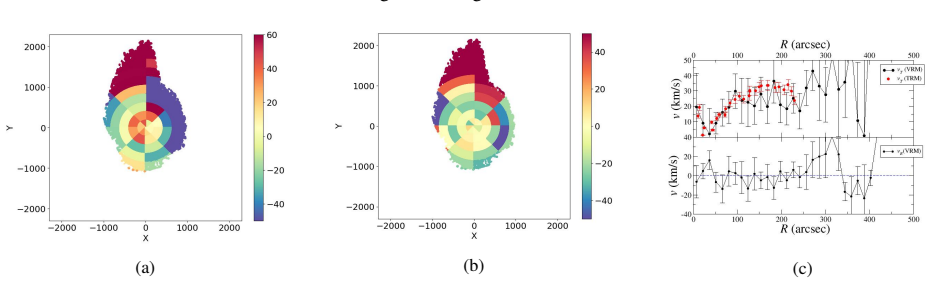
The dark matter disc (DMD) model is the central object: it assumes dark matter in the disc has a surface density equal to gamma_s times the stellar surface density plus gamma_g times the HI gas surface density, with those two weights being the free parameters of the fit. The second load-bearing piece is the velocity ring model (VRM), a flat-disc method that reconstructs coarse-grained two-dimensional maps of the transverse and radial velocity components, which the authors use to decide where the disc is rotationally supported and to build the rotation curves that both mass models must fit. The asymmetric drift correction, derived from the Jeans equations, connects the measured velocity dispersions and the assumed disc density to the circular velocity that the mass models are fit to.
What would settle it
Measure the vertical velocity dispersion or off-plane motions of stars in a face-on dwarf galaxy: a disc-confined dark matter distribution produces a strongly flattened gravitational potential, whereas a spherical halo does not. Alternatively, high-precision gravitational lensing of a background source by a nearby dwarf disc galaxy can map the projected mass distribution directly and would reveal whether the mass is distributed as a disc or a halo.
Extended reading notes
Core claim
The central claim is that for the 22 dwarf galaxies in the LITTLE THINGS subsample, the dark matter disc model gives statistically comparable fits to the asymmetric-drift-corrected rotation curves as the standard NFW halo model, even though the total mass of the disc (baryons plus disc dark matter) is roughly ten to a hundred times smaller than the NFW virial mass. Within the DMD framework, the paper also establishes that the inner slope of the rotation curve is directly set by the linear combination of the stellar and gas surface density profiles, which have flat cores, so the observed linear rise of the circular velocity with radius in the central regions follows without any additional tuning.
Load-bearing premise
The asymmetric drift correction assumes a particular disc density profile, and in the DMD model that density is built from the same two free parameters the fit is meant to determine, with no iterative or independent scheme given to break the coupling; if the Jeans equation should instead use only the tracer gas density, the DMD rotation curves and masses would be mis-specified.
Editorial extensions
If this is right
- If the DMD model is correct, the total dynamical masses of dwarf galaxies are 10 to 100 times smaller than estimates based on spherical NFW halos, so baryons dominate the inner mass budget.
- The cusp-core problem would no longer require feedback or exotic physics to explain flat cores, because a cored disc-like dark matter distribution directly produces linearly rising inner rotation curves.
- The Bosma effect, the observed correlation between dark matter and HI gas, would be elevated from a phenomenological correlation to a direct structural statement about where dark matter resides.
- Rotation curve data alone cannot distinguish the two mass models on the scales probed here, so claims of dark matter confinement to discs need independent geometric probes to be settled.
- Under the DMD model, the inner rotation curve shape is predictable from the observed stellar and gas surface density profiles, providing a built-in cross-check with independent photometric data.
Reading between the lines
- If dark matter is truly confined to galactic discs, standard collisionless cold dark matter would need a dissipative or otherwise self-interacting component that can lose angular momentum and settle into a plane; this is an extension the paper does not make.
- The same disc hypothesis could be tested in gas-poor dwarf spheroidals by measuring the vertical velocity dispersion of their stars: a flattened mass distribution creates a measurably different vertical potential than a spherical halo.
- High-precision strong gravitational lensing of a background source by a nearby dwarf disc galaxy would map the projected mass distribution directly and could separate a disc-like from a spherical dark matter geometry.
- Because the paper's rotation-curve fits only cover a narrow radial range, a concrete follow-up is to ask whether the DMD parameters found here remain stable when the outer, velocity-anisotropic regions are included with a warp treatment.
Editorial analysis
A structured set of objections, weighed in public.
Referee Report
Summary. This paper analyzes the neutral-hydrogen velocity fields of 22 dwarf galaxies from the LITTLE THINGS sample using the velocity ring model (VRM), reconstructs two-dimensional maps of the tangential and radial velocity components, and derives inner-disc rotation curves with an asymmetric-drift correction. The authors fit each rotation curve with two mass models: the standard Navarro-Frenk-White (NFW) halo model and a dark matter disc (DMD) model in which the dark matter surface density is proportional to the stellar and gas surface densities with two free weights γ_s and γ_g. They report that the DMD fits are statistically comparable to the NFW fits and that the DMD masses are 10 to 100 times smaller than the NFW masses. They also argue that the DMD model naturally produces linearly rising inner rotation curves because the baryonic surface densities have cored shapes.
Significance. The paper addresses a question of current interest: whether dwarf galaxy rotation curves can be fitted equally well by a disc-distributed dark matter model and a standard NFW halo. The use of the VRM to map radial and tangential velocity anisotropies in 22 LITTLE THINGS dwarfs is a methodological contribution, and the paper builds on publicly available observations. The explicit formulation of the DMD model in Eqs. (15)-(18) makes the underlying assumption testable. If the comparison were performed self-consistently and the mass-ratio claim were correct, the result would be relevant to the cusp-core problem and to the inferred geometry of dark matter in dwarf galaxies. However, the current manuscript does not provide sufficient evidence for the headline comparison because the DMD drift correction is model-dependent, and the quantitative results in Table 1 contain inconsistencies. The paper does not include machine-checked proofs or released code, so reproducibility rests on the public data and the described procedures.
major comments (3)
- [Sections 3.2 and 4, Eqs. (10), (15), (18)] The asymmetric-drift-corrected circular velocity in the DMD case is not an independent observable. The drift correction σ_D^2 in Eq. (10) contains (R/ρ)(∂ρ/∂R), and for the DMD model the authors set ρ ∝ γ_s Σ_s + γ_g Σ_g in Eq. (18). The corrected v_c is therefore a function of the same parameters γ_s and γ_g that the fit in Eq. (15) is meant to determine. The manuscript does not describe an iterative or fixed-point scheme: Section 5 indicates that the DMD surface density is computed 'once the fit with the DMD mass model has been performed,' but the fit uses that surface density to build the data vector that is fitted. For the NFW model, by contrast, ρ in Eq. (10) is the baryonic density (Eq. 17), independent of the NFW parameters, so the two models are not treated symmetrically. This is a load-bearing issue because the fit range is often less than half a decade (Section 6) and several reduced χ² values in Table 1 are below unity, so a small model-induced shift in v_c can substantially change the inferred γ_s and γ_g, and hence M_dmd and the stated mass ratio. The authors should either use a model-independent density (e.g., the baryonic density) in Eq. (10) for both models, or implement and document a fixed-point iteration over γ_s and γ_g with a convergence test.
- [Abstract and Table 1] The abstract's claim that the DMD masses are 'approximately 10 to 100 times smaller' than the NFW masses is not supported by the numbers in Table 1. Using the tabulated columns (5) and (6), DDO50 has M200/Mdmd ≈ (0.2×10^10)/(1.8×10^9) ≈ 1.1 and NGC2366 has M200/Mdmd ≈ (1.0×10^10)/(2.8×10^9) ≈ 3.6, while the largest ratios are of order 40 (DDO47, DDO52, DDO101, IC1613) and no listed galaxy reaches a ratio of 100. The abstract and Section 7 should be revised to state the actual range, or the table columns should be corrected.
- [Table 1] Table 1 contains several internal inconsistencies between the mass columns and the ratio columns. For DDO101, columns (4) and (6) imply M200/Mbar = (5.5×10^10)/(9.3×10^7) ≈ 591, while column (8) lists 765; for DDO210 the same computation gives ≈222, not 170. The entry for NGC3738, M_dmd = (489±100)×10^9 M⊙, exceeds the listed M200 = (14.6±4)×10^10 M⊙ and is physically implausible for a dwarf galaxy, indicating a unit error or a typo. These issues undermine the quantitative mass comparison and should be fixed before the paper can be properly evaluated.
minor comments (6)
- [Section 2] The sentence 'The determination of the inclination angle by Iorio et al. (2017) not always agree with that by Iorio et al. (2017)' should read 'The determination of the inclination angle by Iorio et al. (2017) does not always agree with that by Oh et al. (2015)'.
- [Eq. (11)] The sentence contains a doubled 'and' ('the gas and stellar components and and vh(R)'); remove the duplicate.
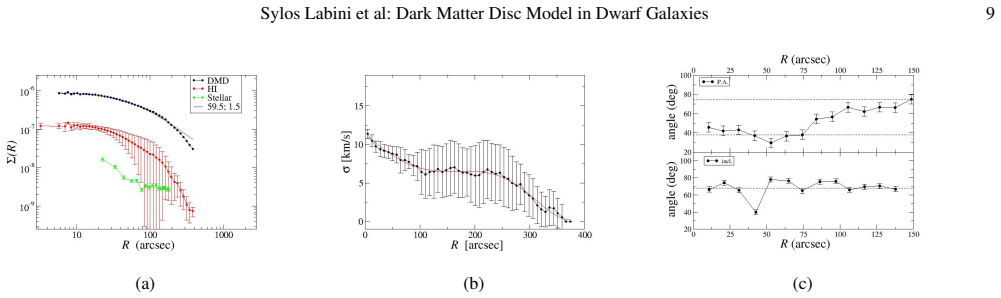
- [Fig. 3 caption] The caption refers to the 'blu line' for the cored profile fit; it should read 'blue line'.
- [Throughout] The paper uses 'transversal' where 'tangential' is the standard term in disk kinematics; for consistency with the v_θ notation, consider using 'tangential' throughout.
- [Table 1] Columns (9) and (10) are labeled 'χ2_dmd' and 'χ2_nfw', but the text calls these 'reduced χ2' in several places; specify whether the quoted values are reduced and state the number of degrees of freedom used.
- [Section 7] The conclusions state that the fits were performed 'to the transversal velocity,' while Section 6 states that they were performed to the asymmetric-drift-corrected circular velocity; make the target of the fit explicit and consistent.
Circularity Check
DMD drift correction puts the fitted γ_s, γ_g into the 'observed' circular velocity (Eqs. 9-10 with Eq. 18), making the DMD data points model-dependent; no iterative scheme is described.
-
self definitional
[Section 3.2 (Eqs. 9-10) coupled with Section 4 (Eq. 18) and Section 6 fitting procedure]
"In Eqs.9-10 the kinematic terms can be measured from the data while density ρ(R) depends on the mass model adopted as we are going to discuss in the next section. ... For the DMD model, the density of the disc entering the Jeans equation (Eq.2) is given (again, up to an irrelevant prefactor) by ρ(R)∼ Σdmd(R) =γsΣs(R) +γgΣg(R). (18) Specifically, it is a linear combination of the stellar and gas surface densities, rescaled by the two free parameters of the DMD model, γs and γg."
Inserting Eq.18 into Eq.10 makes σ_D^2, and therefore the 'observed' circular velocity v_c^2 = v_θ^2 + σ_D^2 in Eq.9, depend on the two parameters γs, γg that the fit is supposed to determine from Eq.15. For the NFW model, ρ in Eq.10 is the baryonic density (Eq.17), independent of the NFW parameters, so the DMD and NFW fits are not symmetric: DMD can reshape its own data points while fitting. The paper describes no iterative or fixed-point scheme; Section 6 only says the best-fit parameters minimize χ^2 between the model circular velocity and the observed one. Section 5 then computes Σ_dmd from the fitted γs, γg, fits it to the cored form Eq.19, and feeds it back into Eqs.9-10.
full rationale
The central comparison is partially circular. The paper's own equations show that the DMD circular velocity used as 'data' is built from the same γs, γg that are being fitted, so the statistical comparison with NFW is not on equal footing. Self-citations to prior DMD/VRM papers (Sylos Labini et al. 2023a,b, 2024b) are not the main problem: the current analysis uses public LITTLE THINGS data and re-fits both models, so those citations are supporting context, not load-bearing. The inner-slope consistency argument is a genuine model property rather than a rename. However, because no fixed-point iteration is described, the DMD fits, the χ^2 values, and Mdmd all reduce partly to the fit inputs; the reported mass ratio is additionally a comparison of two model-dependent definitions. The abstract's '10 to 100 times smaller' also does not match the Table 1 ratios, but that is a reporting inconsistency, not circularity. Overall, one substantive self-referential step in the central comparison: score 6.
Assumptions & free parameters
free parameters (5)
- gamma_s (DMD stellar scaling) =
per galaxy, not tabulated separately; enters M_dmd = gamma_s M_s + gamma_g M_g
- gamma_g (DMD gas scaling) =
per galaxy, not tabulated separately
- NFW r_s and rho_0 =
per galaxy, not tabulated separately; M_200 derived from them
- DMD surface-density profile parameters Sigma_0, R_g, beta (Eq. 19) =
per galaxy, e.g., beta about 1.9 for CVnIdwA
- Sixth-degree polynomial coefficients for sigma(R) =
per galaxy
assumptions (6)
- standard math The galaxy is in a steady, axisymmetric state described by the Jeans equations.
- domain assumption Mixed v_R v_z terms are negligible and the mean radial velocity v_R is about zero in the fitted range.
- domain assumption Velocity anisotropies are small enough that sigma_v_theta and sigma_v_R are approximately equal to sigma, with sigma taken from the moment-2 map.
- domain assumption The galactic disc is flat (no warp) over the fitted inner radii.
- ad hoc to paper In the DMD model, dark matter resides in the disc and its surface density is proportional to the stellar and gas surface densities with constant weights gamma_s and gamma_g.
- domain assumption The stellar mass-to-light ratio and the 1.4 factor for helium are adopted from Oh et al. (2015).
Cite this review
Pith. "Pith review of Exploring the Dark Matter Disc Model in Dwarf Galaxies: Insights from the LITTLE THINGS Sample." pith.science (2026). https://pith.science/paper/42AI7Y7G
@misc{pith2026241209934,
  author       = {Pith},
  title        = {Pith review of: Exploring the Dark Matter Disc Model in Dwarf Galaxies: Insights from the LITTLE THINGS Sample},
  year         = {2026},
  howpublished = {\url{https://pith.science/paper/42AI7Y7G}},
  note         = {Machine review of arXiv:2412.09934}
}
read the original abstract
We conducted an analysis of the velocity field of dwarf galaxies in the LITTLE THINGS sample, focusing on deriving 2D velocity maps that encompass both the transverse and radial velocity fields. Within the range of radial distances where velocity anisotropies are sufficiently small for the disc to be considered rotationally supported, and where the warped geometry of the disc can be neglected, we reconstructed the rotation curve while taking into account the effect of the asymmetric drift. To fit the rotation curves, we employed the standard halo model and the dark matter disc (DMD) model, which assumes that dark matter is primarily confined to the galactic discs and can be traced by the distribution of \HI{}. Interestingly, our analysis revealed that the fits from the DMD model are statistically comparable to those obtained using the standard halo model, but the inferred masses of the galaxies in the DMD model are approximately 10 to 100 times smaller than the masses inferred in the standard halo model. In the DMD model, the inner slope of the rotation curve is directly related to a linear combination of the surface density profiles of the stellar and gas components, which generally exhibit a flat core. Consequently, the observation of a linear relationship between the rotation curve and the radius in the disc central regions is consistent with the framework of the DMD model.
Figures


Figures from the paper (49 more)




Reference graph
Works this paper leans on
-
[1]
, " * write output.state after.block = add.period write newline
ENTRY address archiveprefix author booktitle chapter edition editor howpublished institution eprint journal key month note number organization pages publisher school series title type volume year label extra.label sort.label short.list INTEGERS output.state before.all mid.sentence after.sentence after.block FUNCTION init.state.consts #0 'before.all := #1 ...
-
[2]
write newline
" write newline "" before.all 'output.state := FUNCTION n.dashify 't := "" t empty not t #1 #1 substring "-" = t #1 #2 substring "--" = not "--" * t #2 global.max substring 't := t #1 #1 substring "-" = "-" * t #2 global.max substring 't := while if t #1 #1 substring * t #2 global.max substring 't := if while FUNCTION word.in bbl.in " " * FUNCTION format....
-
[3]
Barnes , E. I. & Sellwood , J. A. 2003, Astronom.J., 125, 1164
work page 2003
-
[4]
Begeman , K. G., Broeils , A. H., & Sanders , R. H. 1991, Mon.Not.R.Astr.Soc., 249, 523
work page 1991
-
[5]
Benhaiem , D., Sylos Labini , F., & Joyce , M. 2019, Phys.Rev.E, 99, 022125
work page 2019
-
[6]
& Tremaine, S
Binney, J. & Tremaine, S. 2008, Galactic Dynamics (Princeton University Press)
2008
-
[7]
1978, PhD thesis, University of Groningen, Netherlands
Bosma , A. 1978, PhD thesis, University of Groningen, Netherlands
1978
- [8]
Show all 72 references
-
[9]
2022, Astrophys.J., 940, 116
Casandjian , J.-M., Ballet , J., Grenier , I., & Remy , Q. 2022, Astrophys.J., 940, 116
2022
-
[10]
& Pfenniger , D
Combes , F. & Pfenniger , D. 1997, Astron.Astrophys., 327, 453
1997
-
[11]
& Kroupa , P
Dabringhausen , J. & Kroupa , P. 2013, Mon.Not.R.Astr.Soc., 429, 1858
2013
-
[12]
de Blok , W. J. G. & Bosma , A. 2002, Astron.Astrophys., 385, 816
2002
-
[13]
de Blok , W. J. G., McGaugh , S. S., & Rubin , V. C. 2001, Astron.J., 122, 2396
2001
-
[14]
de Blok , W. J. G., McGaugh , S. S., & van der Hulst , J. M. 1996, Mon.Not.R.Astr.Soc., 283, 18
1996
-
[15]
Di Teodoro , E. M. & Fraternali , F. 2015, Mon.Not.R.Astron.Soc., 451, 3021
2015
-
[16]
Di Teodoro , E. M. & Peek , J. E. G. 2021, Astrophys.J., 923, 220
2021
-
[17]
2008, Nature, 454, 735
Diemand , J., Kuhlen , M., Madau , P., et al. 2008, Nature, 454, 735
2008
-
[18]
W., Rix, H.-W., & Ness, M
Eilers, A.-C., Hogg, D. W., Rix, H.-W., & Ness, M. K. 2019, The Astrophysical Journal, 871, 120
2019
-
[19]
1965, Trudy Astrofizicheskogo Instituta Alma-Ata, 5, 87
Einasto , J. 1965, Trudy Astrofizicheskogo Instituta Alma-Ata, 5, 87
1965
-
[20]
2001, Astrophys.J.Lett., 562, L47
Fraternali , F., Oosterloo , T., Sancisi , R., & van Moorsel , G. 2001, Astrophys.J.Lett., 562, L47
2001
-
[21]
2002, Astron.Astrophys., 394, 769
Garc \' a-Ruiz , I., Sancisi , R., & Kuijken , K. 2002, Astron.Astrophys., 394, 769
2002
-
[22]
A., Casandjian , J.-M., & Terrier , R
Grenier , I. A., Casandjian , J.-M., & Terrier , R. 2005, Science, 307, 1292
2005
-
[23]
Hessman , F. V. & Ziebart , M. 2011, Astron.Astrophys., 532, A121
2011
-
[24]
S., & Sancisi , R
Hoekstra , H., van Albada , T. S., & Sancisi , R. 2001, Mon.Not.R.Astr.Soc., 323, 453
2001
-
[25]
Hunter , D. A. & Elmegreen , B. G. 2006, Astrophys.J.Supp., 162, 49
2006
-
[26]
A., Ficut-Vicas , D., Ashley , T., et al
Hunter , D. A., Ficut-Vicas , D., Ashley , T., et al. 2012, Astronom.J., 144, 134
2012
-
[27]
2017, Mon.Not.R.Astr.Soc., 466, 4159
Iorio , G., Fraternali , F., Nipoti , C., et al. 2017, Mon.Not.R.Astr.Soc., 466, 4159
2017
-
[28]
2013, Astrophys.J., 767, 146
Ishiyama , T., Rieder , S., Makino , J., et al. 2013, Astrophys.J., 767, 146
2013
-
[29]
2003, Pub.Astron.Soc.Pacific, 115, 928
Kennicutt , Robert C., J., Armus , L., Bendo , G., et al. 2003, Pub.Astron.Soc.Pacific, 115, 928
2003
-
[30]
2012, Pub.Astron.Soc.Austr., 29, 395
Kroupa , P. 2012, Pub.Astron.Soc.Austr., 29, 395
2012
-
[31]
S., Boylan-Kolchin , M., et al
Lazar , A., Bullock , J. S., Boylan-Kolchin , M., et al. 2020, Mon.Not.R.Astr.Soc., 497, 2393
2020
-
[32]
E., Fraternali , F., Oosterloo , T., et al
Mancera Pi \ n a , P. E., Fraternali , F., Oosterloo , T., et al. 2022, Mon.Not.R.Astr.Soc., 514, 3329
2022
-
[33]
E., Posti , L., Fraternali , F., Adams , E
Mancera Pi \ n a , P. E., Posti , L., Fraternali , F., Adams , E. A. K., & Oosterloo , T. 2021, Astron.Astrophys., 647, A76
2021
-
[34]
1994, Nature, 370, 629
Moore , B. 1994, Nature, 370, 629
1994
-
[35]
1999, Astrophys
Moore , B., Ghigna , S., Governato , F., et al. 1999, Astrophys. J., 524, L19
1999
-
[36]
F., Eke , V
Navarro , J. F., Eke , V. R., & Frenk , C. S. 1996, Mon.Not.R.Astron.Soc., 283, L72
1996
-
[37]
F., Frenk , C
Navarro , J. F., Frenk , C. S., & White , S. D. M. 1997, Astrophys. J., 490, 493
1997
-
[38]
F., Hayashi, E., Power, C., et al
Navarro, J. F., Hayashi, E., Power, C., et al. 2004, Mon.Not.R.Astr.Soc., 349, 1039
2004
-
[39]
F., Ludlow , A., Springel , V., et al
Navarro , J. F., Ludlow , A., Springel , V., et al. 2010, Mon.Not.R.Astr.Soc., 402, 21
2010
-
[40]
Oh , S.-H., de Blok , W. J. G., Brinks , E., Walter , F., & Kennicutt , Robert C., J. 2011, Astron.J., 141, 193
2011
-
[41]
Oh , S.-H., de Blok , W. J. G., Walter , F., Brinks , E., & Kennicutt , Jr., R. C. 2008, Astronom.J., 136, 2761
2008
-
[42]
A., Brinks , E., et al
Oh , S.-H., Hunter , D. A., Brinks , E., et al. 2015, Astronom.J., 149, 180
2015
-
[43]
2024, Mon.Not.R.Astr.Soc., 528, 693
Ou , X., Eilers , A.-C., Necib , L., & Frebel , A. 2024, Mon.Not.R.Astr.Soc., 528, 693
2024
-
[44]
Pawlowski , M. S. & Kroupa , P. 2013, Mon.Not.R.Astr.Soc., 435, 2116
2013
-
[45]
1994, Astron.Astrophys., 285, 79
Pfenniger , D., Combes , F., & Martinet , L. 1994, Astron.Astrophys., 285, 79
1994
-
[46]
Planck Collaboration , Ade , P. A. R., Aghanim , N., et al. 2011, Astron.Astrophys., 536, A19
2011
-
[47]
F., Jenkins , A., et al
Power , C., Navarro , J. F., Jenkins , A., et al. 2003, Mon. Not. R. Astron. Soc., 338, 14
2003
-
[48]
I., Iorio , G., Agertz , O., & Fraternali , F
Read , J. I., Iorio , G., Agertz , O., & Fraternali , F. 2016, Mon.Not.R.Astr.Soc., 462, 3628
2016
-
[49]
& Combes , F
Reshetnikov , V. & Combes , F. 1998, Astron.Astrophys., 337, 9
1998
-
[50]
2012, Astron.Astrophys., 540, A70
Retana-Montenegro , E., van Hese , E., Gentile , G., Baes , M., & Frutos-Alfaro , F. 2012, Astron.Astrophys., 540, A70
2012
-
[51]
H., Lockhart , I
Rogstad , D. H., Lockhart , I. A., & Wright , M. C. H. 1974, Astrophys.J., 193, 309
1974
-
[52]
L., Battaner , E., Guijarro , A., L \'o pez-Corredoira , M., & Castro-Rodr \' guez , N
S \'a nchez-Saavedra , M. L., Battaner , E., Guijarro , A., L \'o pez-Corredoira , M., & Castro-Rodr \' guez , N. 2003, Astron.Astrophys., 399, 457
2003
-
[53]
1976, Astron.Astrohys., 53, 159
Sancisi , R. 1976, Astron.Astrohys., 53, 159
1976
-
[54]
1999, Astrophys.Sp.Sci., 269, 59
Sancisi , R. 1999, Astrophys.Sp.Sci., 269, 59
1999
-
[55]
M., Bigiel , F., Klessen , R
Schmidt , T. M., Bigiel , F., Klessen , R. S., & de Blok , W. J. G. 2016, Mon.Not.R.Astr.Soc., 457, 2642
2016
-
[56]
& Dettmar , R.-J
Schwarzkopf , U. & Dettmar , R.-J. 2001, Astron.Astrophys., 373, 402
2001
-
[57]
Sellwood , J. A. & S \'a nchez , R. Z. 2010, Mon.Not.R.Astr.Soc., 404, 1733
2010
-
[58]
A., Spekkens, K., & Eckel, C
Sellwood, J. A., Spekkens, K., & Eckel, C. S. 2021, Monthly Notices of the Royal Astronomical Society, 502, 3843
2021
-
[59]
& Sellwood , J
Spekkens , K. & Sellwood , J. A. 2007, Astrophys.J., 664, 204
2007
-
[60]
2009, Mon.Not.R.Astr.Soc., 398, L21
Stadel , J., Potter , D., Moore , B., et al. 2009, Mon.Not.R.Astr.Soc., 398, L21
2009
-
[61]
A., Sancisi , R., van der Hulst , J
Swaters , R. A., Sancisi , R., van der Hulst , J. M., & van Albada , T. S. 2012, Mon.Not.R.Astr.Soc., 425, 2299
2012
-
[62]
2024, Astrophys.J., 976, 185
Sylos Labini , F. 2024, Astrophys.J., 976, 185
2024
-
[63]
2023 a , Astrophys.J., 945, 3
Sylos Labini , F., Chrob \'a kov \'a , Z ., Capuzzo-Dolcetta , R., & L \'o pez-Corredoira , M. 2023 a , Astrophys.J., 945, 3
2023
-
[64]
2024 a , Mon.Not.R.Astr.Soc., 527, 2697
Sylos Labini , F., De Marzo , G., & Straccamore , M. 2024 a , Mon.Not.R.Astr.Soc., 527, 2697
2024
-
[65]
2024 b , Mon.Not.R.Astr.Soc., 527, 2697
Sylos Labini , F., De Marzo , G., Straccamore , M., & Comer \'o n , S. 2024 b , Mon.Not.R.Astr.Soc., 527, 2697
2024
-
[66]
D., & Capuzzo-Dolcetta , R
Sylos Labini , F., Pinto , L. D., & Capuzzo-Dolcetta , R. 2020, Phys.Rev.E, 102, 042108
2020
-
[67]
2023 b , Mon.Not.R.Astr.Soc., 524, 1560
Sylos Labini , F., Straccamore , M., De Marzo , G., & Comer \'o n , S. 2023 b , Mon.Not.R.Astr.Soc., 524, 1560
2023
-
[68]
Walter , F., Brinks , E., de Blok , W. J. G., et al. 2008, Astronom.J., 136, 2563
2008
-
[69]
M., Roussel , H., et al
Walter , F., Cannon , J. M., Roussel , H., et al. 2007, Astrophys.J., 661, 102
2007
-
[70]
& Lilly , S
Wang , E. & Lilly , S. J. 2023, Astrophys.J., 944, 143
2023
-
[71]
2023, Astrophys.J., 942, 12
Wang , H.-F., Chrob \'a kov \'a , Z ., L \'o pez-Corredoira , M., & Sylos Labini , F. 2023, Astrophys.J., 942, 12
2023
-
[72]
J., Wright , M
Warner , P. J., Wright , M. C. H., & Baldwin , J. E. 1973, Mon.Not.R.Astr.Soc., 163, 163
1973
Reviewed August 11, 2026 · model on record in the stance chip above.
Discussion (0). Continue with ORCID to comment.