REVIEW 3 major objections 6 minor 38 references
UN-DETR: Promoting Objectness Learning via Joint Supervision for Unknown Object Detection
T0 review · 3 major / 6 minor · reviewed 2026-08-11 · deepseek-v4-flash
Pith's one-line read Training an objectness score on both box overlap and classification confidence lets a transformer detector outperform prior methods at finding objects of unseen categories.
desk verdict Solid system paper with a real but incremental contribution; the SOTA margin is confounded with unsupervised pretraining and the attribution to the new IPS head doesn't survive the authors' own ablation. read the letter →
The pith
A machine-rendered reading of the paper's core claim, the machinery that carries it, and where it could break.
The reading
What carries the argument
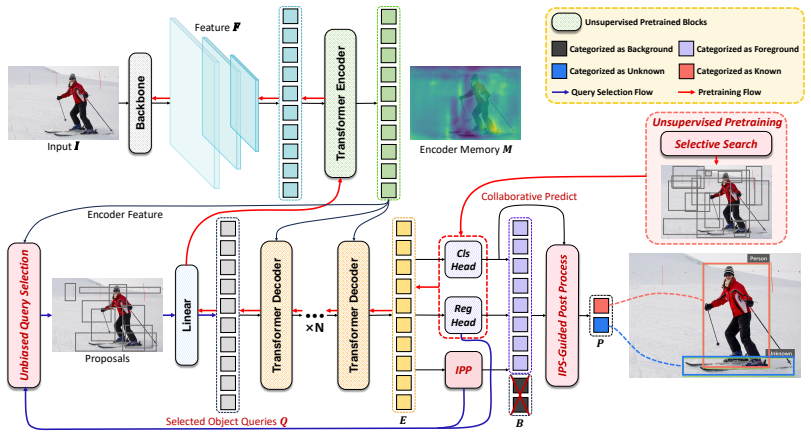
Instance Presence Score (IPS), a learnable scalar output by a dedicated one-layer IPS Predictor head, is the load-bearing object. Its training target is $P_o(e_i)=\alpha\,\mathrm{GIoU}(b_i,\hat{b}_{\sigma_{pos}})+\beta\,\hat{P}^f_{\sigma_{pos}}$, with $\alpha=0.6$, $\beta=0.4$; the first term is the generalized IoU between the regression head's box and the matched ground-truth box, and the second is the sum of the known-class logits, a foreground probability. Samples whose $\mathrm{GIoU}$ falls at or below $\tau=0.6$ are pushed toward a constant $C=0.5$ instead, giving the score a clean separation between foreground-like and background-like boxes. IPS is reused in three places: a one-to-many assignment adds a second set of matched queries as extra positives for IPS training only, Unbiased Query Selection replaces the two-stage DETR query-scoring classification head with an additional IPP head, and an IPS-guided post-process ranks boxes with Distance-IoU NMS before applying a dual-criteria rule (classification confidence and IPS both above thresholds $\Rightarrow$ known; low classification but high IPS $\Rightarrow$ unknown).
What would settle it
The claim would be falsified if re-running the released model on COCO-OOD while sweeping the dual-criteria thresholds reveals that the reported 54.9 U-F1 and 54.5 U-PRE are only obtained at the sweep maximum rather than at a pre-fixed threshold setting.
Extended reading notes
Core claim
The central discovery is that objectness for unknown objects is better learned as a recoupling of two complementary latent spaces rather than from either alone. The paper shows that using only categorical information yields clear foreground/background separation but poor instance separation, while using only positional information yields the opposite. IPS is defined as the probability of an object's presence and is trained to match a convex combination of GIoU(box, matched GT) and the sum of classification logits over known categories, with a low constant target for low-overlap samples. The same IPS is then used to select decoder queries and to guide post-processing, including a known/unknown decision rule based on both classification confidence and IPS. Under the UOD evaluation protocol, this design claims the highest reported unknown-object F1 and precision on COCO-OOD and COCO-Mixed while keeping known-object mAP roughly unchanged.
Load-bearing premise
The central premise is that an objectness score trained as a weighted blend of box overlap (GIoU) and the summed known-class logits transfers to unseen categories, and that the known/unknown thresholds in the final protocol are fixed rather than tuned to each test set.
Editorial extensions
If this is right
- If the reported gains hold, augmenting any detector that has separate classification and regression heads with a jointly supervised IPS head should improve unknown-object recall and precision without retraining the backbone from scratch.
- Because IPS is class-agnostic, using it in query selection should make the decoder's initial queries less biased toward known categories, which is a direct design lesson for open-world detectors.
- The ablation showing U-PRE drops from 54.5 to 35.0 without unsupervised pretraining implies that an objectness prior acquired from region proposals is a major share of the method's precision advantage.
- The dual-criteria rule (known if both classification confidence and IPS are high, unknown if only IPS is high) provides a template for separating known from unknown instances using two complementary confidence signals.
Reading between the lines
- A natural stress test the paper does not run is a full precision-recall sweep of the dual-criteria thresholds; if the reported COCO-OOD numbers sit at the peak of that sweep, the benchmark gains are partly tuning, not pure generalization.
- The same joint-supervision recipe could be dropped into open-vocabulary detectors as an auxiliary objectness head, so that objects outside the prompt vocabulary still get localized and marked unknown rather than missed.
- The COCO-Mixed results are more modest than the COCO-OOD ones: the method leads in U-AP and U-PRE but trails on U-F1, so a careful reader should weigh how much of the 'surpassing previous methods' claim is specific to the all-unknown test set.
- Replacing the fixed convex weights $\alpha=0.6$, $\beta=0.4$ with a learned gating of the two signals is a testable variant that might reduce sensitivity to the choice of known categories.
Signed reviews
Editorial analysis
A structured set of objections, weighed in public.
Referee Report
Summary. The paper proposes UN-DETR, a transformer-based unknown object detector built on Deformable DETR. Its central novelty is an Instance Presence Score (IPS) predicted by a dedicated head, trained with joint supervision from positional (GIoU) and categorical (sum of known-class logits) signals, with a one-to-many assignment for additional positive samples. IPS is also used for query selection and post-processing, and the whole detector is unsupervised-pretrained on the training set with region priors. The paper reports state-of-the-art results on COCO-OOD and strong results on COCO-Mixed, and includes ablations of each component.
Significance. If the reported results hold under a fair comparison, this is a meaningful contribution: it is the first transformer-based UOD method, it introduces a learnable objectness score that combines two complementary signals, and it provides a fairly complete ablation study with convergence and visualization analyses. The authors also provide a code repository, which supports reproducibility. However, the central SOTA claim is currently supported by a comparison in which the proposed method uses an unsupervised pretraining recipe that is not applied to the baselines in the main tables, and the paper's own ablation shows the pretraining is largely responsible for the headline U-F1 and U-PRE margins. The contribution is therefore promising but not yet convincingly established.
major comments (3)
- [Ablation Study, Table 3 row 8] The claim that UN-DETR surpasses the previous leading method (Table 1: U-F1 54.9 vs 47.9, U-PRE 54.5 vs 43.3 on COCO-OOD) is confounded by the unsupervised pretraining component. Removing pretraining drops U-F1 from 54.9 to 44.5 and U-PRE from 54.5 to 35.0, both below UnSniffer's 47.9 and 43.3. The appendix's retrained-baseline results are not integrated into Tables 1-2, and the reported UnSniffer-with-pretraining U-AP of 43.9 is below its original 45.4. Thus the headline margin is not attributable to the jointly supervised IPS mechanism alone; please integrate the pretrained-baseline comparisons into the main tables, or provide a no-pretraining comparison against all baselines on the full metric set.
- [IPS-Guided Post Process, 'Dual-Criteria Unknown Distinguish Protocol'] The known/unknown decision is made by checking whether 'both classification confidence and IPS are above set thresholds', but the threshold values are never reported, and no sensitivity analysis or protocol for choosing them is given. Since U-F1 and U-PRE are computed after this decision rule, the headline results are not independently reproducible from the text. Please report the thresholds, state how they were selected (e.g., fixed in advance or tuned on COCO-OOD), and provide a sensitivity study over these thresholds.
- [Instance Presence Score Predictor, Eqs. (1)-(4)] The IPS supervision target Po = α·eo_bbox + β·eo_cls is not an independent objectness measurement: eo_cls is the sum of the model's own classification logits for the matched prediction, and eo_bbox is the GIoU between the model's predicted box and the ground-truth box. Using the model's own confidence as a categorical supervision signal is a legitimate training strategy, but the paper should clarify this explicitly and justify why it does not induce confirmation bias in the objectness estimate. A concrete validation would be to compare against an IPS trained with binary foreground/background labels for known objects, or to report the correlation between the learned IPS and GIoU on held-out known objects.
minor comments (6)
- [Table 1 caption] The caption writes 'COCO-ODD'; this should be 'COCO-OOD'.
- [Introduction, contributions] The text says 'jointly supervised singals from complementary positional and categorical latent space'; 'singals' should be 'signals', and 'latent space' should be plural.
- [Appendix, Unsupervised Pre-training] 'Futhermore' should be 'Furthermore'.
- [Eqs. (1)-(4)] The metric is written both as 'GIoU' and 'GIOU'; please unify the notation.
- [Unbiased Query Selection] The text says 'we introduce an additional IPP' for query selection, but the same acronym IPP is also used for the main objectness head. Please clarify whether these are the same head, separate heads, or shared-parameter heads, and how the two IPP losses interact.
- [Appendix, Qualitative Analysis] The appendix refers to 'the donut in the second row ... of Figure 3' and 'the moon in the fifth row of Figure 4'; these should reference the qualitative comparison figures (Figures 8 and 9).
Circularity Check
IPS is trained on the model's own summed classification logits and then used as an independent signal to reclassify low-confidence boxes; the core SOTA claim remains empirical and externally benchmarked.
-
self definitional
[Section 'Instance Presence Score Predictor' (Eqs. 1-5) and Section 'IPS-Guided Post Process' ('Dual-Criteria Unknown Distinguish Protocol')]
"ˆeo_cls,σpos = ˆPf σpos (2) where Pf is the sum of K logits ... we set the objective probability Po(ei) = α · eo_bbox + β · eo_cls, which serves as the supervised signal for IPP training ... If both classification confidence and IPS are above set thresholds, the object is assigned to a known category. If classification confidence is low but IPS is high, the object is recognized but not confidently categorized, hence it's classified as unknown."
The IPS regressor is trained to reproduce a target whose categorical component is literally the sum of the model's own classification logits. The dual-criteria unknown/known decision then treats 'IPS high' as though it were independent evidence that can override low classification confidence and label a box unknown. Since IPS is partly a learned copy of the classification head's summed logits, the decision 'classification confidence low but IPS high' reduces, by construction, to re-thresholding the model's own confidence signal rather than consulting a genuinely separate objectness measurement.
full rationale
The paper's headline result is an empirical state-of-the-art claim on public UOD benchmarks, not a mathematical derivation, so most of the argument is not circular in the formal sense. The one concrete reduction-by-construction is in the IPS design: Eq. (2) defines the categorical supervision as the sum of the classification head's own logits, and the post-processing protocol then uses IPS to make known/unknown decisions that are supposed to be independent of classification confidence. That is a partial self-definitional loop, but it does not collapse the whole method because the positional/GIoU component and the unsupervised pretraining are external ingredients. The larger validity concern is experimental: Table 3 row 8 shows that removing unsupervised pretraining drops U-F1 from 54.9 to 44.5 and U-PRE from 54.5 to 35.0, placing UN-DETR below UnSniffer on those metrics, while the appendix reports that retrained baselines with similar pretraining do not match the main-table numbers. This is a serious attribution and reproducibility problem, but it is a confound rather than a circularity. No load-bearing self-citation chain or imported uniqueness theorem appears in the paper. Overall score 4 reflects one partial self-definitional step in the IPS/post-process chain, with the central empirical comparison retaining independent content.
Assumptions & free parameters
free parameters (6)
- alpha (positional weight in IPS target) =
0.6
- beta (categorical weight in IPS target) =
0.4
- C (negative IPS constant) =
0.5
- tau (GIoU positive/negative threshold) =
0.6
- loss weights lambda1, lambda2, lambda3 =
3, 2, 5
- dual-criteria thresholds for known/unknown decision =
unstated
assumptions (5)
- standard math Deformable DETR bipartite matching and transformer decoder update provide a valid detection backbone.
- domain assumption GIoU between a predicted box and its matched ground truth is a class-agnostic objectness signal that transfers to unseen categories.
- domain assumption The sum of known-class logits represents the probability of foreground, independent of specific categories.
- domain assumption Suboptimal one-to-many matched queries are still reliable positives for IPS learning.
- domain assumption Unsupervised pretraining with Selective Search boxes and SwAV embeddings transfers objectness priors to the full detector.
invented entities (2)
-
Instance Presence Score (IPS)
-
Unbiased Query Selection (UQS) additional IPP head
Cite this review
Pith. "Pith review of UN-DETR: Promoting Objectness Learning via Joint Supervision for Unknown Object Detection." pith.science (2026). https://pith.science/paper/VYTQNSOE
@misc{pith2026241210176,
  author       = {Pith},
  title        = {Pith review of: UN-DETR: Promoting Objectness Learning via Joint Supervision for Unknown Object Detection},
  year         = {2026},
  howpublished = {\url{https://pith.science/paper/VYTQNSOE}},
  note         = {Machine review of arXiv:2412.10176}
}
read the original abstract
Unknown Object Detection (UOD) aims to identify objects of unseen categories, differing from the traditional detection paradigm limited by the closed-world assumption. A key component of UOD is learning a generalized representation, i.e. objectness for both known and unknown categories to distinguish and localize objects from the background in a class-agnostic manner. However, previous methods obtain supervision signals for learning objectness in isolation from either localization or classification information, leading to poor performance for UOD. To address this issue, we propose a transformer-based UOD framework, UN-DETR. Based on this, we craft Instance Presence Score (IPS) to represent the probability of an object's presence. For the purpose of information complementarity, IPS employs a strategy of joint supervised learning, integrating attributes representing general objectness from the positional and the categorical latent space as supervision signals. To enhance IPS learning, we introduce a one-to-many assignment strategy to incorporate more supervision. Then, we propose Unbiased Query Selection to provide premium initial query vectors for the decoder. Additionally, we propose an IPS-guided post-process strategy to filter redundant boxes and correct classification predictions for known and unknown objects. Finally, we pretrain the entire UN-DETR in an unsupervised manner, in order to obtain objectness prior. Our UN-DETR is comprehensively evaluated on multiple UOD and known detection benchmarks, demonstrating its effectiveness and achieving state-of-the-art performance.
Figures


Figures from the paper (8 more)


Reference graph
Works this paper leans on
-
[1]
J.; Herzig, R.; Chechik, G.; Rohrbach, A.; Darrell, T.; and Globerson, A
Bar, A.; Wang, X.; Kantorov, V.; Reed, C. J.; Herzig, R.; Chechik, G.; Rohrbach, A.; Darrell, T.; and Globerson, A. 2022. Detreg: Unsupervised pretraining with region priors for object detection. In Proceedings of the IEEE/CVF conference on computer vision and pattern recognition, 14605--14615
work page 2022
-
[2]
Bendale, A.; and Boult, T. E. 2016. Towards Open Set Deep Networks. In 2016 IEEE Conference on Computer Vision and Pattern Recognition (CVPR), 1563--1572
work page 2016
-
[3]
Carion, N.; Massa, F.; Synnaeve, G.; Usunier, N.; Kirillov, A.; and Zagoruyko, S. 2020. End-to-end object detection with transformers. In European conference on computer vision, 213--229. Springer
2020
-
[4]
Caron, M.; Misra, I.; Mairal, J.; Goyal, P.; Bojanowski, P.; and Joulin, A. 2020. Unsupervised learning of visual features by contrasting cluster assignments. Advances in neural information processing systems, 33: 9912--9924
2020
-
[5]
Chen, Q.; Chen, X.; Wang, J.; Zhang, S.; Yao, K.; Feng, H.; Han, J.; Ding, E.; Zeng, G.; and Wang, J. 2023. Group detr: Fast detr training with group-wise one-to-many assignment. In Proceedings of the IEEE/CVF International Conference on Computer Vision, 6633--6642
work page 2023
-
[6]
Denouden, T.; Salay, R.; Czarnecki, K.; Abdelzad, V.; Phan, B.; and Vernekar, S. 2018. Improving reconstruction autoencoder out-of-distribution detection with mahalanobis distance. arXiv preprint arXiv:1812.02765
arXiv 2018
-
[7]
Du, X.; Wang, X.; Gozum, G.; and Li, Y. 2022 a . Unknown-Aware Object Detection: Learning What You Don't Know from Videos in the Wild. In Proceedings of the IEEE/CVF Conference on Computer Vision and Pattern Recognition, 13678--13688
work page 2022
-
[8]
Du, X.; Wang, Z.; Cai, M.; and Li, Y. 2022 b . Vos: Learning what you don't know by virtual outlier synthesis. arXiv preprint arXiv:2202.01197
arXiv 2022
Show all 38 references
-
[9]
K.; Winn, J.; and Zisserman, A
Everingham, M.; Van Gool, L.; Williams, C. K.; Winn, J.; and Zisserman, A. 2010. The pascal visual object classes (voc) challenge. International journal of computer vision, 88: 303--338
2010
-
[10]
S.; and Shah, M
Gupta, A.; Narayan, S.; Joseph, K.; Khan, S.; Khan, F. S.; and Shah, M. 2022. Ow-detr: Open-world detection transformer. In Proceedings of the IEEE/CVF Conference on Computer Vision and Pattern Recognition, 9235--9244
2022
-
[11]
He, K.; Zhang, X.; Ren, S.; and Sun, J. 2016. Deep residual learning for image recognition. In Proceedings of the IEEE conference on computer vision and pattern recognition, 770--778
2016
-
[12]
Hendrycks, D.; and Gimpel, K. 2017. A Baseline for Detecting Misclassified and Out-of-Distribution Examples in Neural Networks. In International Conference on Learning Representations
2017
-
[13]
Jiang, B.; Luo, R.; Mao, J.; Xiao, T.; and Jiang, Y. 2018. Acquisition of localization confidence for accurate object detection. In Proceedings of the European conference on computer vision (ECCV), 784--799
2018
-
[14]
S.; and Balasubramanian, V
Joseph, K.; Khan, S.; Khan, F. S.; and Balasubramanian, V. N. 2021. Towards open world object detection. In Proceedings of the IEEE/CVF conference on computer vision and pattern recognition, 5830--5840
2021
-
[15]
Krizhevsky, A.; Sutskever, I.; and Hinton, G. E. 2012. Imagenet classification with deep convolutional neural networks. Advances in neural information processing systems, 25
2012
-
[16]
M.; and Zhang, L
Li, F.; Zhang, H.; Liu, S.; Guo, J.; Ni, L. M.; and Zhang, L. 2022 a . Dn-detr: Accelerate detr training by introducing query denoising. In Proceedings of the IEEE/CVF conference on computer vision and pattern recognition, 13619--13627
2022
-
[17]
H.; Zhang, P.; Zhang, H.; Yang, J.; Li, C.; Zhong, Y.; Wang, L.; Yuan, L.; Zhang, L.; Hwang, J.-N.; Chang, K.-W.; and Gao, J
Li, L. H.; Zhang, P.; Zhang, H.; Yang, J.; Li, C.; Zhong, Y.; Wang, L.; Yuan, L.; Zhang, L.; Hwang, J.-N.; Chang, K.-W.; and Gao, J. 2022 b . Grounded Language-Image Pre-Training. In Proceedings of the IEEE/CVF Conference on Computer Vision and Pattern Recognition (CVPR), 10965--10975
2022
-
[18]
Liang, S.; Li, Y.; and Srikant, R. 2018. Enhancing The Reliability of Out-of-distribution Image Detection in Neural Networks. In International Conference on Learning Representations
2018
-
[19]
Liang, W.; Xue, F.; Liu, Y.; Zhong, G.; and Ming, A. 2023. Unknown Sniffer for Object Detection: Don't Turn a Blind Eye to Unknown Objects. In Proceedings of the IEEE/CVF Conference on Computer Vision and Pattern Recognition, 3230--3239
2023
-
[20]
Liu, S.; Zeng, Z.; Ren, T.; Li, F.; Zhang, H.; Yang, J.; Jiang, Q.; Li, C.; Yang, J.; Su, H.; Zhu, J.; and Zhang, L. 2023. Grounding DINO: Marrying DINO with Grounded Pre-Training for Open-Set Object Detection. arXiv:arXiv:2303.05499
2023 arXiv
-
[21]
Liu, W.; Wang, X.; Owens, J.; and Li, Y. 2020. Energy-based out-of-distribution detection. Advances in neural information processing systems, 33: 21464--21475
2020
-
[22]
H.; Liu, H.; and Lv, F
Ma, S.; Wang, Y.; Wei, Y.; Fan, J.; Li, T. H.; Liu, H.; and Lv, F. 2023. Cat: Localization and identification cascade detection transformer for open-world object detection. In Proceedings of the IEEE/CVF Conference on Computer Vision and Pattern Recognition, 19681--19690
2023
-
[23]
Neubeck, A.; and Van Gool, L. 2006. Efficient non-maximum suppression. In 18th international conference on pattern recognition (ICPR'06), volume 3, 850--855. IEEE
2006
-
[24]
Redmon, J.; Divvala, S.; Girshick, R.; and Farhadi, A. 2016. You only look once: Unified, real-time object detection. In Proceedings of the IEEE conference on computer vision and pattern recognition, 779--788
2016
-
[25]
Ren, S.; He, K.; Girshick, R.; and Sun, J. 2015. Faster r-cnn: Towards real-time object detection with region proposal networks. Advances in neural information processing systems, 28
2015
-
[26]
R.; Van De Sande, K
Uijlings, J. R.; Van De Sande, K. E.; Gevers, T.; and Smeulders, A. W. 2013. Selective search for object recognition. International journal of computer vision, 104: 154--171
2013
-
[27]
Vaswani, A. 2017. Attention is All You Need. arXiv preprint arXiv:1706.03762
2017 arXiv
-
[28]
Wu, Y.; Zhao, X.; Ma, Y.; Wang, D.; and Liu, X. 2022 a . Two-branch objectness-centric open world detection. In Proceedings of the 3rd International Workshop on Human-Centric Multimedia Analysis, 35--40
2022
-
[29]
Wu, Z.; Lu, Y.; Chen, X.; Wu, Z.; Kang, L.; and Yu, J. 2022 b . UC-OWOD: Unknown-classified open world object detection. In European Conference on Computer Vision, 193--210. Springer
2022
-
[30]
Yang, S.; Sun, P.; Jiang, Y.; Xia, X.; Zhang, R.; Yuan, Z.; Wang, C.; Luo, P.; and Xu, M. 2022. Objects in Semantic Topology. In International Conference on Learning Representations
2022
-
[31]
Zhao, X.; Ma, Y.; Wang, D.; Shen, Y.; Qiao, Y.; and Liu, X. 2023. Revisiting open world object detection. IEEE Transactions on Circuits and Systems for Video Technology
2023
-
[32]
Zheng, J.; Li, W.; Hong, J.; Petersson, L.; and Barnes, N. 2022. Towards open-set object detection and discovery. In Proceedings of the IEEE/CVF Conference on Computer Vision and Pattern Recognition, 3961--3970
2022
-
[33]
Zheng, Z.; Wang, P.; Liu, W.; Li, J.; Ye, R.; and Ren, D. 2020. Distance-IoU loss: Faster and better learning for bounding box regression. In Proceedings of the AAAI conference on artificial intelligence, volume 34, 12993--13000
2020
-
[34]
Zhu, X.; Su, W.; Lu, L.; Li, B.; Wang, X.; and Dai, J. 2020. Deformable detr: Deformable transformers for end-to-end object detection. arXiv preprint arXiv:2010.04159
2020 arXiv
-
[35]
Zohar, O.; Wang, K.-C.; and Yeung, S. 2023. Prob: Probabilistic objectness for open world object detection. In Proceedings of the IEEE/CVF Conference on Computer Vision and Pattern Recognition, 11444--11453
2023
-
[36]
Zong, Z.; Song, G.; and Liu, Y. 2023. Detrs with collaborative hybrid assignments training. In Proceedings of the IEEE/CVF international conference on computer vision, 6748--6758
2023
-
[37]
, " * write output.state after.block = add.period write newline
ENTRY address archivePrefix author booktitle chapter edition editor eid eprint howpublished institution isbn journal key month note number organization pages publisher school series title type volume year label extra.label sort.label short.list INTEGERS output.state before.all...
-
[38]
write newline
" write newline "" before.all 'output.state := FUNCTION n.dashify 't := "" t empty not t #1 #1 substring "-" = t #1 #2 substring "--" = not "--" * t #2 global.max substring 't := t #1 #1 substring "-" = "-" * t #2 global.max substring 't := while if t #1 #1 substring * t #2 gl...
Reviewed August 11, 2026 · model on record in the stance chip above.
Discussion (0). Continue with ORCID to comment.