REVIEW 4 major objections 7 minor 34 references
Physics Instrument Design with Reinforcement Learning
T0 review · 4 major / 7 minor · reviewed 2026-08-11 · deepseek-v4-flash
Pith's one-line read Reinforcement learning can design particle detectors from scratch, and the resulting layouts beat hand-tuned baselines in simulation.
desk verdict A genuine proof-of-concept for RL in detector design, but the calorimeter numbers depend on an unjustified fixed-shower shortcut. read the letter →
The pith
A machine-rendered reading of the paper's core claim, the machinery that carries it, and where it could break.
The reading
What carries the argument
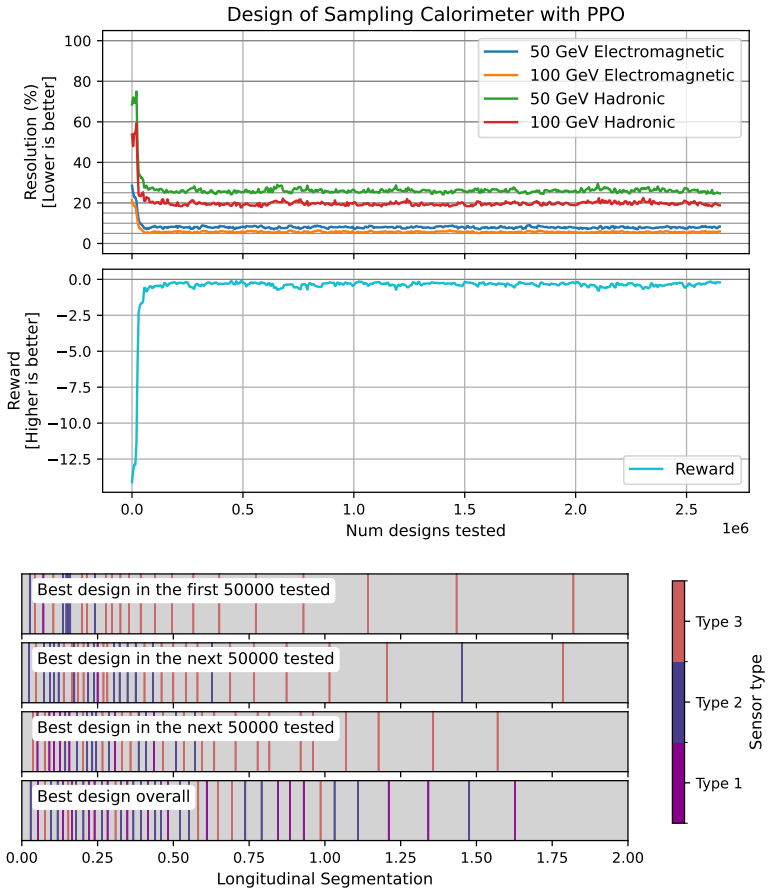
The engine is a mixed-action-space episodic Markov decision process, solved with Proximal Policy Optimization (PPO). At each step the agent outputs a continuous $\Delta z$ placing the next layer or station and a discrete choice of sensor type or granularity; it observes only the current longitudinal position and the budget used, not the full layout (a partially observable setup). The environment returns zero reward until the final step, when the agent receives a design score: calorimeter resolution for 50/100 GeV photon and pion showers in the first study, and a resolution-plus-efficiency score from straight-line momentum reconstruction in the second. PPO's clipped objective keeps policy updates stable while exploration lets the agent escape local minima.
What would settle it
Resimulate each RL-proposed calorimeter layout from scratch (no deposit reuse) with sufficient statistics and compare; if the 25.27% hadronic resolution degrades to baseline levels, the claimed improvement is an artifact of fixed deposits. For the spectrometer, re-score the RL layout using an independent reconstruction algorithm; if resolution or efficiency at 10 GeV reverts to baseline values, the design is specialized to the hand-coded fitter.
Extended reading notes
Core claim
The paper's central claim is that a reinforcement learning agent, given only a budget and a terminal score, can construct particle detector layouts from scratch that outperform hand-coded baselines in simulation. In the calorimeter study, the agent sequentially places active layers with a continuous action for spacing and a discrete action for sensor type; the resulting design improves mean-corrected hadronic resolution from 34.13% to 25.27% at 50 GeV and from 24.48% to 17.79% at 100 GeV, while the electromagnetic resolution stays statistically unchanged. In the spectrometer study, the agent places tracking stations and chooses their pixel granularity, yielding 10 GeV momentum resolution of 3.74% at 100% efficiency, compared with 6.48% and 5.97% for two baselines. The authors present these results as evidence that RL's exploration avoids the local optima that plague gradient-based methods and that it can make the discrete, combinatorial decisions -- number and type of layers -- that differentiable optimization cannot.
Load-bearing premise
The simulation reuses a single set of Geant4 energy deposits to score every calorimeter design, assuming that moving or retyping the active layers does not change how the shower develops; the spectrometer scores are computed with one hand-coded line-fitting reconstruction, so the optimized station positions are optimal for that reconstruction.
Editorial extensions
If this is right
- RL can explore design spaces that gradient-based methods cannot enter, including the number of layers, sensor type, and granularity.
- Because the simulator does not need to be differentiable, the method applies to any Monte Carlo prediction that can be turned into a score.
- The agent rediscovered a known design principle -- dense layers in the front for short electromagnetic showers -- without being told it.
- The resulting designs are starting points for further fine-tuning by differentiable methods, which the authors explicitly allow.
- The same layer-by-layer formulation can be extended to more complex instruments with graph-based reconstruction and surrogate simulators.
Reading between the lines
- The reported gains are computed with a fixed scoring pipeline; re-running the calorimeter study with fresh Geant4 showers for each design, and the spectrometer study with an independent reconstruction algorithm, would show how much of the improvement is intrinsic to the geometry.
- Co-optimizing a graph neural network reconstruction with the geometry, as the outlook suggests, could move the optimal station positions, since the current agent optimizes for a hand-coded line fitter.
- The 'from scratch' claim lives inside the allowed action envelope (budget, z range, sensor menu); opening material choice and full 3D layout is the next stress test.
- Scoring at two particle energies with 2500 events per species means the designs are fitted to those benchmarks; evaluating over continuous energy spectra is a natural next check.
Editorial analysis
A structured set of objections, weighed in public.
Referee Report
Summary. The paper proposes Reinforcement Learning (RL) as an alternative to gradient-based and surrogate-based methods for physics instrument design. It presents two proof-of-concept studies: longitudinal segmentation of a sampling calorimeter (Section 4.1) and combined longitudinal/transverse placement of tracking stations in a spectrometer (Section 4.2). In both cases a PPO agent with a mixed continuous/discrete action space sequentially places detector components, and the final designs are compared against hand-crafted baselines in Tables I and II. The authors claim that RL offers inherent exploration, avoids local minima, and can handle discrete, variable-number design choices without a predefined parametric model.
Significance. If the results hold, the paper would be a useful proof-of-concept that RL can explore discrete and combinatorial detector-design spaces that are inaccessible to gradient-based methods. The problem formulation is clear, the training curves and design visualizations are informative, and the qualitative finding that the agent learns physically sensible strategies (such as front-loaded calorimeter layers) is interesting. However, the current evidence does not support the strongest claims: the calorimeter evaluation reuses a fixed simulation set, no differentiable or surrogate baseline is run, and the reward functions are exactly the metrics used for final evaluation. These issues must be resolved before the paper can make its advertised contribution to the instrumentation community.
major comments (4)
- [Section 4.1, Eq. (2)] The performance of every candidate calorimeter design is scored by reusing a single set of Geant4 energy deposits, justified by the sentence 'Given that it is a sampling calorimeter, it allowed reuse of the same set of simulations across designs.' Since the agent's actions include selecting among three sensor types with different material budgets (0.12, 0.15, 0.20) and placing them at variable positions, this reuse is only valid if the active layers have negligible effect on shower development. No demonstration of this is provided, and for hadronic showers the assumption is strong: changing absorber/sensor materials and thicknesses can modify the shower and sampling fluctuations. Therefore the hadronic resolutions in Table I (25.27% at 50 GeV) are not established as the performance of a physically realizable detector. The authors should rerun the simulation for the final design (or several top designs) and confirm that the reported improvement persists.
- [Abstract, Sections 2 and 4] The paper claims that RL is an alternative to 'differentiable programming and surrogate-based differentiable design optimization methods' and that it offers 'unique advantages' over them, but no competing differentiable, surrogate-based, or Bayesian optimization baseline is evaluated anywhere in the manuscript. Tables I and II compare the RL results only to hand-crafted baseline designs. To substantiate the central contribution, the authors should include at least one standard baseline (e.g., Bayesian optimization, a differentiable surrogate, or even a random/greedy design search) and compare performance and computational cost. If such a baseline is not feasible, the abstract and conclusion should be substantially weakened to present RL as a feasible approach rather than a superior one.
- [Section 4.2, Eqs. (5)-(6)] The spectrometer score is computed with a custom, hand-coded line-fitting reconstruction described in detail in the bullet list under Figure 5. The optimized station positions and granularities are therefore optimal only for that particular reconstruction algorithm. If the design objective is intended to be generic tracking performance, the authors should test the RL-designed spectrometer with at least one independent reconstruction method (e.g., a simple Kalman filter or a graph-based track finder) to show that the improvement in Table II is not an artifact of the chosen fitting procedure. Alternatively, the claims should be explicitly scoped to the specific reconstruction used.
- [Section 4.1 and 4.2, Eqs. (2), (5)-(6)] In both studies the reward that the RL agent maximizes is the same function used to evaluate the final design in Tables I and II. This is not circular in a strict sense because the score is computed from independent simulations of test particles, but it means that the reported improvements over baselines are exactly the quantity the agent was trained to maximize. The threshold constants in Eq. (2) and the coefficients and floors in Eqs. (5)-(6) are free parameters; the paper does not report how the results change under plausible variations of these constants, nor does it justify the chosen values. The robustness of the claimed improvement to reward-shaping choices should be studied or at least discussed.
minor comments (7)
- [Abstract and Section 1] The abstract contains 'It's applicability' which should be 'Its applicability'; Section 1 has a typo 'Otimization' for 'Optimization'.
- [Figure 4 caption] The caption says 'the performance of the calorimeter' but the figure shows the spectrometer; also 'the the best design' contains a duplicated article.
- [Section 4.2] The text says the best design is selected over intervals of 400 designs, while the Figure 4 caption says intervals of 20000 designs; these numbers should be reconciled.
- [Section 4.2] The formula for sensor granularity is garbled as '500Agran + 10) · 500)'; it should be stated as (A_gran + 10) × 500 pixels.
- [Section 4.2] The phrase 'the stripped section' describing the magnet in Figure 4 should be 'the striped section'.
- [Section 5.3] The sentence 'This was as choice of convenience' should be 'This was a choice of convenience'.
- [General] The paper does not state whether code and data will be released. For a methods paper, providing the training code, environment details, and exact simulation configuration would greatly improve reproducibility.
Circularity Check
No significant circularity: the RL designs are scored by independent Geant4 simulation and compared against baselines; reporting the optimized objective is standard optimization, not a circular derivation.
full rationale
The paper's central claim is that RL can optimize detector layouts, and the evidence is the resolution and efficiency of the final design compared with baselines. These metrics are computed from Geant4 simulation (calorimeter) or from a dedicated simulator with line fitting (spectrometer), not derived algebraically from the reward function. The reward in Eq. (2) and Eqs. (5)-(7) is defined directly in terms of those same metrics, so reporting improvement on them is the normal closed-loop optimization procedure: the optimized quantity is the reported quantity, but it is evaluated independently for each candidate design. The calorimeter's reuse of a single set of energy deposits across designs is a physical modeling assumption about non-perturbing sampling layers; if false, the results would be invalid, but the assumption is not equivalent to assuming the conclusion, so it is a correctness risk rather than a circular step. Self-citations (Qasim et al. 2019, 2022) appear only for calibration details and future reconstruction proposals, not as load-bearing evidence for the RL result. No uniqueness theorem or ansatz is imported via self-citation, and no fitted parameter is renamed as a prediction. Therefore no circular step can be exhibited, and the appropriate finding is no significant circularity.
Assumptions & free parameters
free parameters (3)
- Calorimeter reward thresholds
- Spectrometer reward weights and floors
- Sensor type costs and budget cap =
0.12, 0.15, 0.20; 6.0
assumptions (4)
- domain assumption A single set of Geant4-simulated energy deposits can be reused to score any calorimeter design after moving active layers.
- domain assumption The simplified spectrometer model and hand-coded line-fitting reconstruction are faithful proxies for real tracking performance.
- domain assumption PPO with two fully-connected networks and the reduced observations can find the global optimum or a sufficiently good design.
- standard math Standard physics formulas (multiple scattering, momentum resolution) are valid in the regime used.
Cite this review
Pith. "Pith review of Physics Instrument Design with Reinforcement Learning." pith.science (2026). https://pith.science/paper/LY2U5FAY
@misc{pith2026241210237,
  author       = {Pith},
  title        = {Pith review of: Physics Instrument Design with Reinforcement Learning},
  year         = {2026},
  howpublished = {\url{https://pith.science/paper/LY2U5FAY}},
  note         = {Machine review of arXiv:2412.10237}
}
read the original abstract
We present a case for the use of Reinforcement Learning (RL) for the design of physics instrument as an alternative to gradient-based instrument-optimization methods. It's applicability is demonstrated using two empirical studies. One is longitudinal segmentation of calorimeters and the second is both transverse segmentation as well longitudinal placement of trackers in a spectrometer. Based on these experiments, we propose an alternative approach that offers unique advantages over differentiable programming and surrogate-based differentiable design optimization methods. First, Reinforcement Learning (RL) algorithms possess inherent exploratory capabilities, which help mitigate the risk of convergence to local optima. Second, this approach eliminates the necessity of constraining the design to a predefined detector model with fixed parameters. Instead, it allows for the flexible placement of a variable number of detector components and facilitates discrete decision-making. We then discuss the road map of how this idea can be extended into designing very complex instruments. The presented study sets the stage for a novel framework in physics instrument design, offering a scalable and efficient framework that can be pivotal for future projects such as the Future Circular Collider (FCC), where most optimized detectors are essential for exploring physics at unprecedented energy scales.
Figures


Figures from the paper (2 more)


Reference graph
Works this paper leans on
-
[1]
Gauger, Jan Kieseler, Markus Klute, and Vassil Vassilev
Max Aehle, Xuan Tung Nguyen, Mihály Novák, Tommaso Dorigo, Nicolas R. Gauger, Jan Kieseler, Markus Klute, and Vassil Vassilev. Efficient forward-mode algorithmic derivatives of geant4, 2024. URL https://arxiv.org/abs/2407.02966
arXiv 2024
-
[2]
Optimising the active muon shield for the ship experiment at cern
A Baranov, E Burnaev, D Derkach, A Filatov, N Klyuchnikov, O Lantwin, F Ratnikov, A Ustyuzhanin, and A Zaitsev. Optimising the active muon shield for the ship experiment at cern. Journal of Physics: Conference Series, 934: 0 012050, December 2017. ISSN 1742-6596. doi:10.1088/1742-6596/934/1/012050. URL http://dx.doi.org/10.1088/1742-6596/934/1/012050
-
[3]
Caloclouds: fast geometry-independent highly-granular calorimeter simulation
Erik Buhmann, Sascha Diefenbacher, Engin Eren, Frank Gaede, Gregor Kasicezka, Anatolii Korol, William Korcari, Katja Kr\" u ger, and Peter McKeown. Caloclouds: fast geometry-independent highly-granular calorimeter simulation. Journal of Instrumentation, 18 0 (11): 0 P11025, November 2023. ISSN 1748-0221. doi:10.1088/1748-0221/18/11/p11025. URL http://dx.d...
-
[4]
Caloclouds ii: ultra-fast geometry-independent highly-granular calorimeter simulation
Erik Buhmann, Frank Gaede, Gregor Kasieczka, Anatolii Korol, William Korcari, Katja Kr\" u ger, and Peter McKeown. Caloclouds ii: ultra-fast geometry-independent highly-granular calorimeter simulation. Journal of Instrumentation, 19 0 (04): 0 P04020, April 2024. ISSN 1748-0221. doi:10.1088/1748-0221/19/04/p04020. URL http://dx.doi.org/10.1088/1748-0221/19...
-
[5]
Gauger, Christian Glaser, Atılım G
Tommaso Dorigo, Andrea Giammanco, Pietro Vischia, Max Aehle, Mateusz Bawaj, Alexey Boldyrev, Pablo de Castro Manzano, Denis Derkach, Julien Donini, Auralee Edelen, Federica Fanzago, Nicolas R. Gauger, Christian Glaser, Atılım G. Baydin, Lukas Heinrich, Ralf Keidel, Jan Kieseler, Claudius Krause, Maxime Lagrange, Max Lamparth, Lukas Layer, Gernot Maier, Fe...
arXiv 2023
-
[6]
Electron-ion collider: The next QCD frontier: Understanding the glue that binds us all
ePIC Collaboration . Electron-ion collider: The next QCD frontier: Understanding the glue that binds us all. The European Physical Journal A, 52 0 (9), September 2016. ISSN 1434-601X. doi:10.1140/epja/i2016-16268-9. URL http://dx.doi.org/10.1140/epja/i2016-16268-9
-
[7]
Christian W. Fabjan and Fabiola Gianotti. Calorimetry for particle physics. Reviews of Modern Physics, 75 0 (4): 0 1243–1286, October 2003. ISSN 1539-0756. doi:10.1103/revmodphys.75.1243. URL http://dx.doi.org/10.1103/RevModPhys.75.1243
-
[8]
Catastrophic forgetting in connectionist networks
R French. Catastrophic forgetting in connectionist networks. Trends in Cognitive Sciences, 3 0 (4): 0 128–135, April 1999. ISSN 1364-6613. doi:10.1016/s1364-6613(99)01294-2. URL http://dx.doi.org/10.1016/S1364-6613(99)01294-2
Show all 34 references
-
[9]
Geant4—a simulation toolkit
GEANT4 Collaboration . Geant4—a simulation toolkit. Nuclear Instruments and Methods in Physics Research Section A: Accelerators, Spectrometers, Detectors and Associated Equipment, 506 0 (3): 0 250–303, July 2003. ISSN 0168-9002. doi:10.1016/s0168-9002(03)01368-8. URL http://dx...
2003 doi
-
[10]
Generative adversarial nets
Ian Goodfellow, Jean Pouget-Abadie, Mehdi Mirza, Bing Xu, David Warde-Farley, Sherjil Ozair, Aaron Courville, and Yoshua Bengio. Generative adversarial nets. Advances in neural information processing systems, 27, 2014
2014
-
[11]
D. E. Groom and S. R. Klein. Passage of particles through matter. The European Physical Journal C, 15 0 (1–4): 0 163–173, March 2000. ISSN 1434-6052. doi:10.1007/bf02683419. URL http://dx.doi.org/10.1007/BF02683419
-
[12]
Kai Guo, Zhenze Yang, Chi-Hua Yu, and Markus J. Buehler. Artificial intelligence and machine learning in design of mechanical materials. Materials Horizons, 8 0 (4): 0 1153–1172, 2021. ISSN 2051-6355. doi:10.1039/d0mh01451f. URL http://dx.doi.org/10.1039/D0MH01451F
2021 doi
-
[13]
Denoising diffusion probabilistic models
Jonathan Ho, Ajay Jain, and Pieter Abbeel. Denoising diffusion probabilistic models. In H. Larochelle, M. Ranzato, R. Hadsell, M.F. Balcan, and H. Lin, editors, Advances in Neural Information Processing Systems, volume 33, pages 6840--6851. Curran Associates, Inc., 2020. URL h...
2020
-
[14]
Distributed prioritized experience replay, 2018
Dan Horgan, John Quan, David Budden, Gabriel Barth-Maron, Matteo Hessel, Hado van Hasselt, and David Silver. Distributed prioritized experience replay, 2018. URL https://arxiv.org/abs/1803.00933
2018 arXiv
-
[15]
Object condensation: one-stage grid-free multi-object reconstruction in physics detectors, graph, and image data
Jan Kieseler. Object condensation: one-stage grid-free multi-object reconstruction in physics detectors, graph, and image data. The European Physical Journal C, 80 0 (9), September 2020. ISSN 1434-6052. doi:10.1140/epjc/s10052-020-08461-2. URL http://dx.doi.org/10.1140/epjc/s1...
2020 doi
-
[16]
Kingma and Max Welling
Diederik P. Kingma and Max Welling. Auto-Encoding Variational Bayes . In 2nd International Conference on Learning Representations, ICLR 2014, Banff, AB, Canada, April 14-16, 2014, Conference Track Proceedings , 2014
2014
-
[17]
Le, James Laudon, Richard Ho, Roger Carpenter, and Jeff Dean
Azalia Mirhoseini, Anna Goldie, Mustafa Yazgan, Joe Wenjie Jiang, Ebrahim Songhori, Shen Wang, Young-Joon Lee, Eric Johnson, Omkar Pathak, Azade Nova, Jiwoo Pak, Andy Tong, Kavya Srinivasa, William Hang, Emre Tuncer, Quoc V. Le, James Laudon, Richard Ho, Roger Carpenter, and J...
2022 doi
-
[18]
Machine-learning optimized design of experiments (mode), 2024
MODE Collaboration . Machine-learning optimized design of experiments (mode), 2024. URL https://mode-collaboration.github.io. Accessed: 2024-10-31
2024
-
[19]
The beam and detector of the na62 experiment at cern
NA62 Collaboration . The beam and detector of the na62 experiment at cern. Journal of Instrumentation, 12 0 (05): 0 P05025–P05025, May 2017. ISSN 1748-0221. doi:10.1088/1748-0221/12/05/p05025. URL http://dx.doi.org/10.1088/1748-0221/12/05/P05025
2017 doi
-
[20]
2022 NA62 Status Report to the CERN SPSC
NA62 Collaboration . 2022 NA62 Status Report to the CERN SPSC . Technical report, CERN, Geneva, 2022. URL https://cds.cern.ch/record/2805351
2022
-
[21]
Calogan: Simulating 3d high energy particle showers in multilayer electromagnetic calorimeters with generative adversarial networks
Michela Paganini, Luke de Oliveira, and Benjamin Nachman. Calogan: Simulating 3d high energy particle showers in multilayer electromagnetic calorimeters with generative adversarial networks. Physical Review D, 97 0 (1), January 2018. ISSN 2470-0029. doi:10.1103/physrevd.97.014...
2018 doi
-
[22]
Learning representations of irregular particle-detector geometry with distance-weighted graph networks
Shah Rukh Qasim, Jan Kieseler, Yutaro Iiyama, and Maurizio Pierini. Learning representations of irregular particle-detector geometry with distance-weighted graph networks. The European Physical Journal C, 79 0 (7), July 2019. ISSN 1434-6052. doi:10.1140/epjc/s10052-019-7113-9....
2019 doi
-
[23]
End-to-end multi-particle reconstruction in high occupancy imaging calorimeters with graph neural networks
Shah Rukh Qasim, Nadezda Chernyavskaya, Jan Kieseler, Kenneth Long, Oleksandr Viazlo, Maurizio Pierini, and Raheel Nawaz. End-to-end multi-particle reconstruction in high occupancy imaging calorimeters with graph neural networks. The European Physical Journal C, 82 0 (8), Augu...
2022 doi
-
[24]
End-to-end multi-track reconstruction using graph neural networks at belle ii, 2024
Lea Reuter, Giacomo De Pietro, Slavomira Stefkova, Torben Ferber, Valerio Bertacchi, Giulia Casarosa, Luigi Corona, Patrick Ecker, Alexander Glazov, Yubo Han, Martina Laurenza, Thomas Lueck, Ludovico Massaccesi, Suryanarayan Mondal, Bianca Scavino, Stefano Spataro, Christian W...
2024 arXiv
-
[25]
Variational inference with normalizing flows
Danilo Rezende and Shakir Mohamed. Variational inference with normalizing flows. In International conference on machine learning, pages 1530--1538. PMLR, 2015
2015
-
[26]
Overview of the lhcb experiment
Olivier Schneider. Overview of the lhcb experiment. Nuclear Instruments and Methods in Physics Research Section A: Accelerators, Spectrometers, Detectors and Associated Equipment, 446 0 (1–2): 0 213–221, May 2000. ISSN 0168-9002. doi:10.1016/s0168-9002(00)00014-0. URL http://d...
-
[27]
Proximal policy optimization algorithms, 2017
John Schulman, Filip Wolski, Prafulla Dhariwal, Alec Radford, and Oleg Klimov. Proximal policy optimization algorithms, 2017. URL https://arxiv.org/abs/1707.06347
2017 arXiv
-
[28]
Black-box optimization with local generative surrogates
Sergey Shirobokov, Vladislav Belavin, Michael Kagan, Andrei Ustyuzhanin, and Atilim Gunes Baydin. Black-box optimization with local generative surrogates. In H. Larochelle, M. Ranzato, R. Hadsell, M.F. Balcan, and H. Lin, editors, Advances in Neural Information Processing Syst...
2020
-
[29]
David Silver, Aja Huang, Chris J. Maddison, Arthur Guez, Laurent Sifre, George van den Driessche, Julian Schrittwieser, Ioannis Antonoglou, Veda Panneershelvam, Marc Lanctot, Sander Dieleman, Dominik Grewe, John Nham, Nal Kalchbrenner, Ilya Sutskever, Timothy Lillicrap, Madele...
2016 doi
-
[30]
A general reinforcement learning algorithm that masters chess, shogi, and go through self-play
David Silver, Thomas Hubert, Julian Schrittwieser, Ioannis Antonoglou, Matthew Lai, Arthur Guez, Marc Lanctot, Laurent Sifre, Dharshan Kumaran, Thore Graepel, Timothy Lillicrap, Karen Simonyan, and Demis Hassabis. A general reinforcement learning algorithm that masters chess, ...
2018 doi
-
[31]
Tomopt: differential optimisation for task- and constraint-aware design of particle detectors in the context of muon tomography
Giles C Strong, Maxime Lagrange, Aitor Orio, Anna Bordignon, Florian Bury, Tommaso Dorigo, Andrea Giammanco, Mariam Heikal, Jan Kieseler, Max Lamparth, Pablo Martínez Ruíz del Árbol, Federico Nardi, Pietro Vischia, and Haitham Zaraket. Tomopt: differential optimisation for tas...
2024 doi
-
[32]
Reinforcement learning: An introduction
Richard S Sutton and Andrew G Barto. Reinforcement learning: An introduction. MIT press, 2018
2018
-
[33]
Particle-based fast jet simulation at the lhc with variational autoencoders
Mary Touranakou, Nadezda Chernyavskaya, Javier Duarte, Dimitrios Gunopulos, Raghav Kansal, Breno Orzari, Maurizio Pierini, Thiago Tomei, and Jean-Roch Vlimant. Particle-based fast jet simulation at the lhc with variational autoencoders. Machine Learning: Science and Technology...
2022 doi
-
[34]
Zare, and Patrick Riley
Zhenpeng Zhou, Steven Kearnes, Li Li, Richard N. Zare, and Patrick Riley. Optimization of molecules via deep reinforcement learning. Scientific Reports, 9 0 (1), July 2019. ISSN 2045-2322. doi:10.1038/s41598-019-47148-x. URL http://dx.doi.org/10.1038/s41598-019-47148-x
2019 doi
Reviewed August 11, 2026 · model on record in the stance chip above.
Discussion (0). Continue with ORCID to comment.