REVIEW 3 major objections 5 minor 60 references
TrafficLoc: Localizing Traffic Surveillance Cameras in 3D Scenes
T0 review · 3 major / 5 minor · reviewed 2026-08-11 · deepseek-v4-flash
Pith's one-line read TrafficLoc claims that a traffic surveillance camera can be localized in a 3D LiDAR map through coarse-to-fine image-to-point-cloud matching, beating prior methods by up to 86% on simulated intersections and transferring to real scenes.
desk verdict Solid new dataset and method for traffic camera localization, but the SOTA claim needs a more controlled evaluation before I'd take it at face value. read the letter →
The pith
A machine-rendered reading of the paper's core claim, the machinery that carries it, and where it could break.
The reading
What carries the argument
The load-bearing machinery is a coarse-to-fine correspondence pipeline supervised by three purpose-built losses. The Geometry-guided Attention Loss (GAL) takes the raw cross-attention map between image patches and 3D point groups and applies a binary cross-entropy penalty using thresholds on the angular separation for image-to-point attention and on the distance from a point to a camera ray for point-to-image attention, so the fusion module learns to attend only to geometrically plausible regions. The Inter-intra Contrastive Learning (ICL) loss augments standard inter-modal contrastive pairs with negative pairs inside each modality, forcing different image patches and different point groups to remain separable. The Dense Training Alignment (DTA) loss back-propagates through a soft-argmax of the coarse similarity map so every image patch receives gradient, not just sparsely sampled positive pairs. These losses sit inside a Fusion Transformer and are trained jointly with an in-frustum detection loss, coarse and fine matching losses, and finally EPnP-RANSAC pose estimation.
What would settle it
Evaluate TrafficLoc on a held-out real intersection where camera poses are surveyed with a total station, GNSS/IMU, or known calibration targets, after training only on Carla Intersection. If median rotation error on that real set is much worse than the 0.66 degrees seen in simulation, for example several degrees or more, the claimed sim-to-real generalization would be falsified even though the simulated numbers stand.
Extended reading notes
Core claim
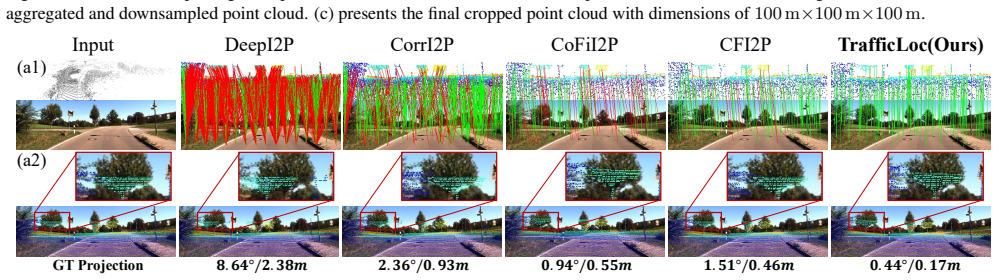
The paper's central claim is that TrafficLoc, a neural network for image-to-point-cloud registration, localizes traffic cameras in 3D scenes with substantially higher accuracy than prior methods, and does so without requiring an initial pose guess, manual 2D-3D correspondences, or panoramic or rendered images. The method first extracts 2D patch features and 3D point-group features, fuses them with a Transformer whose cross-attention maps are supervised by a geometry-guided attention loss derived from camera projection, matches groups to patches in coarse-to-fine stages, and finally feeds point-to-pixel correspondences to EPnP-RANSAC to obtain the 6-DoF pose. On the paper's Carla Intersection test splits, median rotation error falls to 0.66 degrees and median translation to 0.51 m, versus 4.24 degrees and 2.82 m for the previous leading baseline CoFiI2P, an improvement the paper reports as up to 86% across test splits. On KITTI the mean rotation error is 0.87 degrees with 100% registration recall, and the paper also reports that the same model, trained only on simulation, produces visually correct alignment on a real traffic intersection with unknown intrinsics, and that adding its loss components to an existing registration method improves that method as well.
Load-bearing premise
The load-bearing premise is that the simulated Carla Intersection images are close enough to real traffic-camera views that a model trained only on them will localize real cameras; the paper's real-world demonstration is qualitative and has no ground-truth pose, so this assumption is not yet measured.
Editorial extensions
If this is right
- Traffic cameras with known or estimated intrinsic parameters can be registered to an existing LiDAR map in a single forward pass, with no manual keypoint annotation and no panoramic capture.
- Because the method is trained entirely on simulated intersections yet reports low errors on in-vehicle benchmarks, the same model may serve for both roadside and vehicle-mounted cameras, reducing dataset collection cost.
- Sub-degree rotation and sub-metre translation on the simulated test split would be sufficient for many cooperative-perception tasks such as projecting detections from multiple cameras into a common coordinate frame.
- The proposed losses are transferable: the paper shows that adding DTA and GAL to the previous leading method CoFiI2P improves its KITTI results, implying the components are not tied to TrafficLoc's specific architecture.
Reading between the lines
- Editorial inference: If sim-to-real transfer holds, traffic-camera calibration becomes a city-scale mapping service rather than a per-camera manual procedure; cameras that already exist could be localized against maps captured by survey vehicles.
- Editorial inference: The GAL formulation decouples attention supervision from appearance, so it could be applied to other cross-modal alignment tasks, such as radar-to-image or satellite-to-street matching, where geometry is known but photometry differs.
- Editorial inference: The paper's public release of Carla Intersection with systematic pose sampling would let the community test viewpoint robustness of any image-to-point-cloud method independently of real-world sensor noise.
Editorial analysis
A structured set of objections, weighed in public.
Referee Report
Summary. The paper addresses the problem of localizing traffic surveillance cameras within a 3D point cloud map by proposing TrafficLoc, a coarse-to-fine image-to-point-cloud (I2P) registration method. The method consists of a Geometry-guided Feature Fusion (GFF) module supervised by a Geometry-guided Attention Loss (GAL), an Inter-intra Contrastive Learning (ICL) loss for coarse matching, and a Dense Training Alignment (DTA) step with soft-argmax for fine matching. The authors also introduce Carla Intersection, a synthetic dataset of 75 intersections in the Carla simulator, and evaluate TrafficLoc on this dataset, on the real USTC intersection, and on the KITTI and NuScenes benchmarks. The central claims are that TrafficLoc greatly improves performance over previous I2P methods on Carla Intersection (up to 86% RRE reduction), achieves new state-of-the-art results on KITTI and NuScenes, and generalizes to real-world traffic camera data.
Significance. If the reported numbers are reproducible, this is a substantial contribution to I2P registration and to the specific application of traffic camera localization. The paper introduces a new synthetic benchmark that is likely to be useful to the community, and the proposed components (GAL, ICL, DTA) are technically plausible and are backed by extensive ablations in the main text and supplementary material. The authors state that code and data will be released and provide a public project page, which strengthens the reproducibility case. However, the evaluation protocol has several gaps that affect the strength of the central numerical claims: hyperparameters are selected on the test split, no error bars are reported, and the baseline comparisons are not fully controlled. These issues are fixable with additional experiments, and the underlying method appears sound, so the paper merits revision rather than rejection.
major comments (3)
- [Section 5.4 and Supplementary Table 4] The GAL hyperparameters (θlow, θup, dlow, dup, and the fusion layer to which GAL is applied) are selected on the TestT1−T7 split, which is also the split used for the main evaluation. Section 5.4 explicitly states that ablations are run on TestT1−T7, and Supplementary Table 4 reports threshold choices on that same split. This constitutes test-set tuning of the proposed components, while the baselines in Table 1 are not given the same opportunity; consequently, the reported margins over CoFiI2P (e.g., RRE 0.66° vs 4.24° on TestT1−T7) may partly reflect favorable hyperparameter selection. Please rerun the ablations on a held-out validation split (for example, a subset of the training intersections) and report the corresponding results, and provide variance estimates over multiple training runs for the final configuration.
- [Section 5.3, Table 1] The claim that TrafficLoc 'achieves new SOTA performance on KITTI and NuScenes' is supported by a single training run and by comparison to baselines that use different backbones and training configurations. No error bars are reported, and TrafficLoc uses a DUSt3R image encoder, a specific point-cloud size, and a four-layer fusion transformer, which differ from the original baseline setups. This makes it difficult to attribute the improvement to the proposed GAL/ICL/DTA components rather than to the stronger backbone or training-supervision differences. Please report mean and standard deviation over at least three seeds for TrafficLoc and the strongest baselines on KITTI and NuScenes, and provide a controlled comparison in which the baseline is given the same backbone and training procedure; Supplementary Table 5 partially addresses this for CoFiI2P, but the headline comparison in Table 1 remains uncontrolled.
- [Section 5.3, Figure 5] The real-world generalization claim is only qualitatively demonstrated on the USTC intersection, where no ground-truth pose is available. Since the abstract states that TrafficLoc 'generalizes well to real-world data', the absence of any quantitative real-world evaluation leaves this part of the central claim unsupported. Please provide a quantitative evaluation (for example, against manually annotated or survey-grade poses) or, if that is not feasible, explicitly weaken the claim in the abstract and introduction to a qualitative demonstration.
minor comments (5)
- [Section 4.1] There is a typo: 'describied' should be 'described'.
- [Section 4.2, Eqs. (2)-(3)] The notation OIi and OPj is not defined in the text; please clarify that Ii and Pj denote the 3D positions of the image patch and point-group center relative to the camera center O, or add a small figure illustrating the angular radius Rad(i,j) and the distance Dist(Pi, OIj).
- [Table 1] The abbreviation 'Ours withKP red' is unclear; please replace it with 'Ours with predicted K' or 'Ours with Kpred'.
- [References] Several reference entries contain stray page numbers or suffixes (for example, references [5], [13], and [14]), and the capitalization of 'nuScenes' is inconsistent; please clean up the bibliography.
- [Throughout] The spelling 'Nuscenes' is used inconsistently; the official spelling is 'nuScenes'.
Circularity Check
No circularity: TrafficLoc's reported improvements come from supervised training and held-out evaluation, not from fitted parameters or self-citation chains.
full rationale
The derivation chain is self-contained: TrafficLoc is trained with standard supervised losses (GAL, ICL, DTA) that use ground-truth poses and correspondences only during training, while the reported Table 1 numbers are measured on held-out Carla Intersection test splits (unseen intersections and, for TestT10, an unseen world), on KITTI sequences 9-10, and on the NuScenes test split. At inference the pose is produced by EPnP-RANSAC from predicted point-to-pixel correspondences, so the accuracy does not reduce to any fitted parameter by construction. The only in-article self-citations ([26], [49], [50]) appear as background references for place recognition and LiDAR utility; none is load-bearing for the design or the claimed SOTA, and no uniqueness theorem is imported from the authors' prior work. The GAL supervision target is derived from camera projection geometry plus known intrinsics, which is a training signal, not a test-time prediction. The USTC qualitative projection is a sanity check rather than the basis of a numeric derivation; it does not support a quantitative SOTA claim on its own, but it is also not a circular reduction. Supplementary Table 5 further shows that DTA and GAL improve the external CoFiI2P baseline on KITTI, which is independent evidence that these components are not merely fitting TrafficLoc's own pipeline. Concerns about threshold selection on the test split (Table 4) and missing variance estimates are evaluation-protocol weaknesses, not circular reductions; with no equation or fitted value renamed as a prediction, no circular step is exhibited.
Assumptions & free parameters
free parameters (4)
- GAL thresholds (θlow, θup, dlow, dup) =
10°, 20°, 3 m, 5 m
- ICL margins and scale (mp, mn, γ) =
0.2, 1.8, 10
- Loss weights (λ1, λ2, λ3, λ4) =
1, 1, 1, 1
- Input point cloud size (N) =
20480
assumptions (4)
- domain assumption Pinhole camera model with known intrinsic matrix K (or K estimated by DUSt3R)
- domain assumption Ground-truth 6-DoF pose TGT is available for every training image
- domain assumption The image and point cloud overlap sufficiently for matching
- standard math EPnP-RANSAC recovers the correct pose from a set of point-to-pixel correspondences
Cite this review
Pith. "Pith review of TrafficLoc: Localizing Traffic Surveillance Cameras in 3D Scenes." pith.science (2026). https://pith.science/paper/R36IUKOY
@misc{pith2026241210308,
  author       = {Pith},
  title        = {Pith review of: TrafficLoc: Localizing Traffic Surveillance Cameras in 3D Scenes},
  year         = {2026},
  howpublished = {\url{https://pith.science/paper/R36IUKOY}},
  note         = {Machine review of arXiv:2412.10308}
}
read the original abstract
We tackle the problem of localizing traffic cameras within a 3D reference map and propose a novel image-to-point cloud registration (I2P) method, TrafficLoc, in a coarse-tofine matching fashion. To overcome the lack of large-scale real-world intersection datasets, we first introduce Carla Intersection, a new simulated dataset with 75 urban and rural intersections in Carla. We find that current I2P methods struggle with cross-modal matching under large viewpoint differences, especially at traffic intersections. TrafficLoc thus employs a novel Geometry-guided Attention Loss (GAL) to focus only on the corresponding geometric regions under different viewpoints during 2D-3D feature fusion. To address feature inconsistency in paired image patch-point groups, we further propose Inter-intra Contrastive Learning (ICL) to enhance separating 2D patch/3D group features within each intra-modality and introduce Dense Training Alignment (DTA) with soft-argmax for improving position regression. Extensive experiments show our TrafficLoc greatly improves the performance over the SOTA I2P methods (up to 86%) on Carla Intersection and generalizes well to real-world data. TrafficLoc also achieves new SOTA performance on KITTI and NuScenes datasets, demonstrating the superiority across both in-vehicle and traffic cameras. Our project page is publicly available at https://tum-luk.github.io/projects/trafficloc/.
Figures


Figures from the paper (9 more)




Reference graph
Works this paper leans on
-
[1]
Building rome in a day
Sameer Agarwal, Yasutaka Furukawa, Noah Snavely, Ian Si- mon, Brian Curless, Steven M Seitz, and Richard Szeliski. Building rome in a day. Communications of the ACM , 54 (10):105–112, 2011. 2
2011
-
[2]
Buffer: Balancing accuracy, efficiency, and gen- eralizability in point cloud registration
Sheng Ao, Qingyong Hu, Hanyun Wang, Kai Xu, and Yu- lan Guo. Buffer: Balancing accuracy, efficiency, and gen- eralizability in point cloud registration. In Proceedings of the IEEE/CVF conference on computer vision and pattern recognition, pages 1255–1264, 2023. 3
work page 2023
-
[3]
Method for registration of 3-d shapes
Paul J Besl and Neil D McKay. Method for registration of 3-d shapes. In Sensor fusion IV: control paradigms and data structures, pages 586–606. International Society for Optics and Photonics, 1992. 2
work page 1992
-
[4]
A light touch approach to teaching transformers multi-view geometry
Yash Bhalgat, Joao F Henriques, and Andrew Zisserman. A light touch approach to teaching transformers multi-view geometry. In Proceedings of the IEEE/CVF Conference on Computer Vision and Pattern Recognition , pages 4958– 4969, 2023. 4
work page 2023
-
[5]
Holger Caesar, Varun Bankiti, Alex H. Lang, Sourabh V ora, Venice Erin Liong, Qiang Xu, Anush Krishnan, Yu Pan, Gi- ancarlo Baldan, and Oscar Beijbom. nuscenes: A multi- modal dataset for autonomous driving. In 2020 IEEE/CVF Conference on Computer Vision and Pattern Recognition (CVPR), 2020. 2, 7, 5, 6
work page 2020
-
[6]
Global visual localization in lidar-maps through shared 2d-3d embedding space
Daniele Cattaneo, Matteo Vaghi, Simone Fontana, Au- gusto Luis Ballardini, and Domenico Giorgio Sorrenti. Global visual localization in lidar-maps through shared 2d-3d embedding space. In International Conference on Robotics and Automation (ICRA) , pages 4365–4371, 2020. 3
work page 2020
-
[7]
Pimae: Point cloud and image interactive masked autoencoders for 3d object detection
Anthony Chen, Kevin Zhang, Renrui Zhang, Zihan Wang, Yuheng Lu, Yandong Guo, and Shanghang Zhang. Pimae: Point cloud and image interactive masked autoencoders for 3d object detection. In Proceedings of the IEEE/CVF Con- ference on Computer Vision and Pattern Recognition, pages 5291–5301, 2023. 1, 2
work page 2023
-
[8]
Object modeling by regis- tration of multiple range images
Yang Chen and G ´erard Medioni. Object modeling by regis- tration of multiple range images. Image and Vision Comput- ing, 10(3):145–155, 1992. 3
work page 1992
Show all 60 references
-
[9]
Superpoint: Self-supervised interest point detec- tion and description
Daniel DeTone, Tomasz Malisiewicz, and Andrew Rabi- novich. Superpoint: Self-supervised interest point detec- tion and description. In Proceedings of the IEEE/CVF Con- ference on Computer Vision and Pattern Recognition Work- shops (CVPRW), pages 224–236, 2018. 2
2018
-
[10]
Carla: An open urban driv- ing simulator
Alexey Dosovitskiy, German Ros, Felipe Codevilla, Anto- nio L´opez, and Vladlen Koltun. Carla: An open urban driv- ing simulator. Conference on Robot Learning,Conference on Robot Learning, 2017. 6, 3
2017
-
[11]
D2-net: A trainable cnn for joint detection and description of local features
Mihai Dusmanu, Ignacio Rocco, Tomas Pajdla, Marc Polle- feys, Josef Sivic, Akihiko Torii, and Torsten Sattler. D2-net: A trainable cnn for joint detection and description of local features. In Proceedings of the IEEE/CVF Conference on Computer Vision and Pattern Recognition (C...
2019
-
[12]
2d3d-matchnet: Learning to match keypoints across 2d image and 3d point cloud
Mengdan Feng, Sixing Hu, Marcelo H Ang, and Gim Hee Lee. 2d3d-matchnet: Learning to match keypoints across 2d image and 3d point cloud. In International Conference on Robotics and Automation (ICRA) , pages 4790–4796. IEEE,
-
[13]
Fischler and Robert C
Martin A. Fischler and Robert C. Bolles. Random sample consensus: A paradigm for model fitting with applications to image analysis and automated cartography. Commun. ACM, 24(6):381–395, 1981. 3, 4, 6, 7, 2, 5
1981
-
[14]
Are we ready for autonomous driving? the kitti vision benchmark suite
Andreas Geiger, Philip Lenz, and Raquel Urtasun. Are we ready for autonomous driving? the kitti vision benchmark suite. In Proceedings of the IEEE/CVF Conference on Com- puter Vision and Pattern Recognition (CVPR), 2012. 2, 7, 1, 5, 6
2012
-
[15]
Deep residual learning for image recognition
Kaiming He, Xiangyu Zhang, Shaoqing Ren, and Jian Sun. Deep residual learning for image recognition. In Proceed- ings of the IEEE conference on computer vision and pattern recognition, pages 770–778, 2016. 3, 6, 1, 2
2016
-
[16]
Anpr product functions and problem troubleshooting
HIKVISION. Anpr product functions and problem troubleshooting. https : / / www . securitywholesalers . com . au / files / ANPRINSTALLATION1.pdf, 2016–2024. 3
2016
-
[17]
Predator: Registration of 3d point clouds with low overlap
Shengyu Huang, Zan Gojcic, Mikhail Usvyatsov, Andreas Wieser, and Konrad Schindler. Predator: Registration of 3d point clouds with low overlap. In Proceedings of the IEEE/CVF Conference on computer vision and pattern recognition, pages 4267–4276, 2021. 3
2021
-
[18]
Reconstructing the world in six days
Heinly Jared, Johannes L Schonberger, Enrique Dunn, and Jan-Michael Frahm. Reconstructing the world in six days. In Proceedings of the IEEE/CVF Conference on Computer Vision and Pattern Recognition (CVPR), 2015. 2
2015
-
[19]
Intrinsic and extrinsic calibration of roadside lidar and camera
Xin Jing, Fuzhang Han, Xiaqing Ding, Yue Wang, and Rong Xiong. Intrinsic and extrinsic calibration of roadside lidar and camera. In 2022 China Automation Congress (CAC) , pages 2367–2372. IEEE, 2022. 2
2022
-
[20]
Cofii2p: Coarse-to-fine correspon- dences for image-to-point cloud registration
Shuhao Kang, Youqi Liao, Jianping Li, Fuxun Liang, Yuhao Li, Xianghong Zou, Fangning Li, Xieyuanli Chen, Zhen Dong, and Bisheng Yang. Cofii2p: Coarse-to-fine correspon- dences for image-to-point cloud registration. arXiv preprint arXiv:2309.14660, 2023. 2, 3, 5, 6, 7, 8, 1
2023 arXiv
-
[21]
Ep2p-loc: End-to-end 3d point to 2d pixel localization for large-scale visual localization
Minjung Kim, Junseo Koo, and Gunhee Kim. Ep2p-loc: End-to-end 3d point to 2d pixel localization for large-scale visual localization. In Proceedings of the IEEE/CVF Interna- tional Conference on Computer Vision, pages 21527–21537,
-
[22]
Kingma and Jimmy Lei Ba
Diederik P. Kingma and Jimmy Lei Ba. Adam: A method for stochastic optimization. In International Conference on Learning Representations, 2015. 5
2015
-
[23]
General, single-shot, target-less, and automatic lidar-camera extrinsic calibration toolbox
Kenji Koide, Shuji Oishi, Masashi Yokozuka, and Atsuhiko Banno. General, single-shot, target-less, and automatic lidar-camera extrinsic calibration toolbox. arXiv preprint arXiv:2302.05094, 2023. 2
2023 arXiv
-
[24]
Epnp: An accurate o(n) solution to the pnp problem
Vincent Lepetit, Francesc Moreno-Noguer, and Pascal Fua. Epnp: An accurate o(n) solution to the pnp problem. Inter- national Journal of Computer Vision (IJCV), 81(2):155–166,
-
[25]
DeepI2P: Image-to-Point Cloud Registration via Deep Classification
Jiaxin Li and Gim Hee Lee. DeepI2P: Image-to-Point Cloud Registration via Deep Classification. In Proceedings of the IEEE/CVF Conference on Computer Vision and Pattern Recognition (CVPR), pages 15960–15969, 2021. 3, 7, 5 9
2021
-
[26]
Vxp: V oxel-cross-pixel large-scale image- lidar place recognition
Yun-Jin Li, Mariia Gladkova, Yan Xia, Rui Wang, and Daniel Cremers. Vxp: V oxel-cross-pixel large-scale image- lidar place recognition. In 2025 International Conference on 3D Vision (3DV), 2025. 3
2025
-
[27]
Lightglue: Local feature matching at light speed
Philipp Lindenberger, Paul-Edouard Sarlin, and Marc Polle- feys. Lightglue: Local feature matching at light speed. In Proceedings of the IEEE/CVF International Conference on Computer Vision, pages 17627–17638, 2023. 2
2023
-
[28]
Extend your own correspondences: Unsupervised distant point cloud registration by progressive distance extension
Quan Liu, Hongzi Zhu, Zhenxi Wang, Yunsong Zhou, Shan Chang, and Minyi Guo. Extend your own correspondences: Unsupervised distant point cloud registration by progressive distance extension. In Proceedings of the IEEE/CVF Con- ference on Computer Vision and Pattern Recognition,...
2024
-
[29]
Distinctive image features from scale- invariant keypoints
David G Lowe. Distinctive image features from scale- invariant keypoints. International Journal of Computer Vi- sion (IJCV), 60(2):91–110, 2004. 2
2004
-
[30]
Deepicp: An end- to-end deep neural network for 3d point cloud registration
W Lu, G Wan, Y Zhou, X Fu, and S Song. Deepicp: An end- to-end deep neural network for 3d point cloud registration. arXiv preprint arXiv:1905.04153, 2019. 3
1905 arXiv
-
[31]
Orb-slam: A versatile and accurate monocular slam system
Raul Mur-Artal, Jose Maria Martinez Montiel, and Juan D Tardos. Orb-slam: A versatile and accurate monocular slam system. IEEE transactions on robotics , 31(5):1147–1163,
-
[32]
A survey of structure from motion
Onur Ozyesil, Vladislav V oroninski, Ronen Basri, and Amit Singer. A survey of structure from motion. arXiv preprint arXiv:1701.08493, 2017. 2
2017 arXiv
-
[33]
Lcd: Learned cross-domain descriptors for 2d-3d matching
Quang-Hieu Pham, Mikaela Angelina Uy, Binh-Son Hua, Duc Thanh Nguyen, Gemma Roig, and Sai-Kit Yeung. Lcd: Learned cross-domain descriptors for 2d-3d matching. In Proceedings of the AAAI Conference on Artificial Intelli- gence (AAAI), pages 11856–11864, 2020. 3
2020
-
[34]
Pointnet: Deep learning on point sets for 3d classification and segmentation
Charles R Qi, Hao Su, Kaichun Mo, and Leonidas J Guibas. Pointnet: Deep learning on point sets for 3d classification and segmentation. In Proceedings of the IEEE/CVF Confer- ence on Computer Vision and Pattern Recognition (CVPR) , pages 652–660, 2017. 3, 6
2017
-
[35]
Geotrans- former: Fast and robust point cloud registration with geo- metric transformer
Zheng Qin, Hao Yu, Changjian Wang, Yulan Guo, Yuxing Peng, Slobodan Ilic, Dewen Hu, and Kai Xu. Geotrans- former: Fast and robust point cloud registration with geo- metric transformer. IEEE Transactions on Pattern Analysis and Machine Intelligence, 45(8):9806–9821, 2023. 3
2023
-
[36]
Real-time dy- namic object detection for autonomous driving using prior 3d-maps
B Ravi Kiran, Luis Roldao, Benat Irastorza, Renzo Ve- rastegui, Sebastian Suss, Senthil Yogamani, Victor Talpaert, Alexandre Lepoutre, and Guillaume Trehard. Real-time dy- namic object detection for autonomous driving using prior 3d-maps. In Proceedings of the European Confere...
2018
-
[37]
Corri2p: Deep image-to-point cloud registration via dense correspondence
Siyu Ren, Yiming Zeng, Junhui Hou, and Xiaodong Chen. Corri2p: Deep image-to-point cloud registration via dense correspondence. IEEE Transactions on Circuits and Systems for Video Technology, 33(3):1198–1208, 2022. 2, 3, 7, 5
2022
-
[38]
R2D2: repeatable and re- liable detector and descriptor
Jerome Revaud, Philippe Weinzaepfel, C ´esar Roberto de Souza, and Martin Humenberger. R2D2: repeatable and re- liable detector and descriptor. In Advances in Neural Infor- mation Processing Systems (NeurIPS), 2019. 2
2019
-
[39]
Orb: An efficient alternative to sift or surf
Ethan Rublee, Vincent Rabaud, Kurt Konolige, and Gary Bradski. Orb: An efficient alternative to sift or surf. In 2011 International conference on computer vision , pages 2564–
2011
-
[40]
Efficient variants of the icp algorithm
Szymon Rusinkiewicz and Marc Levoy. Efficient variants of the icp algorithm. In Proceedings third international confer- ence on 3-D digital imaging and modeling , pages 145–152. IEEE, 2001. 3
2001
-
[41]
SuperGlue: Learning feature matching with graph neural networks
Paul-Edouard Sarlin, Daniel DeTone, Tomasz Malisiewicz, and Andrew Rabinovich. SuperGlue: Learning feature matching with graph neural networks. In Proceedings of the IEEE/CVF Conference on Computer Vision and Pattern Recognition (CVPR), 2020. 2
2020
-
[42]
Rendering-enhanced auto- matic image-to-point cloud registration for roadside scenes
Yu Sheng, Lu Zhang, Xingchen Li, Yifan Duan, Yanyong Zhang, Yu Zhang, and Jianmin Ji. Rendering-enhanced auto- matic image-to-point cloud registration for roadside scenes. arXiv preprint arXiv:2404.05164, 2024. 2, 7, 8
2024 arXiv
-
[43]
Loftr: Detector-free local feature matching with transformers
Jiaming Sun, Zehong Shen, Yuang Wang, Hujun Bao, and Xiaowei Zhou. Loftr: Detector-free local feature matching with transformers. In Proceedings of the IEEE/CVF con- ference on computer vision and pattern recognition , pages 8922–8931, 2021. 2
2021
-
[44]
Neumap: Neural coordinate map- ping by auto-transdecoder for camera localization
Shitao Tang, Sicong Tang, Andrea Tagliasacchi, Ping Tan, and Yasutaka Furukawa. Neumap: Neural coordinate map- ping by auto-transdecoder for camera localization. In Pro- ceedings of the IEEE/CVF Conference on Computer Vision and Pattern Recognition, pages 929–939, 2023. 4
2023
-
[45]
Toward planet-wide traffic camera cali- bration
Khiem Vuong, Robert Tamburo, and Srinivasa G Narasimhan. Toward planet-wide traffic camera cali- bration. In Proceedings of the IEEE/CVF Winter Conference on Applications of Computer Vision , pages 8553–8562,
-
[46]
Freereg: Image- to-point cloud registration leveraging pretrained diffusion models and monocular depth estimators
Haiping Wang, Yuan Liu, Bing Wang, Yujing Sun, Zhen Dong, Wenping Wang, and Bisheng Yang. Freereg: Image- to-point cloud registration leveraging pretrained diffusion models and monocular depth estimators. arXiv preprint arXiv:2310.03420, 2023. 3
-
[47]
Dust3r: Geometric 3d vi- sion made easy
Shuzhe Wang, Vincent Leroy, Yohann Cabon, Boris Chidlovskii, and Jerome Revaud. Dust3r: Geometric 3d vi- sion made easy. InProceedings of the IEEE/CVF Conference on Computer Vision and Pattern Recognition, pages 20697– 20709, 2024. 3, 7, 1, 2, 4
2024
-
[48]
Efficient loftr: Semi-dense local feature matching with sparse-like speed
Yifan Wang, Xingyi He, Sida Peng, Dongli Tan, and Xiaowei Zhou. Efficient loftr: Semi-dense local feature matching with sparse-like speed. In Proceedings of the IEEE/CVF con- ference on computer vision and pattern recognition , pages 21666–21675, 2024. 2
2024
-
[49]
Soe-net: A self-attention and orientation encoding network for point cloud based place recognition
Yan Xia, Yusheng Xu, Shuang Li, Rui Wang, Juan Du, Daniel Cremers, and Uwe Stilla. Soe-net: A self-attention and orientation encoding network for point cloud based place recognition. In Proceedings of the IEEE/CVF Conference on computer vision and pattern recognition , pages 1...
2021
-
[50]
Casspr: Cross attention single scan place recognition
Yan Xia, Mariia Gladkova, Rui Wang, Qianyun Li, Uwe Stilla, Joao F Henriques, and Daniel Cremers. Casspr: Cross attention single scan place recognition. In Proceedings of the IEEE/CVF International Conference on Computer Vi- sion, pages 8461–8472, 2023. 2
2023
-
[51]
A lightweight and detector-free 3d single object 10 tracker on point clouds
Yan Xia, Qiangqiang Wu, Wei Li, Antoni B Chan, and Uwe Stilla. A lightweight and detector-free 3d single object 10 tracker on point clouds. IEEE Transactions on Intelligent Transportation Systems, 24(5):5543–5554, 2023. 1
2023
-
[52]
3dtnet: Learning local features us- ing 2d and 3d cues
Xiaoxia Xing, Yinghao Cai, Tao Lu, Shaojun Cai, Yiping Yang, and Dayong Wen. 3dtnet: Learning local features us- ing 2d and 3d cues. InInternational Conference on 3D Vision (3DV), pages 435–443, 2018. 3
2018
-
[53]
Cfi2p: Coarse-to-fine cross-modal correspondence learn- ing for image-to-point cloud registration
Gongxin Yao, Yixin Xuan, Yiwei Chen, and Yu Pan. Cfi2p: Coarse-to-fine cross-modal correspondence learn- ing for image-to-point cloud registration. arXiv preprint arXiv:2307.07142, 2023. 2, 3, 4, 5, 7
2023 arXiv
-
[54]
Cofinet: Reliable coarse-to-fine correspondences for robust pointcloud registration
Hao Yu, Fu Li, Mahdi Saleh, Benjamin Busam, and Slobo- dan Ilic. Cofinet: Reliable coarse-to-fine correspondences for robust pointcloud registration. Advances in Neural Infor- mation Processing Systems, 34:23872–23884, 2021. 3
2021
-
[55]
Pixel-level extrinsic self calibration of high resolution lidar and camera in targetless environments
Chongjian Yuan, Xiyuan Liu, Xiaoping Hong, and Fu Zhang. Pixel-level extrinsic self calibration of high resolution lidar and camera in targetless environments. IEEE Robotics and Automation Letters, 6(4):7517–7524, 2021. 2
2021
-
[56]
3dmatch: Learning local geometric descriptors from rgb-d reconstruc- tions
Andy Zeng, Shuran Song, Matthias Niessner, Matthew Fisher, Jianxiong Xiao, and Thomas Funkhouser. 3dmatch: Learning local geometric descriptors from rgb-d reconstruc- tions. In Proceedings of the IEEE/CVF Conference on Com- puter Vision and Pattern Recognition (CVPR), 2017. 3
2017
-
[57]
Telling left from right: Identifying geometry-aware semantic corre- spondence
Junyi Zhang, Charles Herrmann, Junhwa Hur, Eric Chen, Varun Jampani, Deqing Sun, and Ming-Hsuan Yang. Telling left from right: Identifying geometry-aware semantic corre- spondence. In Proceedings of the IEEE/CVF Conference on Computer Vision and Pattern Recognition , pages 307...
2024
-
[58]
Point transformer
Hengshuang Zhao, Li Jiang, Jiaya Jia, Philip HS Torr, and Vladlen Koltun. Point transformer. In Proceedings of the IEEE/CVF International Conference on Computer Vision (ICCV), pages 16259–16268, 2021. 3, 1, 2
2021
-
[59]
NCL” means using normal contrastive learning, while “ICL
Junsheng Zhou, Baorui Ma, Wenyuan Zhang, Yi Fang, Yu- Shen Liu, and Zhizhong Han. Differentiable registration of images and lidar point clouds with voxelpoint-to-pixel matching. Advances in Neural Information Processing Sys- tems, 36, 2024. 3, 7, 8 11 TrafficLoc: Localizing Tr...
2024
-
[960]
# intersections
To generate these images, we sampled camera posi- tions in a grid-like pattern with different heights at the cen- ter of each intersection. For each position, we captured im- ages at 8 yaw angles (spaced at 45 ◦ intervals) and 2 pitch angles. Figure 8 shows the sampled poses f...
Reviewed August 11, 2026 · model on record in the stance chip above.
Discussion (0). Continue with ORCID to comment.