REVIEW 2 major objections 5 minor 47 references
The central engine of low-luminosity radio galaxy 3C 270 (NGC 4261)
T0 review · 2 major / 5 minor · reviewed 2026-08-11 · deepseek-v4-flash
Pith's one-line read 3C 270's scattered light shows no hidden broad-line region or Big Blue Bump.
desk verdict Careful spectropolarimetry that turns a tentative broad-line detection into a robust non-detection, with a load-bearing assumption about template representativeness that should be softened in the abstract. read the letter →
The pith
A machine-rendered reading of the paper's core claim, the machinery that carries it, and where it could break.
The reading
What carries the argument
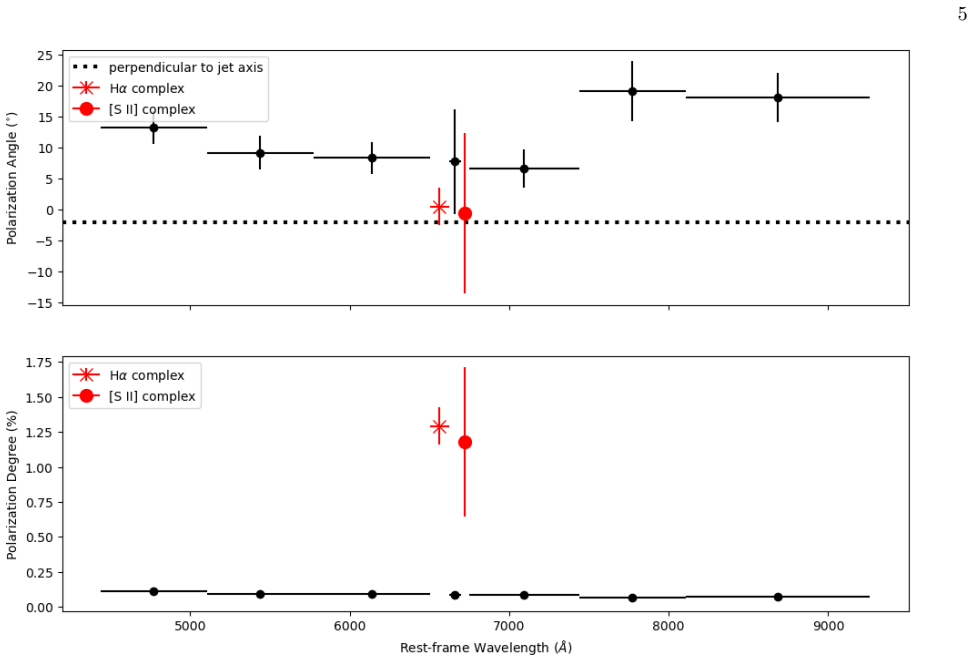
The central observable is the polarized Stokes flux spectrum, which acts as a scattered-light view of the hidden nucleus. Two pieces of machinery carry the argument: an interstellar-polarization correction built from the nearby star HD 107289 and the Serkowski wavelength-dependent model, and an injection test that adds 37 real Seyfert 1 broad-line profiles, scaled by equivalent width to the measured polarized continuum, to see what fraction would be detected at signal-to-noise above 3. The polarization angles of the continuum, Hα, and [S II] being perpendicular to the radio jet anchors the scattering geometry. The Big Blue Bump is the thermal ultraviolet/optical excess expected from a standard radiatively efficient accretion disk, and the absence of such a component in scattered light is what the paper uses to rule out a hidden standard disk.
What would settle it
Take a deeper spectropolarimetric observation of 3C 270 reaching two to three times the current signal-to-noise in the polarized continuum; if a broad Hα component appears in the Stokes flux spectrum, the paper's central claim is wrong. Alternatively, rerun the injection test with a sample that includes narrow-line Seyfert 1 galaxies and low-equivalent-width profiles, and if a substantial fraction remain undetected, the 'over 94%' bound no longer rules out a hidden broad-line region.
Extended reading notes
Core claim
The central claim is that 3C 270's nucleus shows no evidence of a hidden standard accretion disk or hidden broad-line region when observed in scattered polarized light. The Stokes flux spectrum resembles the total flux spectrum and requires no broad component, and over 94% of a sample of luminous Seyfert 1 broad-line profiles would have been significantly detected if present in the polarized flux. The authors infer that the scattered continuum consists of radiatively inefficient accretion flow and/or beamed synchrotron radiation, while the scattered narrow lines come from the innermost narrow-line region. This places 3C 270 in the same class as NGC 4258 and Centaurus A, with the caveat that the scattered continuum is weakly detected, so a commensurate Big Blue Bump and broad-line region cannot be completely ruled out.
Load-bearing premise
The load-bearing premise is that the 37 luminous quasar broad-line profiles used in the injection test are representative of every broad-line profile a hidden broad-line region in 3C 270 could produce; if that region produced an atypical narrow, weak, or asymmetric line, it could escape detection, with the single nearby star used for interstellar-polarization correction adding a smaller secondary uncertainty.
Editorial extensions
If this is right
- If correct, 3C 270 does not contain a hidden thermal accretion disk, so the warm mid-infrared dust seen in this galaxy cannot be powered by a Big Blue Bump heating a compact torus.
- The apparent conflict between a high X-ray column density and low optical extinction is resolved if the optical light reaches us through a scattering mirror rather than directly.
- The accretion flow in 3C 270 would be radiatively inefficient or jet-dominated rather than a standard thin disk, consistent with its very low Eddington ratio.
- Spectropolarimetry would become the key observational test for identifying low-luminosity active galactic nuclei that genuinely lack hidden broad-line regions.
Reading between the lines
- An implication the authors leave implicit is that 3C 270 becomes a test case for the theoretical prediction that the broad-line region disappears at low Eddington ratios, even though the warm dust detection complicates the companion prediction that the torus vanishes with it.
- The injection test could be extended to narrow-line Seyfert 1 profiles and strongly asymmetric or very weak-lined profiles; if a meaningful fraction of those escaped detection, the 'fewer than 6% undetected' statistic would need to be revised.
- A direct way to sharpen the conclusion would be ultraviolet spectropolarimetry: broad Lyα or C IV emission from a hidden disk might appear in scattered light even where optical Hα is diluted by the narrow-line region and scattered continuum.
- The interstellar-polarization correction rests on a single proxy star; checking it against several nearby stars or tomographic dust maps would show whether the continuum polarization angle could shift enough to weaken the perpendicular-to-jet conclusion.
Editorial analysis
A structured set of objections, weighed in public.
Referee Report
Summary. The paper presents VLT/FORS2 spectropolarimetry of the nucleus of the low-luminosity radio galaxy 3C 270 (NGC 4261). After subtracting the interstellar polarization estimated from the nearby star HD 107289, the authors find that the optical continuum and the Hα and [S II] line complexes are polarized at position angles nearly perpendicular to the radio jet, consistent with polar scattering. They show that the polarized line profiles can be modeled by the narrow-line profiles from the total-flux spectrum, and they use an injection test in which 37 type-I AGN broad Hα profiles are scaled onto the polarized continuum; fewer than 6% (2/37) would remain undetected at their SNR threshold. On this basis they argue that 3C 270 contains no hidden broad-line region or big blue bump, and that the scattered continuum is dominated by RIAF and/or beamed synchrotron emission. A caveat is stated at the end: because the scattered continuum is only weakly detected, a commensurate BBB and BLR cannot be totally ruled out.
Significance. If the no-hidden-BLR conclusion holds, this is a valuable empirical data point for low-luminosity AGN accretion models, joining NGC 4258 and Centaurus A as a candidate scattered-only NLR object. The polarimetric calibration is carefully cross-checked with standard stars and with Capetti et al. (2007), and the injection-test methodology is a sensible way to avoid arbitrary assumptions about the shape of an undetected line. The perpendicular polarization of both continuum and narrow lines is robust and makes a strong case for polar scattering geometry. The paper is clearly written and the data appear of good quality.
major comments (2)
- [Sec. 3.2, Table A1, Fig. A1] The conclusion that no hidden BLR/BBB is present rests almost entirely on the statement that fewer than 6% (2/37) of the injected type-I profiles would remain undetected. This statistic is conditional on the explicitly stated assumption that the 37 luminous quasars are representative of all classified type-I AGNs, and that assumption is not tested. Two of the 37 templates are themselves not confidently detected, as shown in Fig. A1 for PG 1004+130. Because the templates are scaled by their own quasar equivalent widths, the test has no demonstrated sensitivity to a hidden BLR with a lower equivalent width (for example, narrow-line Seyfert 1s or low-luminosity Seyferts) or with a strongly asymmetric or double-peaked profile. I request an explicit completeness study over EW, FWHM, and profile shape, and a correspondingly qualified statement in the abstract and in Section 3.2, so that the quoted '94%' is not presented as a general upper limit on the detectability of any hidden BLR.
- [Sec. 3.2, detection criterion] The detection criterion is defined as SNR > 3 at the wavelength corresponding to the half-maximum of the injected profile. This single-point metric may be insensitive to a broad, low-surface-brightness wing whose half-maximum point lies far from the line center, and it is not an integrated significance. I ask the authors either to use an integrated or matched-filter detection statistic, or to demonstrate explicitly that the single-point criterion gives the same completeness for broad profiles (e.g., FWHM ≳ 8000 km/s). This point is directly load-bearing for the no-BLR claim, since the two undetected templates in Fig. A1 already show that the criterion is not universally sensitive.
minor comments (5)
- [Sec. 2.1] The ISP correction assumes λmax = 5500 Å for HD 107289 without a stated justification or an uncertainty estimate. The line polarization angles are nearly unaffected by this choice, so the scattering geometry is robust, but the continuum polarization degree and the polarized continuum flux used in Section 3.2 could shift; please add a brief sensitivity test or a literature-based justification for the assumed λmax.
- [Abstract and Sec. 4] The abstract's wording that 3C 270 is 'the third known case ... with no evidence of an underlying Big Blue Bump' is stronger than the caveat in Section 4 that 'a commensurate BBB and BLR can't be totally ruled out.' These statements are not strictly contradictory, but the abstract should carry the same caveat, especially given the representativeness limitation of the injection-test sample.
- [Sec. 2] The date '2024 / 01 / 24' in the calibration paragraph should read '2014 / 01 / 24', consistent with the observation dates given earlier in the section.
- [Sec. 3.2 and Table A1] The sentence 'Over 94% of a sample of Seyfert I broad line profile would be significantly detected' has a grammar issue; it should read 'broad-line profiles' or similar.
- [Sec. 3.1] The reduced chi-square value of 1.6 for the narrow-line-only fit is reported without the fitted wavelength range or the number of degrees of freedom; adding these details would make the fit assessment more transparent.
Circularity Check
No significant circularity: the no-hidden-BLR/BBB inference rests on an external template injection test with a fixed SNR threshold, not on fitted or self-referential inputs.
full rationale
The paper's central inference is that the polarized flux spectrum of 3C 270 requires no broad-line component and that no hidden BBB/BLR is present. This rests on two independent pieces of evidence. First, the Stokes flux line profiles are acceptably fit using only the narrow-line profiles extracted from the total flux spectrum, with no broad component required (Section 3.1, Fig. 4). Second, the injection test in Section 3.2 takes 37 real type-I quasar H-alpha profiles from external sources (Schmidt & Green 1983; Stirpe 1990; SDSS), scales them by their own equivalent widths, injects them into the measured polarized-flux noise, and applies a predefined SNR > 3 detection threshold; 35 of 37 would be detected. The two undetected profiles, including PG 1004+130 shown in Fig. A1, come from the external Schmidt & Green sample, so the quoted 94% statistic is not manufactured by the authors' own data. The ISP correction uses an independent proxy star, HD 107289, with a 3D dust-map check and agreement with Capetti et al. (2007), so no fitted parameter is renamed as a prediction. The self-citations present (Marin et al. 2025 for the injection method; Jiang et al. in prep. for 9 SDSS templates) are not load-bearing: the method is fully described in this paper, the templates are public spectra, and the conclusion does not depend on any unpublished claim. The Discussion explicitly caveats that 'a commensurate BBB and BLR can't be totally ruled out' because the scattered continuum is only weakly detected, which is an honest limitation rather than a circular move. The sample-representativeness assumption is a legitimate robustness concern about external validity, not a circularity in the derivation chain. Overall, the derivation is self-contained against external benchmarks and no claim reduces by construction to its own inputs.
Assumptions & free parameters
free parameters (2)
- Serkowski lambda_max of interstellar polarization =
5500 Angstrom (assumed)
- Broad-line detection threshold =
SNR = 3
assumptions (5)
- domain assumption The interstellar polarization toward 3C 270 can be represented by the polarization of the star HD 107289, located 12 arcminutes away, with polarization angle coherent to within 10 degrees over 5-degree scales.
- domain assumption The Serkowski relation with lambda_max = 5500 A describes the wavelength dependence of the interstellar polarization.
- domain assumption The 37-spectrum sample of luminous quasars is representative of all classified type-I AGN broad-line profiles.
- domain assumption A hidden standard accretion disk (the big blue bump) would be accompanied by a broad-line region whose lines scatter into our line of sight.
- ad hoc to paper The total-flux narrow-line profiles can model the scattered Stokes flux profiles with only a normalization change.
Cite this review
Pith. "Pith review of The central engine of low-luminosity radio galaxy 3C 270 (NGC 4261)." pith.science (2026). https://pith.science/paper/ZFVXYJNO
@misc{pith2026241210591,
  author       = {Pith},
  title        = {Pith review of: The central engine of low-luminosity radio galaxy 3C 270 (NGC 4261)},
  year         = {2026},
  howpublished = {\url{https://pith.science/paper/ZFVXYJNO}},
  note         = {Machine review of arXiv:2412.10591}
}
read the original abstract
We present the polarization spectra of the nucleus of 3C~270. We confirm that the polarization angle of both the continuum and the emission lines are close to perpendicular to the jet direction after careful correction of interstellar polarization, which indicates polar scattering. The Stokes flux spectrum resembles the total flux spectrum, with no need for a broad component from the Broad Line Region. Over 94\% of a sample of Seyfert I broad line profile would be significantly detected if present in our polarized flux spectrum. We favor the hypothesis that we are observing the continuum including any contribution from Radiatively Inefficient Accretion Flow and beamed synchrotron instead of a Big Blue Bump, as well as the innermost Narrow Line Region, through reflection. This makes 3C~270 the third known case, after NGC~4258 and Centaurus~A, where only narrow lines (and the continuum, if present) are scattered, with no evidence of an underlying Big Blue Bump.
Figures


Figures from the paper (1 more)

Reference graph
Works this paper leans on
-
[1]
2012, Astronomical and Astrophysical Transactions, 27, 557, doi: 10.48550/arXiv.1210.2716
Antonucci, R. 2012, Astronomical and Astrophysical Transactions, 27, 557, doi: 10.48550/arXiv.1210.2716
-
[2]
Antonucci, R. R. J. 1984, ApJ, 278, 499, doi: 10.1086/161816
doi:10.1086/161816 1984
-
[3]
Asmus, D., Gandhi, P., Smette, A., H¨ onig, S. F., & Duschl, W. J. 2011, A&A, 536, A36, doi: 10.1051/0004-6361/201116693
-
[4]
F., Gandhi, P., Smette, A., & Duschl, W
Asmus, D., H¨ onig, S. F., Gandhi, P., Smette, A., & Duschl, W. J. 2014, MNRAS, 439, 1648, doi: 10.1093/mnras/stu041 Astropy Collaboration, Robitaille, T. P., Tollerud, E. J., et al. 2013, A&A, 558, A33, doi: 10.1051/0004-6361/201322068 Astropy Collaboration, Price-Whelan, A. M., Sip˝ ocz, B. M., et al. 2018, AJ, 156, 123, doi: 10.3847/1538-3881/aabc4f
-
[5]
2006, A&A, 451, 35, doi: 10.1051/0004-6361:20053799
Balmaverde, B., Capetti, A., & Grandi, P. 2006, A&A, 451, 35, doi: 10.1051/0004-6361:20053799
-
[6]
Barth, A. J., Filippenko, A. V., & Moran, E. C. 1999a, ApJ, 525, 673, doi: 10.1086/307941 —. 1999b, ApJL, 515, L61, doi: 10.1086/311976
-
[7]
Barth, A. J., Tran, H. D., Brotherton, M. S., et al. 1999c, AJ, 118, 1609, doi: 10.1086/301055
-
[8]
2014, A&A, 561, A24, doi: 10.1051/0004-6361/201322604
Berdyugin, A., Piirola, V., & Teerikorpi, P. 2014, A&A, 561, A24, doi: 10.1051/0004-6361/201322604
Show all 47 references
-
[9]
2022, MNRAS, 516, 5775, doi: 10.1093/mnras/stac2290
Bianchi, S., Chiaberge, M., Laor, A., et al. 2022, MNRAS, 516, 5775, doi: 10.1093/mnras/stac2290
2022 doi
-
[10]
2019, MNRAS, 488, L1, doi: 10.1093/mnrasl/slz080
Bianchi, S., Antonucci, R., Capetti, A., et al. 2019, MNRAS, 488, L1, doi: 10.1093/mnrasl/slz080
2019 doi
-
[11]
Birkinshaw, M., & Davies, R. L. 1985, ApJ, 291, 32, doi: 10.1086/163038
1985 doi
-
[12]
D., Walsh, J
Boizelle, B. D., Walsh, J. L., Barth, A. J., et al. 2021, ApJ, 908, 19, doi: 10.3847/1538-4357/abd24d
2021 doi
-
[13]
J., Chiaberge, M., et al
Capetti, A., Axon, D. J., Chiaberge, M., et al. 2007, A&A, 471, 137, doi: 10.1051/0004-6361:20077370
2007 doi
-
[14]
2000, MNRAS, 318, 493, doi: 10.1046/j.1365-8711.2000.03823.x
Chiaberge, M. 2000, MNRAS, 318, 493, doi: 10.1046/j.1365-8711.2000.03823.x
2000
- [15]
-
[16]
D., Sparks, W
Chiaberge, M., Gilli, R., Macchetto, F. D., Sparks, W. B., & Capetti, A. 2003, ApJ, 582, 645, doi: 10.1086/344690 de Menezes, R., Nemmen, R., Finke, J. D., Almeida, I., &
2003 doi
-
[17]
2020, MNRAS, 492, 4120, doi: 10.1093/mnras/staa083
Rani, B. 2020, MNRAS, 492, 4120, doi: 10.1093/mnras/staa083
2020 doi
-
[18]
2008, NewAR, 52, 274, doi: 10.1016/j.newar.2008.06.010
Elitzur, M. 2008, NewAR, 52, 274, doi: 10.1016/j.newar.2008.06.010
2008 doi
-
[19]
Elitzur, M., & Ho, L. C. 2009, ApJL, 701, L91, doi: 10.1088/0004-637X/701/2/L91
2009 doi
-
[20]
A., McClintock, J
Esin, A. A., McClintock, J. E., & Narayan, R. 1997, ApJ, 489, 865, doi: 10.1086/304829
1997 doi
-
[21]
C., & Jaffe, W
Ferrarese, L., Ford, H. C., & Jaffe, W. 1996, ApJ, 470, 444, doi: 10.1086/177876 10 Gonz´ alez-Mart ´ ın, O., Masegosa, J., Hern´ an-Caballero, A., et al. 2017, ApJ, 841, 37, doi: 10.3847/1538-4357/aa6f16
1996 doi
-
[22]
2019, ApJ, 887, 93, doi: 10.3847/1538-4357/ab5362
Finkbeiner, D. 2019, ApJ, 887, 93, doi: 10.3847/1538-4357/ab5362
2019 doi
- [23]
-
[24]
Ho, L. C. 1999, ApJ, 516, 672, doi: 10.1086/307137
1999 doi
-
[25]
C., Filippenko, A
Ho, L. C., Filippenko, A. V., & Sargent, W. L. 1995, ApJS, 98, 477, doi: 10.1086/192170 H¨ onig, S. F., & Beckert, T. 2007, MNRAS, 380, 1172, doi: 10.1111/j.1365-2966.2007.12157.x
1995
-
[26]
Jaffe, W., Ford, H., Ferrarese, L., van den Bosch, F., & O’Connell, R. W. 1996, ApJ, 460, 214, doi: 10.1086/176963
1996 doi
-
[27]
C., Ferrarese, L., van den Bosch, F., & O’Connell, R
Jaffe, W., Ford, H. C., Ferrarese, L., van den Bosch, F., & O’Connell, R. W. 1993, Nature, 364, 213, doi: 10.1038/364213a0
1993 doi
-
[28]
M., Tremonti, C., et al
Kauffmann, G., Heckman, T. M., Tremonti, C., et al. 2003, MNRAS, 346, 1055, doi: 10.1111/j.1365-2966.2003.07154.x
2003
-
[29]
J., Groves, B., Kauffmann, G., & Heckman, T
Kewley, L. J., Groves, B., Kauffmann, G., & Heckman, T. 2006, MNRAS, 372, 961, doi: 10.1111/j.1365-2966.2006.10859.x
2006
-
[30]
2009, ApJ, 701, 891, doi: 10.1088/0004-637X/701/2/891
Leipski, C., Antonucci, R., Ogle, P., & Whysong, D. 2009, ApJ, 701, 891, doi: 10.1088/0004-637X/701/2/891
2009 doi
-
[31]
2018, MNRAS, 479, 3142, doi: 10.1093/mnras/sty1566
Marin, F. 2018, MNRAS, 479, 3142, doi: 10.1093/mnras/sty1566
2018 doi
- [32]
-
[33]
Sainz, R., Corradi, R. L. M., & Leone, F. 2015, A&A, 574, A16, doi: 10.1051/0004-6361/201424245
2015 doi
-
[34]
2006, ApJ, 647, 161, doi: 10.1086/505337
Ogle, P., Whysong, D., & Antonucci, R. 2006, ApJ, 647, 161, doi: 10.1086/505337
2006 doi
-
[35]
M., Cohen, M
Ogle, P. M., Cohen, M. H., Miller, J. S., et al. 1997, ApJL, 482, L37, doi: 10.1086/310675 Ramos Almeida, C., Mart ´ ınez Gonz´ alez, M. J., Asensio
1997 doi
-
[36]
2016, MNRAS, 461, 1387, doi: 10.1093/mnras/stw1388
Ramos, A., et al. 2016, MNRAS, 461, 1387, doi: 10.1093/mnras/stw1388
2016 doi
-
[37]
A., Cappellari, M., et al
Ruffa, I., Davis, T. A., Cappellari, M., et al. 2023, MNRAS, 522, 6170, doi: 10.1093/mnras/stad1119
2023 doi
-
[38]
Schmidt, M., & Green, R. F. 1983, ApJ, 269, 352, doi: 10.1086/161048
1983 doi
-
[39]
S., & Ford, V
Serkowski, K., Mathewson, D. S., & Ford, V. L. 1975, ApJ, 196, 261, doi: 10.1086/153410
1975 doi
-
[40]
T., Strauss, M
Shen, Y., Richards, G. T., Strauss, M. A., et al. 2011, ApJS, 194, 45, doi: 10.1088/0067-0049/194/2/45
2011 doi
-
[41]
Stirpe, G. M. 1990, A&AS, 85, 1049
1990
-
[42]
2003, A&A, 403, 889, doi: 10.1051/0004-6361:20030417
Feretti, L. 2003, A&A, 403, 889, doi: 10.1051/0004-6361:20030417
2003 doi
-
[43]
P., Baum, S
Vaddi, S., O’Dea, C. P., Baum, S. A., et al. 2016, ApJ, 818, 182, doi: 10.3847/0004-637X/818/2/182
2016 doi
-
[44]
A., Morganti, R., Tadhunter, C
Wills, K. A., Morganti, R., Tadhunter, C. N., Robinson, T. G., & Villar-Martin, M. 2004, MNRAS, 347, 771, doi: 10.1111/j.1365-2966.2004.07195.x
2004
-
[45]
M., Birkinshaw, M., O’Sullivan, E., et al
Worrall, D. M., Birkinshaw, M., O’Sullivan, E., et al. 2010, MNRAS, 408, 701, doi: 10.1111/j.1365-2966.2010.17162.x
2010
-
[46]
1994, ApJS, 95, 107, doi: 10.1086/192096
Worthey, G. 1994, ApJS, 95, 107, doi: 10.1086/192096
1994 doi
-
[47]
2005, ApJ, 627, 711, doi: 10.1086/430044
Fabbiano, G. 2005, ApJ, 627, 711, doi: 10.1086/430044
2005 doi
Reviewed August 11, 2026 · model on record in the stance chip above.
Discussion (0). Continue with ORCID to comment.