REVIEW 3 major objections 5 minor 1 cited by
Compactifications of moduli spaces of K3 surfaces with a higher-order nonsymplectic automorphism
T0 review · 3 major / 5 minor · reviewed 2026-08-11 · deepseek-v4-flash
Pith's one-line read For K3 moduli with order-3 and order-4 automorphisms, the compactifying boundary is explicitly identified as a semifan of ADE root lattices.
desk verdict Solid computation paper; order-3 part convincing, order-4 theorem needs the delegated smoothness/K-triviality check in Prop 4.8 actually done. read the letter →
The pith
A machine-rendered reading of the paper's core claim, the machinery that carries it, and where it could break.
The reading
What carries the argument
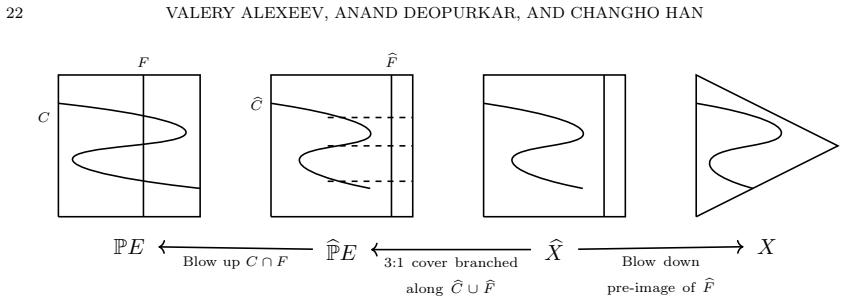
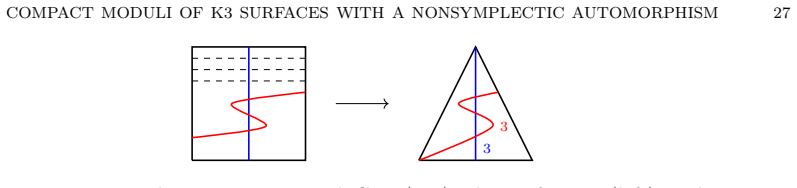
The load-bearing mechanism is the triple Tschirnhausen construction: starting from an admissible triple cover $C\to\mathbb{P}^1$ with marked points, one blows up the threefold $\mathbb{P}E$ at the marked fibers, takes a normalized cyclic triple cover branched over the proper transforms, and blows down the resulting $(-1)$-curves; the output is a Kulikov degeneration of K3 surfaces with an order-3 automorphism. This construction is shown to dominate the boundary of the period domain, so every boundary period is realized by such a degeneration. The other half of the machinery is the lattice of numerically Cartier divisors of a Type II Kulikov surface, which is identified with $J^\perp/J$ and, in the $\rho$-equivariant setting, with $J^\perp_{T_\rho}/J$; the period of the degeneration lives in $J^\perp_{T_\rho}/J \otimes_{\mathbb{Z}[\zeta_3]} E$. Running the minimal model program on the divisor $R$, the fixed curve of the automorphism, produces the unique KSBA stable limit, and comparing which periods give the same stable limit yields exactly the sublattices $F_J$ in Table 1. For order 4 the construction is simpler: an explicit degeneration of $\mathbb{P}^2$ to two quadric cones, pulled back by the cyclic quadruple cover, gives the Kulikov surface, and the same contraction argument gives $F_J = A_1^{\oplus2}$.
What would settle it
Choose the cusp of the $(0,1)$ family with root lattice $E_8\oplus E_6\oplus A_2$ and compute the KSBA stable limit directly for two one-parameter families whose periods differ only in the $E_6$-summand; the paper's argument predicts these limits are distinct, by the Torelli theorem for anti-canonical pairs, so if direct calculation produced isomorphic stable pairs the claimed semifan would be a strict lower bound and the dominance step in Proposition 6.14 would fail.
Extended reading notes
Core claim
The central claim, stated as Theorem 1.1, is that for the four maximal order-3 families the KSBA compactification $F^{\mathrm{KSBA}}_\rho$ is the semitoroidal compactification of the ball quotient $D_\rho/\Gamma_\rho$ with the semifan $F_J$ given in Table 1, and the paper proves this by splitting it into Theorems 7.1, 8.2, 9.3, and 10.5. The ambient lattice at a cusp is $J^\perp_{T_\rho}/J$, and the KSBA semifan is the saturation, or primitive closure, of the parenthesized $A_2$-summands, or zero where no summand is parenthesized. For $(n,k)=(0,2)$ this gives $F_J=0$, so the KSBA boundary is the toroidal boundary; for $(0,1)$, $(1,1)$, and $(2,1)$ the contracted directions are exactly the listed $A_2$ directions. Theorem 1.2 covers the order-4 case: the space of cyclic quadruple covers of $\mathbb{P}^2$ branched at a quartic has a unique cusp with $J^\perp_{T_\rho}/J=D_4^{\oplus2}\oplus A_1^{\oplus2}$, and the KSBA semifan is the $A_1^{\oplus2}$ summand, so the boundary contracts precisely the translates of $A_1^{\oplus2}\otimes_{\mathbb{Z}[i]}E$.
Load-bearing premise
The load-bearing premise is that every one-parameter degeneration near a cusp is produced by the triple Tschirnhausen construction for order 3, or by the stated degeneration model for order 4; if any degeneration is missed, the listed semifans would only be lower bounds on the true contractions.
Editorial extensions
If this is right
- For each of the four maximal order-3 families, the KSBA compactification and its boundary strata are now explicitly computable from Table 1; the boundary points are stable pairs whose isomorphism type is determined by the period restricted to the non-contracted lattice directions.
- In the $(n,k)=(0,2)$ case the KSBA and toroidal compactifications coincide, so the geometric boundary retains all of the period information of the toroidal boundary.
- In the order-4 case, the KSBA boundary over the unique cusp is a finite quotient of an abelian variety with the translates of $A_1^{\oplus2}\otimes_{\mathbb{Z}[i]}E$ contracted; this gives a complete description of the KSBA compactification of the moduli space of cyclic quadruple covers of $\mathbb{P}^2$ branched at a quartic.
- For the $(0,1)$ family, the quotient by the automorphism identifies the KSBA compactification with the compactification of stable log quadrics, so the boundary strata of the K3 moduli space match the geometrically defined boundary strata of that log-surface moduli space.
Reading between the lines
- An extension of the paper's method would restrict Table 1 to the remaining, non-maximal order-3 families; since those families arise from the four maximal ones by specialization, one expects their KSBA semifans to be governed by the same $A_2$-coded contractions, though the paper does not carry out this restriction.
- The pattern that the contracted directions are exactly the $A_2$-summands created by blowing up orbits of fixed points suggests a broader principle: for other cyclic automorphisms, the KSBA semifan may be determined by the root summands coming from such blow-ups, while the $E_6$ and $E_8$ summands inherited from del Pezzo surfaces remain uncontracted.
- A testable extension is to run the same Tschirnhausen-based stable-model computation on an order-3 family with $g\ge 2$ that is not maximal, and check whether the predicted restriction of Table 1 reproduces the actual contractions; a mismatch would pinpoint where the dominance of the boundary period map breaks down.
- The order-4 computation is explicitly ad hoc, so a natural next step is to adapt the triple-cover-style construction to cyclic quadruple covers branched along curves other than quartics, to see whether the $A_1^{\oplus2}$ contraction pattern persists or is special to this family.
Editorial analysis
A structured set of objections, weighed in public.
Referee Report
Summary. The paper studies moduli spaces of K3 surfaces carrying a purely non-symplectic automorphism of order 3 or 4 whose fixed locus contains a curve of genus at least 2. For the four maximal order-3 families with (n,k)=(0,2), (0,1), (1,1), (2,1) and for cyclic quadruple covers of P2 branched along a quartic, the authors identify the KSBA stable-pair compactification with an explicit semitoroidal compactification: the semifans are listed in Table 1 and Theorem 1.2 (FJ=A1^2 inside J-perp/J=D4^2+A1^2). The proof uses the general framework of [AEH24] to reduce KSBA compactifications to semitoroidal data, then computes the data via a new 'triple Tschirnhausen construction' relating degenerations of admissible triple covers to Type II Kulikov models, lattice computations, and the Torelli theorem for anti-canonical del Pezzo pairs.
Significance. If correct, this gives a complete and remarkably simple lattice-theoretic description of the boundary of these compactifications, and demonstrates that the KSBA boundary can be computed explicitly in nontrivial cases. The paper's main contribution is the identification of the exact semifan, not merely a lower bound, and the triple Tschirnhausen construction is an original and plausible computational tool. The lattice tables are detailed, and the logical architecture (reduction to boundary divisors, dominance via anti-canonical Torelli) is coherent. However, two load-bearing verifications are presented sketchily: the smoothness/K-triviality of the constructed order-4 Kulikov model in Proposition 4.8, and the generic finiteness/dominance statement for the order-3 case in Propositions 6.11 and 6.14. These gaps are localizable and appear fixable, but they should be completed before the theorems can be regarded as fully proved.
major comments (3)
- [§4.1, Proposition 4.8] Proposition 4.8, on which Theorem 4.10 and hence Theorem 1.2 rest, constructs a Kulikov model as a cyclic degree-4 cover of a singular threefold and concludes 'We leave it to the reader to verify that X is indeed smooth and K-trivial.' This is a load-bearing assertion: if the total space is singular or has nontrivial canonical class, the central fiber is not a genuine Type II Kulikov degeneration, and the period point psi used in Theorem 4.10 is not a period of a Kulikov degeneration. The earlier sentence 'It is easy to see that B subset ~Y can be smoothed' is part of the same gap. Smoothness of cyclic covers can fail when the branch locus is not transverse to the singular locus of the base, and K-triviality is not automatic for such covers. Please provide a complete verification, for example by local coordinate analysis near the double locus and the blown-up fibers, or by a precise reference covering this specific degeneration.
- [§6.3–6.4, Propositions 6.11 and 6.14] The exactness of all four order-3 semifans in Table 1 depends on the dominance statement of Proposition 6.14: without it, the computations in Sections 7–10 can only show that the listed sublattice is contained in the KSBA semifan. The proof of Proposition 6.14 reduces to Proposition 6.11, whose generic-finiteness argument is compressed. In particular, the case d=9 is dismissed as 'automatic', and the finiteness for blow-ups in Z/3Z-orbits is justified by 'only finitely many embeddings A2 to Lambda'. Since a failure of generic finiteness would leave the equality FJ = ... unproved, I ask that this argument be expanded to a complete proof, or that the missing finiteness statement be stated and proved as a separate lemma.
- [§10.3, Theorem 10.5] Theorem 10.5 lists the fourth cusp as (J-perp/J)_root = E8 + A2 with FJ = <A2>^sat, but Section 10.1, the table in Theorem 5.5, and Table 1 in the introduction all give this cusp as E8 + A2^2, and the proof in §10.3.4 concludes that FJ is the saturation of the complementary A2^2 summand. Please correct the statement of Theorem 10.5 (and any parallel statement in Theorem 1.1 or Table 1 if needed) so that the theorem, the table, and the proof are mutually consistent.
minor comments (5)
- [Table 1] The first data row of Table 1 prints (n,k) as (0,0); it should be (0,2).
- [Proof of Theorem 4.10] There is a typo in the expression 'A1^2 tensor Z[i]]E'; the stray bracket should be removed.
- [Section 5.3, Theorem 5.5] The notation R* for an index-3 overlattice is defined only after the theorem statement; it would be clearer to define it before or inside the statement.
- [Section 4.1, before Proposition 4.5] The sentence 'The pairs that give a type II surface correspond to those with reducible Y' is imprecise because only generic points of the locus Z are discussed; please clarify the genericity assumption.
- [Section 8.4] In Theorem 8.4 the map Y_rho to the Baily-Borel compactification is asserted to be regular; the surrounding text would benefit from a sentence explaining why this map is regular rather than merely rational.
Circularity Check
No circularity: the explicit KSBA semifans are derived from independent period, Torelli, and dimension arguments; the only flagged gap is an unproved smoothness/K-triviality check in Proposition 4.8, which is a correctness issue, not a circular one.
full rationale
The derivation of the KSBA semifans is not circular. The paper takes from [AEH24, Theorem 3.26] the structural fact that the KSBA compactification is a semitoroidal compactification with some semifan F, and then independently computes F by geometric analysis of Kulikov degenerations: Proposition 6.6 constructs Type II models from admissible triple covers; Proposition 6.9 computes root sublattices; Proposition 6.11 and Theorem 6.12 supply a Torelli/dominance statement for anti-canonical pairs; Proposition 6.14 transfers this dominance to the toroidal boundary. For each cusp, the authors exhibit which period translates are contracted by showing that the stable model depends only on certain del Pezzo period summands (e.g., the E6 summands in Sections 8.3.1 and 9.3.1) and by a dimension count in Theorem 4.10. The semifan values in Table 1 and Theorem 4.10 are outputs of these computations, not assumed inputs. The self-citations to [AEH24] are load-bearing but not circular: they are published structural theorems whose assumptions do not include the explicit semifan values being derived. The only flagged deficiency is in Proposition 4.8, where the proof of the order-4 Kulikov model says 'We leave it to the reader to verify that X is indeed smooth and K-trivial' and 'It is easy to see that B ⊂ ~Y can be smoothed to a divisor B ⊂ ~Y'. That is a correctness gap in the proof of Theorem 4.10, but it is not circular reasoning, so it does not raise the circularity score.
Assumptions & free parameters
assumptions (7)
- domain assumption The period map identifies the separated moduli space of rho-markable K3 surfaces with (D_rho minus Delta_rho)/Gamma_rho (Theorem 2.1, citing [AEH24]).
- domain assumption For (X,sigma) satisfying the genus-bound condition, the KSBA compactification F_KSBA is a semitoroidal compactification determined by a semifan ([AEH24, Theorem 3.26]).
- standard math Every one-parameter degeneration of K3 surfaces admits a Kulikov model, and type II models have the stated normal-crossing and lattice structure ([Kul77], [PP81], [FS86], [Kon85]).
- standard math Torelli theorem for rational surfaces with an anti-canonical cycle: an anti-canonical pair is determined up to isomorphism by its period from K-perp to Jac(D) (Theorem 6.12, based on [Loo81]).
- standard math Nikulin's classification of 2-elementary lattices and the uniqueness of the relevant order-3 and order-4 automorphisms of the K3 lattice ([Nik79], [AS08], [BH23]).
- standard math Casnati-Ekedahl structure theorem for triple covers and Pardini's abelian cover construction ([CE96], [Par91]).
- standard math The Hurwitz space of admissible triple covers is irreducible of the stated dimension and its boundary divisors have the stated dual graphs ([HM82], [RW06], [Deo14]).
Cite this review
Pith. "Pith review of Compactifications of moduli spaces of K3 surfaces with a higher-order nonsymplectic automorphism." pith.science (2026). https://pith.science/paper/IFOTL57F
@misc{pith2026241211256,
  author       = {Pith},
  title        = {Pith review of: Compactifications of moduli spaces of K3 surfaces with a higher-order nonsymplectic automorphism},
  year         = {2026},
  howpublished = {\url{https://pith.science/paper/IFOTL57F}},
  note         = {Machine review of arXiv:2412.11256}
}
abstract
We describe Baily-Borel, toroidal, and geometric -- using the KSBA stable pairs -- compactifications of some moduli spaces of K3 surfaces with a nonsymplectic automorphism of order $3$ and $4$ for which the fixed locus of the automorphism contains a curve of genus $\ge2$. For order $3$, we treat all the maximal-dimensional such families. We show that the toroidal and the KSBA compactifications in these cases admit simple descriptions in terms of certain $ADE$ root lattices.
Figures

Figures from the paper (21 more)


Forward citations
Cited by 1 Pith paper
-
Normal stable degenerations of Noether-Horikawa surfaces
Every Q-Gorenstein smoothable normal stable Horikawa surface falls into one of seven explicit families, and its global smoothability is controlled by a single local condition at its elliptic double cone singularities.
Reference graph
Works this paper leans on
-
[1]
Valery Alexeev and Philip Engel , Compactifications of moduli spaces of K3 surfaces with a nonsymplectic involution , arXiv e-prints (2022), arXiv:2208.10383
arXiv 2022
-
[2]
Valery Alexeev and Philip Engel, Compact moduli of K 3 surfaces , Ann. of Math. (2) 198 (2023), no. 2, 727--789
work page 2023
-
[3]
Valery Alexeev, Philip Engel, and Changho Han, Compact moduli of K 3 surfaces with a nonsymplectic automorphism , Trans. Amer. Math. Soc. Ser. B 11 (2024), 144--163
work page 2024
-
[4]
Valery Alexeev, Philip Engel, and Alan Thompson, Stable pair compactification of moduli of K 3 surfaces of degree 2 , J. Reine Angew. Math. 799 (2023), 1--56
work page 2023
-
[5]
Avner Ash, David Mumford, Michael Rapoport, and Yung-Sheng Tai, Smooth compactifications of locally symmetric varieties, second ed., Cambridge Mathematical Library, Cambridge University Press, Cambridge, 2010, With the collaboration of Peter Scholze
work page 2010
-
[6]
Michela Artebani, A compactification of \( M _ 3 \) via \(K3\) surfaces , Nagoya Math. J. 196 (2009), 1--26 (English)
work page 2009
-
[7]
Michela Artebani and Alessandra Sarti, Non-symplectic automorphisms of order 3 on K3 surfaces , Math. Ann. 342 (2008), no. 4, 903--921
work page 2008
-
[8]
W. L. Baily, Jr. and A. Borel, Compactification of arithmetic quotients of bounded symmetric domains, Ann. of Math. (2) 84 (1966), 442--528
work page 1966
Show all 40 references
-
[9]
Sigma 11 (2023), 57 (English), Id/No e54
Simon Brandhorst and Tommy Hofmann, Finite subgroups of automorphisms of \(K3\) surfaces , Forum Math. Sigma 11 (2023), 57 (English), Id/No e54
2023
-
[10]
Gianfranco Casnati and Torsten Ekedahl, Covers of algebraic varieties. I . A general structure theorem, covers of degree 3,4 and E nriques surfaces , J. Algebraic Geom. 5 (1996), no. 3, 439--460
1996
-
[11]
Conference on compact moduli and vector bundles, University of Georgia, Athens, GA, USA, October 21--24, 2010, Providence, RI: American Mathematical Society (AMS), 2012, pp
Sebastian Casalaina-Martin, David Jensen, and Radu Laza, The geometry of the ball quotient model of the moduli space of genus four curves, Compact moduli spaces and vector bundles. Conference on compact moduli and vector bundles, University of Georgia, Athens, GA, USA, October...
2010
-
[12]
J. H. Conway and N. J. A. Sloane, Sphere packings, lattices and groups. With additional contributions by E . Bannai , R . E . Borcherds , J . Leech , S . P . Norton , A . M . Odlyzko , R . A . Parker , L . Queen and B . B . Venkov . , 3rd ed. ed., Grundlehren Math. Wiss., vol....
1999
-
[13]
Anand Deopurkar, Compactifications of H urwitz spaces , Int. Math. Res. Not. IMRN (2014), no. 14, 3863--3911
2014
-
[14]
Anand Deopurkar and Changho Han, Stable log surfaces, admissible covers, and canonical curves of genus 4, Trans. Am. Math. Soc. 374 (2021), no. 1, 589--641 (English)
2021
-
[15]
Dolgachev and Shigeyuki Kond\= o , Moduli of K3 surfaces and complex ball quotients , Arithmetic and geometry around hypergeometric functions, Progr
Igor V. Dolgachev and Shigeyuki Kond\= o , Moduli of K3 surfaces and complex ball quotients , Arithmetic and geometry around hypergeometric functions, Progr. Math., vol. 260, Birkh\" a user, Basel, 2007, pp. 43--100
2007
-
[16]
I. V. Dolgachev, Mirror symmetry for lattice polarized K3 surfaces , J. Math. Sci. 81 (1996), no. 3, 2599--2630, Algebraic geometry, 4
1996
-
[17]
Robert Friedman and Rick Miranda, Smoothing cusp singularities of small length, Math. Ann. 263 (1983), no. 2, 185--212
1983
-
[18]
Robert Friedman and Francesco Scattone, Type III degenerations of K3 surfaces , Invent. Math. 83 (1986), no. 1, 1--39
1986
-
[19]
Paul Hacking, Compact moduli of plane curves, Duke Math. J. 124 (2004), no. 2, 213--257 (English)
2004
-
[20]
Joe Harris and David Mumford, On the Kodaira dimension of the moduli space of curves , Invent. Math. 67 (1982), 23--86 (English)
1982
-
[21]
231, Cambridge University Press, Cambridge, 2023, With the collaboration of Klaus Altmann and S \'a ndor J
J \'a nos Koll \'a r, Families of varieties of general type, Cambridge Tracts in Mathematics, vol. 231, Cambridge University Press, Cambridge, 2023, With the collaboration of Klaus Altmann and S \'a ndor J. Kov \'a cs
2023
-
[22]
Shigeyuki Kond \=o , Type II degenerations of K3 surfaces , Nagoya Math. J. 99 (1985), 11--30. 805078
1985
-
[23]
89 (1993), no
, On the K odaira dimension of the moduli space of K3 surfaces , Compositio Math. 89 (1993), no. 3, 251--299. 1255698
1993
-
[24]
Reine Angew
, A complex hyperbolic structure for the moduli space of curves of genus three, J. Reine Angew. Math. 525 (2000), 219--232 (English)
2000
-
[25]
, Algebraic geometry 2000, Azumino
, The moduli space of curves of genus 4 and Deligne - Mostow 's complex reflection groups. , Algebraic geometry 2000, Azumino. Proceedings of the symposium, Nagano, Japan, July 20--30, 2000, Tokyo: Mathematical Society of Japan, 2002, pp. 383--400 (English)
2000
-
[26]
Vik. S. Kulikov, Degenerations of K3 surfaces and E nriques surfaces , Izv. Akad. Nauk SSSR Ser. Mat. 41 (1977), no. 5, 1008--1042, 1199
1977
-
[27]
J \'a nos Koll \'a r and Chen Yang Xu, Moduli of polarized C alabi- Y au pairs , Acta Math. Sin. (Engl. Ser.) 36 (2020), no. 6, 631--637
2020
-
[28]
Radu Laza, The KSBA compactification for the moduli space of degree two K3 pairs , J. Eur. Math. Soc. (JEMS) 18 (2016), no. 2, 225--279
2016
-
[29]
Eduard Looijenga, Rational surfaces with an anti-canonical cycle, Ann. Math. (2) 114 (1981), 267--322 (English)
1981
-
[30]
, Compactifications defined by arrangements. II . L ocally symmetric varieties of type IV , Duke Math. J. 119 (2003), no. 3, 527--588. 2003125
2003
-
[31]
McMullen, Dynamics on blowups of the projective plane, Publ
Curtis T. McMullen, Dynamics on blowups of the projective plane, Publ. Math. Inst. Hautes \' E tudes Sci. (2007), no. 105, 49--89
2007
-
[32]
Math., vol
Ngaiming Mok, Projective algebraicity of minimal compactifications of complex-hyperbolic space forms of finite volume, Perspectives in analysis, geometry, and topology, Progr. Math., vol. 296, Birkh\" a user/Springer, New York, 2012, pp. 331--354
2012
-
[33]
Shouhei Ma, Hisanori Ohashi, and Shingo Taki, Rationality of the moduli spaces of E isenstein K3 surfaces , Trans. Amer. Math. Soc. 367 (2015), no. 12, 8643--8679. 3403068
2015
-
[34]
V. V. Nikulin, Integer symmetric bilinear forms and some of their geometric applications, Izv. Akad. Nauk SSSR Ser. Mat. 43 (1979), no. 1, 111--177, 238
1979
-
[35]
Reine Angew
Rita Pardini, Abelian covers of algebraic varieties, J. Reine Angew. Math. 417 (1991), 191--213
1991
-
[36]
Ulf Persson and Henry Pinkham, Degeneration of surfaces with trivial canonical bundle, Ann. of Math. (2) 113 (1981), no. 1, 45--66
1981
-
[37]
A. N. Rudakov and I. R. Shafarevich, Surfaces of type K3 over fields of finite characteristic , Current problems in mathematics, V ol. 18, Itogi Nauki i Tekhniki, Akad. Nauk SSSR, Vsesoyuz. Inst. Nauchn. i Tekhn. Inform., Moscow, 1981, pp. 115--207
1981
-
[38]
313--341 (English)
Matthieu Romagny and Stefan Wewers, Hurwitz spaces, Groupes de Galois arithm\'etique et diff\'erentiels, Paris: Soci \'e t \'e Math \'e matique de France, 2006, pp. 313--341 (English)
2006
-
[39]
Francesco Scattone, On the compactification of moduli spaces for algebraic K3 surfaces , Mem. Amer. Math. Soc. 70 (1987), no. 374, x+86
1987
-
[40]
Shingo Taki, Classification of non-symplectic automorphisms of order 3 on K3 surfaces , Math. Nachr. 284 (2011), no. 1, 124--135
2011
Reviewed August 11, 2026 · model on record in the stance chip above.
Discussion (0). Continue with ORCID to comment.